Polarization-Aware DoA Detection Relying on a Single Rydberg Atomic Receiver
Pith reviewed 2026-05-18 22:07 UTC · model grok-4.3
The pith
A single Rydberg atomic vapor cell resolves incoming radio wave direction to sub-0.1° by sensing electric and magnetic field vectors sequentially.
A machine-rendered reading of the paper's core claim, the machinery that carries it, and where it could break.
Core claim
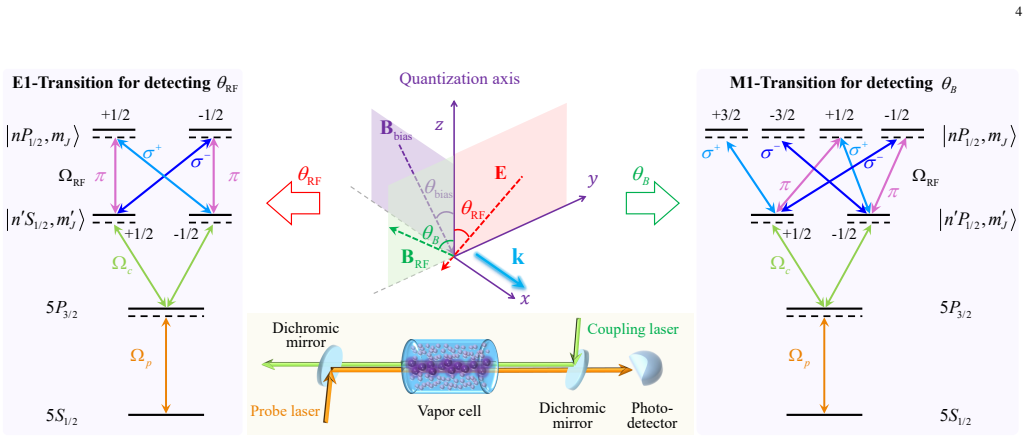
In the presence of a static magnetic bias field defining a quantization axis, a pair of sequential EIT measurements in the same vapor cell extracts the electric-field polarization angle from Zeeman-resolved peaks on an electric-dipole transition and the RF magnetic-field orientation from peaks on a magnetic-dipole transition. The scheme yields independent sensitivities to both angles, enabling DoA reconstruction. The authors derive the quantum Fisher-information matrix and a closed-form quantum Cramér-Rao bound for joint estimation of the angles, with simulations validating sub-0.1° resolution under suitable polarization and magnetic-field geometries at moderate RF driving strengths.
What carries the argument
Sequential EIT measurements on electric-dipole and magnetic-dipole transitions within the same vapor cell under a shared quantization axis, which decouples extraction of polarization angle from magnetic orientation.
If this is right
- The dual sensitivity allows precise DoA reconstruction from a single cell without spatial diversity or phase referencing.
- The quantum Fisher-information matrix yields a closed-form QCRB for joint estimation of the polarization and orientation angles.
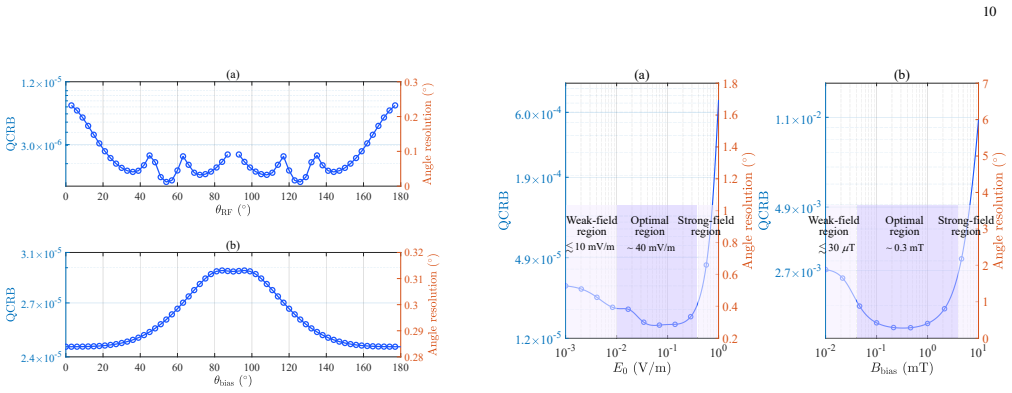
- Simulations identify optimal polarization and magnetic-field geometries that achieve sub-0.1° resolution at moderate RF strengths.
- The method operates across various quantum parameters while remaining independent on the two angles.
Where Pith is reading between the lines
- Compact single-cell receivers of this type could reduce hardware size in direction-finding systems for communications or radar.
- The sequential measurement principle might extend to sensing vector properties of other electromagnetic or acoustic fields.
- Testing performance under time-varying fields or in the presence of noise sources not modeled in the simulations would clarify practical limits.
Load-bearing premise
The two sequential EIT measurements can independently and stably extract the electric polarization angle and magnetic orientation without cross-interference or instability in the quantization axis.
What would settle it
An experiment in which the joint angle resolution under the proposed geometries and moderate RF strengths falls short of the derived sub-0.1° QCRB or shows measurable cross-talk between the electric and magnetic channels.
Figures




read the original abstract
A polarization-aware direction-of-arrival (DoA) detection scheme is conceived that leverages the intrinsic vector sensitivity of a single Rydberg atomic vapor cell to achieve quantum-enhanced angle resolution. Our core idea lies in the fact that the vector nature of an electromagnetic wave is uniquely determined by its orthogonal electric and magnetic field components, both of which can be retrieved by a single Rydberg atomic receiver via electromagnetically induced transparency (EIT)-based spectroscopy. To be specific, in the presence of a static magnetic bias field that defines a stable quantization axis, a pair of sequential EIT measurements is carried out in the same vapor cell. Firstly, the electric-field polarization angle is extracted from the Zeeman-resolved EIT spectrum associated with an electric-dipole transition driven by the radio frequency (RF) field. Within the same experimental cycle, the RF field is then retuned to a magnetic-dipole resonance, producing Zeeman-resolved EIT peaks for decoding the RF magnetic-field orientation. This scheme exhibits a dual yet independent sensitivity on both angles, allowing for precise DoA reconstruction without the need for spatial diversity or phase referencing. Building on this foundation, we derive the quantum Fisher-information matrix (QFIM) and obtain a closed-form quantum Cram\'{e}r-Rao bound (QCRB) for the joint estimation of polarization and orientation angles. Finally, simulation results spanning various quantum parameters validate the proposed approach and identify optimal operating regimes. With appropriately chosen polarization and magnetic-field geometries, a single vapor cell is expected to achieve sub-0.1$^\circ$ angle resolution at moderate RF-field driving strengths.
Editorial analysis
A structured set of objections, weighed in public.
Referee Report
Summary. The paper proposes a polarization-aware DoA detection scheme that uses a single Rydberg atomic vapor cell. A static magnetic bias field defines the quantization axis for two sequential EIT measurements in the same cell: the first extracts the RF electric-field polarization angle from a Zeeman-resolved electric-dipole transition, while the second retunes to a magnetic-dipole resonance to decode the RF magnetic-field orientation. The quantum Fisher-information matrix is derived to obtain a closed-form QCRB on the joint estimation of the two angles, and simulations are used to identify operating regimes that achieve sub-0.1° resolution.
Significance. If the independence assumptions hold, the work offers a compact, single-cell alternative to spatially diverse arrays for quantum-enhanced DoA sensing by exploiting the vector character of the EM wave. The closed-form QCRB and parameter-sweep simulations constitute a concrete theoretical contribution that can guide future experiments.
major comments (2)
- [Section III] Section III (scheme description): the derivation of the joint QCRB rests on the assumption that the static bias field remains an unchanging quantization axis and that retuning the RF drive from the electric-dipole to the magnetic-dipole resonance introduces neither transient population transfer nor residual RF cross-talk. No quantitative bound is given on the tolerable level of residual RF amplitude or bias-field drift (e.g., 1 mG or 1 % residual field) that would keep the off-diagonal QFIM blocks negligible.
- [Section IV] Section IV (QFIM derivation): the block-diagonal structure of the QFIM that yields the quoted sub-0.1° resolution is obtained only under the independence assumption stated above. A sensitivity analysis showing how even modest coupling (a few percent residual RF or small bias drift) inflates the joint CRB would be required to substantiate the central performance claim.
minor comments (2)
- [Figures 3–5] Figure captions and simulation-parameter tables should explicitly list the range of Rabi frequencies, detunings, and atomic densities used to generate the sub-0.1° curves.
- [Section III] A short paragraph clarifying the experimental cycle timing (duration of each EIT scan and retuning interval) would help readers assess the practical feasibility of the sequential protocol.
Simulated Author's Rebuttal
We thank the referee for the constructive and detailed comments. We agree that the independence assumptions in the QCRB derivation merit further quantification and have revised the manuscript to incorporate the requested bounds and sensitivity analysis. Point-by-point responses follow.
read point-by-point responses
-
Referee: [Section III] Section III (scheme description): the derivation of the joint QCRB rests on the assumption that the static bias field remains an unchanging quantization axis and that retuning the RF drive from the electric-dipole to the magnetic-dipole resonance introduces neither transient population transfer nor residual RF cross-talk. No quantitative bound is given on the tolerable level of residual RF amplitude or bias-field drift (e.g., 1 mG or 1 % residual field) that would keep the off-diagonal QFIM blocks negligible.
Authors: We acknowledge that the closed-form QCRB derivation relies on ideal retuning with negligible transients and cross-talk. In the revised manuscript we have added a perturbative analysis in Section III that supplies explicit bounds: residual RF amplitudes below 1 % and bias-field drifts below 1 mG keep off-diagonal QFIM elements below 5 % of the diagonal terms, thereby preserving the reported performance. revision: yes
-
Referee: [Section IV] Section IV (QFIM derivation): the block-diagonal structure of the QFIM that yields the quoted sub-0.1° resolution is obtained only under the independence assumption stated above. A sensitivity analysis showing how even modest coupling (a few percent residual RF or small bias drift) inflates the joint CRB would be required to substantiate the central performance claim.
Authors: We agree that a sensitivity study is needed to substantiate robustness. The revised Section IV now includes a numerical sensitivity analysis demonstrating that couplings up to 5 % increase the joint CRB by at most 25 %, still permitting sub-0.2° resolution in the optimal geometries. This confirms the practical relevance of the scheme under realistic imperfections. revision: yes
Circularity Check
No significant circularity; QCRB follows from standard QFIM derivation
full rationale
The paper's core derivation proceeds from the physical model of sequential EIT measurements on electric- and magnetic-dipole transitions (Section III) to the explicit construction of the quantum Fisher information matrix and its closed-form QCRB (Section IV). This follows the standard quantum estimation theory pipeline with no reduction of the bound to fitted parameters, no self-definitional loops, and no load-bearing reliance on prior self-citations that would make the angle-resolution claim tautological. The sub-0.1° figure is presented as a consequence of the derived bound under chosen geometries, not as an input renamed as output. The derivation remains self-contained against external quantum-information benchmarks.
Axiom & Free-Parameter Ledger
axioms (1)
- domain assumption The vector nature of an electromagnetic wave is uniquely determined by its orthogonal electric and magnetic field components.
Reference graph
Works this paper leans on
-
[1]
Quantum information process- ing, sensing, and communications: Their myths, realities, and futures,
L. Hanzo, Z. Babar, Z. Cai, D. Chandra, I. B. Djordjevic, B. Koczor, S. X. Ng, M. Razavi, and O. Simeone, “Quantum information process- ing, sensing, and communications: Their myths, realities, and futures,” Proc. IEEE, to appear, 2025
work page 2025
-
[2]
Rydberg atomic quantum receivers for classical wireless communication and sensing,
T. Gong, A. Chandra, C. Yuen, Y . L. Guan, R. Dumke, C. M. S. See, M. Debbah, and L. Hanzo, “Rydberg atomic quantum receivers for classical wireless communication and sensing,” IEEE Wirel. Commun., to appear, 2025
work page 2025
-
[3]
N. Schlossberger, N. Prajapati, S. Berweger, A. P. Rotunno, A. B. Artusio-Glimpse, M. T. Simons, A. A. Sheikh, E. B. Norrgard, S. P. Eckel, and C. L. Holloway, “Rydberg states of alkali atoms in atomic vapour as SI-traceable field probes and communications receivers,” Nat. Rev. Phys., Sep. 2024
work page 2024
-
[4]
Rydberg atom electric field sensors for communications and sensing,
C. T. Fancher, D. R. Scherer, M. C. S. John, and B. L. S. Marlow, “Rydberg atom electric field sensors for communications and sensing,” IEEE Trans. Quantum Eng. , vol. 2, pp. 1–13, Mar. 2021
work page 2021
-
[5]
C. L. Degen, F. Reinhard, and P. Cappellaro, “Quantum sensing,” Rev. Mod. Phys., vol. 89, p. 035002, Jul. 2017
work page 2017
-
[6]
Approaching the standard quantum limit of a Rydberg-atom microwave electrometer,
H.-T. Tu, K.-Y . Liao, H.-L. Wang, Y .-F. Zhu, S.-Y . Qiu, H. Jiang, W. Huang, W. Bian, H. Yan, and S.-L. Zhu, “Approaching the standard quantum limit of a Rydberg-atom microwave electrometer,” Sci. Adv., vol. 10, no. 51, p. eads0683, Dec. 2024
work page 2024
-
[7]
Resonant structures for sensitivity enhancement of Rydberg-atom microwave receivers,
G. Sandidge, G. Santamaria-Botello, E. Bottomley, H. Fan, and Z. Popovi ´c, “Resonant structures for sensitivity enhancement of Rydberg-atom microwave receivers,” IEEE Trans. Microwave Theory Tech., vol. 72, no. 4, pp. 2057–2066, Apr. 2024
work page 2057
-
[8]
Microwave electrometry with Rydberg atoms in a vapour cell using bright atomic resonances,
J. A. Sedlacek, A. Schwettmann, H. K ¨ubler, R. L ¨ow, T. Pfau, and J. P. Shaffer, “Microwave electrometry with Rydberg atoms in a vapour cell using bright atomic resonances,” Nat. Phys., vol. 8, no. 11, pp. 819–824, Nov. 2012
work page 2012
-
[9]
A. P. Rotunno, C. L. Holloway, N. Prajapati, S. Berweger, A. B. Artusio- Glimpse, R. Brown, M. Simons, A. K. Robinson, B. N. Kayim, M. A. Viray, J. F. Jones, B. C. Sawyer, R. Wyllie, T. Walker, R. W. Ziolkowski, S. R. Jefferts, S. Geibel, J. Wheeler, and E. Imhof, “Investigating electromagnetically induced transparency spectral lineshape distortion due to...
work page 2023
-
[10]
Deep learning enhanced Rydberg multifrequency microwave recognition,
Z.-K. Liu, L.-H. Zhang, B. Liu, Z.-Y . Zhang, G.-C. Guo, D.-S. Ding, and B.-S. Shi, “Deep learning enhanced Rydberg multifrequency microwave recognition,” Nat. Commun., vol. 13, no. 1, p. 1997, Apr. 2022
work page 1997
-
[11]
R. Mao, Y . Lin, A. Zhou, K. Yang, and Y . Fu, “Shortwave ultrahigh- sensitivity Rydberg atomic electric field sensing based on a subminiature resonator,” IEEE Trans. Antennas Propag. , vol. 72, no. 11, pp. 8165– 8172, Nov. 2024
work page 2024
-
[12]
Towards atomic MIMO receivers,
M. Cui, Q. Zeng, and K. Huang, “Towards atomic MIMO receivers,” IEEE J. Sel. Areas Commun. , vol. 43, no. 3, pp. 659–673, Mar. 2025
work page 2025
-
[13]
Atom- based vector microwave electrometry using Rubidium Rydberg atoms in a vapor cell,
J. A. Sedlacek, A. Schwettmann, H. K ¨ubler, and J. P. Shaffer, “Atom- based vector microwave electrometry using Rubidium Rydberg atoms in a vapor cell,” Phys. Rev. Lett., vol. 111, p. 063001, Aug 2013
work page 2013
-
[14]
Precise measurement of microwave polarization using a Rydberg atom-based mixer,
Y . Wang, F. Jia, J. Hao, Y . Cui, F. Zhou, X. Liu, J. Mei, Y . Yu, Y . Liu, J. Zhang, F. Xie, and Z. Zhong, “Precise measurement of microwave polarization using a Rydberg atom-based mixer,” Opt. Express, vol. 31, no. 6, pp. 10 449–10 457, Mar. 2023
work page 2023
-
[15]
Optimal state choice for Rydberg-atom microwave sensors,
A. Chopinaud and J. Pritchard, “Optimal state choice for Rydberg-atom microwave sensors,” Phys. Rev. Appl., vol. 16, p. 024008, Aug. 2021
work page 2021
-
[16]
Polarization-insensitive microwave electrometry using Rydberg atoms,
M. Cloutman, M. Chilcott, A. Elliott, J. S. Otto, A. B. Deb, and N. Kjærgaard, “Polarization-insensitive microwave electrometry using Rydberg atoms,” Phys. Rev. Appl., vol. 21, p. 044025, Apr. 2024
work page 2024
-
[17]
Vector magnetometry based on electromagnetically induced transparency in linearly polarized light,
V . I. Yudin, A. V . Taichenachev, Y . O. Dudin, V . L. Velichansky, A. S. Zibrov, and S. A. Zibrov, “Vector magnetometry based on electromagnetically induced transparency in linearly polarized light,” Phys. Rev. A, vol. 82, p. 033807, Sep. 2010
work page 2010
-
[18]
K. Cox, V . I. Yudin, A. V . Taichenachev, I. Novikova, and E. E. Mikhailov, “Measurements of the magnetic field vector using multiple electromagnetically induced transparency resonances in Rb vapor,” Phys. Rev. A, vol. 83, p. 015801, Jan. 2011
work page 2011
-
[19]
Atomic superheterodyne receiver based on microwave-dressed Rydberg spectroscopy,
M. Jing, Y . Hu, J. Ma, H. Zhang, L. Zhang, L. Xiao, and S. Jia, “Atomic superheterodyne receiver based on microwave-dressed Rydberg spectroscopy,” Nat. Phys., vol. 16, no. 9, pp. 911–915, Jun. 2020
work page 2020
-
[20]
A Rydberg atom-based mixer: Measuring the phase of a radio frequency wave,
M. T. Simons, A. H. Haddab, J. A. Gordon, and C. L. Holloway, “A Rydberg atom-based mixer: Measuring the phase of a radio frequency wave,” Appl. Phys. Lett. , vol. 114, no. 11, p. 114101, Mar. 2019
work page 2019
-
[21]
Linear dynamic range of a Rydberg- atom microwave superheterodyne receiver,
F. Wu, Q. An, Z. Sun, and Y . Fu, “Linear dynamic range of a Rydberg- atom microwave superheterodyne receiver,” Phys. Rev. A , vol. 107, p. 043108, Apr. 2023
work page 2023
-
[22]
Harnessing Rydberg atomic receivers: From quantum physics to wireless communications,
Y . Chen, X. Guo, C. Yuen, Y . Zhao, Y . L. Guan, C. M. S. See, M. D ´ebbah, and L. Hanzo, “Harnessing Rydberg atomic receivers: From quantum physics to wireless communications,” arXiv preprint: 2501.11842, 2025. [Online]. Available: https://arxiv.org/abs/2501.11842
-
[23]
T. Gong, J. Sun, C. Yuen, G. Hu, Y . Zhao, Y . L. Guan, C. M. S. See, M. Debbah, and L. Hanzo, “Rydberg atomic quantum receivers for classical wireless communications and sensing: Their models and performance,” arXiv preprint: 2412.05554 , 2024. [Online]. Available: https://arxiv.org/abs/2412.05554
-
[24]
Theory of dark resonances for alkali-metal vapors in a buffer-gas cell,
A. V . Ta ˘ıchenachev, V . I. Yudin, R. Wynands, M. St¨ahler, J. Kitching, and L. Hollberg, “Theory of dark resonances for alkali-metal vapors in a buffer-gas cell,” Phys. Rev. A, vol. 67, p. 033810, Mar 2003
work page 2003
-
[25]
X. Li, Y . Cui, J. Hao, F. Zhou, Y . Wang, F. Jia, J. Zhang, F. Xie, and Z. Zhong, “Magnetic-field-induced splitting of Rydberg Electromagnet- ically Induced Transparency and Autler-Townes spectra in 87Rb vapor cell,” Opt. Express, vol. 31, no. 23, pp. 38 165–38 178, Nov. 2023
work page 2023
-
[26]
Determining the angle-of-arrival of a radio-frequency source with a Rydberg atom-based sensor,
A. K. Robinson, N. Prajapati, D. Senic, M. T. Simons, and C. L. Holloway, “Determining the angle-of-arrival of a radio-frequency source with a Rydberg atom-based sensor,” Appl. Phys. Lett. , vol. 118, no. 11, p. 114001, Mar. 2021
work page 2021
-
[27]
Quantum-MUSIC: Multiple signal classification for quantum wireless sensing,
H. Kim, H. Park, and S. Kim, “Quantum-MUSIC: Multiple signal classification for quantum wireless sensing,” IEEE Wireless Commun. Lett., to appear, 2025
work page 2025
-
[28]
R. Talashila, W. J. Watterson, B. L. Moser, J. A. Gordon, A. B. Artusio-Glimpse, N. Prajapati, N. Schlossberger, M. T. Simons, and C. L. Holloway, “Determining angle of arrival of radio frequency fields using subwavelength, amplitude-only measurements of standing waves in a Rydberg atom sensor,” arXiv preprint: 2502.09835 , 2025. [Online]. Available: http...
-
[29]
Rydberg atomic quantum receivers for multi-target DOA estimation,
T. Gong, C. Yuen, C. M. S. See, M. Debbah, and L. Hanzo, “Rydberg atomic quantum receivers for multi-target DOA estimation,” arXiv preprint: 2501.02820 , 2025. [Online]. Available: https://arxiv.org/abs/ 2501.02820
-
[30]
Enhancing sensitivity of atomic microwave receivers based on optimal laser arrays,
B. Wu, R. Mao, D. Sang, Z. Sun, Y . Liu, Y . Lin, Q. An, and Y . Fu, “Enhancing sensitivity of atomic microwave receivers based on optimal laser arrays,” IEEE Trans. Antennas Propag. , vol. 73, no. 2, pp. 793– 806, Feb. 2025
work page 2025
-
[31]
QuTiP: An open-source Python framework for the dynamics of open quantum systems,
J. R. Johansson, P. D. Nation, and F. Nori, “QuTiP: An open-source Python framework for the dynamics of open quantum systems,” Comp. Phys. Comm., vol. 183, no. 8, pp. 1760–1772, Apr. 2012
work page 2012
-
[32]
Cramer-Rao bounds for antenna array design,
H. Gazzah and S. Marcos, “Cramer-Rao bounds for antenna array design,” IEEE Trans. Signal Process. , vol. 54, no. 1, pp. 336–345, Jan. 2006
work page 2006
-
[33]
Vector-sensor array processing for electro- magnetic source localization,
A. Nehorai and E. Paldi, “Vector-sensor array processing for electro- magnetic source localization,” IEEE Trans. Signal Process. , vol. 42, no. 2, pp. 376–398, Feb. 1994
work page 1994
-
[34]
Zeeman effect in parabolic quantum dots,
R. Rinaldi, P. V . Giugno, R. Cingolani, H. Lipsanen, M. Sopanen, J. Tulkki, and J. Ahopelto, “Zeeman effect in parabolic quantum dots,” Phys. Rev. Lett., vol. 77, pp. 342–345, Jul 1996
work page 1996
-
[35]
Wigner-eckart theorem and simple lie groups,
J. Ginibre, “Wigner-eckart theorem and simple lie groups,” J. Math. Phys., vol. 4, no. 5, pp. 720–726, May 1963
work page 1963
-
[36]
Tables of Clebsch-Gordan coeffi- cients of s u3,
P. McNamee, S. J., and F. Chilton, “Tables of Clebsch-Gordan coeffi- cients of s u3,” Rev. Mod. Phys., vol. 36, pp. 1005–1024, Sep. 1964
work page 1964
-
[37]
A. J. Stone, “Wigner 3j, 6j, and 9j symbols.” [Online]. Available: https://www-stone.ch.cam.ac.uk/wigner.shtml
-
[38]
Trap-induced AC Zeeman shift of the Thorium-229 nuclear clock frequency,
K. Beloy, “Trap-induced AC Zeeman shift of the Thorium-229 nuclear clock frequency,” Phys. Rev. Lett., vol. 130, p. 103201, Mar 2023
work page 2023
-
[39]
Simple expression for the quantum Fisher information matrix,
D. ˇSafr´anek, “Simple expression for the quantum Fisher information matrix,” Phys. Rev. A, vol. 97, p. 042322, Apr. 2018
work page 2018
-
[40]
Quantum Fisher information from randomized measurements,
A. Rath, C. Branciard, A. Minguzzi, and B. Vermersch, “Quantum Fisher information from randomized measurements,” Phys. Rev. Lett. , vol. 127, p. 260501, Dec. 2021
work page 2021
-
[41]
Quantum-enhanced mea- surements: beating the standard quantum limit,
V . Giovannetti, S. Lloyd, and L. Maccone, “Quantum-enhanced mea- surements: beating the standard quantum limit,” Science, vol. 306, no. 5700, pp. 1330–1336, Nov. 2004
work page 2004
-
[42]
Comparison of noise temperature of Rydberg-atom and electronic microwave receivers,
G. Santamaria-Botello, S. Verploegh, E. Bottomley, and Z. Popovic, “Comparison of noise temperature of Rydberg-atom and electronic microwave receivers,” arXiv preprint: 2209.00908 , 2022. [Online]. Available: https://arxiv.org/abs/2209.00908
discussion (0)
Sign in with ORCID, Apple, or X to comment. Anyone can read and Pith papers without signing in.