REVIEW 3 major objections 4 minor 19 references
Eigenvalues of Maximal Abelian Covers
T0 review · 3 major / 4 minor · reviewed 2026-08-15 · deepseek-v4-flash
Pith's one-line read This paper gives a complete combinatorial description of the eigenvalues of a maximal abelian cover, and proves that regular base graphs have none.
desk verdict Returns a clean criterion and proves a long-open conjecture for regular graphs of degree at least 2, but the main theorem as stated is false for degree 0 and 1—a cheap fix. read the letter →
The pith
A machine-rendered reading of the paper's core claim, the machinery that carries it, and where it could break.
The reading
What carries the argument
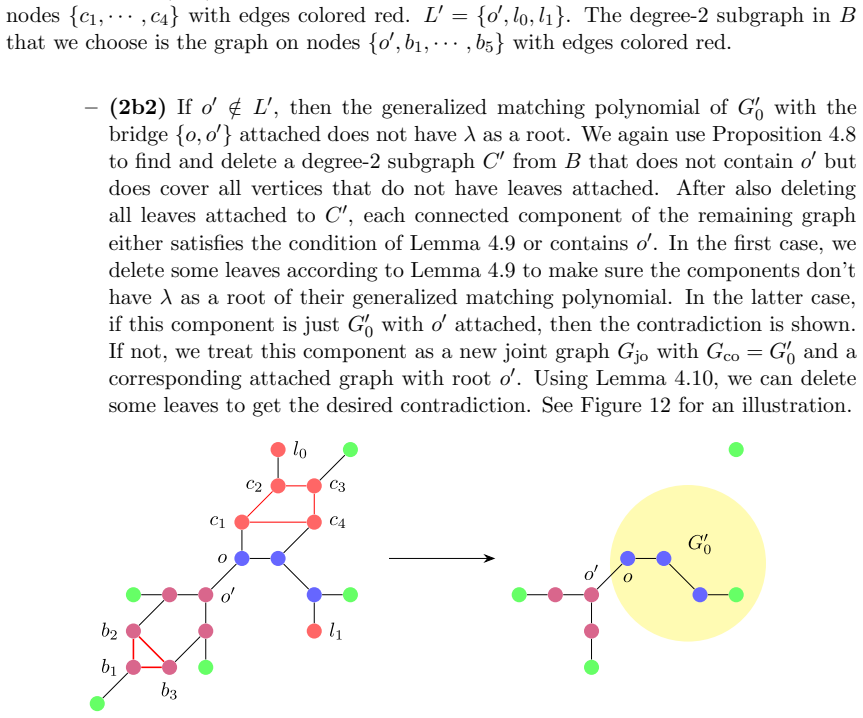
The load-bearing object is the generalized matching polynomial m^H_G, a weighted sum over matchings, together with the set of oriented degree-2 subgraphs. Proposition 3.8 expands det(λI − H(z)) as a trigonometric polynomial whose coefficients are exactly m^H_{G\γ}, and orthogonality of the characters z^γ in $L^{2}$($T^{{|E|}}$) forces every coefficient to vanish, yielding the criterion of Theorem 1.1. The proof of Theorem 1.2 rests on Proposition 4.8, which uses a degree-correction construction and a 2-factor theorem to build degree-2 subgraphs covering all high-degree vertices in bridge-less blocks of a regular graph, and on two lemmas that eliminate matching-polynomial roots by deleting leaves.
What would settle it
For a fixed small regular multi-graph G with bridges, the criterion of Theorem 1.1 makes the question finite: enumerate every degree-2 subgraph γ, compute the generalized matching polynomials m^H_{G\γ}, and check whether their root sets share a real number. A shared root would be an eigenvalue of Hab by the paper's own criterion, refuting Theorem 1.2. A natural candidate class to search is odd-regular multi-graphs assembled from several bridge-blocks, where Proposition 4.8 is the inductive engine.
Extended reading notes
Core claim
The central discovery is a complete characterization: for a finite multi-graph G and a Schrödinger operator H, a real number λ is an eigenvalue of the maximal abelian cover Hab if and only if for every degree-2 subgraph γ, λ is a root of the generalized matching polynomial m^H_{G\γ} of the graph obtained by deleting γ. This is Theorem 1.1, and it solves the Higuchi–Nomura problem. The paper then derives its main theorem: if G is regular, then Hab has no eigenvalues, confirming the corresponding conjecture. An appendix shows that whenever the universal cover has an eigenvalue according to the Banks–Garza-Vargas–Mukherjee criterion, the same value is also an eigenvalue of Hab.
Load-bearing premise
The argument's load-bearing premise is that the degree-correction operation in Proposition 4.8 never creates a bridge where none existed; the paper says this is straightforward to check, and if it fails for some arrangement of multi-edges or self-loops, the induction breaks.
Editorial extensions
If this is right
- If G is even regular, Petersen's theorem supplies a 2-factor, so Theorem 1.1 immediately rules out eigenvalues; the new content lies in the odd-regular, bridge-heavy case.
- All eigenvalues of Hab, when they exist, lie inside the Ramanujan bound: |λ| ≤ ρ where ρ is the spectral radius of the universal-cover operator.
- Any graph satisfying the Banks–Garza-Vargas–Mukherjee criterion for a universal-cover eigenvalue also has the same eigenvalue in its maximal abelian cover.
- The criterion turns the question of flat bands into a finite check: one must examine the roots of generalized matching polynomials associated to all degree-2 subgraphs.
Reading between the lines
- The criterion suggests a concrete finite algorithm: enumerate degree-2 subgraphs, compute the generalized matching polynomials, and intersect their root sets; the open bi-regular case could be probed this way.
- If the authors' open question—whether every eigenvalue of Hab is also an eigenvalue of the universal cover—has an affirmative answer, then Theorem 1.1 and the Banks–Garza-Vargas–Mukherjee criterion would be equivalent, unifying flat bands of abelian covers with point spectrum on trees.
- The degree-correction tool behind Proposition 4.8 may be useful for other factor-existence questions in multi-graphs, since it adjusts vertex degrees while preserving the bridge-less property.
- The leaf-attachment and self-loop corollaries suggest that the absence of eigenvalues is governed by a combination of degree bounds and bridge structure, rather than by regularity itself.
Signed reviews
Editorial analysis
A structured set of objections, weighed in public.
Referee Report
Summary. The paper studies the maximal abelian cover Gab of a finite multi-graph G and characterizes the eigenvalues (flat bands) of the pullback Hab of a Schrödinger operator in terms of the combinatorics of the base graph. Theorem 1.1 states that λ is an eigenvalue of Hab if and only if λ is a root of the generalized matching polynomial of G\γ for every degree-2 subgraph γ of G. The proof uses a periodic graph Gper whose connected components are copies of Gab, Floquet theory, and a determinant expansion in terms of oriented degree-2 subgraphs and matchings. Theorem 1.2 then claims that if G is regular, Hab has no eigenvalues, resolving a conjecture of Higuchi and Nomura. The proof treats even-regular graphs by 2-factors and odd-regular graphs by an induction on bridge-blocks, using a new combinatorial result (Proposition 4.8) on degree-2 subgraphs in bridge-less blocks. An appendix shows that the Banks–Garza-Vargas–Mukherjee criterion for eigenvalues of the universal cover implies the new criterion, so that universal-cover eigenvalues are also eigenvalues of the maximal abelian cover.
Significance. If the degree qualification is fixed, this is a substantial contribution: it provides a complete combinatorial characterization of flat bands for maximal abelian covers and confirms a conjecture for regular graphs of degree at least 2. The determinant expansion in Proposition 3.8 and the generalized matching polynomial framework are clean and likely to be useful beyond this paper. The proof of the odd-regular case is a delicate and novel induction, and the appendix gives a useful comparison with the existing universal-cover criterion. The proofs are detailed and the main line is convincing, but the false statement for degree 0 and 1 and the unproved bridge-less preservation claim need to be addressed.
major comments (3)
- [Section 1, Theorem 1.2 (and Abstract)] Theorem 1.2 as stated is false for regular graphs of degree 0 and 1. For G=K2, the fundamental group is trivial, so Gab is isomorphic to G and the adjacency operator on Gab has eigenvalues ±1. Similarly, a single vertex with no edges is 0-regular and its maximal abelian cover has eigenvalue 0. The proof of Theorem 1.2 only covers degrees where a 2-factor can be used for even d (requiring d≥2) and the Section 4 machinery for odd d≥3 (Lemmas 4.6, 4.7, and 4.11 all assume d≥3). The theorem, the abstract, and the introductory claims should be restated for regular multi-graphs of degree at least 2.
- [Section 4.2, proof of Proposition 4.8] The assertion after Figure 4 that the degree-correction procedure yields a graph G′ that is 'also bridge-less' is not proved. This property is load-bearing because the induction hypothesis is applied to G′. In the even-degree subcase, after removing the edge {v1,u}, the new vertex v′1 is attached by multiple parallel edges, and the proof should verify that no bridge is created in the resulting graph. Please provide a rigorous proof of the preservation of the bridge-less property, or identify precisely which configurations of parallel edges and self-loops could make the claim false and how they are excluded.
- [Section 4.4, proof of Theorem 1.2] The proof of Theorem 1.2 begins with 'Given any odd degree regular graph G that is not bridge-less', but it does not explicitly treat odd-regular bridge-less graphs. A bridge-less d-regular graph has 0 ≤ d−1 bridges, so Lemma 4.6 supplies a 2-factor and Theorem 1.1 already gives the conclusion. This case should be stated explicitly in the proof; without it, the written proof does not cover all odd-regular graphs.
minor comments (4)
- [Section 2.3, definition of A(z)] In the displayed formula for A(z), the second term should read z_e^{-1} w_e A_{e^{-1}} (or equivalently \(\bar z_e w_e A_{e^{-1}}\)), not z_e w_e A_{e^{-1}}. As printed, the formula contradicts the later convention z_{e^{-1}} = z_e^{-1} used in the proof of Theorem 1.1.
- [Abstract and Introduction] The statements 'the maximal abelian cover of any regular multi-graph has no eigenvalues' (Abstract) and 'If G is regular, then Hab has no eigenvalues' (Theorem 1.2) should be qualified to regular graphs of degree at least 2, both in the abstract and in every summarizing sentence in the introduction.
- [Section 4.4, final paragraph] The step applying Proposition 4.8 to leaf-blocks says 'with I containing only the vertex v incident to the outgoing bridge'; it would be helpful to state explicitly why this block is Type II (maximum degree d and bridge-less by Lemma 4.3), so that the hypotheses of Proposition 4.8 are visibly satisfied.
- [Section 4.2, Proposition 4.8 statement] The proposition states 'maximum degree d' but the proof uses Lemma 4.7 with 'maximum degree at most d'. In the context of Type II blocks the maximum degree is exactly d, but for the induction in Proposition 4.8 the intermediate graphs may have maximum degree less than d; please clarify the exact degree hypothesis in both statements.
Circularity Check
No significant circularity: the criterion and the regular-graph theorem are derived from independent Floquet theory, determinant expansions, and novel combinatorial arguments.
full rationale
The paper's main derivation chain is self-contained against external mathematics. Theorem 1.1 is proved by expanding det(λI - H(z)) = Σ_{γ∈Γ} (-1)^{cc(γ)} m^H_{G\γ}(λ) w_γ z_γ (Proposition 3.8) and using Fourier orthogonality of the characters z_γ on T^{|E|}; the equivalence with eigenvalues of H_ab is mediated by Proposition 2.4, which invokes the standard Floquet-Bloch lemmas [17, Lemmas 2.1-2.3] after explicitly realizing G_per as a Z^{|E|}-periodic graph. This is not a fitted input or a definitional identity: the generalized matching polynomials are defined independently, and the determinant expansion is derived from first principles in Lemma 3.7. Theorem 1.2 is a genuinely new combinatorial argument, not a renamed known result: it uses Proposition 4.8 to find degree-2 subgraphs in Type II blocks, Lemma 4.9 to destroy matching-polynomial roots by deleting leaves, and an induction in Lemma 4.11 over non-leaf bridge-blocks. The citation to [17] shares an author (Sabri) but concerns standard parameter-free Floquet theory with stated assumptions that do not include the target results, so it is independent support rather than load-bearing self-citation. The appendix compares the new criterion with the independent Banks-Garza-Vargas-Mukherjee criterion and proves one direction, but the main proof does not depend on that comparison. The possible failure of the printed statement of Theorem 1.2 for degree-0 or degree-1 graphs (e.g., K_2 has trivial maximal abelian cover) is an edge-case correctness issue, not a circularity: the proofs assume d ≥ 3 in the odd case and use 2-factors for even d ≥ 2. No step in the derivation reduces by construction to its own inputs.
Assumptions & free parameters
assumptions (5)
- standard math Floquet lemmas: for a periodic graph, an eigenvalue of infinite multiplicity exists iff the Floquet matrix has this eigenvalue for every quasi-momentum.
- standard math Determinant expansion formula for det(λI−H(z)) in terms of oriented degree-2 subgraphs (Lemma 3.7).
- standard math Heilmann-Lieb matching polynomial recursion extended to Schrödinger operators on multi-graphs.
- standard math Every even-regular multi-graph has a 2-factor (Petersen), and every odd-regular multi-graph with at most d−1 bridges has a 2-factor (Kostochka-Raspaud-Toft-West-Zirlin).
- ad hoc to paper The degree-correction procedure in Proposition 4.8 yields a bridge-less graph G′.
Cite this review
Pith. "Pith review of Eigenvalues of Maximal Abelian Covers." pith.science (2026). https://pith.science/paper/VBX5KB5H
@misc{pith2026250817332,
  author       = {Pith},
  title        = {Pith review of: Eigenvalues of Maximal Abelian Covers},
  year         = {2026},
  howpublished = {\url{https://pith.science/paper/VBX5KB5H}},
  note         = {Machine review of arXiv:2508.17332}
}
read the original abstract
We fully characterize the eigenvalues (flat bands) of the maximal abelian cover of a finite multi-graph in terms of the combinatorics of the base graph. This solves a problem of Higuchi and Nomura (2009, Problem 6.11). We use our new criterion to prove that the maximal abelian cover of any regular multi-graph has no eigenvalues, thereby proving a conjecture of (ibid., Conjecture 6.12). In an appendix, we relate our criterion for eigenvalues of the maximal abelian cover to an existing criterion for eigenvalues of the universal cover.
Figures


Figures from the paper (10 more)



Reference graph
Works this paper leans on
-
[1]
K. Aomoto. Point spectrum on a quasihomogeneous tree. Pacific Journal of Mathe- matics, 147(2):231–242, 1991
work page 1991
-
[2]
O. Arizmendi, G. C´ ebron, R. Speicher, and S. Yin. Universality of free random variables: atoms for non-commutative rational functions. Advances in Mathematics, 443:109595, 2024
work page 2024
-
[3]
I. Averbouch and J. A. Makowsky. The complexity of multivariate matching polyno- mials. preprint, January, 2007
work page 2007
- [4]
-
[5]
M. Faust and W. Liu. Rare flat bands for periodic graph operators. arXiv:2503.03632, 2025
arXiv 2025
-
[6]
C. Godsil. Algebraic Combinatorics, volume 6. CRC Press, 1993
work page 1993
-
[7]
I. Gutman. A survey on the matching polynomial. In Graph Polynomials , pages 77–99. Chapman and Hall/CRC, 2016
work page 2016
- [8]
Show all 19 references
-
[9]
O. J. Heilmann and E. H. Lieb. Theory of monomer-dimer systems. Communications in mathematical Physics , 25(3):190–232, 1972
1972
-
[10]
Higuchi and Y
Y. Higuchi and Y. Nomura. Spectral structure of the laplacian on a covering graph. European Journal of Combinatorics , 30(2):570–585, 2009. 28
2009
-
[11]
Higuchi and T
Y. Higuchi and T. Shirai. A remark on the spectrum of magnetic laplacian on a graph. The proceedings of TGT10, Yokohama Math. J. , 47(2):129–142, 1999
1999
-
[12]
Higuchi and T
Y. Higuchi and T. Shirai. Some spectral and geometric properties for infinite graphs. Contemp. Math., 347(2):29–56, 2004
2004
-
[13]
Koll´ ar, M
A. Koll´ ar, M. Fitzpatrick, P. Sarnak, and A. Houck. Line-graph lattices: Euclidean and non euclidean flat bands, and implementations in circuit quantum electrodynam- ics. Communications in Mathematical Physics , 376:1909–1956, 2020
1909
-
[14]
A. V. Kostochka, A. Raspaud, B. Toft, D. B. West, and D. Zirlin. Cut-edges and regular factors in regular graphs of odd degree.Graphs and Combinatorics, 37(1):199– 207, 2021
2021
-
[15]
C. Y. Ku and K. B. Wong. Gallai–Edmonds structure theorem for weighted matching polynomial. Linear Algebra and its Applications , 439(11):3387–3411, 2013
2013
-
[16]
A. W. Marcus, D. A. Spielman, and N. Srivastava. Interlacing families I: Bipartite ramanujan graphs of all degrees. Annals of Mathematics , 182:307–325, 2015
2015
-
[17]
Sabri and P
M. Sabri and P. Youssef. Flat bands of periodic graphs. Journal of Mathematical Physics, 64(9):092101, Sept. 2023
2023
-
[18]
J. Salez. Spectral atoms of unimodular random trees. Journal of the European Math- ematical Society, 22(2):345–363, 2020
2020
-
[19]
T. Sunada. Topological crystallography: with a view towards discrete geometric anal- ysis, volume 6. Springer Science & Business Media, 2012. Wenbo Li School of Mathematical Sciences, University of Science and Technology of China, No. 96 Jinzhai Road, Hefei, China patlee@mail....
2012
Reviewed August 15, 2026 · model on record in the stance chip above.
Discussion (0). Continue with ORCID to comment.