REVIEW 3 major objections 5 minor 143 references
Role of cosmic voids and their matter properties in shaping wormhole geometry in generalized geometry-matter coupling gravity
T0 review · 3 major / 5 minor · reviewed 2026-08-15 · deepseek-v4-flash
Pith's one-line read This paper claims that the measured density profile of cosmic voids can be transplanted into a generalized gravity theory to produce exact, traversable wormholes that repel light rather than capturing it.
desk verdict A coherent exact wormhole construction in f(R,L_m,T) using the Hamaus void profile, undermined by a false asymptotic-flatness claim and a scale mismatch that invalidates the advertised void-shaped geometry. read the letter →
The pith
A machine-rendered reading of the paper's core claim, the machinery that carries it, and where it could break.
The reading
What carries the argument
The load-bearing object is the shape function X(r) obtained by integrating X' = kappa $r^{2}$ rho with rho equal to the universal void density profile of Eq. (1). The integration yields a closed form built from Gauss hypergeometric functions 2F1, with the throat condition fixing the integration constant. This shape function, through the simplified field equations X' = kappa $r^{2}$ rho, -X = kappa $r^{3}$ P_r, and X - X'r = 2 kappa $r^{3}$ P_t, determines the pressures and therefore every energy condition, the lensing integral in Eq. (34), the TOV force balance, and the exoticity and anisotropy parameters.
What would settle it
Integrate the shape-function equation with the same universal void profile but stop at r = r_sv and match the interior to a vacuum exterior; if the resulting deflection angle at the throat turns positive or the flare-out condition fails, the paper's central claim would not survive. A simpler independent check is to recompute the deflection integral in Eq. (34) using the proper-coordinate transformation l(r) and verify that the throat is indeed the only photon sphere for the stated parameter set.
Extended reading notes
Core claim
The central claim is that a universal cosmic void density profile can be inserted into the field equations of the linear f(R,L_m,T) model to yield an exact wormhole shape function, written as Eq. (23). The shape function is claimed to meet all three standard traversability criteria: throat condition X(r0)=r0, flare-out X'(r0)<1, and asymptotic flatness X/r -> 0. With the representative parameter set delta_c=-0.9, r0=0.75, $\alpha$=3.75, $\beta$=6.5, rho_a=$10^{-5}$, r_sc=75, r_sv=95, the paper reports positive energy density, radial null energy condition satisfied for delta_c in (-0.925,0], tangential null energy condition satisfied at and beyond the throat, and a negative deflection angle, i.e., repulsive gravitational lensing. A further consequence claimed is that the exoticity parameter is negative, indicating a transition from exotic to ordinary matter away from the throat.
Load-bearing premise
The result stands on the assumption that a density profile measured for cosmic voids tens of megaparsecs across, with its fitted parameters, can be applied quantitatively to the matter content of a wormhole throat at the kilometre scale and integrated unchanged all the way to infinity.
Editorial extensions
If this is right
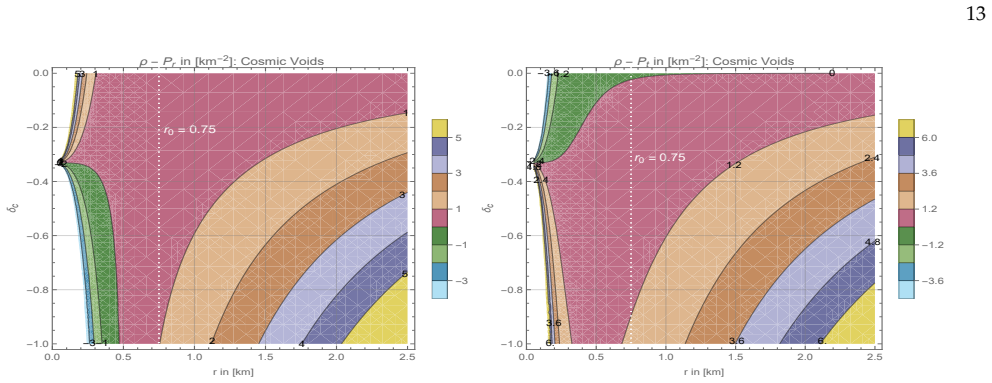
- The void contrast parameter delta_c becomes a dial for energy-condition behaviour: radial NEC holds for delta_c in (-0.925, 0] and fails closer to -1, so voids with moderate contrast require less exotic matter.
- If the solution is correct, a traversable wormhole sourced by void-like density would lens background sources with a negative deflection angle, producing image patterns opposite to black hole lensing.
- The TOV analysis implies the wormhole can be held open by a balance of hydrostatic and anisotropic forces alone, since the gravitational force vanishes at constant redshift.
- The negative exoticity parameter suggests the matter transitions from whatever supports the throat to ordinary matter as the radius increases, softening the usual objection that traversable wormholes require exotic matter everywhere.
Reading between the lines
- The paper integrates the void profile from r0 out to infinity, but a physical cosmic void ends near r_sv; a natural extension is to truncate the profile at the void edge and match the interior to an exterior vacuum solution, which could alter the asymptotics and the sign of the deflection angle.
- The profile parameters r_sc=75 and r_sv=95 are calibrated for voids tens of megaparsecs across, while the throat sits at r0=0.75 km with rho_a in km^-2; a units-and-scales consistency check on whether void matter could support such a structure would sharpen the claim.
- The predicted repulsive lensing is testable in principle: one could compute magnification and image positions for a source behind such a wormhole and search existing microlensing surveys for the unusual 'missing arc' or asymmetry signatures described in the paper.
Signed reviews
Editorial analysis
A structured set of objections, weighed in public.
Referee Report
Summary. The paper constructs exact static, spherically symmetric traversable wormhole solutions in the linear f(R,L_m,T)=R+ηL_m+χT gravity theory by identifying the wormhole matter energy density with the Hamaus universal cosmic void density profile. With a constant redshift function Φ, the field equations reduce to a simple system in which the shape function satisfies X'=κr²ρ; integrating Eq. (22) with the throat condition X(r0)=r0 yields the closed-form shape function in Eq. (23) involving hypergeometric functions. The paper claims that this shape function satisfies the Morris-Thorne throat, flare-out, and asymptotic flatness conditions, that for δc=-0.9 the energy density is positive and the energy-condition violations are mitigated, that the TOV equilibrium holds, and that gravitational lensing yields a negative (repulsive) deflection angle. The work also examines the exoticity parameter, anisotropy, and embedding diagrams.
Significance. If the central claims were correct, the paper would provide a new exact wormhole family in which a cosmologically calibrated matter profile, rather than ad hoc exotic matter, shapes the geometry and weakens energy-condition violations. The reduction of the f(R,L_m,T) field equations to the compact system (19)-(21) is clean, and the closed-form integration of the shape function is a nontrivial technical step worth acknowledging. However, the advertised asymptotic flatness and repulsive-lensing results fail for the stated solution, and the physical transplantation of a Mpc-scale void profile to a kilometer-scale wormhole is not justified. The manuscript's main positive contributions are therefore not realized in the solution as presented.
major comments (3)
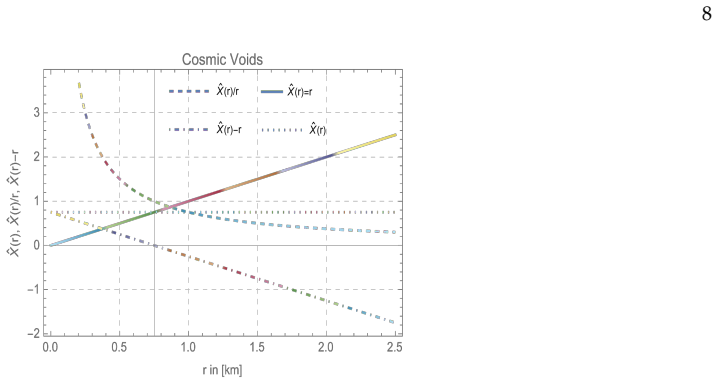
- [§IV, Eq. (23) and Eq. (3)] The solution is not asymptotically flat for the parameter set used. Since the Hamaus profile (1) tends to ρ_a>0 as r→∞ when β>α, Eq. (19) gives X'∼κρ_a r² and hence X∼(κρ_a/3)r³, so X/r∼(κρ_a/3)r² diverges. This violates the paper's own asymptotic flatness condition lim_{r→∞}X/r=0 stated in Eq. (3). The text after Fig. 1 claims that X/r approaches zero as r→∞, but the plotted range is only r≲2.5 km; the asymptotic region is not shown and behaves in the opposite manner. This is not a cosmetic issue: all subsequent claims about the spacetime being asymptotically flat, and any integral over r to infinity, depend on this condition.
- [§V, Eq. (34) and Fig. 7] The lensing deflection angle α(rtp) is evaluated through Eq. (34) with upper limit r=∞, but the integrand contains √(1-X/r), and since X/r diverges as r², the integral is not convergent for large r. The numerical content of Fig. 7 is consistent with this failure: the plotted values include -9223372036854775808, the standard 64-bit signed integer overflow sentinel, and the color-bar entries are of order -10^153. These are not finite, negative deflection angles; they are artifacts of a numerically diverging integral. The claim that the wormhole repels light is therefore not supported by the model.
- [§II, Eq. (1) and §IV after Eq. (22)] The Hamaus universal density profile is an empirical fit to cosmic voids with radii of tens of megaparsecs, characterized by r_sc and r_sv in Mpc. Here the same functional form is imposed as the wormhole energy density for r∈[0.75,∞) with r in kilometers and r_sc=75, r_sv=95. The paper provides no physical or mathematical argument that this profile applies at centimeter-to-kilometer scales or that ρ_a remains a positive constant at infinity in a compact-object context. If the profile is intended to describe only the interior of a finite void, the solution must be truncated at the void boundary and matched to an exterior vacuum or cosmological spacetime; no such matching is given. This undermines the physical interpretation of the solution as a wormhole sourced by cosmic-void matter.
minor comments (5)
- [§IV, energy conditions text] The statement that 'both conditions X'<1 and X/r<1 hold for all r greater than r0' is not supported by the asymptotic behavior derived from Eq. (19); the claim should be restricted to the numerically explored range r≲2.5 km.
- [§III, around Eq. (15)] The choice L_m=-ρ is introduced without discussion; since the field equations depend on this identification, it should be stated explicitly and justified in the text.
- [Figures 3-8] The density and pressure quantities are labeled in units of km^{-2}, which is unconventional; with G=c=1 the dimension is length^{-2}, but the relationship between the plotted values and the input parameters (in particular ρ_a=0.00001) should be clarified.
- [Fig. 7] The figure caption and color bar contain formatting errors, including spaces in numbers, '6.8×10. 153', and the axis label 'rTurning Point'; these should be corrected.
- [Eq. (42)] The expression for the exoticity parameter Ω_Exoticity appears to have a mismatched bracket at the end, making the formula ambiguous; it should be rewritten with balanced parentheses.
Circularity Check
Derivation is a self-contained solve of the field equations with an externally fitted void profile; no load-bearing circular step.
full rationale
The construction is not circular: Eq. (19) is the linear f(R,L_m,T) field equation with constant redshift, and Eq. (22) substitutes the Hamaus void profile (Eq. (1)), an external empirical input from Hamaus et al. [83]. Eq. (23) is then the explicit integral of that input, with the throat condition fixing only the integration constant. The pressure components (Eqs. (25)-(26)), energy conditions (Eqs. (30)-(32)), lensing integral (Eq. (34)), TOV forces, and anisotropy/exoticity parameters are all computed from the resulting metric rather than used to define it. The statement rho+P_r+2P_t=0 is an algebraic identity of Eqs. (19)-(21) and is presented as a consistency remark, not as a load-bearing prediction. The advertised 'influence' of voids on the wormhole geometry is the expected consequence of choosing that density profile as the source; this is exact-solution construction, not a fitted parameter being renamed as a prediction. The self-citations in the reference list supply context or prior applications and are not the load-bearing justification for Eq. (23). I therefore find no circularity. A separate mathematical concern, that the profile tends to rho_a>0 at infinity so X/r does not tend to zero for the plotted parameters, is a correctness issue rather than a circularity.
Assumptions & free parameters
free parameters (9)
- η (λ) =
0.75
- χ =
0.75
- δc =
-0.9 (scanned in [-1,0])
- α =
3.75
- β =
6.5
- r_sc =
75
- r_sv =
95
- ρ_a =
0.00001 km^-2
- r0 =
0.75 km
assumptions (6)
- ad hoc to paper Φ(r)=constant redshift function
- domain assumption Lm=-ρ
- domain assumption Energy-momentum tensor is an anisotropic perfect fluid diag(-ρ,P_r,P_t,P_t)
- ad hoc to paper Hamaus void profile Eq. (1) is the wormhole energy density for all r≥r0 to infinity
- domain assumption Field equations of f(R,L_m,T) with linear model R+ηL_m+χT
- standard math Hypergeometric function integral representations used for the shape function
Cite this review
Pith. "Pith review of Role of cosmic voids and their matter properties in shaping wormhole geometry in generalized geometry-matter coupling gravity." pith.science (2026). https://pith.science/paper/MFG5Y3E6
@misc{pith2026250817492,
  author       = {Pith},
  title        = {Pith review of: Role of cosmic voids and their matter properties in shaping wormhole geometry in generalized geometry-matter coupling gravity},
  year         = {2026},
  howpublished = {\url{https://pith.science/paper/MFG5Y3E6}},
  note         = {Machine review of arXiv:2508.17492}
}
abstract
Cosmic voids are increasingly recognized as a promising tool for cosmological exploration. Their distribution and density profiles are highly responsive to alterations in gravitational theories, along with the influences of dark energy and neutrinos. Investigating voids offers a compelling opportunity to uncover signatures of alternative gravity models on a cosmological level. Voids span a notable range of density contrasts, from approximately -$1$ near their centers to around $0$ at their edges, where screening mechanisms become less effective. The primary objective of this study is to explore a novel model that introduces a new category of wormhole solutions by leveraging cosmic voids$-$vast underdense regions of the universe$-$for the first time. We focus on identifying new exact static wormhole models by proposing an alternative viewpoint on their matter content, rooted in the recently formulated $f(R,\mathcal{L}_m,T)$ theory of gravity. By developing a unique solution based on a universal density profile for voids, we examine crucial constraints on the parameters that dictate matter distribution and the structure of spacetime itself. Our results reveal how these cosmic voids significantly influence the geometry of wormholes, steepening the gradient toward the throat and mitigating violations of the null and weak energy conditions, particularly beyond their centers. We also highlight intriguing gravitational lensing effects, showing that this wormhole repels light rather than capturing it, creating a fascinating interaction between gravity and light.
Figures


Figures from the paper (5 more)



Reference graph
Works this paper leans on
-
[1]
D. J. Eisenstein et al. [SDSS], Astrophys. J. 633, 560-574 (2005)
2005
-
[2]
This means the throat of the wormhole be- haves like an unstable photon sphere
[114]. This means the throat of the wormhole be- haves like an unstable photon sphere. It’s an interest- ing point that we can explore further by examining the angle α(rtp ), which shows how much the photon gets deflected: α(rtp ) =−π + 2 Z ∞ rtp eΦ q 1− ˆX′ r′ q r2 K2− e2Φ dr. (34) Here,K := L/E is known as the impact parameter. When we look at a constan...
-
[3]
S. W. Allen, D. A. Rapetti, R. W. Schmidt, H. Ebeling, G. Mor- ris and A. C. Fabian, Mon. Not. Roy. Astron. Soc. 383, 879-896 (2008)
2008
-
[4]
Kowalski et al
M. Kowalski et al. [Supernova Cosmology Project], Astrophys. J. 686, 749-778 (2008)
2008
-
[5]
Aghanim et al
N. Aghanim et al. [Planck], Astron. Astrophys. 641, A6 (2020) [erratum: Astron. Astrophys. 652, C4 (2021)]
2020
-
[6]
Hinshaw et al
G. Hinshaw et al. [WMAP], Astrophys. J. Suppl. 208, 19 (2013)
2013
-
[7]
A. G. Riess et al. [Supernova Search Team], Astron. J. 116, 1009- 1038 (1998)
1998
-
[8]
Perlmutter et al
S. Perlmutter et al. [Supernova Cosmology Project], Nature 391, 51-54 (1998)
1998
Show all 143 references
-
[9]
Nojiri and S
S. Nojiri and S. D. Odintsov, eConf C0602061, 06 (2006)
2006
-
[10]
A. D. Dolgov and M. Kawasaki, Phys. Lett. B 573, 1-4 (2003)
2003
-
[11]
Joyce, B
A. Joyce, B. Jain, J. Khoury and M. Trodden, Phys. Rept. 568, 1-98 (2015)
2015
-
[12]
Clifton, P
T. Clifton, P . G. Ferreira, A. Padilla and C. Skordis, Phys. Rept. 513, 1-189 (2012)
2012
-
[13]
J., 1859, Annales de l’Observatoire de Paris, 5, 1
Le Verrier U. J., 1859, Annales de l’Observatoire de Paris, 5, 1
-
[14]
Ishak, Living Rev
M. Ishak, Living Rev. Rel. 22, no.1, 1 (2019)
2019
-
[15]
C. M. Will, Phys. Rev. D 71, 084027 (2005)
2005
-
[16]
Bertotti, L
B. Bertotti, L. Iess and P . Tortora, Nature425, 374-376 (2003)
2003
-
[17]
Hinterbichler and J
K. Hinterbichler and J. Khoury, Phys. Rev. Lett. 104, 231301 (2010)
2010
-
[18]
Khoury and A
J. Khoury and A. Weltman, Phys. Rev. Lett. 93, 171104 (2004)
2004
-
[19]
Brax and P
P . Brax and P . Valageas, Phys. Rev. D90, no.2, 023507 (2014)
2014
-
[20]
Brax and P
P . Brax and P . Valageas, Phys. Rev. D88, no.2, 023527 (2013)
2013
-
[21]
Motohashi, A
H. Motohashi, A. A. Starobinsky and J. Yokoyama, Phys. Rev. Lett. 110, no.12, 121302 (2013)
2013
-
[22]
J. h. He, Phys. Rev. D 88, no.10, 103523 (2013)
2013
-
[23]
Giocoli, M
C. Giocoli, M. Baldi and L. Moscardini, Mon. Not. Roy. Astron. Soc. 481, no.2, 2813-2828 (2018)
2018
-
[24]
Baldi, F
M. Baldi, F. Villaescusa-Navarro, M. Viel, E. Puchwein, V . Springel and L. Moscardini, Mon. Not. Roy. Astron. Soc.440, no.1, 75-88 (2014)
2014
-
[25]
Fukuda et al
Y. Fukuda et al. [Super-Kamiokande], Phys. Rev. Lett. 81, 1562- 1567 (1998)
1998
-
[26]
Becker-Szendy, C
R. Becker-Szendy, C. B. Bratton, D. Casper, S. T. Dye, W. Gajew- ski, M. Goldhaber, T. J. Haines, P . G. Halverson, D. Kielczewska and W. R. Kropp, et al. Phys. Rev. D 46, 3720-3724 (1992)
1992
-
[27]
Harko and F
T. Harko and F. S. N. Lobo, Eur. Phys. J. C 70, 373-379 (2010)
2010
-
[28]
S. N. Ahmed et al. [SNO], Phys. Rev. Lett. 92, 181301 (2004)
2004
-
[29]
Haghani and T
Z. Haghani and T. Harko, Eur. Phys. J. C 81, no.7, 615 (2021)
2021
-
[30]
Harko, F
T. Harko, F. S. N. Lobo, S. Nojiri and S. D. Odintsov, Phys. Rev. D 84, 024020 (2011)
2011
-
[31]
Amendola, R
L. Amendola, R. Gannouji, D. Polarski and S. Tsujikawa, Phys. Rev. D 75, 083504 (2007)
2007
-
[32]
Amendola, D
L. Amendola, D. Polarski and S. Tsujikawa, Phys. Rev. Lett. 98, 131302 (2007)
2007
-
[33]
Y. Xu, G. Li, T. Harko and S. D. Liang, Eur. Phys. J. C 79, no.8, 708 (2019)
2019
-
[34]
E. L. B. Junior, M. E. Rodrigues, I. G. Salako and M. J. S. Houndjo, Class. Quant. Grav. 33, no.12, 125006 (2016)
2016
-
[35]
Ilyas and Z
M. Ilyas and Z. U. N. Shinwari, JHEAp 48, 100414 (2025)
2025
-
[36]
N ´ajera and A
A. N ´ajera and A. Fajardo, JCAP 03, no.03, 020 (2022)
2022
-
[37]
Errehymy, O
A. Errehymy, O. Donmez, A. Syzdykova, K. Myrzakulov, S. Muminov, A. Dauletov and J. Rayimbaev, Annals Phys. 481, 170164 (2025)
2025
-
[38]
Errehymy, O
A. Errehymy, O. Donmez, A. Syzdykova, K. Myrzakulov, S. Muminov, A. Dauletov and J. Rayimbaev, Annals Phys. 480, 170105 (2025)
2025
-
[39]
Ilyas, Can
M. Ilyas, Can. J. Phys. 102, no.6, 332-343 (2024)
2024
-
[40]
Ilyas, S
M. Ilyas, S. Khan, A. R. Athar, F. Khan, R. Iqbal, H. I. Alrebdi, K. S. Nisar and A. H. Abdel-Aty, Int. J. Geom. Meth. Mod. Phys. 22, no.05, 2450322 (2025)
2025
-
[41]
Errehymy, A
A. Errehymy, A. Banerjee, O. Donmez, M. Daoud, K. S. Nisar and A. H. Abdel-Aty, Gen. Rel. Grav.56, no.6, 76 (2024)
2024
-
[42]
Errehymy, I
A. Errehymy, I. Karar, K. Myrzakulov, A. Banerjee, A. H. Abdel- Aty and K. S. Nisar, JHEAp 44, 410-418 (2024)
2024
-
[43]
Battista, S
E. Battista, S. Capozziello and A. Errehymy, Eur. Phys. J. C 84, no.12, 1314 (2024)
2024
-
[44]
Errehymy, A
A. Errehymy, A. Banerjee, S. Hansraj, O. Donmez, K. S. Nisar and A. H. Abdel-Aty, Eur. Phys. J. C84, no.6, 573 (2024)
2024
-
[45]
Ilyas and K
M. Ilyas and K. Bamba, JCAP 10, 038 (2023)
2023
-
[46]
Ilyas, F
M. Ilyas, F. Khan, I. Ahmad, R. Iqbal and S. Khan, Eur. Phys. J. Plus 138, no.10, 880 (2023)
2023
-
[47]
A. R. Athar, M. Ilyas and B. Masud, Int. J. Geom. Meth. Mod. Phys. 20, no.01, 2350003 (2023)
2023
-
[48]
Ilyas and R
M. Ilyas and R. Iqbal, Int. J. Geom. Meth. Mod. Phys. 20, no.13, 2350230 (2023)
2023
-
[49]
S. A. Gregory, L. A. Thompson, Astrophys. J., 222, 784 (1978)
1978
-
[50]
J ˆoeveer, J
M. J ˆoeveer, J. Einasto, and E. Tago, Spatial distribution of galax- ies and of clusters of galaxies in the southern galactic hemi- sphere. Mon. Not. Roy. Astron. Soc., 185, 357 (1978)
1978
-
[51]
Jaber, M
M. Jaber, M. Peper, W. A. Hellwing, M. A. Aragon-Calvo and O. Valenzuela, Mon. Not. Roy. Astron. Soc.527, no.2, 4087-4099 (2023)
2023
-
[52]
M. A. Aragon-Calvo and A. S. Szalay, Mon. Not. Roy. Astron. Soc. 428, 3409 (2013)
2013
-
[53]
N. I. Libeskind, R. van de Weygaert, M. Cautun, B. Falck, E. Tempel, T. Abel, M. Alpaslan, M. A. Arag ´on-Calvo, J. E. Forero-Romero and R. Gonzalez, et al. Mon. Not. Roy. As- tron. Soc. 473, no.1, 1195-1217 (2018)
2018
-
[54]
Cautun, R
M. Cautun, R. van de Weygaert, B. J. T. Jones and C. S. Frenk, Mon. Not. Roy. Astron. Soc.441, no.4, 2923-2973 (2014)
2014
-
[55]
Alcock and B
C. Alcock and B. Paczynski, Nature 281, 358-359 (1979)
1979
-
[56]
Kaiser, Mon
N. Kaiser, Mon. Not. Roy. Astron. Soc. 227, 1-27 (1987)
1987
-
[57]
Flamm, Phys
L. Flamm, Phys. Z. 17, 448 (1916)
1916
-
[58]
R. K. Sachs and A. M. Wolfe, Astrophys. J. 147, 73-90 (1967)
1967
-
[59]
C. W. Misner and J. A. Wheeler, Annals Phys. 2, 525-603 (1957)
1957
-
[60]
Einstein and N
A. Einstein and N. Rosen, Phys. Rev. 48, 73-77 (1935)
1935
-
[61]
H. G. Ellis, J. Math. Phys. 14, 104-118 (1973)
1973
-
[62]
M. S. Morris and K. S. Thorne, Am. J. Phys. 56, 395-412 (1988)
1988
-
[63]
Damour and S
T. Damour and S. N. Solodukhin, Phys. Rev. D76, 024016 (2007)
2007
-
[64]
Visser, Lorentzian wormholes: From Einstein to Hawking , (AIP Press, New York, 1995)
M. Visser, Lorentzian wormholes: From Einstein to Hawking , (AIP Press, New York, 1995)
1995
-
[65]
B. P . Abbott et al. [LIGO Scientific and Virgo], Phys. Rev. Lett. 116, 061102 (2016)
2016
-
[66]
These studies collectively highlight the need for more refined observational strate- gies to differentiate between black hole and wormhole candidates
broadened this perspective by demonstrating that wormholes can exhibit a range of ringing behaviors— some that strongly resemble black holes and others that diverge significantly—depending on the underlying ge- ometry and matter content. These studies collectively highlight th...
1978
-
[67]
Cardoso, E
V . Cardoso, E. Franzin and P . Pani, Phys. Rev. Lett.116, 171101 (2016) [erratum: Phys. Rev. Lett. 117, 089902 (2016)]
2016
-
[68]
R. A. Konoplya and A. Zhidenko, JCAP 12, 043 (2016)
2016
-
[69]
Bambi, Phys
C. Bambi, Phys. Rev. D 87, 107501 (2013)
2013
-
[70]
P . G. Nedkova, V . K. Tinchev and S. S. Yazadjiev, Phys. Rev. D 88 (2013) no.12, 124019
2013
-
[71]
Ohgami and N
T. Ohgami and N. Sakai, Phys. Rev. D 91, 124020 (2015)
2015
-
[72]
Shaikh and S
R. Shaikh and S. Kar, Phys. Rev. D 96, 044037 (2017)
2017
-
[73]
Jusufi and A
K. Jusufi and A. ¨Ovg ¨un, Phys. Rev. D 97, no.2, 024042 (2018)
2018
-
[74]
Shaikh, Phys
R. Shaikh, Phys. Rev. D 98, 024044 (2018). 19
2018
-
[75]
Shaikh, P
R. Shaikh, P . Banerjee, S. Paul and T. Sarkar, Phys. Lett. B 789, 270-275 (2019) [erratum: Phys. Lett. B 791, 422-423 (2019)]
2019
-
[76]
D. C. Dai and D. Stojkovic, Phys. Rev. D 100, 083513 (2019)
2019
-
[77]
J. P . Luminet, Astron. Astrophys.75, 228-235 (1979)
1979
-
[78]
Stuchlik and J
Z. Stuchlik and J. Schee, Class. Quant. Grav. 27, 215017 (2010)
2010
-
[79]
Stuchlik and J
Z. Stuchlik and J. Schee, Class. Quant. Grav. 31, 195013 (2014)
2014
-
[80]
Schee and Z
J. Schee and Z. Stuchlik, JCAP 06 (2015), 048
2015
-
[81]
Gyulchev, P
G. Gyulchev, P . Nedkova, T. Vetsov and S. Yazadjiev, Phys. Rev. D 100 (2019) no.2, 024055
2019
-
[82]
S. X. Tian and Z. H. Zhu, Phys. Rev. D 100 (2019) no.6, 064011
2019
-
[83]
Banerjee, S
A. Banerjee, S. Hansraj, A. Pradhan and A. Errehymy, Chinese Physics C, 49, 015101 (2025)
2025
-
[84]
R. K. Sheth and R. van de Weygaert, Mon. Not. Roy. Astron. Soc. 350, 517 (2004)
2004
-
[85]
Hamaus, P
N. Hamaus, P . M. Sutter and B. D. Wandelt, Phys. Rev. Lett.112, 251302 (2014)
2014
-
[86]
P . K. F. Kuhfittig, Eur. Phys. J. C74, no.99, 2818 (2014)
2014
-
[87]
F. S. N. Lobo, Phys. Rev. D 71, 084011 (2005)
2005
-
[88]
Y. C. Cai, N. Padilla and B. Li, Mon. Not. Roy. Astron. Soc. 451, no.1, 1036-1055 (2015)
2015
-
[89]
Pisani, E
A. Pisani, E. Massara, D. N. Spergel, D. Alonso, T. Baker, Y. C. Cai, M. Cautun, C. Davies, V . Demchenko and O. Dor ´e, et al. [arXiv:1903.05161 [astro-ph.CO]]
1903 arXiv
-
[90]
Zubair, S
M. Zubair, S. Waheed, Q. Muneer and M. Ahmad, Fortsch. Phys. 71, no.8-9, 2300018 (2023)
2023
-
[91]
C. E. Mota, J. M. Z. Pretel and C. O. V . Flores, Eur. Phys. J. C84, no.7, 673 (2024)
2024
-
[92]
J. A. S. Fortunato, P . H. R. S. Moraes, E. Brito, J. G. de Lima J ´unior and T. S. Guerini, Phys. Dark Univ.48, 101893 (2025)
2025
-
[93]
P . H. R. S. Moraes, A. S. Agrawal and B. Mishra, Phys. Lett. B 855, 138818 (2024)
2024
-
[94]
Errehymy, Y
A. Errehymy, Y. Khedif, M. Daoud, K. Myrzakulov, A. H. Abdel-Aty and K. S. Nisar, JHEAp 47, 100370 (2025)
2025
-
[95]
R. P . Kirshner et al., Astrophys. J., 248, L57-L60 (1981)
1981
-
[96]
de Lapparent, M
V . de Lapparent, M. J. Geller, J. P . Huchra, Astrophys. J., 302, L1 (1986)
1986
-
[97]
van de Weygaert, S
R. van de Weygaert, S. Shandarin, E. Saar, and J. Einasto, in The Zeldovich Universe: Genesis and Growth of the Cosmic Web, IAU Symp., 308 (2016)
2016
-
[98]
Pisani et al
A. Pisani et al. Cosmic voids: a novel probe to shed light on our Universe. BAAS, 51, no. 3, 40, (2019)
2019
-
[99]
Ceccarelli et al
L. Ceccarelli et al. Clues on void evolution - I. Large-scale galaxy distributions around voids. Mon. Not. Roy. Astron. Soc., 434, no. 2, 1435-1442, (2013)
2013
-
[100]
Cai et al
Y.-C. Cai et al. A Possible Cold Imprint of Voids on the Mi- crowave Background Radiation. Astrophys. J., 786, no. 2, 110, (2014)
2014
-
[101]
Cai et al
Y.-C. Cai et al. The lensing and temperature imprints of voids on the cosmic microwave background. Mon. Not. Roy. Astron. Soc., 466, no. 3, 3364-3375, (2017)
2017
-
[102]
J. M. Colberg et al. The Aspen-Amsterdam void finder compar- ison project. Mon. Not. Roy. Astron. Soc., 387, no. 2, 933-944, (2008)
2008
-
[103]
Paz et al
D. Paz et al. Clues on void evolution-II. Measuring density and velocity profiles on SDSS galaxy redshift space distortions. Mon. Not. Roy. Astron. Soc., 436, no. 4, 3480-3491, (2013)
2013
-
[104]
Carroll, Lecture Notes on General Relativity , arXiv: gr- qc/9712019 (1997)
Sean M. Carroll, Lecture Notes on General Relativity , arXiv: gr- qc/9712019 (1997)
1997
-
[105]
Hochberg and M
D. Hochberg and M. Visser, Phys. Rev. D 58, 044021 (1998)
1998
-
[106]
Hochberg, D., Visser, M.: Phys. Rev. Lett. 81 746 (1998)
1998
-
[107]
Raychaudhuri, Phys
A. Raychaudhuri, Phys. Rev. 98, 1123 (1955)
1955
-
[108]
Capozziello, S
S. Capozziello, S. Nojiri, S.D. Odintsov, Phys. Let. B 781, 99-106 (2018)
2018
-
[109]
Godani, G.C
N. Godani, G.C. Samanta, Ann. Phys. 429, 168460 (2021)
2021
-
[110]
T.K. Dey, S. Sen, Mod. Phys. Lett. A 23, 953-962 (2008)
2008
-
[111]
Tsukamoto, Phys
N. Tsukamoto, Phys. Rev. D 94, 124001 (2016)
2016
-
[112]
Virbhadra, G.F.R
K.S. Virbhadra, G.F.R. Ellis, Phys. Rev. D 62, 084003 (2000)
2000
-
[113]
Virbhadra, G.F.R
K.S. Virbhadra, G.F.R. Ellis,, Phys. Rev. D 65, 103004 (2002)
2002
-
[114]
Bozza, Gen
V . Bozza, Gen. Relativ. Gravit.42, 2269-2300 (2010)
2010
-
[115]
Bozza, Phys
V . Bozza, Phys. Rev. D66, 103001 (2002)
2002
-
[116]
Shaikh et al., JCAP 07, 028 (2019)
R. Shaikh et al., JCAP 07, 028 (2019)
2019
-
[117]
Weinberg, Gravitation and Cosmology: Principles and Ap- plications of the General Theory of Relativity (1972)
S. Weinberg, Gravitation and Cosmology: Principles and Ap- plications of the General Theory of Relativity (1972)
1972
-
[118]
Claudel, K.S
C.M. Claudel, K.S. Virbhadra, G.F.R. Ellis, J. Math. Phys. 42, 818-838 (2001)
2001
-
[119]
K. K. Nandi, Y. Z. Zhang, R. G. Cai and A. Panchenko, Phys. Rev. D 79, 024011 (2009)
2009
-
[120]
T. K. Dey and S. Sen, Mod. Phys. Lett. A 23, 953-962 (2008)
2008
-
[121]
Tsukamoto and T
N. Tsukamoto and T. Harada, Phys. Rev. D 95, no.2, 024030 (2017)
2017
-
[122]
Perlick, Living Rev
V . Perlick, Living Rev. Rel.7, 9 (2004)
2004
-
[123]
Abe, Astrophys
F. Abe, Astrophys. J. 725, 787-793 (2010)
2010
-
[124]
Y. Toki, T. Kitamura, H. Asada and F. Abe, Astrophys. J.740, 121 (2011)
2011
-
[125]
Safonova, D
M. Safonova, D. F. Torres and G. E. Romero, Phys. Rev. D 65, 023001 (2002)
2002
-
[126]
Perlick, O
V . Perlick, O. Y. Tsupko and G. S. Bisnovatyi-Kogan, Phys. Rev. D 92, no.10, 104031 (2015)
2015
-
[127]
Gorini et al., Phys
V . Gorini et al., Phys. Rev. D78, 064064 (2008)
2008
-
[128]
Kuhfittig, Fundamental J
P .K.F. Kuhfittig, Fundamental J. Mod. Phys.14, 23-31 (2020)
2020
-
[129]
Bronnikov, M.V
K.A. Bronnikov, M.V . Skvortsova, A.A. Starobinsky, Grav. Cos- mol. 16, 216-222 (2010)
2010
-
[130]
Haghani, T
Z. Haghani, T. Harko, Eur. Phys. J. C 81, 615 (2021)
2021
-
[131]
M.Visser, Lorentzian Wormholes: From Einstein to Hawking (American Institute of Physics, New York, 1995)
1995
-
[132]
Kuhfittig,Eur
P .K.F. Kuhfittig,Eur. Phys. J. C 74, 2818 (2014)
2014
-
[133]
Solanki, Z
R. Solanki, Z. Hassan, P .K. Sahoo,Chin. J. Phys. 85, 74-88 (2023)
2023
-
[134]
Jaybhaye, M
L. Jaybhaye, M. Tayde, P .K. Sahoo, Commun. Theor. Phys. 76, 055402 (2024)
2024
-
[135]
S. K. Maurya, J. Kumar, S. Kiroriwal and A. Errehymy, Phys. Dark Univ. 46, 101564 (2024)
2024
-
[136]
Errehymy, S
A. Errehymy, S. K. Maurya, S. Hansraj, M. Mahmoud, K. S. Nisar and A. H. Abdel-Aty, Chin. J. Phys. 89, 56-68 (2024)
2024
-
[137]
Godani, G.C
N. Godani, G.C. Samanta,Eur. Phys. J. C 80, 30 (2020)
2020
-
[138]
Godani, G.C
N. Godani, G.C. Samanta, New Astronomy 80, 101399 (2020)
2020
-
[139]
Deb, B.K
D. Deb, B.K. Guha, Phys. Rev. D 97, 084026 (2018)
2018
-
[140]
J. P . S. Lemos, F. S. N. Lobo and S. Quinet de Oliveira, Phys. Rev. D 68, 064004 (2003)
2003
-
[141]
W. T. Kim, J. J. Oh and M. S. Yoon, Phys. Rev. D70, 044006 (2004)
2004
-
[142]
Cattoen, T
C. Cattoen, T. Faber and M. Visser, Class. Quant. Grav.22, 4189- 4202 (2005)
2005
-
[143]
F. S. N. Lobo, F. Parsaei and N. Riazi, Phys. Rev. D 87, no.8, 084030 (2013)
2013
Reviewed August 15, 2026 · model on record in the stance chip above.
Discussion (0). Continue with ORCID to comment.