REVIEW 4 major objections 6 minor 69 references
Exact Solutions for a Teleparallel Cosmological Model with Vector Field via Noether Symmetry
T0 review · 4 major / 6 minor · reviewed 2026-08-15 · deepseek-v4-flash
Pith's one-line read This paper claims that Noether symmetry selects a linear coupling $g(\xi)=g_0\xi$ and power-law potential $V(\xi)=V_0\xi^n$ in a vector-field teleparallel cosmology, producing exact solutions for $a(t)$ and $\xi(t)$; the $n=1$ branch can…
desk verdict Clean Noether algebra, but the 'isotropic' vector ansatz selects a spatial direction and the paper never checks the off-diagonal field equations — the exact solutions are not yet solutions of the full theory. read the letter →
The pith
A machine-rendered reading of the paper's core claim, the machinery that carries it, and where it could break.
The reading
What carries the argument
The machinery is the Noether symmetry condition $\mathcal{L}_X L=0$ applied to the minisuperspace Lagrangian (8). It fixes the symmetry generator $X$, produces a conserved momentum $I_0$, and generates the coordinate transformation $(a,\xi)\to(s,u)$ in which $s$ is cyclic; the transformed Lagrangian is first-order and integrable. The workhorse identity is the conserved quantity $\frac{\alpha_0(2n-3)}{4n}e^{(n-3)u/[2(2n-3)]}\dot u=I_0$, which, combined with the zero energy constraint, integrates directly to the closed forms for $a(t)$ and $\xi(t)$.
What would settle it
Numerically integrate the original field equations (9)--(11) with initial data taken from the closed solution (62) and check whether $q(t)$ and $\omega_\xi(t)$ follow the analytic curves through the claimed deceleration-to-acceleration and possible phantom transition; any divergence before those transitions would falsify the claim that (62)--(66) are exact solutions of the model.
Extended reading notes
Core claim
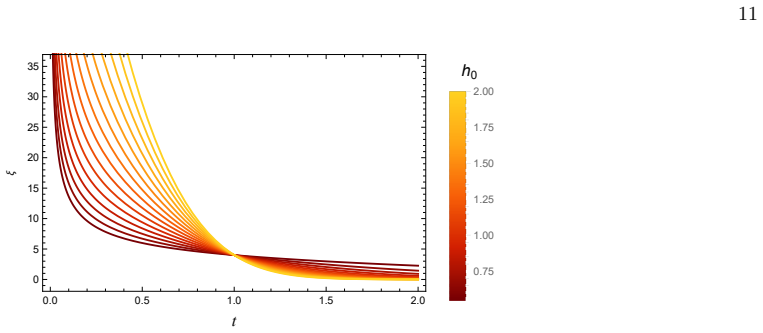
The central claim is that the Noether symmetry conditions reduce the point-like Lagrangian to a system with a cyclic variable, whose conservation law and zero energy function integrate exactly. The result is a family of solutions in Eqs. (40)--(41), with late-time power law $a(t)\sim t^{\gamma_n}$ where $\gamma_n$ depends on $n$. For $n=1$, after fixing $I_0=-\alpha_0$, $a(0)=0$, $a(1)=1$, and $H(1)=h_0$, the exact scale factor is $a(t)=t^{1/2}e^{(2h_0-1)(t^2-1)/4}$, with the deceleration parameter turning negative and $\omega_\xi$ able to drop below $-1$; for $h_0=1/2$ the model reduces to a radiation-dominated universe. For $n=3$, the exact scale factor is $a(t)=\bigl[(V_0\alpha_0^2 e^{2u_0}/6I_0^2)(e^{-4I_0 t/\alpha_0}-e^{8I_0 t/\alpha_0})\bigr]^{1/2}$, whose deceleration and equation-of-state parameters pass from positive/deceleration to negative/acceleration and tend toward $\omega_\xi=-1$ at late times without phantom crossing. The paper presents these as exact solutions of the model rather than numerical approximations.
Load-bearing premise
The whole solution chain depends on assuming the forms $V(\xi)=V_0\xi^n$, $g(\xi)=g_0\xi$, and a power-law symmetry generator rather than proving that Noether symmetry forces these forms uniquely; if other symmetry branches exist, the exact solutions and their phantom or quintessence conclusions need not be the model's only physical output.
Editorial extensions
If this is right
- For generic $n\neq 1,3$, the late-time scale factor obeys a power law $a(t)\sim t^{\gamma_n}$, so the model's acceleration or deceleration is governed entirely by $n$ through the exponent $\gamma_n$.
- For $n=1$, the model begins in a radiation-dominated phase when $h_0=1/2$ and can switch from deceleration to acceleration; at $h_0=0.74$ the reported present values $q=-0.525$ and $\omega_\xi=-0.683$ sit inside the observational range.
- For $n=1$ and sufficiently large $h_0$, the equation-of-state parameter crosses $\omega_\xi=-1$, giving a phantom phase consistent with phantom dark energy.
- For $n=3$, the exact solution shows a decelerating-to-accelerating transition with $\omega_\xi$ approaching $-1$ from above, and no phantom crossing occurs.
- The closed forms for $H(t)$, $q(t)$, and $\omega_\xi(t)$ provide explicit targets that observational constraints on $h_0$ (for $n=1$) and on the combination $I_0/\alpha_0$ (for $n=3$) could directly test.
Reading between the lines
- The paper checks its $n=1$ parameter values against observational ranges but does not run a full likelihood analysis; a natural next step would be to fit $h_0$ (and, for $n=3$, $I_0/\alpha_0$) to supernova, CMB, and Hubble-data distance measurements.
- Because the general solutions start at a non-zero constant scale factor as $t\to 0$, they suggest an emergent or bouncing early phase; checking whether curvature and torsion invariants stay finite there would tell whether this is a genuine nonsingular cosmology.
- The Noether conditions are solved with a specific monomial ansatz, so the symmetry criterion has not been shown to be exhaustive; finding other symmetry branches with different coupling or potential forms would delimit how unique the exact solutions really are.
- Adding ordinary matter or radiation to the $n=1$ branch would shift the deceleration-to-acceleration and phantom-crossing times, so the stated cosmic history is a dark-energy-only limiting case.
Signed reviews
Editorial analysis
A structured set of objections, weighed in public.
Referee Report
Summary. The paper studies a teleparallel-gravity cosmology with a vector field A_mu non-minimally coupled to the torsion scalar T through a function f(xi), with xi = A_mu A^mu and a potential V(xi). After imposing a flat FRW metric and the vector ansatz A_mu = (0, a phi, a phi, a phi), the authors construct a point-like Lagrangian and apply Noether symmetry conditions. They assume a power-law potential V = V0 xi^n and a linear coupling g = g0 xi, derive a symmetry generator and a cyclic variable, and obtain exact analytical solutions for the scale factor a(t) and xi(t) for general n. The special cases n = 1 and n = 3 are treated separately: for n = 1 the model is claimed to describe a transition from deceleration to acceleration with a possible phantom phase; for n = 3 it is claimed to reach a stable accelerating phase with omega approaching -1 without crossing the phantom divide. The paper concludes with plots and a qualitative observational comparison of q and omega.
Significance. If the result held as stated, the paper would provide an explicit exactly solvable vector-field teleparallel cosmology, a useful addition to the Noether-symmetry literature in modified gravity. The Noether algebra and the integrations leading to Eqs. (40)-(41), (62), and (77) are presented in enough detail to be checked, and the final formulas for q(t) and omega_xi(t) are simple and falsifiable. However, the central claims are currently undermined by a sign error in the Hamiltonian constraint, by the absence of any verification that the reduced solutions satisfy the full field equations of action (1) rather than only the minisuperspace trace, and by the fact that the potential and coupling forms are assumed rather than derived from the symmetry conditions. These issues are load-bearing for the claimed deceleration-to-acceleration and phantom/quintessence behavior.
major comments (4)
- [Section II, Eq. (12)] Equation (12) has a sign error. Setting E = 0 in Eq. (11) gives 4g H^2 + 4H \dot{\xi} + \dot{\xi}^2/\xi + 8V = 0, i.e. H^2 = -(8V + \dot{\xi}^2/\xi + 4H\dot{\xi})/(4g), not the plus sign shown in Eq. (12). The inconsistency is concrete: substituting the n = 1 solution (62)-(64) with V0 = h0/4 - 1/8 into Eq. (12) yields H^2 = -H^2. This invalidates the displayed Friedmann equation and the definitions of rho_xi and p_xi as written, and the derivation of the subsequent cosmological parameters needs to be redone with a consistent sign convention.
- [Section II, Eq. (5)] The vector ansatz (5) is not isotropic. With A_i = a(t) phi(t) for each spatial component, a generic spatial rotation changes the direction of the vector field, so the configuration selects a preferred spatial direction. Consequently F_{0i} = a(H phi + \dot{phi}) and the Maxwell-type stress tensor contains off-diagonal spatial components proportional to (H phi + \dot{phi})^2. The point-like Lagrangian (8) is constructed after imposing the FRW metric and this ansatz, so it encodes only the trace of the field equations. The statement after Eq. (7) that the vector-field equation is satisfied does not address the off-diagonal components of the metric/tetrad field equations. The exact solutions (40)-(41), (62), and (77) are therefore not shown to solve the full action (1); this is a central gap that must be closed by direct verification of the off-diagonal equations.
- [Section III, Eqs. (22)-(24)] The Noether analysis does not derive the functional forms of the coupling and potential; it assumes them. The text assumes V = V0 xi^n, the monomial symmetry generator (22), and g = g0 xi before solving Eqs. (18)-(21), and only the coefficients m, k, and g0 are determined by the conditions. Thus the linear coupling and the power-law potential are inputs, not outputs, of the symmetry criterion. The cosmological phases described in Section IV are properties of this chosen two-parameter family and should not be presented as generic consequences of the Noether symmetry.
- [Section IV.A, after Eq. (66)] The observational comparison is conditional in a direct way. The boundary conditions a(1) = 1 and H(1) = h0 fix constants in the n = 1 solution, and then q = -0.525 and omega_xi = -0.683 are evaluated at t = 1 for h0 = 0.74. These are fitted values determined by the chosen normalization and the model parameter, not independent predictions, so agreement with the cited observational ranges [68, 69] does not by itself validate the model.
minor comments (6)
- [Section IV.B] The sentence 'From (57), at t = 0' before Eq. (76) refers to Eq. (57) of the n = 1 case; it should refer to the n = 3 solution, e.g. Eq. (74) or (69).
- [Section III.B, after Eq. (39)] The text says 'solving for z(t)', but the variable has not been called z; it should be s(t). The same symbol z then appears in the n = 3 Lagrangian (67) without definition.
- [Eq. (40)] The displayed bracket in Eq. (40) contains a stray comma before the closing bracket and appears to have a mismatched parenthesis.
- [Section II, Eq. (14)] The derivation of Eq. (14) from Eq. (9) is not shown; in particular, the powers of a in Eq. (9) should be tracked carefully when passing from a, \dot{a}, \ddot{a} to H, \dot{H}.
- [Fig. 6] The horizontal axis label in Fig. 6 appears garbled, and the legend description ('yellow line' and 'red line') should be checked after typesetting.
- [Abstract and Introduction] The phrase 'spatially isotropic vector field configuration' is misleading: a nonzero spatial vector with equal components is not invariant under the full rotation group, as discussed in Major Comment 2.
Circularity Check
No significant circularity: the exact solutions follow from the stated action and explicit Noether ansatz, and no fitted parameter is renamed as an independent prediction.
full rationale
The derivation chain is self-contained given its explicitly stated assumptions. In Section III, the paper transparently assumes V(ξ) = V0 ξ^n and g(ξ) = g0 ξ, and adopts a monomial ansatz for the Noether symmetry generator, rather than deriving those functional forms from the Noether conditions alone. This is a model-building assumption, not a circular reduction: the Noether conditions (18)-(21) are then genuinely used to fix the symmetry generator and g0 in (23)-(24), and the coordinate transformation (28)-(29), transformed Lagrangian (32), conserved current (33), and energy constraint (36) yield the general solutions (40)-(41) by integration. The n=1 and n=3 cases are re-derived from the same Lagrangian in the appropriate limits, with integration constants fixed by boundary conditions a(0)=0, a(1)=1, and H(1)=h0. The quoted present-day values q=-0.525 and ωξ=-0.683 for h0=0.74 are direct algebraic outputs of the chosen h0, so they are parametric consequences rather than independent predictions; however, the paper does not claim to have fit h0 to those quantities, so this is not a case of 'fitted input called prediction.' The monomial ansatz is a restriction rather than a uniqueness proof, which weakens the phrase 'identify specific forms,' but it does not make the derivation circular. The separate concern that the vector-field ansatz Aμ=(0,aφ,aφ,aφ) may not satisfy the off-diagonal field equations is a consistency or correctness issue about whether the reduced point-like Lagrangian captures the full action, not a circularity of the derivation chain. No load-bearing self-citation or imported uniqueness theorem is used. Score 0.
Assumptions & free parameters
free parameters (5)
- h0 (present Hubble parameter at t=1) =
h0 in (0.5, 2]; example h0=0.74
- n (potential exponent in V=V0 xi^n) =
general n; special cases 1 and 3
- V0 (potential amplitude) =
n=1: V0=(2h0-1)/8; otherwise free
- I0 and alpha0 (Noether charge and symmetry amplitude) =
I0 = -alpha0
- u0, s0 (integration constants) =
n=1: u0=0, s0 fixed; n=3: s0 fixed, u0 free
assumptions (5)
- domain assumption Flat FRW metric and isotropic vector field A_mu=(0, a phi, a phi, a phi)
- ad hoc to paper V(xi)=V0 xi^n and g(xi)=g0 xi
- ad hoc to paper Noether generator ansatz alpha=alpha0 a^k xi^m and beta=-(3alpha0/n)a^{k-1} xi^{m+1}
- domain assumption Zero energy constraint E=0
- ad hoc to paper Boundary conditions a(0)=0, a(1)=1 and H(1)=h0
Cite this review
Pith. "Pith review of Exact Solutions for a Teleparallel Cosmological Model with Vector Field via Noether Symmetry." pith.science (2026). https://pith.science/paper/ZGADLNIZ
@misc{pith2026250817795,
  author       = {Pith},
  title        = {Pith review of: Exact Solutions for a Teleparallel Cosmological Model with Vector Field via Noether Symmetry},
  year         = {2026},
  howpublished = {\url{https://pith.science/paper/ZGADLNIZ}},
  note         = {Machine review of arXiv:2508.17795}
}
abstract
We study a cosmological model in the framework of teleparallel gravity, where a vector field $A_\mu$ is non-minimally coupled to the torsion scalar $T$ in a flat Friedmann-Robertson-Walker (FRW) universe. Using the Noether symmetry approach, we identify specific forms for the coupling function $g(\xi)$ and the potential $V(\xi) = V_0 \xi^n$, with $\xi \equiv A_\mu A^\mu$. The method allows us to find exact analytical solutions for the scale factor $a(t)$ and the scalar function $\xi(t)$. General solutions for arbitrary values of $n$ are derived, but special cases such as $n = 1$ and $n = 3$ are studied separately due to their distinct behavior. For $n = 1$, the model describes a transition from decelerated to accelerated expansion, and depending on the value of the model parameter, a transition to a phantom phase is also possible, which is consistent with phantom dark energy. For the special case $n=3$, this model first experiences a deceleration phase and then enters a stable accelerating phase, such that the acceleration parameter $q(t)$ changes from positive to negative values and the equation of state parameter $\omega_\xi(t)$ tends to $-1$ at late times, similar to quintessence dark energy. Unlike the case $n=1$, in this case, no transition to the phantom phase is observed. Therefore, this model can describe the behavior of the universe during periods of dark energy dominance.
Figures


Figures from the paper (3 more)


Reference graph
Works this paper leans on
-
[1]
A. G. Riess et al. [Supernova Search Team], Astron. J. 116 (1998), 1009-1038 doi:10.1086/300499 [arXiv:astro-ph/9 805201 [astro-ph]]
doi:10.1086/300499 1998
-
[2]
S. Perlmutter et al. [Supernova Cosmology Project], Astrophys. J. 517 (1999), 565-586 doi:10.1086/307221 [arXiv:astro- ph/9812133 [astro-ph]]
arXiv 1999
-
[3]
D. N. Spergel et al. [WMAP], Astrophys. J. Suppl. 148 (2003), 175-194 doi:10.1086/377226 [arXiv:astro-ph/030 2209 [astro-ph]]. 14
doi:10.1086/377226 2003
-
[4]
P. A. R. Ade et al. [Planck], Astron. Astrophys. 594 (2016), A13 doi:10.1051/0004-6361/201525830 [arXiv:150 2.01589 [astro-ph.CO]]
-
[5]
N. Aghanim et al. [Planck], Astron. Astrophys. 641 (2020), A6 [erratum: Astron. Astrophys. 652 (2021), C4] doi:10.1051/0004-6361/201833910 [arXiv:1807.06209 [as tro-ph.CO]]
arXiv 2020
-
[6]
P. J. E. Peebles and B. Ratra, Rev. Mod. Phys. 75 (2003), 559-606 doi:10.1103/RevModPhys.75.559 [arXiv:a stro- ph/0207347 [astro-ph]]
arXiv 2003
-
[7]
T. Clifton, P. G. Ferreira, A. Padilla and C. Skordis, Phy s. Rept. 513 (2012), 1-189 doi:10.1016/j.physrep.2012.01.001 [arXiv:1106.2476 [astro-ph.CO]]
arXiv 2012
-
[8]
M. Ishak, Living Rev. Rel. 22 (2019) no.1, 1 doi:10.1007/s41114-018-0017-4 [arXiv:180 6.10122 [astro-ph.CO]]
Show all 69 references
-
[9]
Yoo and Y
J. Yoo and Y. Watanabe, Int. J. Mod. Phys. D 21 (2012), 1230002 doi:10.1142/S0218271812300029 [arXiv:1 212.4726 [astro-ph.CO]]
2012 doi
-
[10]
Patil, Ruchika and S
T. Patil, Ruchika and S. Panda, JCAP 05 (2024), 033 doi:10.1088/1475-7516/2024/05/033 [arXiv:2 307.03740 [astro- ph.CO]]
2024 doi
-
[11]
Bousso, Gen
R. Bousso, Gen. Rel. Grav. 40 (2008), 607-637 doi:10.1007/s10714-007-0557-5 [arXiv:0 708.4231 [hep-th]]
2008 doi
-
[12]
D. A. D ´ ıaz-Pach´ on, O. H¨ ossjer and C. Mathew, Astrophys. J. Suppl. 271 (2024) no.2, 56 doi:10.3847/1538-4365/ad2c88 [arXiv:2401.04190 [astro-ph.CO]]
2024 arXiv
-
[13]
Gubitosi, F
G. Gubitosi, F. Piazza and F. Vernizzi, JCAP 02 (2013), 032 doi:10.1088/1475-7516/2013/02/032 [arXiv:1 210.0201 [hep- th]]
2013 doi
-
[14]
Avsajanishvili, G
O. Avsajanishvili, G. Y. Chitov, T. Kahniashvili, S. Ma ndal and L. Samushia, Universe 10 (2024) no.3, 122 doi:10.3390/universe10030122 [arXiv:2310.16911 [astro -ph.CO]]
2024 arXiv
-
[15]
E. J. Copeland, M. Sami and S. Tsujikawa, Int. J. Mod. Phy s. D 15 (2006), 1753-1936 doi:10.1142/S021827180600942X [arXiv:hep-th/0603057 [hep-th]]
2006 arXiv
-
[16]
Ratra and P
B. Ratra and P. J. E. Peebles, Phys. Rev. D 37 (1988), 3406 doi:10.1103/PhysRevD.37.3406
1988 doi
-
[17]
Wetterich, Nucl
C. Wetterich, Nucl. Phys. B 302 (1988), 668-696 doi:10.1016/0550-3213(88)90193-9 [arXi v:1711.03844 [hep-th]]
1988 arXiv
-
[18]
R. R. Caldwell, R. Dave and P. J. Steinhardt, Phys. Rev. L ett. 80 (1998), 1582-1585 doi:10.1103/PhysRevLett.80.1582 [arXiv:astro-ph/9708069 [astro-ph]]
1998 arXiv
-
[19]
P. J. Steinhardt, L. M. Wang and I. Zlatev, Phys. Rev. D 59 (1999), 123504 doi:10.1103/PhysRevD.59.123504 [arXiv:a stro- ph/9812313 [astro-ph]]
1999
-
[20]
Rozas-Fernandez, Phys
A. Rozas-Fernandez, Phys. Lett. B 709 (2012), 313-321 doi:10.1016/j.physletb.2012.02.030 [ar Xiv:1106.0056 [astro-ph.CO]]
2012 arXiv
-
[21]
K. J. Ludwick, Mod. Phys. Lett. A 32 (2017) no.28, 1730025 doi:10.1142/S0217732317300257 [ar Xiv:1708.06981 [astro- ph.CO]]
2017 arXiv
-
[22]
Calcagni and A
G. Calcagni and A. R. Liddle, Phys. Rev. D 74 (2006), 043528 doi:10.1103/PhysRevD.74.043528 [arXiv:a stro-ph/0606003 [astro-ph]]
2006
-
[23]
Basumatary and C
A. Basumatary and C. R. Mahanta, East Eur. J. Phys. 2024 (2024) no.4, 51-60 doi:10.26565/2312-4334-2024-4-04
2024 doi
-
[24]
Sobhanbabu and M
Y. Sobhanbabu and M. V. Santhi, Eur. Phys. J. Plus 137 (2022) no.6, 753 doi:10.1140/epjp/s13360-022-02957-4
2022 doi
-
[25]
Hinshaw et al
G. Hinshaw et al. [WMAP], Astrophys. J. Suppl. 208 (2013), 19 doi:10.1088/0067-0049/208/2/19 [arXiv:1212. 5226 [astro- ph.CO]]
2013 doi
-
[26]
Nojiri and S
S. Nojiri and S. D. Odintsov, Phys. Rev. D 68 (2003), 123512 doi:10.1103/PhysRevD.68.123512 [arXiv:h ep-th/0307288 [hep-th]]
2003
-
[27]
Nojiri, S
S. Nojiri, S. D. Odintsov and M. Sasaki, Phys. Rev. D 71 (2005), 123509 doi:10.1103/PhysRevD.71.123509 [arXiv:h ep- th/0504052 [hep-th]]
2005
-
[28]
de Rham, G
C. de Rham, G. Gabadadze and A. J. Tolley, Phys. Rev. Lett . 106 (2011), 231101 doi:10.1103/PhysRevLett.106.231101 [arXiv:1011.1232 [hep-th]]
2011 arXiv
-
[29]
Suzuki et al
N. Suzuki et al. [Supernova Cosmology Project], Astrophys. J. 746 (2012), 85 doi:10.1088/0004-637X/746/1/85 [arXiv:1105.3470 [astro-ph.CO]]
2012 arXiv
-
[30]
Bahamonde, K
S. Bahamonde, K. F. Dialektopoulos, C. Escamilla-Rive ra, G. Farrugia, V. Gakis, M. Hendry, M. Hohmann, J. Levi Said , J. Mifsud and E. Di Valentino, Rept. Prog. Phys. 86 (2023) no.2, 026901 doi:10.1088/1361-6633/ac9cef [arXiv :2106.13793 [gr-qc]]
2023 arXiv
-
[31]
Y. F. Cai, S. Capozziello, M. De Laurentis and E. N. Sarid akis, Rept. Prog. Phys. 79 (2016) no.10, 106901 doi:10.1088/0034- 4885/79/10/106901 [arXiv:1511.07586 [gr-qc]]
2016 arXiv
-
[32]
Aldrovandi and J
R. Aldrovandi and J. G. Pereira, Springer, 2013, ISBN 97 8-94-007-5142-2, 978-94-007-5143-9 doi:10.1007/978-94-007-5143-9
2013 doi
-
[33]
Capozziello, O
S. Capozziello, O. Luongo and E. N. Saridakis, Phys. Rev . D 91 (2015) no.12, 124037 doi:10.1103/PhysRevD.91.124037 [arXiv:1503.02832 [gr-qc]]
2015 arXiv
-
[34]
Myrzakulov, Entropy 14 (2012), 1627-1651 doi:10.3390/e14091627 [arXiv:1212.21 55 [gr-qc]]
R. Myrzakulov, Entropy 14 (2012), 1627-1651 doi:10.3390/e14091627 [arXiv:1212.21 55 [gr-qc]]
2012 doi
-
[35]
Kucukakca, A
Y. Kucukakca, A. R. Akbarieh and S. Ashrafi, Chin. J. Phys . 82 (2023), 47-61 doi:10.1016/j.cjph.2022.12.005
2023 doi
-
[36]
Amiri, A
M. Amiri, A. R. Akbarieh, Y. Kucukakca and M. Haghighat, Int. J. Geom. Meth. Mod. Phys. 22 (2025) no.03, 2450285 doi:10.1142/S0219887824502852
2025 doi
-
[37]
Kucukakca, A
Y. Kucukakca, A. R. Akbarieh and M. Amiri, Eur. Phys. J. C 84 (2024) no.5, 523 doi:10.1140/epjc/s10052-024-12874-8
2024 doi
-
[38]
C. S. C. M. Coelho, A. L. Y. Gschrey and C. J. A. P. Martins, Phys. Rev. D 111 (2025) no.4, 043543 doi:10.1103/PhysRevD.111.043543 [arXiv:2502.04828 [as tro-ph.CO]]
2025 arXiv
-
[39]
Armendariz-Picon, JCAP 07 (2004), 007 doi:10.1088/1475-7516/2004/07/007 [arXiv:a stro-ph/0405267 [astro-ph]]
C. Armendariz-Picon, JCAP 07 (2004), 007 doi:10.1088/1475-7516/2004/07/007 [arXiv:a stro-ph/0405267 [astro-ph]]
2004
-
[40]
Nakamura, R
S. Nakamura, R. Kase and S. Tsujikawa, JCAP 12 (2019), 032 doi:10.1088/1475-7516/2019/12/032 [arXiv:1 907.12216 [gr-qc]]. 15
2019 doi
-
[41]
Capozziello, E
S. Capozziello, E. Piedipalumbo, C. Rubano and P. Scude llaro, Phys. Rev. D 80 (2009), 104030 doi:10.1103/PhysRevD.80.104030 [arXiv:0908.2362 [astr o-ph.CO]]
2009 arXiv
-
[42]
Camci and Y
U. Camci and Y. Kucukakca, Phys. Rev. D 76 (2007), 084023 doi:10.1103/PhysRevD.76.084023
2007 doi
-
[43]
Kucukakca, U
Y. Kucukakca, U. Camci and I. Semiz, Gen. Rel. Grav. 44 (2012), 1893-1917 doi:10.1007/s10714-012-1371-2 [arXiv:1204.6410 [gr-qc]]
2012 arXiv
-
[44]
Paliathanasis, Phys
A. Paliathanasis, Phys. Dark Univ. 42 (2023), 101275 doi:10.1016/j.dark.2023.101275 [arXiv:2 306.12064 [gr-qc]]
2023
-
[45]
Noether symmetries of Einstein-aether scalar field cosmology,
Y. Kucukakca and A. R. Akbarieh, “Noether symmetries of Einstein-aether scalar field cosmology,” Eur. Phys. J. C 80 (2020) no.11, 1019
2020
-
[46]
D. Laya, R. Bhaumik and S. Chakraborty, Eur. Phys. J. C 83 (2023) no.8, 701 doi:10.1140/epjc/s10052-023-11875-3
2023 doi
-
[47]
I. B. Oz, Y. Kucukakca and N.Unal, Can. J. Phys. 96 (2018) no.7, 677-680 doi:10.1139/cjp-2017-0765
2018 doi
-
[48]
Kucukakca, Int
Y. Kucukakca, Int. J. Geom. Meth. Mod. Phys. 17 (2020) no.12, 2050179 doi:10.1142/S0219887820501790
2020 doi
-
[49]
Kucukakca, Eur
Y. Kucukakca, Eur. Phys. J. C 74 (2014) no.10, 3086 doi:10.1140/epjc/s10052-014-3086-x [ arXiv:1407.1188 [gr-qc]]
2014 arXiv
-
[50]
Gecim, Y
G. Gecim, Y. Kucukakca and Y. Sucu, Adv. High Energy Phys . 2015 (2015), 567395 doi:10.1155/2015/567395 [arXiv:1410.5283 [gr-qc]]
2015 arXiv
-
[51]
Motavalli, A
H. Motavalli, A. R. Akbarieh and M. Nasiry, J. Exp. Theor . Phys. 123 (2016) no.1, 33-39 doi:10.1134/S1063776116070207
2016 doi
-
[52]
A. R. Akbarieh, P. S. Ilkhchi and Y. Kucukakca, Int. J. Ge om. Meth. Mod. Phys. 20 (2023) no.06, 2350106 doi:10.1142/S0219887823501062
2023 doi
-
[53]
Capozziello and A
S. Capozziello and A. De Felice, JCAP 08 (2008), 016 doi:10.1088/1475-7516/2008/08/016 [arXiv:0 804.2163 [gr-qc]]
2008 doi
-
[54]
Kucuakca and U
Y. Kucuakca and U. Camci, Astrophys. Space Sci. 338 (2012), 211-216 doi:10.1007/s10509-011-0921-5 [arXiv:1 111.5336 [gr-qc]]
2012 doi
-
[55]
Kucukakca, Astrophys
Y. Kucukakca, Astrophys. Space Sci. 361 (2016) no.2, 80 doi:10.1007/s10509-016-2667-6
2016 doi
-
[56]
H. Wei, X. J. Guo and L. F. Wang, Phys. Lett. B 707 (2012), 298-304 doi:10.1016/j.physletb.2011.12.039 [ar Xiv:1112.2270 [gr-qc]]
2012 arXiv
-
[57]
Atazadeh and F
K. Atazadeh and F. Darabi, Eur. Phys. J. C 72 (2012), 2016 doi:10.1140/epjc/s10052-012-2016-z [arXiv :1112.2824 [physics.gen-ph]]
2012 arXiv
-
[58]
Tajahmad, Eur
B. Tajahmad, Eur. Phys. J. C 77 (2017) no.8, 510 doi:10.1140/epjc/s10052-017-5050-z [ar Xiv:1701.01620 [gr-qc]]
2017 arXiv
-
[59]
Kucukakca, Eur
Y. Kucukakca, Eur. Phys. J. C 73 (2013) no.2, 2327 doi:10.1140/epjc/s10052-013-2327-8 [a rXiv:1404.7315 [gr-qc]]
2013 arXiv
-
[60]
Gecim and Y
G. Gecim and Y. Kucukakca, Int. J. Geom. Meth. Mod. Phys. 15 (2018) no.09, 1850151 doi:10.1142/S0219887818501517 [arXiv:1708.07430 [gr-qc]]
2018 arXiv
-
[61]
Bahamonde and S
S. Bahamonde and S. Capozziello, Eur. Phys. J. C 77 (2017) no.2, 107 doi:10.1140/epjc/s10052-017-4677-0 [arXiv:1612.01299 [gr-qc]]
2017 arXiv
-
[62]
Kucukakca, Turk
Y. Kucukakca, Turk. J. Phys. 42 (2018) no.4, 386-401 doi:10.3906/fiz-1802-39 [arXiv:1807 .05050 [gr-qc]]
2018
-
[63]
Paliathanasis, Eur
A. Paliathanasis, Eur. Phys. J. Plus 137 (2022) no.9, 1070 doi:10.1140/epjp/s13360-022-03278-2 [ arXiv:2207.08575 [gr-qc]]
2022 arXiv
-
[64]
L. K. Duchaniya, B. Mishra and J. Levi Said, Eur. Phys. J. C 83 (2023) no.7, 613 doi:10.1140/epjc/s10052-023-11792-5 [arXiv:2210.11944 [gr-qc]]
2023 arXiv
-
[65]
Capozziello, R
S. Capozziello, R. De Ritis, C. Rubano and P. Scudellaro , Riv. Nuovo Cim. 19N4 (1996), 1-114 doi:10.1007/BF02742992
1996 doi
-
[66]
Demianski, E
M. Demianski, E. Piedipalumbo, C. Rubano and C. Tortora , Astron. Astrophys. 431 (2005), 27-43 doi:10.1051/0004- 6361:20041508 [arXiv:astro-ph/0410445 [astro-ph]]
2005 arXiv
-
[67]
Rubano, P
C. Rubano, P. Scudellaro, E. Piedipalumbo, S. Capozzie llo and M. Capone, Phys. Rev. D 69 (2004), 103510 doi:10.1103/PhysRevD.69.103510 [arXiv:astro-ph/03115 37 [astro-ph]]
2004 doi
- [68]
-
[69]
Pourojaghi, M
S. Pourojaghi, M. Malekjani and Z. Davari, Mon. Not. Roy . Astron. Soc. 537 (2025) no.1, 436-447 doi:10.1093/mnras/staf037 [arXiv:2408.10704 [astro-ph .CO]]
2025 arXiv
Reviewed August 15, 2026 · model on record in the stance chip above.
Discussion (0). Continue with ORCID to comment.