A Metropolitan-scale Multiplexed Quantum Repeater with Bell Nonlocality
Pith reviewed 2026-05-18 21:44 UTC · model grok-4.3
The pith
A multiplexed protocol certifies Bell nonlocality in a quantum repeater over 14.5 km of metropolitan fiber.
A machine-rendered reading of the paper's core claim, the machinery that carries it, and where it could break.
Core claim
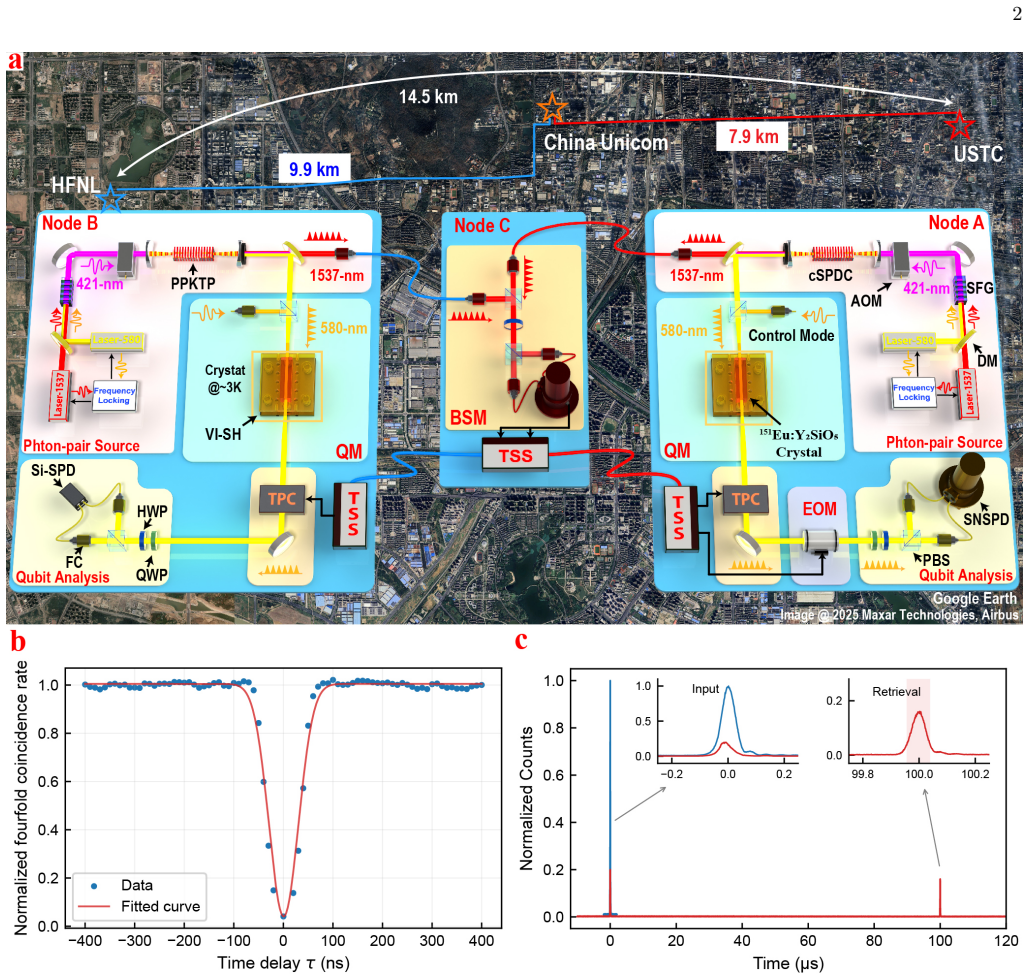
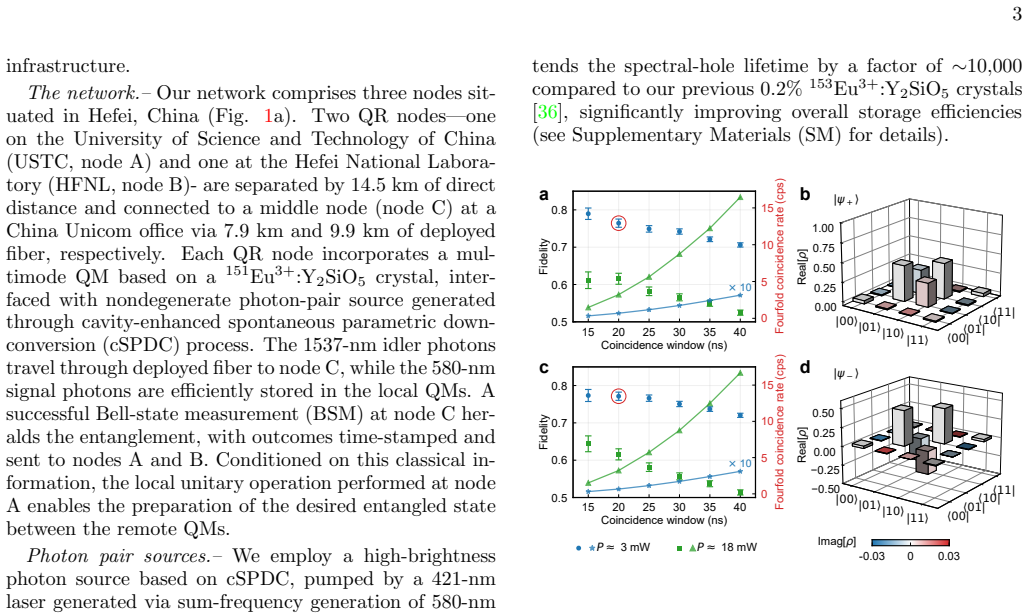
The authors establish that their MQR-TM protocol generates a Bell state with fidelity 78.6 plus or minus 2.0 percent between two solid-state quantum memories separated by 14.5 km, violating the CHSH-Bell inequality by 3.7 standard deviations and thereby certifying Bell nonlocality for the first time in a metropolitan-scale quantum repeater. The architecture supports autonomous node operation without fiber phase stabilization.
What carries the argument
The multiplexed quantum repeater protocol based on time measurements (MQR-TM), which combines single-photon interference for high heralding rates with two-photon interference for phase robustness through time-bin analysis.
If this is right
- Metropolitan quantum links can certify nonlocality without continuous active phase locking.
- Entanglement distribution rates increase while preserving Bell certification.
- Solid-state memories become practical building blocks for repeater chains.
- Autonomous quantum nodes simplify deployment across fiber networks.
Where Pith is reading between the lines
- The same time-bin method could be tested on longer links by cascading additional multiplexed nodes.
- Hybrid protocols combining this approach with other interference schemes become worth exploring.
- Similar certification could be attempted with different physical qubit platforms to check generality.
Load-bearing premise
Post-selection and time-bin analysis correctly identify heralded entanglement events without introducing hidden correlations or phase drifts that would invalidate the CHSH test.
What would settle it
A repeat of the experiment that yields a CHSH violation below the classical bound when the same data are re-analyzed with an independent post-selection window or an added phase-reference check.
Figures


read the original abstract
Quantum repeaters can overcome exponential photon loss in optical fibers, enabling heralded entanglement between distant quantum memories. The definitive benchmark for this entanglement is Bell nonlocality; however, recent metropolitan-scale demonstrations based on single-photon interference (SPI) schemes have been limited to generating low-quality entanglement, falling short of Bell nonlocality certification. Here, we introduce a multiplexed quantum repeater protocol based on time measurements (MQR-TM), successfully combining the high heralding rate of SPI schemes with the phase robustness of two-photon interference (TPI) schemes. This approach achieves heralded entanglement distribution between two solid-state quantum memories over a record 14.5~km separation, generating a Bell state with a fidelity of $78.6 \pm 2.0\%$. We observe a CHSH-Bell inequality violation by 3.7 standard deviations, marking the first certification of Bell nonlocality in metropolitan-scale quantum repeaters. Our architecture supports autonomous quantum node operation without fiber channel phase stabilization, offering a practical framework for scalable quantum-repeater networks.
Editorial analysis
A structured set of objections, weighed in public.
Referee Report
Summary. The manuscript presents a multiplexed quantum repeater protocol based on time measurements (MQR-TM) that combines high heralding rates from single-photon interference with the phase robustness of two-photon interference. It reports experimental generation of heralded entanglement between two solid-state quantum memories separated by 14.5 km, with a Bell-state fidelity of 78.6 ± 2.0% and a CHSH inequality violation observed at 3.7 standard deviations, claimed as the first certification of Bell nonlocality in a metropolitan-scale quantum repeater. The architecture is presented as enabling autonomous node operation without requiring active fiber-channel phase stabilization.
Significance. If the central experimental claim is substantiated by the full dataset and analysis, the result would mark a notable advance toward practical quantum repeater networks by demonstrating Bell nonlocality certification over record metropolitan distances in a multiplexed, phase-robust scheme. The combination of high-rate operation with nonlocality certification addresses a key gap in prior metropolitan demonstrations and supports scalability arguments for repeater-based quantum networks.
major comments (1)
- [Data analysis and CHSH evaluation sections] The central claim of a 3.7σ CHSH violation certifying nonlocality rests on the assumption that post-selection and time-bin analysis identify heralded events without introducing hidden correlations or unaccounted phase drifts. The manuscript should provide explicit quantitative bounds on differential phase fluctuations between time bins and on asymmetric detection efficiencies within the chosen post-selection windows (see the data analysis and CHSH evaluation sections), as even small effects in a 14.5 km link could allow a local-hidden-variable model to reproduce the observed correlations.
minor comments (1)
- [Abstract] The abstract states the fidelity and violation values but does not reference the specific error model or post-selection efficiency; these should be summarized with a forward reference to the relevant methods subsection for immediate clarity.
Simulated Author's Rebuttal
We thank the referee for their careful reading of the manuscript and for identifying this important point regarding the robustness of our CHSH analysis. We have prepared a point-by-point response below and will incorporate the requested clarifications into the revised version.
read point-by-point responses
-
Referee: [Data analysis and CHSH evaluation sections] The central claim of a 3.7σ CHSH violation certifying nonlocality rests on the assumption that post-selection and time-bin analysis identify heralded events without introducing hidden correlations or unaccounted phase drifts. The manuscript should provide explicit quantitative bounds on differential phase fluctuations between time bins and on asymmetric detection efficiencies within the chosen post-selection windows (see the data analysis and CHSH evaluation sections), as even small effects in a 14.5 km link could allow a local-hidden-variable model to reproduce the observed correlations.
Authors: We agree that explicit quantitative bounds strengthen the nonlocality claim and that the current manuscript does not present them in sufficient detail. In the revised manuscript we will add a dedicated subsection to the Data analysis and CHSH evaluation section (with supporting material in the supplement) that derives these bounds directly from our calibration data. Specifically, we will report the measured differential phase stability between adjacent time bins over the 14.5 km link and the maximum asymmetry in detection efficiency inside the post-selection windows, together with a simple model showing that the observed violation remains incompatible with local-hidden-variable theories even when these effects are taken at their upper bounds. We will also clarify how the time-measurement multiplexing protocol itself suppresses the relevant phase-drift channels without active stabilization. revision: yes
Circularity Check
No circularity: experimental measurements reported directly from data
full rationale
The paper reports an experimental demonstration achieving heralded entanglement over 14.5 km with measured fidelity of 78.6 ± 2.0% and a direct CHSH-Bell inequality violation of 3.7 standard deviations. No derivation chain is presented in which a prediction or first-principles result reduces by construction to fitted parameters, self-citations, or ansatzes within the paper's own equations. The central claims rest on observed statistics from the time-bin analysis and post-selection, which are externally falsifiable via the CHSH test rather than internally forced. This is the standard case for an experimental result that is self-contained against benchmarks.
Axiom & Free-Parameter Ledger
axioms (1)
- standard math Standard quantum mechanics and the validity of the CHSH inequality for certifying nonlocality
Lean theorems connected to this paper
-
IndisputableMonolith/Foundation/ArrowOfTime.leanarrow_from_z unclear?
unclearRelation between the paper passage and the cited Recognition theorem.
multiplexed quantum repeater protocol based on time measurements (MQR-TM), combining high heralding rate of SPI schemes with the phase robustness of two-photon interference (TPI) schemes... CHSH-Bell inequality violation by 3.7 standard deviations
What do these tags mean?
- matches
- The paper's claim is directly supported by a theorem in the formal canon.
- supports
- The theorem supports part of the paper's argument, but the paper may add assumptions or extra steps.
- extends
- The paper goes beyond the formal theorem; the theorem is a base layer rather than the whole result.
- uses
- The paper appears to rely on the theorem as machinery.
- contradicts
- The paper's claim conflicts with a theorem or certificate in the canon.
- unclear
- Pith found a possible connection, but the passage is too broad, indirect, or ambiguous to say the theorem truly supports the claim.
Forward citations
Cited by 2 Pith papers
-
Efficient integrated quantum memory for light
Integrated Eu3+:Y2SiO5 quantum memories in fiber and waveguide microcavities achieve record efficiencies of 80.3% for coherent pulses and 69.8% for heralded single photons while storing 20 temporal modes.
-
Spectroscopy and Coherence of an Excited-State Transition in Tm$^{3+}$:YAlO$_3$ at Telecommunication Wavelength
The first measurement of coherence in an excited-state optical transition in a rare-earth doped crystal yields a maximum coherence time of 4.75 μs at telecom wavelength.
Reference graph
Works this paper leans on
-
[1]
We measure the CHSH value for the her- alded atomic entanglement using the measurement set- tings A0 = (Z + X)/ √ 2, A1 = (Z − X)/ √ 2, B0 = −Z and B1 = X. As shown in Fig. 4, we observe a maxi- mal violation of S = 2.22 ± 0.06 exceeding the classical bound by 3.7 standard deviations. This high entangle- ment quality arises from the noise-robust TPI schem...
-
[2]
Briegel, H. J., D¨ ur, W., Cirac, J. I. & Zoller, P. Quan- tum repeaters: The role of imperfect local operations in quantum communication. Physical Review Letters 81, 5932–5935 (1998). URL https://link.aps.org/doi/ 10.1103/PhysRevLett.81.5932
-
[3]
Kimble, H. J. The quantum internet. Nature 453, 1023–1030 (2008). URL https://doi.org/10.1038/ nature07127
work page 2008
-
[4]
Sangouard, N., Simon, C., de Riedmatten, H. & Gisin, N. Quantum repeaters based on atomic ensembles and linear optics. Rev. Mod. Phys. 83, 33–80 (2011). URL https: //link.aps.org/doi/10.1103/RevModPhys.83.33
-
[5]
Wehner, S., Elkouss, D. & Hanson, R. Quantum inter- net: A vision for the road ahead. Science 362, eaam9288 (2018). URL https://www.science.org/doi/abs/10. 1126/science.aam9288
work page 2018
-
[6]
Device-independent security of quantum cryptography against collective attacks
Ac´ ın, A.et al. Device-independent security of quantum cryptography against collective attacks. Physical Review Letters 98, 230501 (2007). URL https://link.aps.org/ doi/10.1103/PhysRevLett.98.230501
-
[7]
Pironio, S. et al. Random numbers certified by bell’s theorem. Nature 464, 1021–1024 (2010). URL https: //doi.org/10.1038/nature09008
-
[8]
Hensen, B. et al. Loophole-free bell inequality violation using electron spins separated by 1.3 kilometres. Nature 526, 682–686 (2015). URL https://doi.org/10.1038/ nature15759
work page 2015
-
[9]
Liu, J.-L. et al. Creation of memory–memory entan- glement in a metropolitan quantum network. Nature 629, 579–585 (2024). URL https://doi.org/10.1038/ s41586-024-07308-0
work page 2024
-
[10]
Stolk, A. J. et al. Metropolitan-scale heralded entan- glement of solid-state qubits. Science Advances 10, eadp6442 (2024). URL https://www.science.org/doi/ abs/10.1126/sciadv.adp6442
-
[11]
Halder, M. et al. Entangling independent photons by time measurement. Nature Physics 3, 692–695 (2007). URL https://doi.org/10.1038/nphys700
-
[12]
Liu, X. et al. Heralded entanglement distribution between two absorptive quantum memories. Nature 594, 41–45 (2021). URL https://doi.org/10.1038/ s41586-021-03505-3
work page 2021
-
[13]
Clauser, J. F., Horne, M. A., Shimony, A. & Holt, R. A. Proposed experiment to test local hidden- variable theories. Physical Review Letters 23, 880– 884 (1969). URL https://link.aps.org/doi/10.1103/ PhysRevLett.23.880
work page 1969
-
[14]
Chou, C.-W. et al. Functional quantum nodes for en- tanglement distribution over scalable quantum networks. Science 316, 1316–1320 (2007). URL https://www. science.org/doi/abs/10.1126/science.1140300
-
[15]
Yu, Y. et al. Entanglement of two quantum mem- ories via fibres over dozens of kilometres. Nature 578, 240–245 (2020). URL https://doi.org/10.1038/ s41586-020-1976-7
work page 2020
- [16]
-
[17]
Hofmann, J. et al. Heralded entanglement be- tween widely separated atoms. Science 337, 72–75 (2012). URL https://www.science.org/doi/abs/10. 1126/science.1221856
work page 2012
-
[18]
van Leent, T. et al. Entangling single atoms over 33 km telecom fibre. Nature 607, 69–73 (2022). URL https: //doi.org/10.1038/s41586-022-04764-4
-
[19]
Zhang, W. et al. A device-independent quantum key distribution system for distant users. Nature 607, 687–691 (2022). URL https://doi.org/10.1038/ s41586-022-04891-y
work page 2022
-
[20]
Nadlinger, D. P. et al. Experimental quantum key distribution certified by bell’s theorem. Nature 607, 682–686 (2022). URL https://doi.org/10.1038/ s41586-022-04941-5
work page 2022
-
[21]
Krutyanskiy, V. et al. Entanglement of trapped-ion qubits separated by 230 meters. Physical Review Let- ters 130, 050803 (2023). URL https://link.aps.org/ doi/10.1103/PhysRevLett.130.050803
-
[22]
Delteil, A. et al. Generation of heralded entanglement between distant hole spins. Nature Physics 12, 218–223 (2016). URL https://doi.org/10.1038/nphys3605
-
[23]
Knaut, C. M. et al. Entanglement of nanophotonic quantum memory nodes in a telecom network. Nature 629, 573–578 (2024). URL https://doi.org/10.1038/ s41586-024-07252-z
work page 2024
-
[24]
Afzal, F. et al. Distributed quantum computing in silicon (2024). Preprint at 7 https://doi.org/10.48550/arXiv.2406.01704
-
[25]
Riedinger, R. et al. Remote quantum entangle- ment between two micromechanical oscillators. Nature 556, 473–477 (2018). URL https://doi.org/10.1038/ s41586-018-0036-z
work page 2018
-
[26]
Lago-Rivera, D., Grandi, S., Rakonjac, J. V., Seri, A. & de Riedmatten, H. Telecom-heralded entanglement be- tween multimode solid-state quantum memories. Nature 594, 37–40 (2021). URL https://doi.org/10.1038/ s41586-021-03481-8
work page 2021
-
[27]
Ruskuc, A. et al. Multiplexed entanglement of multi-emitter quantum network nodes. Nature 639, 54–59 (2025). URL https://doi.org/10.1038/ s41586-024-08537-z
work page 2025
-
[28]
Zhu, T.-X., Liu, X., Zhou, Z.-Q. & Li, C.-F. Re- mote quantum networks based on quantum memories. Nanophotonics 14, 1975–1992 (2025). URL https:// doi.org/10.1515/nanoph-2024-0487
-
[29]
Adamson, S. A. Parallel remote state preparation for fully device-independent verifiable blind quantum computation. Physical Review Research 7, 013069 (2025). URL https://link.aps.org/doi/10.1103/ PhysRevResearch.7.013069
work page 2025
-
[30]
ˇSupi´ c, I. & Bowles, J. Self-testing of quantum systems: a review. Quantum 4, 337 (2020). URL https://doi. org/10.22331/q-2020-09-30-337
-
[31]
Sekatski, P., Bancal, J.-D., Ioannou, M., Afzelius, M. & Brunner, N. Toward the device-independent certifi- cation of a quantum memory. Physical Review Letters 131, 170802 (2023). URL https://link.aps.org/doi/ 10.1103/PhysRevLett.131.170802
-
[32]
Barrett, S. D. & Kok, P. Efficient high-fidelity quantum computation using matter qubits and linear optics. Phys. Rev. A 71, 060310 (2005). URL https://link.aps.org/ doi/10.1103/PhysRevA.71.060310
-
[33]
Simon, C. et al. Quantum repeaters with photon pair sources and multimode memories. Physical Review Let- ters 98, 190503 (2007). URL https://link.aps.org/ doi/10.1103/PhysRevLett.98.190503
-
[34]
Fekete, J., Riel¨ ander, D., Cristiani, M. & de Riedmat- ten, H. Ultranarrow-band photon-pair source compat- ible with solid state quantum memories and telecom- munication networks. Physical Review Letters 110, 220502 (2013). URL https://link.aps.org/doi/10. 1103/PhysRevLett.110.220502
work page 2013
-
[35]
de Riedmatten, H., Afzelius, M., Staudt, M. U., Simon, C. & Gisin, N. A solid-state light–matter interface at the single-photon level. Nature 456, 773–777 (2008). URL https://doi.org/10.1038/nature07607
-
[36]
Ortu, A., Holz¨ apfel, A., Etesse, J. & Afzelius, M. Storage of photonic time-bin qubits for up to 20 ms in a rare-earth doped crystal. npj Quantum Information 8, 29 (2022). URL https://doi.org/10.1038/s41534-022-00541-3
-
[37]
Liu, X. et al. Nonlocal photonic quantum gates over 7.0 km. Nature Communications 15, 8529 (2024). URL https://doi.org/10.1038/s41467-024-52912-3
-
[38]
G¨ uhne, O. & T´ oth, G. Entanglement detec- tion. Physics Reports 474, 1–75 (2009). URL https://www.sciencedirect.com/science/article/ pii/S0370157309000623
work page 2009
-
[39]
Ma, Y.-Z. et al. Elimination of noise in optically rephased photon echoes. Nature Communications 12, 4378 (2021). URL https://doi.org/10.1038/s41467-021-24679-4
-
[40]
Liu, Y.-P. et al. A millisecond integrated quantum mem- ory for photonic qubits. Science Advances 11, eadu5264 (2025). URL https://www.science.org/doi/abs/10. 1126/sciadv.adu5264
work page 2025
-
[41]
Jiang, L., Taylor, J. M. & Lukin, M. D. Fast and robust approach to long-distance quantum communica- tion with atomic ensembles. Physical Review A 76, 012301 (2007). URL https://link.aps.org/doi/10. 1103/PhysRevA.76.012301
work page 2007
-
[42]
Zhao, B., Chen, Z.-B., Chen, Y.-A., Schmiedmayer, J. & Pan, J.-W. Robust creation of entanglement be- tween remote memory qubits. Physical Review Letters 98, 240502 (2007). URL https://link.aps.org/doi/ 10.1103/PhysRevLett.98.240502
-
[43]
Liu, J. et al. A solid-state source of strongly entangled photon pairs with high brightness and indistinguishabil- ity. Nature Nanotechnology 14, 586–593 (2019). URL https://doi.org/10.1038/s41565-019-0435-9
-
[44]
Afzelius, M. & Simon, C. Impedance-matched cav- ity quantum memory. Phys. Rev. A 82, 022310 (2010). URL https://link.aps.org/doi/10.1103/ PhysRevA.82.022310
work page 2010
-
[45]
Moiseev, S. A., Andrianov, S. N. & Gubaidullin, F. F. Efficient multimode quantum memory based on pho- ton echo in an optimal qed cavity. Phys. Rev. A 82, 022311 (2010). URL https://link.aps.org/doi/10. 1103/PhysRevA.82.022311
work page 2010
-
[46]
Ma, Y., Ma, Y.-Z., Zhou, Z.-Q., Li, C.-F. & Guo, G.-C. One-hour coherent optical storage in an atomic frequency comb memory. Nature Communications 12, 2381 (2021). URL https://doi.org/10.1038/s41467-021-22706-y . Acknowledgments This work is supported by the Innovation Program for Quantum Science and Tech- nology (No. 2021ZD0301200 and 2021ZD0301604), the...
discussion (0)
Sign in with ORCID, Apple, or X to comment. Anyone can read and Pith papers without signing in.