Correlation Enhanced Autonomous Quantum Battery Charging via Structured Reservoirs
Pith reviewed 2026-05-18 21:29 UTC · model grok-4.3
The pith
Global and local coherences plus total correlations enhance autonomous quantum battery charging
A machine-rendered reading of the paper's core claim, the machinery that carries it, and where it could break.
Core claim
The paper establishes that global and local coherences, as well as total correlations, act as quantum resources that enhance autonomous charging. The free energy stored in the quantum battery splits into contributions from coherence and correlations. Upper and lower bounds on ergotropy are derived in terms of these quantities, with numerical evidence from the three coupling configurations supporting the bounds.
What carries the argument
Three coupling configurations of a two-qubit structured reservoir interacting with the charger-battery system, together with ergotropy bounds expressed via free energy of coherence and correlations
If this is right
- Coherences and correlations can be adjusted through initial state choice and coupling to raise charging power and ergotropy.
- The free energy decomposition quantifies how much of the stored energy comes from coherence versus correlations.
- Structured reservoirs enable fully autonomous battery operation by turning environmental quantum features into usable resources.
Where Pith is reading between the lines
- The same resource-splitting approach could be tested in batteries with more than one charger qubit to check scalability of the enhancement.
- Adding controlled decoherence channels might reveal the regime where the derived bounds remain tight or begin to loosen.
Load-bearing premise
The three specified coupling configurations and the choice between incoherent and coherent initial states are sufficient to capture the relevant dynamics and resource enhancements.
What would settle it
A calculation in one of the three configurations where the measured ergotropy exceeds the derived upper bound or falls below the lower bound would falsify the claim.
Figures



read the original abstract
In this work, we investigate autonomous charging of a quantum battery coupled to a structured reservoir composed of two qubits, each locally coupled to its own bosonic thermal bath. Moreover, the reservoir interacts with a charger-battery architecture through three configurations: (I) direct coupling between reservoir qubits and battery, (II) collective coupling among reservoir qubits, charger, and battery, and (III) collective coupling between reservoir qubits and charger together with a local charger-battery interaction. Using incoherent and coherent initial states, we analyze stored energy, ergotropy, and charging power of the battery, and derive upper and lower bounds on extractable work in terms of free energy of coherence and correlations exchanged between subsystems. Our results show that global and local coherences, as well as total correlations, act as quantum resources that enhance autonomous charging. Additionally, we demonstrate that the free energy stored in the quantum battery splits into contributions from coherence and correlations, providing numerical evidence supporting the derived ergotropy bounds. Importantly, this work highlights how structured reservoirs enable autonomous and resource-enhanced quantum battery operation.
Editorial analysis
A structured set of objections, weighed in public.
Referee Report
Summary. The paper investigates autonomous charging of a quantum battery coupled to a structured two-qubit reservoir, with each qubit locally coupled to a bosonic thermal bath. It examines three coupling configurations between the reservoir and the charger-battery system (direct reservoir-battery, collective reservoir-charger-battery, and collective reservoir-charger plus local charger-battery), using both incoherent and coherent initial states. The authors analyze stored energy, ergotropy, and charging power, derive upper and lower bounds on extractable work from the free energy of coherence and correlations, and provide numerical evidence that global/local coherences and total correlations enhance charging while the battery free energy splits into coherence and correlation contributions.
Significance. If the central claims hold, the work is significant for quantum thermodynamics and battery research. It identifies concrete quantum resources (coherence and correlations) that can be engineered via structured reservoirs to improve autonomous operation, offers explicit ergotropy bounds tied to free-energy decompositions, and supplies numerical support for resource-enhanced performance. These elements distinguish the manuscript from purely phenomenological studies and could inform designs for controlled quantum energy storage.
major comments (2)
- [§3] §3 (Derivation of ergotropy bounds): The upper and lower bounds relating extractable work to free energy of coherence and correlations are derived using the specific interaction Hamiltonians and state decompositions for the three coupling configurations; it is unclear whether these expressions remain valid under variations in coupling strength or the addition of extra decoherence channels, which is load-bearing for the claim that coherences and correlations function as general resources.
- [§4] §4 (Numerical results and parameter choices): The reported enhancements in ergotropy and the free-energy splitting are demonstrated only for the three specified configurations and selected initial states; without robustness checks against non-Markovian effects or strong-coupling corrections in the bosonic baths, the numerical support does not fully establish that the bounds generalize beyond the simulated regimes.
minor comments (2)
- [Abstract] The abstract and introduction would benefit from a brief statement of the range of bath temperatures and coupling strengths explored in the numerics to contextualize the evidence.
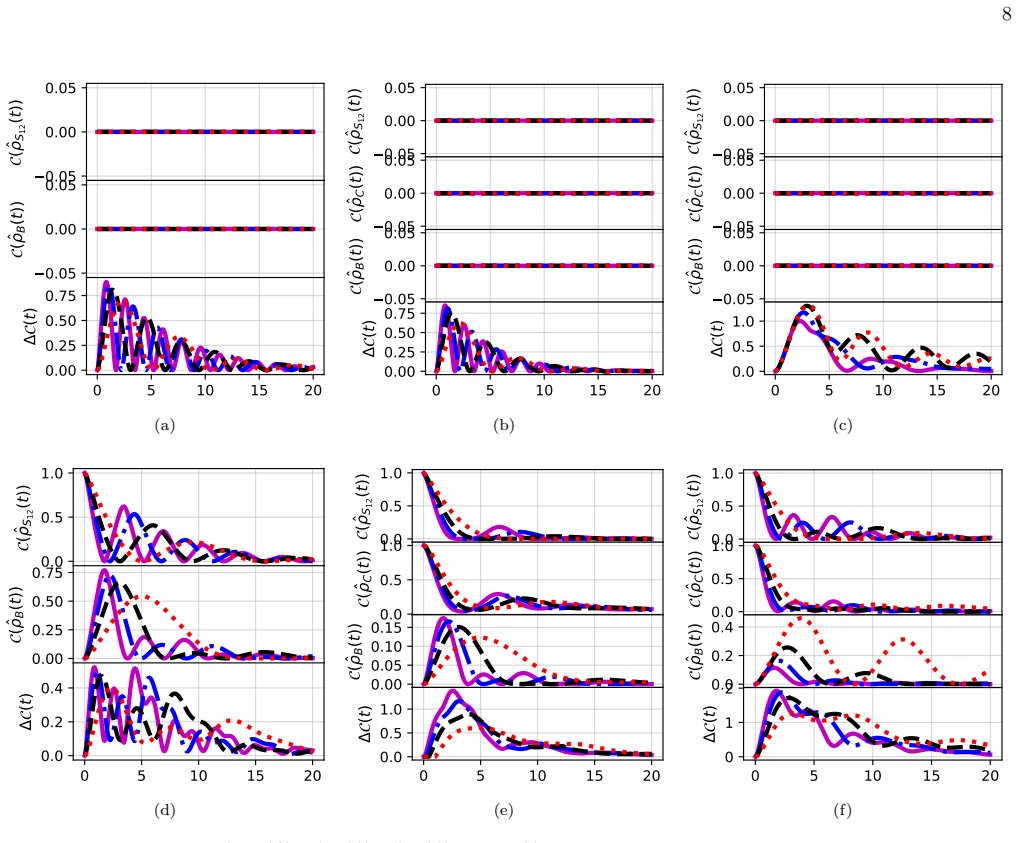
- [Figures] Figure captions for the charging-power plots should explicitly label which curves correspond to which of the three configurations and initial-state choices.
Simulated Author's Rebuttal
We thank the referee for their thorough review and valuable suggestions. We have carefully considered each comment and provide point-by-point responses below. Where appropriate, we will revise the manuscript to address the concerns raised.
read point-by-point responses
-
Referee: [§3] §3 (Derivation of ergotropy bounds): The upper and lower bounds relating extractable work to free energy of coherence and correlations are derived using the specific interaction Hamiltonians and state decompositions for the three coupling configurations; it is unclear whether these expressions remain valid under variations in coupling strength or the addition of extra decoherence channels, which is load-bearing for the claim that coherences and correlations function as general resources.
Authors: The derivation of the ergotropy bounds relies on the specific interaction Hamiltonians for the three coupling configurations and the decomposition of the total state into local and global coherence and correlation terms. While the underlying free-energy quantities (coherence and correlations) are defined generally via quantum information measures, the explicit upper and lower bounds are obtained by exploiting the structure of the system-reservoir interactions in our model. We acknowledge that these bounds may not hold identically under arbitrary changes in coupling strengths or additional decoherence channels. In the revised manuscript, we will clarify the regime of validity, emphasizing that the results demonstrate the resource-enhancing role within the considered autonomous charging setup and weak-coupling limit to the baths. We do not assert complete generality but provide a concrete example where these quantum resources improve performance. revision: partial
-
Referee: [§4] §4 (Numerical results and parameter choices): The reported enhancements in ergotropy and the free-energy splitting are demonstrated only for the three specified configurations and selected initial states; without robustness checks against non-Markovian effects or strong-coupling corrections in the bosonic baths, the numerical support does not fully establish that the bounds generalize beyond the simulated regimes.
Authors: Our numerical demonstrations are performed for the three coupling configurations and the chosen initial states (incoherent and coherent), with the bosonic baths treated in the standard weak-coupling, Markovian limit. We agree that additional robustness checks would strengthen the claims. However, incorporating non-Markovian dynamics or strong-coupling corrections would necessitate a substantially different modeling approach, such as exact master equations or numerical methods, which lies outside the current scope. In the revision, we will add a discussion of the limitations of the approximations used and include supplementary numerical results by varying the bath coupling strengths within the perturbative regime to show stability of the observed enhancements. revision: partial
Circularity Check
Derivation of ergotropy bounds relies on explicit model Hamiltonians and numerical verification without reduction to inputs by construction.
full rationale
The paper explicitly constructs the system from three specified coupling configurations between the two-qubit reservoir and charger-battery, together with incoherent versus coherent initial states, then derives bounds on extractable work from the free energy of coherence and correlations. Numerical evidence is presented to confirm the splitting of stored free energy and to support the bounds. No step reduces a claimed prediction or bound to a fitted parameter, self-definition, or self-citation chain; the central results remain independent of the specific simulated regimes once the interaction Hamiltonians are given. This is the most common honest finding for a model-based quantum thermodynamics paper that supplies both analytic bounds and supporting numerics.
Axiom & Free-Parameter Ledger
axioms (2)
- domain assumption Standard Markovian or non-Markovian master-equation dynamics for qubits coupled to bosonic thermal baths
- domain assumption Unitary evolution under the specified interaction Hamiltonians for the three coupling configurations
Lean theorems connected to this paper
-
IndisputableMonolith/Cost/FunctionalEquation.leanwashburn_uniqueness_aczel unclear?
unclearRelation between the paper passage and the cited Recognition theorem.
We investigate the Hamiltonian ĤInt, which describes the interaction between the qubits of the system S. Here, we will discuss three scenarios... The interaction Hamiltonian for this scenario, denoted ĤIntI, is given by ĤIntI = g1 [|0S11S20B⟩ ⟨1S10S21B| + H.c.]
-
IndisputableMonolith/Foundation/AlphaCoordinateFixation.leanJ_uniquely_calibrated_via_higher_derivative unclear?
unclearRelation between the paper passage and the cited Recognition theorem.
the free energy of coherence of the quantum battery, W(ρ̂B), bounds the ergotropy of coherence... 0 ≤ E_C_B ≤ W(ρ̂B) := K_B T C(ρ̂B)
What do these tags mean?
- matches
- The paper's claim is directly supported by a theorem in the formal canon.
- supports
- The theorem supports part of the paper's argument, but the paper may add assumptions or extra steps.
- extends
- The paper goes beyond the formal theorem; the theorem is a base layer rather than the whole result.
- uses
- The paper appears to rely on the theorem as machinery.
- contradicts
- The paper's claim conflicts with a theorem or certificate in the canon.
- unclear
- Pith found a possible connection, but the passage is too broad, indirect, or ambiguous to say the theorem truly supports the claim.
Reference graph
Works this paper leans on
-
[1]
11 (Scenario I), with the objective of establishing a com- mon interaction between S1, S2, and B
Scenario I: Common interaction between S12 and the battery For this scenario, we consider the batteryB to be in di- rect contact with the qubits S12, as illustrated in Fig. 11 (Scenario I), with the objective of establishing a com- mon interaction between S1, S2, and B. The goal is to induce transitions from the state |0S11S20B⟩ to the state |1S10S21B⟩ un...
-
[2]
Scenario II: Common interaction between S12 and the charger–battery system In this scenario, we analyze the case of a common in- teraction between S12 and C and B, respectively, as il- lustrated in Fig. 11 (Scenario II). We realize a common interaction between the total system qubits to drive the transition from |0S11S21C0B⟩ to |1S10S20C1B⟩ under the reso...
-
[3]
Scenario III: Common interaction between S12 and the charger, and local charger–battery interaction We now consider a common interaction between S12 and the charger, with the objective of driving the tran- sition from the state |0S11S20C⟩ ⟨0S11S20C| ⊗ I B to the state |1S10S21C⟩ ⟨1S10S21C| ⊗ I B. Between the charger and the battery, the interaction biases...
-
[4]
Energy Storage and Ergotropy of the Quantum Battery The energy stored in the quantum batteryB over time, denoted EB, is an important quantity to highlight the energy transferred to the quantum battery. Mathemati- cally, it is defined a EB = T r{ ˆHB ˆρB}, (13) where this energy can increase over time; however, this does not necessarily mean that the batte...
work page 1919
-
[5]
Free Energy of Coherence and Bounds on Quantum Battery Ergotropy As demonstrated in Eq. 1414, the ergotropy can origi- nate either from the population or from the coherence of the quantum battery. In the literature, the maximum extractable work due to coherence is quantified by the free energy of coherence [ 1717, 1818, 2828]. For any state ˆ ρ, denoted W...
-
[6]
Max F Riedel et al, ”The European quantum technologies flagship programme ” , Quantum Sci. Technol. 2 030501 (2017)
work page 2017
-
[7]
Antonio Ac´ ın et al,”The quantum technologies roadmap: a European community view”, New J. Phys. 20 080201 (2018)
work page 2018
-
[8]
Quantum bat- teries: The future of energy storage?,
J. Q. Quach, G. Cerullo, and T. Virgili, “Quantum bat- teries: The future of energy storage?,” Joule 7, 2195– 2200 (2023)
work page 2023
-
[9]
Application of quan- tum computing in the design of new materials for batter- ies,
A. Demir, E. Yildiz, and C. Kaya, “Application of quan- tum computing in the design of new materials for batter- ies,” J. Tecnol. Quantica 1, 288–300 (2024)
work page 2024
-
[10]
Charger-mediated energy transfer for quantum batteries: An open-system approach,
D. Farina, G. M. Andolina, A. Mari, M. Polini, and V. Giovannetti, “Charger-mediated energy transfer for quantum batteries: An open-system approach,” Phys. Rev. B 99, 035421 (2019)
work page 2019
-
[11]
Charger-mediated en- ergy transfer in exactly solvable models for quantum bat- teries,
G. M. Andolina, D. Farina, A. Mari, V. Pellegrini, V. Giovannetti, and M. Polini, “Charger-mediated en- ergy transfer in exactly solvable models for quantum bat- teries,” Phys. Rev. B 98, 205423 (2018)
work page 2018
-
[12]
Performance of a super- conducting quantum battery,
S. Elghaayda, A. Ali, S. Al-Kuwari, A. Czerwinski, M. Mansour, and S. Haddadi, “Performance of a super- conducting quantum battery,” Adv. Quantum Technol. 2025, 2400651
work page 2025
-
[13]
Topological quantum batteries,
Z. G. Lu, G. Tian, X. Y. L¨ u, and C. Shang, “Topological quantum batteries,” Phys. Rev. Lett. 134, 180401 (2025)
work page 2025
-
[14]
Super-optimal charging of quantum batteries via reser- voir engineering,
B. Ahmadi, P. Mazurek, S. Barzanjeh, and P. Horodecki, “Super-optimal charging of quantum batteries via reser- voir engineering,” Phys. Rev. Appl. 23, 024010 (2024)
work page 2024
-
[15]
Dynamical blockade of a reservoir for op- timal performances of a quantum battery,
F. Cavaliere, G. Gemme, G. Benenti, D. Ferraro, and M. Sassetti, “Dynamical blockade of a reservoir for op- timal performances of a quantum battery,” Commun. Phys. 8, 76 (2025)
work page 2025
-
[16]
Reservoir-assisted quantum bat- tery charging at finite temperatures,
Y. Yao and X. Q. Shao, “Reservoir-assisted quantum bat- tery charging at finite temperatures,” Phys. Rev. A 111, 062616 (2025)
work page 2025
-
[17]
Nonreciprocal quantum batteries,
B. Ahmadi, P. Mazurek, P. Horodecki, and S. Barzan- jeh, “Nonreciprocal quantum batteries,” Phys. Rev. Lett. 132, 210402 (2024)
work page 2024
-
[18]
En- hancing the performance of an open quantum battery via environment engineering,
K. Xu, H. J. Zhu, G. F. Zhang, and W. M. Liu, “En- hancing the performance of an open quantum battery via environment engineering,” Phys. Rev. E 104, 064143 (2021)
work page 2021
-
[19]
Quantum batteries in non-Markovian reservoirs,
J. L. Li, H. Z. Shen, and X. X. Yi, “Quantum batteries in non-Markovian reservoirs,” Opt. Lett. 47, 5614–5617 (2022)
work page 2022
-
[20]
Structure of passive states and its implication in charging quantum batteries,
M. Alimuddin, T. Guha, and P. Parashar, “Structure of passive states and its implication in charging quantum batteries,” Phys. Rev. E 102, 022106 (2020)
work page 2020
-
[21]
Quantum coherence and ergotropy,
G. Francica, F. C. Binder, G. Guarnieri, M. T. Mitchi- son, J. Goold, and F. Plastina, “Quantum coherence and ergotropy,” Phys. Rev. Lett. 125, 180603 (2020)
work page 2020
-
[22]
Ergotropy from quantum and classical correlations,
A. Touil, B. C ¸ akmak, and S. Deffner, “Ergotropy from quantum and classical correlations,” J. Phys. A: Math. Theor. 55, 025301 (2021)
work page 2021
-
[23]
Extraction of ergotropy: Free energy bound and application to open cycle engines,
T. Biswas, M. Lobejko, P. Mazurek, K. Ja lowiecki, and M. Horodecki, “Extraction of ergotropy: Free energy bound and application to open cycle engines,” Quantum 6, 841 (2022)
work page 2022
-
[24]
R. Castellano, D. Farina, V. Giovannetti, and A. Acin, “Extended local ergotropy,” Phys. Rev. Lett. 133, 150402 (2024)
work page 2024
-
[25]
S.Lorenzo et al, ”Composite quantum collision models”, Phys. Rev. A, 96, 032107 (2017)
work page 2017
-
[26]
”The theory of open quan- tum systems”
H.-P.Breuer, F.Petruccione. ”The theory of open quan- tum systems”. Oxford University Press(2002)
work page 2002
-
[27]
A.Rivas Vargas, ”Open quantum systems and quantum information dynamics”, (Doctoral thesis, Universitaire Ulm) (2011)
work page 2011
-
[28]
S. Ghosh, A. Opala, M. Matuszewski, T. Paterek, and T. C. H. Liew, “Quantum reservoir processing,” npj Quantum Information 5, 35 (2019)
work page 2019
-
[29]
B. L. Fang, J. Shi, and T. Wu, “Quantum-memory- assisted entropic uncertainty relation and quantum co- herence in structured reservoir,” Int. J. Theor. Phys. 59, 763 (2020)
work page 2020
-
[30]
How small can thermal machines be? The smallest possible refrig- erator,
N. Linden, S. Popescu, and P. Skrzypczyk, “How small can thermal machines be? The smallest possible refrig- erator,” Phys. Rev. Lett. 105, 130401 (2010)
work page 2010
-
[31]
A. Khoudiri, A. El Allati, ¨O. E. M¨ ustecaplıo˘ glu, and K. El Anouz, “Non-Markovianity and a generalized Lan- dauer bound for a minimal quantum autonomous thermal machine with a work qubit,” Phys. Rev. E 111, 044124 (2025)
work page 2025
-
[32]
M. Lostaglio, D. Jennings, and T. Rudolph, “Descrip- tion of quantum coherence in thermodynamic processes requires constraints beyond free energy,” Nat. Commun. 6, 6383 (2015)
work page 2015
-
[33]
Comparison of incoherent operations and measures of coherence,
E. Chitambar and G. Gour, “Comparison of incoherent operations and measures of coherence,” Phys. Rev. A 94, 052336 (2016)
work page 2016
-
[34]
Quantum version of free- energy–irreversible-work relations,
W. De Roeck and C. Maes, “Quantum version of free- energy–irreversible-work relations,” Phys. Rev. E 69, 026115 (2004)
work page 2004
-
[35]
T. Baumgratz, M. Cramer, and M. B. Plenio, “Quanti- fying coherence,” Phys. Rev. Lett. 113, 140401 (2014)
work page 2014
-
[36]
Coupling super- conducting qubits via a cavity bus,
J. Majer, J. M. Chow, J. M. Gambetta, J. Koch, B. R. Johnson, J. A. Schreier, et al. , “Coupling super- conducting qubits via a cavity bus,”Nature 449, 443–447 (2007)
work page 2007
-
[38]
Demonstration of two-qubit algorithms with a superconducting quantum processor,
L. DiCarlo, J. M. Chow, J. M. Gambetta, L. S. Bishop, B. R. Johnson, D. I. Schuster, et al. , “Demonstration of two-qubit algorithms with a superconducting quantum processor,” Nature 460, 240–244 (2009)
work page 2009
-
[39]
Universal gate for fixed-frequency qubits via a tunable bus,
D. C. McKay, S. Filipp, A. Mezzacapo, E. Magesan, J. M. Chow, and J. M. Gambetta, “Universal gate for fixed-frequency qubits via a tunable bus,” Phys. Rev. Appl. 6, 064007 (2016)
work page 2016
-
[40]
Bounds on charging power of open quantum batteries,
S. Zakavati, F. T. Tabesh, and S. Salimi, “Bounds on charging power of open quantum batteries,” Phys. Rev. E 104, 054117 (2021)
work page 2021
-
[41]
Y. Khlifi, A. El Allati, A. Salah, and Y. Hassouni, “Quan- tum heat engine based on spin isotropic Heisenberg mod- els with Dzyaloshinskii–Moriya interaction,” Int. J. Mod. Phys. B 34, 2050212 (2020)
work page 2020
-
[42]
Non-Markovian effects on the perfor- mance of a quantum Otto refrigerator,
A. El Allati, K. El Anouz, M. H. B. A. Chakour, and S. Al-Kuwari, “Non-Markovian effects on the perfor- mance of a quantum Otto refrigerator,” Phys. Lett. A 11 496, 129316 (2024)
work page 2024
-
[43]
Steady state entanglement behavior between two quantum refrigera- tors,
Y. Khlifi, S. Seddik, and A. El Allati, “Steady state entanglement behavior between two quantum refrigera- tors,” Physica A 596, 127199 (2022)
work page 2022
-
[44]
M. H. B. Chakour, A. El Allati, and Y. Hassouni, “Entan- gled quantum refrigerator based on two anisotropic spin- 1/2 Heisenberg XYZ chain with Dzyaloshinskii–Moriya interaction,” Eur. Phys. J. D 75, 42 (2021)
work page 2021
-
[45]
B. M. H. Abdou Chakour, A. El Allati, and Y. Hassouni, “[Title not provided],” Phys. Lett. A 451, 128410 (2022)
work page 2022
-
[46]
Eval- uating the performance of a refrigerator by an external system using entanglement,
Y. Khlifi, A. El Allati, A. Salah, and Y. Hassouni, “Eval- uating the performance of a refrigerator by an external system using entanglement,” Eur. Phys. J. D 75, 195 (2021)
work page 2021
discussion (0)
Sign in with ORCID, Apple, or X to comment. Anyone can read and Pith papers without signing in.