REVIEW 4 major objections 4 minor 1 cited by
Numerical study of high-dimensional covariance estimation and localization for data assimilation
T0 review · 4 major / 4 minor · reviewed 2026-08-05 · deepseek-v4-flash
Pith's one-line read Traditional distance-based Gaspari-Cohn localization generally yields the largest error reduction in the cycling ensemble data assimilation experiments tested, beating or matching more general statistical covariance estimation methods that
desk verdict Solid benchmark, but the general claim on distance-based localization reaches past the evidence. read the letter →
The pith
A machine-rendered reading of the paper's core claim, the machinery that carries it, and where it could break.
The reading
What carries the argument
The study's central object is the localized forecast covariance Pf = T ∘ S, the elementwise (Schur) product of the ensemble sample covariance S with a tapering matrix T; the Schur Product Theorem guarantees the result is positive semidefinite whenever T is. Traditional localization builds T from spatial distance using the Gaspari-Cohn function, a compactly supported approximation to a Gaussian. The comparison machinery includes the variance-correlation factorization S = V^(1/2) C V^(1/2) underlying power-law corrections (PLC) and the NICE estimator; a Cholesky-factor construction that extends distance-based tapering to state-parameter cross-covariances; and hard, soft, and SCAD thresholding
What would settle it
Run the same cycling EnKF comparison on a dynamical system whose true forecast covariance has substantial off-diagonal mass at long range—for example, a model with strong teleconnections or multiscale couplings between distant regions—and compare tuned Gaspari-Cohn localization against NICE or PLC. If a structure-agnostic method consistently achieves materially lower analysis RMSE than GC across ensemble sizes and observation densities, the paper's central claim about the general superiority of distance-based localization would be overturned.
Extended reading notes
Core claim
The paper's central claim is that on the test problems examined—a Gaussian illustration, a modified Lorenz '96 model with joint state-parameter estimation, and a two-layer quasi-geostrophic model—traditional distance-based localization with the Gaspari-Cohn function yields the largest or near-largest reduction in EnKF analysis error relative to the raw sample covariance. Correlation-based methods (PLC, NICE) come close but not better; hybrid shrinkage to a climatological covariance and GenGC localization are the only methods that are sometimes comparable or slightly better, and both require a background covariance or more tunable parameters that GC does not. Thresholding and Ledoit-Wolf shri
Load-bearing premise
The conclusion depends on the test problems being representative: even though they were designed to challenge distance-based localization, their true correlations still fade with distance, and the paper flags in Section 5 that this spatial structure likely helped distance-based methods win.
Editorial extensions
If this is right
- In cycling stochastic EnKF settings, practitioners can expect simple, tuned Gaspari-Cohn localization to match or beat more elaborate covariance estimation schemes without extra overhead.
- Shrinkage is only as good as its target: hybrid estimators with a climatological background can slightly beat GC, but Ledoit-Wolf shrinkage to the identity matrix is not competitive for data assimilation.
- Thresholding methods are risky inside an EnKF because non-PSD covariance estimates introduce negative eigenvalues that destabilize the filter; making thresholds large enough to stabilize the filter removes their benefit.
- Positive semidefiniteness of the localized covariance, rather than the sophistication of the tapering rule, appears to be the dominant factor in error reduction.
- Correlation-based localization (PLC, NICE) produces competitive but slightly worse analyses than distance-based localization even in problems designed to favor structure-agnostic methods.
Reading between the lines
- The paper's own caveat in Section 5 suggests its two test problems still have correlations that decay with distance; a genuine stress test of the 'distance-based wins' claim would need a problem with long-range, nonlocal covariance structure (e.g., teleconnections or multiscale extreme-weather features), where structure-agnostic methods could plausibly dominate.
- One testable extension: repeat the comparison with NICE and PLC in a state space without any natural metric (e.g., graph-based or abstract parameter spaces), where distance-based localization cannot even be defined; the paper hints these methods may be more competitive there.
- The filter blow-ups from thresholding point to a concrete diagnostic: monitoring the minimum eigenvalue of HPf H^T + R during cycling could serve as an early-warning criterion for whether a covariance estimation method is safe to use in an EnKF.
- If the dominance of PSD preservation over localization-rule sophistication holds, research effort in covariance localization might shift from designing fancier tapering rules toward cheap ways to enforce positive definiteness and cheap climatological targets for shrinkage.
Signed reviews
Editorial analysis
A structured set of objections, weighed in public.
Referee Report
Summary. The paper compares traditional distance-based (Gaspari-Cohn, GC) covariance localization with a range of alternative schemes — generalized GC (GenGC), hybrid/shrinkage estimators, Ledoit-Wolf, power-law correction (PLC), NICE, and hard/soft/SCAD thresholding — in three settings: a Gaussian covariance-estimation illustration, a modified Lorenz-96 model with joint state and parameter estimation, and a two-layer quasi-geostrophic model. In cycling stochastic EnKF experiments with small ensembles, the authors find that localization of any kind that preserves positive definiteness substantially reduces analysis RMSE relative to using the raw sample covariance, that GC localization is generally at least as good as the alternatives, that hybrid estimators and GenGC sometimes yield small improvements, and that thresholding and Ledoit-Wolf perform poorly, with thresholding frequently causing filter divergence due to non-positive-definite covariance estimates. The paper concludes that simple distance-based localization remains a strong default.
Significance. If the conclusions hold, the paper provides a valuable empirical check on a growing literature proposing more complex covariance estimators and localization schemes for ensemble data assimilation. Its strengths include carefully designed test problems that go beyond the usual Lorenz-96 benchmark (state-parameter estimation, spatially averaged observations, inhomogeneous forcing), repeated experiments over 50 draws with quantile reporting, large-ensemble references, and explicit discussion of failure modes such as non-PSD thresholded covariances. The results are reported with enough detail that the main comparisons are interpretable. However, the headline claim that distance-based localization is generally best is broader than what the experiments can support, and several methodological choices (tuning on the evaluation metric, no covariance inflation, no code release) weaken the force of the comparisons. The paper is a useful contribution but needs substantial revision to align its claims with its evidence.
major comments (4)
- [Abstract; §5; §2.6] The abstract's claim that 'traditional, distance-based localization generally leads to the largest error reduction' overreaches the evidence. As Section 5 concedes, both test problems 'have an underlying spatial structure that likely contributes to the success of distance-based localization' and do not 'necessarily model multiscale features observed in extreme weather events.' Section 2.6 similarly notes that distance-based localization is 'most appropriate' when covariances decay with distance. The modified L96 and QG problems are local dynamics with local (spatially averaged) observations and distance-decaying covariances, so they do not constitute a genuine stress test for nonlocal or strongly multiscale structures. The wording of the main conclusion should be restricted to the tested class of problems, or additional experiments with genuinely nonlocal correlation structures (e.g., no
- [§3.2, §4.2; Eqs. (16), (4), (6), (7)-(9)] Hyperparameters for the competing methods are tuned by minimizing the same analysis-RMSE metric on which the methods are then ranked (e.g., the GenGC scale c* in Eq. (16), hybrid coefficients alpha1 and alpha2, PLC power a, and threshold lambda). No separate validation set or sensitivity analysis is reported. This can systematically favor methods with more tunable parameters and make reported gains (or lack of gains) artifacts of tuning. Please describe the tuning protocol precisely, including whether tuning is performed on independent synthetic observations or on the actual test experiments, and provide sensitivity of the rankings to hyperparameter choices.
- [§3.1, §3.3, §4.3] The experiments deliberately omit covariance inflation, yet Section 3.3 states that PLC and NICE underestimate variances and that this 'may be fixed with an appropriate variance inflation scheme.' Because covariance inflation is standard in small-ensemble EnKF practice and is known to interact with localization, the absence of inflation may disadvantage the correlation-based methods in particular. The paper should either include experiments with a standard inflation scheme (applied equally to all methods) or explicitly temper the claim that PLC/NICE 'cannot reach the low RMSE' of GC/hybrid methods to the no-inflation setting.
- [§3.3] The discussion of thresholding is internally hard to follow. The text says that for thresholds large enough to avoid blow-up, 'essentially no thresholding occurs, i.e., the thresholded forecast covariance is nearly identical to the sample covariance,' yet the filter is said to diverge and the reported RMSE is worse than for the sample covariance. Please clarify what is meant by 'diverges' in this regime, how the RMSE values in Figure 4 are computed when the filter is said to diverge, and why a nearly un-thresholded covariance leads to worse behavior than using the sample covariance directly.
minor comments (4)
- [§3.3] Typo: 'psotive definitness' should be 'positive definiteness.'
- [§4.1] The sentence 'We chose the forecast time to be one (model) time unit based on the autocorrelation times inherent to the QG model, which we estimate to be approximately three model time units' is confusing: a forecast time of one time unit is not obviously consistent with an autocorrelation time of three. Please clarify the reasoning.
- [§4.2] The statement that no inhomogeneous covariance structure was found for GenGC appears to conflict with the description of strong zonal structure in the climatological stream functions in §4.1. Please specify whether the lack of inhomogeneity refers to the forecast error covariance rather than the climatology, and how this was assessed.
- [Data Availability] Since this is a numerical study, providing the code on GitHub/Zenodo only after acceptance makes independent verification difficult during review. Consider making the code available as supplemental material for the review process.
Circularity Check
No circular derivation: the central claim is an independent empirical benchmark with only non-load-bearing self-citations.
full rationale
The paper's main conclusion—that traditional distance-based GC localization generally yields the largest error reduction among tested methods—is an empirical finding obtained from cycling EnKF experiments on two dynamical models, not a quantity derived from the method definitions. Each localization/covariance method is implemented according to its own published formulation, hyperparameters are tuned on the same analysis-RMSE metric for all tunable methods, and large-ensemble no-localization references are included as benchmarks. The comparison is therefore self-contained and externally meaningful. The paper does cite the authors' own prior work (Morzfeld & Hodyss 2023; Hodyss & Morzfeld 2023; Gilpin et al. 2023; Vishny et al. 2024), but these citations supply the methods being tested and an interpretive 'linear theory' context; the numerical ranking does not reduce to any of these cited results. The admitted limitation that the test problems 'have an underlying spatial structure that likely contributes to the success of distance-based localization' (Section 5) is a threat to external validity, not circularity. No equation or fitted parameter is renamed as a prediction. Score 2 reflects only the presence of non-load-bearing self-citations; there is no exhibited circular step.
Assumptions & free parameters
free parameters (7)
- GC state cutoff c (L96) =
0.05
- GC parameter cutoff c (L96) =
0.075
- GC cutoffs in QG (four) =
not reported
- GenGC scale c* (L96) =
0.05
- Hybrid coefficients alpha1, alpha2 =
not reported
- PLC power a =
not reported
- Threshold lambda for hard/soft/SCAD =
chosen to avoid filter blow-up
assumptions (5)
- domain assumption The stochastic EnKF is representative of ensemble DA methods and conclusions generalize to other variants
- domain assumption Test problems' covariance structure is sufficiently challenging to distance-based localization
- standard math Tapering via Schur product with a PSD correlation matrix keeps the localized covariance PSD
- domain assumption No covariance inflation is applied so the effect of estimation methods is isolated
- domain assumption Observation error covariance R and noise amplitudes are fixed and known
Cite this review
Pith. "Pith review of Numerical study of high-dimensional covariance estimation and localization for data assimilation." pith.science (2026). https://pith.science/paper/ZP2P5VQR
@misc{pith2026250818299,
  author       = {Pith},
  title        = {Pith review of: Numerical study of high-dimensional covariance estimation and localization for data assimilation},
  year         = {2026},
  howpublished = {\url{https://pith.science/paper/ZP2P5VQR}},
  note         = {Machine review of arXiv:2508.18299}
}
read the original abstract
Covariance localization is a critical component of ensemble-based data assimilation (DA) and many current localization schemes simply dampen correlations as a function of distance. Increases in computational resources, broadening scope of application for DA, and advances in general statistical methodology raise the question as to whether alternative localization methods may improve ensemble DA relative to current schemes. We carefully explore this issue by comparing distance based localization with alternative covariance localization techniques, partially those taken from the statistical literature. The comparison is done on test problems that we designed to challenge distance-based localization, including joint state-parameter estimation in a modified Lorenz '96 model and state estimation in a two-layer quasi-geostrophic model. Across all sets of experiments, we find that while localization of any kind (with rare exceptions) can lead to significant reductions in error, traditional, distance-based localization generally leads to the largest error reduction. More general localization schemes can sometimes lead to greater error reduction, though the impacts may only be marginal and may require more tuning and/or prior information.
Figures


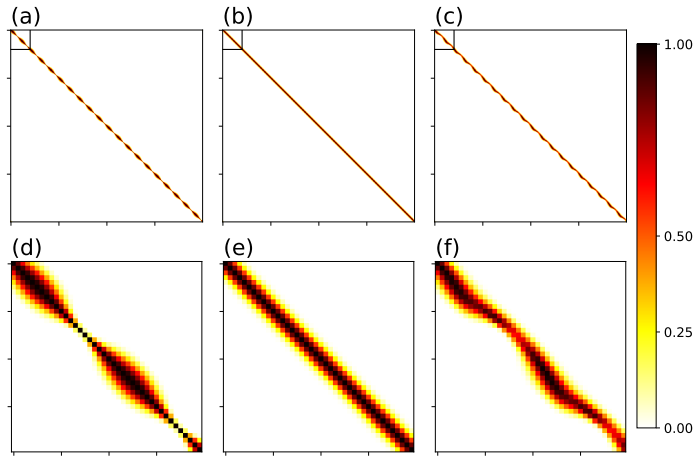
Figures from the paper (5 more)


Forward citations
Cited by 1 Pith paper
-
Towards Training-Free Underwater 3D Object Detection from Sonar Point Clouds: A Comparison of Traditional and Deep Learning Approaches
Template matching achieves 83% mAP on real sonar data, outperforming a neural network trained on synthetic data, which drops to 40% mAP, showing training-free geometric methods can beat synthetic-to-real transfer.
Reference graph
Works this paper leans on
-
[1]
Al-Ghattas, O., Chen, J., Sanz-Alonso, D., and Waniorek, N. (2025). Covariance operator estima- tion: Sparsity, lengthscale, and ensemble Kalman filters. Bernoulli, 31(3):2377–2402. Anderson, J. (2001). An ensemble adjustment Kalman filter for data assimilation. Mon. Weather Rev., 129(12):2884–2903. Anderson, J. (2012). Localization and sampling error cor...
work page 2025
-
[227]
Bishop, C. and Hodyss, D. (2009a). Ensemble covariances adaptively localized with ECO-RAP. Part 1: Tests on simple error models. Tellus A, 61(1):84–96. Bishop, C. and Hodyss, D. (2009b). Ensemble covariances adaptively localized with ECO-RAP. Part 2: A strategy for the atmosphere. Tellus A, 61(1):97–111. Bishop, C., Whitaker, J., and Lei, L. (2017). Gain ...
work page 2017
-
[683]
Talagrand, O. and Courtier, P. (1987). Variational assimilation of meteorological observations with the adjoint vorticity equation. I: Theory. Q. J. Roy. Meteor. Soc. , 113:1311–1328. Tippett, M., Anderson, J., Bishop, C., Hamill, T., and Whitaker, J. (2003). Ensemble square root filters. Mon. Weather Rev. , 131:1485–1490. Vallis, G. K. (2017). Atmospheri...
work page 1987
-
[1360]
Sigma- point Kalman filter data assimilation methods for strongly nonlinear systems
Flowerdew, J. (2015). Towards a theory of optimal localisation. Tellus A, 67(1):25257. Gaspari, G. and Cohn, S. E. (1999). Construction of correlation functions in two and three dimen- sions. Q. J. Roy. Meteor. Soc. , 125:723–757. Gaspari, G., Cohn, S. E., Guo, J., and Pawson, S. (2006). Construction and application of covari- ance functions with variable...
work page 2015
-
[1468]
Buehner, M., Mourneau, J., and Charette, C. (2013). Four-dimensional ensemble-variational data assimilation for global deterministic weather prediction. Nonlin. Processes Geophys., 20:669–682. 19 Buehner, M. and Shlyaeva, A. (2015). Scale-dependent background-error covariance localisation. Tellus A, 67:28027. Burgers, G., van Leeuwen, P., and Evensen, G. ...
work page 2013
-
[2426]
Horn, R. and Johnson, C. R. (1985). Matrix Analysis. Cambridge University Press. Houtekamer, P. L. and Mitchell, H. L. (2001). A sequential ensemble Kalman filter for atmospheric data assimilation. Mon. Weather Rev. , 128:123–137. 20 Kuhl, D. D., Rosmond, T. E., Bishop, C. H., McLay, J., and Baker, N. L. (2013). Comparison of hybrid ensemble/4dvar and 4dv...
arXiv 1985
-
[3500]
Hodyss, D. and Morzfeld, M. (2023). How sampling errors in covariance estimates cause bias in the Kalman gain and impact ensemble data assimilation. Mon. Weather Rev. , 151(9):2413 –
work page 2023
Reviewed August 5, 2026 · model on record in the stance chip above.
Discussion (0). Continue with ORCID to comment.