REVIEW 2 major objections 4 minor 1 cited by
Destructive Interference induced constraints in Floquet systems
T0 review · 2 major / 4 minor · reviewed 2026-08-05 · deepseek-v4-flash
Pith's one-line read Destructive interference among quantum trajectories, switched on by special drive frequencies, is claimed to be a general mechanism for generating kinetic constraints in periodically driven systems, with or without a conserved quantity.
desk verdict A clever and mostly sound mechanism for generating kinetically constrained Floquet dynamics, but the 'exponentially long prethermal' claim overreaches: the first nonzero leak is polynomial in 1/omega. read the letter →
The pith
A machine-rendered reading of the paper's core claim, the machinery that carries it, and where it could break.
The reading
What carries the argument
The renormalization factor F(V0 Delta Q / hbar omega_D) = (1/T) integral_0^T exp(iPhi(t,0) Delta Q) dt is the central object. It is the integrated phase accumulated by all quantum trajectories that connect two computational basis states through one jump of the kinetic term H1, and its vanishing is the condition for destructive interference. Because F is a function of the drive frequency, the drive amplitude, and the change Delta Q of the driven operator, choosing a frequency at which F has common zeros for a chosen set of Delta Q values selectively removes those processes from H_F^(1). The paper also shows that for the square-pulse protocol F has periodic roots, which is what allows both Typ
What would settle it
Evolve the same L=16 initial state |a> with the exact Floquet unitary at omega_e = V0/hbar for V0 = 20, 40, 80, and record the out-of-time-ordered correlator at a site inside the inert block (e.g. j=7). If the correlator drops from 1 toward 0 before a time that grows exponentially with V0/J, or if the leakage amplitude across the block scales differently from J^3/omega^2, the central claim that interference imposes prethermal constraints and localization is falsified. A complementary check: at omega_o = 2V0/(3hbar), the state |a> should delocalize within 100 cycles; if it instead remains fragm
Extended reading notes
Core claim
The central discovery is that destructive many-body interference among the many time-ordered paths a system can take inside one drive period is not a nuisance but a design tool. For a Hamiltonian H(t)=V(t)Q+H1, where V(t) drives a diagonal operator Q and H1 generates jumps, each first-order trajectory from state |m> to |n> carries a phase f(t)=e^{iPhi(t,0)Delta Q}, where Delta Q is the change in Q. The total transition amplitude is proportional to F(V0 Delta Q / hbar omega_D) = (1/T) integral_0^T f(t) dt. If the drive protocol and frequency make F vanish for a set of processes, those processes are absent from the first-order Floquet Hamiltonian H_F^(1). Complete cancellation over all Delta Q
Load-bearing premise
The construction assumes the exact dynamics is governed by the first-order Floquet Hamiltonian for the observation time: higher-order corrections that restore the cancelled processes are claimed to be as small as O(J^3/omega^2) and hence negligible up to an exponentially long prethermal time, but the numerics illustrate this only for L=16 and 100 cycles.
Editorial extensions
If this is right
- The drive frequency acts as a tuning knob: the same microscopic H1 gives a dipole-conserving fragmented theory at omega_e and a non-conserving fragmented theory at omega_o.
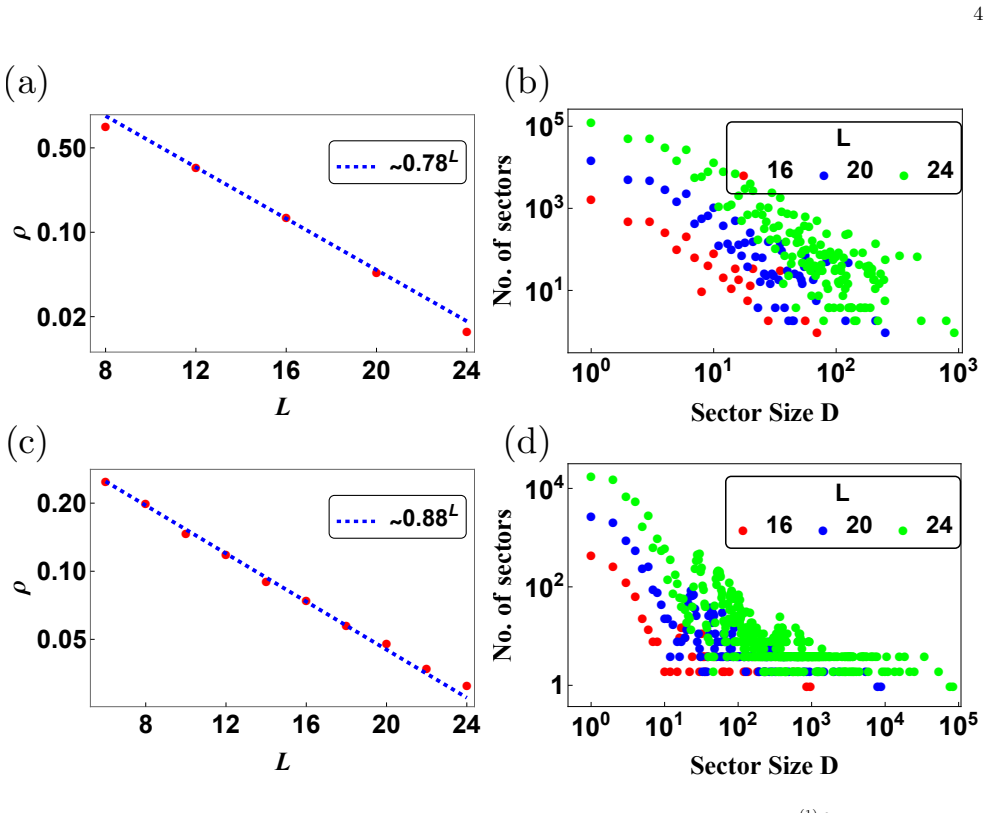
- Both first-order Hamiltonians are strongly Hilbert-space fragmented: the largest fragment occupies an exponentially small fraction of the symmetry sector, and the number of frozen one-dimensional fragments grows exponentially (basis about 1.75 at omega_e and 1.61 at omega_o).
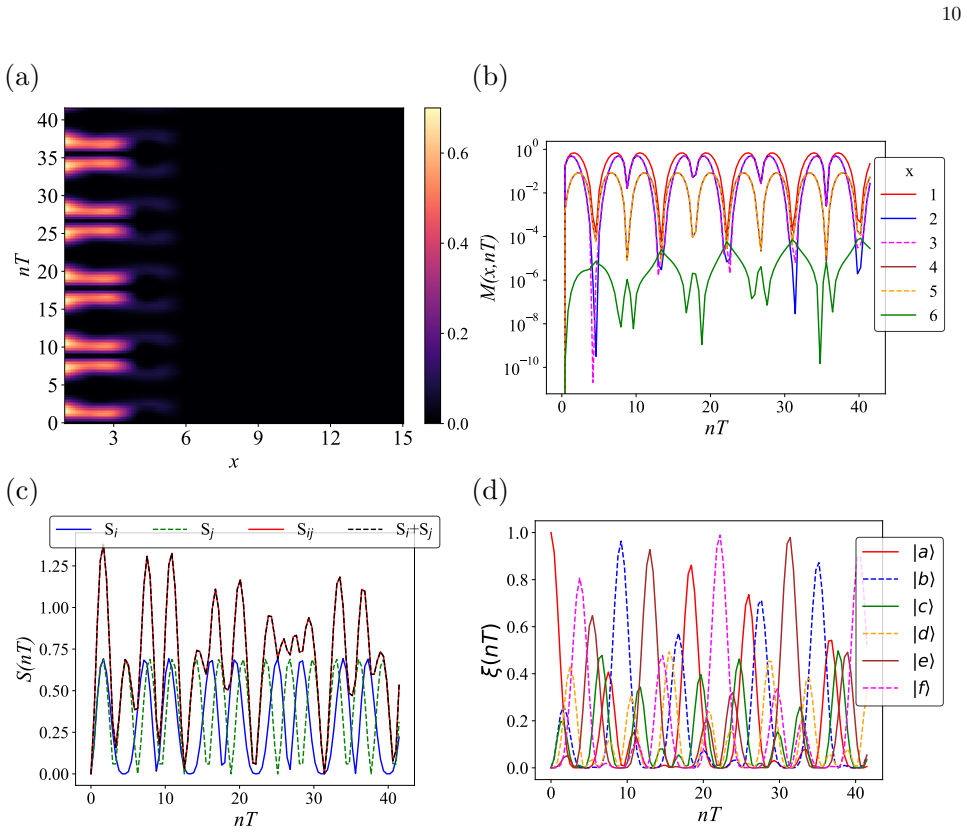
- Information localization is state- and frequency-dependent: some initial states keep information confined at both frequencies, whereas others localize only at omega_e; driving at omega_o deliberately delocalizes them.
- The suppression is exact only at first order, so the constraints are prethermal: higher-order leakage restores the forbidden moves after an exponentially long time, which is enough for finite-time experiments.
- Because the constraint is set by the zero set of F on the allowed Delta Q values, the framework can be reused to generate other constrained models, including Rydberg-like and East-model-like constraints, by designing a drive protocol whose F has common zeros.
Reading between the lines
- The Type-II result is the structurally new step: kinetic constraints without a conservation law are claimed to be impossible to generate from a static Hamiltonian, so if the prethermal claim survives higher-order scrutiny it gives a genuinely new way to make ergodicity-breaking Hamiltonians.
- A quantitative test follows directly from footnote [37]: if the lowest leakage is really O(J^3/omega^2), the localization lifetime should grow exponentially with V0/J; this is checkable by exact numerics at fixed L with V0 = 20, 40, 80.
- Because only a time-dependent local potential is needed to drive the dipole term, the mechanism is in principle implementable in cold-atom or ion-trap settings; the four-spin interaction H1 is the part that would need an experimental blueprint.
- I would expect the DI condition to be transferable to other drive protocols: the supplementary material shows that F is the zeroth Fourier component of the phase factor, so designing a waveform with zeros at prescribed Delta Q values is a Fourier-construction problem.
Editorial analysis
A structured set of objections, weighed in public.
Referee Report
Summary. The paper proposes that destructive many-body interference between quantum trajectories within one drive period can generate prethermal kinetic constraints in Floquet systems. For a driven spin-1/2 chain, at specially chosen frequencies the first-order Floquet Hamiltonian reduces either to a dipole-conserving constrained model (Type-I, complete destructive interference) or to a constrained model without an obvious global conservation law (Type-II, partial destructive interference). The authors derive the renormalized first-order Hamiltonians, show via exact diagonalization and transfer-matrix enumeration that both exhibit strong Hilbert-space fragmentation, and present exact-Floquet OTOC and mutual-information data suggesting spatial localization of quantum information on the timescales shown.
Significance. If the central claim is correct, the paper offers a conceptually attractive and systematic way to generate kinetic constraints in driven systems, including Type-II constraints that are harder to obtain in static settings. The first-order Floquet derivation is clean and parameter-free, the frozen-state transfer-matrix enumeration is explicit and machine-checkable, and the OTOC/mutual-information data are forward computations with the exact Floquet unitary, not fits to the first-order construction. These are genuine strengths. The main unresolved issue is the persistence time of the constraints: the paper asserts an exponentially long prethermal timescale, but the provided argument and numerics support at most a polynomial lifetime. This is load-bearing for the claims of 'prethermal' dynamics and information localization, and it needs to be addressed before publication.
major comments (2)
- [Discussion and footnote [37]] The claim of an exponentially long prethermal timescale is not supported. The authors state that the lowest correction to H_F is O(J^3/omega^2), which is polynomial, not exponential. For the numerics (V0=20, J=1, hbar=1, omega=20), this gives t* ~ omega^2/J^3 = 400 in units of 1/J, i.e. roughly 1.3e3 drive cycles. The OTOC data go to 100 cycles and the mutual-information check to 500 cycles, both inside this polynomial window, so they cannot distinguish polynomial from exponential behavior. Standard Floquet prethermalization guarantees closeness to a local dressed Hamiltonian for exponentially long times, but it does not imply that this dressed Hamiltonian preserves the first-order fragmentation. Without a separate argument that the H_F^(3) leakage matrix elements are exponentially suppressed, the 'exponentially long' statement in the Discussion is unjustified. The manuscript should eith
- [Introduction, third paragraph] The statement that Type-II constraints have 'no mechanism of generation in time-independent settings' is too strong. A large-U Hubbard model or a Rydberg Hamiltonian with strong nearest-neighbor interactions generates, from an unconstrained Hamiltonian, low-energy constrained dynamics (e.g. no double occupancy or no adjacent excitations) without an associated global conservation law. The destructive-interference mechanism proposed here may be new and systematic in Floquet settings, but the absolute 'no mechanism' claim should be qualified, for instance to 'no systematic prethermal mechanism in Floquet systems' or 'no mechanism of the kind proposed here'.
minor comments (4)
- [Abstract] Typo: 'an one-dimensional' should be 'a one-dimensional'.
- [Supplementary Material III.B] The text says the zeroth-order Bessel function J0(x) 'is a periodic function of its argument.' This is incorrect; J0 is not periodic. The argument about suitability of the cosine drive should be rephrased in terms of the existence of roots, not periodicity.
- [Eq. (3) and notation] The notation \(\Delta Q^{(nm)}_l\) in Eq. (3) is introduced somewhat abruptly; the subscript l is defined only later. A sentence clarifying that the change is local to the support of P_l would improve readability.
- [Table II and Eq. (7)] The special frequencies \(\omega^*_e = V_0/(\hbar m)\) and \(\omega^*_o=2V_0/((2m+1)\hbar)\) should specify the range of m (e.g. m nonzero integer) to avoid the m=0 singular case.
Circularity Check
No circularity: the constraints are derived analytically from first-order Floquet perturbation theory and checked with exact unitary dynamics; self-citation is ancillary.
full rationale
The central derivation chain is self-contained. Equation (4) follows from standard FPT: H_F^(1) = (1/T)∫dt U_0† H_1 U_0, yielding the renormalization factor F(V0ΔQ/ℏω) as the time integral of the phase factor. The special frequencies in Table II are roots of the analytically computed F for the square pulse (sin(γ0/2)=0 and sinγ0=0), not parameters fitted to numerics. Equations (7) and (8) are obtained by imposing those roots, and the HSF/frozen-state counts in the Supplementary Material are forward exact diagonalizations and transfer-matrix enumerations of those first-order Hamiltonians. The OTOC and mutual-information results are simulations with the exact Floquet unitary, so they are genuine probes of whether the first-order constraints survive, not inversions of the model. No fitted parameter is relabeled as a prediction. The only self-citation [29] is used in the Discussion to support the exponential prethermal timescale, but it is accompanied by external references [38-40] and is not the source of the DI construction; the first-order constraints do not rely on it. Footnote [37] asserts O(J^3/ω^2) leakage without derivation, which is a support gap for the exponential-timescale claim, not a circular step: a polynomial leakage estimate cannot itself prove exponential protection. No equation in the paper is equivalent to its inputs by construction.
Assumptions & free parameters
assumptions (4)
- domain assumption The drive amplitude is the largest scale, V0 >> J, so Floquet perturbation theory / RWA gives the Floquet Hamiltonian order by order.
- domain assumption The drive has zero average phase Phi(T,0)=0, so U0(T,0)=1 and H_F^(0)=0.
- standard math The phase accumulated between jumps is exp(iPhi Delta Q), i.e., only the eigenvalue change matters.
- domain assumption Higher-order Floquet corrections are weak enough that the first-order constraints survive up to an exponentially long prethermal time.
Cite this review
Pith. "Pith review of Destructive Interference induced constraints in Floquet systems." pith.science (2026). https://pith.science/paper/2YZUWWPM
@misc{pith2026250818368,
  author       = {Pith},
  title        = {Pith review of: Destructive Interference induced constraints in Floquet systems},
  year         = {2026},
  howpublished = {\url{https://pith.science/paper/2YZUWWPM}},
  note         = {Machine review of arXiv:2508.18368}
}
read the original abstract
We introduce the paradigm of destructive many-body interference between quantum trajectories as a means to systematically generate prethermal kinetically constrained dynamics in Floquet systems driven at special frequencies. Depending on the processes that are suppressed by interference, the constraint may or may not be associated with an emergent global conservation; the latter kind having no mechanism of generation in time-independent settings. As an example, we construct an one-dimensional interacting spin model exhibiting strong Hilbert space fragmentation with and without dipole moment conservation, depending on the drive frequency. By probing the spatiotemporal profile of the out-of-time-ordered correlator, we show that this model, in particular, has initial states in which quantum information can be spatially localized - a useful feature in the field of quantum technologies. Our paradigm unifies various types of Hilbert space fragmentation that can be realized in driven systems.
Figures


Figures from the paper (6 more)




Forward citations
Cited by 1 Pith paper
-
Non-relativistic Floquet Conformal Field Theory
Periodically driven non-relativistic conformal field theories show three Floquet phases — oscillatory, heating, and power-law transition — fixed exactly by the SO(2,1) representation parameter ρ.
Reference graph
Works this paper leans on
-
[37]
∆ ˆQi is defined such that e i ℏ ∆ ˆQi ˆPi = e i ℏ ∑ ′ j ˆQj ˆPie− i ℏ ∑ ′ j ˆQj , in which the prime on the sum indicates that the sum is over those j’s, for which the support of ˆQj overlaps with the support of ˆPi
-
[1]
V. Khemani, M. Hermele and R. Nandkishore, Phys. Rev. B 101, 174204 (2020)
work page 2020
-
[2]
From time t′ = 0 → t1, the state |mð evolves only under H0 gathering a phase e−iΦ( t1, 0)Q(m) , where ˆQ|mð = Q(m)|mð and Φ( t1, 0) = 1 ℏ ∫ t1 0 dt′V (t′). At time t′ =t1, there is a jump from |mð → |nð under the action of H1 and finally from t′ = t1 → T , the state stays at |nð accumulating a phase e−iΦ( T,t 1)Q(n) . This trajectory therefore carries a ne...
-
[3]
T. Rakovszky, P. Sala, R. Verresen, M. Knap and F. Poll- mann, Phys. Rev. B 101, 125126 (2020)
work page 2020
-
[4]
P. Sala, T. Rakovszky, R. Verresen, M. Knap and F. Poll- mann, Phys. Rev. X 10, 011047 (2020)
work page 2020
-
[5]
G. De Tomasi, D. Hetterich, P. Sala, and F. Pollmann, Phys. Rev. B 100, 214313(2019); P. Frey, L. Hackl, and S. Rachel, Phys. Rev. B 106, L220301 (2022)
work page 2019
-
[6]
Z.-C. Yang, F. Liu, A. V. Gorshkov and T. Iadecola, Phys. Rev. Lett. 124, 207602 (2020)
work page 2020
-
[7]
T. Kohlert, S. Scherg, P. Sala, F. Pollmann, B. H. Mad- husudhana, I. Bloch, and M. Aidelsburger, Phys. Rev. Lett. 130, 010201
Show all 53 references
-
[8]
Moudgalya and O
S. Moudgalya and O. I. Motrunich, Phys. Rev. X 12, 011050 (2022); D. T. Stephen, O. Hart, and R. M. Nand- kishore, Phys. Rev. Lett. 132, 040401 (2024);D. Hahn, P. A. McClarty, D. J. Luitz, SciPost Phys. 11, 074 (2021); N. Regnault and B. A. Bernevig, arXiv:2210.08019 (un- publ...
2022
-
[9]
14, 140 (2023)
J Lehmann, P Sala, F Pollmann, and T Rakovszky Sci- Post Phys. 14, 140 (2023)
2023
-
[10]
Mukherjee, D
B. Mukherjee, D. Banerjee, K. Sengupta, and A. Sen, Phys. Rev. B 104, 155117 (2021); P. Brighi, M. Ljubotina, and M. Serbyn, SciPost Phys. 15, 093 (2023)
2021
-
[11]
In Fig. 3(a), as time progresses, the operator σ z 2 spreads in the region spanning the sites j = 1 −4 (evident from the value of F (r,nT ) reducing from 1 here), whereas the operator σ z 11 spreads in the region j = 11 − 16. Almost no in- formation propagates through the inac...
2021
-
[12]
Classen-Howes, R
J. Classen-Howes, R. Senese, and A. Prakash, arXiv:2408.10321 (unpublished)
-
[13]
Roy and A
S. Roy and A. Lazarides, Phys. Rev. Research 2, 023159 (2020)
2020
-
[14]
van Horssen, E
M. van Horssen, E. Levi and J. P. Garrahan, Phys. Rev. B 92, 100305(R) (2015)
2015
-
[15]
Pancotti, G
N. Pancotti, G. Giudice, J. Ignacio Cirac, J. P. Garrahan and M. C. Ba˜ nuls, Phys. Rev. X 10, 021051 (2020)
2020
-
[16]
Z. Lan, M. van Horssen, S. Powell and J. P. Garrahan, Phys. Rev. Lett. 121, 040603 (2018)
2018
-
[17]
C. J. Turner, A. A. Michailidis, D. A. Abanin, M. Serbyn, and Z. Papi´ c, Nat. Phys. 14, 745 (2018); S. Maudgalya, N. Regnault, and B. A. Bernevig, Phys. Rev. B 98, 235156 (2018)
2018
-
[18]
W. W. Ho, S. Choi, H. Pitchler, and M. D. Lukin, Phys. Rev. Lett. 122, 040603 (2019); N. Shiraishi, J. Stat. Mech. 08313 (2019)
2019
-
[19]
S. Choi, C. J. Turner, H. Pichler, W. W. Ho, A. A. Michailidis, Z. Papi´ c, M. Serbyn, M. D. Lukin, and D. A. Abanin, Phys. Rev. Lett. 122, 220603 (2019); T. Iadecola, M. Schecter, and S. Xu, Phys. Rev. B 100, 184312 (2019)
2019
-
[20]
P. A. McClarty, M. Haque, A. Sen and J. Richter, Phys. 6 Rev. B 102, 224303(2020); D. Banerjee and A. Sen Phys. Rev. Lett. 126, 220601(2021)
2020
-
[21]
Sugiura, T
S. Sugiura, T. Kuwahara, and K. Saito, Phys. Rev. Re- search 3, L012010 (2021); P-G Rozon, M. J. Gullans, and K. Agarwal Phys. Rev. B 106, 184304 (2022)
2021
-
[22]
Mukherjee, A
B. Mukherjee, A. Sen, and K. Sengupta, Phys. Rev. B 106, 064305 (2022); A. Hudomal, J-Y Desaules, B. Mukherjee, G-X Su, J. C. Halimeh, and Z. Papic, Phys. Rev. B 106, 104302 (2022)
2022
-
[23]
H. Zhao, J. Vovrosh, F. Mintert, J. Knolle Phys. Rev. Lett. 124, 160604 (2020); H. Zhao, A. Smith, F. Mintert, and J. Knolle Phys. Rev. Lett. 127, 150601 (2021)
2020
-
[24]
Mukherjee, S
B. Mukherjee, S. Nandy, A. Sen, D. Sen, and K. Sen- gupta, Phys. Rev. B 101, 245107 (2020)
2020
-
[25]
Mukherjee, A
B. Mukherjee, A. Sen, D. Sen, and K. Sengupta, Phys. Rev. B 102, 014301 (2020)
2020
-
[26]
Das, Phys
A. Das, Phys. Rev. B 82, 172402 (2010); S. Bhat- tacharyya, A. Das, and S. Dasgupta, Phys. Rev. B 86, 054410 (2012); S. S. Hedge, H. Katiyar, T. S. Mahesh, and A. Das, Phys. Rev. B 90, 174407 (2014)
2010
-
[27]
Haldar, R
A. Haldar, R. Moessner, and A. Das. Phys. Rev. B 97, 245122 (2018); A. Haldar, D. Sen, R. Moessner, and A. Das. Phys. Rev. X 11, 021008 (2021)
2018
-
[28]
Agarwala, U
A. Agarwala, U. Bhattacharya, A. Dutta, and D. Sen, Phys. Rev. B 93, 174301 (2016); A. Agarwala and D. Sen, ibid. 95, 014305 (2017)
2016
-
[29]
D. J. Luitz, A. Lazarides, and Y. Bar Lev, Phys. Rev. B 97, 020303(R) (2018)
2018
-
[30]
Aditya and D
S. Aditya and D. Sen, SciPost Phys. Core 6, 083 (2023)
2023
-
[31]
Ghosh, I
S. Ghosh, I. Paul and K. Sengupta, Phys. Rev. Lett. 130, 120401 (2023)
2023
-
[32]
Bertini, P
B. Bertini, P. Kos and T. Prosen, Phys. Rev. Lett. 132, 080401 (2024); B. Bertini, C. De Fazio, J. P. Garrahan and K. Klobas, Phys. Rev. Lett. 132, 120402 (2024); K. Klobas, C. De Fazio and J. P. Garrahan, Phys. Rev. E 110, L022101 (2024)
2024
-
[33]
Bukov, L
M. Bukov, L. D’Alessio, and A. Polkovnikov, Adv. Phys. 64, 139 (2014)
2014
-
[34]
A. Sen, D. Sen, and K. Sengupta, J. Phys. Cond. Mat. 33, 443003 (2021)
2021
-
[35]
Bilitewski and N
T. Bilitewski and N. Cooper, Phys. Rev A 91, 063611 (2015)
2015
-
[36]
See Supplementary Material for details
-
[38]
A. I. Larkin and Y. N. Ovchinnikov, Soviet J. Exp. Theor. Phys. 28, 1200 (1969); A. Nahum, S. Vijay, and J. Haah, Phys. Rev. X 8, 021014 (2018); B. Swingle, Nature Phys 14, 988–990 (2018); S. Xu and B. Swingle, Phys. Rev. X 9, 031048 (2019)
1969
-
[39]
This is due to the fact that higher-order corrections to the Floquet Hamil- tonian lift this fragmented structure, thereby destroying information localization
Careful observation suggests that there is very little infor- mation leak through the inactive block. This is due to the fact that higher-order corrections to the Floquet Hamil- tonian lift this fragmented structure, thereby destroying information localization. However, the lo...
-
[40]
T. Mori, T. Kuwahara, and K. Saito. Phys. Rev. Lett. 116, 120401 (2016); T. Kuwahara, T. Mori, and K. Saito, Annals of Physics 367, 96 (2016)
2016
-
[41]
Vajna, K
S. Vajna, K. Klobas, T. Prosen, and A. Polkovnikov, Phys. Rev. Lett. 120, 200607 (2018)
2018
-
[42]
W. W. Ho, T. Mori, D. A. Abanin, and E. G. Dalla Torre, Annals of Physics 454, 169297 (2023)
2023
-
[43]
Grossmann, T
F. Grossmann, T. Dittrich, P. Jung, and P. H¨ anggi, Phys. Rev. Lett. 67, 516 (1991); E. Kierig et al, Phys. Rev. Lett. 100, 190405 (2008); M. P. Strzys, E. M. Graefe, and H. J. Korsch, New J. Phys. 10, 013024 (2008)
1991
-
[44]
J. Gong, L. Morales-Molina, and P. H¨ anggi, Phys. Rev. Lett. 103, 133002 (2009); S. Longhi, Phys. Rev. A 83, 034102 (2011); D. Ryndyk, C. Kohlf¨ urst, F. Queisser, and R. Sch¨ utzhold, Phys. Rev. Research 6, 023056 (2024)
2009
-
[45]
G. H. Fredrickson and H. C. Andersen, Phys. Rev. Lett. 53, 1244 (1984); G. H. Fredrickson and H. C. Andersen, J. Chem. Phys. 83, 5822–5831 (1985); R. G. Palmer, D. L. Stein, E. Abrahams and P. W. Anderson, Phys. Rev. Letter. 53, 958 (1984)
1984
-
[46]
Sollich and M
P. Sollich and M. R. Evans, Phys. Rev. E 68, 031504 (2003); F. Ritort and P. Sollich, Advances in Physics, 52 (4), 219–342, (2003)
2003
-
[47]
Hartarsky and C
I. Hartarsky and C. Toninelli, arXiv:2412.13634 (unpub- lished)
-
[48]
eurohpc-ju.europa.eu
-
[49]
(1), the time-evolution operator over a complete time period T can be split in two parts, namely UF ≡ U (T, 0) = U0(T, 0)W (T, 0)
www.izum.si END MA TTER Appendix A: First-order Floquet Unitary – For the time-periodic Hamiltonian in Eq. (1), the time-evolution operator over a complete time period T can be split in two parts, namely UF ≡ U (T, 0) = U0(T, 0)W (T, 0). Here U0(T, 0) encodes the time evolutio...
-
[50]
Both the square pulse drive protocol, V (t) = V0sgn(sinω Dt), and the continuous drive protocol, V (t) = V0 sinω Dt, satisfy this criterion
∆ Q∗ j has two non-zero values of the form ±∆ q: In this case, the function F must have at least one root and be an even function in fre- quency space. Both the square pulse drive protocol, V (t) = V0sgn(sinω Dt), and the continuous drive protocol, V (t) = V0 sinω Dt, satisfy ...
-
[51]
The square pulse protocol meets this criterion, but the continuous drive protocol does not
∆ Q∗ j are equispaced, i.e., ∆ Q∗ j = p∆ Qmin where p is an integer: In this case, F needs to have roots at periodic intervals ω ∗ p = ω ∗/p , where ω ∗ satisfies F ( V0∆ Qmin ℏω ∗ ) = 0. The square pulse protocol meets this criterion, but the continuous drive protocol does not...
-
[52]
Destructive Interference induced constraints in Floquet systems
0.5 1.0 Im [ f ] - 1 0 1 - 1 0 1 ( a ) - 1 0 1 - 1 0 1 ( b ) Re [ f ] FIG. 4. (Color online) Plot of the locus of f (t) (Eq. (2) and discussion before Eq. (6)) as t : 0 → T for the process (a) ˆS+ j− 1 ˆS+ j ˆS− j+1 ˆS− j+2 with ∆ p = −4 and (b) ˆS+ j− 1 ˆS− j ˆS+ j+1 ˆS− j+2 ...
2025
-
[53]
Similar behavior was seen in Ref
This oscillatory behavior can be attributed to the presence of only 6 states in the fragment of H(1),e F to which |að belongs. Similar behavior was seen in Ref. 4. 12 (a) 4 8 12 16 j 0 20 40 60nT (b) 4 8 12 16 j 20 40 60nT 1.0 0.5 0.0 0.5 1.0 FIG. 5: (Color online) Spatio-temp...
2014
Reviewed August 5, 2026 · model on record in the stance chip above.
Discussion (0). Continue with ORCID to comment.