REVIEW 3 major objections 5 minor 45 references
Why Relational Graphs Will Save the Next Generation of Vision Foundation Models?
T0 review · 3 major / 5 minor · reviewed 2026-08-05 · deepseek-v4-flash
Pith's one-line read Vision foundation models recognize entities but lack explicit relational reasoning; this paper argues that augmenting them with dynamic relational graphs — graphs whose topology and edge semantics are inferred from input and task context —
desk verdict A well-written position piece whose cross-domain claim collapses because the medical 'FM-only' baseline is nnFormer, not a foundation model; the video results are plausible but rely entirely on the author's preprints. read the letter →
The pith
A machine-rendered reading of the paper's core claim, the machinery that carries it, and where it could break.
The reading
What carries the argument
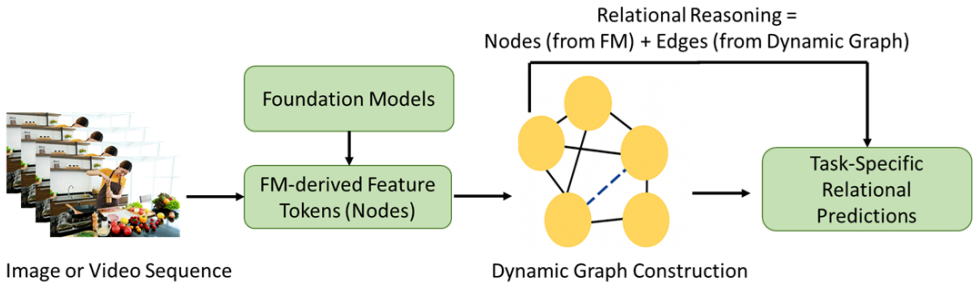
The central object is the dynamic relational graph module operating on FM-derived embeddings. Nodes are entities (hands, objects, anatomical regions) obtained from the FM backbone; edges — and even topology — are inferred adaptively from input and task context, so the graph emphasizes the task-relevant relations, such as a thick edge for the active hand–object pair or patient-specific region connections. This mechanism is what lets the hybrid reason sparsely and explicitly instead of through dense pairwise attention, and it is the load-bearing difference from static graph formulations.
What would settle it
Re-run the reported comparisons under a fixed protocol: same VideoMAE backbone, same graph module, same hyperparameters, full training and validation splits, and multiple seeds, on at least EPIC-KITCHENS and BraTS2020. If FM+dynamic graph does not consistently beat FM-only and FM+static graph on accuracy and Dice, or if the memory and latency advantage reverses when sparse message passing is actually enforced, the central claim is refuted.
Extended reading notes
Core claim
The paper's central claim is that augmenting vision foundation models with dynamic relational graphs provides a principled way to overcome current limitations in relational competence. A dynamic relational graph is a graph whose topology and edge semantics are inferred from the input and task context, as opposed to a static graph with fixed connectivity such as skeletal joints or atlas regions. The authors argue that FMs supply strong node-level features while the graph module infers adaptive edges, modeling asymmetric hand–object coordination in egocentric video and patient-specific inter-region connectivity in brain tumor segmentation. Reported results show FM+dynamic graph consistently ou
Load-bearing premise
The quantitative argument rests on two unpublished preprints ([14,15]) whose results appear only as adapted tables (Section 4.1 Table 1, Section 4.2 Table 3), so the load-bearing premise is that those experiments are properly controlled, repeatable, and representative; if that premise fails, the claimed consistent improvement has no support in this paper.
Editorial extensions
If this is right
- Next-generation vision FMs should integrate learned dynamic graph construction directly into the architecture, making node and edge inference an intrinsic capability rather than an external add-on.
- Relational reasoning should operate hierarchically — part–object–scene in activity understanding, region–organ–system in medical imaging — to support multi-level inference.
- Graphs provide a natural substrate for cross-modal fusion, linking video+audio or multi-sequence MRI through explicit relational structures.
- Progress requires benchmarks and metrics that directly probe relational competence, including role asymmetries, structured dependencies, and causal reasoning.
- Structured sparsity from reasoning over semantic nodes rather than dense token grids promises lower memory and latency, enabling deployment on moderate hardware.
Reading between the lines
- The mechanism is domain-agnostic: any task with identifiable entities and context-dependent relations, such as autonomous driving scene graphs, video question answering, or multi-agent coordination, is a candidate for the same FM+dynamic graph hybrid.
- The claimed efficiency gain is conditional: as the paper concedes, many current dynamic-graph implementations still materialize dense relation matrices, so the sparsity benefit only materializes with sparse message passing or pruned backbones.
- If dynamic graph construction becomes fully learned and end-to-end, the boundary between attention and graph reasoning may blur; the paper's agenda points toward architectures where relational structure is a first-class pretraining objective rather than a post hoc module.
Editorial analysis
A structured set of objections, weighed in public.
Referee Report
Summary. This is a position paper arguing that current vision foundation models (FMs) lack explicit relational reasoning, and that augmenting FMs with dynamic relational graphs (DRGs) provides a principled remedy. The paper reviews limitations of FMs in relational tasks, defines static vs. dynamic graphs, and argues for their complementarity with FMs. The empirical support is two case studies: manipulation action recognition (Section 4.1) and brain tumor segmentation (Section 4.2), reported in Tables 1-3 as being 'adapted from' the author's preprints [14,15]. The paper claims consistent gains in accuracy, robustness, interpretability, and efficiency for FM+DG over FM-only and FM+static-graph baselines, and closes with a research agenda for FM-graph hybrids.
Significance. The central question is timely and the position is plausible: explicit relational inductive biases could plausibly complement the representational strengths of FMs, and the paper gives a clear conceptual framework plus a concrete agenda. The paper also honestly acknowledges, in Section 3.4, that many current dynamic-graph implementations still materialize dense relation matrices, which is a useful caveat. However, the quantitative evidence is the weakest link. Tables 1-3 are taken from unpublished preprints by the same authors, with no experimental protocol, error bars, or code. More seriously, the 'FM-only' baseline in the medical case (Table 3) is nnFormer, a task-specific 3D transformer, not a foundation model by the paper's own definition. If that observation is correct, the cross-domain claim collapses to the video domain alone. The paper's contribution is therefore currently a research position with illustrative but not fully verifiable support; the direction is valuable, but the evidence needs substantial strengthening.
major comments (3)
- The row labeled 'nnFormer (FM only)' is not an FM under the paper's own definition: FMs are 'trained on large-scale, multimodal corpora' (Abstract, Section 1), whereas nnFormer is a 3D transformer for volumetric medical segmentation, conventionally trained on the target dataset. The same issue applies to 'EfficientGFormer: FM+Dynamic Graph' if it is trained on BraTS. Thus Table 3 does not compare FM+DG vs. FM-only; it compares a task-specific transformer with and without graph modules. This is an internal inconsistency that is load-bearing: the medical case cannot support the FM-specific claim unless a genuine FM backbone is used. The authors should either replace nnFormer with an actual FM (e.g., a model pretrained on large-scale image corpora) or narrow the medical claim to graph augmentation of non-FM transformers.
- All quantitative results are 'adapted from our recent work' [14,15], with no experimental protocol, hyperparameters, number of runs, error bars, or statistical significance. The central claim of 'consistently outperforms' rests on these tables. For example, Table 3 shows gains of +2.3 WT, +3.2 TC, +3.9 ET over nnFormer; without variance estimates it is impossible to tell whether these differences are meaningful. The authors should report means ± std over multiple seeds, provide the preprints' full experimental details, or release code/checkpoints so the results are reproducible. As it stands, the paper's quantitative evidence is not independently checkable.
- The two case studies are both from the same authors' recent work [14,15], and both instantiate the same FM+DG hypothesis. This is not circular by construction, since those works compare against external baselines and benchmarks, but it is a self-referential evidence loop: no independent replication or negative result is presented. For a position paper making a broad 'will save the next generation' claim, the absence of any externally validated FM+DG example weakens the generality of the conclusion. I encourage the authors to include at least one independent FM+graph result from the literature, or to temper the title and conclusion accordingly.
minor comments (5)
- The text says 'three large-scale benchmarks' but then lists four: EPIC-KITCHENS, UCOOK2, Something-Something V2, and COIN. Please correct the count or the list.
- The column header 'YCII' is undefined. The text refers to UCOOK2/YouCookII; the abbreviation should be defined or spelled out consistently.
- Figure 3 is described as a 'Qualitative illustration' but no details are given about which model variant produced the shown predictions, which patient/case was used, or whether this was a median or best result. Please clarify.
- The efficiency comparison in Table 2 would benefit from details on how FLOPs and latency were measured (e.g., whether all variants use identical input sizes, batch sizes, and CUDA settings). Also, the paper's own admission that current implementations often materialize dense matrices makes the efficiency claim context-dependent; please state clearly under what conditions the sparse-efficiency argument holds.
- Reference [23] appears to have an unusual journal name/volume combination ('Computer Vision and Image Understanding 41 (1) (2025) 491-516'); please verify the bibliographic data. Also, some references lack page numbers or DOIs; please harmonize the style.
Circularity Check
Central evidence is self-referential (author's own preprints) and the medical 'FM-only' baseline is mislabeled (nnFormer), so the cross-domain support is weaker than claimed; no equation-level circularity.
-
self citation load bearing
[Section 4, 'Illustrative Evidence Across Two Domains'; Table 1 and Table 3 captions]
"To substantiate the proposed synergy between foundation models and dynamic relational graphs, we highlight evidence from two distinct domains where we have recently applied this framework: manipulation action recognition and brain tumor segmentation [14, 15]. Results are adapted from our recent work [14]."
The central claim is that augmenting FMs with dynamic relational graphs provides a principled way to overcome current limitations. The only quantitative support is Tables 1-3, all 'adapted from our recent work' [14,15], whose systems instantiate exactly the FM+DG design being argued for. The paper provides no independent experimental protocol, code, or external replication, so the evidence loop closes on the author's own preprints. This is self-citation that is load-bearing rather than incidental; it is not a mathematical reduction, but the support is self-referential.
-
renaming known result
[Section 4.2 and Table 3]
"As shown in Table 3, we compared three model variants on the BraTS2020 benchmark [42]: FM-only, FM +static graph (nnFormer +SG, using atlas-based connectivity), and FM+dynamic graph (EfficientGFormer, learning adaptive connectivity from data). ... nnFormer (FM only) [45]"
The abstract defines FMs as models trained on large-scale, multimodal corpora providing transferable representations. nnFormer is a 3D transformer for volumetric medical image segmentation, conventionally trained on BraTS, not pretrained on large-scale vision corpora. By labeling nnFormer 'FM only' in Table 3, the paper renames a task-specific baseline as a foundation model, so the comparison FM+DG vs FM-only is not actually performed in the medical domain. This makes the cross-domain evidence reduce to the video experiments alone, weakening the central position.
full rationale
This is a position paper, not a derivation; Sections 2-3 are argumentative and cite a broad literature on FM limitations and graph-based reasoning. The quantitative core is Section 4, which imports Tables 1-3 from the author's own preprints [14,15]. Because those preprints implement the same FM+DG framework being advocated, the tables do not provide independent confirmation of the central claim—they are load-bearing self-citation. In addition, Table 3 labels nnFormer as 'FM only,' which conflicts with the paper's own definition of FMs as models pretrained on large-scale, multimodal corpora. Unless [15] actually uses a pretrained FM backbone, the medical comparison is not an FM+DG vs FM-only test, so the claimed cross-domain evidence rests on only one domain. No fitted parameter is renamed as a prediction, and no uniqueness theorem is invoked. The central claim retains independent conceptual content, so this is not a fully circular derivation; however, the evidential loop is self-referential and partially mislabeled, warranting a score of 5.
Assumptions & free parameters
assumptions (3)
- domain assumption Vision foundation models are deficient in explicit relational reasoning
- domain assumption Graphs provide a sparse, compositional, dynamic inductive bias appropriate for visual reasoning
- ad hoc to paper The quantitative results in Tables 1-3, adapted from the author's preprints [14,15], are valid and properly controlled
Cite this review
Pith. "Pith review of Why Relational Graphs Will Save the Next Generation of Vision Foundation Models?." pith.science (2026). https://pith.science/paper/RMJWPXIW
@misc{pith2026250818421,
  author       = {Pith},
  title        = {Pith review of: Why Relational Graphs Will Save the Next Generation of Vision Foundation Models?},
  year         = {2026},
  howpublished = {\url{https://pith.science/paper/RMJWPXIW}},
  note         = {Machine review of arXiv:2508.18421}
}
read the original abstract
Vision foundation models (FMs) have become the predominant architecture in computer vision, providing highly transferable representations learned from large-scale, multimodal corpora. Nonetheless, they exhibit persistent limitations on tasks that require explicit reasoning over entities, roles, and spatio-temporal relations. Such relational competence is indispensable for fine-grained human activity recognition, egocentric video understanding, and multimodal medical image analysis, where spatial, temporal, and semantic dependencies are decisive for performance. We advance the position that next-generation FMs should incorporate explicit relational interfaces, instantiated as dynamic relational graphs (graphs whose topology and edge semantics are inferred from the input and task context). We illustrate this position with cross-domain evidence from recent systems in human manipulation action recognition and brain tumor segmentation, showing that augmenting FMs with lightweight, context-adaptive graph-reasoning modules improves fine-grained semantic fidelity, out of distribution robustness, interpretability, and computational efficiency relative to FM only baselines. Importantly, by reasoning sparsely over semantic nodes, such hybrids also achieve favorable memory and hardware efficiency, enabling deployment under practical resource constraints. We conclude with a targeted research agenda for FM graph hybrids, prioritizing learned dynamic graph construction, multi-level relational reasoning (e.g., part object scene in activity understanding, or region organ in medical imaging), cross-modal fusion, and evaluation protocols that directly probe relational competence in structured vision tasks.
Figures


Reference graph
Works this paper leans on
-
[1]
A. Dosovitskiy, L. Beyer, A. Kolesnikov, D. Weissenborn, X. Zhai, T. Un- terthiner, M. Dehghani, M. Minderer, G. Heigold, S. Gelly, J. Uszkoreit, N. Houlsby, An image is worth 16x16 words: Transformers for image recognition at scale, in: International Conference on Learning Represen- tations (ICLR), 2021
work page 2021
-
[2]
A. Radford, J. W. Kim, C. Hallacy, A. Ramesh, G. Goh, S. Agarwal, G. Sastry, A. Askell, P. Mishkin, J. Clark, G. Krueger, I. Sutskever, Learn- ing transferable visual models from natural language supervision, in: In- ternational Conference on Machine Learning (ICML), PMLR, 2021, pp. 8748–8763
work page 2021
-
[3]
A. Kirillov, E. Mintun, N. Ravi, H. Mao, D. Rolland, L. Gustafson, T. Xiao, S. Whitehead, A. C. Berg, W.-Y . Lo, P. Doll´ar, R. Girshick, Seg- ment anything, arXiv preprint arXiv:2304.02643 (2023)
arXiv 2023
-
[4]
I. Laptev, On space-time interest points, in: Proceedings of the IEEE International Conference on Computer Vision (ICCV), IEEE, 2005, pp. 432–439
work page 2005
-
[5]
H. Wang, C. Schmid, Action recognition with improved trajectories, in: Proceedings of the IEEE International Conference on Computer Vision (ICCV), IEEE, 2013, pp. 3551–3558
work page 2013
-
[6]
F. Ziaeetabar, E. E. Aksoy, F. W¨org¨otter, M. Tamosiunaite, Semantic anal- ysis of manipulation actions using spatial relations, in: 2017 IEEE inter- national conference on robotics and automation (ICRA), IEEE, 2017, pp. 4612–4619
work page 2017
-
[7]
F. Ziaeetabar, T. Kulvicius, M. Tamosiunaite, F. W ¨org¨otter, Prediction of manipulation action classes using semantic spatial reasoning, in: 2018 IEEE/RSJ International Conference on Intelligent Robots and Systems (IROS), IEEE, 2018, pp. 3350–3357. 6
work page 2018
-
[8]
F. Ziaeetabar, T. Kulvicius, M. Tamosiunaite, F. W ¨org¨otter, Recognition and prediction of manipulation actions using enriched semantic event chains, Robotics and Autonomous Systems 110 (2018) 173–188
work page 2018
Show all 45 references
-
[9]
Ziaeetabar, Spatio-temporal reasoning for semantic scene understand- ing and its application in recognition and prediction of manipulation ac- tions in image sequences, Ph.D
F. Ziaeetabar, Spatio-temporal reasoning for semantic scene understand- ing and its application in recognition and prediction of manipulation ac- tions in image sequences, Ph.D. thesis, Dissertation, G ¨ottingen, Georg- August Universit¨at, 2019 (2020)
2019
-
[10]
Simonyan, A
K. Simonyan, A. Zisserman, Two-stream convolutional networks for ac- tion recognition in videos, in: Advances in Neural Information Processing Systems (NeurIPS), 2014, pp. 568–576
2014
-
[11]
Carreira, A
J. Carreira, A. Zisserman, Quo vadis, action recognition? a new model and the kinetics dataset, in: Proceedings of the IEEE Conference on Com- puter Vision and Pattern Recognition (CVPR), 2017, pp. 6299–6308
2017
-
[12]
Ziaeetabar, R
F. Ziaeetabar, R. Safabakhsh, S. Momtazi, M. Tamosiunaite, F. W¨org¨otter, Multi sentence description of complex manipulation action videos, Ma- chine Vision and Applications 35 (4) (2024) 64
2024
-
[13]
Ziaeetabar, M
F. Ziaeetabar, M. Tamosiunaite, F. W ¨org¨otter, A hierarchical graph-based approach for recognition and description generation of bimanual actions in videos, IEEE Access (2024)
2024
-
[14]
Ziaeetabar, F
F. Ziaeetabar, F. W ¨org¨otter, Leveraging foundation models for multi- modal graph-based action recognition, arXiv preprint arXiv:2505.15192 (2025)
2025
-
[15]
Ziaeetabar, E fficientgformer: Multimodal brain tumor segmentation via pruned graph-augmented transformer, arXiv preprint arXiv:2508.01465 (2025)
F. Ziaeetabar, E fficientgformer: Multimodal brain tumor segmentation via pruned graph-augmented transformer, arXiv preprint arXiv:2508.01465 (2025)
2025 arXiv
-
[16]
Lepori, D
M. Lepori, D. Loureiro, A. Aizawa, N. Kalchbrenner, Who is afraid of relations? vision transformers struggle with relational tasks, in: Advances in Neural Information Processing Systems (NeurIPS), 2024. URL https://arxiv.org/abs/2406.15955
2024 arXiv
-
[17]
Altabaa, J
A. Altabaa, J. La fferty, Disentangling and integrating relational and sensory information in transformer architectures, arXiv preprint arXiv:2405.16727 (2024). URL https://arxiv.org/abs/2405.16727
2024 arXiv
-
[18]
H. Li, R. Chen, D. Zhao, H. Ji, Do vision-language transformers exhibit visual commonsense?, arXiv preprint arXiv:2405.16934 (2024). URL https://arxiv.org/abs/2405.16934
2024 arXiv
-
[19]
Ponbagavathi, Z
A. Ponbagavathi, Z. Lin, K. Singh, A. Dutta, Prompt-guided relational reasoning for social behavior understanding with vision foundation mod- els, arXiv preprint arXiv:2508.07996 (2025). URL https://arxiv.org/abs/2508.07996
2025 arXiv
-
[20]
Sarkar, M
S. Sarkar, M. Idna, Reasoning in computer vision: Taxonomy, models, tasks, arXiv preprint arXiv:2508.10523 (2025). URL https://arxiv.org/abs/2508.10523
2025
-
[21]
Y . Li, Z. Liu, Z. Li, X. Zhang, Z. Xu, X. Chen, H. Shi, S. Jiang, X. Wang, J. Wang, et al., Perception, Reason, Think, and Plan : A survey on large multimodal reasoning models, arXiv preprint arXiv:2505.04921 (2025). URL https://arxiv.org/abs/2505.04921
2025 arXiv
-
[22]
T. M. Mitchell, The need for biases in learning generalizations, Techni- cal Report CBM-TR-117, Rutgers University, Department of Computer Science, Laboratory for Computer Science Research (1980)
1980
-
[23]
Senior, G
H. Senior, G. Slabaugh, S. Yuan, L. Rossi, Graph neural networks in vision-language image understanding: A survey, Computer Vision and Image Understanding 41 (1) (2025) 491–516. doi:10.1007/ s00371-024-03343-0
2025
-
[24]
Lu, et al., Recent research progress of graph neural networks in computer vision, Electronics 14 (9) (2025) 1742
H. Lu, et al., Recent research progress of graph neural networks in computer vision, Electronics 14 (9) (2025) 1742. doi:10.3390/ electronics14091742
2025
-
[25]
S. Yan, Y . Xiong, D. Lin, Spatial temporal graph convolutional networks for skeleton-based action recognition, in: Proceedings of the AAAI Conference on Artificial Intelligence, V ol. 32, 2018. URL https://ojs.aaai.org/index.php/AAAI/article/view/ 12328
2018
-
[26]
Z. Wu, S. Pan, F. Chen, G. Long, C. Zhang, P. S. Yu, A comprehensive survey on graph neural networks, IEEE Transactions on Neural Networks and Learning Systems 32 (1) (2019) 4–24.doi:10.1109/TNNLS.2020. 2978386
2019 doi
-
[27]
Y . Li, Y . Han, Y . Huang, Y . Cao, Z. Qin, K. Ren, A survey on graph neural networks, IEEE Transactions on Big Data 7 (6) (2020) 1719–1738. doi:10.1109/TBDATA.2020.2981686
2020
-
[28]
J. Shen, X. Li, L. He, C.-C. J. Kuo, Interpretable graph convolutional neural networks for skeleton-based action recognition, in: 2021 IEEE International Conference on Image Processing (ICIP), IEEE, 2021, pp. 3043–3047. doi:10.1109/ICIP42928.2021.9506304
2021
-
[29]
Caesar, V
H. Caesar, V . Bankiti, A. H. Lang, S. V ora, V . E. Liong, Q. Xu, A. Kr- ishnan, Y . Pan, G. Baldan, O. Beijbom, nuscenes: A multimodal dataset for autonomous driving, in: Proceedings of the IEEE /CVF Conference on Computer Vision and Pattern Recognition (CVPR), 2020, pp. 116...
2020
-
[30]
Huang, C
D. Huang, C. Gan, D. Wang, B. Xiao, X. Wu, X. Lin, Location-aware graph convolutional networks for video question answering, in: Proceed- ings of the AAAI Conference on Artificial Intelligence, V ol. 34, 2020, pp. 11021–11028
2020
-
[31]
Y . Wang, Y . Sun, Z. Liu, S. E. Sarma, M. M. Bronstein, J. M. Solomon, Dynamic graph cnn for learning on point clouds, ACM Transactions on Graphics (TOG) 38 (5) (2019) 146:1–146:12
2019
-
[32]
Y . Li, R. Yu, C. Shahabi, Y . Liu, Diffusion convolutional recurrent neural network: Data-driven traffic forecasting, in: International Conference on Learning Representations (ICLR), 2018
2018
-
[33]
Zhang, C
P. Zhang, C. Lan, J. Xing, W. Zeng, J. Xue, N. Zheng, Semantics-guided neural networks for e fficient skeleton-based human action recognition, in: Proceedings of the IEEE /CVF Conference on Computer Vision and Pattern Recognition (CVPR), 2020, pp. 1112–1121
2020
-
[34]
T. Song, Z. Zhang, K. Han, H. Huang, D. Shen, Dynamic graph learning for brain disorder analysis, in: Proceedings of the IEEE /CVF Interna- tional Conference on Computer Vision (ICCV), 2021, pp. 1556–1566
2021
-
[35]
Damen, H
D. Damen, H. Doughty, G. M. Farinella, A. Furnari, E. Kazakos, J. Ma, D. Moltisanti, J. Munro, T. Perrett, W. Price, M. Wray, EPIC- KITCHENS: Egocentric vision dataset for multimodal action understand- ing, in: Proceedings of the European Conference on Computer Vision (ECCV), ...
2018
-
[36]
L. Zhou, C. Xu, J. J. Corso, YouCookII: A large-scale dataset for cooking activity recognition, in: Proceedings of the IEEE Conference on Com- puter Vision and Pattern Recognition (CVPR), 2018, pp. 1989–1998
2018
-
[37]
Goyal, S
R. Goyal, S. E. Kahou, V . Michalski, J. Materzynska, S. Westphal, H. Kim, V . Haenel, I. Fruend, P. Yianilos, M. Mueller-Freitag, F. Hoppe, C. Thurau, I. Bax, R. Memisevic, The ”something something” video database for learning and evaluating visual common sense, in: Proceed- ...
2017
-
[38]
Y . Tang, L. Zhao, S. Zhang, Y . Gong, J. Li, J. Yang, COIN: A large-scale dataset for comprehensive instructional video analysis, in: Proceedings of the IEEE Conference on Computer Vision and Pattern Recognition (CVPR), 2019, pp. 1207–1216
2019
-
[39]
B. Xu, S. Zheng, Q. Jin, Pov: Prompt-oriented view-agnostic learning for egocentric hand-object interaction in the multi-view world, in: Proceed- ings of the 31st ACM International Conference on Multimedia, 2023, pp. 2807–2816
2023
-
[40]
Duhme, R
M. Duhme, R. Memmesheimer, D. Paulus, Fusion-gcn: Multimodal ac- tion recognition using graph convolutional networks, in: DAGM German conference on pattern recognition, Springer, 2021, pp. 265–281
2021
-
[41]
M. Wang, J. Xing, J. Mei, Y . Liu, Y . Jiang, Actionclip: Adapting language-image pretrained models for video action recognition, IEEE transactions on neural networks and learning systems (2023)
2023
-
[42]
U. Baid, S. Ghodasara, S. Mohan, M. Bilello, E. Calabrese, E. Colak, K. Farahani, J. Kalpathy-Cramer, F. C. Kitamura, D. Ma, et al., The brain tumor segmentation (brats) challenge 2020: Global comparison of meth- ods for multimodal brain tumor segmentation, Medical Image Analy...
2020
-
[43]
Hatamizadeh, V
A. Hatamizadeh, V . Nath, Y . Tang, A. Myronenko, et al., Unetr: Trans- formers for 3d medical image segmentation, in: Proceedings of the IEEE/CVF Winter Conference on Applications of Computer Vision, 2022, pp. 574–584
2022
-
[44]
Hatamizadeh, Y
A. Hatamizadeh, Y . Tang, A. Myronenko, et al., Swin unetr: Swin trans- formers for semantic segmentation of brain tumors in mri images, arXiv preprint arXiv:2201.01266 (2022)
2022 arXiv
-
[45]
H.-Y . Zhou, J. Guo, X. Zhang, L. Yu, L. Wang, Y . Yu, nnformer: V olumet- ric medical image segmentation via a 3d transformer, IEEE Transactions on Medical Imaging 42 (4) (2022) 1177–1188. 7
2022
Reviewed August 5, 2026 · model on record in the stance chip above.
Discussion (0). Sign in to comment.