REVIEW 3 major objections 6 minor 3 references
Unified theory of testing relevant hypotheses in functional time series
T0 review · 3 major / 6 minor · reviewed 2026-08-15 · deepseek-v4-flash
Pith's one-line read A single self-normalized B-spline decision rule tests relevant hypotheses in functional time series under arbitrary sampling, with fixed Brownian-motion critical values and no nuisance-parameter estimation.
desk verdict A valuable unified framework that overreaches in its key boundary claim; the B-spline bias under (A6) breaks the stated size at the boundary, and the abstract contradicts the paper's own detection-rate corollary. read the letter →
The pith
A machine-rendered reading of the paper's core claim, the machinery that carries it, and where it could break.
The reading
What carries the argument
The machinery is the combination of a B-spline estimator computed on partial samples and a self-normalizer built from those same partial fits. With $\hat m(t,\cdot)$ denoting the mean estimated from the first $[nt]$ observations, the test rejects when $(T_n-\Delta)/V_{n,\epsilon}$ exceeds $Q_{1-\alpha,\epsilon}$, the quantile of the pivotal ratio $W(1)/[\int_\epsilon^1 t^2\{W(t)-tW(1)\}^2 dt]^{1/2}$ with $W$ a standard Brownian motion. The estimator and normalizer live on the same scale, so the nuisance factor $\tau_n(m)$—the analogue of the long-run variance—cancels in the ratio. The technical engine that produces the joint weak convergence in (2.4) is a sequential Gaussian approximation for dependent random vectors of moderately high dimension (Lemma S.4.1 in the supplement), which turns the B-spline coefficient process into a Gaussian process whose self-normalized version is pivotal; the non-degeneracy condition $(*)$ ensures $\tau_n^2(m)$ dominates the approximation error so the denominator does not degenerate.
What would settle it
Simulate a sparse functional time series at the boundary $\int m^2 = \Delta$ using a functional AR(1) with innovations near the edge of the assumed moment and dependence conditions, and check whether the empirical rejection probability approaches $\alpha$ as $n$ grows; any systematic drift away from $\alpha$, or a mismatch between the empirical quantiles of $(T_n-\Delta)/V_{n,\epsilon}$ and the Brownian-motion ratio quantile $Q_{1-\alpha,\epsilon}$, would indicate that the Gaussian approximation in Lemma S.4.1 fails.
Extended reading notes
Core claim
On the paper's own terms, the discovery is that relevant-hypothesis testing in functional time series need not be rebuilt for each problem or each sampling regime. For model (1.1)—discretely observed trajectories with mean $m$, stationary functional noise $\xi_i$, and measurement error $\sigma\varepsilon$—the B-spline estimator $\hat m(\cdot)$ and the self-normalizer $V_{n,\epsilon}$ built from partial-sample fits give a rejection rule (2.3) whose asymptotic rejection probability is $0$ when $\int m^2 < \Delta$, $\alpha$ when $\int m^2 = \Delta$ under the non-degeneracy condition $(*)$, and $1$ when $\int m^2 > \Delta$ (Theorem 2.1). The same pivotal structure is proved for two-sample comparisons (Theorem 2.3), single relevant change points (Theorem 3.1), and multiple change points (Theorem 3.3), provided the change-point locations are estimated consistently. Under local alternatives $\|m\|_{L^2}^2 = \Delta + c_0\sqrt{(1+J_n E(N^{-1}))/n}$, the test retains nontrivial power (Theorem 2.2), so the detection rate is of order $n^{-1/2}$ in dense designs and $\sqrt{J_n E(N^{-1})/n}$ in sparse designs, with the phase transition occurring where $\{E(N^{-1})\}^{-1}$ crosses $(n\log n)^{1/(2q^*)}$.
Load-bearing premise
The load-bearing premise is that the sequential Gaussian approximation for dependent random vectors of moderately high dimension (Lemma S.4.1 in the supplementary material) holds under the paper's dependence and moment conditions; this lemma generates the pivotal joint convergence in (2.4), and it is stated only in the supplement, not proved in the main text.
Editorial extensions
If this is right
- For applied work, testing whether a mean difference is at least $\Delta$ on discretely observed curves needs no separate procedure per sampling density: the same B-spline fit, self-normalizer, and critical value $Q_{1-\alpha,\epsilon}$ are used whether each subject is observed a few times or many times.
- Because detection of $n^{-1/2}$-local alternatives holds at arbitrary sampling frequencies, the sparse-to-dense phase transition is fully characterized: the detection rate is $\sqrt{J_n E(N^{-1})/n}$ in the sparse regime and $\sqrt{1/n}$ in the dense regime, with the boundary at $\{E(N^{-1})\}^{-1}\asymp(n\log n)^{1/(2q^*)}$.
- The same pivotal limiting distribution covers one-sample, two-sample, single and multiple change-point relevant tests, so a user substitutes the appropriate estimated difference and self-normalizer while keeping the critical value fixed.
- At the exact boundary $\|m\|^2_{L^2}=\Delta$, the test has asymptotic size exactly $\alpha$ whenever the non-degeneracy condition $(*)$ (or its two-sample and change-point analogues) holds; without it, the boundary case may be mis-sized.
Reading between the lines
- Going beyond the paper: because the pivotal ratio depends only on a Brownian motion, the same self-normalized construction may extend to other functionals—covariance operators or eigen-structures—whenever a B-spline partial-sum representation and a sequential Gaussian approximation are available; the paper does not make this claim.
- A practical reading of Theorem 2.2 that the paper leaves implicit is that in sparse designs, adding more observations per subject does not improve the detection rate; only increasing the number of subjects $n$ does, so sampling effort is best spent on subjects, not grid density, once the phase-transition boundary is passed.
- The paper flags stationarity and low dimensionality as limitations; a natural extension, not pursued here, would adapt the Gaussian-approximation step to locally stationary functional time series, making the same recipe applicable to nonstationary panels.
- Condition $(*)$ is a theoretical non-degeneracy condition, and the paper gives no data-driven check; an empirical researcher could estimate $\tau_n^2(m)$ on the boundary case and verify that it dominates $1+J_n E(N^{-1})$ before trusting the nominal level.
Signed reviews
Editorial analysis
A structured set of objections, weighed in public.
Referee Report
Summary. The paper proposes a unified framework for testing relevant hypotheses in functional time series with discretely observed, contaminated trajectories under arbitrary sampling schemes. It covers one-sample tests on the mean function, two-sample comparisons, and single and multiple change point tests. The test statistics are based on B-spline estimates of partial mean functions, and critical values are obtained by self-normalization, avoiding estimation of long-run covariance and noise variance functions. The main theorems claim asymptotic size alpha at the boundary of the relevant null hypothesis, consistency under fixed alternatives, and nontrivial power at local alternatives with a detection rate depending on sampling frequency, yielding a sparse-to-dense phase transition. Simulations and two real-data applications are reported. All proofs are deferred to a supplementary file that is not included in the submission.
Significance. If the theoretical claims are correct after the corrections below, the paper would be a useful contribution: it extends relevant-hypothesis testing from fully observed functional data to discretely observed data with measurement error, covers several testing problems in one framework, and provides a self-normalizing construction that avoids nuisance estimation. The unified treatment of sparse and dense sampling and the discussion of alternative self-normalizers are valuable. The paper also reports extensive simulations across distributions and sampling schemes and two real-data analyses. However, the main technical engine, a sequential Gaussian approximation for dependent random vectors, is only mentioned by reference to an unavailable supplement, and two load-bearing statements in the main text need correction: the boundary size claim in Theorem 2.1 is not justified under Assumption (A6), and the local-alternative scaling in Theorem 2.2 is internally inconsistent with the rates quoted in Corollary 2.1. The contribution is therefore contingent on these fixes.
major comments (3)
- [Section 2.1, Assumption (A6) and Theorem 2.1] At the boundary integral of m squared equals Delta, the proof requires sqrt(n)(T_n - Delta)/(2 tau_n(m)) to be asymptotically pivotal after cancellation of tau_n. The B-spline approximation error of order J_n^{-q*} in L2 produces a bias in the plug-in squared-norm statistic T_n of order J_n^{-2q*}; after scaling by sqrt(n)/tau_n this contributes sqrt(n) J_n^{-2q*}/tau_n. The first line of Assumption (A6) only requires sqrt(n) J_n^{-q*} (1 + J_n E(N^{-1}))^{-1/2} = O(1), which together with condition (*) does not imply that this T_n-bias term is o(1). For instance, in the dense regime E(N^{-1}) = o(J_n^{-1}) with q* = 4, choosing J_n = c n^{1/8} satisfies (A6), but the limiting boundary rejection probability becomes P(W(1) + b > Q_{1-alpha,epsilon} sqrt(integral t^2 (W(t) - t W(1))^2 dt)) for a generally nonzero constant b, not alpha. Condition (*) does not control this bias. The theorem should either impose a genuine undersmoothing condition, for example sqrt(n) J_n^{-2q*} (1 + J_n E(N^{-1}))^{-1/2} = o(1), or explicitly account for the bias. The analogous boundary claims in Theorems 2.3, 3.1, and 3.3 inherit this issue.
- [Section 2.1, Theorem 2.2 and Corollary 2.1] Under the local alternative in Theorem 2.2, the noncentrality parameter of (T_n - Delta)/V_{n,epsilon} is sqrt(n)(||m||^2 - Delta)/(2 tau_n(m)) approximately c0/(2 sqrt(n)), because tau_n(m) is of order sqrt(1 + J_n E(N^{-1})) by condition (*). This tends to zero, so the stated alternative cannot yield nontrivial power. The scaling in the theorem appears to be off by a factor sqrt(n): with ||m||^2 - Delta = c0 sqrt(1 + J_n E(N^{-1}))/sqrt(n), the noncentrality is O(1), which matches the rates quoted in Corollary 2.1. The same scaling issue appears in Theorem 3.2. Moreover, the abstract's claim that the detection rate remains n^{-1/2} even in sparse regimes is contradicted by Corollary 2.1(1), where the squared-norm detection rate is sqrt(J_n E(N^{-1})/n), which is larger than n^{-1/2} whenever J_n E(N^{-1}) tends to infinity.
- [Section 2.1, joint weak convergence (2.4) and supplementary materials] The central technical result is the joint weak convergence in (2.4), which rests on the sequential Gaussian approximation for dependent random vectors stated as Lemma S.4.1. This lemma is not stated in the main text, and all proofs are deferred to a supplement that is not part of the submitted manuscript. Since Theorems 2.1 through 3.3 all depend on this approximation, the central claims cannot be verified from the submitted text. The revision should include the supplement, or at minimum a complete statement of Lemma S.4.1 and the main proof steps needed to establish (2.4).
minor comments (6)
- [Abstract] There is a typo in the first line: 'releva nt' should be 'relevant'.
- [Section 2.1, display of Assumption (A6)] The moment condition on the measurement errors is written with E|epsilon_i|^{r1}; it should clearly be E|epsilon_{ij}|^{r1} with the absolute value displayed, and the notation should be aligned with the definitions of r1 and r.
- [Throughout, notation] The symbol rendered as 'greaterorsimilar' should be typeset as, for example, \gtrsim or 'greater than or asymptotically similar to', to avoid confusion in conditions (*), (**), and (⋆).
- [Corollary 2.1 and Corollary 3.1] 'referred as' should be 'referred to as' in both statements.
- [Section 5.1 and Figure 9] The text refers to the AU.SHF implied volatility data, while Figure 9 says 'AU.SHX'; the abbreviation should be made consistent.
- [Just before Theorem 2.1] The phrase 'under some regular conditions' before display (2.4) is vague; since Assumptions (A1)-(A6) are already stated, the display should refer to those assumptions directly.
Circularity Check
No circular reduction: the one-sample test is self-contained and the self-citations are supporting lemmas, not restatements of the target results.
full rationale
The derivation chain for the central one-sample test (Theorem 2.1) is not circular. The statistic (T_n - Δ)/V_{n,ǫ} cancels the nuisance scale τ_n(m) by construction, and the limiting law is the fixed Brownian-motion functional W(1)/(∫_ǫ^1 t^2(W(t)-tW(1))^2 dt)^{1/2}, so the critical value Q_{1-α,ǫ} does not depend on estimated nuisance parameters. No parameter is fitted to a subset of the data and then called a prediction; the only smoothing choice J_n is regulated by Assumption (A6), and the non-degeneracy condition (∗) is a stated sufficient condition, not an estimated quantity. The paper relies on the authors' own previous work for two supporting facts: the consistency of the change-point estimator k̂_n,L2 (Assumption (B2), attributed to Cai and Hu [2024]) and the phase-transition terminology (Cai and Hu [2025b]). These citations are load-bearing only in the sense that they supply lemmas whose stated assumptions do not include the paper's target result; they are not self-referential reductions. The sequential Gaussian approximation (Lemma S.4.1) is deferred to the supplementary material and is not verified in the submission, but that is a proof-completeness/correctness concern, not circularity. The skeptic's boundary-bias objection concerns whether Assumption (A6) actually forces the bias term √n J_n^{-q*} to vanish relative to the self-normalizer scale; that is a correctness risk under the stated assumptions, not an instance of the paper deriving its conclusion from its input. Overall, the central claim has independent content and the score reflects only the presence of minor, non-circular self-citations.
Assumptions & free parameters
free parameters (2)
- Number of B-spline knots J_n =
chosen via BIC in simulations; theory requires (A6) rate range
- Trimming parameter epsilon =
0.1 in simulations; user-chosen in (0,1)
assumptions (7)
- domain assumption Mean function m lies in a Holder class H^{q,nu}[0,1] (A1)
- domain assumption Design density bounded above and away from zero (A2)
- domain assumption Physical dependence measure decays polynomially (A5)
- domain assumption Rate conditions on J_n, n, N in (A6)
- ad hoc to paper Non-degeneracy condition tau_n^2(m) greater than or similar to 1 + J_n E(N^{-1}) (*)
- ad hoc to paper Sequential Gaussian approximation for dependent random vectors in moderate dimension (Lemma S.4.1)
- domain assumption Change point estimator convergence rate (B2)
Cite this review
Pith. "Pith review of Unified theory of testing relevant hypotheses in functional time series." pith.science (2026). https://pith.science/paper/JJD25UZP
@misc{pith2026250818624,
  author       = {Pith},
  title        = {Pith review of: Unified theory of testing relevant hypotheses in functional time series},
  year         = {2026},
  howpublished = {\url{https://pith.science/paper/JJD25UZP}},
  note         = {Machine review of arXiv:2508.18624}
}
abstract
In this paper, we develop a {\em unified} framework for testing relevant hypotheses in functional time series. The proposed approach accommodates one-sample, two-sample, and change point problems for contaminated observations under arbitrary sampling schemes. Combining B-spline estimation with self-normalization, we construct nuisance-parameter-free tests that bypass auxiliary estimation of long-run covariance functions and measurement-error variance functions. We establish asymptotic validity by exploiting a sequential Gaussian approximation for dependent random vectors of moderately high dimension, which leads to a pivotal limiting distribution. We also provide sufficient conditions for the non-degeneracy of the self-normalizer and establish consistent decision rules. A key theoretical finding is that the proposed tests detect \(n^{-1/2}\)-local alternatives under arbitrary sampling frequencies. This uncovers a sparse-to-dense phase transition distinct from those typically observed in functional data analysis: while the sampling frequency affects the asymptotic variance, the detection rate remains \(n^{-1/2}\), even in sparsely sampled regimes. We further study multiple change point alternatives and extend the theory to settings where consistent change point estimates are available. We also discuss the choice of self-normalizers, including the recently developed range-adjusted self-normalizer. Extensive simulations support the theoretical results, and applications to the AU.SHF implied volatility and traffic volume datasets demonstrate the practical utility of the proposed methods.
Figures


Figures from the paper (7 more)

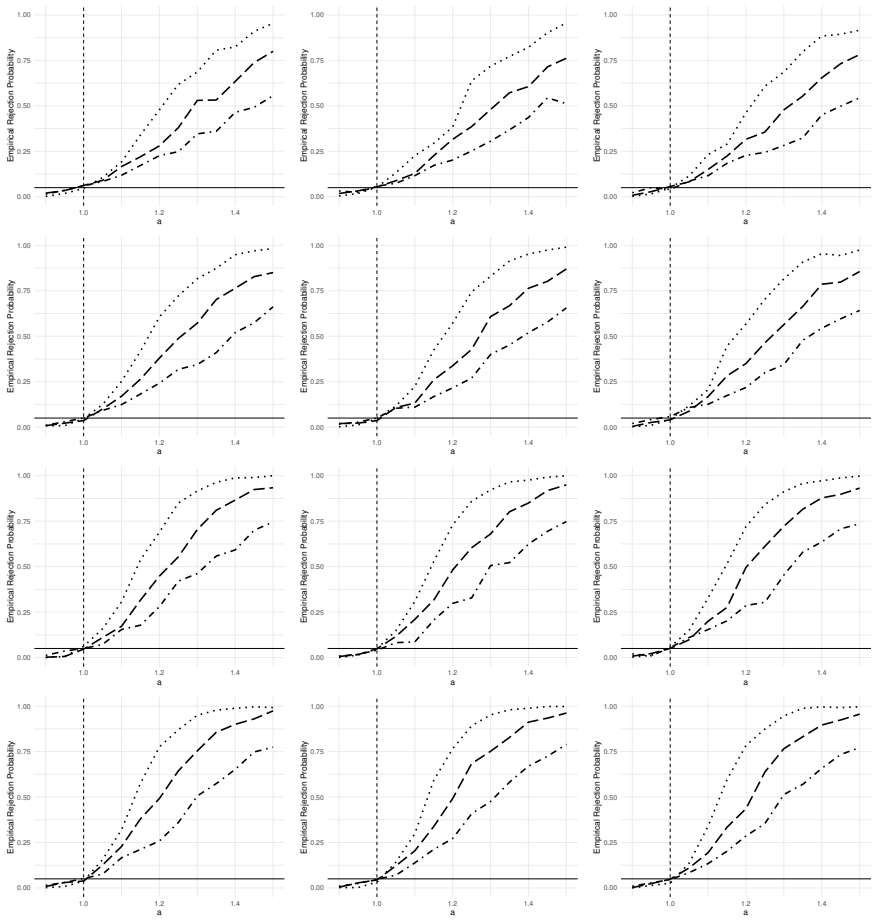
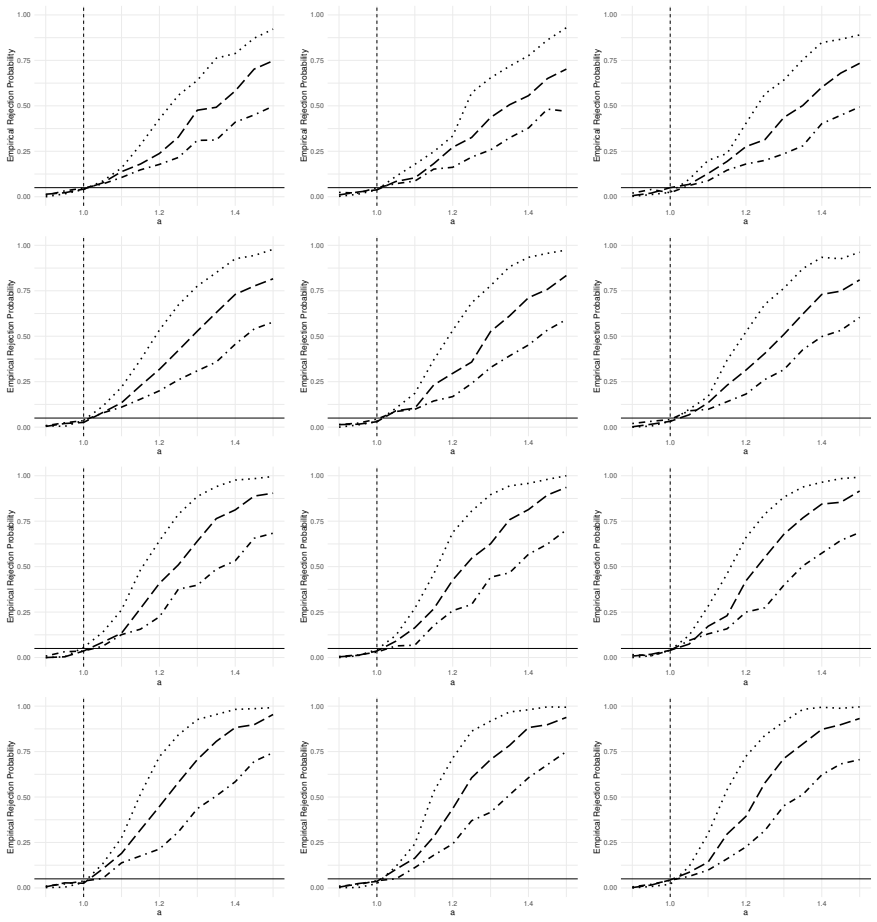


Reference graph
Works this paper leans on
-
[2015]
H. Sharghi Ghale-Joogh and S. M. E. Hosseini-Nasab. On mean deriv ative estimation of longitudinal and functional data: from sparse to dense. Statistical Papers , 62(4): 2047–2066,
-
[2016]
Z. Luo and W. Wu. Simultaneous inference for mean curves of funct ional and longitudinal data: A unified theory. Statistica Sinica, 2025+. C. M. Madrid Padilla, D. Wang, Z. Zhao, and Y. Yu. Change-point dete ction for sparse and dense functional data in general dimensions. Advances in Neural Information Processing Systems, 35:37121–37133,
work page 2025
-
[2021]
L. Cai and Q. Hu. From sparse to dense functional time series: pha se transitions of detecting structural breaks and beyond. arXiv preprint arXiv:2412.20858 ,
Reviewed August 15, 2026 · model on record in the stance chip above.
Discussion (0). Continue with ORCID to comment.