REVIEW 4 major objections 5 minor 1 cited by
Drawing2CAD: Sequence-to-Sequence Learning for CAD Generation from Vector Drawings
T0 review · 4 major / 5 minor · reviewed 2026-08-05 · deepseek-v4-flash
Pith's one-line read Drawing2CAD claims that parametric CAD models can be generated directly from vector engineering drawings by treating both drawings and CAD models as command sequences and learning the translation with a dual-decoder transformer.
desk verdict A new task, dataset, and clean baseline for SVG-to-CAD, but the inputs are clean synthetic projections and the industrial-workflow claim remains unproven. read the letter →
The pith
A machine-rendered reading of the paper's core claim, the machinery that carries it, and where it could break.
The reading
What carries the argument
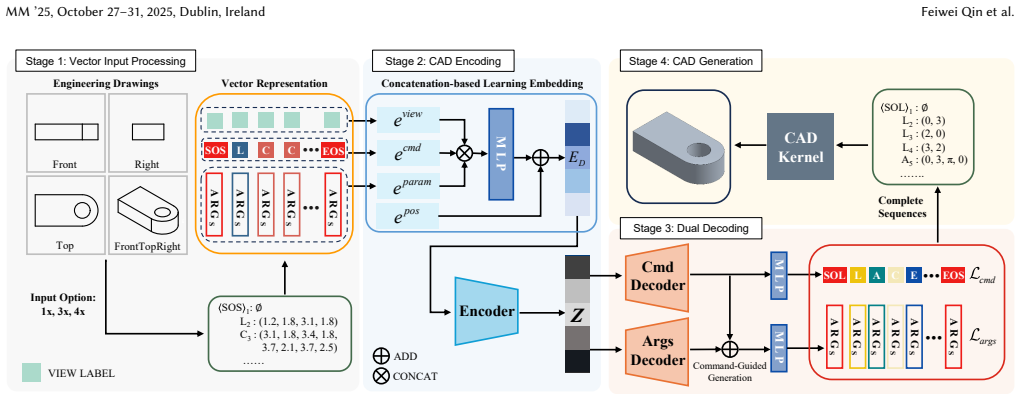
The load-bearing object is a paired command-sequence representation: an SVG drawing becomes a sequence of (view label, LineTo/CubicBézier, 8-parameter) tokens, and the target CAD model becomes a sequence of (command type, parameters) tokens. The mechanism that carries the argument is a concatenation-based embedding that fuses view, command, and parameter embeddings through an MLP instead of adding them, followed by a dual-decoder transformer. The command decoder and argument decoder attend to the same latent vector, and the argument decoder receives the command decoder's output as an added guidance signal, enforcing one-to-one correspondence between command type and parameter set. The soft t
What would settle it
Take a set of real, human-made engineering drawings (including dimensions, hidden lines, and annotations), convert them to SVG, and run the pretrained Drawing2CAD on them; if command accuracy and model validity drop sharply relative to the clean TechDraw-generated test set, the central claim does not generalize to the industrial workflow the paper motivates.
Extended reading notes
Core claim
The central claim is that parametric CAD models can be generated directly from vector engineering drawings by reframing both drawing and model as command sequences and learning the translation between them. The input SVG is parsed into a sequence of LineTo and CubicBézier commands with eight coordinates each, tagged with which of the four standard views it came from; the output is a CAD construction sequence of Line, Circle, Arc, and Extrude operations. The paper's architecture encodes that drawing sequence into a latent vector, then uses two decoders: one predicts command types, the other predicts parameter values, with the command predictions added into the parameter decoder so that each p
Load-bearing premise
The weakest assumption is that the SVG engineering drawings used for training and testing—clean, exact projections automatically generated by FreeCAD from the target CAD models—are representative enough of real engineering drawings that a model trained on them will work where drawings contain dimensions, hidden lines, annotations, and noise.
Editorial extensions
If this is right
- Vector engineering drawings can serve as a direct, information-rich input modality for CAD sequence generation, and SVG inputs beat rasterized PNG inputs on accuracy and validity in these experiments.
- Providing multiple views (three orthographic plus isometric) improves command accuracy and lowers invalidity compared with a single isometric view, so input configuration matters and multi-view is generally better.
- Decoupling command-type prediction from parameter prediction, with command-guided parameter generation, improves both accuracy and the rate of constructible models.
- A distance-aware, tolerance-based parameter loss is a workable alternative to hard classification for CAD parameters, producing models closer to design intent.
- The CAD-VGDrawing dataset gives the community paired vector/raster drawings and CAD sequences to train and benchmark future SVG-to-CAD models.
Reading between the lines
- The current dataset is built from clean, automatic TechDraw projections of CAD models. A natural next test is whether the same pipeline survives real engineering drawings with dimensions, hidden lines, and annotations; that is the industrial setting the paper motivates.
- Because the method only reads visible geometry, occluded features (e.g., a side hole invisible in all views) are unrecoverable from the drawing alone; adding implicit 3D priors or cross-view consistency training would be needed to infer such features.
- The sequence-to-sequence framing is not obviously limited to SVG: any structured vector input (freehand sketch strokes, architectural plans, or diagrammatic line art) could be translated into CAD operations once a compatible primitive representation is defined.
- The soft-target loss embodies a principle that could transfer to other structured generation tasks: when small numeric deviations are semantically harmless, a distance-weighted target distribution can stabilize training without sacrificing downstream validity.
Editorial analysis
A structured set of objections, weighed in public.
Referee Report
Summary. This paper introduces Drawing2CAD, a sequence-to-sequence transformer that maps vector (SVG) engineering drawings to parametric CAD operation sequences. The authors propose a normalized SVG primitive representation (LineTo/CubicBézier with 8 coordinates, Eqs. 1-2), a dual-decoder architecture with command-guided parameter generation, and a soft-target cross-entropy loss (Eqs. 6-7) that tolerates small parameter deviations. To train and evaluate, they create CAD-VGDrawing by projecting DeepCAD STEP models with FreeCAD TechDraw into four views, yielding 157,591 SVG-to-CAD pairs. Experiments compare vector vs raster inputs (Table 1), Drawing2CAD vs a reimplemented DeepCAD-vector baseline (Table 2), and ablate components (Table 3). The central claim is that this is the first framework to generate parametric CAD models directly from vector engineering drawings and that it consistently outperforms the baseline.
Significance. If the claims hold, the paper opens a useful new modality for CAD generation that aligns with 2D-first industrial workflows, and the CAD-VGDrawing dataset plus code release is a valuable community resource. The sequence-to-sequence framing over SVG primitives is a natural and original approach, and the dual-decoder plus soft-target loss is a sensible engineering contribution. However, the evidence is currently limited to clean synthetic projections of the very same models that provide the target sequences, so the practical significance for real engineering drawings remains to be demonstrated.
major comments (4)
- [§4.2-4.3] The dataset is built by automatically projecting each DeepCAD STEP solid with FreeCAD TechDraw, so every input is a clean, exact geometric projection of the target model. The preprocessing in §4.3 then discards path attributes (visibility, color, fill) and restricts commands to LineTo and CubicBézier. Real engineering drawings additionally contain dimensions, hidden/center lines, hatching, title blocks, dashed styles, and annotation noise. No experiment evaluates on such drawings and no robustness ablation introduces annotation-level noise; §6 and §A.1-A.3 only analyze view/occlusion failures on the same clean inputs. Thus the reported ACC_cmd/IR/MCD are upper bounds for clean synthetic projections, and the title/abstract claim of 'engineering drawings' overstates the demonstrated scope. Please either evaluate on real-world drawings or on synthetic drawings augmented with typical annotat
- [§5.2, Table 2] The text states Drawing2CAD 'consistently outperforms DeepCAD-vector in all metrics', but for 1x input MCD is 12.10 vs 11.52 — i.e., worse. The gains in ACC_cmd (+0.42 to +1.03), ACC_param (+0.56 to +0.95), and IR (about 1-3 points) are small, and no error bars, repeated seeds, or significance tests are reported, so it is unclear whether these differences are stable. Please report mean±std over at least 3 seeds with a paired test, and correct the 'all metrics' claim.
- [§5.1, Table 1] The vector-vs-raster comparison is confounded: DeepCAD-vector uses a sequence encoder (modified DeepCAD) while DeepCAD-raster replaces the encoder with a DINOv2 ViT. The two pipelines differ in architecture, tokenization, and pretraining, so the consistent vector advantage may stem from encoder design rather than the input modality. A controlled comparison using the same encoder architecture and equivalent preprocessing (e.g., rasterizing the same SVG and feeding the same transformer encoder) is needed to support the claim that 'vector engineering drawings provide a more suitable and information-rich input'.
- [§5.2, Table 3] The ablations do not show that each added component helps. For 1x (Table 3a), adding the soft-target loss decreases ACC_cmd relative to 'dual dec. + baseline loss' (81.86 vs 81.94), and adding command guidance further drops ACC_cmd to 81.56 and ACC_param to 74.30; the final concatenation embedding raises ACC_cmd slightly but lowers ACC_param. No error bars or significance tests are provided, yet the text claims components are 'essential and effective' and that final models 'significantly outperform' reduced versions. Please report seed variance and avoid component-level claims not supported by the table.
minor comments (5)
- [§4.4] The description of the dual decoder is ambiguous. 'Both decoders take a learned constant embedding as input' is not enough to understand the generation procedure; please clarify whether decoding is autoregressive, how the start/end tokens are used, and how sequence length is determined.
- [§4.5-4.6] The soft-target loss and the parameter accuracy metric use the same tolerance value (3). This is a reasonable design consistency, but ACC_param measures 'within ±3 quantized bins' rather than exact match. Please report exact-match ACC_param and a sensitivity analysis over tolerance/eta values so readers can interpret the reported magnitudes.
- [§4.2] The dataset construction filters out models for which FreeCAD failed and then restricts SVG sequence length to <=100. This may bias the benchmark toward simpler geometries; please provide statistics of the filtered vs retained subsets (e.g., CAD sequence length distributions) in the main text or supplement.
- [§2.2] Free2CAD [19] also maps drawings to CAD-like commands. A brief explicit comparison or differentiation would help position the novelty of Drawing2CAD relative to this prior work.
- [Figure 1] The caption and the token labels in Figure 1 appear visually cluttered and partly garbled (e.g., 'L2 L3 L4 A5...' list). Please clean up the figure for readability.
Circularity Check
No significant circularity: the SVG-to-CAD mapping is learned and evaluated on a held-out split; the synthetic dataset is a domain-shift limitation, not a definitional loop.
full rationale
The paper's derivation chain is self-contained. The input representation (Eqs. 1-2) is a vector encoding of SVG primitives, and the target is a DeepCAD-style operation sequence; no equation defines one in terms of the other. The CAD-VGDrawing dataset is built by projecting DeepCAD STEP models with FreeCAD TechDraw, so the drawings are clean synthetic projections of the target shape. This is a supervised pairing, not a reduction: the mapping from drawing to construction sequence is learned and tested on a held-out split, and the paper's own failure analyses (Section 6, A.1-A.3) show that the learned mapping is not trivially invertible. The only near-coincidence is that the parameter accuracy metric (Eq. 9, eta=3) uses the same tolerance as the soft-target loss (Eq. 7, tolerance=3); this is a consistent choice of evaluation criterion and training objective, not a fitted parameter renamed as a prediction. The baseline DeepCAD-vector is a reimplementation of DeepCAD [44], an external prior work, not a self-citation chain, and the comparison is a standard same-data, held-out evaluation. No uniqueness theorem, ansatz, or load-bearing self-citation is invoked. The main risk is external validity (real engineering drawings contain dimensions, hidden lines, and annotations not present in the TechDraw renderings), which is a generalization/correctness concern, not circularity.
Assumptions & free parameters
free parameters (4)
- alpha (soft target decay) =
2.0
- tolerance (soft target loss) =
3
- eta (parameter accuracy threshold) =
3
- SVG sequence length cap =
100
assumptions (4)
- domain assumption DeepCAD dataset provides ground-truth CAD operation sequences that are executable and correspond to the rendered models.
- domain assumption FreeCAD's TechDraw module produces accurate engineering drawings from STEP files, with enough fidelity for the SVG representations.
- domain assumption The 8-parameter LineTo/CubicBezier representation with 8-bit quantization preserves the geometric information needed to recover CAD sequences.
- domain assumption The command vocabulary {Line, Circle, Arc, Extrude} is sufficient to model all target shapes.
Cite this review
Pith. "Pith review of Drawing2CAD: Sequence-to-Sequence Learning for CAD Generation from Vector Drawings." pith.science (2026). https://pith.science/paper/CANF3UJZ
@misc{pith2026250818733,
  author       = {Pith},
  title        = {Pith review of: Drawing2CAD: Sequence-to-Sequence Learning for CAD Generation from Vector Drawings},
  year         = {2026},
  howpublished = {\url{https://pith.science/paper/CANF3UJZ}},
  note         = {Machine review of arXiv:2508.18733}
}
read the original abstract
Computer-Aided Design (CAD) generative modeling is driving significant innovations across industrial applications. Recent works have shown remarkable progress in creating solid models from various inputs such as point clouds, meshes, and text descriptions. However, these methods fundamentally diverge from traditional industrial workflows that begin with 2D engineering drawings. The automatic generation of parametric CAD models from these 2D vector drawings remains underexplored despite being a critical step in engineering design. To address this gap, our key insight is to reframe CAD generation as a sequence-to-sequence learning problem where vector drawing primitives directly inform the generation of parametric CAD operations, preserving geometric precision and design intent throughout the transformation process. We propose Drawing2CAD, a framework with three key technical components: a network-friendly vector primitive representation that preserves precise geometric information, a dual-decoder transformer architecture that decouples command type and parameter generation while maintaining precise correspondence, and a soft target distribution loss function accommodating inherent flexibility in CAD parameters. To train and evaluate Drawing2CAD, we create CAD-VGDrawing, a dataset of paired engineering drawings and parametric CAD models, and conduct thorough experiments to demonstrate the effectiveness of our method. Code and dataset are available at https://github.com/lllssc/Drawing2CAD.
Figures


Figures from the paper (6 more)


Forward citations
Cited by 1 Pith paper
-
Bridging the Sim-to-Real Gap in Semiconductor Visual Program Synthesis via Input Binarization
Binarization of SEM inputs improves VLM-based visual program synthesis for semiconductor geometries, lifting mean Dice coefficient from 0.4393 to 0.5256 on MIIC data.
Reference graph
Works this paper leans on
-
[1]
Md Ferdous Alam and Faez Ahmed. 2024. Gencad: Image-conditioned computer- aided design generation with transformer-based contrastive representation and diffusion priors.arXiv preprint arXiv:2409.16294(2024)
arXiv 2024
- [2]
-
[3]
Camba, Pedro Company, and Ferran Naya
Jorge D. Camba, Pedro Company, and Ferran Naya. 2022. Sketch-Based Modeling in Mechanical Engineering Design: Current Status and Opportunities.Computer- Aided Design150 (2022), 103283
work page 2022
-
[4]
Neill D. F. Campbell and Jan Kautz. 2014. Learning a manifold of fonts.ACM Transactions on Graphics (TOG)33, 4 (July 2014), 11 pages
work page 2014
-
[5]
Alexandre Carlier, Martin Danelljan, Alexandre Alahi, and Radu Timofte. 2020. DeepSVG: a hierarchical generative network for vector graphics animation. In Proceedings of the International Conference on Neural Information Processing Sys- tems (NIPS)(Vancouver, BC, Canada)(NIPS ’20). Curran Associates Inc., Red Hook, NY, USA, 11 pages
work page 2020
-
[6]
Tianrun Chen, Chunan Yu, Yuanqi Hu, Jing Li, Tao Xu, Runlong Cao, Lanyun Zhu, Ying Zang, Yong Zhang, Zejian Li, et al . 2024. Img2cad: Conditioned 3d cad model generation from single image with structured visual geometry.arXiv preprint arXiv:2410.03417(2024)
arXiv 2024
-
[7]
Alexey Dosovitskiy, Lucas Beyer, Alexander Kolesnikov, Dirk Weissenborn, Xi- aohua Zhai, Thomas Unterthiner, Mostafa Dehghani, Matthias Minderer, Georg Heigold, Sylvain Gelly, et al. 2020. An image is worth 16x16 words: Transformers for image recognition at scale.arXiv preprint arXiv:2010.11929(2020)
arXiv 2020
-
[8]
Elona Dupont, Kseniya Cherenkova, Dimitrios Mallis, Gleb Gusev, Anis Kacem, and Djamila Aouada. 2024. TransCAD: A Hierarchical Transformer for CAD Sequence Inference from Point Clouds. InProceedings of the European Conference on Computer Vision (ECCV)(Milan, Italy). Springer-Verlag, Berlin, Heidelberg, 19–36
work page 2024
Show all 58 references
-
[9]
Rubin Fan, Fazhi He, Yuxin Liu, and Jing Lin. 2025. A history-based parametric CAD sketch dataset with advanced engineering commands.Computer-Aided Design182 (2025), 103848
2025
-
[10]
2002–2025
FreeCAD Community. 2002–2025. FreeCAD: Open Source Parametric 3D CAD Modeler. https://www.freecad.org/
2002
-
[11]
Jie-Hui Gong, Gui-Fang Zhang, Hui Zhang, and Jia-Guang Sun. 2006. Reconstruc- tion of 3D curvilinear wire-frame from three orthographic views.Computers & Graphics30, 2 (2006), 213–224
2006
-
[12]
Wenyu Han, Siyuan Xiang, Chenhui Liu, Ruoyu Wang, and Chen Feng. 2020. Spare3d: A dataset for spatial reasoning on three-view line drawings. InPro- ceedings of the IEEE/CVF Conference on Computer Vision and Pattern Recognition (CVPR). 14690–14699
2020
-
[13]
Ajay B Harish and Abhishek Rajendra Prasad. 2021. Photo2CAD: Automated 3D solid reconstruction from 2D drawings using OpenCV.arXiv preprint arXiv:2101.04248(2021)
2021 arXiv
-
[14]
Wentao Hu, Jia Zheng, Zixin Zhang, Xiaojun Yuan, Jian Yin, and Zihan Zhou. 2023. PlankAssembly: Robust 3D Reconstruction from Three Orthographic Views with Learnt Shape Programs. InProceedings of the IEEE/CVF International Conference on Computer Vision (ICCV). 18449–18459
2023
-
[15]
Mohammad Sadil Khan, Elona Dupont, Sk Aziz Ali, Kseniya Cherenkova, Anis Kacem, and Djamila Aouada. 2024. Cad-signet: Cad language inference from point clouds using layer-wise sketch instance guided attention. InProceedings of the IEEE/CVF Conference on Computer Vision and Pat...
2024
-
[16]
Mu-Hsing Kuo. 1998. Reconstruction of quadric surface solids from three-view engineering drawings.Computer-Aided Design30, 7 (1998), 517–527
1998
-
[17]
Joseph George Lambourne, Karl Willis, Pradeep Kumar Jayaraman, Longfei Zhang, Aditya Sanghi, and Kamal Rahimi Malekshan. 2022. Reconstructing editable prismatic CAD from rounded voxel models. InSIGGRAPH Asia 2022 Conference Papers(Daegu, Republic of Korea)(SA ’22). Association...
2022
-
[18]
Joseph G Lambourne, Karl DD Willis, Pradeep Kumar Jayaraman, Aditya Sanghi, Peter Meltzer, and Hooman Shayani. 2021. Brepnet: A topological message passing system for solid models. InProceedings of the IEEE/CVF Conference on Computer Vision and Pattern Recognition (CVPR). 12773–12782
2021
-
[19]
Changjian Li, Hao Pan, Adrien Bousseau, and Niloy J. Mitra. 2022. Free2CAD: parsing freehand drawings into CAD commands.ACM Transactions on Graphics (TOG)41, 4, Article 93 (2022), 16 pages
2022
-
[20]
Xingang Li and Zhenghui Sha. 2025. Image2CADSeq: Computer-Aided De- sign Sequence and Knowledge Inference from Product Images.arXiv preprint arXiv:2501.04928(2025)
2025 arXiv
-
[21]
Xueyang Li, Yu Song, Yunzhong Lou, and Xiangdong Zhou. 2024. CAD Translator: An Effective Drive for Text to 3D Parametric Computer-Aided Design Generative Modeling. InProceedings of the 32nd ACM International Conference on Multimedia (Melbourne VIC, Australia)(MM ’24). Associa...
2024
-
[22]
Shi-Xia Liu, Shi-Min Hu, Yu-Jian Chen, and Jia-Guang Sun. 2001. Reconstruction of curved solids from engineering drawings.Computer-Aided Design33, 14 (2001), 1059–1072
2001
-
[23]
Yujia Liu, Anton Obukhov, Jan Dirk Wegner, and Konrad Schindler. 2024. Point2CAD: Reverse engineering CAD models from 3D point clouds. InPro- ceedings of the IEEE/CVF Conference on Computer Vision and Pattern Recognition (CVPR). 3763–3772
2024
-
[24]
Raphael Gontijo Lopes, David Ha, Douglas Eck, and Jonathon Shlens. 2019. A learned representation for scalable vector graphics. InProceedings of the IEEE/CVF International Conference on Computer Vision (CVPR). 7930–7939
2019
-
[25]
Weijian Ma, Shuaiqi Chen, Yunzhong Lou, Xueyang Li, and Xiangdong Zhou
-
[26]
Weijian Ma, Minyang Xu, Xueyang Li, and Xiangdong Zhou. 2023. MultiCAD: Contrastive Representation Learning for Multi-modal 3D Computer-Aided De- sign Models. InProceedings of the 32nd ACM International Conference on Infor- mation and Knowledge Management(Birmingham, United Ki...
2023
-
[27]
Tovey Michael. 1989. Drawing and CAD in industrial design.Design Studies10, 1 (1989), 24–39
1989
-
[28]
2014–2024
Networkx Contributors. 2014–2024. Networkx: Network Analysis in Python. https://networkx.org/
2014
-
[29]
Ke Niu, Yuwen Chen, Haiyang Yu, Zhuofan Chen, Xianghui Que, Bin Li, and Xiangyang Xue. 2025. PHT-CAD: Efficient CAD Parametric Primitive Analysis with Progressive Hierarchical Tuning.arXiv preprint arXiv:2503.18147(2025)
2025 arXiv
-
[30]
Maxime Oquab, Timothée Darcet, Theo Moutakanni, Huy V. Vo, Marc Szafraniec, Vasil Khalidov, Pierre Fernandez, Daniel Haziza, Francisco Massa, Alaaeldin El-Nouby, Russell Howes, Po-Yao Huang, Hu Xu, Vasu Sharma, Shang-Wen Li, Wojciech Galuba, Mike Rabbat, Mido Assran, Nicolas B...
2023 arXiv
-
[31]
Kry, and Mikhail Bessmeltsev
Ivan Puhachov, Cedric Martens, Paul G. Kry, and Mikhail Bessmeltsev. 2023. Re- construction of Machine-Made Shapes from Bitmap Sketches.ACM Transactions on Graphics (TOG)42, 6 (Dec. 2023), 16 pages
2023
-
[32]
2008-2025
PythonOCC Contributors. 2008-2025. PythonOCC: 3D CAD/CAE Modeling for Python. https://dev.opencascade.org/project/pythonocc
2008
-
[33]
Qi, Li Yi, Hao Su, and Leonidas J
Charles R. Qi, Li Yi, Hao Su, and Leonidas J. Guibas. 2017. PointNet++: deep hierarchical feature learning on point sets in a metric space. InProceedings of the International Conference on Neural Information Processing Systems (NIPS)(Long Beach, California, USA)(NIPS’17). Curr...
2017
-
[34]
Pradyumna Reddy, Michael Gharbi, Michal Lukac, and Niloy J Mitra. 2021. Im2vec: Synthesizing vector graphics without vector supervision. InProceedings of the IEEE/CVF Conference on Computer Vision and Pattern Recognition (CVPR). 7342– 7351
2021
-
[35]
Pradyumna Reddy, Zhifei Zhang, Zhaowen Wang, Matthew Fisher, Hailin Jin, and Niloy J. Mitra. 2021. A multi-implicit neural representation for fonts. InPro- ceedings of the International Conference on Neural Information Processing Systems (NIPS) (NIPS ’21). Curran Associates In...
2021
-
[36]
Zeyu Shen, Mingyang Zhao, Dong-Ming Yan, and Wencheng Wang. 2025. Mesh2Brep: B-Rep Reconstruction Via Robust Primitive Fitting and Intersection- Aware Constraints.IEEE Transactions on Visualization and Computer Graphics (TVCG)(2025), 1–17
2025
-
[37]
Zecheng Tang, Chenfei Wu, Zekai Zhang, Minheng Ni, Shengming Yin, Yu Liu, Zhengyuan Yang, Lijuan Wang, Zicheng Liu, Juntao Li, and Nan Duan. 2024. StrokeNUWA: tokenizing strokes for vector graphic synthesis. InProceedings of the International Conference on Machine Learning (IC...
2024
-
[38]
Mikaela Angelina Uy, Yen-Yu Chang, Minhyuk Sung, Purvi Goel, Joseph G Lam- bourne, Tolga Birdal, and Leonidas J Guibas. 2022. Point2cyl: Reverse engineering 3d objects from point clouds to extrusion cylinders. InProceedings of the IEEE/CVF Conference on Computer Vision and Pat...
2022
-
[39]
Gomez, Łukasz Kaiser, and Illia Polosukhin
Ashish Vaswani, Noam Shazeer, Niki Parmar, Jakob Uszkoreit, Llion Jones, Aidan N. Gomez, Łukasz Kaiser, and Illia Polosukhin. 2017. Attention is all you need. InProceedings of the International Conference on Neural Information Processing Systems (NIPS)(Long Beach, California, ...
2017
-
[40]
Weidong Wang and Georges G Grinstein. 1993. A survey of 3D solid recon- struction from 2D projection line drawings. InComputer Graphics Forum, Vol. 12. Wiley Online Library, 137–158
1993
-
[41]
Xilin Wang, Jia Zheng, Yuanchao Hu, Hao Zhu, Qian Yu, and Zihan Zhou. 2024. From 2D CAD Drawings to 3D Parametric Models: A Vision-Language Approach. arXiv preprint arXiv:2412.11892(2024)
2024 arXiv
-
[42]
Yizhi Wang and Zhouhui Lian. 2021. DeepVecFont: synthesizing high-quality vector fonts via dual-modality learning.ACM Transactions on Graphics (TOG)40 (Dec. 2021), 15 pages
2021
-
[43]
Karl D. D. Willis, Yewen Pu, Jieliang Luo, Hang Chu, Tao Du, Joseph G. Lambourne, Armando Solar-Lezama, and Wojciech Matusik. 2021. Fusion 360 gallery: a dataset and environment for programmatic CAD construction from human design sequences.ACM Transactions on Graphics (TOG)40,...
2021
-
[44]
Rundi Wu, Chang Xiao, and Changxi Zheng. 2021. Deepcad: A deep genera- tive network for computer-aided design models. InProceedings of the IEEE/CVF International Conference on Computer Vision (CVPR). 6772–6782
2021
-
[45]
Xiang Xu, Karl DD Willis, Joseph G Lambourne, Chin-Yi Cheng, Pradeep Kumar Jayaraman, and Yasutaka Furukawa. 2022. SkexGen: Autoregressive Generation of CAD Construction Sequences with Disentangled Codebooks. InProceedings of the International Conference on Machine Learning (I...
2022
-
[46]
Volpe Yary, Palai Matteo, Governi Lapo, and Furferi Rocco. 2010. From 2D Ortho- graphic views to 3D Pseudo-Wireframe: An Automatic Procedure.International Journal of Computer Applications5 (08 2010), 18–24
2010
-
[47]
Mohsen Yavartanoo, Sangmin Hong, Reyhaneh Neshatavar, and Kyoung Mu Lee
-
[48]
Aijia Zhang, Weiqiang Jia, Zou Qiang, Yixiong Feng, Xiaoxiang Wei, and Ye Zhang
-
[49]
Text2CAD: Text to 3D CAD Generation via Technical Drawings.arXiv preprint arXiv:2411.06206(2024)
2024 arXiv
-
[50]
Chao Zhang, Arnaud Polette, Romain Pinquié, Gregorio Carasi, Henri De Char- nace, and Jean-Philippe Pernot. 2025. eCAD-Net: Editable Parametric CAD Models Reconstruction from Dumb B-Rep Models Using Deep Neural Networks. Computer-Aided Design178 (2025), 103806
2025
-
[51]
Shuming Zhang, Zhidong Guan, Hao Jiang, Tao Ning, Xiaodong Wang, and Pingan Tan. 2024. Brep2Seq: a dataset and hierarchical deep learning network for reconstruction and generation of computer-aided design models.Journal of Computational Design and Engineering11, 1 (01 2024), 110–134
2024
-
[52]
Chao Zhang, Romain Pinquié, Arnaud Polette, Gregorio Carasi, Henri De Char- nace, and Jean-Philippe Pernot. 2023. Automatic 3D CAD models reconstruction from 2D orthographic drawings.Computers & Graphics114 (2023), 179–189
2023
-
[53]
Jiwei Zhou and Jorge D. Camba. 2025. The status, evolution, and future challenges of multimodal large language models (LLMs) in parametric CAD.Expert Systems with Applications(2025), 127520
2025
-
[54]
Shengdi Zhou, Tianyi Tang, and Bin Zhou. 2023. CADParser: a learning approach of sequence modeling for B-Rep CAD. InProceedings of the International Joint Conference on Artificial Intelligence (IJCAI)(Macao, P.R.China)(IJCAI ’23). 9 pages
2023
-
[55]
Yi Zhang, Fazhi He, Rubin Fan, and Bo Fan. 2024. View2CAD: Parsing Multi-view into CAD Command Sequences. InProceedings of the International Conference on Computer Supported Cooperative Work in Design (CSCWD). IEEE, 2949–2954
2024
-
[58]
1x", "3x
Qiang Zou, Yincai Wu, Zhenyu Liu, Weiwei Xu, and Shuming Gao. 2024. Intelli- gent CAD 2.0.Visual Informatics8, 4 (2024), 1–12. Drawing2CAD: Sequence-to-Sequence Learning for CAD Generation from Vector Drawings MM ’25, October 27–31, 2025, Dublin, Ireland Supplementary Material...
2024
-
[2024]
InProceedings of the IEEE/CVF Conference on Computer Vision and Pattern Recognition (CVPR)
Draw Step by Step: Reconstructing CAD Construction Sequences from Point Clouds via Multimodal Diffusion. InProceedings of the IEEE/CVF Conference on Computer Vision and Pattern Recognition (CVPR). 27154–27163
-
[2025]
Diffusion-CAD: Controllable Diffusion Model for Generating Computer- Aided Design Models.IEEE Transactions on Visualization and Computer Graphics (2025), 1–12
2025
Reviewed August 5, 2026 · model on record in the stance chip above.
Discussion (0). Sign in to comment.