REVIEW 4 major objections 5 minor 32 references
Asymptotic Properties of a Forward-Backward-Forward Differential Equation and Its Discrete Version for Solving Quasimonotone Variational Inequalities
T0 review · 4 major / 5 minor · reviewed 2026-08-05 · deepseek-v4-flash
Pith's one-line read A forward-backward-forward scheme for quasimonotone variational inequalities converges weakly in continuous time, and its Bregman discrete version converges strongly under only uniform continuity of the operator.
desk verdict Genuine new algorithm, but a load-bearing gap: Lemma 3.5 silently assumes finiteness of A_p that C4 doesn't provide, so the continuous weak-convergence claim is unsupported; the discrete theorem also overclaims. read the letter →
The pith
A machine-rendered reading of the paper's core claim, the machinery that carries it, and where it could break.
The reading
What carries the argument
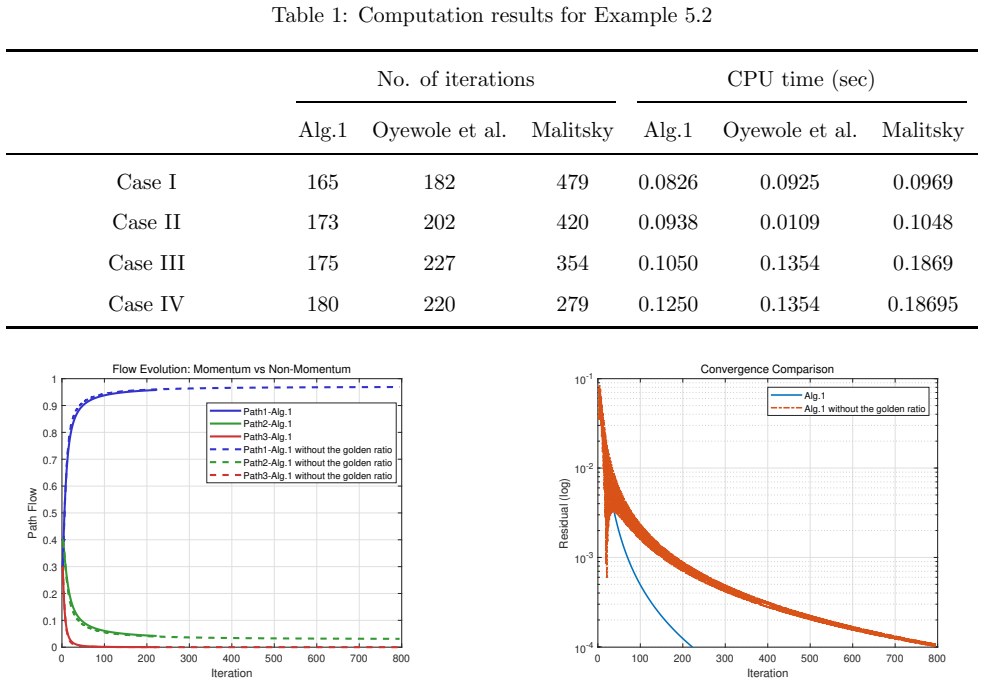
The load-bearing structure is the FBF iteration: y is a projection of x − λF(x), and the next point is y plus the correction λ(F(x) − F(y)). Its discrete Bregman version, Algorithm 1, wraps this in a golden-ratio extrapolation step w_k and a Bregman projection. The central identities are the Bregman three-point identity and the obtuse-angle property of projections, which convert the variational inequality residual into a decrease of Bregman distance, yielding a quasi-Fejér monotonicity inequality. Around that, two mechanisms do the work: the golden-ratio extrapolation, which creates the momentum pattern in the convergence inequality, and the adaptive step rule, which sets λ_{k+1} by comparin
What would settle it
A concrete test: build a quasimonotone, Lipschitz operator on ℓ2 satisfying C1–C4 whose zero set outside Ω_D is an infinite pairwise-separated set, such as points at the scaled orthonormal basis vectors; if trajectories of (1.3) fail to have a unique weak cluster point, Proposition 3.7 is refuted. For the discrete claim, run Algorithm 1 on a uniformly continuous, non-Lipschitz quasimonotone operator, for instance the traffic cost F_i(x)=1+x_i^0.2 on the simplex, with C5 holding and λ_k → 0; if the generated sequence fails to converge strongly to Ω_D, Theorem 4.5 is refuted.
Extended reading notes
Core claim
The central claim is that the forward-backward-forward mechanism, in both differential-equation and iterative forms, tolerates much weaker assumptions than the monotone-plus-Lipschitz package it was originally designed for. The paper proves that the Bregman Algorithm 1, with its golden-ratio extrapolated point, generates a sequence converging strongly to a solution of the quasimonotone variational inequality when the operator is quasimonotone and uniformly continuous, not necessarily Lipschitz, assuming a residual-growth condition C5 holds and the zero set outside the Minty-type solution set contains no solutions. In continuous time, it proves weak convergence of the trajectories x(t) and y(
Load-bearing premise
The continuous-time weak-convergence proof needs the set of points where the operator vanishes near a solution to be finite, but the written assumption only separates those points pairwise; in an infinite-dimensional space an infinite pairwise-separated set can exist, so finiteness is a hidden load-bearing premise.
Editorial extensions
If this is right
- If the central claim is correct, FBF-type methods apply to quasimonotone variational inequalities without requiring strong pseudomonotonicity or sequential weak-to-weak continuity.
- The discrete Bregman algorithm strongly converges for uniformly continuous, non-Lipschitz operators, meaning problems previously requiring line search or a global Lipschitz constant become tractable.
- The nonmonotone golden-ratio step rule works in reflexive Banach spaces via Bregman distances, not just Hilbert spaces.
- Time averages and weighted averages of the iterates converge strongly, supporting the use of averaged outputs in practice.
- The framework covers infinite-dimensional and non-Lipschitz examples, including traffic equilibrium models with power-type cost functions.
Reading between the lines
- Beyond the paper: the same ratio-based step rule, comparing displacement to operator change, could likely be transplanted to other projection-based splitting schemes for quasimonotone inclusions, since it does not use the monotonicity structure directly.
- Beyond the paper: the residual-growth condition C5 suggests a testable diagnostic for whether strong convergence is achievable in practice: monitor the normalized gap |⟨F(y_k), y_k − p⟩| / ||y_k − p||^{2+ε} along the trajectory, as the theory predicts it must stay bounded away from zero.
- Beyond the paper: in finite-dimensional settings, the separation condition on the zero set may be automatically satisfiable for generic operators, which would make the continuous-time weak-convergence result more broadly applicable than its proof currently shows.
- Beyond the paper: the open question the authors state, whether time-averaged weak convergence holds without strong convergence, could be tackled with an averaged Opial-type lemma; if it holds, it would make ergodic convergence available under the same weak assumptions as the trajectory convergence.
Editorial analysis
A structured set of objections, weighed in public.
Referee Report
Summary. The paper studies a forward-backward-forward (FBF) type differential equation for quasimonotone variational inequalities in Hilbert spaces and a Bregman-type discrete algorithm in reflexive Banach spaces. In the continuous part, it claims weak convergence of the trajectories under conditions C1–C4 (quasimonotonicity, Lipschitz continuity, a sequential lower-semicontinuity condition on the norm of F, and pairwise separation of the set A_p), strong convergence under an additional asymptotic gap condition C5, and ergodic convergence. In the discrete part, it proposes a golden-ratio extrapolated Bregman FBF algorithm with a nonmonotone adaptive step-size rule and claims strong convergence under uniform continuity of the operator, together with D1–D4 and C5. The basic energy estimate (Proposition 3.3) is clean, and the algorithmic idea is interesting, but the proofs of the central convergence claims contain serious gaps: Lemma 3.5 silently adds a finiteness assumption not present in C4; Lemma 3.6 uses an invalid weak-limit inference; Proposition 3.7 misuses the separation lemma; and Theorem 4.5 invokes a condition C5 that is defined only for the continuous trajectory, not for the discrete sequence. The paper also states in the conclusion that the discrete analysis currently relies on Lipschitz continuity and is confined to finite-dimensional Hilbert spaces, which contradicts the theorem statements in Section 4.
Significance. If the results were correct, the paper would make a useful contribution: it would extend FBF-type dynamics to quasimonotone operators without sequential weak-to-weak continuity, and it would offer a Bregman algorithm with an adaptive step-size rule that avoids line search and does not require Lipschitz continuity. The numerical examples, especially the traffic equilibrium model, illustrate a plausible practical regime. However, the advertised central theorems are not established by the arguments given. The continuous weak-convergence proof depends on an unstated finiteness assumption and an invalid weak-limit step, and the discrete strong-convergence theorem is ill-posed because C5 is not defined for the iterates. These are load-bearing issues, not presentation defects. The paper does contain a correct and useful energy estimate (Proposition 3.3), but the asymptotic claims go substantially beyond what the proofs support.
major comments (4)
- [§3, Lemma 3.5 and condition C4] Lemma 3.5 asserts that A_p := {p} ∪ A is finite, but C4 only postulates pairwise separation with gap 2δ_p. In an infinite-dimensional Hilbert space, an infinite set such as {2δ e_n : n ∈ N} ∪ {0} satisfies C4 while no finite family of hyperplane-tubes can separate its points, so the construction of finitely many unit vectors r_1,...,r_m fails. Proposition 3.7 relies on Lemma 3.5 through Lemma 3.6 to prove uniqueness of the weak cluster point. Since finiteness is not part of C4, the advertised weak-convergence result under C1–C4 is unsupported. This is the central continuous-time claim, not a minor gap.
- [§3, Lemma 3.6 and Proposition 3.7] The second part of Lemma 3.6 argues that if x(t_k) ∉ Ω and x(t_k) ⇀ x*, then x* ∉ Ω. This is false in general: the complement of an open set is norm-closed but not necessarily weakly closed, and a weak limit of a sequence in a closed nonconvex set can lie inside the set. Moreover, the claim that any weak cluster point must lie in A_p is not supported: Proposition 3.4 only gives that such a point is in Ω_D or has F = 0; it need not equal the fixed point p that defines A_p. Proposition 3.7 then asserts, without justification, that for two distinct weak cluster points y1,y2 one can find a time N5 with x(t_N5) near y1 and y(t_N5) near y2. Lemma 3.6 only gives eventual membership in the union of the tubes, not in the tube around a specified cluster point. The proof of weak convergence is therefore not valid.
- [§4, Theorem 4.5 and condition C5] C5 is introduced in Section 3 as a condition on the continuous trajectory: it reads liminf_{t→∞} |⟨F(y(t)), y(t)−u⟩| / ||y(t)−u||^{2+ε} > 0 for all u ∈ K. Theorem 4.5 is a statement about the discrete sequence {x_k} generated by Algorithm 1, but no discrete analogue of C5 is stated. The proof nevertheless applies C5 to {y_{k_i}} as if it were a condition on the iterates. This makes the main strong-convergence theorem ill-posed. In addition, the abstract claims strong convergence under uniform continuity alone, whereas Theorem 4.5 also requires C5 and the assumption F(p) ≠ 0 for all p ∈ Ω \ Ω_D. These additional conditions are essential to the proof and should be stated in the abstract and introduction.
- [§4 and §6] The discrete analysis is not sufficiently self-contained, and the stated scope is internally inconsistent. Lemma 4.1 defers its proof to the authors' earlier work [25]; Proposition 4.4 says 'For brevity, we omit the details here' for the key case λ_k → 0; and Lemma 4.2 repeatedly says the remaining subcase proof is 'similar ... so we omit.' More seriously, the conclusion states that existence and uniqueness of the proposed discrete dynamical system relies on Lipschitz continuity of F and that the convergence analysis has been conducted only in finite-dimensional Hilbert spaces, yet Theorem 4.5 is stated for reflexive Banach spaces. These limitations directly affect the manuscript's central claim of a Bregman FBF method with strong convergence under mere uniform continuity.
minor comments (5)
- [§3, Proposition 3.4] In Case 2, after assuming limsup ||F(y_n)|| = M > 0, the proof states 'there exists K such that ||F(y_n)|| > M/2 for all n ≥ K.' This is only true along a subsequence, not for the whole sequence. The argument can be repaired by passing to a subsequence, but as written the step is invalid.
- [§3, Proposition 3.7 and notation] The notation x(t)_{N5} is confusing (the subscript appears to be attached to a continuous trajectory). More importantly, the phrase 'According to Lemma 3.5, there exists N5 ... such that x(t)_{N5} ∈ Ω(y1, δ_p/2) and y(t)_{N5} ∈ Ω(y2, δ_p/2)' does not follow from Lemma 3.5; the lemma only yields disjoint tubes around the points of a finite A_p, not simultaneous proximity of x(t) and y(t) to two prescribed weak cluster points at the same time.
- [§3, Theorem 3.10] In bounding J2(T), the proof writes ||y(t) − x*|| = ||y(t) − x(t)|| + ||x(t) − x*||; this should be an inequality (≤), not an equality. The subsequent estimate remains essentially correct after this correction.
- [§5, Example 5.3] The example is described as 'not monotone in the classical sense,' but the displayed computation shows ⟨F(y)−F(x), y−x⟩ = Σ (F_i(y_i)−F_i(x_i))(y_i−x_i) ≥ 0 for increasing functions, which is exactly monotonicity on the simplex. The non-Lipschitz nature due to the unbounded derivative at the boundary is the relevant feature; the monotonicity statement should be corrected.
- [Abstract and Introduction] The abstract and bullet-point contributions state that strong convergence is obtained under uniform continuity without Lipschitz continuity, but omit the extra assumptions C5 and F(p) ≠ 0 on Ω \ Ω_D that appear in Theorem 4.5. These should be disclosed wherever the main result is advertised.
Circularity Check
No significant circularity: the continuous and discrete convergence proofs are genuine extensions; the self-cited step-size lemma is auxiliary and the main claims are not defined in terms of their assumptions.
full rationale
I checked the derivation chain for reductions of conclusions to inputs. In the continuous part, Proposition 3.3 derives the dissipation inequality from the projection obtuse-angle property and quasimonotonicity; Proposition 3.4 is proved in the text even though it is labeled an analogue of [25]; Lemmas 3.5-3.6 and Proposition 3.7 use explicit arguments. In the discrete part, the adaptive step rule (4.1) is not a fitted prediction: Lemma 4.2 and Theorem 4.5 treat both cases λ_k→λ>0 and λ_k→0, so strong convergence is not obtained by assuming the step size is bounded away from zero. The one proof actually delegated to the authors' earlier work is Lemma 4.1: 'The proof of this lemma can refer to our earlier work [25].' This is a self-citation and it supports the discrete proof, but it is an auxiliary statement about the step-size sequence whose assumptions do not contain the target conclusion; it is published and not an input/output equivalence. No uniqueness theorem is imported from the authors, and the golden-ratio extrapolation is credited to Malitsky [26]. Two non-circular rigor issues should be flagged: Lemma 3.5 silently strengthens C4 by assuming A_p is finite ('let A_p := {p} ∪ A ⊂ H be a finite subset') while C4 only gives pairwise separation, so Proposition 3.7's weak convergence has an unsupported hypothesis in infinite-dimensional Hilbert spaces; and Lemma 4.1's proof is omitted. These are correctness/self-containedness concerns, not cases where a prediction is equivalent to its inputs by construction.
Assumptions & free parameters
free parameters (3)
- delta_p in C4 =
exists per p
- c and epsilon in C5 =
exists (c>0, epsilon>=0)
- rho0 in Lemma 4.2 =
1
assumptions (6)
- domain assumption C1/D1: the Minty solution set Omega_D is nonempty
- ad hoc to paper C4: pairwise separation of A_p with gap 2 delta_p
- ad hoc to paper Lemma 3.5: A_p is finite (implicit)
- ad hoc to paper C5: asymptotic nondegeneracy of the gap along the trajectory
- ad hoc to paper F(p) is nonzero for all p in Omega \ Omega_D (Theorem 4.5)
- domain assumption Phi is Legendre, strongly convex, uniformly Frechet differentiable (D3)
Cite this review
Pith. "Pith review of Asymptotic Properties of a Forward-Backward-Forward Differential Equation and Its Discrete Version for Solving Quasimonotone Variational Inequalities." pith.science (2026). https://pith.science/paper/UPSVXO3J
@misc{pith2026250818866,
  author       = {Pith},
  title        = {Pith review of: Asymptotic Properties of a Forward-Backward-Forward Differential Equation and Its Discrete Version for Solving Quasimonotone Variational Inequalities},
  year         = {2026},
  howpublished = {\url{https://pith.science/paper/UPSVXO3J}},
  note         = {Machine review of arXiv:2508.18866}
}
read the original abstract
This paper investigates the asymptotic behavior of a forward-backward-forward (FBF) type differential equation and its discrete counterpart for solving quasimonotone variational inequalities (VIs). Building on recent continuous-time dynamical system frameworks for VIs, we extend these methods to accommodate quasimonotone operators. We establish weak and strong convergence under significantly relaxed conditions, without requiring strong pseudomonotonicity or sequential weak-to-weak continuity. Additionally, we prove ergodic convergence of the continuous trajectories, offering further insight into the long-term stability of the system. In the discrete setting, we propose a novel Bregman-type algorithm that incorporates a nonmonotone adaptive step-size rule based on the golden ratio technique. A key contribution of this work is demonstrating that the proposed method ensures strong convergence under the assumption of uniform continuity of the operator, thereby relaxing the standard Lipschitz continuity requirement prevalent in existing methods. Numerical experiments, including infinite-dimensional and non-Lipschitz cases, are presented to illustrate the improved convergence and broader applicability of the proposed approach.
Figures


Figures from the paper (1 more)
Reference graph
Works this paper leans on
-
[25]
Liu, H. and Yang, J. (2020) Weak convergence of iterativ e methods for solving quasimonotone variational inequalities. Comput. Optim. Appl. , 77, 491–508
work page 2020
-
[1]
(1964) Formes bilin´ eaires coercitives sur les ensembles convexes
Stampacchia, G. (1964) Formes bilin´ eaires coercitives sur les ensembles convexes. C. R. Acad. Sci. Paris, 258, 4413–4416
work page 1964
-
[2]
Facchinei, F. and Pang, J.-S. (2003) Finite-Dimensional Variational Inequalities and Complemen - tarity Problems. New York: Springer. DOI: 10.1007/b97303
-
[3]
(1993) Network Economics: A Variational Inequality Approach
Nagurney, A. (1993) Network Economics: A Variational Inequality Approach . Dordrecht: Kluwer Academic Publishers. DOI: 10.1007/978-1-4757-2257-7
-
[4]
Bertsekas, D. P. (1999) Nonlinear Programming, 2nd ed. Belmont, MA: Athena Scientific
work page 1999
-
[5]
Bauschke, H. H. and Combettes, P. L. (2011) Convex Analysis and Monotone Operator Theory in Hilbert Spaces. New York: Springer. DOI: 10.1007/978-1-4419-9467-7
-
[6]
Goldstein, A. A. (1964) Convex programming in Hilbert sp ace. Bull. Amer. Math. Soc. , 70, 709– 710
work page 1964
-
[7]
(2015) Projected reflected gradient method s for monotone variational inequalities
Malitsky, Y. (2015) Projected reflected gradient method s for monotone variational inequalities. SIAM J. Optim. , 25, 502–520
work page 2015
Show all 32 references
-
[8]
and Liu, H
Yang, J. and Liu, H. (2018) A modified projected gradient m ethod for monotone variational inequalities. J. Optim. Theory Appl. , 179, 197–211
2018
-
[9]
and Liu, H
Yang, J. and Liu, H. (2019) Strong convergence result for solving monotone variational inequalities in Hilbert space. Numer. Algorithms , 80, 741–752
2019
-
[10]
and Reich, S
Censor, Y., Gibali, A. and Reich, S. (2011) Strong conve rgence of subgradient extragradient meth- ods for the variational inequality problem in Hilbert space . Optim. Methods Softw. , 26, 827–845
2011
-
[11]
Korpelevich, G. M. (1976) The extragradient method for finding saddle points and other problems. Ekon. Mat. Metody , 12, 747–756
1976
-
[12]
and Reich, S
Censor, Y., Gibali, A. and Reich, S. (2011) The subgradi ent extragradient method for solving variational inequalities in Hilbert space. J. Optim. Theory Appl. , 148, 318–335
2011
-
[13]
(2000) A modified forward-backward splitting method for maximal monotone mappings
Tseng, P. (2000) A modified forward-backward splitting method for maximal monotone mappings. SIAM J. Control Optim. , 38, 431–446
2000
-
[14]
and He, Y
Ye, M. and He, Y. (2015) A double projection method for so lving variational inequalities without monotonicity. Comput. Optim. Appl. , 60, 141–150
2015
-
[15]
Wang, W. Y. and Ma, B. B. (2023) Extragradient type proje ction algorithm for solving quasi- monotone variational inequalities. Optimization, 2023, 1–17
2023
-
[16]
and He, Y
Lei, M. and He, Y. (2021) An extragradient method for sol ving variational inequalities without monotonicity. J. Optim. Theory Appl. , 188, 432–446
2021
-
[17]
Cai, G., Dong, Q. L. and Peng, Y. (2021) Strong convergen ce theorems for solving variational inequality problems with pseudomonotone and non-Lipschit z operators. J. Optim. Theory Appl. , 188, 447–472
2021
-
[18]
(2000) On the minimizing property of a secon d order dissipative system in Hilbert spaces
Alvarez, F. (2000) On the minimizing property of a secon d order dissipative system in Hilbert spaces. SIAM J. Control Optim. , 38, 1102–1119. 32
2000
-
[19]
and Czarnecki, M
Attouch, H. and Czarnecki, M. O. (2011) Asymptotic beha vior of coupled dynamical systems with multiscale aspects. J. Differential Equations , 248, 1315–1344
2011
-
[20]
(1973)Op´ erateurs maximaux monotones et semi-groupes de contractions dans les espaces de Hilbert
Br´ ezis, H. (1973)Op´ erateurs maximaux monotones et semi-groupes de contractions dans les espaces de Hilbert. Amsterdam: North-Holland
1973
-
[21]
Bruck, R. E. (1975) Asymptotic convergence of nonlinea r contraction semigroups in Hilbert space. J. Funct. Anal. , 18, 15–26
1975
-
[22]
I., Csetnek, E
Bot, R. I., Csetnek, E. R. and Vuong, P. T. (2020) The forw ard-backward-forward method from continuous and discrete perspective for pseudo-monotone v ariational inequalities in Hilbert spaces. Eur. J. Oper. Res. , 287, 49–60
2020
-
[23]
and Bot, R
Banert, S. and Bot, R. I. (2018) A forward-backward-for ward differential equation and its asymp- totic properties. J. Convex Anal. , 25(2), 371–388
2018
-
[24]
and Cholamjiak, P
Wang, Z., Sunthrayuth, P., Adamu, A. and Cholamjiak, P. (2023) Modified accelerated Bregman projection methods for solving quasi-monotone variationa l inequalities. Optimization, 73(7), 2053– 2087
2023
-
[26]
(2018) Golden ratio algorithms for variat ional inequalities
Malitsky, Y. (2018) Golden ratio algorithms for variat ional inequalities. Math. Program. , 184, 383–410
2018
-
[27]
(1991) Uniform continuity is almost Lips chitz continuity
Vanderbei, R. (1991) Uniform continuity is almost Lips chitz continuity. Stat. Oper. Res. Ser. SOR , 11
1991
-
[28]
and Svaiter, B
Abbas, B., Attouch, H. and Svaiter, B. F. (2014) Newton- like dynamics and forward-backward methods for structured monotone inclusions in Hilbert spac es. J. Optim. Theory Appl. , 161(2), 331–360
2014
-
[29]
(2020) The extragradient method for quas i-monotone variational inequalities
Alahuddin, A. (2020) The extragradient method for quas i-monotone variational inequalities. Op- timization, 71(9), 2519–2528
2020
-
[30]
K., Abass, H
Oyewole, O. K., Abass, H. A. and Ogunsola, O. J. (2025) An improved subgradient extragradient self-adaptive algorithm based on the golden ratio techniqu e for variational inequality problems in Banach spaces. J. Comput. Appl. Math. , 460, 116420
2025
-
[31]
and Yang, J
Wang, M., Liu, H. and Yang, J. (2025) Convergence analys is of the self-adaptive projection method for variational inequalities with non-Lipschitz co ntinuous operators. arXiv preprint , arXiv:2506.07349
2025 arXiv
-
[32]
and Yang, J
Wang, M., Liu, H. and Yang, J. (2025) A reconsideration o f quasimonotone variational inequality problems. arXiv preprint, arXiv:2506.09389. 33
2025
Reviewed August 5, 2026 · model on record in the stance chip above.
Discussion (0). Sign in to comment.