Mass-induced Coulomb drag in capacitively coupled superconducting nanowires
Pith reviewed 2026-05-18 21:28 UTC · model grok-4.3
The pith
A mass gap in one superconducting nanowire induces finite Coulomb drag in its capacitively coupled partner.
A machine-rendered reading of the paper's core claim, the machinery that carries it, and where it could break.
Core claim
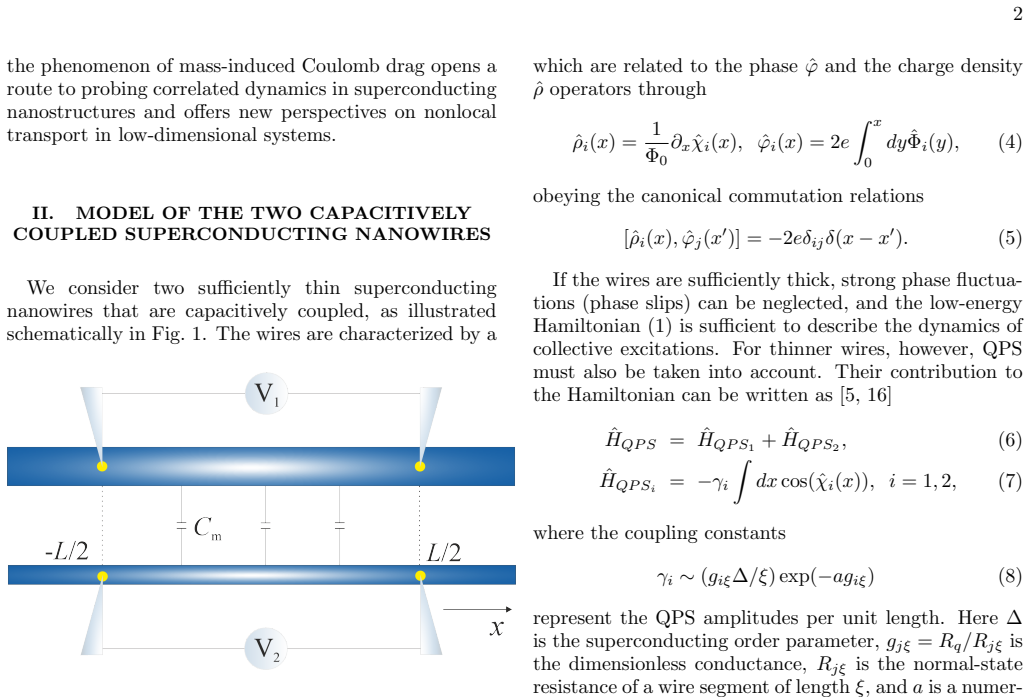
Quantum phase slips generate voltage fluctuations in the active nanowire that induce signals in the passive one through mutual capacitance. In the fully superconducting case these signals cancel perfectly. A mass gap in the passive wire synchronizes the plasmon modes, eliminating the cancellation and yielding a stationary drag voltage. This voltage is small for short wires but saturates at a value set by the mutual capacitance when the wires are long, as explained by semiclassical pulse propagation.
What carries the argument
The mass term in the gapped nanowire that synchronizes plasmon modes to prevent complete cancellation of induced voltage pulses from quantum phase slips.
If this is right
- Finite drag voltage emerges only when one wire develops a mass gap below the superconductor-insulator transition.
- Drag coefficient crosses over from weak in short wires to maximal value determined by mutual capacitance in long wires.
- Semiclassical voltage pulse propagation shows the mass term stops full signal cancellation.
- The effect provides a new way to probe nonlocal transport near quantum criticality in low-dimensional superconductors.
Where Pith is reading between the lines
- The length dependence could be tested by fabricating nanowire pairs of varying lengths.
- This drag mechanism might apply to other systems with tunable gaps, such as in Josephson junction arrays.
- It suggests experimental signatures for the superconductor-insulator transition in capacitively coupled setups.
Load-bearing premise
Perturbative treatment of quantum phase slips and semiclassical plasmon propagation remain accurate in the gapped phase without additional dissipation or higher-order effects that could restore exact cancellation.
What would settle it
An experiment showing that the drag voltage remains zero or does not exhibit the predicted saturation with increasing wire length when one wire is tuned into the gapped regime would falsify the central claim.
Figures

read the original abstract
We investigate Coulomb drag in a system of two capacitively coupled superconducting nanowires. In this context, drag refers to the appearance of a stationary voltage in the passive wire in response to a current bias applied to the active one. Quantum phase slips (QPS) in the biased wire generate voltage fluctuations that can be transmitted to the other. Using perturbative and semiclassical approaches, we show that when both wires are superconducting the induced voltage vanishes due to exact cancellation of plasmon contributions. By contrast, when the second wire is tuned below the superconductor-insulator transition and develops a mass gap, this cancellation is lifted and a finite drag voltage emerges. The drag coefficient exhibits a crossover from weak drag in short wires to a maximal value set by the mutual capacitance in long wires. A semiclassical picture of voltage pulse propagation clarifies the physical origin of the effect: the mass term synchronizes plasmon modes and prevents complete cancellation of induced signals. Our results establish a mechanism of mass-induced Coulomb drag in low-dimensional superconductors and suggest new routes for probing nonlocal transport near quantum criticality.
Editorial analysis
A structured set of objections, weighed in public.
Referee Report
Summary. The manuscript investigates Coulomb drag between two capacitively coupled superconducting nanowires. Using perturbative treatment of quantum phase slips (QPS) and a semiclassical analysis of plasmon propagation, the authors show that an exact cancellation of induced voltages occurs when both wires remain superconducting. When the passive wire is tuned below the superconductor-insulator transition and acquires a mass gap, this cancellation is lifted, producing a finite drag voltage. The drag coefficient crosses over from weak drag at short wire lengths to a maximal value fixed by the mutual capacitance at long lengths. A semiclassical picture of synchronized voltage-pulse propagation is invoked to explain the role of the mass term.
Significance. If the central result holds, the work identifies a concrete mechanism for mass-induced Coulomb drag in low-dimensional superconductors and supplies a length-dependent crossover that is in principle testable. The combination of perturbative QPS expansion with a semiclassical plasmon picture yields a transparent physical account of how a gap in one wire breaks the cancellation present in the fully superconducting case. This could offer a new probe of nonlocal transport near the superconductor-insulator transition.
major comments (1)
- [Semiclassical plasmon analysis and gapped-regime drag calculation] The central claim that the mass gap lifts the plasmon cancellation rests on the perturbative QPS treatment and semiclassical wave-packet propagation remaining controlled once the passive wire enters the gapped regime. No explicit bound on the QPS fugacity or estimate of higher-order corrections that might restore partial cancellation or modify the short-to-long wire scaling is provided; this assumption is load-bearing for the predicted length crossover and the magnitude set by mutual capacitance.
minor comments (2)
- [Introduction and model section] Notation for the mutual capacitance and the mass gap parameter should be introduced with a clear definition at first use and kept consistent between the perturbative and semiclassical sections.
- [Abstract] The abstract states that the drag reaches a 'maximal value set by the mutual capacitance' in long wires; a brief statement of the limiting expression (e.g., in terms of C_m and bias current) would help readers assess the result without consulting the full derivation.
Simulated Author's Rebuttal
We thank the referee for the careful reading and constructive feedback on our manuscript. We address the major comment below and indicate the revisions we will make.
read point-by-point responses
-
Referee: [Semiclassical plasmon analysis and gapped-regime drag calculation] The central claim that the mass gap lifts the plasmon cancellation rests on the perturbative QPS treatment and semiclassical wave-packet propagation remaining controlled once the passive wire enters the gapped regime. No explicit bound on the QPS fugacity or estimate of higher-order corrections that might restore partial cancellation or modify the short-to-long wire scaling is provided; this assumption is load-bearing for the predicted length crossover and the magnitude set by mutual capacitance.
Authors: We agree that an explicit discussion of the validity regime strengthens the presentation. Our perturbative treatment is controlled for small QPS fugacity y ≪ 1, the standard regime for superconducting nanowires. In the gapped passive wire the mass term exponentially suppresses multi-QPS processes beyond the leading order, so that corrections enter at O(y²) and remain subdominant; they neither restore the exact cancellation nor alter the leading length dependence of the drag voltage. In the long-wire limit the semiclassical plasmon propagation is justified because the gap cuts off infrared quantum fluctuations. We will add a short paragraph (or subsection) in the revised manuscript that states these bounds, specifies the range y < 0.1 and wire lengths relative to the gap-induced correlation length, and confirms that the reported crossover and saturation value are robust within this window. revision: yes
Circularity Check
No circularity: derivation follows from standard perturbative QPS and semiclassical mode analysis
full rationale
The paper derives the vanishing drag voltage from exact plasmon cancellation when both wires are superconducting, and the emergence of finite drag from the mass gap lifting that cancellation, using perturbative expansion in QPS fugacity and semiclassical plasmon propagation. These steps are direct consequences of the coupled-wire equations of motion and mode synchronization by the mass term, without any reduction to self-defined fitted quantities, predictions equivalent to inputs by construction, or load-bearing self-citations. The length-dependent crossover to a mutual-capacitance-limited value is likewise obtained from the semiclassical pulse-propagation picture applied to the gapped geometry. The central claim therefore remains independent of its own outputs and is self-contained against the model assumptions stated in the abstract.
Axiom & Free-Parameter Ledger
free parameters (1)
- mutual capacitance
axioms (2)
- domain assumption Perturbative expansion in quantum phase slip amplitude remains valid
- domain assumption Semiclassical propagation of plasmon modes accurately captures synchronization by the mass term
Lean theorems connected to this paper
-
IndisputableMonolith/Cost/FunctionalEquation.leanwashburn_uniqueness_aczel unclear?
unclearRelation between the paper passage and the cited Recognition theorem.
when both wires are superconducting the induced voltage vanishes due to exact cancellation of plasmon contributions. By contrast, when the second wire ... develops a mass gap, this cancellation is lifted
-
IndisputableMonolith/Foundation/AbsoluteFloorClosure.leanreality_from_one_distinction unclear?
unclearRelation between the paper passage and the cited Recognition theorem.
the mass term synchronizes plasmon modes and prevents complete cancellation of induced signals
What do these tags mean?
- matches
- The paper's claim is directly supported by a theorem in the formal canon.
- supports
- The theorem supports part of the paper's argument, but the paper may add assumptions or extra steps.
- extends
- The paper goes beyond the formal theorem; the theorem is a base layer rather than the whole result.
- uses
- The paper appears to rely on the theorem as machinery.
- contradicts
- The paper's claim conflicts with a theorem or certificate in the canon.
- unclear
- Pith found a possible connection, but the passage is too broad, indirect, or ambiguous to say the theorem truly supports the claim.
Reference graph
Works this paper leans on
-
[1]
to the case of two capacitively coupled nanowires. It has two useful limits: ⟨V1(I1)⟩ ∝ Φ0ueffγ2 1 L ω2λ11 c T 2λ11−3 I1, T ≫ I1Φ0, I 2λ11−2 1 , T ≪ I1Φ0. (22) We recall that the voltage in the second wire is given by ⟨V2(I1)⟩ = D⟨V1(I1)⟩, where the drag coefficient D is defined in Eq. (20). IV. SEMICLASSICAL INTERPRET A TION OF THE DRAG EFFECT To e...
-
[2]
K. Y. Arutyunov, D. S. Golubev, and A. D. Zaikin, Su- perconductivity in one dimension, Physics Reports 464, 1 (2008)
work page 2008
-
[3]
A. Bezryadin, Quantum suppression of superconductivity in nanowires, Journal of Physics: Condensed Matter 20, 043202 (2008)
work page 2008
-
[4]
Zaikin, Handbook of nanophysics: Nanotubes and nanowires (2010)
A. Zaikin, Handbook of nanophysics: Nanotubes and nanowires (2010)
work page 2010
-
[5]
A. Bezryadin, Superconductivity in nanowires: fabrica- tion and quantum transport (John Wiley & Sons, 2013)
work page 2013
-
[6]
A. D. Zaikin and D. Golubev, Dissipative Quantum Me- chanics of Nanostructures: Electron Transport, Fluc- tuations, and Interactions (Jenny Stanford Publishing, 2019)
work page 2019
-
[7]
A. D. Zaikin, D. S. Golubev, A. van Otterlo, and G. T. Zim´ anyi, Quantum phase slips and transport in ultrathin superconducting wires, Physical review letters 78, 1552 (1997)
work page 1997
-
[8]
V. Berezinskii, Destruction of long-range order in one- dimensional and two-dimensional systems having a con- tinuous symmetry group i. classical systems, Sov. Phys. JETP 32, 493 (1971)
work page 1971
-
[9]
J. M. Kosterlitz and D. J. Thouless, Ordering, metasta- bility and phase transitions in two-dimensional systems, in Basic Notions Of Condensed Matter Physics (CRC Press, 2018) pp. 493–515
work page 2018
-
[10]
J. M. Kosterlitz, The critical properties of the two- dimensional xy model, Journal of Physics C: Solid State Physics 7, 1046 (1974)
work page 1974
-
[11]
A. Bezryadin, C. Lau, and M. Tinkham, Quantum sup- pression of superconductivity in ultrathin nanowires, Na- ture 404, 971 (2000)
work page 2000
-
[12]
C. N. Lau, N. Markovic, M. Bockrath, A. Bezryadin, and M. Tinkham, Quantum phase slips in superconducting nanowires, Physical review letters 87, 217003 (2001). 6
work page 2001
-
[13]
X. D. Baumans, D. Cerbu, O.-A. Adami, V. S. Zharinov, N. Verellen, G. Papari, J. E. Scheerder, G. Zhang, V. V. Moshchalkov, A. V. Silhanek, et al., Thermal and quan- tum depletion of superconductivity in narrow junctions created by controlled electromigration, Nature communi- cations 7, 10560 (2016)
work page 2016
-
[14]
K. Y. Arutyunov, J. S. Lehtinen, A. Radkevich, A. G. Semenov, and A. D. Zaikin, Superconducting insulators and localization of cooper pairs, Communications Physics 4, 146 (2021)
work page 2021
-
[15]
A. M. Tsvelik, Quantum field theory in condensed matter physics (Cambridge university press, 2007)
work page 2007
- [16]
-
[17]
A. G. Semenov and A. D. Zaikin, Persistent cur- rents in quantum phase slip rings, Physical Review B—Condensed Matter and Materials Physics 88, 054505 (2013)
work page 2013
-
[18]
A. G. Semenov and A. D. Zaikin, Quantum phase slip noise, Physical Review B 94, 014512 (2016)
work page 2016
-
[19]
A. Latyshev, A. G. Semenov, and A. D. Zaikin, Voltage fluctuations in a system of capacitively coupled super- conducting nanowires, Journal of Superconductivity and Novel Magnetism 33, 2329 (2020)
work page 2020
-
[20]
A. Latyshev, A. G. Semenov, and A. D. Zaikin, Plasma modes in capacitively coupled superconducting nanowires, Beilstein Journal of Nanotechnology 13, 292 (2022)
work page 2022
-
[21]
A. Iucci and M. Cazalilla, Quantum quench dynamics of the sine-gordon model in some solvable limits, New Journal of Physics 12, 055019 (2010)
work page 2010
-
[22]
L. Foini and T. Giamarchi, Nonequilibrium dynamics of coupled luttinger liquids, Physical Review A 91, 023627 (2015)
work page 2015
-
[23]
L. Foini and T. Giamarchi, Relaxation dynamics of two coherently coupled one-dimensional bosonic gases, The European Physical Journal Special Topics 226, 2763 (2017)
work page 2017
-
[24]
P. Ruggiero, L. Foini, and T. Giamarchi, Large-scale thermalization, prethermalization, and impact of tem- perature in the quench dynamics of two unequal luttinger liquids, Physical Review Research 3, 013048 (2021)
work page 2021
-
[25]
A. Latyshev, A. G. Semenov, and A. D. Zaikin, Superconductor–insulator transition in capacitively cou- pled superconducting nanowires, Beilstein journal of nan- otechnology 11, 1402 (2020)
work page 2020
-
[26]
Weiss, Quantum dissipative systems (World Scientific, 2012)
U. Weiss, Quantum dissipative systems (World Scientific, 2012)
work page 2012
-
[27]
A. G. Semenov and A. D. Zaikin, Quantum phase slips and voltage fluctuations in superconducting nanowires, Fortschritte der Physik 65, 1600043 (2017)
work page 2017
-
[28]
G.-L. Ingold and Y. Nazarov, Single charge tunneling, NATO ASI Series B 294, 21 (1992). Appendix A: The details of the calculations using the Keldysh technique In this Appendix we provide the technical details of the perturbative expansion in ˆHQP S1 using the Keldysh formalism, leading to the results summarized in Sec. III. The derivation proceeds in thr...
work page 1992
-
[29]
(A8) 7 Applying the perturbative expansion in ˆHQP S1 to lead- ing order, as outlined in Sec
The Keldysh Green function is obtained using the fluctuation–dissipation theorem (FDT), ˇGK(ω, x, x′) = 1 2 coth p ˇC ˇLω2 − ˇC ˇm2 2T ! × ˇGR(ω, x, x′) − [ ˇGR(ω, x, x′)]† . (A8) 7 Applying the perturbative expansion in ˆHQP S1 to lead- ing order, as outlined in Sec. III, yields Eq. (17) of the main text, where the QPS decay rate enters as ΓQP S(ω) = γ2 ...
discussion (0)
Sign in with ORCID, Apple, or X to comment. Anyone can read and Pith papers without signing in.