SMoE: An Algorithm-System Co-Design for Pushing MoE to the Edge via Expert Substitution
Pith reviewed 2026-05-18 21:36 UTC · model grok-4.3
The pith
SMoE substitutes low-importance experts with cached similar ones to cut MoE decoding latency 48 percent on edge hardware while keeping accuracy nearly lossless.
A machine-rendered reading of the paper's core claim, the machinery that carries it, and where it could break.
Core claim
The paper claims that an algorithm-system co-design called SMoE uses expert importance to substitute low-importance activated experts with functionally similar ones already cached in GPU memory, together with a scheduling policy that maximizes the reuse ratio of those cached experts. This combination reduces memory usage and data transfer, largely eliminates PCIe overhead, and delivers 48 percent lower decoding latency with over 60 percent expert cache hit rate while maintaining nearly lossless accuracy.
What carries the argument
Importance-guided expert substitution paired with a reuse-maximizing scheduler for GPU-cached experts.
Load-bearing premise
Low-importance activated experts can be replaced by functionally similar cached experts without significant accuracy degradation.
What would settle it
A direct accuracy comparison on standard language-model benchmarks showing whether perplexity or task scores degrade noticeably when the substitution policy is active versus when every required expert is loaded from host memory.
Figures




read the original abstract
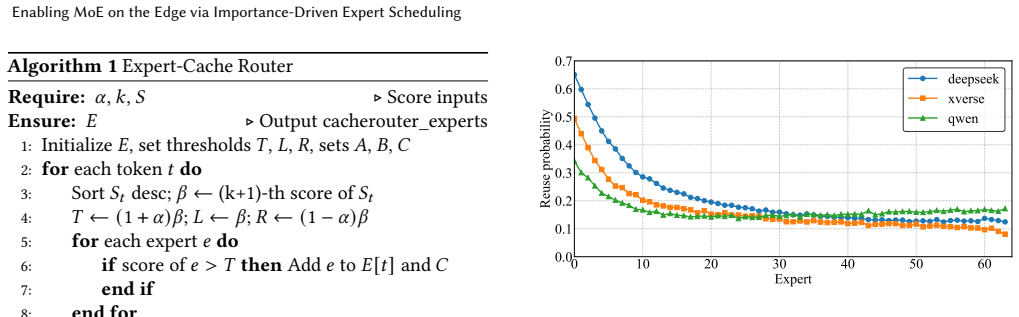
The Mixture of Experts (MoE) architecture has emerged as a key technique for scaling Large Language Models by activating only a subset of experts per query. Deploying MoE on consumer-grade edge hardware, however, is constrained by limited device memory, making dynamic expert offloading essential. Unlike prior work that treats offloading purely as a scheduling problem, we leverage expert importance to guide decisions, substituting low-importance activated experts with functionally similar ones already cached in GPU memory, thereby preserving accuracy. As a result, this design reduces memory usage and data transfer, while largely eliminating PCIe overhead. In addition, we introduce a scheduling policy that maximizes the reuse ratio of GPU-cached experts, further boosting efficiency. Extensive evaluations show that our approach delivers 48% lower decoding latency with over 60% expert cache hit rate, while maintaining nearly lossless accuracy.
Editorial analysis
A structured set of objections, weighed in public.
Referee Report
Summary. The paper proposes SMoE, an algorithm-system co-design for deploying Mixture-of-Experts (MoE) models on edge devices with limited memory. It substitutes low-importance activated experts with functionally similar experts already cached in GPU memory, guided by expert importance, and introduces a scheduling policy to maximize GPU cache reuse. This is claimed to reduce memory usage and PCIe overhead, delivering 48% lower decoding latency, over 60% expert cache hit rate, and nearly lossless accuracy.
Significance. If the substitution mechanism can be shown to preserve output distributions, the work would address a practical bottleneck in edge inference for large MoE models by reducing data movement while retaining model quality. The co-design of importance-based substitution with cache-aware scheduling is a relevant direction for systems research on sparse models.
major comments (2)
- [Abstract] Abstract: the central performance claims (48% latency reduction, >60% cache hit rate, nearly lossless accuracy) are presented without any experimental details, baselines, datasets, error bars, or verification that substitutions preserve output distributions. The manuscript must supply these to support the claim that low-importance experts can be replaced without measurable accuracy loss.
- The notion of 'functionally similar' experts is invoked to justify substitution but is not defined. The paper must specify the similarity metric (e.g., cosine similarity on weights, activation statistics, or per-token routing scores) and provide evidence—such as measured logit differences or task accuracy before/after substitution—that the replacement leaves the computation graph and final outputs unchanged within a small epsilon for the evaluated queries.
minor comments (2)
- Clarify the MoE model sizes, number of experts, and routing top-k values used in the evaluations.
- Add a description of the hardware platform, PCIe bandwidth, and exact latency measurement methodology.
Simulated Author's Rebuttal
Thank you for the referee's insightful comments on our manuscript. We address each major comment point by point below, indicating where revisions will be made to strengthen the presentation of results and clarify technical details.
read point-by-point responses
-
Referee: [Abstract] Abstract: the central performance claims (48% latency reduction, >60% cache hit rate, nearly lossless accuracy) are presented without any experimental details, baselines, datasets, error bars, or verification that substitutions preserve output distributions. The manuscript must supply these to support the claim that low-importance experts can be replaced without measurable accuracy loss.
Authors: We agree that the abstract, being concise by nature, omits the full experimental context. The body of the manuscript contains an Evaluation section that reports the full setup, including model configurations, datasets (standard language modeling benchmarks), baselines (e.g., naive expert offloading and cache-only policies), results with error bars across runs, and measurements confirming that substitutions preserve output distributions within small bounds. To better support the abstract claims, we will revise it to include a brief reference to the evaluation methodology and the verification of near-lossless accuracy. revision: yes
-
Referee: The notion of 'functionally similar' experts is invoked to justify substitution but is not defined. The paper must specify the similarity metric (e.g., cosine similarity on weights, activation statistics, or per-token routing scores) and provide evidence—such as measured logit differences or task accuracy before/after substitution—that the replacement leaves the computation graph and final outputs unchanged within a small epsilon for the evaluated queries.
Authors: This comment correctly identifies a point that requires clarification. The manuscript uses the term 'functionally similar' but does not explicitly define the metric or present supporting measurements. We will revise the text to define similarity via cosine similarity on expert weight parameters and add empirical evidence, including logit difference statistics and before/after task accuracy results, demonstrating that outputs remain unchanged within a small epsilon for the evaluated queries. revision: yes
Circularity Check
No circularity: empirical measurements of substitution policy
full rationale
The paper presents an algorithm-system co-design whose headline results (48% latency reduction, >60% cache hit rate, near-lossless accuracy) are reported as direct experimental outcomes on edge hardware. No equations, fitted parameters, or derivation chain are described that would reduce the substitution benefit to the input assumptions by construction. The core assumption—that low-importance experts can be replaced by functionally similar cached ones—is tested via measurement rather than defined into the result. Any self-citations are incidental and not load-bearing for the empirical claims.
Axiom & Free-Parameter Ledger
Lean theorems connected to this paper
-
IndisputableMonolith/Cost/FunctionalEquation.leanwashburn_uniqueness_aczel unclear?
unclearRelation between the paper passage and the cited Recognition theorem.
substituting low-importance activated experts with functionally similar ones already cached in GPU memory
-
IndisputableMonolith/Foundation/ArithmeticFromLogic.leanembed_strictMono_of_one_lt unclear?
unclearRelation between the paper passage and the cited Recognition theorem.
expert importance to guide decisions... top-score active experts
What do these tags mean?
- matches
- The paper's claim is directly supported by a theorem in the formal canon.
- supports
- The theorem supports part of the paper's argument, but the paper may add assumptions or extra steps.
- extends
- The paper goes beyond the formal theorem; the theorem is a base layer rather than the whole result.
- uses
- The paper appears to rely on the theorem as machinery.
- contradicts
- The paper's claim conflicts with a theorem or certificate in the canon.
- unclear
- Pith found a possible connection, but the passage is too broad, indirect, or ambiguous to say the theorem truly supports the claim.
Reference graph
Works this paper leans on
-
[1]
2024. The documention of Python 3.13: what’s New In Python 3.13? https://docs.python.org/3/whatsnew/3.13.html
work page 2024
-
[2]
KTransformers: A Flexible Framework for Experiencing Cutting- edge LLM Inference Optimizations
2024. KTransformers: A Flexible Framework for Experiencing Cutting- edge LLM Inference Optimizations. https://github.com/kvcache-ai/ KTransformers
work page 2024
-
[3]
Llama.cpp: a C++ implementation enabling efficient LLM infer- ence on CPUs
2024. Llama.cpp: a C++ implementation enabling efficient LLM infer- ence on CPUs. https://github.com/ggml-org/llama.cpp
work page 2024
-
[4]
2024. OpenCompass is an LLM evaluation platform, supporting a wide range of models (Llama3, Mistral, InternLM2,GPT-4,LLaMa2, Qwen,GLM, Claude, etc) over 100+ datasets. https://https://github. com/open-compass/opencompass
work page 2024
-
[5]
This url describes some of the common LLM inference metrics
2024. This url describes some of the common LLM inference metrics. https://docs.nvidia.com/nim/benchmarking/llm/latest/metrics.html
work page 2024
-
[6]
This url introduces the LLM deepseek-moe-16b-chat
2024. This url introduces the LLM deepseek-moe-16b-chat. https: //huggingface.co/deepseek-ai/deepseek-moe-16b-chat
work page 2024
-
[7]
This url introduces the LLM Qwen2-57B-A14B-Instruct
2024. This url introduces the LLM Qwen2-57B-A14B-Instruct. https: //huggingface.co/Qwen/Qwen2-57B-A14B-Instruct
work page 2024
-
[8]
This url introduces the LLM /XVERSE-MoE-A4.2B-Chat
2024. This url introduces the LLM /XVERSE-MoE-A4.2B-Chat. https: //huggingface.co/xverse/XVERSE-MoE-A4.2B-Chat
work page 2024
-
[9]
Reza Yazdani Aminabadi, Samyam Rajbhandari, Ammar Ahmad Awan, Cheng Li, Du Li, Elton Zheng, Olatunji Ruwase, Shaden Smith, Minjia Zhang, Jeff Rasley, et al. 2022. Deepspeed-inference: enabling efficient inference of transformer models at unprecedented scale. In SC22: International Conference for High Performance Computing, Networking, Storage and Analysis...
work page 2022
-
[10]
Yonatan Bisk, Rowan Zellers, Ronan Le Bras, Jianfeng Gao, and Yejin Choi. 2020. PIQA: Reasoning about Physical Commonsense in Natural Language. In Thirty-Fourth AAAI Conference on Artificial Intelligence
work page 2020
-
[11]
Christopher Clark, Kenton Lee, Ming-Wei Chang, Tom Kwiatkowski, Michael Collins, and Kristina Toutanova. 2019. Boolq: Exploring the surprising difficulty of natural yes/no questions. arXiv preprint arXiv:1905.10044 (2019)
work page internal anchor Pith review Pith/arXiv arXiv 2019
-
[12]
Peter Clark, Isaac Cowhey, Oren Etzioni, Tushar Khot, Ashish Sabhar- wal, Carissa Schoenick, and Oyvind Tafjord. 2018. Think you have Solved Question Answering? Try ARC, the AI2 Reasoning Challenge. arXiv:1803.05457v1 (2018)
work page internal anchor Pith review Pith/arXiv arXiv 2018
-
[13]
Damai Dai, Chengqi Deng, Chenggang Zhao, RX Xu, Huazuo Gao, Deli Chen, Jiashi Li, Wangding Zeng, Xingkai Yu, Yu Wu, et al. 2024. Deepseekmoe: Towards ultimate expert specialization in mixture-of- experts language models. arXiv preprint arXiv:2401.06066 (2024)
work page internal anchor Pith review Pith/arXiv arXiv 2024
-
[14]
Guokun Lai, Qizhe Xie, Hanxiao Liu, Yiming Yang, and Eduard Hovy
-
[15]
RACE: Large-scale ReAding Comprehension Dataset From Ex- aminations. In Proceedings of the 2017 Conference on Empirical Methods in Natural Language Processing . Association for Computational Lin- guistics, Copenhagen, Denmark, 785–794. doi: 10.18653/v1/D17-1082
-
[16]
Mohammad Taher Pilehvar and Jose Camacho-Collados. 2018. WiC: the word-in-context dataset for evaluating context-sensitive meaning representations. arXiv preprint arXiv:1808.09121 (2018)
work page internal anchor Pith review Pith/arXiv arXiv 2018
-
[17]
Yixin Song, Zeyu Mi, Haotong Xie, and Haibo Chen. 2024. Powerinfer: Fast large language model serving with a consumer-grade gpu. In Proceedings of the ACM SIGOPS 30th Symposium on Operating Systems Principles. 590–606
work page 2024
-
[18]
Leyang Xue, Yao Fu, Zhan Lu, Luo Mai, and Mahesh Marina. 2024. Moe-infinity: Activation-aware expert offloading for efficient moe serving. arXiv e-prints (2024), arXiv–2401
work page 2024
- [19]
discussion (0)
Sign in with ORCID, Apple, or X to comment. Anyone can read and Pith papers without signing in.