Disorder-induced proximate quantum spin ice phase in Pr2Sn2O7
Pith reviewed 2026-05-18 20:36 UTC · model grok-4.3
The pith
In Pr2Sn2O7, disorder induces spin freezing at 0.15 K while quantum spin-ice correlations persist down to low temperatures.
A machine-rendered reading of the paper's core claim, the machinery that carries it, and where it could break.
Core claim
The central claim is that in the non-Kramers pyrochlore Pr2Sn2O7, structural disorder produces a proximate quantum spin-ice phase in which hallmark quantum spin-ice correlations and dynamics coexist with a disorder-induced spin-freezing transition at 0.15 K and the recovery of a full nuclear Schottky anomaly.
What carries the argument
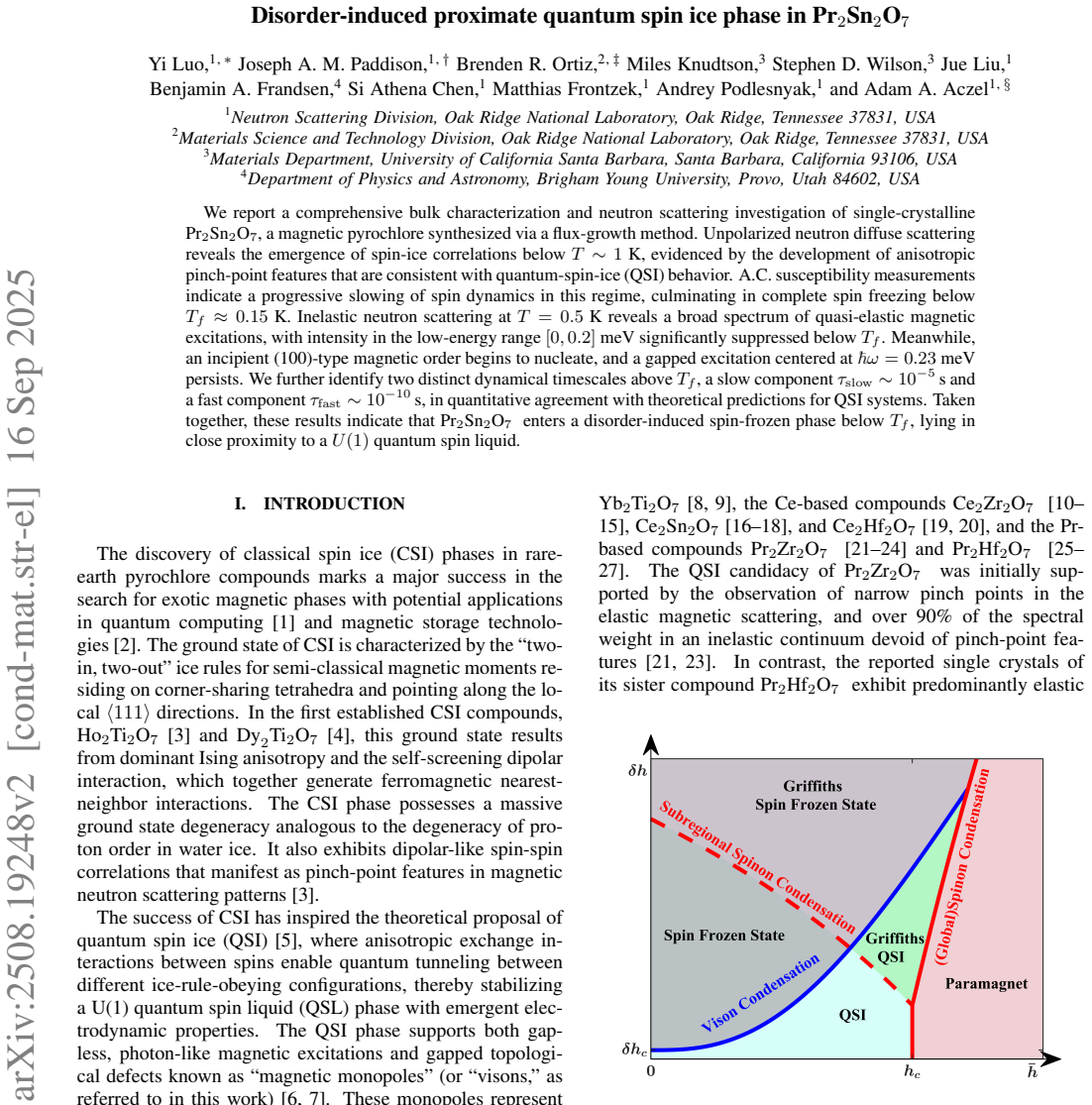
The disorder-perturbed phase diagram for non-Kramers pyrochlores, which positions Pr2Sn2O7 near the spin-frozen boundary while still allowing quantum spin-ice correlations to survive.
If this is right
- Quantum spin-ice behavior can evolve into frozen ground states through the action of structural disorder.
- Proximity to a quantum spin liquid can coexist with disorder-induced spin freezing in non-Kramers pyrochlores.
- The ground-state selection in these materials is sensitive to small amounts of disorder that shift the system across phase boundaries.
- Two distinct dynamical timescales and anisotropic correlations remain observable even after the system freezes.
Where Pith is reading between the lines
- Similar disorder effects could be tested by deliberately introducing controlled defects into other non-Kramers pyrochlores to map the same boundary.
- The framework suggests that sample-to-sample variations in freezing temperatures reported across the Pr pyrochlore family may largely reflect differences in disorder levels rather than differences in the underlying exchange parameters.
- If the phase diagram is general, then reducing disorder in Pr2Sn2O7 should push the system deeper into the quantum spin-ice regime without changing the high-temperature correlations.
Load-bearing premise
The spin freezing at 0.15 K is caused primarily by disorder rather than by an intrinsic feature of the ideal lattice.
What would settle it
A measurement on a substantially cleaner single crystal of Pr2Sn2O7 that shows the absence of spin freezing or a much lower freezing temperature would falsify the disorder-driven interpretation.
Figures


read the original abstract
Magnetic pyrochlores with non-Kramers rare-earth ions provide a platform for exploring emergent gauge physics and quantum spin-ice behavior, yet the influence of structural disorder on their ground states remains insufficiently understood. Here we combine bulk characterization and single-crystal neutron-scattering measurements to investigate the non-Kramers pyrochlore Pr2Sn2O7. At temperatures below ~1 K, the system exhibits key hallmarks of quantum spin-ice physics, including anisotropic spin-ice correlations and two distinct dynamical timescales. Upon further cooling, however, we observe a complete spin-freezing transition at T_f ~ 0.15 K, accompanied by recovery of the full nuclear Schottky anomaly, the emergence of a gapped magnetic excitation, and the development of incipient (100) magnetic correlations. Comparison with related Pr-based pyrochlores places Pr2Sn2O7 near the spin-frozen boundary of a disorder-perturbed phase diagram. These results establish a disorder-driven framework for how quantum spin-ice behavior evolves into frozen ground states, demonstrating that proximity to a quantum spin liquid can coexist with disorder-induced spin freezing in non-Kramers pyrochlores.
Editorial analysis
A structured set of objections, weighed in public.
Referee Report
Summary. The manuscript reports bulk characterization and single-crystal neutron-scattering measurements on the non-Kramers pyrochlore Pr2Sn2O7. Below ~1 K the system displays anisotropic spin-ice correlations and two dynamical timescales, consistent with quantum spin-ice physics. Further cooling reveals a spin-freezing transition at Tf ~ 0.15 K, accompanied by recovery of the full nuclear Schottky anomaly, a gapped magnetic excitation, and incipient (100) magnetic correlations. The authors interpret these findings as a disorder-induced proximate quantum spin ice phase and place Pr2Sn2O7 near the spin-frozen boundary of a disorder-perturbed phase diagram for Pr-based pyrochlores.
Significance. If the central interpretation is confirmed, the work supplies a concrete experimental example of how structural disorder can drive the evolution from quantum spin-ice correlations to a frozen state while preserving proximity to a quantum spin liquid. The combination of bulk thermodynamics and neutron data on a single non-Kramers pyrochlore adds a useful data point to the growing literature on disorder effects in these materials.
major comments (1)
- [Abstract and final paragraph] Abstract and final paragraph: The assertion that the Tf ≈ 0.15 K spin freezing is disorder-induced and that the system lies near the spin-frozen boundary relies on qualitative comparison with other Pr pyrochlores and schematic phase-diagram placement. No quantitative disorder metric—such as refined cation/oxygen occupancies from diffraction or an effective random-field strength extracted from specific-heat modeling—is reported for the measured crystal. Without this link the causal attribution to disorder remains an inference rather than a direct consequence of the data.
minor comments (2)
- [Methods/Experimental details] The manuscript should provide a dedicated section or appendix detailing the neutron data reduction, background subtraction, and error propagation procedures that underlie the reported anisotropic correlations, two timescales, and gapped mode.
- [Figures and captions] Figure captions and text should explicitly state the temperature ranges, wave-vector ranges, and fitting models used to extract the two dynamical timescales and the gapped excitation energy.
Simulated Author's Rebuttal
We thank the referee for their careful reading of our manuscript and for the positive assessment of its significance. We address the major comment below and propose revisions to strengthen the presentation of our interpretation.
read point-by-point responses
-
Referee: [Abstract and final paragraph] Abstract and final paragraph: The assertion that the Tf ≈ 0.15 K spin freezing is disorder-induced and that the system lies near the spin-frozen boundary relies on qualitative comparison with other Pr pyrochlores and schematic phase-diagram placement. No quantitative disorder metric—such as refined cation/oxygen occupancies from diffraction or an effective random-field strength extracted from specific-heat modeling—is reported for the measured crystal. Without this link the causal attribution to disorder remains an inference rather than a direct consequence of the data.
Authors: We appreciate the referee's point regarding the need for a more direct link between the observed spin freezing and disorder. While our manuscript does not include a refined structural analysis for disorder parameters in the specific crystal studied (as the neutron scattering experiment was optimized for magnetic correlations rather than nuclear structure), the interpretation is grounded in the systematic comparison with other Pr pyrochlores where such metrics have been established in the literature. In the revised version, we will modify the abstract and the final paragraph to explicitly state that the placement near the spin-frozen boundary is inferred from this comparative analysis and the characteristic signatures of disorder effects (such as the low freezing temperature and gapped excitations). Additionally, we will consider adding a brief modeling of the specific-heat data to estimate an effective random-field strength if it can be done without introducing new assumptions. This will make the causal attribution clearer while remaining faithful to the data presented. revision: yes
Circularity Check
No circularity: purely experimental observations and external comparisons
full rationale
The manuscript is an experimental report based on bulk characterization and single-crystal neutron scattering. All central observations (anisotropic spin-ice correlations below ~1 K, complete spin freezing at T_f ~ 0.15 K, gapped excitations, incipient (100) order, and recovery of the nuclear Schottky anomaly) are presented as direct data products. The interpretive claim of a 'disorder-induced proximate quantum spin ice phase' is reached by qualitative placement relative to other Pr-based pyrochlores and a schematic disorder-perturbed phase diagram; no equations, fitted parameters renamed as predictions, self-definitional loops, or load-bearing self-citation chains appear in the provided text. The derivation chain is therefore self-contained against external benchmarks and contains no reductions by construction.
Axiom & Free-Parameter Ledger
axioms (1)
- domain assumption Neutron scattering intensity maps magnetic spin correlations in pyrochlore lattices
Lean theorems connected to this paper
-
IndisputableMonolith/Cost/FunctionalEquation.leanwashburn_uniqueness_aczel unclear?
unclearRelation between the paper passage and the cited Recognition theorem.
Hamiltonian H = Σ Jn σz_i σz_j − Σ hi σx_i with random transverse fields hi; phase diagram in Fig. 1 parameterized by ¯h and δh
-
IndisputableMonolith/Foundation/AlexanderDuality.leanalexander_duality_circle_linking unclear?
unclearRelation between the paper passage and the cited Recognition theorem.
Neutron diffuse scattering showing pinch-point features and gapped excitations at 0.23 meV below Tf ≈ 0.15 K
What do these tags mean?
- matches
- The paper's claim is directly supported by a theorem in the formal canon.
- supports
- The theorem supports part of the paper's argument, but the paper may add assumptions or extra steps.
- extends
- The paper goes beyond the formal theorem; the theorem is a base layer rather than the whole result.
- uses
- The paper appears to rely on the theorem as machinery.
- contradicts
- The paper's claim conflicts with a theorem or certificate in the canon.
- unclear
- Pith found a possible connection, but the passage is too broad, indirect, or ambiguous to say the theorem truly supports the claim.
Forward citations
Cited by 1 Pith paper
-
Influence of controlled disorder on the dipolar spin ice state of Ho-based pyrochlores
Controlled disorder in Ho2GaSbO7 and Ho2ScSbO7 preserves the dipolar spin-ice state but generates disorder-induced quantum fluctuations via splitting of the non-Kramers ground-state doublet.
Reference graph
Works this paper leans on
-
[1]
Subtraction of background In Fig. A7(a), we identify a temperature-independent shoulder-like background feature centered aroundℏω∼ 0.1meV , which is absent on the energy-gain side (ℏω <0) at T= 10K. To remove this feature, we assume the background is temperature independent and there is negligible background at the energy-gain side; this assumption is sup...
-
[2]
Details of constant-energy slices In Fig. A10(a–h), we present constant-energyQ-maps sim- ilar to those shown in Fig. 5(d–j), but obtained using an inci- dent energy ofE i = 0.99meV . This configuration offers ex- 15 TABLE II. Atomic positions and anisotropic displacement parameters of single-crystal Pr 2Sn2O7 at various temperatures and measurement metho...
-
[3]
C. Broholm and R. J. Cava and S. A. Kivelson and D. G. No- cera and M. R. Norman and T. Senthil, Quantum spin liquids, Science367, eaay0668 (2020)
work page 2020
-
[4]
N. Y . Yao, C. R. Laumann, A. V . Gorshkov, H. Weimer, L. Jiang, J. I. Cirac, P. Zoller, and M. D. Lukin, Topologically protected quantum state transfer in a chiral spin liquid, Nature Communications4, 1585 (2013)
work page 2013
-
[5]
T. Fennell, P. P. Deen, A. R. Wildes, K. Schmalzl, D. Prab- hakaran, A. T. Boothroyd, R. J. Aldus, D. F. McMorrow, and S. T. Bramwell, Magnetic Coulomb phase in the spin ice Ho2Ti2O7, Science326, 415 (2009)
work page 2009
-
[6]
B. C. den Hertog and M. J. P. Gingras, Dipolar interactions and origin of spin ice in Ising pyrochlore magnets, Physical Review Letters84, 3430 (2000)
work page 2000
-
[7]
L. Savary and L. Balents, Coulombic quantum liquids in spin- 1/2 pyrochlores, Physical Review Letters108, 037202 (2012)
work page 2012
-
[8]
G. Chen, ”Magnetic monopole” condensation of the pyrochlore ice U(1) quantum spin liquid: Application to Pr 2Ir2O7 and Yb2Ti2O7, Physical Review B94, 205107 (2016)
work page 2016
-
[9]
G. Chen, Dirac’s ”magnetic monopoles” in pyrochlore ice U(1) spin liquids: Spectrum and classification, Physical Review B 96, 195127 (2017)
work page 2017
-
[10]
K. A. Ross, L. Savary, B. D. Gaulin, and L. Balents, Quantum excitations in quantum spin ice, Physical Review X1, 021002 (2011)
work page 2011
- [11]
-
[12]
J. Gaudet, E. M. Smith, J. Dudemaine, J. Beare, C. R. C. Buhariwalla, N. P. Butch, M. B. Stone, D. R. Yahne, K. A. Ross, C. A. Marjerrison, J. D. Garrett, G. M. Luke, A. D. Bianchi, and B. D. Gaulin, Quantum Spin Ice Dynamics in the Dipole–Octupole Pyrochlore Magnet Ce2Zr2O7, Phys. Rev. Lett.122, 187201 (2019)
work page 2019
-
[13]
A. Bhardwaj, S. Zhang, H. Yan, R. Moessner, A. H. Nevidom- skyy, and H. J. Changlani, Sleuthing out exotic quantum spin liquidity in the pyrochlore magnet Ce 2Zr2O7, npj Quantum Materials7, 51 (2022)
work page 2022
-
[14]
B. Gao, T. Chen, D. W. Tam, C. Huang, K. Sasmal, D. T. Adroja, F. Ye, H. Cao, G. Sala, M. B. Stone, C. Baines, J. A. T. Verezhak, H. Hu, J. Chung, X. Xu, S. Cheong, M. Nallaiyan, S. Spagna, M. B. Maple, A. H. Nevidomskyy, E. Morosan, G. Chen, and P. Dai, Experimental signatures of a three-dimensional quantum spin liquid in effective spin-1/2 Ce2Zr2O7 pyro...
work page 2019
-
[15]
E. M. Smith, O. Benton, D. R. Yahne, B. Placke, R. Sch ¨afer, J. Gaudet, J. Dudemaine, A. Fitterman, J. Beare, A. R. Wildes, S. Bhattacharya, T. DeLazzer, C. R. C. Buhariwalla, N. P. Butch, R. Movshovich, J. D. Garrett, C. A. Marjerrison, J. P. Clancy, E. Kermarrec, G. M. Luke, A. D. Bianchi, K. A. Ross, and B. D. Gaulin, The case for a U(1) π Quantum Spi...
work page 2022
-
[16]
E. M. Smith, R. Sch ¨afer, J. Dudemaine, B. Placke, B. Yuan, Z. Morgan, F. Ye, R. Moessner, O. Benton, A. D. Bianchi, and B. D. Gaulin, Single-Crystal Diffuse Neutron Scattering Study of the Dipole–Octupole Quantum Spin-Ice Candidate Ce2Zr2O7: No Apparent Octupolar Correlations AboveT= 0.05K, Phys. Rev. X15, 021033 (2025)
work page 2025
-
[17]
B. Gao, F. Desrochers, D. W. Tam, D. M. Kirschbaum, P. Stef- fens, A. Hiess, D. H. Nguyen, Y . Su, S.-W. Cheong, S. Paschen, et al., Neutron scattering and thermodynamic evidence for emergent photons and fractionalization in a pyrochlore spin ice, Nature Physics , 1 (2025)
work page 2025
-
[18]
R. Sibille, N. Gauthier, E. Lhotel, V . Por ´ee, V . Pomjakushin, R. A. Ewings, T. G. Perring, J. Ollivier, A. R. Wildes, C. Rit- ter, T. C. Hansen, D. A. Keen, G. J. Nilsen, L. Keller, S. Petit, and T. Fennell, A quantum liquid of magnetic octupoles on the pyrochlore lattice, Nature Physics16, 546 (2020)
work page 2020
- [19]
-
[20]
D. R. Yahne, B. Placke, R. Sch ¨afer, O. Benton, R. Moess- ner, M. Powell, J. W. Kolis, C. M. Pasco, A. F. May, M. D. Frontzek, E. M. Smith, B. D. Gaulin, S. Calder, and K. A. Ross, Dipolar Spin Ice Regime Proximate to an All-in-All-Out N ´eel Ground State in the Dipolar-Octupolar Pyrochlore Ce 2Sn2O7, Phys. Rev. X14, 10.1103/PhysRevX.14.011005 (2024)
-
[21]
V . Por´ee, A. Bhardwaj, E. Lhotel, S. Petit, N. Gauthier, H. Yan, V . Pomjakushin, J. Ollivier, J. A. Quilliam, A. H. Nevidom- skyy, H. J. Changlani, and R. Sibille, Dipolar-octupolar corre- lations and hierarchy of exchange interactions in Ce 2Hf2O7, arXiv preprint (2023), arXiv:2305.08261
-
[22]
E. M. Smith, A. Fitterman, R. Sch ¨afer, B. Placke, A. Woods, S. Lee, S. H.-Y . Huang, J. Beare, S. Sharma, D. Chatterjee, et al., Two-Peak Heat Capacity Accounts for R ln (2) Entropy and Ground State Access in the Dipole-Octupole Pyrochlore Ce2Hf2O7, Physical Review Letters135, 086702 (2025)
work page 2025
- [23]
-
[24]
J.-J. Wen, S. M. Koohpayeh, K. A. Ross, B. A. Trump, T. M. McQueen, K. Kimura, S. Nakatsuji, Y . Qiu, D. M. Pajerowski, J. R. D. Copley, and C. L. Broholm, Disordered route to the Coulomb quantum spin liquid: Random transverse fields on spin ice in Pr 2Zr2O7, Physical Review Letters118, 107206 (2017)
work page 2017
- [25]
- [26]
-
[27]
R. Sibille, E. Lhotel, M. C. Hatnean, G. Balakrishnan, B. F ˚ak, N. Gauthier, T. Fennell, and M. Kenzelmann, Candidate quan- tum spin ice in the pyrochlore Pr 2Hf2O7, Physical Review B 94, 024436 (2016)
work page 2016
-
[28]
V . K. Anand, L. Opherden, J. Xu, D. T. Adroja, A. T. M. N. Islam, T. Herrmannsd¨orfer, J. Hornung, R. S. mann, M. Uhlarz, H. C. Walker,et al., Physical properties of the candidate quan- tum spin-ice system Pr2Hf2O7, Physical Review B94, 144415 (2016)
work page 2016
-
[29]
R. Sibille, N. Gauthier, H. Yan, M. C. Hatnean, J. Ollivier, B. Winn, U. Filges, G. Balakrishnan, M. Kenzelmann, N. Shan- non,et al., Experimental signatures of emergent quantum elec- trodynamics in Pr2Hf2O7, Nature Physics14, 711 (2018)
work page 2018
-
[30]
A. J. Princep, D. Prabhakaran, A. T. Boothroyd, and D. T. Adroja, Crystal-field states of Pr 3+ in the candidate quantum spin ice Pr2Sn2O7, Physical Review B88, 104421 (2013)
work page 2013
-
[31]
L. Savary and L. Balents, Disorder-Induced Quantum Spin Liquid in Spin Ice Pyrochlores, Physical Review Letters118, 087203 (2017)
work page 2017
-
[32]
O. Benton, Instabilities of a U(1) Quantum Spin Liquid in Disordered Non-Kramers Pyrochlores, Physical Review Letters 121, 037203 (2018)
work page 2018
-
[33]
J. R ¨ochner, L. Balents, and K. P. Schmidt, Spin liquid and quantum phase transition without symmetry breaking in a frus- trated three-dimensional Ising model, Physical Review B94, 201111(R) (2016)
work page 2016
-
[34]
T. Pardini, A. Menon, S. P. Hau-Riege, and R. R. P. Singh, Local entanglement and confinement transitions in the random transverse-field Ising model on the pyrochlore lattice, Physical Review B100, 144437 (2019)
work page 2019
-
[35]
R. B. Griffiths, Nonanalytic Behavior Above the Critical Point in a Random Ising Ferromagnet, Physical Review Letters23, 17 (1969)
work page 1969
-
[36]
H. D. Zhou, C. R. Wiebe, J. G. Cheng, C. H. Li, L. Balicas, Y . J. Jo, L. N. Pan, J. S. Gardner, Y . Qiu, and J. R. D. Copley, Dynamic Spin Ice: Pr 2Sn2O7, Physical Review Letters101, 227204 (2008)
work page 2008
-
[37]
B. R. Ortiz, P. M. Sarte, G. Pokharel, M. J. Knudtson, S. J. G. Alvarado, A. F. May, S. Calder, L. Mangin-Thro, A. R. Wildes, H. Zhou, G. Sala, C. R. Wiebe, S. D. Wilson, J. A. M. Paddi- son, and A. A. Aczel, Revisiting spin ice physics in the ferro- magnetic Ising pyrochlore Pr 2Sn2O7, Physical Review B109, 134420 (2024)
work page 2024
-
[38]
B. Tomasello, C. Castelnovo, R. Moessner, and J. Quintanilla, Correlated Quantum Tunneling of Monopoles in Spin Ice, Phys- ical Review Letters123, 067204 (2019)
work page 2019
-
[39]
O. Arnold, J. C. Bilheux, J. M. Borreguero, A. Buts, S. I. Camp- bell, L. Chapon, M. Doucet, N. Draper, R. F. Leal, M. A. Gigg, V . E. Lynch, A. Markvardsen, D. J. Mikkelson, R. L. Mikkel- son, R. Miller, K. Palmen, P. Parker, G. Passos, T. G. Perring, P. F. Peterson, S. Ren, M. A. Reuter, A. T. Savici, J. W. Taylor, R. J. Taylor, R. Tolchenov, W. Zhou, a...
work page 2014
-
[40]
A. A. Coelho, TOPAS and TOPAS-Academic: an optimization program integrating computer algebra and crystallographic ob- jects written in C++, Journal of Applied Crystallography51, 210 (2018)
work page 2018
-
[41]
C. L. Farrow, P. Juh ´as, J. W. Liu, D. Bryndin, E. S. Bo ˇzin, J. Bloch, T. Proffen, and S. J. L. Billinge, PDFfit2 and PDFgui: computer programs for studying nanostructure in crystals, Jour- nal of Physics: Condensed Matter19, 335219 (2007)
work page 2007
- [42]
-
[43]
J. A. M. Paddison, Spinteract: A Program to Refine Magnetic Interactions to Diffuse Scattering Data, Journal of Physics: Condensed Matter35, 495802 (2023)
work page 2023
-
[44]
C. V . Topping and S. J. Blundell, A.C. susceptibility as a probe of low-frequency magnetic dynamics, Journal of Physics: Con- densed Matter31, 015801 (2018)
work page 2018
-
[45]
E. S. R. Gopal,Specific Heats at Low Temperatures, Interna- tional Cryogenics Monograph Series (Plenum Press, New York, 1966)
work page 1966
-
[46]
N. Tang, Y . Gritsenko, K. Kimura, S. Bhattacharjee, A. Sakai, M. Fu, H. Takeda, H. Man, K. Sugawara, Y . Matsumoto, Y . Shimura, J. Wen, C. Broholm, H. Sawa, M. Takigawa, T. Sakakibara, S. Zherlitsyn, J. Wosnitza, R. Moessner, and S. Nakatsuji, Spin–orbital liquid state and liquid–gas metam- agnetic transition on a pyrochlore lattice, Nature Physics19, 92 (2022)
work page 2022
-
[47]
P. B ¨oni and G. Shirane, Paramagnetic neutron scattering from the Heisenberg ferromagnet EuO, Phys. Rev. B33, 3012 (1986)
work page 1986
-
[48]
S. T. Bramwell, M. J. Harris, B. C. den Hertog, M. J. P. Gingras, J. S. Gardner, D. F. McMorrow, A. R. Wildes, A. L. Cornelius, J. D. M. Champion, R. G. Melko, and T. Fennell, Spin correla- tions in Ho2Ti2O7: a dipolar spin ice system, Phys. Rev. Lett. 87, 047205 (2001)
work page 2001
- [49]
-
[50]
T. Yavors’kii, T. Fennell, M. J. P. Gingras, and S. T. Bramwell, Dy2Ti2O7 spin ice: A test case for emergent clusters in a frus- trated magnet, Physical Review Letters101, 037204 (2008)
work page 2008
-
[51]
A. M. Samarakoon, A. Sokolowski, B. Klemke, R. Feyerherm, M. Meissner, R. A. Borzi, F. Ye, Q. Zhang, Z. Dun, H. Zhou, T. Egami, J. N. Hall´en, L. Jaubert, C. Castelnovo, R. Moessner, S. A. Grigera, and D. A. Tennant, Structural magnetic glassi- ness in the spin ice Dy 2Ti2O7, Physical Review Research4, 033159 (2022)
work page 2022
- [52]
-
[53]
H. Fukazawa, R. G. Melko, R. Higashinaka, Y . Maeno, and M. J. P. Gingras, Magnetic anisotropy of the spin-ice compound Dy2Ti2O7, Physical Review B65, 054410 (2002)
work page 2002
-
[54]
P. Bonville, S. Guitteny, A. Gukasov, I. Mirebeau, B. Ker- marrec, J. Robert, P. Steffens, S. Petit, G. Dhalenne, and A. Revcolevschi, Magnetic properties and crystal field in 18 Pr2Zr2O7, Phys. Rev. B94, 134428 (2016). 19 FIG. A8. (a) Determination of the shoulder-like background feature atℏω∼0.1meV observed in Fig. A7(a), measured withE i = 0.99meV . Th...
work page 2016
discussion (0)
Sign in with ORCID, Apple, or X to comment. Anyone can read and Pith papers without signing in.