REVIEW 4 major objections 4 minor 47 references
Orchid: Orchestrating Context Across Creative Workflows with Generative AI
T0 review · 4 major / 4 minor · reviewed 2026-08-15 · deepseek-v4-flash
Pith's one-line read A notebook that lets users specify, reference, and monitor context across a creative workflow produces more novel and feasible generative-AI outcomes than a chat-plus-search toolkit, according to a within-subjects study of 12 users.
desk verdict A well-described design probe whose evaluation supports the integrated system but not the specific causal claim about context orchestration; needs a more honest framing and some statistical cleanup before publication. read the letter →
The pith
A machine-rendered reading of the paper's core claim, the machinery that carries it, and where it could break.
The reading
What carries the argument
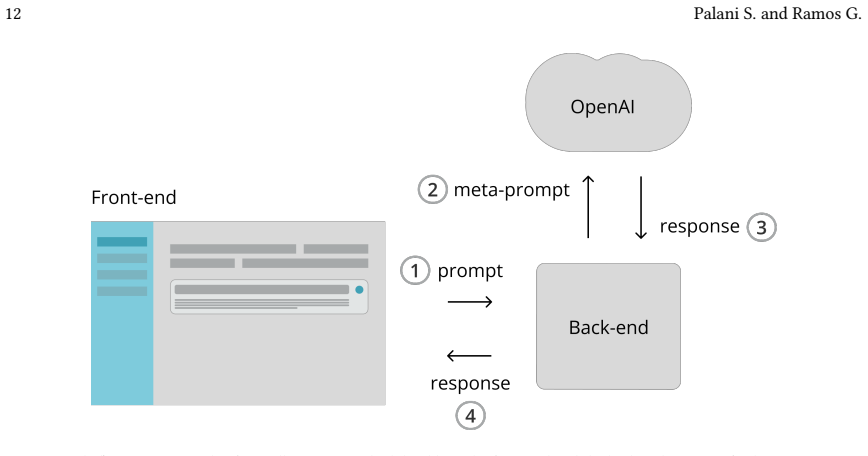
The central object is the meta-prompt: Orchid's back end takes the user's short prompt and expands it with whichever project documents, personal preferences, persona definitions, and goal or task breakdowns the user has referenced or implicitly grounded, then sends that assembled prompt to a large language model. The load-bearing interaction mechanisms are the @ mention for explicit references, in-line selection prompting, implicit grounding by page placement, and the Transparency Lens that shows what context a prompt is using. These mechanisms turn context into editable, named artifacts, such as project pages, a Me page, and Persona pages, that the user can reuse without retyping them in each prompt.
What would settle it
Run a follow-up study with the same integrated notebook in both arms, where the only difference is whether @ mentions, in-line grounding, personas, and the transparency lens are enabled; if expert-rated creativity and self-reported alignment are no better in the enabled arm, the paper's causal claim about context orchestration fails. A simpler falsifier: if a baseline chat tool that already supports @-style context attachments produces the same creativity scores as Orchid in a head-to-head comparison, the contribution reduces to interface packaging rather than context orchestration.
Extended reading notes
Core claim
The central claim is that context orchestration, giving users first-class affordances to specify, reference, and monitor context across sessions and models, is what lets generative AI act as a creative partner rather than a prompt-response engine. The evidence is the comparative study: blind expert raters judged outcomes more novel, feasible, and valuable under Orchid than under the baseline toolkit, and participants reported higher alignment with their goals, more control, more transparency, and a more empathetic, collaborative relationship with the AI. Behavioral logs show that Orchid users grounded operations in context frequently, with an average of 24.75 context references per participant, while baseline users switched tools about 15.75 times and copy-pasted about 8.56 times per session while issuing significantly more prompts. The conclusion is that reducing the cost of carrying context across iterations improves both the creative product and the experience of working with AI.
Load-bearing premise
The study assumes that the better outcomes come from the context-orchestration features, but the Orchid condition also differs from the baseline in being a single integrated notebook with task decomposition, persona templates, asynchronous generation, and a consistent interface, so the specific effect of context features is not isolated.
Editorial extensions
If this is right
- If context orchestration is the active ingredient, chat-based assistants that expose editable, persistent context objects should outperform raw long-context windows on multi-session creative tasks.
- Tools that let users see which context a prompt used should reduce the metacognitive load of validating AI output, because users can check whether the system had the right information before trusting the result.
- Personas and personal context pages turn prompt engineering from a typing skill into a curation skill: users spend effort defining reusable lenses rather than restating them per prompt.
- Designers of creativity support tools should treat context as a managed artifact with its own lifecycle, not as an implicit property of a single session.
Reading between the lines
- Not an Orchid claim: the study varies several features together, so the causal role of context orchestration per se is not isolated; a fair reading is that Orchid as a whole beats the baseline toolkit, not that each affordance is necessary.
- A natural extension the authors do not test is adding only the reference and transparency affordances to an ordinary chat tool, without the notebook shell, which would test whether context referencing alone drives the observed gains.
- If the meta-prompt mechanism is the real driver, any interface that lowers the cost of attaching context, even a simple file-folder metaphor, should show similar creativity gains, which would predict that user control over what is in context matters more than context-window size.
Signed reviews
Editorial analysis
A structured set of objections, weighed in public.
Referee Report
Summary. The paper presents Orchid, a GenAI-enabled notebook system that lets users specify, reference, and monitor context across creative workflows. Context specification is supported through project pages, a personal 'Me' page, and editable expert personas; referencing is supported through @-mentions, in-line selection, and implicit grounding; monitoring is supported through a Transparency Lens and result blocks. The paper reports a within-subjects user study (n=12) in which participants completed creative redesign tasks once with Orchid and once with a baseline stack of web search, LLM chat, and a notebook. Blind expert raters scored the creative outputs on novelty, feasibility, and value, and the paper reports a significantly higher combined creativity score for Orchid (M=11.50 vs 6.45, reported p=0.01), non-significantly higher novelty, significantly higher feasibility and value, lower prompt counts, and higher self-reported alignment, control, transparency, and empathetic support. The paper's central claim is that context orchestration, rather than raw context-window size or fragmented tools, can improve human-AI alignment and creative outcomes.
Significance. If the reported effect could be attributed specifically to context orchestration, the contribution would be useful to the creativity support tools and human-AI interaction communities: the design goals are clearly articulated, the system description is unusually complete, and the authors ship the actual prompt templates in the supplementary material. The within-subjects design, blind expert raters, counterbalanced order, and logging of interaction behavior are strengths. However, the evidence as presented does not isolate context orchestration from the many other differences between the Orchid condition and the baseline, and the abstract overstates the novelty result. The central design thesis is plausible and the empirical direction is worth reporting, but the causal attribution needs either additional analysis or a substantially more careful framing.
major comments (4)
- [§3, §4.2, §5.1] The comparison that supports the paper's central claim is confounded: the Orchid condition differs from the baseline not only in context orchestration but also in integration into a single notebook surface, goal decomposition and task pages, persona templates, asynchronous generation, and the transparency lens. Because the expert-rated outcome advantage in §5.1 could plausibly be caused by any of these features, the study as designed cannot attribute the effect to context orchestration specifically. I am not asserting the effect is absent, but the central claim of the abstract ('By prioritizing context orchestration...') requires an ablation, a feature-level mediation analysis, or a within-Orchid correlation between context-referencing behavior (e.g., @-mentions) and the expert-rated outcomes; alternatively, the claims should be reframed as a comparison of an integrated notebook versus a fragmented tool stack.
- [§5.1, Abstract] The abstract states that participants 'produced more novel and feasible outcomes,' but the novelty difference was not statistically significant (M=3.38 vs 1.92, reported as non-significant). The headline claim should be limited to the combined creativity measure (and feasibility/value), with novelty explicitly reported as a directional but non-significant trend. Additionally, the measures section does not report inter-rater reliability for the blind expert ratings (e.g., ICC or Cohen's kappa), and it is unclear whether the reported means refer to individual outputs or to a single per-participant aggregate; both details are needed to interpret the ratings.
- [§5.1–§5.2, Figure 11] The statistical reporting is not interpretable as written: 'P=1.58,Q=0.01↑↑' and 'WSRT: R=↓1.94,Q=0.03↑' do not name the test statistic or its distribution, do not report effect sizes, and do not state whether multiple-comparison corrections were applied. The notation 'N O=2.10' is also undefined (presumably standard deviation or standard error). Please provide standard test names, degrees of freedom, effect sizes, and define all symbols; otherwise readers cannot verify the significance claims.
- [§5.2, §5.3] The log-analysis claims that Orchid reduced prompts per session (M=12.00 vs 6.53) and increased context grounding (M=24.75 prompts) are presented as evidence for context orchestration, but these metrics are not normalized by the total number of actions or task complexity, and the baseline's tool-switching/copy-paste counts are not formally compared to Orchid behavior. A direct comparison of total interaction cost or a within-participant ratio would strengthen the claim that Orchid reduces redundant prompting.
minor comments (4)
- [§3.2] The heading 'Refering to Context' and numerous OCR artifacts in the text ('a!ordances', 'work"ows', 'Washignton') should be corrected in the camera-ready version.
- [§5.5] The quote attributed to P15 appears in a study that reports n=12; please verify the participant identifiers so the data are internally consistent.
- [§4.4] The procedure states that the presentation order of conditions was counterbalanced but does not state whether the two task topics were also counterbalanced with conditions; please clarify the topic-condition assignment to rule out topic effects.
- [Appendix A] The provided prompt templates contain formatting artifacts (e.g., '{{⁄quotesingle.Vartext}}') that make them difficult to reuse; please provide clean, copyable prompt source.
Circularity Check
No significant circularity: the central evaluation is empirical and externally rated; the only self-citation is a design-motivation reference that is not load-bearing.
full rationale
The paper's central claim is that users produced better creative outcomes with Orchid than with a baseline toolkit. That claim rests on a within-subjects study with blind expert ratings of novelty, feasibility, and value (Section 5.1), behavioral log analyses (Section 5.2), and self-report survey measures (Sections 5.2-5.4). These outcome measures are not defined in terms of Orchid's context-orchestration features, no parameters are fitted to make the results come out, and the observed differences are empirical rather than derivable from the system's design by construction. The reduction in prompts per session is a measured behavior, not a fitted prediction. The only potentially relevant self-citation is [37], used in Section 3.1 to motivate the persona design ("This is inspired by an insight from [37]"), but it is not the evidence for the evaluation and does not constrain the outcome. The fact that the Orchid condition differs from the baseline on multiple design dimensions is a study-validity confound, not circularity. The paper makes no appeal to a uniqueness theorem or to a fitted input renamed as a prediction, and no derivation reduces to its own assumptions. The evaluation is self-contained against external expert judgments, so the circularity score is 0.
Assumptions & free parameters
assumptions (3)
- domain assumption Expert ratings on 1-5 scales for novelty, feasibility, and value are a valid and reliable measure of creative outcome quality.
- domain assumption The simulated work task scenario (Section 4.1) elicits creative behavior representative of real creative workflows.
- domain assumption The baseline stack (web search, LLM chat, digital notebook) represents current practice for creative workflows.
Cite this review
Pith. "Pith review of Orchid: Orchestrating Context Across Creative Workflows with Generative AI." pith.science (2026). https://pith.science/paper/GFEPFRPQ
@misc{pith2026250819517,
  author       = {Pith},
  title        = {Pith review of: Orchid: Orchestrating Context Across Creative Workflows with Generative AI},
  year         = {2026},
  howpublished = {\url{https://pith.science/paper/GFEPFRPQ}},
  note         = {Machine review of arXiv:2508.19517}
}
read the original abstract
Context is critical for meaningful interactions between people and Generative AI (GenAI). Yet mainstream tools offer limited means to orchestrate it, particularly across workflows that span multiple interactions, sessions, and models, as often occurs in creative projects. Re specifying prior details, juggling diverse artifacts, and dealing with context drift overwhelm users, obscure intent, and curtail creativity. To address these challenges, we present Orchid, a system that gives its users affordances to specify, reference, and monitor context throughout evolving workflows. Specifically, Orchid enables users to (1) specify context related to the project, themselves, and different styles, (2) reference these via explicit mentions, inline selection, or implicit grounding, and (3) monitor context assigned to different interactions across the workflow. In a within-subjects study (n=12), participants using Orchid to execute creative tasks (compared to a baseline toolkit of web search, LLM-based chat, and digital notebooks) produced more novel and feasible outcomes, reporting greater alignment between their intent and the AI's responses, higher perceived control, and increased transparency. By prioritizing context orchestration, Orchid offers an actionable step toward next generation GenAI tools that support complex, iterative workflows - enabling creators and AI to stay aligned and augment their creative potential.
Figures


Figures from the paper (12 more)




Reference graph
Works this paper leans on
-
[1]
Teresa M Amabile. 1996. Creativity and innovation in organizations . Vol. 5. Harvard Business School Boston
work page 1996
-
[2]
Tyler Angert, Miroslav Suzara, Jenny Han, Christopher Pondoc, and Hariharan Subramonyam. 2023. Spellburst: A Node-based Interface for Exploratory Creative Coding with Natural Language Prompts. In Proceedings of the 36th Annual ACM Symposium on User Interface Software and Technology (San Francisco, CA, USA) (UIST ’23). Association for Computing Machinery, ...
work page 2023
-
[3]
Iz Beltagy, Matthew E. Peters, and Arman Cohan. 2020. Longformer: The Long-Document Transformer. arXiv preprint arXiv:2004.05150 (2020). arXiv:2004.05150 [cs.CL]
arXiv 2020
-
[4]
Pia Borlund. 2003. The IIR evaluation model: a framework for evaluation of interactive information retrieval systems. Information research 8, 3 (2003), 8–3
work page 2003
-
[5]
Tom Brown, Benjamin Mann, Nick Ryder, Melanie Subbiah, Jared D Kaplan, Prafulla Dhariwal, Arvind Neelakantan, Pranav Shyam, Girish Sastry, Amanda Askell, et al. 2020. Language models are few-shot learners. Advances in neural information processing systems 33 (2020), 1877–1901
2020
-
[6]
Aydar Bulatov, Yury Kuratov, and Mikhail Burtsev. 2022. Recurrent memory transformer. Advances in Neural Information Processing Systems 35 (2022), 11079–11091
work page 2022
-
[7]
Kathy Charmaz. 2014. Constructing Grounded Theory (2nd ed.). Sage, London
work page 2014
-
[8]
Herbert H Clark and Susan E Brennan. 1991. Grounding in communication. (1991)
1991
Show all 47 references
-
[9]
Oliver Cobb and Arnaud Van Looveren. 2022. Context-Aware Drift Detection. arXiv: 2203.08644 [stat.ML] https://arxiv.org/abs/2203.08644
2022 arXiv
-
[10]
British Design Council. [n.d.]. The Double Diamond. https://www.designcouncil.org.uk/our-resources/the-double-diamond/
-
[11]
Le, and Ruslan Salakhutdinov
Zihang Dai, Zhilin Yang, Yiming Yang, Jaime Carbonell, Quoc V. Le, and Ruslan Salakhutdinov. 2019. Transformer-XL: Attentive Language Models Beyond a Fixed-Length Context. arXiv: 1901.02860 [cs.LG] https://arxiv.org/abs/1901.02860
2019 arXiv
-
[12]
K DEYA. 2001. Understanding and using context, personal and ubiquitous computing. Springer-Verlag 5, 1 (2001), 4–7
2001
-
[13]
Gerhard Fischer. 2001. User modeling in human–computer interaction. User modeling and user-adapted interaction 11 (2001), 65–86
2001
-
[14]
Jonas Frich, Jens Emil Grønbæk, Marcel Borowski, and Peter Dalsgaard. 2024. Exploring the impact of AI features on collaborative creativity. (2024)
2024
-
[15]
Jonas Frich, Lindsay MacDonald Vermeulen, Christian Remy, Michael Mose Biskjaer, and Peter Dalsgaard. 2019. Mapping the landscape of creativity support tools in HCI. In Proceedings of the 2019 CHI Conference on Human Factors in Computing Systems . 1–18
2019
-
[16]
Yunfan Gao, Yun Xiong, Xinyu Gao, Kangxiang Jia, Jinliu Pan, Yuxi Bi, Yi Dai, Jiawei Sun, Qianyu Guo, Meng Wang, and Haofen Wang. 2023. Retrieval- Augmented Generation for Large Language Models: A Survey. ArXiv abs/2312.10997 (2023). https://api.semanticscholar.org/CorpusID:266359151
2023 arXiv
-
[17]
Barbara J Grosz and Candace L Sidner. 1986. Attention, intentions, and the structure of discourse. Computational linguistics 12, 3 (1986), 175–204
1986
-
[18]
Jonathan Grudin. 1994. Groupware and social dynamics: Eight challenges for developers. Commun. ACM 37, 1 (1994), 92–105
1994
-
[19]
Kelvin Guu, Kenton Lee, Zora Tung, Panupong Pasupat, and Ming-Wei Chang. 2020. REALM: Retrieval-Augmented Language Model Pre-Training. arXiv:2002.08909 [cs.CL] https://arxiv.org/abs/2002.08909
2020 arXiv
-
[20]
Rossi, Subhabrata Mukherjee, Xianfeng Tang, Qi He, Zhigang Hua, Bo Long, Tong Zhao, Neil Shah, Amin Javari, Yinglong Xia, and Jiliang Tang
Haoyu Han, Yu Wang, Harry Shomer, Kai Guo, Jiayuan Ding, Yongjia Lei, Mahantesh Halappanavar, Ryan A. Rossi, Subhabrata Mukherjee, Xianfeng Tang, Qi He, Zhigang Hua, Bo Long, Tong Zhao, Neil Shah, Amin Javari, Yinglong Xia, and Jiliang Tang. 2025. Retrieval-Augmented Generatio...
2025 arXiv
-
[21]
World Leaders in Research-Based User Experience. [n.d.]. Thinking aloud: The Number 1 usability tool. https://www.nngroup.com/articles/thinking- aloud-the-1-usability-tool/
-
[22]
Dan Jurafsky and James H Martin. 2021. Speech and Language Processing . Prentice Hall. 3rd Edition Draft, available online. Orchid: Orchestrating Context Across Creative Work"ows with Generative AI 21
2021
-
[23]
Jikun Kang, Wenqi Wu, Filippos Christianos, Alex J Chan, Fraser Greenlee, George Thomas, Marvin Purtorab, and Andy Toulis. 2025. LM2: Large Memory Models. arXiv preprint arXiv:2502.06049 (2025)
2025 arXiv
-
[24]
Dae Hyun Kim, Hyungyu Shin, Shakhnozakhon Yadgarova, Jinho Son, Hariharan Subramonyam, and Juho Kim. 2024. AINeedsPlanner: A Workbook to Support E!ective Collaboration Between AI Experts and Clients. In Proceedings of the 2024 ACM Designing Interactive Systems Conference (Cope...
2024
-
[25]
Avraham N Kluger and Angelo DeNisi. 1996. The e!ects of feedback interventions on performance: a historical review, a meta-analysis, and a preliminary feedback intervention theory. Psychological bulletin 119, 2 (1996), 254
1996
-
[26]
Aobo Kong, Shiwan Zhao, Hao Chen, Qicheng Li, Yong Qin, Ruiqi Sun, Xin Zhou, Enzhi Wang, and Xiaohang Dong. 2024. Better Zero-Shot Reasoning with Role-Play Prompting. arXiv: 2308.07702 [cs.CL] https://arxiv.org/abs/2308.07702
2024 arXiv
-
[27]
thinking-aloud
Clayton Lewis. 1982. Using the" thinking-aloud" method in cognitive interface design . IBM TJ Watson Research Center Yorktown Heights, NY
1982
-
[28]
Patrick Lewis, Ethan Perez, Aleksandra Piktus, Fabio Petroni, Vladimir Karpukhin, Naman Goyal, Heinrich Küttler, Mike Lewis, Wen-tau Yih, Tim Rocktäschel, et al. 2020. Retrieval-augmented generation for knowledge-intensive nlp tasks. Advances in neural information processing s...
2020
-
[29]
What it wants me to say
Michael Xieyang Liu, Advait Sarkar, Carina Negreanu, Benjamin Zorn, Jack Williams, Neil Toronto, and Andrew D Gordon. 2023. “What it wants me to say”: Bridging the abstraction gap between end-user programmers and code-generating large language models. In Proceedings of the 202...
2023
-
[30]
Liu, Kevin Lin, John Hewitt, Ashwin Paranjape, Michele Bevilacqua, Fabio Petroni, and Percy Liang
Nelson F. Liu, Kevin Lin, John Hewitt, Ashwin Paranjape, Michele Bevilacqua, Fabio Petroni, and Percy Liang. 2023. Lost in the Middle: How Language Models Use Long Contexts. arXiv: 2307.03172 [cs.CL] https://arxiv.org/abs/2307.03172
2023 arXiv
-
[31]
Yiren Liu, Pranav Sharma, Mehul Jitendra Oswal, Haijun Xia, and Yun Huang. 2024. PersonaFlow: Boosting Research Ideation with LLM-Simulated Expert Personas. arXiv: 2409.12538 [cs.HC] https://arxiv.org/abs/2409.12538
2024 arXiv
-
[32]
Maryellen C MacDonald, Neal J Pearlmutter, and Mark S Seidenberg. 1994. The lexical nature of syntactic ambiguity resolution. Psychological review 101, 4 (1994), 676
1994
-
[33]
Narges Mahyar and Melanie Tory. 2014. Supporting communication and coordination in collaborative sensemaking. IEEE transactions on visualization and computer graphics 20, 12 (2014), 1633–1642
2014
-
[34]
Gary Marcus. 2022. Stop Treating AI Models Like People . https://garymarcus.substack.com/p/stop-treating-ai-models-like-people?utm_source= substack&utm_medium=email Substack Newsletter
2022
-
[35]
OpenAI. 2023. GPT-4 Technical Report. ArXiv abs/2303.08774 (2023). https://api.semanticscholar.org/CorpusID:257532815
2023 arXiv
-
[36]
Patil, Ion Stoica, and Joseph E
Charles Packer, Sarah Wooders, Kevin Lin, Vivian Fang, Shishir G. Patil, Ion Stoica, and Joseph E. Gonzalez. 2024. MemGPT: Towards LLMs as Operating Systems. arXiv: 2310.08560 [cs.AI] https://arxiv.org/abs/2310.08560
2024 arXiv
-
[37]
Srishti Palani and Gonzalo Ramos. 2024. Evolving roles and work"ows of creative practitioners in the age of generative AI. In Proceedings of the 16th Conference on Creativity & Cognition . 170–184
2024
-
[38]
Jun Rekimoto, Yuji Ayatsuka, and Kazuteru Hayashi. 1998. Augment-able reality: Situated communication through physical and digital spaces. In Digest of Papers. Second International Symposium on Wearable Computers (Cat. No. 98EX215) . IEEE, 68–75
1998
-
[39]
Jeba Rezwana and Mary Lou Maher. 2023. User perspectives on ethical challenges in human-AI co-creativity: A design #ction study. In Proceedings of the 15th Conference on Creativity and Cognition . 62–74
2023
-
[40]
Jeba Rezwana and Mary Lou Maher. 2024. Conceptual Models as a Basis for a Framework for Exploring Mental Models of Co-Creative AI. (2024)
2024
-
[41]
Milad Saad and Mary Lou Maher. 1996. Shared understanding in computer-supported collaborative design. Computer-Aided Design 28, 3 (1996), 183–192
1996
-
[42]
Joon Gi Shin, Janin Koch, Andrés Lucero, Peter Dalsgaard, and Wendy E Mackay. 2023. Integrating AI in human-human collaborative ideation. In Extended Abstracts of the 2023 CHI Conference on Human Factors in Computing Systems . 1–5
2023
-
[43]
Robert J Sternberg. 1999. Handbook of creativity . Cambridge University Press
1999
-
[44]
Lev Tankelevitch, Viktor Kewenig, Auste Simkute, Ava Elizabeth Scott, Advait Sarkar, Abigail Sellen, and Sean Rintel. 2023. The Metacognitive Demands and Opportunities of Generative AI. arXiv preprint arXiv:2312.10893 (2023)
2023 arXiv
-
[45]
Michael Terry, Chinmay Kulkarni, Martin Wattenberg, Lucas Dixon, and Meredith Ringel Morris. 2023. AI alignment in the design of interactive AI: Speci#cation alignment, process alignment, and evaluation support. arXiv preprint arXiv:2311.00710 (2023)
2023 arXiv
-
[46]
Jason Wei, Xuezhi Wang, Dale Schuurmans, Maarten Bosma, Fei Xia, Ed Chi, Quoc V Le, Denny Zhou, et al . 2022. Chain-of-thought prompting elicits reasoning in large language models. Advances in neural information processing systems 35 (2022), 24824–24837
2022
-
[47]
Shunyu Yao, Je!rey Zhao, Dian Yu, Nan Du, Izhak Shafran, Karthik Narasimhan, and Yuan Cao. 2023. ReAct: Synergizing Reasoning and Acting in Language Models. arXiv: 2210.03629 [cs.CL] Orchid: Orchestrating Context Across Creative Work"ows with Generative AI a A SUPPLEMENTARY MA...
2023 arXiv
Reviewed August 15, 2026 · model on record in the stance chip above.
Discussion (0). Continue with ORCID to comment.