REVIEW 3 major objections 4 minor 67 references
Breaking the Layer Barrier: Remodeling Private Transformer Inference with Hybrid CKKS and MPC
T0 review · 3 major / 4 minor · reviewed 2026-08-15 · deepseek-v4-flash
Pith's one-line read Private Transformer inference can shed most of its cryptographic overhead by fusing fine-grained linear operators across layer boundaries and converting between CKKS ciphertexts and MPC shares through a new, provably secure protocol.
desk verdict A genuinely fast private Transformer inference system with real communication gains, but the CKKS-to-MPC conversion's security proof has a distributional gap that must be fixed before the security claim is credible. read the letter →
The pith
A machine-rendered reading of the paper's core claim, the machinery that carries it, and where it could break.
The reading
What carries the argument
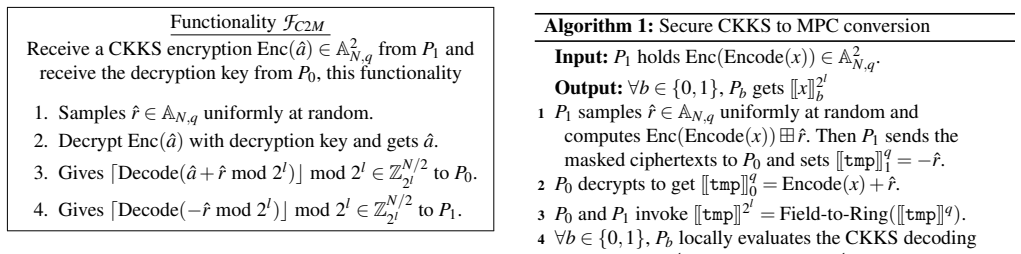
The load-bearing object is the CKKS-to-MPC conversion in Algorithm 1: after CKKS evaluates a fused linear operator, the server adds a uniformly random polynomial $\hat{r}\in A_{N,q}$ to the plaintext polynomial inside the ciphertext, sends the masked ciphertext to the client, and both parties switch the additive shares from the prime field $\mathbb{Z}_q$ to the ring $\mathbb{Z}_{2^\ell}$ before applying the CKKS decoding map locally. Uniformity of $\hat{r}$ is what makes the client's view independent of the server's weights, and the proof of Theorem 1 is the argument that this holds. The second mechanism, FineGrainFusion, is an operator taxonomy with a fusion table: same-category operators share packing, and legal fusions are selected so that no repacking of intermediate ciphertexts is needed. The third mechanism is the diagonal-packing MatMul, which produces partial sums of diagonals of the output matrix directly, so that fewer rotations are needed than in earlier protocols.
What would settle it
Run Algorithm 1 repeatedly for a fixed server weight vector with $N=8192$ and $q\approx 2^{60}$, then test the client's final share for statistical dependence on the high-order bits of the weight vector; a mutual-information or chi-square test that distinguishes the empirical share distribution from the ideal functionality's uniform distribution would falsify Theorem 1.
Extended reading notes
Core claim
The central discovery is that most communication in hybrid HE/MPC inference is not the linear algebra itself but the bookkeeping between operators: fixed-point truncations after every multiplication and conversions between HE ciphertexts and MPC shares. BLB removes the layer barrier by treating a Transformer as a graph of primitive operators, classifying linear operators as Identity, Expansion, Reduction, or Transformation, and fusing eligible neighbors; in a Transformer block this yields five fused linear blocks. The cryptographic centerpiece is Algorithm 1, a CKKS-to-MPC conversion in which the server masks the CKKS plaintext polynomial by adding a polynomial sampled uniformly from the ring $A_{N,q}$, then both parties switch shares from $\mathbb{Z}_q$ to $\mathbb{Z}_{2^\ell}$ with a Field-to-Ring protocol and locally decode. Theorem 1 asserts this conversion securely realizes the ideal functionality $\mathcal{F}_{\text{C2M}}$ against honest-but-curious adversaries. The paper also contributes a rotation-efficient ciphertext-ciphertext MatMul built on diagonal packing, multi-head packing, and baby-step-giant-step, cutting homomorphic rotations by factors of 8 to 29.
Load-bearing premise
The entire scheme is only as secure as the assumption that the uniform polynomial mask remains perfectly random after the protocol's rounding, modulus-switch, and decoding steps; if any of those steps introduces a correlation with the server's weights, information about the model could leak.
Editorial extensions
If this is right
- Private Transformer inference becomes feasible in WAN settings: BLB reports 3.0 GB communication for BERT-base, 7.8 GB for BERT-large, and 1.5 GB for GPT2-base, down from tens of gigabytes in earlier layer-wise hybrid systems.
- Truncation communication is eliminated entirely; fixed-point truncation is folded into local decoding on an enlarged ring with failure probability below $2^{-40}$.
- The fusion-aware MatMul reduces homomorphic rotations by factors of 8 to 29 relative to earlier fused-MatMul protocols, turning HE rotations from a bottleneck into a minor cost.
- Without any fine-tuning, private inference accuracy stays within about one point of plaintext accuracy on standard classification benchmarks, and on some datasets the approximation noise acts as a mild regularizer.
- With GPU acceleration, BLB becomes faster than its baselines under every tested network condition, with latency reductions from $1.5\times$ to $13\times$ depending on model and network.
Reading between the lines
- The same uniform-polynomial masking could be applied to any CKKS-to-MPC handoff, since the flaw it fixes lives in the encoding distribution rather than in any Transformer-specific structure.
- If the security proof were ever refuted, the performance story would not automatically survive: the communication savings come from fusion, but the confidentiality guarantee rests entirely on Theorem 1, so the two claims should be tracked separately.
- FineGrainFusion is architecture-agnostic in principle: residual networks and other architectures with adjacent linear operators around nonlinearities could be fused the same way, with CKKS rescale absorbing the extra bit-width growth.
- Against non-interactive FHE-only alternatives, the batched-input experiment suggests the real comparison is amortized throughput: BLB's per-query latency and accuracy advantages narrow when many queries from the same user are processed together.
Signed reviews
Editorial analysis
A structured set of objections, weighed in public.
Referee Report
Summary. The paper proposes BLB, a hybrid CKKS/MPC framework for private Transformer inference. It breaks the conventional layer-wise evaluation into fine-grained linear-operator fusion, uses CKKS for the fused linear operators to control ciphertext bit-width growth, and introduces a CKKS-to-MPC (and reverse) conversion protocol claimed to be the first secure one. It also designs a rotation-efficient ciphertext-ciphertext MatMul protocol with multi-head packing and BSGS optimization. The evaluation reports large communication and latency improvements over BOLT and Bumblebee on BERT-base, BERT-large, and GPT2-base, with accuracy close to plaintext inference. The central security claim is Theorem 1, which asserts that the CKKS-to-MPC conversion in Algorithm 1 securely realizes the FC2M functionality in Figure 9.
Significance. If the results hold, BLB is a practically significant step for private Transformer inference: it reduces communication by roughly an order of magnitude compared to BOLT, improves GPU latency, and preserves accuracy without fine-tuning. The paper includes a concrete artifact DOI and reports comparisons against multiple baselines on the same hardware, which is a strength. The fine-grained fusion taxonomy and the diagonal-packing MatMul protocol are useful technical contributions. However, the load-bearing security proof of the CKKS-to-MPC conversion has a distributional gap, and the end-to-end performance claim contains an internal inconsistency in Section 7.3. The significance is therefore conditional on a corrected security argument and a reconciled performance statement.
major comments (3)
- [Appendix A, proof of Theorem 1; Algorithm 1; Figure 9] The proof's assertion that the real protocol outputs are 'exactly how Algorithm 1 computes' the ideal outputs is not correct under the definitions given. In Algorithm 1, after decryption P0 holds (Encode(x)+r mod q), and after Field-to-Ring (Appendix C.3: signed extension plus local mod reduction) the pre-decode share is ((Encode(x)+r mod q) mod 2^l). Since r is uniform over Z_q, this value is independent of Encode(x). In the ideal functionality FC2M (Figure 9), P0's pre-decode value is Encode(x)+r mod 2^l with r drawn uniformly from the same Z_q; because r mod 2^l is non-uniform when q is not a multiple of 2^l, this distribution depends on Encode(x). The proof's claim that both real and ideal outputs are decoded results of uniformly distributed polynomials over A_{N,2^l} is therefore not established. Appendix C.3 describes Field-to-Ring as a deterministic signed extension followed by local reduction, so the proof also does not show that this step re-randomizes the shares to the ideal distribution. This is a load-bearing gap in the paper's central security claim; please either prove Theorem 1 with a correctly specified functionality (for example, one that samples the actual post-reduction distribution) or provide a formal analysis of the full Field-to-Ring composition.
- [Section 7.3, Communication Breakdown Analysis; Figure 11; Table 9] The text states that BLB reduces communication by 'approximately 4x and 2x across three models compared to BOLT and Bumblebee, respectively.' This is inconsistent with the abstract's 21x/2x claim and with Table 9, where BERT-base BOLT is 63.6 GB versus BLB 3.0 GB (21.2x), GPT2-base BOLT is 34.8 GB versus BLB 1.5 GB (23.2x), and BERT-large BOLT is 158.9 GB versus BLB 7.8 GB (20.4x). Figure 11's '4x' label is also ambiguous. Please correct the text and figure or clearly state what quantity is being compared; as written, the headline performance claim is internally inconsistent.
- [Section 3 and Appendix A, overall security claim] The paper describes BLB as a private inference framework and assumes an honest-but-curious adversary, but the only formal security statement is Theorem 1 for Algorithm 1. The security of the complete protocol, including Algorithm 2 (MPC-to-CKKS), the fused MatMul protocols, and the probabilistic truncation in Appendix C.4, is not covered by a stated composition argument. Since the truncation functionality in Figure 16 intentionally leaks the cutoff point to the adversary, the interplay between that leakage and the FC2M simulator needs an explicit treatment. Please either state an end-to-end security theorem for the full BLB protocol or clearly delimit the security guarantee to the conversion building block.
minor comments (4)
- [Figure 5] The figure label 'Nonliner' should be 'Nonlinear'.
- [Section 9 and abstract] The abstract states a '13x' latency reduction without qualification, while Section 9 says 'up to 13x'. The qualified form is more accurate given Table 9 (the 13x figure appears only for BERT-large at WAN2 on GPU), so please use 'up to' consistently.
- [Appendix C.4] The proof of the modified probabilistic truncation functionality is delegated to 'Section 3 in [19]' rather than being summarized or stated in the paper. At minimum, the realized functionality and the simulation argument should be specified, since the truncation protocol is used in the full inference pipeline.
- [Section 7.1 and Table 9] The paper says OT primitives do not affect protocol construction, but Table 9 explicitly uses VOLE-OT for BLB while Figures 12 and 13 report BLB with both IKNP and VOLE variants. Please make the OT-primitive choice explicit in every comparison so readers can reproduce the numbers.
Circularity Check
No significant circularity: the performance and protocol claims are derived from external benchmarks, operation counts, and standard building blocks, not from fitted inputs or self-referential definitions.
full rationale
BLB's headline communication and latency reductions are measured against external baselines (BOLT and Bumblebee) on the same machine, and the complexity figures in Table 5 and Table 7 are operation counts rather than fitted values. The FineGrainFusion operator classification is a design taxonomy, not a derived prediction; the fusion patterns are justified by packing rules and correctness arguments. HE parameters are set by a target MSE, and the ablation in Table 11 separates the fusion/conversion contribution from the MatMul contribution, so the performance claims do not reduce to their inputs. The paper does adopt nonlinear-layer protocols from Bumblebee and BOLT, and Bumblebee has an overlapping author, but this is a normal building-block dependency: the central fusion, CKKS/MPC conversion, and fused MatMul claims are not justified by those citations alone. The main weakness is in the proof sketch of Theorem 1: the proof asserts that the real Field-to-Ring/Decode outputs are 'exactly how Algorithm 1 computes' the ideal outputs, without proving that the distribution after reduction modulo 2^l matches the FC2M ideal distribution. That is a security-proof gap, not circularity, because Algorithm 1 is not fitted to the functionality's conclusion and the underlying Field-to-Ring protocol is cited from external prior work. No load-bearing derivation in the paper is equivalent to its own inputs by construction.
Assumptions & free parameters
free parameters (3)
- Fixed-point scale s =
13
- Ring bit width l =
43
- MSE threshold =
10^-11
assumptions (4)
- domain assumption Honest-but-curious two-party security model
- standard math CKKS and underlying MPC/OT primitives are secure
- domain assumption Piecewise linear approximations of GeLU, Softmax, LayerNorm from BOLT/Bumblebee are accurate enough
- domain assumption CKKS computation error remains below the MSE threshold after fusion
Cite this review
Pith. "Pith review of Breaking the Layer Barrier: Remodeling Private Transformer Inference with Hybrid CKKS and MPC." pith.science (2026). https://pith.science/paper/YZ2HDADT
@misc{pith2026250819525,
  author       = {Pith},
  title        = {Pith review of: Breaking the Layer Barrier: Remodeling Private Transformer Inference with Hybrid CKKS and MPC},
  year         = {2026},
  howpublished = {\url{https://pith.science/paper/YZ2HDADT}},
  note         = {Machine review of arXiv:2508.19525}
}
abstract
This paper presents an efficient framework for private Transformer inference that combines Homomorphic Encryption (HE) and Secure Multi-party Computation (MPC) to protect data privacy. Existing methods often leverage HE for linear layers (e.g., matrix multiplications) and MPC for non-linear layers (e.g., Softmax activation functions), but the conversion between HE and MPC introduces significant communication costs. The proposed framework, dubbed BLB, overcomes this by breaking down layers into fine-grained operators and further fusing adjacent linear operators, reducing the need for HE/MPC conversions. To manage the increased ciphertext bit width from the fused linear operators, BLB proposes the first secure conversion protocol between CKKS and MPC and enables CKKS-based computation of the fused operators. Additionally, BLB proposes an efficient matrix multiplication protocol for fused computation in Transformers. Extensive evaluations on BERT-base, BERT-large, and GPT2-base show that BLB achieves a $21\times$ reduction in communication overhead compared to BOLT (S\&P'24) and a $2\times$ reduction compared to Bumblebee (NDSS'25), along with latency reductions of $13\times$ and $1.8\times$, respectively, when leveraging GPU acceleration.
Figures


Figures from the paper (13 more)




Reference graph
Works this paper leans on
-
[1]
https://github.com/ Microsoft/SEAL, November 2020
Microsoft SEAL (release 3.6). https://github.com/ Microsoft/SEAL, November 2020
work page 2020
-
[2]
Privformer: Privacy-preserving trans- former with mpc
Yoshimasa Akimoto, Kazuto Fukuchi, Youhei Akimoto, and Jun Sakuma. Privformer: Privacy-preserving trans- former with mpc. In 2023 IEEE 8th EuroS&P, pages 392–410. IEEE, 2023
work page 2023
-
[3]
Heliks: He lin- ear algebra kernels for secure inference
Shashank Balla and Farinaz Koushanfar. Heliks: He lin- ear algebra kernels for secure inference. In Proceedings of the 2023 ACM SIGSAC Conference on Computer and Communications Security, pages 2306–2320, 2023
work page 2023
-
[4]
Ezpc: Programmable, efficient, and scalable secure two-party computation for machine learning
Nishanth Chandran and Divya Gupta et al. Ezpc: Programmable, efficient, and scalable secure two-party computation for machine learning. Cryptology ePrint Archive, 2017
work page 2017
-
[5]
Accelerating Private Large Transformers Inference through Fine-grained Collaborative Computation
Yuntian Chen and Zhanyong Tang et al. Accelerat- ing private large transformers inference through fine- grained collaborative computation. arXiv preprint arXiv:2412.16537, 2024
work page Pith review arXiv 2024
-
[6]
Personal voice assistant security and privacy—a survey
Peng Cheng and Utz Roedig. Personal voice assistant security and privacy—a survey. Proceedings of the IEEE, 110(4):476–507, 2022
work page 2022
-
[7]
A full rns variant of approx- imate homomorphic encryption
Jung Hee Cheon, Kyoohyung Han, Andrey Kim, Miran Kim, and Yongsoo Song. A full rns variant of approx- imate homomorphic encryption. In Selected Areas in Cryptography–SAC 2018: 25th International Confer- ence, pages 347–368. Springer, 2019
work page 2018
-
[8]
Homomorphic encryption for arithmetic of approximate numbers
Jung Hee Cheon, Andrey Kim, Miran Kim, and Yong- soo Song. Homomorphic encryption for arithmetic of approximate numbers. In Advances in Cryptology– ASIACRYPT 2017: 23rd International Conference on the Theory and Applications of Cryptology and Infor- mation Security, pages 409–437. Springer, 2017
work page 2017
Show all 67 references
-
[9]
Eva: An encrypted vector arithmetic language and compiler for efficient homomorphic computation
Roshan Dathathri and Blagovesta Kostova et al. Eva: An encrypted vector arithmetic language and compiler for efficient homomorphic computation. In Proceedings of the 41st ACM SIGPLAN Conference on Programming Language Design and Implementation, 2020
2020
-
[10]
Puma: Secure in- ference of llama-7b in five minutes
Ye Dong and Wen jie Lu et al. Puma: Secure in- ference of llama-7b in five minutes. arXiv preprint arXiv:2307.12533, 2023
2023
-
[11]
Language models are unsupervised multitask learners
Alec Radford et al. Language models are unsupervised multitask learners. OpenAI blog, 1(8):9, 2019
2019
-
[12]
Securegpt: A framework for multi- party privacy-preserving transformer inference in gpt
Chenkai Zeng et al. Securegpt: A framework for multi- party privacy-preserving transformer inference in gpt. IEEE Transactions on Information Forensics and Secu- rity, 2024
2024
-
[13]
Cryptflow2: Practical 2-party secure inference
Deevashwer Rathee et al. Cryptflow2: Practical 2-party secure inference. In Proceedings of the 2020 ACM SIGSAC Conference on Computer and Communications Security, pages 325–342, 2020
2020
-
[14]
Efficient two-round ot extension and silent non-interactive secure computation
Elette Boyle et al. Efficient two-round ot extension and silent non-interactive secure computation. In Proceed- ings of the 2019 ACM SIGSAC Conference on Computer and Communications Security
2019
-
[15]
Mp2ml: A mixed-protocol ma- chine learning framework for private inference
Fabian Boemer et al. Mp2ml: A mixed-protocol ma- chine learning framework for private inference. In Pro- ceedings of the 15th International Conference on Avail- ability, Reliability and Security, pages 1–10, 2020
2020
-
[16]
Llama: Open and efficient founda- tion language models
Hugo Touvron et al. Llama: Open and efficient founda- tion language models. arXiv preprint arXiv:2302.13971, 2023
2023 arXiv
-
[17]
Rhombus: Fast homomorphic matrix- vector multiplication for secure two-party inference
Jiaxing He et al. Rhombus: Fast homomorphic matrix- vector multiplication for secure two-party inference. In CCS, 2024
2024
-
[18]
Secure transformer-based neural network inference for protein sequence classification
Jingwei Chen et al. Secure transformer-based neural network inference for protein sequence classification. Cryptology ePrint Archive, 2024
2024
-
[19]
Curl: Private llms through wavelet-encoded look-up tables
Manuel B Santos et al. Curl: Private llms through wavelet-encoded look-up tables. Conference on Applied Machine Learning for Information Security, 2024
2024
-
[20]
Craterlake: a hardware acceler- ator for efficient unbounded computation on encrypted data
Nikola Samardzic et al. Craterlake: a hardware acceler- ator for efficient unbounded computation on encrypted data. In Proceedings of the 49th Annual International Symposium on Computer Architecture, 2022
2022
-
[21]
Delphi: A cryptographic infer- ence service for neural networks, Jan 2020
Pratyush Mishra et al. Delphi: A cryptographic infer- ence service for neural networks, Jan 2020
2020
-
[22]
Hyena: Balancing packing, reuse, and rotations for encrypted inference
Sarabjeet Singh et al. Hyena: Balancing packing, reuse, and rotations for encrypted inference. In 2024 IEEE Symposium on Security and Privacy (SP) , pages 107–
2024
-
[23]
Coinn: Crypto/ml codesign for oblivious inference via neural networks
Siam Umar Hussain et al. Coinn: Crypto/ml codesign for oblivious inference via neural networks. In Proceed- ings of the 2021 ACM SIGSAC Conference on Computer and Communications Security, pages 3266–3281, 2021
2021
-
[24]
Privcirnet: Efficient private inference via block circulant transformation
Tianshi Xu et al. Privcirnet: Efficient private inference via block circulant transformation. Neural Information Processing Systems (NeurIPS), 2024
2024
-
[25]
Characterization of mpc-based private inference for transformer-based models
Yongqin Wang et al. Characterization of mpc-based private inference for transformer-based models. In 2022 IEEE ISPASS, pages 187–197
2022
-
[26]
Nimbus: Secure and efficient two-party inference for transformers
Zhengyi Li et al. Nimbus: Secure and efficient two-party inference for transformers. NeurIPS, 2024
2024
-
[27]
F1: A fast and programmable ac- celerator for fully homomorphic encryption
Samardzic Nikola et el. F1: A fast and programmable ac- celerator for fully homomorphic encryption. In MICRO- 54: 54th Annual IEEE/ACM International Symposium on Microarchitecture, pages 238–252, 2021
2021
-
[28]
Secure multi-party computation
Oded Goldreich. Secure multi-party computation. Manuscript. Preliminary version, 78(110):1–108, 1998
1998
-
[29]
The Foundations of Cryptography - Volume 2: Basic Applications
Oded Goldreich. The Foundations of Cryptography - Volume 2: Basic Applications. Cambridge University Press, 2004
2004
-
[30]
Sigma: Secure gpt inference with func- tion secret sharing
Kanav Gupta, Neha Jawalkar, Ananta Mukherjee, Nis- hanth Chandran, Divya Gupta, Ashish Panwar, and Rahul Sharma. Sigma: Secure gpt inference with func- tion secret sharing. Cryptology ePrint Archive, 2023
2023
-
[31]
Iron: Private inference on transformers
Meng Hao, Hongwei Li, Hanxiao Chen, Pengzhi Xing, Guowen Xu, and Tianwei Zhang. Iron: Private inference on transformers. In Advances in Neural Information Processing Systems, 2022
2022
-
[32]
Secbert: Privacy- preserving pre-training based neural network inference system
Hai Huang and Yongjian Wang. Secbert: Privacy- preserving pre-training based neural network inference system. Neural Networks, 172:106135, 2024
2024
-
[33]
Cheetah: Lean and fast secure{Two-Party} deep neural network inference
Zhicong Huang, Wen-jie Lu, Cheng Hong, and Jian- sheng Ding. Cheetah: Lean and fast secure{Two-Party} deep neural network inference. In USENIX Security Symposium 2022, pages 809–826, 2022
2022
-
[34]
https://huggingface.co/
Huggingface. https://huggingface.co/
-
[35]
Secure outsourced matrix computation and application to neural networks
Xiaoqian Jiang, Miran Kim, Kristin Lauter, and Yong- soo Song. Secure outsourced matrix computation and application to neural networks. In Proceedings of the 2018 ACM SIGSAC conference on computer and com- munications security, pages 1209–1222, 2018
2018
-
[36]
Neujeans: Private neural net- work inference with joint optimization of convolution and bootstrapping
Jae Hyung Ju, Jaiyoung Park, Jongmin Kim, Donghwan Kim, and Jung Ho Ahn. Neujeans: Private neural net- work inference with joint optimization of convolution and bootstrapping. The ACM Conference on Computer and Communications Security (CCS), 2024
2024
-
[37]
Chandrakasan
Chiraag Juvekar, Vinod Vaikuntanathan, and AnanthaP. Chandrakasan. GAZELLE: A low latency framework for secure neural network inference, Jan 2018
2018
-
[38]
Bert: Pre-training of deep bidirectional trans- formers for language understanding
Jacob Devlin Ming-Wei Chang Kenton and Lee Kristina Toutanova. Bert: Pre-training of deep bidirectional trans- formers for language understanding. In Proceedings of naacL-HLT, volume 1, page 2, 2019
2019
-
[39]
Optimized privacy- preserving cnn inference with fully homomorphic en- cryption
Dongwoo Kim and Cyril Guyot. Optimized privacy- preserving cnn inference with fully homomorphic en- cryption. IEEE Transactions on Information Forensics and Security, 18:2175–2187, 2023
2023
-
[40]
Improved ot extension for transferring short secrets
Vladimir Kolesnikov and Ranjit Kumaresan. Improved ot extension for transferring short secrets. In Advances in Cryptology–CRYPTO 2013: 33rd Annual Cryptology Conference, 2013., pages 54–70, 2013
2013
-
[41]
Crypt- flow: Secure tensorflow inference
Nishant Kumar, Mayank Rathee, Nishanth Chandran, Divya Gupta, Aseem Rastogi, and Rahul Sharma. Crypt- flow: Secure tensorflow inference. In 2020 IEEE Sym- posium on Security and Privacy (SP), 2020
2020
-
[42]
Low-complexity deep convolutional neural networks on fully homomorphic encryption using multiplexed parallel convolutions
Eunsang Lee, Joon-Woo Lee, Junghyun Lee, Young-Sik Kim, Yongjune Kim, Jong-Seon No, and Woosuk Choi. Low-complexity deep convolutional neural networks on fully homomorphic encryption using multiplexed parallel convolutions. In International Conference on Machine Learning, page...
2022
-
[43]
Mpcformer: fast, performant and private transformer inference with mpc
Dacheng Li, Rulin Shao, Hongyi Wang, Han Guo, Eric P Xing, and Hao Zhang. Mpcformer: fast, performant and private transformer inference with mpc. arXiv preprint arXiv:2211.01452, 2022
2022 arXiv
-
[44]
Efficient 3pc for binary circuits with application to maliciously-secure dnn inference
Yun Li, Yufei Duan, Zhicong Huang, Cheng Hong, Chao Zhang, and Yifan Song. Efficient 3pc for binary circuits with application to maliciously-secure dnn inference. In 32nd USENIX Security Symposium (USENIX Security 23), pages 5377–5394, 2023
2023
-
[45]
Bumblebee: Secure two-party inference frame- work for large transformers
Wen-jie Lu, Zhicong Huang, Zhen Gu, Jingyu Li, Jian Liu, Kui Ren, Cheng Hong, Tao Wei, and WenGuang Chen. Bumblebee: Secure two-party inference frame- work for large transformers. Network and Distributed System Security (NDSS), 2025
2025
-
[46]
Secformer: Fast and accurate privacy-preserving inference for trans- former models via smpc
Jinglong Luo and Yehong Zhang et al. Secformer: Fast and accurate privacy-preserving inference for trans- former models via smpc. In Findings of the Association for Computational Linguistics ACL, 2024
2024
-
[47]
Secureml: A system for scalable privacy-preserving machine learning
Payman Mohassel and Yupeng Zhang. Secureml: A system for scalable privacy-preserving machine learning. In 2017 IEEE symposium on security and privacy (SP), pages 19–38. IEEE, 2017
2017
-
[48]
THOR: Secure transformer inference with homomorphic encryption
Jungho Moon, Dongwoo Yoo, Xiaoqian Jiang, and Mi- ran Kim. THOR: Secure transformer inference with homomorphic encryption. Cryptology ePrint Archive, Paper 2024/1881, 2024
2024
-
[49]
Q. Pang, J. Zhu, H. Möllering, W. Zheng, and T. Schnei- der. Bolt: Privacy-preserving, accurate and efficient in- ference for transformers. In 2024 IEEE Symposium on Security and Privacy (SP), pages 133–133, Los Alami- tos, CA, USA, may 2024. IEEE Computer Society
2024
-
[50]
Pow- erformer: Efficient privacy-preserving transformer with batch rectifier-power max function and optimized homo- morphic attention
Dongjin Park, Eunsang Lee, and Joon-Woo Lee. Pow- erformer: Efficient privacy-preserving transformer with batch rectifier-power max function and optimized homo- morphic attention. Cryptology ePrint Archive, 2024
2024
-
[51]
Sirnn: A math library for secure rnn inference
Deevashwer Rathee, Mayank Rathee, Rahul Kranti Ki- ran Goli, Divya Gupta, Rahul Sharma, Nishanth Chan- dran, and Aseem Rastogi. Sirnn: A math library for secure rnn inference. In 2021 IEEE Symposium on Se- curity and Privacy (SP), pages 1003–1020. IEEE, 2021
2021
-
[52]
Mobilenetv2: Inverted residuals and linear bottlenecks
Mark Sandler and Andrew Howard et al. Mobilenetv2: Inverted residuals and linear bottlenecks. InProceedings of the IEEE conference on computer vision and pattern recognition, pages 4510–4520, 2018
2018
-
[53]
Transformer-based person re-identification: a comprehensive review.IEEE Transactions on Intelligent Vehicles, 2024
Prodip Kumar Sarker, Qingjie Zhao, and Md Kamal Uddin. Transformer-based person re-identification: a comprehensive review.IEEE Transactions on Intelligent Vehicles, 2024
2024
-
[54]
Transformers in medical imaging: A survey
Fahad Shamshad and Salman Khan et al. Transformers in medical imaging: A survey. Medical Image Analysis, 88:102802, 2023
2023
-
[55]
Leveraging gpu in homomorphic encryption: Framework design and anal- ysis of bfv variants
Shiyu Shen and Hao Yang et al. Leveraging gpu in homomorphic encryption: Framework design and anal- ysis of bfv variants. IEEE Transactions on Computers, 73(12):2817–2829, 2024
2024
-
[56]
Alex Wang, Amanpreet Singh, Julian Michael, Felix Hill, Omer Levy, and Samuel R. Bowman. Glue: A multi-task benchmark and analysis platform for natural language understanding, 2019
2019
-
[57]
Mpcvit: Searching for mpc-friendly vision transformer with heterogeneous attention
Wenxuan Zeng, Meng Li, Wenjie Xiong, Wenjie Lu, Jin Tan, Runsheng Wang, and Ru Huang. Mpcvit: Searching for mpc-friendly vision transformer with heterogeneous attention. arXiv preprint arXiv:2211.13955, 2022
2022 arXiv
-
[58]
Secure trans- former inference made non-interactive
Jiawen Zhang and Xinpeng Yang et al. Secure trans- former inference made non-interactive. Network and Distributed System Security (NDSS), 2025
2025
-
[59]
From individual computation to allied optimization: Remodeling privacy-preserving neural inference with function input tuning
Qiao Zhang, Tao Xiang, Chunsheng Xin, and Hongyi Wu. From individual computation to allied optimization: Remodeling privacy-preserving neural inference with function input tuning. In 2024 IEEE Symposium on Security and Privacy (SP), pages 101–101. A Security Discussion Securit...
2024
-
[61]
S0 simulates these messages by: ❶ S0 inputs with random generated key and O0 where O0 is the decoded result of a uniform plaintext polynomial
the secret key, 2) the masked CKKS ciphertext, and 3) its view in the Field-to-Ring sub-protocol [51]. S0 simulates these messages by: ❶ S0 inputs with random generated key and O0 where O0 is the decoded result of a uniform plaintext polynomial. Then, S0 encodes O0 to the unif...
-
[62]
Reconstruct m from sharing JmK
-
[63]
Set m(s) =⌊m/2s⌋ and m(s) = (m mod 2s)
-
[64]
Pick cutoff point s(s) at random in Z2s
-
[65]
Set m′ = m(s) + u where u = 1{m(s) > s(s)}
-
[66]
Generate a random sharing Jm′K of m′
-
[67]
Figure 16: The modified probabilistic truncation functionality Table 12: Amortized latency comparison on BERT-base
Output Jm′K and leak s(s) to the adversary. Figure 16: The modified probabilistic truncation functionality Table 12: Amortized latency comparison on BERT-base. Framework Amortized Latency (min) LAN W AN2 W AN3 BLB 2 .5 6 .6 13 .2 BLB +batch size 32 0 .79 2 .1 4 .1 NEXUS+batch ...
-
[107]
IEEE Computer Society, 2024
2024
Reviewed August 15, 2026 · model on record in the stance chip above.
Discussion (0). Continue with ORCID to comment.