REVIEW 5 major objections 5 minor 124 references
Near-Ultimate Quantum-Enhanced Sensitivity in Dissipative Critical Sensing with Partial Access
T0 review · 5 major / 5 minor · reviewed 2026-08-15 · deepseek-v4-flash
Pith's one-line read Off-resonance operation turns a dissipative Jaynes-Cummings sensor into a near-ultimate partial-access probe.
desk verdict The near-saturation homodyne result is worth a look, but the advertised super-linear scaling does not survive contact with the paper's own fits. read the letter →
The pith
A machine-rendered reading of the paper's core claim, the machinery that carries it, and where it could break.
The reading
What carries the argument
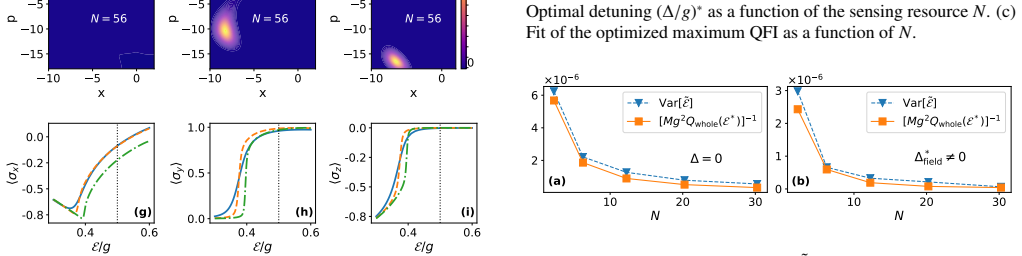
The load-bearing element is the steady state of the driven Jaynes-Cummings master equation, computed as the zero-eigenvalue eigenstate of the Liouvillian. The system's dissipative quantum phase transition at drive amplitude $2E=g$ (in the thermodynamic limit $N=(g/2\kappa)^2\to\infty$) organizes all the sensing behavior: on resonance the field turns from a vacuum-like state to a bistable two-peak Wigner function, and the qubit polarizes so strongly that qubit-field entanglement becomes weak. Detuning $\Delta$ breaks the bistability and selects one peak, producing a sharp maximum in the quantum Fisher information around $E/g\approx 0.4$. Because the steady state is weakly entangled and the field's Wigner function stays positive and nearly Gaussian, the field's reduced state carries almost all of the information about $E$, which is why a single optimized field quadrature measurement suffices.
What would settle it
Compute the peak quantum Fisher information for $N=100$, $200$, $500$, and $1000$ with the same Liouvillian and refit $A N^B + C$; if $B$ falls to 1 (or below) within the extended range, the claimed super-linear quantum enhancement is not established. A complementary experiment would compare homodyne-based Bayesian estimator variance against $[M g^2 Q_{\rm whole}(E)]^{-1}$ at a fixed larger $N$, since the paper's near-saturation claim fails if the gap widens as $N$ grows.
Extended reading notes
Core claim
The paper's central claim is that the steady state of the driven-dissipative Jaynes-Cummings model, taken at its dissipative quantum phase transition, is a complete sensing solution: it needs no initial-state engineering, its optimal operation point is a sharp response peak created by detuning, and its precision can be read out from the field alone. The resource is $N=(g/2\kappa)^2$, and the maximum quantum Fisher information grows with $N$—with super-linear scaling reported for the qubit subsystem, whose QFI follows an $N^{1.25}$ power law, while the whole-system and field QFIs show the same polynomial growth. Detuning selects one of the two bistable field states in phase space, and at the optimal working point the field's reduced state reproduces almost the whole-system QFI. Combining a homodyne measurement on the field with Bayesian estimation yields estimator variance close to $[M g^2 Q_{\rm whole}(E)]^{-1}$, the global quantum Cramér-Rao bound, so the practical local scheme nearly saturates the ultimate limit set by the full probe.
Load-bearing premise
The central claim that precision grows super-linearly with the resource $N$ rests on fitting $A N^B + C$ to numerically computed peak quantum Fisher information over a short range of $N$ (about 20 to a few hundred) with no reported error bars, so if that fitted exponent is a finite-size artifact the super-linear enhancement may not survive at larger $N$.
Editorial extensions
If this is right
- Steady-state critical sensors of this type can be run without ground-state preparation: the same precision should be reproducible from generic initial conditions because the sensing state is the dissipative steady state.
- A field-only homodyne measurement followed by Bayesian updating recovers almost all of the estimation precision available in the full qubit-field state, so the protocol is implementable with linear optics and standard post-processing.
- Detuning the drive off resonance and choosing its sign lets an experimenter select the preferred bistable phase-space peak and operate at the sharp response near $E/g\approx 0.4$, improving on resonance.
- Because the field's Wigner function remains positive and near-Gaussian at the working point, nonclassical resource states are not needed for the measurement step, only for the coherent drive and coupling.
- Increasing the coupling-to-loss ratio $N=(g/2\kappa)^2$ directly raises the peak information, giving a concrete design target for cavity-QED or circuit-QED implementations.
Reading between the lines
- A testable extension is to port the same homodyne-plus-Bayesian pipeline to other driven-dissipative systems with a single dominant positive phase-space peak, such as detuned Kerr resonators, where the near-Gaussian condition that makes homodyne efficient is also satisfied.
- Since off-resonance operation shifts the optimal homodyne angle between $\pi/2$ and $3\pi/4$ as $N$ changes, an adaptive protocol that re-optimizes the quadrature angle during Bayesian updating could close the remaining gap to the QFI bound at finite $N$.
- If the reported exponents survive at larger $N$, the resource $N$ functions as an effective probe size, and a rigorous finite-size scaling analysis of the maximum QFI would connect this dissipative sensor to the established critical-metrology scaling hierarchy.
Signed reviews
Editorial analysis
A structured set of objections, weighed in public.
Referee Report
Summary. The manuscript studies the driven-dissipative Jaynes-Cummings model as a critical quantum sensor for estimating the drive amplitude E, using the ratio N=(g/2κ)^2 as the sensing resource. It presents numerical QFI calculations for the full system, the field subsystem, and the qubit subsystem, both on and off resonance, and proposes a homodyne measurement combined with Bayesian estimation to approach the ultimate precision bound. The central advertised claim is that detuning off resonance yields a super-linear (quantum-enhanced) scaling of sensitivity with N in both the full system and the field subsystem, while requiring only partial access. The paper also reports that the field subsystem encodes most of the information and that the homodyne protocol nearly saturates the full-system QFI bound.
Significance. If the central scaling claim were correct, the result would be of genuine interest: it would show dissipative critical sensing with no initial-state preparation and partial accessibility, with a concrete feasible measurement. The manuscript contains a systematic numerical study of a physically relevant model, including QFI for the whole system and subsystems, phase-space diagnostics, entanglement and purity analysis, and a self-contained estimation protocol. However, the headline claim of super-linear quantum-enhanced sensitivity is not supported by the reported fits: the full-system and field QFI are fitted with a linear exponent B≈1 in both the on-resonance and the off-resonance analyses, and only the qubit, whose QFI is orders of magnitude smaller, shows a super-linear fit. The homodyne near-saturation result is a separate numerical demonstration and does not remedy the scaling contradiction. As it stands, the advertised main result is contradicted by the manuscript's own evidence.
major comments (5)
- ['On resonance scaling analysis', Fig. 2] The abstract and conclusions claim that super-linear enhancement manifests in the full system and a partial subsystem, but Fig. 2(c) reports a linear exponent B≈1 for the whole system and the field subsystem, while only the qubit in Fig. 2(b) has B≈1.25. Since the qubit QFI is about three orders of magnitude smaller than the field/whole QFI (max about 35 in Fig. 2(b) versus about 2×10^4 in Fig. 2(c)), the qubit's super-linear fit does not support the advertised practical quantum-enhanced sensitivity.
- ['Off resonance scaling analysis', Fig. 4(c)] The text states that the fitted exponent can be linear or super-linear depending on the subsystem, but it does not report the actual B values, fit uncertainties, or goodness-of-fit for any subsystem. The figure labels 'Fit N' and 'Fit N^1.25' indicate that the whole and field subsystems are again linear and only the qubit is super-linear, so the off-resonance data do not substantiate the abstract's claim that super-linear enhancement appears in both the full system and the partial subsystem.
- ['On resonance scaling analysis' and 'Off resonance scaling analysis', Figs. 2 and 4] The asymptotic exponents are inferred from power-law fits of the form AN^B+C over a narrow window N≳20 up to N≈62 or 100, with no error bars, no residuals, no fitting-window dependence, and no truncation-convergence checks. Because the three-parameter form can absorb finite-size curvature through the constant C, the reported exponents are not a reliable basis for a claim of super-linear (quantum-enhanced) scaling.
- [Supplemental Material, Sec. II (C-D)] The Bayesian estimation demonstration uses the same theoretical model to generate simulated data (counts C_m drawn from the discretized probabilities P_m) and to compute the likelihood P(data|E). The near-saturation shown in Fig. 5 is therefore a self-consistency check of the model rather than an independent validation that the homodyne protocol reaches the ultimate bound; an independent noise model or experimental data would be needed to support the 'near-ultimate' claim.
- ['Off resonance quantum-enhanced sensor' and 'Conclusions'] The off-resonance enhancement relative to resonance is a constant-factor improvement in QFI at fixed N, not a change in scaling with N. With B≈1 for the field and whole system, the QFI grows linearly with the resource N, so the central conclusion that quantum-enhanced sensitivity is achieved for the whole probe and the field subsystem is not supported by the reported data.
minor comments (5)
- [Fig. 2 and Fig. 4 captions] The y-axis labels 'g^2 whole', 'g^2 field', and 'g^2 qubit' should be written as 'g^2 Q_whole', 'g^2 Q_field', and 'g^2 Q_qubit' to avoid ambiguity.
- [Eq. (6)] The notation in Eq. (6) is nonstandard; the subscript 'n' under arg max appears to be a placeholder for the variable E/g, and the expression should be written explicitly as arg max over E/g of Q_j(E).
- [References] Reference [68] is incomplete, lacking a title, and references [17]/[62] and [23]/[57] are duplicated with different numbers.
- ['Off resonance scaling analysis', Eq. (7) and Fig. 4] The text introduces optimal values (Δ/g)_j^* and (E/g)_j^* for each subsystem j but then says the section focuses only on the detuning that maximizes Q_field; the relation between the general definition and the specific values plotted in Fig. 4 should be clarified.
- [Conclusions] The sentence 'Achieving quantum-enhanced sensitivity for the whole probe and the field subsystem' is a sentence fragment and should be merged with the preceding sentence.
Circularity Check
No circularity: scaling exponents are descriptive fits to independently computed QFI; the abstract's 'super-linear for whole/field' mismatch is a correctness issue, not a circular one.
full rationale
I find no significant circularity. The central quantities—the QFI of the full state, the field subsystem, and the qubit subsystem—are computed from the steady state of the Lindblad master equation (Eq. 3) by numerical diagonalization, rather than being derived from the scaling claim. The resource N=(g/2kappa)^2 is adopted from Carmichael (Ref. [84]) as an external input, and the exponents B are obtained by fitting the computed maximum QFI values to the phenomenological form AN^B+C. No equation is defined in terms of the conclusion, and no fitted parameter is renamed as an independent prediction. The homodyne-Bayesian demonstration uses simulated measurement data drawn from the same steady-state model, making it a self-consistent numerical experiment rather than a derivation that assumes its own result. The abstract's claim that super-linear enhancement 'manifests in both the full system and partial subsystem' is in tension with the fits in Figs. 2(c) and 4(c), which give B close to 1 for the whole system and the field; that tension is an internal-consistency and robustness concern, not a circularity. Similarly, the narrow fitted N range and absence of error bars affect the reliability of the scaling claim but do not make the claim equivalent to its inputs by construction. Self-citations appear in the reference list, but they are not load-bearing: the model comes from an external reference, and the numerical results are self-contained against the stated master equation. No uniqueness theorem or ansatz is smuggled in via self-citation, and no known empirical pattern is merely renamed. The appropriate finding is therefore no circularity.
Assumptions & free parameters
free parameters (6)
- Power-law exponent B (whole system) =
approximately 1
- Power-law exponent B (field subsystem) =
approximately 1
- Power-law exponent B (qubit subsystem) =
approximately 1.25
- Optimal detuning (Delta/g)* =
approximately 0.1 to 0.2, depending on N
- Optimal drive amplitude (E/g)* =
approximately 0.4 for off-resonance and 0.5 for resonance
- Homodyne phase angle phi* =
between pi/2 and 3pi/4 for off-resonance, near pi/2 for resonance
assumptions (5)
- domain assumption The open system dynamics is correctly described by the Lindblad master equation in Eq. (3) with a single photon-loss channel.
- domain assumption In the thermodynamic limit N tending to infinity, the driven-dissipative Jaynes-Cummings model undergoes a dissipative phase transition at 2E=g, as established in Ref. [84].
- domain assumption The zero eigenvector of the Liouvillian computed for a truncated Hilbert space accurately approximates the steady state used for all QFI calculations.
- ad hoc to paper The power-law fit A N^B + C to numerical data over N from 20 to 100 captures the asymptotic scaling behavior of the QFI.
- ad hoc to paper The Bayesian estimation procedure uses the same theoretical model to simulate data and to compute the likelihood function.
Cite this review
Pith. "Pith review of Near-Ultimate Quantum-Enhanced Sensitivity in Dissipative Critical Sensing with Partial Access." pith.science (2026). https://pith.science/paper/SSVTZN5Z
@misc{pith2026250819606,
  author       = {Pith},
  title        = {Pith review of: Near-Ultimate Quantum-Enhanced Sensitivity in Dissipative Critical Sensing with Partial Access},
  year         = {2026},
  howpublished = {\url{https://pith.science/paper/SSVTZN5Z}},
  note         = {Machine review of arXiv:2508.19606}
}
read the original abstract
Quantum sensors are powerful devices that exploit quantum effects to detect minute quantities with extremely high precision. Two obstacles to harnessing the full capacity of quantum probes are the resource-intensive preparation of the probe and the need for sophisticated measurements that typically require full access to the entire probe. Here, we address these challenges by investigating the driven Jaynes-Cummings system undergoing a dissipative quantum phase transition as a quantum sensor. We show that detuning the system off resonance significantly improves sensing performance by adequately selecting a preferred bistable state in phase space. Our dissipative sensor, independent of the initial probe preparation, exhibits a super-linear enhancement in sensitivity with respect to a specific sensing resource -- the strong-coupling regime ratio -- which manifests in both the full system and partial subsystem. Hence, quantum-enhanced sensitivity persists even when only partial system accessibility is available. Remarkably, we show that a homodyne detection of the field state, combined with Bayesian estimation, nearly saturates the ultimate sensitivity limit of the entire system.
Figures


Figures from the paper (1 more)
Reference graph
Works this paper leans on
-
[1]
Quantum sensing,
Christian L Degen, Friedemann Reinhard, and Paola Cap- pellaro, “Quantum sensing,” Reviews of Modern Physics 89, 035002 (2017)
2017
-
[2]
See SM [123] for entanglement and purity details for this case
The emer- gence of a nonzero component along the y-axis, due to ∆,0, breaks the bistability and leads to the preferred localization of the field in phase space—choosing∆<0 (i.e., the right bistable peak) causes the qubit’s y-component to acquire a phase, re- sulting in the state |−i⟩. See SM [123] for entanglement and purity details for this case. Off res...
-
[3]
Quantum metrology,
Vittorio Giovannetti, Seth Lloyd, and Lorenzo Maccone, “Quantum metrology,” Phys. Rev. Lett.96, 010401 (2006)
2006
-
[4]
Ad- vances in quantum metrology,
Vittorio Giovannetti, Seth Lloyd, and Lorenzo Maccone, “Ad- vances in quantum metrology,” Nature photonics 5, 222–229 (2011)
2011
-
[5]
Quantum-enhanced measurements: beating the standard quantum limit,
Vittorio Giovannetti, Seth Lloyd, and Lorenzo Maccone, “Quantum-enhanced measurements: beating the standard quantum limit,” Science 306, 1330–1336 (2004)
2004
-
[6]
Review: Quantum metrology and sens- ing with many-body systems,
Victor Montenegro, Chiranjib Mukhopadhyay, Rozhin Youse- fjani, Saubhik Sarkar, Utkarsh Mishra, Matteo G.A. Paris, and Abolfazl Bayat, “Review: Quantum metrology and sens- ing with many-body systems,” Physics Reports 1134, 1–62 (2025)
2025
-
[7]
Quantum metrology from a quantum information science perspective,
G ´eza T´oth and Iagoba Apellaniz, “Quantum metrology from a quantum information science perspective,” Journal of Physics A: Mathematical and Theoretical 47, 424006 (2014)
2014
-
[8]
Photonic quantum metrology,
Emanuele Polino, Mauro Valeri, Nicol `o Spagnolo, and Fabio Sciarrino, “Photonic quantum metrology,” A VS Quantum Sci- ence 2 (2020)
2020
Show all 124 references
-
[9]
Driving enhanced quan- tum sensing in partially accessible many-body systems,
Utkarsh Mishra and Abolfazl Bayat, “Driving enhanced quan- tum sensing in partially accessible many-body systems,” Phys- ical Review Letters 127, 080504 (2021)
2021
-
[10]
Integrable quantum many-body sensors for ac field sensing,
Utkarsh Mishra and Abolfazl Bayat, “Integrable quantum many-body sensors for ac field sensing,” Scientific Reports12, 14760 (2022)
2022
-
[11]
Global sensing and its impact for quantum many-body probes with criticality,
Victor Montenegro, Utkarsh Mishra, and Abolfazl Bayat, “Global sensing and its impact for quantum many-body probes with criticality,” Physical Review Letters126, 200501 (2021)
2021
-
[12]
Optimal metrology with programmable quantum sen- sors,
Christian D Marciniak, Thomas Feldker, Ivan Pogorelov, Raphael Kaubruegger, Denis V Vasilyev, Rick van Bijnen, Philipp Schindler, Peter Zoller, Rainer Blatt, and Thomas Monz, “Optimal metrology with programmable quantum sen- sors,” Nature 603, 604–609 (2022)
2022
-
[13]
Stark localization as a resource for weak-field sensing with super- heisenberg precision,
Xingjian He, Rozhin Yousefjani, and Abolfazl Bayat, “Stark localization as a resource for weak-field sensing with super- heisenberg precision,” Physical Review Letters 131, 010801 (2023)
2023
-
[14]
Current trends in global quantum metrology,
Chiranjib Mukhopadhyay, Victor Montenegro, and Abolfazl Bayat, “Current trends in global quantum metrology,” Jour- nal of Physics A: Mathematical and Theoretical 58, 063001 (2025)
2025
-
[15]
Gravimetry through non-linear optomechanics,
Sofia Qvarfort, Alessio Serafini, P. F. Barker, and Sougato Bose, “Gravimetry through non-linear optomechanics,” Nat. Commun. 9, 3690 (2018)
2018
-
[16]
Heisenberg-limited spin-mechanical gravimetry,
Victor Montenegro, “Heisenberg-limited spin-mechanical gravimetry,” Phys. Rev. Res.7, 013016 (2025)
2025
-
[17]
Magnetic hamil- tonian parameter estimation using deep learning techniques,
Hee Young Kwon, HG Yoon, C Lee, G Chen, K Liu, AK Schmid, YZ Wu, JW Choi, and C Won, “Magnetic hamil- tonian parameter estimation using deep learning techniques,” Science advances 6, eabb0872 (2020)
2020
-
[18]
Quantum critical scaling of the geometric tensors,
Lorenzo Campos Venuti and Paolo Zanardi, “Quantum critical scaling of the geometric tensors,” Physical Review Letters99, 095701 (2007)
2007
-
[19]
Quantum criticality as a resource for quantum esti- mation,
Paolo Zanardi, Matteo GA Paris, and Lorenzo Campos Venuti, “Quantum criticality as a resource for quantum esti- mation,” Phys. Rev. A78, 042105 (2008)
2008
-
[20]
Estimation of many-body quan- tum hamiltonians via compressive sensing,
Alireza Shabani, Masoud Mohseni, Seth Lloyd, Robert L Ko- sut, and Herschel Rabitz, “Estimation of many-body quan- tum hamiltonians via compressive sensing,” Physical Re- view A—Atomic, Molecular, and Optical Physics 84, 012107 (2011)
2011
-
[21]
Robust quantum sensing in strongly interact- ing systems with many-body scars,
Shane Dooley, “Robust quantum sensing in strongly interact- ing systems with many-body scars,” PRX Quantum2, 020330 (2021)
2021
-
[22]
Free-fermionic topological quantum sensors,
Saubhik Sarkar, Chiranjib Mukhopadhyay, Abhijeet Alase, and Abolfazl Bayat, “Free-fermionic topological quantum sensors,” Physical Review Letters 129, 090503 (2022)
2022
-
[23]
Probing of nonlinear hybrid optomechanical systems via par- tial accessibility,
V . Montenegro, M. G. Genoni, A. Bayat, and M. G. A. Paris, “Probing of nonlinear hybrid optomechanical systems via par- tial accessibility,” Phys. Rev. Res.4, 033036 (2022)
2022
-
[24]
Modular many-body quantum sensors,
Chiranjib Mukhopadhyay and Abolfazl Bayat, “Modular many-body quantum sensors,” Physical Review Letters 133, 120601 (2024)
2024
-
[25]
Localization-driven quantum sensing,
Ayan Sahoo, Utkarsh Mishra, and Debraj Rakshit, “Localization-driven quantum sensing,” Physical Review A 109, L030601 (2024)
2024
-
[26]
Essay: Quantum sensing with atomic, molecular, and optical platforms for fundamental physics,
Jun Ye and Peter Zoller, “Essay: Quantum sensing with atomic, molecular, and optical platforms for fundamental physics,” Physical Review Letters 132, 190001 (2024)
2024
-
[27]
Quan- tum sensing with topological-paired bound states,
Tao Zhang, Peng Xu, Jiazhong Hu, and Xingze Qiu, “Quan- tum sensing with topological-paired bound states,” New Jour- nal of Physics (2025)
2025
-
[28]
Evolution-free hamiltonian parameter estimation through zeeman markers,
Daniel Burgarth and Ashok Ajoy, “Evolution-free hamiltonian parameter estimation through zeeman markers,” Physical Re- view Letters 119, 030402 (2017). 6
2017
-
[29]
Thermometry in the quantum regime: recent theoretical progress,
Mohammad Mehboudi, Anna Sanpera, and Luis A Cor- rea, “Thermometry in the quantum regime: recent theoretical progress,” Journal of Physics A: Mathematical and Theoretical 52, 303001 (2019)
2019
-
[30]
Quantum ther- mometry by single-qubit dephasing,
Sholeh Razavian, Claudia Benedetti, Matteo Bina, Yahya Akbari-Kourbolagh, and Matteo G. A. Paris, “Quantum ther- mometry by single-qubit dephasing,” The European Physical Journal Plus 134, 284 (2019)
2019
-
[31]
Thermometry of strongly correlated fermionic quantum sys- tems using impurity probes,
George Mihailescu, Steve Campbell, and Andrew K Mitchell, “Thermometry of strongly correlated fermionic quantum sys- tems using impurity probes,” Physical Review A 107, 042614 (2023)
2023
-
[32]
Mechanical oscillator thermometry in the nonlinear optome- chanical regime,
V . Montenegro, M. G. Genoni, A. Bayat, and M. G. A. Paris, “Mechanical oscillator thermometry in the nonlinear optome- chanical regime,” Phys. Rev. Res.2, 043338 (2020)
2020
-
[33]
Topological quantum thermometry,
Anubhav Kumar Srivastava, Utso Bhattacharya, Maciej Lewenstein, and Marcin Płodzie ´n, “Topological quantum thermometry,” (2023), arXiv:2311.14524 [quant-ph]
2023 arXiv
-
[34]
Optimal nonequi- librium thermometry in markovian environments,
Pavel Sekatski and Mart´ı Perarnau-Llobet, “Optimal nonequi- librium thermometry in markovian environments,” Quantum 6, 869 (2022)
2022
-
[35]
Optimal cold atom thermometry using adaptive bayesian strategies,
Jonas Glatthard, Jes ´us Rubio, Rahul Sawant, Thomas Hewitt, Giovanni Barontini, and Luis A. Correa, “Optimal cold atom thermometry using adaptive bayesian strategies,” PRX Quan- tum 3, 040330 (2022)
2022
-
[36]
Optimal probes for global quantum ther- mometry,
Wai-Keong Mok, Kishor Bharti, Leong-Chuan Kwek, and Abolfazl Bayat, “Optimal probes for global quantum ther- mometry,” Commun. Phys. 4, 62 (2021)
2021
-
[37]
Global quantum thermometry,
Jes ´us Rubio, Janet Anders, and Luis A Correa, “Global quantum thermometry,” Physical Review Letters 127, 190402 (2021)
2021
-
[38]
Global and local thermometry schemes in coupled quantum systems,
Steve Campbell, Mohammad Mehboudi, Gabriele De Chiara, and Mauro Paternostro, “Global and local thermometry schemes in coupled quantum systems,” New Journal of Physics 19, 103003 (2017)
2017
-
[39]
Control-enhanced sequential scheme for general quantum pa- rameter estimation at the heisenberg limit,
Zhibo Hou, Rui-Jia Wang, Jun-Feng Tang, Haidong Yuan, Guo-Yong Xiang, Chuan-Feng Li, and Guang-Can Guo, “Control-enhanced sequential scheme for general quantum pa- rameter estimation at the heisenberg limit,” Phys. Rev. Lett. 123, 040501 (2019)
2019
-
[40]
Quantum parameter estimation with optimal control,
Jing Liu and Haidong Yuan, “Quantum parameter estimation with optimal control,” Phys. Rev. A96, 012117 (2017)
2017
-
[41]
E fficient algo- rithm for optimizing adaptive quantum metrology processes,
Alexander Hentschel and Barry C. Sanders, “E fficient algo- rithm for optimizing adaptive quantum metrology processes,” Phys. Rev. Lett. 107, 233601 (2011)
2011
-
[42]
Calibration of quantum sensors by neural networks,
Valeria Cimini, Ilaria Gianani, Nicol `o Spagnolo, Fabio Lec- cese, Fabio Sciarrino, and Marco Barbieri, “Calibration of quantum sensors by neural networks,” Phys. Rev. Lett. 123, 230502 (2019)
2019
-
[43]
Optimal feedback scheme and universal time scaling for hamiltonian parameter estimation,
Haidong Yuan and Chi-Hang Fred Fung, “Optimal feedback scheme and universal time scaling for hamiltonian parameter estimation,” Phys. Rev. Lett.115, 110401 (2015)
2015
-
[44]
Dynamical- decoupling-based quantum sensing: Floquet spectroscopy,
JE Lang, Ren-Bao Liu, and TS Monteiro, “Dynamical- decoupling-based quantum sensing: Floquet spectroscopy,” Phys. Rev. X 5, 041016 (2015)
2015
-
[45]
Sequential measurements for quantum- enhanced magnetometry in spin chain probes,
Victor Montenegro, Gareth Si ˆon Jones, Sougato Bose, and Abolfazl Bayat, “Sequential measurements for quantum- enhanced magnetometry in spin chain probes,” Phys. Rev. Lett. 129, 120503 (2022)
2022
-
[46]
Quantum estimation via sequential measure- ments,
Daniel Burgarth, Vittorio Giovannetti, Airi N Kato, and Kazuya Yuasa, “Quantum estimation via sequential measure- ments,” New Journal of Physics 17, 113055 (2015)
2015
-
[47]
Ex- tractable information capacity in sequential measurements metrology,
Yaoling Yang, Victor Montenegro, and Abolfazl Bayat, “Ex- tractable information capacity in sequential measurements metrology,” Phys. Rev. Res.5, 043273 (2023)
2023
-
[48]
Critical quantum sensing based on the jaynes-cummings model with a squeezing drive,
Jia-Hao L ¨u, Wen Ning, Xin Zhu, Fan Wu, Li-Tuo Shen, Zhen- Biao Yang, and Shi-Biao Zheng, “Critical quantum sensing based on the jaynes-cummings model with a squeezing drive,” Phys. Rev. A 106, 062616 (2022)
2022
-
[49]
Quantum metrology in lipkin-meshkov-glick critical sys- tems,
Giulio Salvatori, Antonio Mandarino, and Matteo GA Paris, “Quantum metrology in lipkin-meshkov-glick critical sys- tems,” Phys. Rev. A90, 022111 (2014)
2014
-
[50]
Criticality-enhanced quantum sensing in the anisotropic quantum rabi model,
Xin Zhu, Jia-Hao L ¨u, Wen Ning, Fan Wu, Li-Tuo Shen, Zhen-Biao Yang, and Shi-Biao Zheng, “Criticality-enhanced quantum sensing in the anisotropic quantum rabi model,” Sci. China Phys. Mech. Astron. 66 (2023), 10.1007/s11433-022- 2073-9
2023 doi
-
[51]
Critical quantum metrology with a finite- component quantum phase transition,
Louis Garbe, Matteo Bina, Arne Keller, Matteo GA Paris, and Simone Felicetti, “Critical quantum metrology with a finite- component quantum phase transition,” Phys. Rev. Lett. 124, 120504 (2020)
2020
-
[52]
Critical quantum metrology assisted by real-time feedback control,
Ra ffaele Salvia, Mohammad Mehboudi, and Mart ´ı Perarnau- Llobet, “Critical quantum metrology assisted by real-time feedback control,” Phys. Rev. Lett.130, 240803 (2023)
2023
-
[53]
Com- bining critical and quantum metrology,
Christoph Hotter, Helmut Ritsch, and Karol Gietka, “Com- bining critical and quantum metrology,” Phys. Rev. Lett. 132, 060801 (2024)
2024
-
[54]
Optimal quantum estimation in spin systems at criticality,
Carmen Invernizzi, Michael Korbman, Lorenzo Campos Venuti, and Matteo GA Paris, “Optimal quantum estimation in spin systems at criticality,” Phys. Rev. A78, 042106 (2008)
2008
-
[55]
Mixed-state fidelity and quantum criticality at finite temper- ature,
Paolo Zanardi, HT Quan, Xiaoguang Wang, and CP Sun, “Mixed-state fidelity and quantum criticality at finite temper- ature,” Phys. Rev. A75, 032109 (2007)
2007
-
[56]
Ground state over- lap and quantum phase transitions,
Paolo Zanardi and Nikola Paunkovi ´c, “Ground state over- lap and quantum phase transitions,” Phys. Rev. E 74, 031123 (2006)
2006
-
[57]
Quantum critical metrology,
Ir ´en´ee Fr ´erot and Tommaso Roscilde, “Quantum critical metrology,” Phys. Rev. Lett.121, 020402 (2018)
2018
-
[58]
Modular many-body quantum sensors,
Chiranjib Mukhopadhyay and Abolfazl Bayat, “Modular many-body quantum sensors,” Phys. Rev. Lett. 133, 120601 (2024)
2024
-
[59]
Un- certain quantum critical metrology: From single- to multipa- rameter sensing,
George Mihailescu, Steve Campbell, and Karol Gietka, “Un- certain quantum critical metrology: From single- to multipa- rameter sensing,” Phys. Rev. A111, 052621 (2025)
2025
-
[60]
Understand- ing and Improving Critical Metrology. Quenching Superradi- ant Light-Matter Systems Beyond the Critical Point,
Karol Gietka, Lewis Ruks, and Thomas Busch, “Understand- ing and Improving Critical Metrology. Quenching Superradi- ant Light-Matter Systems Beyond the Critical Point,” Quan- tum 6, 700 (2022)
2022
-
[61]
Collective quantum en- hancement in critical quantum sensing,
Uesli Alushi, Alessandro Coppo, Valentina Brosco, Roberto Di Candia, and Simone Felicetti, “Collective quantum en- hancement in critical quantum sensing,” Communications Physics 8, 74 (2025)
2025
-
[62]
Singularities in ground-state fidelity and quantum phase transitions for the ki- taev model,
Jian-Hui Zhao and Huan-Qiang Zhou, “Singularities in ground-state fidelity and quantum phase transitions for the ki- taev model,” Phys. Rev. B80, 014403 (2009)
2009
-
[63]
Quantum critical scaling of the geometric tensors,
Lorenzo Campos Venuti and Paolo Zanardi, “Quantum critical scaling of the geometric tensors,” Phys. Rev. Lett. 99, 095701 (2007)
2007
-
[64]
Quan- tum monte carlo simulations of fidelity at magnetic quantum phase transitions,
David Schwandt, Fabien Alet, and Sylvain Capponi, “Quan- tum monte carlo simulations of fidelity at magnetic quantum phase transitions,” Phys. Rev. Lett.103, 170501 (2009)
2009
-
[65]
Quantum critical scaling of fidelity suscepti- bility,
A Fabricio Albuquerque, Fabien Alet, Cl ´ement Sire, and Syl- vain Capponi, “Quantum critical scaling of fidelity suscepti- bility,” Phys. Rev. B81, 064418 (2010)
2010
-
[66]
Universal dynam- ics near quantum critical points,
Vladimir Gritsev and Anatoli Polkovnikov, “Universal dynam- ics near quantum critical points,” arXiv:0910.3692 (2009)
2009 arXiv
-
[67]
Fidelity susceptibility, scaling, and universality 7 in quantum critical phenomena,
Shi-Jian Gu, Ho-Man Kwok, Wen-Qiang Ning, Hai-Qing Lin, et al. , “Fidelity susceptibility, scaling, and universality 7 in quantum critical phenomena,” Phys. Rev. B 77, 245109 (2008)
2008
-
[68]
Fi- delity susceptibility and conductivity of the current in one- dimensional lattice models with open or periodic boundary conditions,
Sebastian Greschner, AK Kolezhuk, and T Vekua, “Fi- delity susceptibility and conductivity of the current in one- dimensional lattice models with open or periodic boundary conditions,” Phys. Rev. B88, 195101 (2013)
2013
-
[69]
Utkarsh Mishra and Abolfazl Bayat, (2021), arXiv:2105.13507 [quant-ph]
2021 arXiv
-
[70]
Critical parametric quantum sensing,
R. Di Candia, F. Minganti, K. V . Petrovnin, G. S. Paraoanu, and S. Felicetti, “Critical parametric quantum sensing,” npj Quantum Information 9, 23 (2023)
2023
-
[71]
Spectral theory of liouvillians for dissipative phase transitions,
Fabrizio Minganti, Alberto Biella, Nicola Bartolo, and Cris- tiano Ciuti, “Spectral theory of liouvillians for dissipative phase transitions,” Physical Review A 98, 042118 (2018)
2018
-
[72]
Dissipative phase transition in a central spin system,
Eric M Kessler, Geza Giedke, Atac Imamoglu, Susanne F Yelin, Mikhail D Lukin, and J Ignacio Cirac, “Dissipative phase transition in a central spin system,” Phys. Rev. A 86, 012116 (2012)
2012
-
[73]
Dynamics and universality in noise-driven dissipative systems,
Emanuele G. Dalla Torre, Eugene Demler, Thierry Giamarchi, and Ehud Altman, “Dynamics and universality in noise-driven dissipative systems,” Phys. Rev. B85, 184302 (2012)
2012
-
[74]
Driven markovian quan- tum criticality,
Jamir Marino and Sebastian Diehl, “Driven markovian quan- tum criticality,” Phys. Rev. Lett.116, 070407 (2016)
2016
-
[75]
Quantum sensing close to a dissipative phase transition: Symmetry breaking and criticality as metrological resources,
Samuel Fern ´andez-Lorenzo and Diego Porras, “Quantum sensing close to a dissipative phase transition: Symmetry breaking and criticality as metrological resources,” Phys. Rev. A 96, 013817 (2017)
2017
-
[76]
A dissipative time crystal with or without z2 symmetry breaking,
Crist ´obal Lled ´o and Marzena H Szyma ´nska, “A dissipative time crystal with or without z2 symmetry breaking,” New J. Phys. 22, 075002 (2020)
2020
-
[77]
Exact steady state of a kerr resonator with one- and two-photon driving and dissipation: Controllable wigner-function multimodality and dissipative phase transi- tions,
Nicola Bartolo, Fabrizio Minganti, Wim Casteels, and Cris- tiano Ciuti, “Exact steady state of a kerr resonator with one- and two-photon driving and dissipation: Controllable wigner-function multimodality and dissipative phase transi- tions,” Phys. Rev. A94, 033841 (2016)
2016
-
[78]
Crit- ical behavior of dissipative two-dimensional spin lattices,
R. Rota, F. Storme, N. Bartolo, R. Fazio, and C. Ciuti, “Crit- ical behavior of dissipative two-dimensional spin lattices,” Phys. Rev. B 95, 134431 (2017)
2017
-
[79]
Bistability versus metastability in driven dissipative rydberg gases,
F. Letscher, O. Thomas, T. Niederpr¨um, M. Fleischhauer, and H. Ott, “Bistability versus metastability in driven dissipative rydberg gases,” Phys. Rev. X7, 021020 (2017)
2017
-
[80]
Multicritical behavior in dissipative ising models,
Vincent R. Overbeck, Mohammad F. Maghrebi, Alexey V . Gorshkov, and Hendrik Weimer, “Multicritical behavior in dissipative ising models,” Phys. Rev. A95, 042133 (2017)
2017
-
[81]
Boundary time crystals,
F Iemini, A Russomanno, J Keeling, M Schir `o, M Dalmonte, and R Fazio, “Boundary time crystals,” Phys. Rev. Lett. 121, 035301 (2018)
2018
-
[82]
Dissipation-driven phase tran- sition in two-dimensional josephson arrays,
Luca Capriotti, Alessandro Cuccoli, Andrea Fubini, Valerio Tognetti, and Ruggero Vaia, “Dissipation-driven phase tran- sition in two-dimensional josephson arrays,” Phys. Rev. Lett. 94, 157001 (2005)
2005
-
[83]
Quantum transducer using a paramet- ric driven-dissipative phase transition,
Toni L Heugel, Matteo Biondi, Oded Zilberberg, and Rama- subramanian Chitra, “Quantum transducer using a paramet- ric driven-dissipative phase transition,” Phys. Rev. Lett. 123, 173601 (2019)
2019
-
[84]
Nonequilibrium functional renormalization for driven- dissipative bose-einstein condensation,
L. M. Sieberer, S. D. Huber, E. Altman, and S. Diehl, “Nonequilibrium functional renormalization for driven- dissipative bose-einstein condensation,” Phys. Rev. B 89, 134310 (2014)
2014
-
[85]
Breakdown of photon blockade: A dissipa- tive quantum phase transition in zero dimensions,
H. J. Carmichael, “Breakdown of photon blockade: A dissipa- tive quantum phase transition in zero dimensions,” Phys. Rev. X 5, 031028 (2015)
2015
-
[86]
Degenerate parametric oscillation in quantum membrane optomechanics,
M ´onica Benito, Carlos S ´anchez Mu ˜noz, and Carlos Navarrete-Benlloch, “Degenerate parametric oscillation in quantum membrane optomechanics,” Phys. Rev. A93, 023846 (2016)
2016
-
[87]
Beyond mean-field bistability in driven-dissipative lattices: Bunching- antibunching transition and quantum simulation,
J. J. Mendoza-Arenas, S. R. Clark, S. Felicetti, G. Romero, E. Solano, D. G. Angelakis, and D. Jaksch, “Beyond mean-field bistability in driven-dissipative lattices: Bunching- antibunching transition and quantum simulation,” Phys. Rev. A 93, 023821 (2016)
2016
-
[88]
Critical dynamical properties of a first-order dissipative phase transi- tion,
Wim Casteels, Rosario Fazio, and Christiano Ciuti, “Critical dynamical properties of a first-order dissipative phase transi- tion,” Phys. Rev. A95, 012128 (2017)
2017
-
[89]
Quantum entanglement in the spatial-symmetry-breaking phase transition of a driven- dissipative bose-hubbard dimer,
Wim Casteels and Cristiano Ciuti, “Quantum entanglement in the spatial-symmetry-breaking phase transition of a driven- dissipative bose-hubbard dimer,” Phys. Rev. A 95, 013812 (2017)
2017
-
[90]
Spontaneous symmetry breaking in a quadratically driven nonlinear photonic lattice,
Vincenzo Savona, “Spontaneous symmetry breaking in a quadratically driven nonlinear photonic lattice,” Phys. Rev. A 96, 033826 (2017)
2017
-
[91]
Dynamical critical phenomena in driven-dissipative sys- tems,
LM Sieberer, Sebastian D Huber, Ehud Altman, and S Diehl, “Dynamical critical phenomena in driven-dissipative sys- tems,” Phys. Rev. Lett.110, 195301 (2013)
2013
-
[92]
Clus- ter mean-field approach to the steady-state phase diagram of dissipative spin systems,
Jiasen Jin, Alberto Biella, Oscar Viyuela, Leonardo Mazza, Jonathan Keeling, Rosario Fazio, and Davide Rossini, “Clus- ter mean-field approach to the steady-state phase diagram of dissipative spin systems,” Phys. Rev. X6, 031011 (2016)
2016
-
[93]
Antiferromagnetic phase transition in a nonequilibrium lattice of rydberg atoms,
Tony E. Lee, H. H¨affner, and M. C. Cross, “Antiferromagnetic phase transition in a nonequilibrium lattice of rydberg atoms,” Phys. Rev. A 84, 031402 (2011)
2011
-
[94]
Limit-cycle phase in driven-dissipative spin systems,
Ching-Kit Chan, Tony E. Lee, and Sarang Gopalakrishnan, “Limit-cycle phase in driven-dissipative spin systems,” Phys. Rev. A 91, 051601 (2015)
2015
-
[95]
Nonequi- librium many-body steady states via keldysh formalism,
Mohammad F. Maghrebi and Alexey V . Gorshkov, “Nonequi- librium many-body steady states via keldysh formalism,” Phys. Rev. B 93, 014307 (2016)
2016
-
[96]
Probing a dis- sipative phase transition with a trapped ion through reservoir engineering,
M-L Cai, Z-D Liu, Y Jiang, Y-K Wu, Q-X Mei, W-D Zhao, L He, X Zhang, Z-C Zhou, and L-M Duan, “Probing a dis- sipative phase transition with a trapped ion through reservoir engineering,” Chinese Phys. Lett. 39, 020502 (2022)
2022
-
[97]
A non-equilibrium superradiant phase transition in free space,
Giovanni Ferioli, Antoine Glicenstein, Igor Ferrier-Barbut, and Antoine Browaeys, “A non-equilibrium superradiant phase transition in free space,” Nat. Phys. 19, 1345–1349 (2023)
2023
-
[98]
Experimental observation of a dissipative phase transition in a multi-mode many-body quantum system,
J Benary, C Baals, E Bernhart, J Jiang, M R ¨ohrle, and H Ott, “Experimental observation of a dissipative phase transition in a multi-mode many-body quantum system,” New J. Phys. 24, 103034 (2022)
2022
-
[99]
Real- time observation of fluctuations at the driven-dissipative dicke phase transition,
Ferdinand Brennecke, Rafael Mottl, Kristian Baumann, Re- nate Landig, Tobias Donner, and Tilman Esslinger, “Real- time observation of fluctuations at the driven-dissipative dicke phase transition,” Proc. Natl. Acad. Sci. 110, 11763–11767 (2013)
2013
-
[100]
Emerging dissipative phases in a superradiant quantum gas with tunable decay,
Francesco Ferri, Rodrigo Rosa-Medina, Fabian Finger, Nis- hant Dogra, Matteo Soriente, Oded Zilberberg, Tobias Don- ner, and Tilman Esslinger, “Emerging dissipative phases in a superradiant quantum gas with tunable decay,” Phys. Rev. X 11, 041046 (2021)
2021
-
[101]
Dicke quantum phase transition with a superfluid gas in an optical cavity,
Kristian Baumann, Christine Guerlin, Ferdinand Brennecke, and Tilman Esslinger, “Dicke quantum phase transition with a superfluid gas in an optical cavity,” Nature 464, 1301–1306 (2010)
2010
-
[102]
Signatures of a dissipative phase transition in photon correlation measurements,
Thomas Fink, Anne Schade, Sven H ¨ofling, Christian Schnei- der, and Atac ¸ Imamoglu, “Signatures of a dissipative phase transition in photon correlation measurements,” Nat. Phys.14, 365–369 (2018)
2018
-
[103]
Spontaneous spin bifurcations and ferro- magnetic phase transitions in a spinor exciton-polariton con- densate,
Hamid Ohadi, A Dreismann, YG Rubo, F Pinsker, Y del Valle- 8 Inclan Redondo, SI Tsintzos, Z Hatzopoulos, PG Savvidis, and JJ Baumberg, “Spontaneous spin bifurcations and ferro- magnetic phase transitions in a spinor exciton-polariton con- densate,” Phys. Rev. X5, 031002 (2015)
2015
-
[104]
Observation of a dissipative phase transition in a one-dimensional circuit QED lattice,
Mattias Fitzpatrick, Neereja M Sundaresan, Andy CY Li, Jens Koch, and Andrew A Houck, “Observation of a dissipative phase transition in a one-dimensional circuit QED lattice,” Phys. Rev. X 7, 011016 (2017)
2017
-
[105]
Ob- servation of the crossover from photon ordering to delocal- ization in tunably coupled resonators,
Michele C Collodo, Anton Poto ˇcnik, Simone Gasparinetti, Jean-Claude Besse, Marek Pechal, Mahdi Sameti, Michael J Hartmann, Andreas Wallraff, and Christopher Eichler, “Ob- servation of the crossover from photon ordering to delocal- ization in tunably coupled resonators,” Phys...
2019
-
[106]
Phase diagram and self- organizing dynamics in a thermal ensemble of strongly inter- acting rydberg atoms,
Dong-Sheng Ding, Hannes Busche, Bao-Sen Shi, Guang- Can Guo, and Charles S. Adams, “Phase diagram and self- organizing dynamics in a thermal ensemble of strongly inter- acting rydberg atoms,” Phys. Rev. X10, 021023 (2020)
2020
-
[107]
Observation of first- and second-order dissipative phase transitions in a two-photon driven kerr res- onator,
Guillaume Beaulieu, Fabrizio Minganti, Simone Frasca, Vin- cenzo Savona, Simone Felicetti, Roberto Di Candia, and Pasquale Scarlino, “Observation of first- and second-order dissipative phase transitions in a two-photon driven kerr res- onator,” Nature Communications 16, 1954 (2025)
2025
-
[108]
Dissipative quantum sensing with a mag- netometer based on nitrogen-vacancy centers in diamond,
Yijin Xie, Jianpei Geng, Huiyao Yu, Xing Rong, Ya Wang, and Jiangfeng Du, “Dissipative quantum sensing with a mag- netometer based on nitrogen-vacancy centers in diamond,” Physical Review Applied 14, 014013 (2020)
2020
-
[109]
High-density quantum sensing with dissipative first order transitions,
Meghana Raghunandan, J ¨org Wrachtrup, and Hendrik Weimer, “High-density quantum sensing with dissipative first order transitions,” Physical Review Letters 120 (2018), 10.1103/physrevlett.120.150501
2018 doi
-
[110]
Enhanced two-parameter phase-space- displacement estimation close to a dissipative phase transi- tion,
Peter A Ivanov, “Enhanced two-parameter phase-space- displacement estimation close to a dissipative phase transi- tion,” Physical Review A 102, 052611 (2020)
2020
-
[111]
Quantum sensing with driven-dissipative su-schrie ffer-heeger lattices,
Oscar Arandes and Emil J. Bergholtz, “Quantum sensing with driven-dissipative su-schrie ffer-heeger lattices,” Phys. Rev. Res. 7, 013309 (2025)
2025
-
[112]
Quantum metrology with boundary time crystals,
Victor Montenegro, Marco G Genoni, Abolfazl Bayat, and Matteo GA Paris, “Quantum metrology with boundary time crystals,” Commun. Phys. 6, 304 (2023)
2023
-
[113]
Boundary time crystals as ac sensors: Enhancements and constraints,
Dominic Gribben, Anna Sanpera, Rosario Fazio, Jamir Marino, and Fernando Iemini, “Boundary time crystals as ac sensors: Enhancements and constraints,” SciPost Physics 18, 100 (2025)
2025
-
[114]
Quan- tum metrology with critical driven-dissipative collective spin system,
Venelin P Pavlov, Diego Porras, and Peter A Ivanov, “Quan- tum metrology with critical driven-dissipative collective spin system,” Physica Scripta 98, 095103 (2023)
2023
-
[115]
26 (Princeton university press, 1999)
Harald Cram ´er, Mathematical methods of statistics , V ol. 26 (Princeton university press, 1999)
1999
-
[116]
Le Cam, Asymptotic methods in statistical deci- sion theory, Springer series in statistics (Springer-Verlag, New York, 1986)
Lucien M. Le Cam, Asymptotic methods in statistical deci- sion theory, Springer series in statistics (Springer-Verlag, New York, 1986)
1986
-
[117]
Information and the accuracy attainable in the estimation of statistical parameters,
C Radhakrishna Rao, “Information and the accuracy attainable in the estimation of statistical parameters,” in Breakthroughs in Statistics: F oundations and basic theory (Springer, 1992) pp. 235–247
1992
-
[118]
649 (Springer Science & Business Media, 2004)
Matteo Paris and Jaroslav Rehacek, Quantum state estimation, V ol. 649 (Springer Science & Business Media, 2004)
2004
-
[119]
Carl W Helstrom, Quantum Detection and Estimation Theory (Academic Press, 1976)
1976
-
[120]
Van Trees, Detection, Estimation, and Modulation Theory, Part I, 2nd ed
Harry L. Van Trees, Detection, Estimation, and Modulation Theory, Part I, 2nd ed. (Wiley-Interscience, 2004)
2004
-
[121]
Holevo, Probabilistic and Statistical Aspects of Quantum Theory (Edizioni della Normale, Pisa, 2011)
A.S. Holevo, Probabilistic and Statistical Aspects of Quantum Theory (Edizioni della Normale, Pisa, 2011)
2011
-
[122]
Statistical dis- tance and the geometry of quantum states,
Samuel L Braunstein and Carlton M Caves, “Statistical dis- tance and the geometry of quantum states,” Phys. Rev. Lett. 72, 3439 (1994)
1994
-
[123]
Qutip 5: The quantum toolbox in python,
Neill Lambert, Eric Gigu `ere, Paul Menczel, Boxi Li, Patrick Hopf, Gerardo Su ´arez, Marc Gali, Jake Lishman, Rushiraj Gadhvi, Rochisha Agarwal, Asier Galicia, Nathan Shammah, Paul Nation, J. R. Johansson, Shahnawaz Ahmed, Simon Cross, Alexander Pitchford, and Franco Nori, “Q...
2024 arXiv
-
[124]
Quantum Estimation Background
See Supplemental Material for details. 1 Supplemental Material: Near-Ultimate Quantum-Enhanced Sensitivity in Dissipative Critical Sensing with Partial Access I. QUANTUM ENTANGLEMENT AND PURITY ANALYSIS In the middle and bottom panels of Fig. (1) (on-resonance case), we observ...
Reviewed August 15, 2026 · model on record in the stance chip above.
Discussion (0). Continue with ORCID to comment.