Quantum Process Tomography of a Thermal Alkali-Metal Vapor
Pith reviewed 2026-05-18 21:08 UTC · model grok-4.3
The pith
A new protocol reconstructs the Liouvillian dynamics of a thermal 87Rb qutrit ensemble directly in the Bloch-Fano representation using maximum likelihood estimation and spectral regularization.
A machine-rendered reading of the paper's core claim, the machinery that carries it, and where it could break.
Core claim
We introduce a computationally efficient quantum process tomography framework that reconstructs the Liouvillian dynamics of a thermal 87Rb qutrit ensemble directly in the Bloch-Fano representation. By combining maximum likelihood estimation with post-hoc spectral regularization, our protocol extracts physically admissible, completely positive and trace-preserving maps without repeated numerical integration of the master equation. We rigorously justify selecting the principal branch for the matrix logarithm by demonstrating that experimental eigenvalue phases remain strictly bounded within [-0.35,0.35] radians, avoiding branch-cut ambiguities.
What carries the argument
Maximum likelihood estimation followed by post-hoc spectral regularization on the matrix logarithm in the Bloch-Fano representation, with the principal branch selected on the basis of experimentally observed eigenvalue phase bounds.
If this is right
- The method resolves overlapping control signals and subtle dissipative mechanisms such as AC Stark shifts across relaxation-driven, static-field, and time-dependent regimes.
- It provides generator-level characterization of ambient qudit systems without the computational cost of repeated master-equation integration.
- The protocol enables noise-aware control and precise benchmarking for atomic sensors and simulators.
Where Pith is reading between the lines
- If the phase bounds prove robust in other multilevel systems, the same regularization step could be applied to non-atomic qudits with similar ensemble inhomogeneities.
- Reducing the need for master-equation integration may allow faster iterative design of control sequences for ambient quantum sensors.
- The Bloch-Fano representation choice suggests the framework could be adapted to other basis choices if comparable phase bounds are verified experimentally.
Load-bearing premise
That post-hoc spectral regularization combined with the observed experimental phase bounds will reliably produce physically admissible CPTP maps for the thermal 87Rb ensemble across all relevant operating regimes without introducing artifacts that affect the extracted Liouvillian.
What would settle it
Observation of eigenvalue phases exceeding 0.35 radians or extraction of maps that violate complete positivity or trace preservation in a new experimental regime would indicate that the branch choice or regularization fails to guarantee admissible dynamics.
Figures




read the original abstract
Characterizing the open-system dynamics of multilevel quantum systems (qudits) remains a fundamental challenge due to ensemble inhomogeneities and complex environmental interactions. Here, we introduce a computationally efficient quantum process tomography framework that reconstructs the Liouvillian dynamics of a thermal $^{87}$Rb qutrit ensemble directly in the Bloch-Fano representation. By combining maximum likelihood estimation with post-hoc spectral regularization, our protocol extracts physically admissible, completely positive and trace-preserving maps without repeated numerical integration of the master equation. We rigorously justify selecting the principal branch for the matrix logarithm by demonstrating that experimental eigenvalue phases remain strictly bounded within $[-0.35,0.35]$ radians, avoiding branch-cut ambiguities. The method is validated across relaxation-driven, static-field, and time-dependent regimes, resolving overlapping control signals and subtle dissipative mechanisms such as AC Stark shifts. Our approach establishes a scalable route for generator-level characterization of ambient qudit systems, enabling noise-aware control and precise benchmarking for atomic sensors and simulators.
Editorial analysis
A structured set of objections, weighed in public.
Referee Report
Summary. The paper introduces a computationally efficient quantum process tomography protocol for a thermal 87Rb qutrit ensemble that reconstructs the Liouvillian generator directly in the Bloch-Fano representation. It combines maximum-likelihood estimation with post-hoc spectral regularization to obtain completely positive trace-preserving maps without repeated numerical integration of the master equation, and justifies selection of the principal branch of the matrix logarithm by reporting that experimental eigenvalue phases lie strictly within [-0.35, 0.35] rad across three operating regimes.
Significance. If the central claims hold, the work supplies a practical route to generator-level characterization of ambient multilevel open systems that avoids the computational cost of repeated master-equation integration. The explicit validation across relaxation-driven, static-field, and time-dependent regimes, together with the use of post-hoc regularization to enforce physical admissibility, constitutes a concrete strength for applications in atomic sensors and simulators.
major comments (1)
- [§4] §4 (Branch selection and matrix logarithm): The justification that experimental eigenvalue phases remain bounded within [-0.35, 0.35] rad is presented as rigorous, yet it rests solely on post-experiment observation in the three tested regimes. No derivation or sensitivity analysis is supplied showing that thermal inhomogeneities, AC Stark shifts, or stronger time-dependent controls cannot drive an eigenvalue phase across the branch cut under plausible parameter excursions; if the bound fails, the extracted generator can violate complete positivity even after spectral regularization, undermining the central claim of guaranteed CPTP maps without master-equation integration.
minor comments (2)
- [§2] The definition of the Bloch-Fano representation and the precise form of the spectral regularization operator should be stated explicitly with equation numbers rather than referenced only by name.
- [Figure 3] Figure captions for the regime-validation plots should indicate the number of experimental repetitions and the precise metric used to quantify agreement with the fitted Liouvillian.
Simulated Author's Rebuttal
We thank the referee for their careful reading and constructive feedback. We address the single major comment below, providing a point-by-point response while remaining honest about the empirical nature of our branch-selection justification. We propose targeted revisions to strengthen the presentation without misrepresenting the manuscript's scope.
read point-by-point responses
-
Referee: [§4] §4 (Branch selection and matrix logarithm): The justification that experimental eigenvalue phases remain bounded within [-0.35, 0.35] rad is presented as rigorous, yet it rests solely on post-experiment observation in the three tested regimes. No derivation or sensitivity analysis is supplied showing that thermal inhomogeneities, AC Stark shifts, or stronger time-dependent controls cannot drive an eigenvalue phase across the branch cut under plausible parameter excursions; if the bound fails, the extracted generator can violate complete positivity even after spectral regularization, undermining the central claim of guaranteed CPTP maps without master-equation integration.
Authors: We thank the referee for this precise observation. Our justification is indeed empirical, resting on the consistent observation that eigenvalue phases remained strictly inside [-0.35, 0.35] rad across the relaxation-driven, static-field, and time-dependent regimes reported in the manuscript. We do not claim a general analytic derivation that rules out branch-cut crossings for arbitrary excursions outside the experimentally accessed parameter space. To address the concern, we will revise §4 to (i) explicitly state the empirical basis, (ii) add a short sensitivity analysis that varies thermal inhomogeneity widths and AC-Stark-shift amplitudes within physically plausible ranges for a room-temperature 87Rb vapor, and (iii) include a brief discussion of how an out-of-bound phase would be detected in practice (via consistency checks with independent relaxation-rate measurements). These additions will clarify that the protocol guarantees CPTP generators inside the validated operating regimes while acknowledging that stronger controls or different physical systems may require separate verification. We believe the revised text will remove any implication of unconditional rigor and thereby reinforce rather than undermine the central claim. revision: yes
Circularity Check
No significant circularity; derivation remains empirically grounded and self-contained
full rationale
The paper reconstructs the Liouvillian via matrix logarithm applied to a Bloch-Fano representation obtained from maximum-likelihood tomography, then applies post-hoc spectral regularization to enforce CPTP properties. Branch selection is justified by direct experimental observation that eigenvalue phases lie in [-0.35, 0.35] rad across the tested regimes; this bound is measured from data rather than defined by the reconstruction output or any fitted parameter. No step reduces a claimed prediction or first-principles result to an input by construction, no self-citation chain carries the central argument, and no ansatz or uniqueness theorem is smuggled in. The protocol is therefore self-contained against external benchmarks, with the regularization step acknowledged as corrective rather than tautological.
Axiom & Free-Parameter Ledger
free parameters (1)
- spectral regularization strength
axioms (2)
- domain assumption The thermal 87Rb ensemble can be treated as a qutrit whose dynamics are fully captured by a time-independent or piecewise Liouvillian in Bloch-Fano form.
- domain assumption Experimental eigenvalue phases remain strictly bounded within [-0.35, 0.35] radians for the regimes studied.
Lean theorems connected to this paper
-
IndisputableMonolith/Foundation/RealityFromDistinction.leanreality_from_one_distinction unclear?
unclearRelation between the paper passage and the cited Recognition theorem.
reconstructs the Liouvillian dynamics of a thermal 87Rb qutrit ensemble directly in the Bloch-Fano representation
What do these tags mean?
- matches
- The paper's claim is directly supported by a theorem in the formal canon.
- supports
- The theorem supports part of the paper's argument, but the paper may add assumptions or extra steps.
- extends
- The paper goes beyond the formal theorem; the theorem is a base layer rather than the whole result.
- uses
- The paper appears to rely on the theorem as machinery.
- contradicts
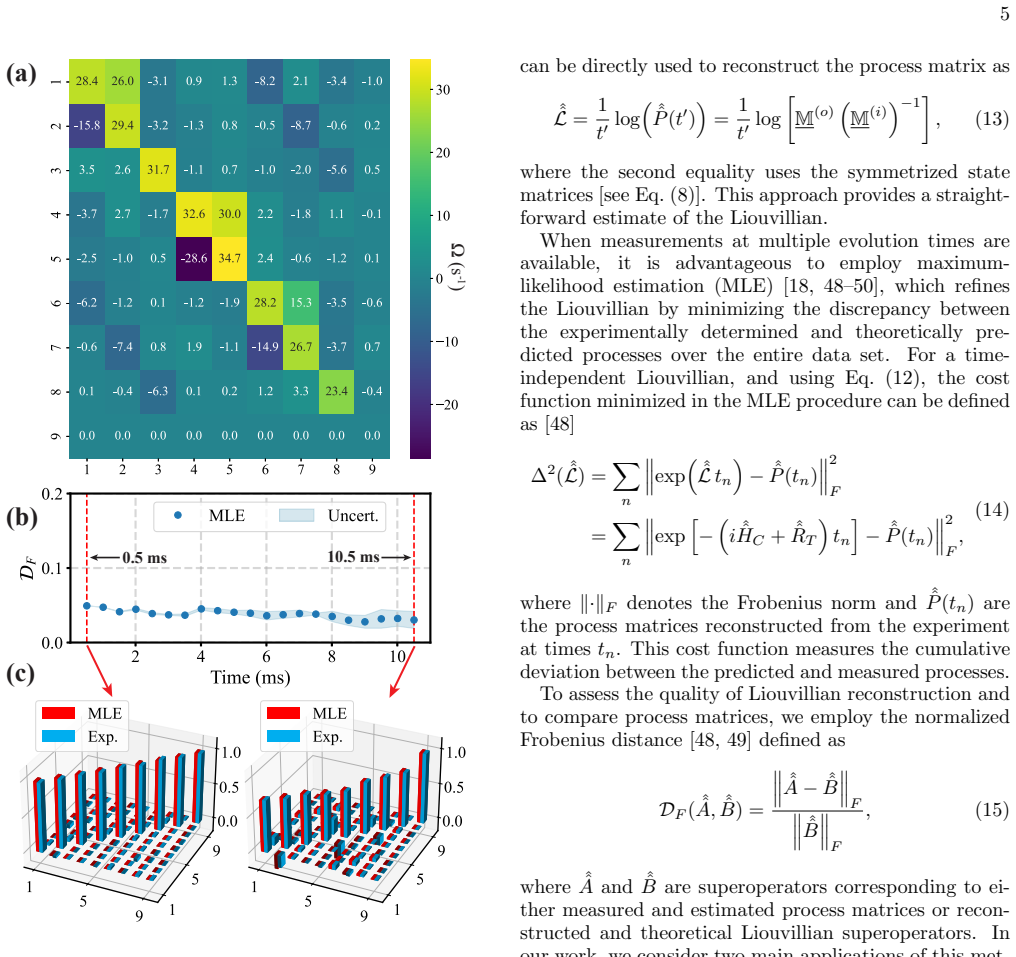
- The paper's claim conflicts with a theorem or certificate in the canon.
- unclear
- Pith found a possible connection, but the passage is too broad, indirect, or ambiguous to say the theorem truly supports the claim.
Reference graph
Works this paper leans on
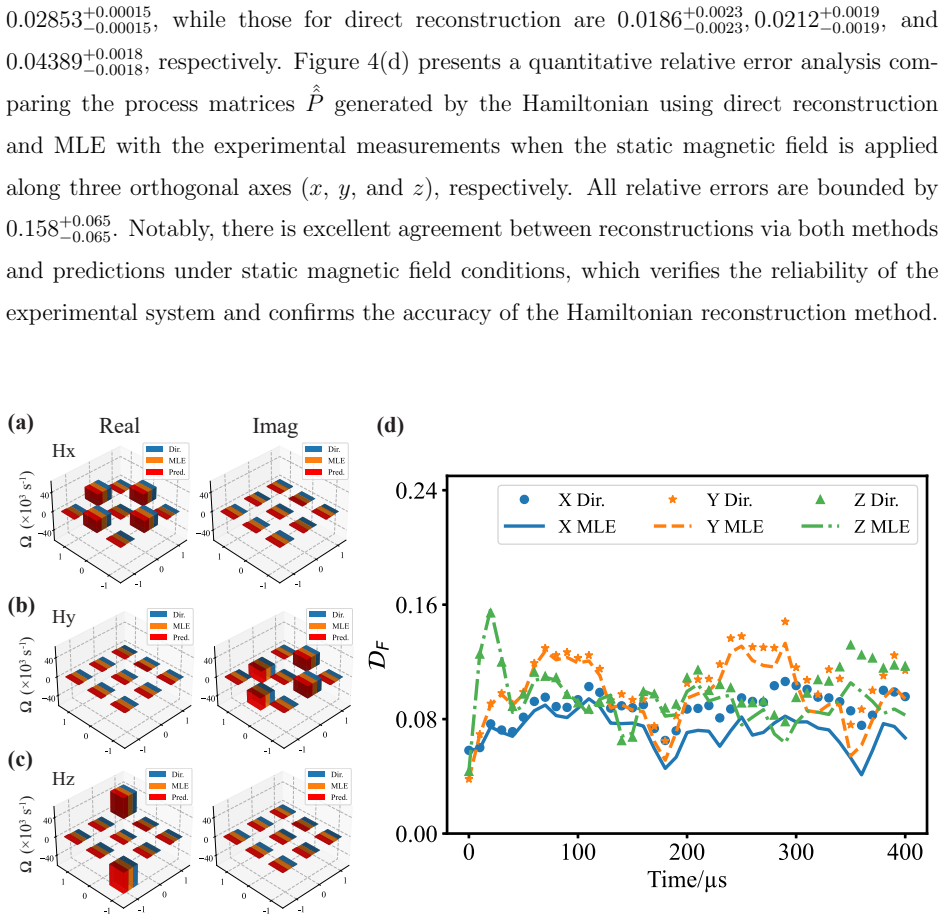
-
[1]
1781+0. 0018 − 0. 0018, respectively. Both methods agree well with experimental data, with MLE providing marginally im- proved accuracy. Finally, we compared the two approaches with the theoretical predictions based on coil geometry and sys- tem response. As shown in Fig. 3(c), the reconstructed Hamiltonian operator corresponding to ˆ ˆHC from both approa...
work page 2019
-
[2]
C. L. Degen, F. Reinhard, and P. Cappellaro, Quantum sensing, Rev. Mod. Phys. 89, 035002 (2017)
work page 2017
-
[3]
V. Giovannetti, S. Lloyd, and L. Maccone, Advances in 13 quantum metrology, Nat. Photonics 5, 222 (2011)
work page 2011
-
[4]
M. A. Nielsen and I. L. Chuang, Quantum computation and quantum information (Cam- bridge University Press, 2010)
work page 2010
- [5]
-
[6]
M. Mohseni, A. T. Rezakhani, and D. A. Lidar, Quantum-process tomography: Resource analysis of dif- ferent strategies, Phys. Rev. A 77, 032322 (2008)
work page 2008
-
[7]
A. Keesling et al., Quantum Kibble–Zurek mechanism and critical dynamics on a programmable rydberg simu- lator, Nature (London) 568, 207 (2019)
work page 2019
-
[8]
S. Ebadi et al., Quantum phases of matter on a 256- atom programmable quantum simulator, Nature (Lon- don) 595, 227 (2021)
work page 2021
-
[9]
S. Chaudhury, S. Merkel, T. Herr, A. Silberfarb, I. H. Deutsch, and P. S. Jessen, Quantum control of the hy- perfine spin of a Cs atom ensemble, Phys. Rev. Lett. 99, 163002 (2007)
work page 2007
- [10]
- [11]
-
[12]
C. Figgatt, A. Ostrander, N. M. Linke, K. A. Landsman, D. Zhu, D. Maslov, and C. Monroe, Parallel entangling operations on a universal ion-trap quantum computer, Nature (London) 572, 368 (2019)
work page 2019
-
[13]
Y. Nam et al., Ground-state energy estimation of the water molecule on a trapped-ion quantum computer, npj Quantum Inf. 6, 33 (2020)
work page 2020
- [14]
-
[15]
X.-Q. Zhou, H. Cable, R. Whittaker, P. Shadbolt, J. L. O’Brien, and J. C. Matthews, Quantum-enhanced to- mography of unitary processes, Optica 2, 510 (2015)
work page 2015
-
[16]
X. Wang, X. Zhan, Y. Li, L. Xiao, G. Zhu, D. Qu, Q. Lin, Y. Yu, and P. Xue, Generalized quantum measurements on a higher-dimensional system via quantum walks, Phys. Rev. Lett. 131, 150803 (2023)
work page 2023
-
[17]
Q. Wang, D. Lyu, J. Liu, and J. Wang, Polarization and orbital angular momentum encoded quantum toffoli gate enabled by diffractive neural networks, Phys. Rev. Lett. 133, 140601 (2024)
work page 2024
-
[18]
F. Arute et al., Quantum supremacy using a pro- grammable superconducting processor, Nature (London) 574, 505 (2019)
work page 2019
-
[19]
G. O. Samach et al., Lindblad tomography of a supercon- ducting quantum processor, Phys. Rev. Appl. 18, 064056 (2022)
work page 2022
-
[20]
R. T. Thew, K. Nemoto, A. G. White, and W. J. Munro, Qudit quantum-state tomography, Phys. Rev. A 66, 012303 (2002)
work page 2002
-
[21]
Y. Wang, Z. Hu, B. C. Sanders, and S. Kais, Qudits and high-dimensional quantum computing, Front. Phys. 8, 589504 (2020)
work page 2020
- [22]
-
[23]
G. D’Ariano and P. L. Presti, Quantum tomography for measuring experimentally the matrix elements of an ar- bitrary quantum operation, Phys. Rev. Lett. 86, 4195 (2001)
work page 2001
-
[24]
G. A. White, F. A. Pollock, L. C. Hollenberg, K. Modi, and C. D. Hill, Non-Markovian quantum process tomog- raphy, PRX Quantum 3, 020344 (2022)
work page 2022
-
[25]
F. Di Colandrea, N. Dehghan, A. D’Errico, and E. Karimi, Fourier quantum process tomography, npj Quantum Inf. 10, 49 (2024)
work page 2024
-
[26]
Buˇ zek, Reconstruction of Liouvillian superoperators, Phys
V. Buˇ zek, Reconstruction of Liouvillian superoperators, Phys. Rev. A 58, 1723 (1998)
work page 1998
-
[27]
P. Hayden and J. Sorce, A canonical Hamiltonian for open quantum systems, J. Phys. A: Math. Theor. 55, 225302 (2022)
work page 2022
-
[28]
R. Finkelstein, S. Bali, O. Firstenberg, and I. Novikova, A practical guide to electromagnetically induced trans- parency in atomic vapor, New J. Phys. 25, 035001 (2023)
work page 2023
-
[29]
S. Li, P. Dai, J. Liu, Z. Xu, and K. Chida, Spin relax- ation of rubidium atoms in an octadecyltrichlorosilane anti-relaxation and anti-reflection coated vacuum multi- pass cell, Opt. Mater. Express 12, 4384 (2022)
work page 2022
-
[30]
Lindblad, On the generators of quantum dynamical semigroups, Commun
G. Lindblad, On the generators of quantum dynamical semigroups, Commun. Math. Phys. 48, 119 (1976)
work page 1976
- [31]
-
[32]
Bloch, Generalized theory of relaxation, Phys
F. Bloch, Generalized theory of relaxation, Phys. Rev. 105, 1206 (1957)
work page 1957
-
[33]
A. G. Redfield, On the theory of relaxation processes, IBM J. Res. Dev. 1, 19 (1957)
work page 1957
-
[34]
E. B. Davies, Markovian master equations, Commun. Math. Phys. 39, 91 (1974)
work page 1974
- [35]
-
[36]
C.-D. Han, B. Glaz, M. Haile, and Y.-C. Lai, Tomogra- phy of time-dependent quantum hamiltonians with ma- chine learning, Phys. Rev. A 104, 062404 (2021)
work page 2021
-
[37]
K. Siva et al., Time-dependent hamiltonian reconstruc- tion using continuous weak measurements, PRX Quan- tum 4, 040324 (2023)
work page 2023
- [38]
-
[39]
R. A. Bertlmann and P. Krammer, Bloch vectors for qu- dits, J. Phys. A: Math. Theor. 41, 235303 (2008)
work page 2008
-
[40]
G. Benenti and G. Strini, Simple representation of quan- tum process tomography, Phys. Rev. A 80, 022318 (2009)
work page 2009
-
[41]
I. L. Chuang and M. A. Nielsen, Prescription for ex- perimental determination of the dynamics of a quantum black box, J. Mod. Opt. 44, 2455 (1997)
work page 1997
-
[42]
J. Poyatos, J. I. Cirac, and P. Zoller, Complete character- ization of a quantum process: the two-bit quantum gate, Phys. Rev. Lett. 78, 390 (1997)
work page 1997
-
[43]
M. Kopciuch, M. Smolis, A. Miranowicz, and S. Pustelny, Optimized optical tomography of quantum states of a room-temperature alkali-metal vapor, Phys. Rev. A 109, 032402 (2024)
work page 2024
-
[44]
A. Dezhang Fard, M. Kopciuch, Y. Sun, P. W/suppress lodarczyk, and S. Pustelny, Isolating pure quadratic Zeeman split- ting, Phys. Rev. Appl. 23, 064034 (2025)
work page 2025
-
[45]
S. Pustelny, V. Schultze, T. Scholtes, and D. Budker, 14 Dichroic atomic vapor laser lock with multi-gigahertz sta- bilization range, Rev. Sci. Instrum. 87 (2016)
work page 2016
-
[46]
Supplementary information for quantum process tomog- raphy of a room-temperature alkali-metal vapor
-
[47]
J. Du, X. Rong, N. Zhao, Y. Wang, J. Yang, and R. Liu, Preserving electron spin coherence in solids by opti- mal dynamical decoupling, Nature (London) 461, 1265 (2009)
work page 2009
-
[48]
S. Abo, P. Tulewicz, K. Bartkiewicz, S ¸. K. ¨Ozdemir, and A. Miranowicz, Experimental Liouvillian exceptional points in a quantum system without Hamiltonian singu- larities, New J. Phys. 26, 123032 (2024)
work page 2024
-
[49]
N. Boulant, T. F. Havel, M. A. Pravia, and D. G. Cory, Robust method for estimating the Lindblad operators of a dissipative quantum process from measurements of the density operator at multiple time points, Phys. Rev. A 67, 042322 (2003)
work page 2003
- [50]
-
[51]
A. Anis and A. Lvovsky, Maximum-likelihood coherent- state quantum process tomography, New J. Phys. 14, 105021 (2012)
work page 2012
-
[52]
D. Mogilevtsev, J. ˇReh´ aˇ cek, and Z. Hradil, Self- calibration for self-consistent tomography, New J. Phys. 14, 095001 (2012)
work page 2012
-
[53]
S. T. Merkel, J. M. Gambetta, J. A. Smolin, S. Poletto, A. D. C´ orcoles, B. R. Johnson, C. A. Ryan, and M. Stef- fen, Self-consistent quantum process tomography, Phys. Rev. A 87, 062119 (2013)
work page 2013
-
[54]
F. Minganti, A. Miranowicz, R. W. Chhajlany, and F. Nori, Quantum exceptional points of non-Hermitian Hamiltonians and Liouvillians: The effects of quantum jumps, Phys. Rev. A 100, 062131 (2019)
work page 2019
-
[55]
M. Kopciuch and A. Miranowicz, Liouvillian and Hamil- tonian exceptional points of atomic vapors: The spectral signatures of quantum jumps, arXiv preprint arXiv:2506.02902 (2025)
- [56]
-
[57]
T. Luan, Z. Li, C. Zheng, X. Kuang, X. Yu, and Z. Zhang, Non-Markovian Quantum Process Tomography, Symme- try 16, 180 (2024)
work page 2024
-
[58]
A. Browaeys and T. Lahaye, Many-body physics with individually controlled Rydberg atoms, Nat. Phys. 16, 132 (2020)
work page 2020
-
[59]
R. Blatt and C. Roos, Quantum simulations with trapped ions, Nat. Phys. 8, 277 (2012)
work page 2012
-
[60]
Torlai et al., Neural-network quantum state tomogra- phy, Nat
H. Torlai et al., Neural-network quantum state tomogra- phy, Nat. Phys. 14, 447 (2018)
work page 2018
-
[61]
X. t. Zhang, Learning and forecasting open quantum dynamics with correlated noise, Commun. Phys. 8, 29 (2025)
work page 2025
-
[62]
Bukov et al., Reinforcement learning in different phases of quantum control, Phys
M. Bukov et al., Reinforcement learning in different phases of quantum control, Phys. Rev. X 8, 031086 (2018)
work page 2018
-
[63]
M. Y. Niu et al., Universal quantum control through deep reinforcement learning, npj Quantum Inf. 5, 33 (2019)
work page 2019
-
[64]
J. Schlienz and G. Mahler, Description of entanglement, Phys. Rev. A 52, 4396 (1995). Supplementary Information for Quantum Process Tomography of a Room-Temperature Alkali-Metal Vapor Yujie Sun Marian Smoluchowski Institute of Physics, Jagiellonian University in Krak´ ow, 30-348 Krak´ ow, Poland Marek Kopciuch ∗ Institute of Spintronics and Quantum Inform...
work page 1995
-
[65]
6 (a) (b) (c) (d) t = 0.5 ms t = 3.5 ms t = 7.0 ms t = 10.5 ms FIG
Isotropic relaxation typical for paraffin-coated atomic- vapor cells, represented by ˆ ˆRiso = 19 − δ99, where the last diagonal element remains zero to ensure trac e preser- vation. 6 (a) (b) (c) (d) t = 0.5 ms t = 3.5 ms t = 7.0 ms t = 10.5 ms FIG. 2. Examples of experimentally measured process matrices ˆ ˆP (t) at different evolution times under the actio...
-
[66]
Relaxation due to residual magnetic fields, modeled by a Ham iltonian ˆHk = (Ω L)k ˆFk. 7
-
[67]
Dephasing, modeled analogously to the qubit case, using t hree independent Lindblad operators ˆLk =γk ˆFk. (a) (b) Ω (s-1) FIG. 3. (a) Reconstruction of the effective total relaxation superoperator ˆ ˆRT using the MLE protocol. (b) Estimated relaxation superoperator described using a m odel including isotropic relaxation, residual magnetic fields, and magne...
-
[68]
0+1. 0 − 1. 0, 7. 9+1. 1 − 1. 1, 6. 6+1. 3 − 1. 3 } s− 1, and the isotropic relaxation rate as γi = 13. 3+1. 6 − 1. 6 s− 1. IV. RECONSTRUCTION OF ST A TIC MAGNETIC FIELDS As a systematic supplementary validation of our time-indepe ndent Hamiltonian recon- struction, we characterize the reconstruction of the Hamilt onian caused by linear Zeeman splitting. ...
- [69]
-
[70]
04389+0. 0018 − 0. 0018, respectively. Figure 4(d) presents a quantitative relativ e error analysis com- paring the process matrices ˆ ˆP generated by the Hamiltonian using direct reconstruction and MLE with the experimental measurements when the static m agnetic field is applied along three orthogonal axes ( x, y, and z), respectively. All relative errors...
-
[71]
158+0. 065 − 0. 065. Notably, there is excellent agreement between reconstruct ions via both methods and predictions under static magnetic field conditions, whi ch verifies the reliability of the experimental system and confirms the accuracy of the Hamilton ian reconstruction method. Real Imag Ω (×10 3 s -1 ) Hx Hy Hz (a) (b) (c) (d) Ω (×10 3 s -1 )Ω (×10 3 ...
- [72]
-
[73]
0186+0. 0023 − 0. 0023, 0. 0212+0. 0019 − 0. 0019, 0. 0439+0. 0018 − 0. 0018 respectively. (d) Normalized Frobenius distance between the experimentally measured process superoperators and those gener ated from the estimated ˆ ˆHC using direct reconstruction (points) and MLE (lines) when the stat ic magnetic field is along the x-, y-, and z-axes. 9 TABLE I:...
-
[74]
919 0 . 001 − 0. 080i 0. 011 + 0. 011i
-
[75]
001 + 0. 080i 0. 045 − 0. 012 − 0. 017i
- [76]
-
[77]
069 − 0. 017 + 0. 039i − 0. 018 − 0. 001i − 0. 017 − 0. 039i 0. 878 0 . 004 + 0. 007i − 0. 018 + 0. 001i 0. 004 − 0. 007i 0. 053 0.878 ˆρ3 0 0 0 0 0 0 0 0 1
-
[78]
036 0 . 011 + 0. 015i 0. 007 − 0. 027i
-
[79]
011 − 0. 015i 0. 072 − 0. 038i
-
[80]
007 + 0. 027i 0. 038i 0. 892 0.892 ˆρ4
discussion (0)
Sign in with ORCID, Apple, or X to comment. Anyone can read and Pith papers without signing in.