REVIEW 3 major objections 7 minor 58 references
Inverse Elastica: A Theoretical Framework for Inverse Design of Morphing Slender Structures
T0 review · 3 major / 7 minor · reviewed 2026-08-05 · deepseek-v4-flash
Pith's one-line read A direct inverse of elastica computes a rod's undeformed shape from its target deformed shape.
desk verdict A mostly sound reformulation of inverse rod design, but the central claim only holds when the target includes the full material frame; worth a serious referee, expect revision. read the letter →
The pith
A machine-rendered reading of the paper's core claim, the machinery that carries it, and where it could break.
The reading
What carries the argument
The central object is the inverse elastica system (Eq. 16): the Kirchhoff equilibrium and linear constitutive equations written in the known deformed frame, augmented by the geometric frame-propagation equations for the undeformed configuration. Because the deformed Darboux vector, the curvature-and-twist vector giving the rotation of the material frame along the rod, is known, the unknown undeformed curvature is read off directly from the computed moment. The undeformed centerline is then obtained by integrating its frame equations. This replacement of the forward nonlinear boundary-value problem with a nearly linear inverse one is what allows direct recovery instead of optimization loops.
What would settle it
Fabricate a rod with the intrinsic curvature predicted for a target circular arc under one choice of end-force parameters, and a second rod under a different choice; clamp both into the same arc and run a forward discrete rod simulation or measure end reactions. The theory says both undeformed shapes deform to the same arc; if either fails to reach the target shape, the direct-inversion claim is refuted. A second check: for a fixed target centerline, solve the inverse equations under two different prescribed twist distributions and verify whether forward loading of the two predicted rods repro
Extended reading notes
Core claim
Section 2.2 states the central claim: for a prescribed deformed configuration with known Darboux vector, material frame, boundary displacements, and applied loads, the complete inverse elastica system (Eq. 16) determines the unknown internal force, internal moment, undeformed centerline, and undeformed quaternion. The undeformed configuration is recovered by 'inverse loading' under displacement boundary conditions, without iterating the forward problem. Because the deformed curvature vector is known, the equations lose the coupling between unknown frame rotation and unknown forces that makes the forward elastica nonlinear; the price is that a single deformed centerline does not fix a unique
Load-bearing premise
The target deformed state must be supplied with its complete material frame and twist distribution, not merely its centerline, because the inverse equations use that frame; a wrong prescribed twist yields a wrong undeformed shape.
Editorial extensions
If this is right
- For a fully prescribed target shape and loads, the undeformed curvature follows from a single boundary-value solve, so iterative forward simulations are not needed for the design step.
- Under displacement-only boundary conditions, multiple undeformed shapes reach the same target; the freedom in end force and moment becomes a design space for extra objectives such as minimal curvature or compact volume.
- The inverse equations are less nonlinear than the forward rod equations because the deformed Darboux vector is known, making solution continuation and optimization cheaper and more stable.
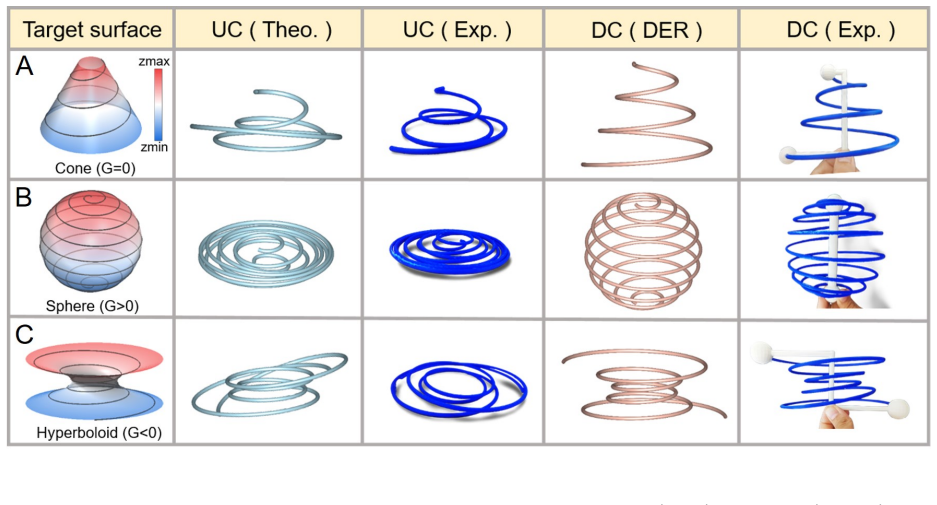
- For shapes whose desired features cannot be stated as boundary conditions, the theory reduces the optimization to six initial force and moment values, enabling rational design of knots and helix-discretized surfaces with Gaussian curvature varying in sign.
Reading between the lines
- Editorial inference: because only the deformed frame appears in the inverse equations, the twist distribution of the target is a free input; treating it as a design variable could produce families of manufacturable rods for the same centerline.
- Editorial inference: the same inversion logic applies to rods with nonuniform stiffness if the stiffness matrix is allowed to vary with arc length, since the constitutive law still gives the undeformed curvature directly from the computed moment.
- Editorial inference: the multiplicity under clamped boundary conditions could be exploited for robustness, selecting undeformed shapes whose end reactions are least sensitive to manufacturing error.
- Editorial inference: an inverse discrete elastic rod companion would generalize the framework to gridshells and branched rod networks, where closed-form boundary conditions are unavailable.
Signed reviews
Editorial analysis
A structured set of objections, weighed in public.
Referee Report
Summary. The paper develops an 'inverse elastica' framework for determining the undeformed configuration (UC) of a slender elastic rod from a prescribed deformed configuration (DC) and boundary conditions. The governing equations, Eq. (16), combine the Kirchhoff equilibrium and constitutive equations written in the known deformed frame with geometric compatibility equations for the UC. The authors claim three features: reduced nonlinearity, solution multiplicity, and a concept of 'inverse loading.' They illustrate the framework with a closed-form 2D arc solution, a 3D helical inverse-loading example, a theory-assisted optimization strategy for cases where UC constraints are not expressible as boundary conditions, and applications to a trefoil knot, helix-discretized surfaces (torus, cone, sphere, hyperboloid), and a hemispherical helical antenna. Validation is performed with discrete elastic rod (DER) simulations and, for some surface cases, experiments.
Significance. If the input is understood to be a fully framed target curve, the central reformulation is sound and potentially useful: it converts part of the forward Kirchhoff problem into a better-posed or at least cheaper inverse computation, exposes the non-uniqueness due to boundary force/moment freedom, and provides nontrivial worked examples with numerical and partial experimental support. The paper does not oversell the mathematics as a theorem; it is a framework with demonstrations. However, the stated claim that Eq. (16) determines the UC 'from a target deformed shape' requires a qualification that the material frame of the DC is part of the input. For centerline-only targets the problem is underdetermined, and the paper offers no general criterion for choosing the twist distribution. This is a load-bearing representational issue rather than an internal inconsistency. The DER verification partly reuses the same mechanical model, but the experimental results for the cone/sphere/hyperboloid cases provide independent support.
major comments (3)
- [Section 2.2, Eq. (16)] The inverse equations are written in terms of the deformed Darboux vector Ω = skew(ω), which is obtained from the deformed material frame q(s), not from the centerline Γ(s) alone. The paper states that 'we can solve F, M, Γ0 and q0 from Eq. (16) with the given displacement boundary condition q0(0), q0(L) and Γ0(0), Γ0(L) for UC,' but it never lists the full deformed frame as part of the required target data. For a target specified only as a space curve, the material frame can be rotated about the tangent by an arbitrary angle, changing ω and hence producing different ω0 and different UCs. This is not merely a technicality: the trefoil example in Section 3.2.1 explicitly sets the twist to (π − 0.9192)t to achieve continuity of the ribbon normals, and a different twist choice would give a different optimized UC. The paper should either restrict the claimed domain to target data consisting
- [Section 2.3.2, Eq. (25)] The simplified planar-UC solution for a helical DC is stated in Eq. (25) without derivation. The equations F1 = (D3−D1)ω1ω3, F2 = (D3−D1)ω2ω3, F3 = (D3−D1)ω3^2, and ω20 = (1−D1/D2)ω2 are not obvious from Eq. (24) and require either derivation or a reference. This matters because the subsequent conclusion that the UC is a unique planar arc with curvature (1−D1/D2)ω2, and the interpretation for circular cross-sections, rest on this result. Also, the text immediately after Eq. (25) writes 'curvature is (1 − D2/D1)ω2', which appears to be a typo: the equation says (1 − D1/D2)ω2. The derivation should be included or cited.
- [Sections 2.2 and 3.1] Well-posedness of the inverse BVP is not analyzed. The paper correctly notes non-uniqueness for displacement boundary conditions, but it does not discuss existence. For arbitrary BCs and target data, Eq. (16) may have no solution; the theory-assisted optimization in Eq. (27) implicitly assumes that a solution exists and that the optimization trajectory stays within the solvable set. The authors should state the regularity and compatibility conditions under which Eq. (16) has a solution, or at least explicitly acknowledge that existence is verified case-by-case in the examples. This is directly relevant to the abstract's claim of handling 'arbitrary boundary conditions.'
minor comments (7)
- [Section 2.3.2, after Eq. (25)] Typo: the text says the UC curvature is '(1 − D2/D1)ω2', but Eq. (25) gives '(1 − D1/D2)ω2'. Please correct.
- [Section 2.2, Eq. (11)] In the moment balance, 'm = 0' should presumably be '\bar m = 0' or '\bar m' with the same notation as the other terms; the bar notation is used inconsistently.
- [Section 3.1] Typo: 'Nelder-Meaed' should be 'Nelder-Mead'.
- [Section 2.3.2 and Figure 4] The text 'z coordination' should be 'z-coordinate'. In Figure 4, the phrase 'from 0.25 to 0.75' presumably means normalized arc length s/L, which should be stated.
- [Section 2.3.1, Figure 3] The notation 'the first UC (2, 0)' is cryptic; it presumably denotes (Fy/(ω2D2), ω0) = (2, 0). Please clarify in the caption or text.
- [Section 2.2 and references] The citation 'Yu et al., 2021; Sun et al., 2022; Yu et al., 2023; ?' contains an unresolved '?'. Please fill in the missing reference.
- [Sections 3.2.2 and 3.2.3] The material frame for the target helix-discretized surfaces is not specified. The Darboux vector ω used in Eq. (16) depends on this frame. Please state how the frame is chosen for these examples (e.g., the natural Bishop frame, the Frenet frame, or a surface-adapted frame).
Circularity Check
No significant circularity: inverse elastica is a direct inversion of the forward Kirchhoff equations with no fitted parameter passed off as a prediction; the main caveats are limitations, not circular reductions.
full rationale
The central derivation in Section 2.2 takes the target deformed configuration (Γ, q, hence ω) as known input and solves Eq. (16) for F, M, ω0, Γ0, and q0. This is not circular: the undeformed curvature is obtained from the constitutive equation M = (ω − ω0)S after M is determined by equilibrium in the known deformed frame, so the output is not re-inserted as an input. No parameter is fitted to the target shape; the theory-assisted optimization varies boundary force/moment initial values to minimize a loss function on UC properties, which is design optimization rather than prediction from fitted data. The uniqueness statements for clamped-free conditions rely on elementary ODE initial-value theory, not on a self-citation. Self-citations (Li et al. 2025a,b; Li 2025) appear in the introduction and future-work discussion and are not load-bearing for the inverse derivation. DER forward simulations use the same Kirchhoff constitutive model and therefore provide a self-consistency check, but the 3D-printed SLA experiments in Section 3.2.3 supply independent support. The manuscript's main limitation—that a target centerline alone does not determine ω, so the full material frame/twist must be supplied—is an identifiability/input-specification issue, not an equation equivalent to its input by construction. Accordingly, no circular step can be quoted.
Assumptions & free parameters
free parameters (3)
- Fx, Fy (end force components in 2D arc example) =
arbitrary real parameters
- omega0 (integration constant in 2D inverse elastica) =
arbitrary real parameter
- F(0) and M(0) (six initial force/moment components) =
optimized by Nelder-Mead
assumptions (5)
- domain assumption Kirchhoff rod model: inextensible, unshearable, linear elastic, cross-section stiffness S = diag(EI1, EI2, GJ)
- domain assumption The deformed configuration and its material frame (Darboux vector ω) are known exactly and the rod is in equilibrium in that configuration
- standard math Existence and uniqueness of solutions to the inverse BVP/IVP under the stated boundary conditions (Picard-Lindelöf style argument)
- domain assumption The Nelder-Mead optimizer converges to a satisfactory (locally optimal) design in the 6-dimensional force/moment space
- domain assumption In the antenna application, gravity is the only distributed load and is prescribed in the DC frame
Cite this review
Pith. "Pith review of Inverse Elastica: A Theoretical Framework for Inverse Design of Morphing Slender Structures." pith.science (2026). https://pith.science/paper/5FHMPT3O
@misc{pith2026250819673,
  author       = {Pith},
  title        = {Pith review of: Inverse Elastica: A Theoretical Framework for Inverse Design of Morphing Slender Structures},
  year         = {2026},
  howpublished = {\url{https://pith.science/paper/5FHMPT3O}},
  note         = {Machine review of arXiv:2508.19673}
}
read the original abstract
Inverse design of morphing slender structures with programmable curvature has significant applications in various engineering fields. Most existing studies formulate it as an optimization problem, which requires repeatedly solving the forward equations to identify optimal designs. Such methods, however, are computationally intensive and often susceptible to local minima issues. In contrast, solving the inverse problem theoretically, which can bypass the need for optimizations, is highly efficient yet remains challenging, particularly for cases involving arbitrary boundary conditions (BCs). Here, we develop a systematic theoretical framework, termed inverse elastica, for the direct determination of the undeformed configuration from a target deformed shape along with prescribed BCs. Building upon the classical elastica, inverse elastica is derived by supplementing the geometric equations of undeformed configurations. The framework shows three key features: reduced nonlinearity, solution multiplicity, and inverse loading. These principles are demonstrated through two representative models: an analytical solution for a two-dimensional arc and a numerical continuation study of the inverse loading of a three-dimensional helical spring. Furthermore, we develop a theory-assisted optimization strategy for cases in which the constrains of the undeformed configurations cannot be directly formulated as BCs. Using this strategy, we achieve rational inverse design of complex spatial curves and curve-discretized surfaces with varying Gaussian curvatures. Our theoretical predictions are validated through both discrete elastic rod simulations and experiments.
Figures


Figures from the paper (7 more)




Reference graph
Works this paper leans on
-
[1]
Abbena, E., Salamon, S., and Gray, A. (2017). Modern differential geometry of curves and surfaces with Mathematica . Chapman and Hall/CRC
work page 2017
-
[2]
Aharoni, H., Xia, Y., Zhang, X., Kamien, R. D., and Yang, S. (2018). Universal inverse design of surfaces with thin nematic elastomer sheets. Proceedings of the National Academy of Sciences , 115(28):7206--7211
work page 2018
-
[3]
Armon, S., Efrati, E., Kupferman, R., and Sharon, E. (2011). Geometry and mechanics in the opening of chiral seed pods. Science , 333(6050):1726--1730
work page 2011
-
[4]
Audoly, B. and Pomeau, Y. (2000). Elasticity and geometry. In Peyresq lectures on nonlinear phenomena , pages 1--35. World Scientific
work page 2000
-
[5]
Baek, C., Sageman-Furnas, A. O., Jawed, M. K., and Reis, P. M. (2018). Form finding in elastic gridshells. Proceedings of the National Academy of Sciences , 115(1):75--80
work page 2018
-
[6]
Benvenuto, R., Salvi, S., and Lavagna, M. (2015). Dynamics analysis and gnc design of flexible systems for space debris active removal. Acta Astronautica , 110:247--265
work page 2015
-
[7]
Bergou, M., Wardetzky, M., Robinson, S., Audoly, B., and Grinspun, E. (2008). Discrete elastic rods. In ACM SIGGRAPH 2008 Papers , pages 1--12
work page 2008
-
[8]
Bertails-Descoubes, F., Derouet-Jourdan, A., Romero, V., and Lazarus, A. (2018). Inverse design of an isotropic suspended kirchhoff rod: theoretical and numerical results on the uniqueness of the natural shape. Proceedings of the Royal Society A: Mathematical, Physical and Engineering Sciences , 474(2212):20170837
work page 2018
Show all 58 references
-
[9]
W., Van Rees, W
Boley, J. W., Van Rees, W. M., Lissandrello, C., Horenstein, M. N., Truby, R. L., Kotikian, A., Lewis, J. A., and Mahadevan, L. (2019). Shape-shifting structured lattices via multimaterial 4d printing. Proceedings of the National Academy of Sciences , 116(42):20856--20862
2019
-
[10]
J., and Haataja, M
Chen, Z., Majidi, C., Srolovitz, D. J., and Haataja, M. (2011). Tunable helical ribbons. Applied Physics Letters , 98(1)
2011
-
[11]
Cheng, X., Fan, Z., Yao, S., Jin, T., Lv, Z., Lan, Y., Bo, R., Chen, Y., Zhang, F., Shen, Z., et al. (2023). Programming 3d curved mesosurfaces using microlattice designs. Science , 379(6638):1225--1232
2023
-
[12]
Chu, L. J. (1948). Physical limitations of omni-directional antennas. Journal of Applied Physics , 19(12):1163--1175
1948
-
[13]
Derouet-Jourdan, A., Bertails-Descoubes, F., Daviet, G., and Thollot, J. (2013). Inverse dynamic hair modeling with frictional contact. ACM Transactions on Graphics (TOG) , 32(6):1--10
2013
-
[14]
Derouet-Jourdan, A., Bertails-Descoubes, F., and Thollot, J. (2010). Stable inverse dynamic curves. ACM Transactions on Graphics (TOG) , 29(6):1--10
2010
-
[15]
Do Carmo, M. P. (2016). Differential geometry of curves and surfaces: revised and updated second edition . Courier Dover Publications
2016
-
[16]
J., Champneys, A
Doedel, E. J., Champneys, A. R., Dercole, F., Fairgrieve, T. F., Kuznetsov, Y. A., Oldeman, B., Paffenroth, R., Sandstede, B., Wang, X., and Zhang, C. (2007). Auto-07p: Continuation and bifurcation software for ordinary differential equations
2007
-
[17]
Efrati, E., Sharon, E., and Kupferman, R. (2009). Elastic theory of unconstrained non-euclidean plates. Journal of the Mechanics and Physics of Solids , 57(4):762--775
2009
-
[18]
A., and Zhang, Y
Fan, Z., Yang, Y., Zhang, F., Xu, Z., Zhao, H., Wang, T., Song, H., Huang, Y., Rogers, J. A., and Zhang, Y. (2020). Inverse design strategies for 3d surfaces formed by mechanically guided assembly. Advanced Materials , 32(14):1908424
2020
-
[19]
J., and Liu, M
Huang, W., Hao, Z., Li, J., Tong, D., Guo, K., Zhang, Y., Gao, H., Hsia, K. J., and Liu, M. (2025). A tutorial on simulating nonlinear behaviors of flexible structures with the discrete differential geometry (ddg) method. Applied Mechanics Reviews , pages 1--88
2025
-
[20]
Huang, W., Zou, H., Liu, H., Yang, W., Gao, J., and Liu, Z. (2023). Contact dynamic analysis of tether-net system for space debris capture using incremental potential formulation. Advances in Space Research , 72(6):2039--2050
2023
-
[21]
K., Novelia, A., and O'Reilly, O
Jawed, M. K., Novelia, A., and O'Reilly, O. M. (2018). A primer on the kinematics of discrete elastic rods . Springer
2018
-
[22]
Kansara, H., Liu, M., He, Y., and Tan, W. (2023). Inverse design and additive manufacturing of shape-morphing structures based on functionally graded composites. Journal of the Mechanics and Physics of Solids , 180:105382
2023
-
[23]
and Maddocks, J
Kehrbaum, S. and Maddocks, J. (1997). Elastic rods, rigid bodies, quaternions and the last quadrature. Philosophical Transactions of the Royal Society of London. Series A: Mathematical, Physical and Engineering Sciences , 355(1732):2117--2136
1997
-
[24]
A., Liu, S., and Zhao, X
Kim, Y., Parada, G. A., Liu, S., and Zhao, X. (2019). Ferromagnetic soft continuum robots. Science Robotics , 4(33):eaax7329
2019
-
[25]
Kong, M., Shin, G., Lee, S.-H., and Yoon, I.-J. (2016). Electrically small folded spherical helix antennas using copper strips and 3d printing technology. Electronics Letters , 52(12):994--996
2016
-
[26]
Lee, Y.-K., Xi, Z., Lee, Y.-J., Kim, Y.-H., Hao, Y., Choi, H., Lee, M.-G., Joo, Y.-C., Kim, C., Lien, J.-M., et al. (2020). Computational wrapping: A universal method to wrap 3d-curved surfaces with nonstretchable materials for conformal devices. Science Advances , 6(15):eaax6212
2020
-
[27]
Levien, R. (2008). The elastica: a mathematical history. Technical report, Technical Report No. UCB/EECS-2008-103
2008
-
[28]
Li, J. (2025). The inverse discrete elastic rod. To be submitted
2025
-
[29]
Li, J., Sun, X., He, Z., Hou, Y., Wu, H., and Zhu, Y. (2025a). Biomimetic turing machine: A multiscale theoretical framework for the inverse design of target space curves. Journal of the Mechanics and Physics of Solids , 196:105999
-
[30]
Li, J., Tong, D., Hao, Z., Zhu, Y., Wu, H., Liu, M., and Huang, W. (2025b). Harnessing discrete differential geometry: A virtual playground for the bilayer soft robotics. Advanced Intelligent Systems , page 2500141
-
[31]
A., Tan, Y
Ling, S., Tian, X., Zeng, Q., Qin, Z., Kurt, S. A., Tan, Y. J., Fuh, J. Y., Liu, Z., Dickey, M. D., Ho, J. S., et al. (2024). Tension-driven three-dimensional printing of free-standing field’s metal structures. Nature Electronics , 7(8):671--683
2024
-
[32]
Liu, M., Domino, L., and Vella, D. (2020). Tapered elastic as a route for axisymmetric morphing structures. Soft Matter , 16(33):7739--7750
2020
-
[33]
Love, A. E. H. (1944). A treatise on the mathematical theory of elasticity . Courier Corporation
1944
-
[34]
Matsutani, S. (2010). Euler's elastica and beyond. Journal of Geometry and Symmetry in Physics , 17:45--86
2010
-
[35]
Matsutani, S. (2024). Euler's original derivation of elastica equation. arXiv preprint arXiv:2411.09227
2024 arXiv
-
[36]
E., Grandgeorge, P., and Neukirch, S
Moulton, D. E., Grandgeorge, P., and Neukirch, S. (2018). Stable elastic knots with no self-contact. Journal of the Mechanics and Physics of Solids , 116:33--53
2018
-
[37]
O'Reilly, O. M. (2017). Modeling nonlinear problems in the mechanics of strings and rods . Springer
2017
-
[38]
Qin, L., Huang, W., Du, Y., Zheng, L., and Jawed, M. K. (2020). Genetic algorithm-based inverse design of elastic gridshells. Structural and Multidisciplinary Optimization , 62:2691--2707
2020
-
[39]
Qin, L., Zhu, J., and Huang, W. (2022). A bottom-up optimization method for inverse design of two-dimensional clamped-free elastic rods. International Journal for Numerical Methods in Engineering , 123(11):2556--2572
2022
-
[40]
Trimeresurus sabahi fucatus, banded pit viper - takua pa district, phang-nga province
Rushen (2019). Trimeresurus sabahi fucatus, banded pit viper - takua pa district, phang-nga province. https://commons.wikimedia.org/wiki/File:Trimeresurus_sabahi_fucatus,_Banded_pit_viper_-_Takua_Pa_District,_Phang-nga_Province_(46710893582).jpg. Image licensed under CC BY 2.0...
2019
-
[41]
L., and Selinger, J
Sawa, Y., Ye, F., Urayama, K., Takigawa, T., Gimenez-Pinto, V., Selinger, R. L., and Selinger, J. V. (2011). Shape selection of twist-nematic-elastomer ribbons. Proceedings of the National Academy of Sciences , 108(16):6364--6368
2011
-
[42]
Shi, Q., Huang, W., Yu, T., and Li, M. (2025). Double-eigenvalue bifurcation and multistability in serpentine strips with tunable buckling behaviors. Journal of the Mechanics and Physics of Solids , 195:105922
2025
-
[43]
H., Choi, T
Shin, B., Ha, J., Lee, M., Park, K., Park, G. H., Choi, T. H., Cho, K.-J., and Kim, H.-Y. (2018). Hygrobot: A self-locomotive ratcheted actuator powered by environmental humidity. Science Robotics , 3(14):eaar2629
2018
-
[44]
Si \'e fert, E., Reyssat, E., Bico, J., and Roman, B. (2019). Bio-inspired pneumatic shape-morphing elastomers. Nature Materials , 18(1):24--28
2019
-
[45]
and Nelder, J
Singer, S. and Nelder, J. (2009). Nelder-mead algorithm. Scholarpedia , 4(7):2928
2009
-
[46]
J., and Zhao, R
Sun, X., Wu, S., Dai, J., Leanza, S., Yue, L., Yu, L., Jin, Y., Qi, H. J., and Zhao, R. R. (2022). Phase diagram and mechanics of snap-folding of ring origami by twisting. International Journal of Solids and Structures , 248:111685
2022
-
[47]
A., Nuzzo, R
Sydney Gladman, A., Matsumoto, E. A., Nuzzo, R. G., Mahadevan, L., and Lewis, J. A. (2016). Biomimetic 4d printing. Nature Materials , 15(4):413--418
2016
-
[48]
Timoshenko, S. (1925). Analysis of bi-metal thermostats. Journal of the Optical Society of America , 11(3):233--255
1925
-
[49]
Tong, D., Hao, Z., Li, J., and Huang, W. (2025). Inverse design of planar clamped-free elastic rods from noisy data. International Journal for Numerical Methods in Engineering , 126(5):e70018
2025
-
[50]
M., Vouga, E., and Mahadevan, L
Van Rees, W. M., Vouga, E., and Mahadevan, L. (2017). Growth patterns for shape-shifting elastic bilayers. Proceedings of the National Academy of Sciences , 114(44):11597--11602
2017
-
[51]
Wang, T., Dai, Z., Potier-Ferry, M., and Xu, F. (2023). Curvature-regulated multiphase patterns in tori. Physical Review Letters , 130(4):048201
2023
-
[52]
Wang, T., Potier-Ferry, M., and Xu, F. (2025). A nonlinear toroidal shell model for surface morphologies and morphogenesis. Journal of the Mechanics and Physics of Solids , 200:106135
2025
-
[53]
Xu, S., Yan, Z., Jang, K.-I., Huang, W., Fu, H., Kim, J., Wei, Z., Flavin, M., McCracken, J., Wang, R., et al. (2015). Assembly of micro/nanomaterials into complex, three-dimensional architectures by compressive buckling. Science , 347(6218):154--159
2015
-
[54]
J., and Liu, M
Yang, X., Zhou, Y., Zhao, H., Huang, W., Wang, Y., Hsia, K. J., and Liu, M. (2023). Morphing matter: From mechanical principles to robotic applications. Soft Science , 3(4):38
2023
-
[55]
Yu, T., Dreier, L., Marmo, F., Gabriele, S., Parascho, S., and Adriaenssens, S. (2021). Numerical modeling of static equilibria and bifurcations in bigons and bigon rings. Journal of the Mechanics and Physics of Solids , 152:104459
2021
-
[56]
and Hanna, J
Yu, T. and Hanna, J. (2019). Bifurcations of buckled, clamped anisotropic rods and thin bands under lateral end translations. Journal of the Mechanics and Physics of Solids , 122:657--685
2019
-
[57]
Yu, T., Marmo, F., Cesarano, P., and Adriaenssens, S. (2023). Continuous modeling of creased annuli with tunable bistable and looping behaviors. Proceedings of the National Academy of Sciences , 120(4):e2209048120
2023
-
[58]
Zhang, Y., Yang, J., Liu, M., and Vella, D. (2022). Shape-morphing structures based on perforated kirigami. Extreme Mechanics Letters , 56:101857
2022
Reviewed August 5, 2026 · model on record in the stance chip above.
Discussion (0). Continue with ORCID to comment.