REVIEW 4 major objections 6 minor 24 references
LabelGS: Label-Aware 3D Gaussian Splatting for 3D Scene Segmentation
T0 review · 4 major / 6 minor · reviewed 2026-08-05 · deepseek-v4-flash
Pith's one-line read LabelGS makes 3D Gaussian scenes segmentable by assigning each pixel's label directly to the Gaussian that dominates its rendering, and reports state-of-the-art segmentation accuracy with a 22x training speedup over Feature-3DGS.
desk verdict A fast, clever label-lifting method for 3DGS, but the evaluation is undermined by self-referential ground truth and ablations that don't support the design. read the letter →
The pith
A machine-rendered reading of the paper's core claim, the machinery that carries it, and where it could break.
The reading
What carries the argument
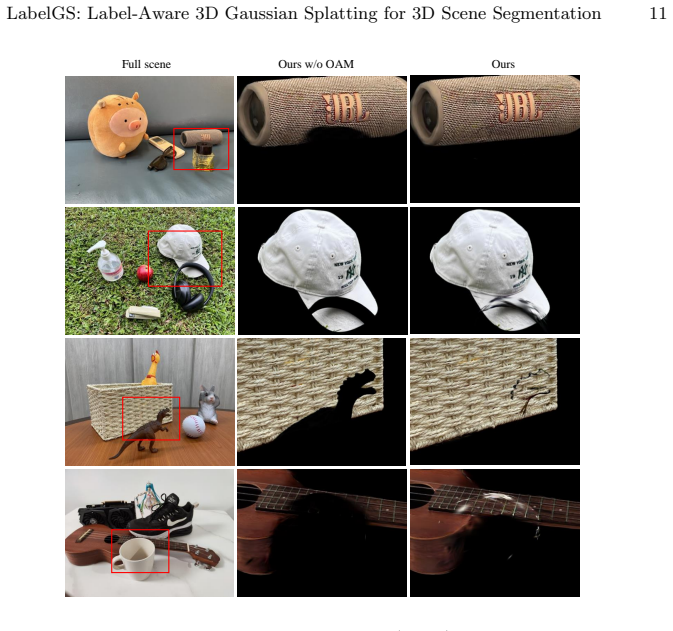
The central mechanism is Main Gaussian Labeling (MGL): for each pixel, assign the pixel's label to the Gaussian j that maximizes alpha_i * T_i during splatting, i.e. the Gaussian that most strongly explains that pixel. Around this core sit the Occlusion Analysis Model (OAM), which uses monocular depth estimates to decide which masks occlude which and builds unoccluded masks for loss computation, and the Gaussian Projection Filter (GPF), which only accepts a label if the Gaussian's projected center lies in the same label region as the pixel. These components turn a set of 2D masks into a label-attributed 3D Gaussian model at low overhead.
What would settle it
Re-evaluate LabelGS on the same four datasets using independently human-annotated ground-truth masks for held-out views instead of masks exported from the tracking model. If mIoU and PSNR drop to the level of the feature-based baselines, the claim that direct label lifting yields accurate 3D segmentation would be refuted.
Extended reading notes
Core claim
The central claim is that direct label assignment to Gaussians—rather than learning a feature field, a compressed semantic embedding, or a group identity—is the key to fast and accurate 3D scene segmentation in Gaussian Splatting. For each training pixel, the label is given to the Gaussian with the largest alpha-weighted contribution (the 'main' Gaussian), so segmentation becomes a property of the representation itself, not a post-processing step over learned features. The paper further claims that an Occlusion Analysis Model, which uses monocular depth to build per-mask occlusion lists and excludes occluded areas from the label loss, prevents the model from overfitting occlusions, and that
Load-bearing premise
The reported accuracy assumes that the 2D masks generated by the same tracking model used to supervise LabelGS are a valid ground truth for what should count as a correctly segmented object in a novel view.
Editorial extensions
If this is right
- 3D scene segmentation becomes a rendering-time lookup rather than a learned feature optimization, so training time and memory stay close to plain 3D Gaussian Splatting.
- Extracting a subset of Gaussians by label yields a renderable 3D object with precise boundaries in unseen views, directly supporting object removal, editing, and novel-view visualization.
- The approach reduces the 3D segmentation problem to 2D video object tracking plus a single assignment rule, so improvements in the 2D tracker should transfer directly to 3D segmentation quality.
- A 22x training speedup over Feature-3DGS at 1440x1080 makes interactive or iterated segmentation of a scene practical on a single consumer GPU.
- The random region sampling strategy for label loss keeps the added optimization cost low even when many object masks are present.
Reading between the lines
- The direct label-assignment rule is likely to combine with open-vocabulary label sources: if a 2D open-vocabulary segmenter replaces the video tracker, LabelGS could yield zero-shot 3D segmentation without any retraining of the assignment rule.
- The Occlusion Analysis Model is a general occlusion-aware supervision heuristic; it could be tested as a standalone module in other lifting pipelines, where it should help whenever training views contain occluded objects visible from other viewpoints.
- Because the benchmark's ground-truth masks are produced by the same tracking model used for supervision, the reported mIoU may overstate performance on objects the tracker misses; an evaluation with independent human annotations would clarify how much of the gain is intrinsic to the labeling rule versus inherited from the tracker.
- The Gaussian Projection Filter's negative effect on 360-degree datasets suggests a view-dependent or adaptive version—applying the filter only where view coverage is sparse—might preserve its benefit on forward-facing scenes without harming full-coverage scenes.
Editorial analysis
A structured set of objections, weighed in public.
Referee Report
Summary. The paper proposes LabelGS, a method that augments 3D Gaussian Splatting with per-Gaussian object labels. Cross-view consistent masks are obtained from the DEVA video tracker; an Occlusion Analysis Model uses monocular depth to suppress occluded areas during label loss computation; Main Gaussian Labeling assigns each pixel label to the Gaussian with the highest alpha-weighted contribution; a Gaussian Projection Filter resolves label conflicts. The authors report mIoU/PSNR/SSIM/LPIPS on 3D-OVS, LLFF, LERF-Mask, and Mip-NeRF360, introduce a modified/new benchmark by adding masks to LLFF and Mip-NeRF360, and claim a 22x training speedup over Feature-3DGS. Code is promised for release.
Significance. If independently validated, LabelGS would be a valuable and conceptually simple alternative to feature/grouping-based 3D Gaussian segmentation: it avoids high-dimensional feature learning, labels Gaussians directly, and reports a large training-time advantage over Feature-3DGS. The paper includes component-wise ablations and a direct runtime comparison, which are useful. However, the current evidence does not establish the SOTA claim because the test masks for the extended benchmark are not shown to be independent of the DEVA supervision, and the full model is not consistently better than its own ablations.
major comments (4)
- [§4.1, Datasets and Metrics; §3.1] The extended LLFF/Mip-NeRF360 benchmark adds masks of salient objects for evaluation, but the manuscript does not show these masks are independent of the DEVA masks used for supervision. Since DEVA generates the cross-view labels that supervise LabelGS (Eq. 1), and the Limitation section states LabelGS learns labels generated by DEVA, evaluating on DEVA-produced test masks measures how faithfully LabelGS transfers DEVA's own labels to novel views. This is circular for the SOTA claim. Please re-evaluate on independently human-annotated ground truth (or existing benchmarks with independent GT) and report the resulting numbers.
- [§4.1, threshold selection] For LangSplat and Feature-3DGS, the protocol tries 1000 score thresholds and selects the one with the best PSNR on the rendered test views (after cropping to the prompt-mask bounding box). This uses the test ground-truth masks to tune the baselines, which is test-set leakage. It likely inflates the baselines and invalidates the reported comparison, even if it does not favor LabelGS. Please use a validation split or a fixed threshold and report the effect.
- [§4.4 Ablation Studies; Table 2] The ablations do not support the claims. On 3D-OVS, full LabelGS mIoU is 0.925, while w/o GPF is 0.926 and w/o OAM is 0.928; on LERF, full is 0.75 vs 0.82 (w/o GPF) and 0.80 (w/o OAM); on Mip-NeRF360, full is 0.75 vs 0.79 (w/o OAM). Section 4.4 states GPF improves 3D-OVS, which Table 2 contradicts, and that OAM changes are slight, which the LERF drop is not. The full method is not consistently better than its own ablations, so the claimed contributions of GPF and OAM are unsubstantiated. Please revisit the design or report differences with variance/statistical tests and explain why the full model is preferred.
- [§4.2 Quantitative Results] The claim that LabelGS 'outperforms previous state-of-the-art methods, including Feature-3DGS' is only directly tested against Feature-3DGS on 3D-OVS; Feature-3DGS is not evaluated on LLFF, LERF, or Mip-NeRF360. The other datasets are compared with LangSplat, Gaussian Grouping, and SAGS. Please either add Feature-3DGS results on the remaining datasets (or state clearly that the SOTA claim is based on 3D-OVS only, with the other comparisons being against a different set of baselines).
minor comments (6)
- [Abstract; §1; §5] Use a consistent spelling of 'DEVA'. The text contains 'DEV A' (in the abstract and Section 1) and 'DEV A-tracking-failed' in the Limitation.
- [§3.3, Eq. (8)] The notation 'Proj_i(H(G,k))' is undefined for a set of Gaussians. Please specify how the subset H(G,k) is rendered (e.g., alpha-compositing only those Gaussians) before applying the loss.
- [§3.3] Typo: 'Main Gaussain Labeling' should be 'Main Gaussian Labeling'.
- [Table 4] The training-time comparison is reported for a single scene (sofa) at 15,000 iterations. Please clarify whether both methods are compared at the same convergence criterion and whether the 22x figure is representative across scenes/resolutions.
- [§4.2] The phrase 'Our result significantly surpasses' is used without statistical significance tests. Please avoid 'significantly' unless a test is reported.
- [Figure 2] Panel (d) is labeled GPF but the caption and text do not explain the weight annotations (w=0.2, etc.) in that panel. Please make the figure self-contained.
Circularity Check
Benchmark circularity: DEVA-generated masks are both the supervision and the test ground truth, and the label-assignment rule copies DEVA labels into Gaussians by construction.
-
other
[Section 4.1 (Datasets and Metrics); Section 3.1; Implementation Details]
"We modified these datasets by removing occluded segmentation masks, i.e. background masks. ... we select one mask of the object as the 3D segmentation prompt, while masks from other views are used as the test set. We render the extracted 3D Gaussians in test views and compare with ground truth image."
The test-set 'ground truth' masks are generated by the same DEVA tracker that produces the supervision masks. Section 3.1 obtains cross-view masks with DEVA, and the implementation states 'we use DEV A to track the objects from training images.' Thus the reported mIoU/PSNR measure how faithfully LabelGS transfers DEVA's own labels to novel views, not agreement with independent human annotation. The 'new benchmark' is therefore constructed from the supervision signal itself, so the SOTA comparison is untested against independent ground truth. The Limitation section reinforces this by admitting failure on DEVA-tracking-failed targets.
-
self definitional
[Section 3.3, Eq. (6) and Eq. (8)]
"the label of pixel v is assigned to the Gaussian that contributes the most to the rendering, ... Bj = Li(v), s.t. j = arg max k (αkTk) ... Llabel = P t i=1 P N k=1 L1(P roji(H(G, k))U i k, IiM i kU i k)"
Gaussian labels are set equal to the DEVA pixel label at the pixel where the Gaussian is the main contributor. Rendering the label map of H(G,k) therefore returns, by construction, the input mask M_i^k in the unoccluded region, so the label loss is minimized by the assignment rule itself on training views. The 'prediction' is the input mask re-rendered through the Gaussian representation rather than an independently derived segmentation. Combined with the DEVA-based test ground truth, the evaluation loop is closed: the output labels and the benchmark labels share the same origin.
full rationale
LabelGS is an empirical method paper rather than a formal derivation, so classical circular-derivation patterns are limited. The central circularity is that the cross-view masks supervising the label loss (Eq. 8) and the ground-truth masks used for the new benchmark test comparisons (Sec. 4.1) are both produced by the DEVA tracker. Moreover, the Main Gaussian Labeling rule (Eq. 6) is a direct copy of DEVA pixel labels to the main-rendering Gaussian, making the training-view label map equal to the input mask by construction. Consequently, the headline claim that LabelGS 'outperforms previous state-of-the-art methods' in 3D scene segmentation is, in substantial part, a measure of self-consistency with the DEVA/SAM labeling ecosystem, not of agreement with independent human annotations. This is partial circularity, not total: the underlying 3DGS color/geometry optimization, DOV, OAM, GPF, and the reported 22x training speedup are independent technical contributions, and the PSNR decline from added constraints is a real trade-off. There are no load-bearing self-citations or imported uniqueness theorems. Score 6 reflects that the central empirical claim reduces to evaluating the method against its own supervision source.
Assumptions & free parameters
free parameters (4)
- Label assignment threshold =
0.6
- Label loss weight lambda2 =
not reported
- Random region sampling size =
10 masks per iteration
- Label loss start iteration =
1000
assumptions (4)
- domain assumption DEVA produces cross-view consistent masks that correctly cover every target object in all training views (Section 3.1, Eq. 1).
- domain assumption DepthAnythingV2 monocular depths at mask boundaries are accurate enough to determine occlusion order via adjacent boundary average depth (Section 3.2, Eq. 2).
- domain assumption The pixel belongs to the single Gaussian with maximum alpha-times-transmittance (Eq. 6), and conflicts are resolvable by the projection filter (Eq. 7).
- domain assumption Masks generated by SAM/DEVA in the modified and extended benchmarks are a valid ground truth for 3D scene segmentation (Section 4.1).
Cite this review
Pith. "Pith review of LabelGS: Label-Aware 3D Gaussian Splatting for 3D Scene Segmentation." pith.science (2026). https://pith.science/paper/HPMB6TKH
@misc{pith2026250819699,
  author       = {Pith},
  title        = {Pith review of: LabelGS: Label-Aware 3D Gaussian Splatting for 3D Scene Segmentation},
  year         = {2026},
  howpublished = {\url{https://pith.science/paper/HPMB6TKH}},
  note         = {Machine review of arXiv:2508.19699}
}
read the original abstract
3D Gaussian Splatting (3DGS) has emerged as a novel explicit representation for 3D scenes, offering both high-fidelity reconstruction and efficient rendering. However, 3DGS lacks 3D segmentation ability, which limits its applicability in tasks that require scene understanding. The identification and isolating of specific object components is crucial. To address this limitation, we propose Label-aware 3D Gaussian Splatting (LabelGS), a method that augments the Gaussian representation with object label.LabelGS introduces cross-view consistent semantic masks for 3D Gaussians and employs a novel Occlusion Analysis Model to avoid overfitting occlusion during optimization, Main Gaussian Labeling model to lift 2D semantic prior to 3D Gaussian and Gaussian Projection Filter to avoid Gaussian label conflict. Our approach achieves effective decoupling of Gaussian representations and refines the 3DGS optimization process through a random region sampling strategy, significantly improving efficiency. Extensive experiments demonstrate that LabelGS outperforms previous state-of-the-art methods, including Feature-3DGS, in the 3D scene segmentation task. Notably, LabelGS achieves a remarkable 22X speedup in training compared to Feature-3DGS, at a resolution of 1440X1080. Our code will be at https://github.com/garrisonz/LabelGS.
Figures


Figures from the paper (5 more)



Reference graph
Works this paper leans on
-
[1]
In: Proceedings of the IEEE/CVF international conference on computer vision
Barron, J.T., Mildenhall, B., Tancik, M., Hedman, P., Martin-Brualla, R., Srini- vasan, P.P.: Mip-nerf: A multiscale representation for anti-aliasing neural radiance fields. In: Proceedings of the IEEE/CVF international conference on computer vision. pp. 5855–5864 (2021) 14 Authors Suppressed Due to Excessive Length
work page 2021
-
[2]
In: Proceedings of the IEEE/CVF conference on computer vision and pattern recognition
Barron, J.T., Mildenhall, B., Verbin, D., Srinivasan, P.P., Hedman, P.: Mip- nerf 360: Unbounded anti-aliased neural radiance fields. In: Proceedings of the IEEE/CVF conference on computer vision and pattern recognition. pp. 5470–5479 (2022)
2022
-
[3]
Cen, J., Zhou, Z., Fang, J., Yang, C., Shen, W., Xie, L., Zhang, X., Tian, Q.: Segment anything in 3d with nerfs. In: NeurIPS (2023)
work page 2023
-
[4]
Cheng, H.K., Oh, S.W., Price, B., Schwing, A., Lee, J.Y.: Tracking anything with decoupled video segmentation. In: ICCV (2023)
work page 2023
-
[5]
IEEE Robotics and Automation Letters 7(3), 8138–8145 (2022)
Guan, T., Kothandaraman, D., Chandra, R., Sathyamoorthy, A.J., Weerakoon, K., Manocha, D.: Ga-nav: Efficient terrain segmentation for robot navigation in unstructured outdoor environments. IEEE Robotics and Automation Letters 7(3), 8138–8145 (2022)
work page 2022
-
[6]
Advances in neural information processing systems 6 (1993)
Hinton, G.E., Zemel, R.: Autoencoders, minimum description length and helmholtz free energy. Advances in neural information processing systems 6 (1993)
work page 1993
-
[7]
arXiv preprint arXiv:2401.17857 (2024)
Hu, X., Wang, Y., Fan, L., Fan, J., Peng, J., Lei, Z., Li, Q., Zhang, Z.: Semantic anything in 3d gaussians. arXiv preprint arXiv:2401.17857 (2024)
arXiv 2024
-
[8]
ACM Transactions on Graphics 42(4) (July 2023)
Kerbl, B., Kopanas, G., Leimk¨ uhler, T., Drettakis, G.: 3d gaussian splatting for real-time radiance field rendering. ACM Transactions on Graphics 42(4) (July 2023)
work page 2023
Show all 24 references
-
[9]
In: International Conference on Computer Vision (ICCV) (2023)
Kerr, J., Kim, C.M., Goldberg, K., Kanazawa, A., Tancik, M.: Lerf: Language em- bedded radiance fields. In: International Conference on Computer Vision (ICCV) (2023)
2023
-
[10]
arXiv preprint arXiv:1312.6114 (2013)
Kingma, D.P., Welling, M.: Auto-encoding variational bayes. arXiv preprint arXiv:1312.6114 (2013)
2013 arXiv
-
[11]
arXiv:2304.02643 (2023)
Kirillov, A., Mintun, E., Ravi, N., Mao, H., Rolland, C., Gustafson, L., Xiao, T., Whitehead, S., Berg, A.C., Lo, W.Y., Doll´ ar, P., Girshick, R.: Segment anything. arXiv:2304.02643 (2023)
2023 arXiv
-
[12]
In: International Conference on Learning Representations (2022)
Li, B., Weinberger, K.Q., Belongie, S., Koltun, V., Ranftl, R.: Language-driven semantic segmentation. In: International Conference on Learning Representations (2022)
2022
-
[13]
arXiv preprint arXiv:2305.14093 (2023)
Liu, K., Zhan, F., Zhang, J., Xu, M., Yu, Y., Saddik, A.E., Theobalt, C., Xing, E., Lu, S.: Weakly supervised 3d open-vocabulary segmentation. arXiv preprint arXiv:2305.14093 (2023)
2023 arXiv
-
[14]
Commu- nications of the ACM 65(1), 99–106 (2021)
Mildenhall, B., Srinivasan, P.P., Tancik, M., Barron, J.T., Ramamoorthi, R., Ng, R.: Nerf: Representing scenes as neural radiance fields for view synthesis. Commu- nications of the ACM 65(1), 99–106 (2021)
2021
-
[15]
ACM Trans
M¨ uller, T., Evans, A., Schied, C., Keller, A.: Instant neural graphics primitives with a multiresolution hash encoding. ACM Trans. Graph. 41(4), 102:1–102:15 (Jul 2022)
2022
-
[16]
arXiv preprint arXiv:2312.16084 (2023)
Qin, M., Li, W., Zhou, J., Wang, H., Pfister, H.: Langsplat: 3d language gaussian splatting. arXiv preprint arXiv:2312.16084 (2023)
2023 arXiv
-
[17]
BMC medical imaging 15, 1–28 (2015)
Taha, A.A., Hanbury, A.: Metrics for evaluating 3d medical image segmentation: analysis, selection, and tool. BMC medical imaging 15, 1–28 (2015)
2015
-
[18]
In: Proceedings of the IEEE/CVF Conference on Computer Vision and Pattern Recognition
Tancik, M., Casser, V., Yan, X., Pradhan, S., Mildenhall, B., Srinivasan, P.P., Bar- ron, J.T., Kretzschmar, H.: Block-nerf: Scalable large scene neural view synthesis. In: Proceedings of the IEEE/CVF Conference on Computer Vision and Pattern Recognition. pp. 8248–8258 (2022)
2022
-
[19]
In: 2017 international conference on 3D vision (3DV)
Tchapmi, L., Choy, C., Armeni, I., Gwak, J., Savarese, S.: Segcloud: Semantic segmentation of 3d point clouds. In: 2017 international conference on 3D vision (3DV). pp. 537–547. IEEE (2017) LabelGS: Label-Aware 3D Gaussian Splatting for 3D Scene Segmentation 15
2017
-
[20]
arXiv preprint arXiv:2406.09414 (2024)
Yang, L., Kang, B., Huang, Z., Zhao, Z., Xu, X., Feng, J., Zhao, H.: Depth anything v2. arXiv preprint arXiv:2406.09414 (2024)
2024 arXiv
-
[21]
arXiv preprint arXiv:2312.00732 (2023)
Ye, M., Danelljan, M., Yu, F., Ke, L.: Gaussian grouping: Segment and edit any- thing in 3d scenes. arXiv preprint arXiv:2312.00732 (2023)
2023 arXiv
-
[22]
arXiv preprint arXiv:2311.11666 (2023)
Ying, H., Yin, Y., Zhang, J., Wang, F., Yu, T., Huang, R., Fang, L.: Omniseg3d: Omniversal 3d segmentation via hierarchical contrastive learning. arXiv preprint arXiv:2311.11666 (2023)
2023 arXiv
-
[23]
In: Proceed- ings of the IEEE/CVF Conference on Computer Vision and Pattern Recognition
Zhou, D., Fang, J., Song, X., Liu, L., Yin, J., Dai, Y., Li, H., Yang, R.: Joint 3d instance segmentation and object detection for autonomous driving. In: Proceed- ings of the IEEE/CVF Conference on Computer Vision and Pattern Recognition. pp. 1839–1849 (2020)
2020
-
[24]
In: Proceedings of the IEEE/CVF Conference on Computer Vision and Pattern Recognition
Zhou, S., Chang, H., Jiang, S., Fan, Z., Zhu, Z., Xu, D., Chari, P., You, S., Wang, Z., Kadambi, A.: Feature 3dgs: Supercharging 3d gaussian splatting to enable distilled feature fields. In: Proceedings of the IEEE/CVF Conference on Computer Vision and Pattern Recognition. pp....
2024
Reviewed August 5, 2026 · model on record in the stance chip above.
Discussion (0). Sign in to comment.