REVIEW 4 major objections 5 minor 25 references
Experimental Insights from OpenAirInterface 5G positioning Testbeds: Challenges and solutions
T0 review · 4 major / 5 minor · reviewed 2026-08-05 · deepseek-v4-flash
Pith's one-line read This paper reports that a fully open-source 5G positioning pipeline, built with OpenAirInterface and uplink TDoA, achieves 1–2 meter accuracy in 90% of cases across three real-world testbeds after adding ToA/TDoA filtering and particle-swar
desk verdict Useful testbed paper with a real dataset, but the abstract's 1-2 m / 90% claim overstates what the TDoA pipeline achieves and the filters look data-fit. read the letter →
The pith
A machine-rendered reading of the paper's core claim, the machinery that carries it, and where it could break.
The reading
What carries the argument
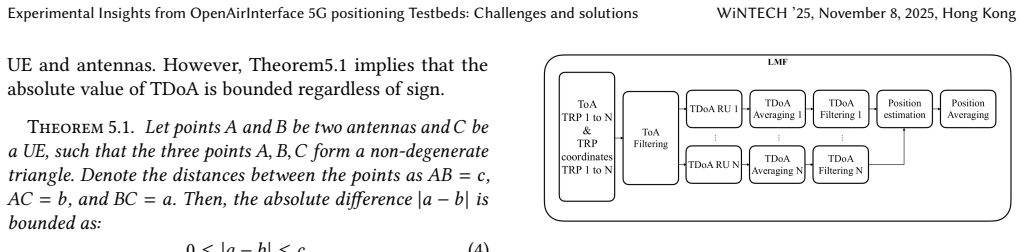
The load-bearing objects are: the strongest-peak ToA read off the channel impulse response (Eq. 1); the per-RU TDoA difference (Eq. 5) that cancels inter-RU clock drift; a TDoA bound from the triangle inequality (Theorem 5.1) used as a physical-feasibility filter; and a particle-swarm optimizer that minimizes the TDoA loss (Eqs. 8–11). For the data-driven branch, the mechanism is a TDoA-aligned, peak-normalized CIR matrix (Eq. 14) with a binary LoS/NLoS mask (Eq. 15) fed into a CNN that regresses 2D position.
What would settle it
Run the same filtered LMF pipeline in a factory hall with known ground truth while deliberately placing a strong metal reflector so that the reflected CIR peak is the strongest; if more than 10% of test points exceed 2 m error, the generalised 1–2 m/90% claim does not hold in such NLoS-dominated settings.
Extended reading notes
Core claim
The central claim is that a complete positioning pipeline implemented in the OpenAirInterface Location Management Function—empirical ToA filtering, geometry-bounded TDoA filtering, per-RU TDoA references, and a particle-swarm optimizer—makes UL-TDoA reliable enough to reach 1–2 m error in 90% of cases on three distinct live 5G networks. The paper also demonstrates that where TDoA degrades in dense multipath, an O-RAN-inspired fingerprinting framework using TDoA-aligned, peak-normalized CIRs with a learned LoS/NLoS mask achieves sub-meter accuracy, and that this data-driven method degrades gracefully when fewer antennas are available.
Load-bearing premise
The ToA is taken as the delay of the strongest multipath peak, which is a valid timing reference only when the direct path is also the strongest path; in dense NLoS environments that condition fails, as the paper's own Airbus TDoA results show.
Editorial extensions
If this is right
- Operators can replicate 1–2 m UL-TDoA positioning using open-source network functions and commercial O-RAN radio units, without proprietary positioning modules.
- The per-RU TDoA reference strategy mitigates clock drift in multi-RU deployments, so large outdoor coverage does not require tight cross-RU synchronization.
- ToA/TDoA filtering based on empirical delay-spread bounds and the triangle-inequality limit removes physically impossible measurements, improving robustness in dense multipath.
- CIR-based fingerprinting with NLoS masking can outperform TDoA accuracy in factory halls and degrades gracefully as antenna count drops.
- The public dataset of CIRs with ground-truth labels enables other groups to benchmark and train data-driven positioning methods against a common reference.
Reading between the lines
- The strongest-peak ToA definition ties the pipeline's success to environments where the direct path is also the strongest path; extending the filters to detect first-arrival peaks (e.g., through super-resolution or learned timing features) would likely close the gap in the hardest NLoS factory cases.
- The per-RU reference strategy effectively treats each radio unit as a self-synchronized cluster, suggesting a natural extension where inter-RU clock offsets are estimated jointly with the UE position, potentially removing the need for precision time protocol altogether.
- The LoS/NLoS masking threshold (gamma = 0.4) is tuned to this dataset; a self-calibrating threshold based on training CIR statistics could make the fingerprinting method transferable across sites without manual adjustment.
- The MQTT-based CIR offloading used here is a stand-in for the standard E2 interface; validating the same fingerprinting model over E2 with a near-real-time RIC would test whether the approach holds under standard O-RAN latency and signaling constraints.
Editorial analysis
A structured set of objections, weighed in public.
Referee Report
Summary. The paper reports experimental UL-TDoA positioning results from three 5G testbeds (EURECOM GEO-5G outdoor, STELLANTIS indoor, Airbus factory hall) built on OpenAirInterface with an LMF. It proposes a processing pipeline comprising statistical ToA filtering, geometry-based TDoA filtering, a PSO position estimator, and an optional CIR-based CNN fingerprinting method with NLoS antenna masking. The authors release the datasets publicly. The central claim, stated in the abstract and introduction, is that 1–2 m positioning accuracy is achieved in 90% of cases across the testbeds.
Significance. If the claims hold, this is a valuable experimental contribution: it demonstrates an open-source, 3GPP-compliant LMF positioning pipeline on real O-RAN hardware, validates a geometric TDoA bound, releases a public CIR dataset, and shows that a CNN fingerprinting method can outperform TDoA in a dense factory environment. The PSO estimator is self-contained and independent of the reported error metrics, and the geometric bound in Theorem 5.1 is correct. However, the headline accuracy claim is not supported by Table 2, and the calibration of the ToA filter and NLoS mask uses the same data on which performance is evaluated, which may make the reported numbers optimistic.
major comments (4)
- [Abstract, §6, Table 2] The abstract states that results demonstrate '1–2 meter positioning accuracy in 90% of cases in different testbeds', but Table 2's CE90 values for the proposed PSO/TDoA pipeline are: GEO-5G 8 non-collinear antennas 1.96 m, per-RU reference 2.02 m, handheld mobile UE 2.36 m, Stellantis filtered 1.99 m, and Airbus 16-antenna TDoA 8.94 m. Only two of these configurations are below 2 m at CE90; the per-RU and handheld configurations exceed 2 m, and the Airbus TDoA result fails by a large margin. The sub-meter Airbus result (0.74 m) is from the CNN fingerprinting method, not the LMF TDoA pipeline. The conclusion (§7) itself is more modest ('approximately 2m accuracy in 90% of cases under favorable conditions'). The abstract and introduction should be revised to state which method and which configurations meet the 1–2 m target, and the 90%-of-cases claim should be made configuration-specific.
- [§5.1, Eq. (3)] The ToA filter uses empirical mean μτ and standard deviation στ of the max-peak delay distribution, but the manuscript does not state whether this distribution is estimated on a dataset disjoint from the CIRs whose ToAs are filtered and then scored in Table 2. If the same data are used to fit the filter bounds and to compute CE90, the reported accuracy is optimistically biased. The authors should either report filter parameters calibrated on an independent training set and evaluate on a held-out test set, or quantify the sensitivity of the results to the choice of the ±1σ threshold. This is load-bearing for all filtered TDoA results, including the claimed 1.99 m at Stellantis.
- [§5.3.2, Eq. (15), Table 2] The NLoS masking threshold γ=0.4 is selected 'empirically based on analysis of a labeled dataset' (Fig. 6b) and then applied in both training and inference. No train/validation/test partition is described for this threshold selection, and no training details for the CNN (loss function, optimizer, epochs, split ratio, repeated runs) are provided. The reported Airbus fingerprinting result, 0.74 m CE90, is therefore not established as a genuine test-set result. The authors should report a clear data partition, show that γ is chosen only on the training/validation portion, and give test-set metrics with confidence intervals.
- [§3, Eq. (1); §4.3, Table 2] ToA is defined as the delay of the strongest multipath component, i.e., the peak of the CIR magnitude. In NLoS conditions this peak is a reflected path, not the first arrival. The Airbus TDoA result (CE90 = 8.94 m) is consistent with this limitation. The manuscript should explicitly state that the TDoA pipeline is expected to be reliable only when the strongest peak is a valid proxy for the true arrival time, and the '1–2 m' claim should be scoped accordingly. Alternatively, a first-peak detector or an LoS/NLoS classification step before TDoA estimation would be needed to support a broader claim.
minor comments (5)
- [§5.3.1, Eqs. (10)-(11)] Eq. (11) uses u_p^(t) on the right-hand side, but the iteration index should be i, not t. Also, the PSO hyperparameters are partially given (w=0.9, c1=0.5, c2=0.9), but the number of particles, number of iterations, and moving-average window size are not reported; these are needed for reproducibility.
- [§5.1, Eq. (7)] The notation for the speed of light is inconsistent: Eq. (6) uses v, while Eq. (7) uses c. Unify the notation and define the symbol explicitly.
- [§6, Table 2] Table 2 reports MAE and CE90 without sample sizes, confidence intervals, or the number of test points. The reader cannot assess the statistical significance of differences between configurations (e.g., 1.96 m vs 2.02 m). Please add these details.
- [§4.1] The conversion from RTK geographic coordinates to the local Cartesian frame is described as 'a linear transformation', but the transformation parameters (translation, rotation, scaling) and how they were estimated are not given. This is important because ground truth accuracy underpins all reported errors.
- [§5.3.2] The description of the CNN input states the CIR matrix is in C^{M×C} and uses complex notation, but the layers in Table 1 appear to treat it as real. Clarify whether the absolute value/real part is used as input, and describe the preprocessing consistently.
Circularity Check
No significant circularity: the positioning pipeline is an empirical system evaluated against external ground truth, not a derivation that reduces to its inputs.
full rationale
The paper presents an experimental positioning system. ToA is defined via Eq. (1) as the strongest-peak delay, TDoA is a difference of ToAs, and the PSO loss (Eq. 8) compares measured TDoAs with geometric predictions from known antenna coordinates. The TDoA filter bound (Eq. 7) is an application of the triangle inequality. The ToA filter (Eq. 3) uses the empirical mean and standard deviation of the observed peak-delay distribution, and the fingerprinting threshold gamma=0.4 is explicitly selected empirically; these are transparent data-dependent calibrations, not hidden fitted parameters renamed as predictions. The reported CE90 values are measured against external laser/RTK ground truth, so the accuracy numbers are independent of the calibration choices in a way that a constructed equivalence would not be. Self-citations to prior OAI NRPPa/LMF work and to PSO comparisons are not load-bearing for the quantitative results. The main weaknesses are the lack of explicit train/test separation for the filters and CNN, which is a methodological concern about optimistic evaluation, but it does not make the central derivation circular by construction.
Assumptions & free parameters
free parameters (5)
- ToA filter bounds mu_tau, sigma_tau =
from empirical peak-delay distribution (not explicitly stated)
- NLoS masking threshold gamma =
0.4
- PSO hyperparameters w, c1, c2 =
0.9, 0.5, 0.9
- Moving average window size =
not specified
- Particles count and iterations =
not specified
assumptions (5)
- domain assumption UE position is always bounded within the convex frame of M antennas
- domain assumption Antennas within each RU are tightly synchronized via PTP with GNSS-disciplined grandmaster, nanosecond-level
- domain assumption The CIR is a sum of delayed Dirac deltas (Eq. 2) and the strongest peak corresponds to a usable ToA
- standard math Triangle inequality in Euclidean geometry (Theorem 5.1)
- domain assumption The measured dataset (CIRs, timestamps, labels) is ground truth accurate
Cite this review
Pith. "Pith review of Experimental Insights from OpenAirInterface 5G positioning Testbeds: Challenges and solutions." pith.science (2026). https://pith.science/paper/OIZEU5AD
@misc{pith2026250819736,
  author       = {Pith},
  title        = {Pith review of: Experimental Insights from OpenAirInterface 5G positioning Testbeds: Challenges and solutions},
  year         = {2026},
  howpublished = {\url{https://pith.science/paper/OIZEU5AD}},
  note         = {Machine review of arXiv:2508.19736}
}
read the original abstract
5G New Radio (NR) is a key enabler of accurate positioning in smart cities and smart factories. This paper presents the experimental results from three 5G positioning testbeds running open-source OpenAirInterface (OAI) gNB and Core Network (CN), using Uplink Time Difference of Arrival (UL-TDoA) with the newly integrated Location Management Function (LMF). The testbeds are deployed across both indoor factories and outdoor scenarios with O-RAN Radio Units (RUs), following a 3GPP-compliant system model. The experiments highlight the impact of synchronization impairments, multipath propagation, and deployment geometry on positioning accuracy. To address these challenges, we propose tailored ToA and TDoA filtering as well as a novel position estimation method based on Particle Swarm Optimization (PSO) within the LMF pipeline. Moreover, we show a beyond-5G framework that leverages non-conventional measurements such as Channel Impulse Response (CIR) to train and test Artificial Intelligence and Machine Learning (AI/ML) models for data-driven positioning. The results demonstrate the feasibility of achieving 1-2 meter positioning accuracy in 90% of cases in different testbeds, offering practical insights for the design of robust 5G positioning systems. Moreover, we publicly release the datasets collected in this work to support the research within the 5G positioning community.
Figures


Figures from the paper (5 more)


Reference graph
Works this paper leans on
-
[1]
3GPP. 2020. NG-RAN; NR Positioning Protocol A (NRPPa) . TS 38.455 v16.1.0. NG-RAN; positioning signaling between gNB and LMF
work page 2020
-
[2]
3GPP. 2022. 5G; System; Location Management Services . TS 29.572 v17.4.0. Defines LMF and its service-based interface (Nlmf_Location)
work page 2022
-
[3]
Adeel Malik and Mohsen Ahadi and Florian Kaltenberger and Klaus Warnke and Nguyen Tien Thinh and Nada Bouknana and Cedric Thienot and Godswill Onche and Sagar Arora. 2025. From Concept to Reality: 5G Positioning with Open-Source Implementation of UL- TDoA in OpenAirInterface. arXiv:2409.05217 [cs.IT] https://arxiv.org/ abs/2409.05217
arXiv 2025
-
[4]
Mohsen Ahadi, Adeel Malik, Florian Kaltenberger, and Cedric Thienot
-
[5]
Ahadi, Mohsen and Kaltenberger, Florian. 2023. 5GNR indoor posi- tioning by joint DL-TDoA and DL-AoD. In2023 IEEE Wireless Commu- nications and Networking Conference (WCNC) . IEEE, 1–6
work page 2023
-
[6]
Chan, Y.T. and Ho, K.C. 1994. A simple and efficient estimator for hyperbolic location. IEEE Transactions on Signal Processing 42, 8 (1994), 1905–1915. doi:10.1109/78.301830
-
[7]
del Peral-Rosado, José A. and Yildirim, Ali Y. and Klinger, Nils C. and Nolle, Patric and Razavi, Sara M. and Parsawar, Sagar and Mundla- muri, Rakesh and Kaltenberger, Florian and Sirola, Niilo and Garlaschi, Stefano and Canzian, Luca and Talvitie, Jukka and Flachs, Detlef. 2023. Preliminary Field Results of a Dedicated 5G Positioning Network for Enhance...
-
[8]
and Muruganathan, Siva and Masini, Gino and Busin, Åke and Gunnarsson, Fredrik
Dwivedi, Satyam and Shreevastav, Ritesh and Munier, Florent and Nygren, Johannes and Siomina, Iana and Lyazidi, Yazid and Shrestha, Deep and Lindmark, Gustav and Ernström, Per and Stare, Erik and Razavi, Sara M. and Muruganathan, Siva and Masini, Gino and Busin, Åke and Gunnarsson, Fredrik. 2021. Positioning in 5G Networks. IEEE Communications Magazine 59...
doi:10.1109/mcom 2021
Show all 25 references
-
[9]
Ettus Research. [n. d.]. USRP Software Defined Radio (SDR). https: //www.ettus.com/. Accessed: 2025-07-16
2025
-
[10]
FIRECELL. [n. d.]. Private 4G/5G Networks. https://www.firecell.io/. Accessed: 2025-07-16
2025
-
[11]
Michele Gucciardo, Ilenia Tinnirello, Gian Michele Dell’Aera, and Marco Caretti. 2019. A Flexible 4G/5G Control Platform for Fingerprint- based Indoor Localization. In IEEE INFOCOM 2019 - IEEE Conference on Computer Communications Workshops (INFOCOM WKSHPS) . 744–749. doi:10.1...
2019
-
[12]
and Gunnarsson, F
Gustafsson, F. and Gunnarsson, F. 2003. Positioning using time- difference of arrival measurements. In 2003 IEEE International Con- ference on Acoustics, Speech, and Signal Processing, 2003. Proceedings. (ICASSP ’03)., Vol. 6. VI–553. doi:10.1109/ICASSP.2003.1201741
2003 arXiv
-
[13]
Florian Kaltenberger, Tommaso Melodia, Irfan Ghauri, Michele Polese, Raymond Knopp, Tien Thinh Nguyen, Sakthivel Velumani, Davide Villa, Leonardo Bonati, Robert Schmidt, Sagar Arora, Mikel Iraza- bal, and Navid Nikaein. 2024. Driving innovation in 6G wireless technologies: The...
2024 arXiv
-
[14]
Khamsi and William A
Mohamed A. Khamsi and William A. Kirk. 2001. An Introduction to Metric Spaces and Fixed Point Theory . Wiley-IEEE
2001
-
[15]
Pahlavan
Xinrong Li and K. Pahlavan. 2004. Super-resolution TOA estimation with diversity for indoor geolocation. IEEE Transactions on Wireless Communications 3, 1 (2004), 224–234. doi:10.1109/TWC.2003.819035
2004
-
[16]
Li, Dexin and Chu, Xinghe and Wang, Luhan and Lu, Zhaoming and Zhou, Shuya and Wen, Xiangming. 2022. Performance Evaluation of E-CID based Positioning on OAI 5G-NR Testbed. In 2022 IEEE/CIC International Conference on Communications in China (ICCC) . 832–837. doi:10.1109/ICCC5...
2022
-
[17]
Cameron and Sundaresan, Karthikeyan
Lin, Yu-Tai and Matson, N. Cameron and Sundaresan, Karthikeyan
-
[18]
Pratap Misra and Per Enge. 2011. Global Positioning System: Signals, Measurements and Performance (2nd ed.). Ganga-Jamuna Press
2011
-
[19]
Rakesh Mundlamuri, Rajeev Gangula, Florian Kaltenberger, and Ray- mond Knopp. 2025. 5G NR Positioning with OpenAirInterface: Tools and Methodologies. In 2025 20th Wireless On-Demand Network Systems and Services Conference (WONS). 1–7
2025
-
[20]
Palamà, Ivan and Bartoletti, Stefania and Bianchi, Giuseppe and Blefari Melazzi, Nicola. 2024. Experimental assessment of SDR-based 5G positioning: methodologies and insights.Annals of Telecommunications 79, 5 (2024), 301–313
2024
-
[21]
Rajeev Gangula and Tommaso Melodia and Rakesh Mundlamuri and Florian Kaltenberger. 2024. Round Trip Time Estimation Utilizing Cyclic Shift of Uplink Reference Signal. arXiv:2410.04528 [cs.IT] https: //arxiv.org/abs/2410.04528
2024 arXiv
-
[22]
VVDN Technologies. 2023. 5G NR Enterprise Radio Units. https://www.vvdntech.com/en-us/adaptive-compute-and- comms/enterprise-radio-unit. Low- and mid-power O -RUs pre-integrated with CU/DU stack
2023
-
[23]
Samuele Zanini, Luca Petrucci, Ivan Palamà, Giuseppe Bianchi, and Stefania Bartoletti. 2024. Towards End-to-end Implementation of 5G Positioning with Off-the-shelf Devices. In 2024 IEEE 100th Vehicular Technology Conference (VTC2024-Fall) . 1–6. doi:10.1109/VTC2024- Fall63153....
2024
-
[2023]
5G NR UL SRS TDoA Positioning by OpenAirInterface
-
[2024]
Bringing Collaborative Positioning to Native 5G Systems for Enhanced 2D & 3D Location Services. Proc. ACM Netw. 2, CoNEXT4, Article 23 (Nov. 2024), 21 pages. doi:10.1145/3696380
2024 doi
Reviewed August 5, 2026 · model on record in the stance chip above.
Discussion (0). Continue with ORCID to comment.