REVIEW 5 major objections 5 minor 52 references
Elimination tournaments make match networks less hierarchical and more cyclic than round-robin formats.
Reviewed by Pith at T0; open to challenge. T0 means a machine referee read the full paper against a public rubric. the ladder, T0–T4 →
Elimination-style tournaments yield more circular win-loss patterns and less apparent hierarchy than round-robin play, and network centrality scores predict match winners as accurately as Elo or official rankings.
T0 review reviewed 2026-08-05 challenge →
load-bearing objection A solid empirical study of round-robin vs elimination formats, but the headline claim about elimination increasing cycles is overreached and rests on a pooled null that needs phase-specific checks. the 5 major comments →
Hierarchy and ranking in pairwise sports contests
The pith
A machine-rendered reading of the paper's core claim, the machinery that carries it, and where it could break.
The reading
Core claim
On the paper's own terms, the key result is that elimination tournaments lead to networks with a smaller level of hierarchy and thus an increased probability of circular win-loss situations (cycles). When match directions are resampled according to the fitted two-parameter Bradley-Terry-type model of Eq. (2), the observed number of 3-cycles in the direct-elimination phase exceeds the expected number (cycle enrichment above 1), while round-robin pools show enrichment below 1. The paper interprets this as evidence that knockout formats generate more upsets relative to estimated player strengths, and that a substantial part of the perceived hierarchy in such sports comes from the tree-shaped or
What carries the argument
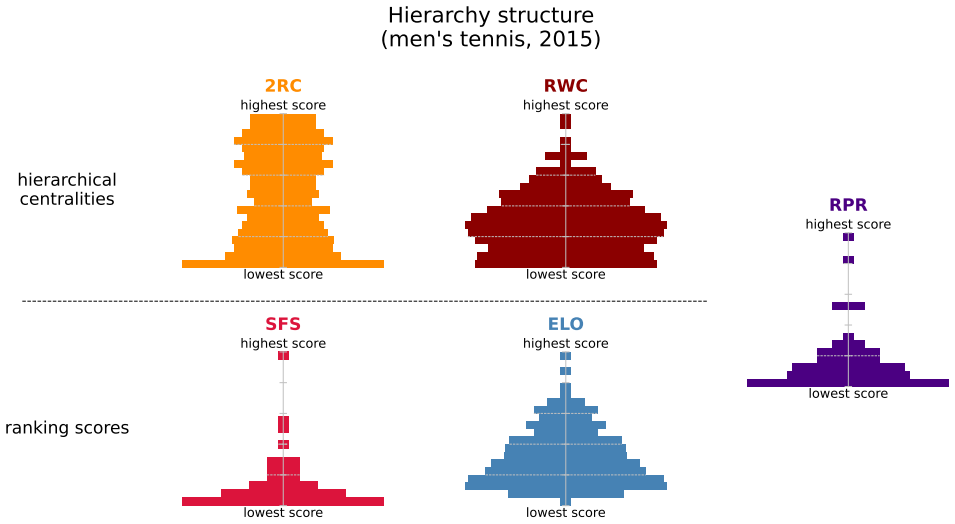
Directed match networks built from a one-year sliding window over past results, combined with three global hierarchy measures (flow hierarchy FH, global reaching centrality GRC, and random walk hierarchy RWH), cycle abundance metrics (cycle density and cycle-FFL ratio), and a cycle-enrichment statistic that compares observed 3-cycles with those produced by resampling each match direction from a two-parameter logistic model of win probability. Reversed PageRank (RPR) serves as both a hierarchical centrality and a ranking score.
Load-bearing premise
The claim that elimination phases contain more upsets than expected rests on the fitted two-parameter model being an unbiased generator of every match's direction; if that model is misspecified, the expected cycle count is wrong and the format effect conclusion does not follow.
What would settle it
Take the same datasets and repeat the cycle-enrichment calculation with an alternative outcome model (for example, one that adds surface effects or a different rating formula); if the direct-elimination phase no longer shows cycle enrichment above 1 while pool phases stay below 1, the claimed format effect would not survive the change of model.
If this is right
- Knockout-style tournaments can be expected to produce more non-transitive outcomes among the same field of players than round-robin pools.
- Official rankings built primarily from elimination events may overstate the true dominance of top players, because the format itself creates a pyramid of wins.
- Network-derived scores such as reversed PageRank can predict match outcomes with accuracy close to Elo and official points, offering a ranking method independent of federation points.
- The power-law tail observed in reversed PageRank scores identifies a 'doorstep' separating the very best players from other elite athletes.
Where Pith is reading between the lines
- The cycle-enrichment statistic could be used as a design tool: organizers wanting fewer upsets could favour round-robin phases, while those wanting higher upset rates would use knockout formats.
- The same analysis could be applied to other head-to-head sports (badminton, boxing, MMA) to test whether the format effect generalizes beyond tennis and fencing.
- Because the enrichment calculation relies on a specific parametric model of match outcomes, the claim should be re-tested with alternative outcome models (including surface-dependent or time-varying strengths) before being taken as a universal law of tournament design.
- The finding that reversed PageRank has a two-segment power-law distribution suggests a natural, data-driven threshold for 'elite' status that does not require arbitrary point cutoffs.
Editorial analysis
A structured set of objections, weighed in public.
Referee Report
Summary. The paper constructs time-evolving directed networks from elite tennis and fencing match data (nodes = players, directed edges = winner to loser) and studies hierarchy and ranking. It applies three global hierarchy measures (flow hierarchy, global reaching centrality, random walk hierarchy), cycle-abundance statistics, and five node-level ranking scores (official sports federation score, Elo, reversed PageRank, 2-reach centrality, random walk centrality). The two central claims are: (1) networks built from elimination-format matches show a smaller level of hierarchy and an increased probability of cyclic (upset) outcomes compared with round-robin-style matches, and (2) hierarchy-based network metrics predict future match outcomes with accuracy comparable to official rankings and Elo. The prediction analysis uses a temporal out-of-sample split: scores are computed from matches before the prediction year, the parameters of the model in Eq. (2) are fitted on a preceding fitting period, and accuracy is evaluated on the next year's matches.
Significance. If the hierarchy/cycle claim were established, the paper would make a useful contribution to the literature on tournament design and network-based ranking: it would show that the format of competition itself shifts the directed network away from transitivity, and that simple network centralities are competitive with established rating systems. The manuscript has clear strengths: it uses publicly available data across eight competition categories, it compares multiple hierarchy measures and multiple ranking scores, and the prediction protocol is a genuine out-of-sample evaluation. The central cycle-enrichment claim, however, currently rests on a null model whose calibration is not demonstrated, and the abstract generalizes the finding beyond what the data show (men's tennis, itself an elimination format, shows enrichment near 1, not above 1). These issues are fixable but require new evidence or a substantial claim restriction.
major comments (5)
- [Methods: 'Cycle abundance and cycle enrichment'; Figure 3] The cycle-enrichment analysis uses a single set of fitted parameters (α, β) from Eq. (2), apparently pooled across all matches in a given year, to generate the expected cycle count for both pool-phase and DE-phase subnetworks. If the true upset propensity differs by phase, the pooled null is miscalibrated: DE matches will appear enriched whenever their upset rate exceeds the pooled average, even if a phase-specific model would predict the observed cycle count exactly. The paper does not report phase-specific α/β fits or any goodness-of-fit of Eq. (2) separately for pool and DE. It also does not state clearly whether the α/β used in Figure 3 are fitted in-sample on the same year's matches (descriptive goodness-of-fit) or out-of-sample as in the prediction analysis. Please provide phase-specific fits, an explicit statement of the fitting window, and a calibration check; without this, the c
- [Abstract and Results, Figure 3(a) vs Figure 3(d)] The abstract states that 'elimination tournaments lead to networks with a smaller level of hierarchy and thus, importantly, to an increased probability of circular win-loss situations (cycles).' The data in Figure 3 do not support this as a general statement about elimination formats. Men's tennis, which the text itself describes as single-elimination, shows cycle enrichment near 1 (Figure 3a), not above 1, whereas the elevated enrichment appears only for the DE phase of fencing (Figure 3d). The claim should be restricted to the fencing DE phase, or the authors must supply an explanation for why tennis's elimination format behaves differently and why the universal wording is justified.
- [Results, Figure 2(e)–(h)] The headline claim of 'smaller level of hierarchy' in elimination networks is in tension with the raw hierarchy measures: FH and RWH/RWC are larger for the DE-phase network than for the pool-phase network (Figure 2g vs Figure 2e). The authors attribute this to the tree-shaped skeleton of DE graphs, but the abstract and Discussion do not carry this caveat. The comparison to Erdős–Rényi ratios is suggestive, but the paper should either report a structure-controlled hierarchy comparison explicitly or temper the abstract's unqualified statement. The current text moves from raw measures to ratios to cycle enrichment without a single, clearly defined quantity that supports 'smaller level of hierarchy' across all measures.
- [Table 4] The rows for Women's épée and Women's foil are identical: FM 0.329, SE 0.213, LE 0.417 for 2RC, RWC, SFS, ELO, and RPR. This is almost certainly a data-entry or copy-paste error. Since Table 4 is the main evidence for the prediction claim across all categories, these duplicated rows need to be corrected before the comparison can be assessed. If the values are genuinely identical, the manuscript should explain why.
- [Figure 3; Results paragraph on 'significantly larger'] The text states that cycle enrichment values are 'significantly larger' for DE matches, but no confidence intervals, standard errors, or significance tests are reported for the enrichment ratios. The shaded regions are only described as standard deviations of an unspecified number of relinking trials; the Methods section describes relinking in the singular ('we relinked the network'), so the number of null realizations is unclear. Please state the number of relinking samples and provide error bars or confidence intervals for the enrichment values, and preferably a formal test comparing pool and DE enrichment distributions.
minor comments (5)
- [Figure 1 caption] The caption says 'the tennis tournament is in a round-robin format,' which contradicts the Results section where tennis is correctly described as single-elimination. Tennis Grand Slams and tour-level events are not round-robin; this is also relevant to the abstract's wording about 'round-robin data.' Please correct the caption and adjust the abstract to avoid conflating sport identity with tournament format.
- [Results, paragraph after Figure 2(e)] The text reads 'FH and RWC values are firmly larger for the direct elimination network' but the corresponding measures in the figure and Methods are FH, GRC, and RWH (random walk hierarchy), not RWC (random walk centrality). Please correct the acronym.
- [Throughout] The phrase 'revered pagerank' appears several times (e.g., Figure 4, Figure 6, SI captions); it should be 'reversed PageRank.' Also, Figure 7 caption and one SI caption contain 'rank-socre' instead of 'rank-score.'
- [SI captions S40–S55] Several SI captions mislabel the year: e.g., Figure S41 says 'men's tennis, 2015' in the caption text while the panel header says 2023. Similar copy-paste issues occur in other SI captions. Please standardize.
- [Methods: 'Making predictions using score differences'] The description of the fitting procedure is somewhat indirect ('trial probabilities for matches at t'). A precise statement of which matches are in ts, which in tf, and how they relate to the calendar-year scores would help reproducibility. Also, the Elo update formula and the PageRank equation contain notation (e.g., M(i), L(j)) that should be defined explicitly, since L(j) is also used for the number of links in the FH definition.
Circularity Check
No significant circularity: the paper's predictions are genuinely out-of-sample and its cycle-enrichment analysis is a standard goodness-of-fit comparison, not a definitional or fitted-input tautology.
full rationale
The paper's central empirical claims are supported by two distinct analyses. The prediction of match outcomes (Table 4) is explicitly out-of-sample: parameters (α, β) in Eq. (2) are fitted on matches from year t and then applied to predict matches in year t+1, using scores from year t−1 or the score-counting period. This is a genuine forecast, not a re-description of the input. The cycle-enrichment analysis (Figure 3) compares the observed number of 3-cycles to the number expected under a null model in which each match direction is redrawn from the Bernoulli distribution implied by Eq. (2) with the fitted parameters. Although those parameters are fitted to the same year's matches, the expected cycle count is not statistically forced to equal the observed cycle count; it is a goodness-of-fit residual, and the paper does not label it a prediction. The hierarchy measures (FH, GRC, RWH) and the cycle-abundance measures are computed independently from the same network, and the conclusion that elimination tournaments show lower hierarchy relative to random models is based on comparisons to configuration-model and Erdős–Rényi baselines, not on a definitional equivalence. Self-citations (e.g., refs. 29 and 31 for GRC and RWH/RWC) are used as pre-existing mathematical tools, not as load-bearing evidence for a novel claim, and they do not smuggle in an ansatz or a uniqueness theorem. The paper's own caveat about interpreting randomization comparisons is a statistical caution, not an admission of circularity. No equation or fitted parameter is defined in terms of the quantity it is used to explain. Overall, the derivation chain is self-contained and does not reduce to its inputs by construction.
Axiom & Free-Parameter Ledger
free parameters (5)
- alpha(t), beta(t) =
not reported in main text
- f (random walk hierarchy parameter) =
not specified
- d (PageRank teleportation) =
0.85
- K, S (Elo update parameters) =
K=32, S=400
- t_nb = t_s = t_f = 1 year =
1 year
axioms (4)
- domain assumption Match outcomes reflect an underlying but noisy player strength (dominance).
- domain assumption The one-year window captures the relevant timescale of ability change.
- domain assumption The restricted elite-event dataset is representative of true relationships.
- domain assumption The null models (configuration model, Erdős-Rényi) provide appropriate baselines for hierarchy.
Cite this review
Pith. "Pith review of Hierarchy and ranking in pairwise sports contests." pith.science (2026). https://pith.science/paper/BHP7KP2U
@misc{pith2026250819848,
  author       = {Pith},
  title        = {Pith review of: Hierarchy and ranking in pairwise sports contests},
  year         = {2026},
  howpublished = {\url{https://pith.science/paper/BHP7KP2U}},
  note         = {Machine review of arXiv:2508.19848}
}
read the original abstract
Ranking athletes by their performance in competitions and tournaments is common in every popular sport and has significant benefits that contribute to both the organization and strategic aspects of competitions. Although rankings are perhaps the most concise and most straightforward representation of the relative strength among the competitors, beyond this one-dimensional characterization, it is also possible to capture the relationships between athletes in greater detail. Following this approach, our study examines the networks between athletes in individual sports such as tennis and fencing, where the nodes are associated with the contestants and the edges are directed from the winner to the loser. We demonstrate that the connections formed through matches arrange themselves into a time-evolving hierarchy, with the top players positioned at its apex. The structure of the resulting networks exhibits detectable differences depending on whether they are constructed purely from round-robin data or from purely elimination-style tournaments. We find that elimination tournaments lead to networks with a smaller level of hierarchy and thus, importantly, to an increased probability of circular win-loss situations (cycles). The position within the hierarchy, along with other network metrics, can be used to predict match outcomes. In the systems studied, these methods provide predictions with an accuracy comparable to that of forecasts based on official sports ranking points or the Elo rating system. A deeper understanding of the delicate aspects of the networks of pairwise contests enhances our ability to model, predict, and optimize the behaviour of many complex systems, whether in sports tournaments, social interactions, or other competitive environments.
Figures




Reference graph
Works this paper leans on
-
[1]
Albert, R. & Barabási, A.-L. Statistical mechanics of complex networks. Rev. Mod. Phys. 74, 47–97, DOI: https: //doi.org/10.1103/RevModPhys.74.47 (2002)
-
[2]
Dorogovtsev, S. N. & Mendes, J. F. F.Evolution of Networks: From Biological Nets to the Internet and WWW (Oxford University Press, 2003)
work page 2003
-
[3]
Newman, M., Barabási, A.-L. & Watts, D. J. The Structure and Dynamics of Networks (Princeton University Press, 2006)
work page 2006
-
[4]
Holme, P. & Saramäki, J. Temporal networks. Phys. Reports 519, 97 – 125, DOI: https://doi.org/10.1016/j.physrep.2012. 03.001 (2012)
-
[5]
Barrat, A., Barthélemy, M. & Vespignani, A. Dynamical processes on complex networks (Cambridge University Press, 2008)
work page 2008
-
[6]
Bozóki, S., Csató, L. & Temesi, J. An application of incomplete pairwise comparison matrices for ranking top tennis players. Eur. J. Oper. Res. 248, 211–218, DOI: https://doi.org/10.1016/j.ejor.2015.06.069 (2016)
-
[7]
De Bacco, C., Larremore, D. B. & Moore, C. A physical model for efficient ranking in networks. Sci. Adv. 4, eaar8260, DOI: https://doi.org/10.1126/sciadv.aar8260 (2018)
-
[8]
Zappalà, C., Pluchino, A., Rapisarda, A., Biondo, A. E. & Sobkowicz, P. On the role of chance in fencing tournaments: An agent-based approach. Plos one 17, e0267541, DOI: https://doi.org/10.1371/journal.pone.0267541 (2022)
-
[9]
Newman, M. E. J. Efficient computation of rankings from pairwise comparisons. J. Mach. Learn. Res. 24, 1–25 (2023)
work page 2023
-
[10]
Zappalà, C., Biondo, A. E., Pluchino, A. & Rapisarda, A. The paradox of talent: how chance affects success in tennis tournaments. Chaos, Solitons & Fractals 176, 114088, DOI: https://doi.org/10.1016/j.chaos.2023.114088 (2023)
-
[11]
Ranking: The Unwritten Rules of the Social Game We All Play (Oxford University Press, 2019)
Érdi, P. Ranking: The Unwritten Rules of the Social Game We All Play (Oxford University Press, 2019)
work page 2019
-
[12]
Clauset, A., Moore, C. & Newman, M. E. J. Hierarchical structure and the prediction of missing links in networks. Nature 453, 98–101, DOI: https://doi.org/10.1038/nature06830 (2008). 18/20
-
[13]
Hierarchy in Natural and Social Sciences, vol
Pumain, D. Hierarchy in Natural and Social Sciences, vol. 3 of Methodos Series (Springer, 2005)
work page 2005
-
[14]
Zafeiris, A. & Vicsek, T. Why we live in hierarchies?: A quantitative treatise (Springer, 2017)
work page 2017
-
[15]
Ma, H.-W., Buer, J. & Zeng, A.-P. Hierarchical structure and modules in the escherichia coli transcriptional regulatory network revealed by a new top-down approach. BMC Bioinforma. 5, 199, DOI: https://doi.org/10.1186/1471-2105-5-199 (2004)
-
[16]
Palla, G. et al. Hierarchy and control of ageing-related methylation networks. PLoS Comput. Biol. 17, e1009327, DOI: https://doi.org/10.1371/journal.pcbi.1009327 (2021)
-
[17]
Nagy, M., Ákos, Z., Biro, D. & Vicsek, T. Hierarchical group dynamics in pigeon flocks. Nature 464, 890––893, DOI: https://doi.org/10.1038/nature08891 (2010)
-
[18]
Nagy, M. et al. Context-dependent hierarchies in pigeons. Proc. Natl. Acad. Sci. 110, 13049–13054, DOI: https: //doi.org/10.1073/pnas.1305552110 (2013)
-
[19]
Ozogány, K. & Vicsek, T. Modeling the emergence of modular leadership hierarchy during the collective motion of herds made of harems. J. Stat.l Phys. 158, 628–646, DOI: https://doi.org/10.1007/s10955-014-1131-7 (2015)
-
[20]
Tibély, G., Sousa-Rodrigues, D., Pollner, P. & Palla, G. Comparing the hierarchy of keywords in on-line news portals. PLOS ONE 11, e0165728, DOI: https://doi.org/10.1371/journal.pone.0165728 (2016)
-
[21]
Palla, G., Tibély, G., Mones, E., Pollner, P. & Vicsek, T. Hierarchical networks of scientific journals. Palgrave Commun. 1, 1–9, DOI: https://doi.org/10.1057/palcomms.2015.16 (2015)
-
[22]
Balogh, S. G., Zagyva, D., Pollner, P. & Palla, G. Time evolution of the hierarchical networks between pubmed mesh terms. PLOS ONE 14, e0220648, DOI: https://doi.org/10.1371/journal.pone.0220648 (2019)
-
[23]
Hirata, H. & Ulanowicz, R. E. Information theoretical analysis of the aggregation and hierarchical structure of ecological networks. J. Theor. Biol. 116, 321—-341, DOI: https://doi.org/10.1016/S0022-5193(85)80271-X (1985)
-
[24]
Wickens, J. S. & Ulanowicz, R. E. On quantifying hierarchical connections in ecology. J. Socioal Biol. Struct. 11, 369––377, DOI: https://doi.org/10.1016/0140-1750(88)90066-8 (1988)
-
[25]
Eldredge, N. Unfinished synthesis: biological hierarchies and modern evolutionary thought (Oxford University Press, 1985)
work page 1985
-
[26]
McShea, D. W. The hierarchical structure of organisms: a scale and documentation of a trend in the maximum.Paleobiology 27, 405–423 (2001)
work page 2001
-
[27]
Mengistu, H., Huizinga, J., Mouret, J.-B. & Clune, J. The evolutionary origins of hierarchy. PLOS Comput. Biol. 12, 1–23, DOI: https://doi.org/10.1371/journal.pcbi.1004829 (2016)
-
[28]
Trusina, A., Maslov, S., Minnhagen, P. & Sneppen, K. Hierarchy measures in complex networks. Phys. Rev. Lett. 92, 178702, DOI: https://doi.org/10.1103/PhysRevLett.92.178702 (2004)
-
[29]
Mones, E., Vicsek, L. & Vicsek, T. Hierarchy measure for complex networks. PlOS ONE 7, e33799, DOI: https: //doi.org/10.1371/journal.pone.0033799 (2012)
-
[30]
Corominas-Murtra, B., Goñi, J., Solé, R. V . & Rodríguez-Caso, C. On the origins of hierarchy in complex networks. Proc. Nat. Acad. Sci. 110, 13316–13321, DOI: https://doi.org/10.1073/pnas.1300832110 (2013)
-
[31]
Czégel, D. & Palla, G. Random walk hierarchy measure: What is more hierarchical, a chain, a tree or a star? Sci. reports 5, 17994, DOI: https://doi.org/10.1038/srep17994 (2015)
-
[32]
Gupte, M., Shankar, P., Li, J., Muthukrishnan, S. & Iftode, L. Finding hierarchy in directed online social networks. In Proceedings of the 20th international conference on World wide web, 557–566, DOI: https://doi.org/10.1145/1963405. 1963484 (Association for Computing Machinery, 2011)
doi:10.1145/1963405 2011
-
[33]
Letizia, E., Barucca, P. & Lillo, F. Resolution of ranking hierarchies in directed networks. PLOS ONE 13, e0191604, DOI: https://doi.org/10.1371/journal.pone.0191604 (2018)
-
[34]
An approach for quantifying paired comparisons and rank order
Guttman, L. An approach for quantifying paired comparisons and rank order. The Annals Math. Stat. 17, 144–163, DOI: https://doi.org/10.1214/aoms/1177730977 (1946)
arXiv 1946
-
[35]
Elo, A. E. The proposed uscf rating system, its development, theory, and applications. Chess Life XXII, 242–247 (1967)
work page 1967
-
[36]
Who is the best player ever? a complex network analysis of the history of professional tennis
Radicchi, F. Who is the best player ever? a complex network analysis of the history of professional tennis. PLOS ONE 6, e17249, DOI: https://10.1371/journal.pone.0017249 (2011). 19/20
-
[37]
Giorgi, P., Koopman, S. J. & Lit, R. The analysis and forecasting of tennis matches by using a high dimensional dynamic model. J. Royal Stat. Soc. Ser. A (Statistics Soc. 182, 1393–1409, DOI: https://doi.org/10.1111/rssa.12464 (2019)
-
[38]
Yue, J. C., Chou, E. P., Hsieh, M.-H. & Hsiao, L.-C. A study of forecasting tennis matches via the glicko model. PLOS ONE 17, e0266838, DOI: https://doi.org/10.1371/journal.pone.0266838 (2022)
-
[39]
Arcagni, A., Candila, V . & Grassi, R. A new model for predicting the winner in tennis based on the eigenvector centrality. Annals Oper. Res. 325, 615–632, DOI: https://doi.org/10.1007/s10479-022-04594-7 (2023)
-
[40]
Bradley, R. A. & Terry, M. E. Rank analysis of incomplete block designs: I. the method of paired comparisons. Biometrika 39, 324–345, DOI: https://doi.org/10.2307/2334029 (1952)
doi:10.2307/2334029 1952
-
[41]
Jerdee, M. & Newman, M. E. J. Luck, skill, and depth of competition in games and social hierarchies. Sci. Adv. 10, eadn2654, DOI: https://doi.org/10.1126/sciadv.adn2654 (2024)
-
[42]
Sackmann, J. Atp tennis data. https://github.com/JeffSackmann/tennis_atp (2025). Accessed: 01 Jan 2025
work page 2025
-
[43]
Sackmann, J. Wta tennis data. https://github.com/JeffSackmann/tennis_wta (2025). Accessed: 01 Jan 2025
work page 2025
-
[44]
Post-Michaelsen, A. Fie fencing data. https://github.com/amichaelsen/fie-fencing-dataset (2025). Accessed: 01 Jan 2025
work page 2025
-
[45]
Luo, J. & Magee, C. L. Detecting evolving patterns of self-organizing networks by flow hierarchy measurement.Complexity 16, 53–61, DOI: https://doi.org/10.1002/cplx.20368 (2011)
-
[46]
Borgatti, S. P. The key player problem. In Breiger, R., Carley, K. & Pattison, P. (eds.)Dynamic Social Network Modeling and Analysis: Workshop Summary and Papers, 376–387, DOI: https://doi.org/10.17226/10735 (National Academies Press, 2003)
-
[47]
Brin, S. & Page, L. The anatomy of a large-scale hypertextual web search engine. Comput. networks ISDN systems 30, 107–117, DOI: https://doi.org/10.1016/S0169-7552(98)00110-X (1998)
-
[48]
ATP Tour, Inc. PIF ATP rankings. https://www.atptour.com/en/rankings/singles (2025). Accessed: 01 Jan 2025
work page 2025
-
[49]
WTA Tour, Inc. PIF WTA rankings. https://www.wtatennis.com/rankings/singles (2025). Accessed: 01 Jan 2025
work page 2025
-
[50]
Federation, F. I. F. Athletes & rankings. https://fie.org/athletes (2025). Accessed: 01 Jan 2025
work page 2025
- [51]
-
[52]
A probabilistic proof of an asymptotic formula for the number of labelled regular graphs
Bollobás, B. A probabilistic proof of an asymptotic formula for the number of labelled regular graphs. Eur. J. Comb. 1, 311–316, DOI: https://doi.org/10.1016/S0195-6698(80)80030-8 (1980). Acknowledgements This project was supported by the National Research, Development and Innovation Office under grant no. SNN139598, and by the EKÖP-24 University Excellen...
This paper was first reviewed by deepseek-v4-flash on August 5, 2026.
discussion (0)
Sign in with ORCID, Apple, or X to comment. Anyone can read and Pith papers without signing in.