REVIEW 2 major objections 4 minor 36 references
Tridendriform and dendriform Zeta Values from Schroeder trees
T0 review · 2 major / 4 minor · reviewed 2026-08-05 · deepseek-v4-flash
Pith's one-line read Multiple Zeta Values are shown to factor through tridendriform and dendriform algebra morphisms on Schroeder trees, so arborified zeta values are multiplicative for associative tree products.
desk verdict Worth reading and worth refereeing: a clean structural contribution to MZV/tree combinatorics, with one real definitional bug in the vertex-decoration bridge and one unproved theorem in the Shintani section; both look fixable. read the letter →
The pith
A machine-rendered reading of the paper's core claim, the machinery that carries it, and where it could break.
The reading
What carries the argument
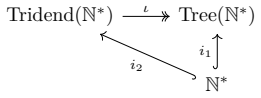
The engine is the universal property of free tridendriform and dendriform algebras: angle-decorated Schroeder trees—planar rooted trees whose internal vertices have at least two children—freely generate the tridendriform category, while {x,y}-decorated binary trees freely generate the dendriform category. Specifying the value on one-node trees determines a unique algebra morphism into the spaces of formal series and formal integrals, giving ζ_FS and ζ_FI and hence ζ_Tri and ζ_Dend. The maps ι and flat connect the tree spaces back to words, and the evaluation map ev turns convergent formal objects into real numbers.
What would settle it
Take the decorated Schroeder tree whose root has two angles both labelled 1. The paper's map ι sends it to a vertex decorated by 2, but Definition 4.1 admits only decorations strictly larger than the number of angles, so ι(t) is not an element of Tree(N*) as written. Checking whether the intended non-strict inequality was meant settles whether the equality ev∘ζ_Tri(t)=ζ_T(ι(t)) can be evaluated as stated.
Extended reading notes
Core claim
The central claim is that ζ = ev ∘ ζ_FS and ζ_int = ev ∘ ζ_FI, where ζ_FS is a tridendriform algebra morphism from words to formal series and ζ_FI is a dendriform algebra morphism from words to formal integrals. Applying the universal properties of Schroeder trees and binary trees yields tridendriform zeta values ζ_Tri and dendriform zeta values ζ_Dend, which are algebra morphisms for associative quasi-shuffle and shuffle products of trees. As a consequence, arborified zeta values ζ_T and ζ_T_int are algebra morphisms for these associative products, and every convergent tridendriform or dendriform zeta value is an explicit rational combination of usual Multiple Zeta Values.
Load-bearing premise
The construction assumes that summing angle decorations always gives a vertex decoration allowed by Definition 4.1, but that definition requires the decoration to be strictly larger than the number of angles, so a vertex with two angles both labelled 1 violates it and the map ι is not defined on some trees the paper later calls convergent.
Editorial extensions
If this is right
- Arborified zeta values ζ_T and ζ_T_int are multiplicative for associative, noncommutative tree products, not just for word shuffles.
- Every convergent tridendriform or dendriform zeta value can be written explicitly as a rational linear combination of classical Multiple Zeta Values.
- The classical multiplicativity of Multiple Zeta Values for quasi-shuffles and shuffles is recovered as the shadow of finer tridendriform and dendriform morphisms that are lost only at the final evaluation.
- A family of Shintani zeta values can be expressed as linear combinations of Multiple Zeta Values with rational coefficients.
- The formal series and formal integral spaces inherit standard analytic-bookkeeping properties before any convergence issue is addressed, separating algebra from analysis.
Reading between the lines
- The strict inequality in Definition 4.1 appears to be a domain-definition slip: a vertex whose angles are all decorated by 1 has decoration equal to the number of angles, so relaxing the condition to 'greater than or equal' makes the map ι total and is consistent with the paper's own convergence theorem.
- The construction is insensitive to the particular monoid structure on the decorations, so the same formal-series recipe could build zeta-like tree-indexed functions for other commutative semigroups.
- Because the new tree products are associative but not commutative, iterating them should produce identities among arborified zeta values that have no word-shuffle analogue, potentially yielding new relations among classical Multiple Zeta Values.
- The paper notes the lack of a tree-level analogue of Kontsevitch's map; if such a map exists, it would close the diagram between ζ_Tri and ζ_Dend and likely reveal a single tree-indexed object unifying both zeta families.
Editorial analysis
A structured set of objections, weighed in public.
Referee Report
Summary. The paper develops a framework of formal series (Def. 2.1) and formal Chen integrals (Def. 5.1) carrying tridendriform and dendriform algebra structures. Using freeness of Schroeder and planar binary trees, it defines tridendriform and dendriform zeta values (Defs. 3.6, 6.5), and shows that the classical MZV maps factor as ζ = ev∘ζ_FS and ζ_int = ev∘ζ_FI with ζ_FS and ζ_FI being algebra morphisms (Props. 2.10, 5.10). It then relates these maps to arborified zeta values via a flattening map and the map ι (Thm. 4.10, Cor. 4.12, Cor. 7.6), obtaining new morphism properties for arborified zeta values with respect to associative products on trees (Cors. 4.13, 7.7). Finally it gives a Shintani zeta representation of dendriform zeta values (Thm. 8.4).
Significance. If the domain issues are fixed, the paper gives a clean algebraic explanation of the shuffle/quasi-shuffle property of MZVs by lifting evaluation to formal objects. The universal-property arguments are elegant, and the resulting associative tree products for arborified zeta values are genuinely new and explicitly computable. Strengths include explicit decompositions ζ = ev∘ζ_FS and ζ_int = ev∘ζ_FI, the construction of new formal series and integral spaces, and concrete relations expressing arborified zeta values as rational linear combinations of MZVs. These are falsifiable and testable claims, and the framework is likely to be useful for further generalizations.
major comments (2)
- [Definitions 4.1–4.2; Lemma 4.4; Theorem 4.8; Corollary 4.12] Definition 4.1's strict inequality d(v)>|Ang(v)| makes Tree(N*) too small for the map ι of Definition 4.2. For a vertex all of whose angle decorations are 1, d(v)=|Ang(v)|, so ι(t) is not in Tree(N*). Already the generator i(1) is mapped to a binary vertex decorated 1, which Definition 4.1 excludes; consequently flat∘ι is not defined on all of Tridend(N*) and the universal-property proof of Theorem 4.10 breaks. Moreover Theorem 4.8 is false for this domain: the word 21 ∈ W_conv(N*) is flat(B+_2(|, B+_1(|,|))), but the binary child B+_1(|,|) violates the strict inequality. Corollaries 4.12–4.13 also use ζT(ι(t)) for convergent trees whose root has two angles decorated 1, giving d(v)=|Ang(v)|. Remove the inequality (or impose only d(v)≥1) and let convergence be defined by root≠1 as in Theorem 4.8; this restores ι, Lemma 4.4 and the corollaries.
- [Theorem 8.4] The main Shintani result is stated without proof: the text says 'We will omit the proof since it is an adaptation of [9, Theorem 1.19]'. This is a load-bearing claim for the abstract and Section 8. The segment/matrix construction in Definitions 8.2–8.3 is intricate, and the claimed invariance under x-decorated bifurcated vertices is not demonstrated. At least a proof sketch, or a precise explanation of why the proof of [9, Theorem 1.19] carries over unchanged, should be included. Also, Remark 8.1 ('permuting rows... does not change the value') is only true if the word ω_t is permuted correspondingly; as written it is misleading.
minor comments (4)
- [Proposition 2.2] In the second displayed identity, the product bound 'n∏' should presumably be 'd∏'; as written it is a typo.
- [Lemma 1.11] The notation w_{i,j} is used without definition; it should be defined explicitly, e.g. as the sum of the two letters.
- [Definition 8.2] The definition of B(t) has ambiguous precedence: 'v ∈ νy(t) or v ∈ νx(t) and v is a bifurcated vertex'. Parentheses would clarify the intended logical grouping.
- [Section 5.1] The vector space K is used in Definition 5.1 without specifying the field; the earlier notation KX suggests it is the base field, but the field itself is never named.
Circularity Check
No circularity: the freeness-based constructions and commutativity diagrams are genuine universal-property arguments; cited results are external support.
full rationale
The paper's central maps ζFS, ζFI, ζTri, ζDend are defined either by explicit formal series/integral formulas or by freeness universal properties, and the morphism properties stated in Propositions 2.10, 5.10 and Definitions 3.6, 6.5 are direct consequences of those definitions, not derived from the target properties. The commutativity theorems 4.10 and 7.5 are proved by exhibiting one more morphism with the same values on generators and invoking uniqueness from the free algebra universal property (Theorems 3.5 and 6.4); this is a standard and non-circular argument. The new corollaries 4.13 and 7.7 then use the known fact that ζ and ζint are algebra morphisms for quasi-shuffle/shuffle (equation (3)) together with the proved flat-morphism lemmas (4.9 and 7.4). The reliance on [8] for Theorems 4.8 and 7.3, and on [9] for Theorem 8.4, is self-citation by one of the authors, but these are external published results invoked as lemmas, not restatements of the paper's own conclusions; hence they do not make the derivation circular. There is a genuine domain/correctness issue: Definition 4.1 requires d(v) > |Ang(v)| strictly, while the map ι of Definition 4.2 can produce d(v) = |Ang(v)| (e.g., a vertex with two angles both decorated 1), so ι is not well-defined on all of Tridend(N*) and Corollary 4.12's ζT(ι(t)) can be undefined; this is a fixable defect in the stated definitions (replace '>' by '≥'), not a circular reduction. The proof of Theorem 8.4 is omitted with a sketch referring to an adaptation of [9, Thm 1.19]; again this is missing proof detail, not circularity.
Assumptions & free parameters
assumptions (9)
- standard math Freeness of Tridend(Omega) over Schroeder trees (theorem 3.5)
- standard math Freeness of Dend(Omega) over binary trees (theorem 6.4)
- standard math Words with quasi-shuffle form a tridendriform algebra (proposition 1.9)
- standard math Words with shuffle form a dendriform algebra (proposition 1.9)
- standard math Convergence criterion for arborified zeta values (theorem 4.8)
- standard math Kontsevitch relation zeta = zeta_int composed with s
- domain assumption Well-definedness of the evaluation map ev on convergent formal series/integrals
- ad hoc to paper Strict inequality d(v) > |Ang(v)| in Definition 4.1 is compatible with the map iota
- ad hoc to paper Theorem 8.4 is a valid adaptation of [9, Theorem 1.19]
invented entities (4)
-
Space of formal series S_N*
-
Space of formal Chen integrals A_Omega
-
Tridendriform zeta values zeta_Tri
-
Dendriform zeta values zeta_Dend
Cite this review
Pith. "Pith review of Tridendriform and dendriform Zeta Values from Schroeder trees." pith.science (2026). https://pith.science/paper/C2YIR7GS
@misc{pith2026250819863,
  author       = {Pith},
  title        = {Pith review of: Tridendriform and dendriform Zeta Values from Schroeder trees},
  year         = {2026},
  howpublished = {\url{https://pith.science/paper/C2YIR7GS}},
  note         = {Machine review of arXiv:2508.19863}
}
read the original abstract
To build new generalisations of Multiple Zeta Values, we define new spaces of formal series and formal integrals. We show that they are tridendriform and dendriform algebras. This allows us to reinterpret the fact that Multiple Zeta Values are algebra morphisms for shuffles of words in terms of finer tridendriform and dendriform structures. Applying universal properties of Schroeder trees we obtain generalisations of Multiple Zeta Values that are algebra morphisms for associative products. Hence we find new properties of Arborified Zeta Values and state how this enables the computation of some Shintani Zeta Values.
Figures


Figures from the paper (1 more)

Reference graph
Works this paper leans on
-
[1]
Multidimensiona l shintani zeta functions and zeta distributions on r ˆd
Takahiro Aoyama and Takashi Nakamura. Multidimensiona l shintani zeta functions and zeta distributions on r ˆd. Tokyo Journal Mathematics , 36:521538, 2013. 4
work page 2013
-
[2]
Tridendriform structu re on combinatorial hopf algebras
Emily Burgunder and María Ronco. Tridendriform structu re on combinatorial hopf algebras. Journal of Algebra , 324(10):2860–2883, 2010. 7
work page 2010
-
[3]
Valeurs aux entiers négatifs des fonctions zêta et fonctions zêta p-adiques
Pierrette Cassou-Nogues. Valeurs aux entiers négatifs des fonctions zêta et fonctions zêta p-adiques. Inventiones mathematicae, 51(1):29–59, 1979. 4
work page 1979
-
[4]
Pierre Catoire. Tridendriform structures. Symmetry, Integrability and Geometry: Methods and Applications, September 2023. 4, 9, 16, 18, 31, 32
work page 2023
-
[5]
Zinbiel algebras and multiple zeta v alues
Frédéric Chapoton. Zinbiel algebras and multiple zeta v alues. Documenta Mathematica , 27:519–533, 2022. 4 38
work page 2022
-
[6]
Kuo-Tsai Chen. Iterated path integrals. Bull. Am. Math. Soc. , 83:831–879, 1977. 13
work page 1977
-
[7]
Kuo-Tsai Chen. Iterated path integrals. Bulletin of the American Mathematical Society , 83(5):831–879, 1977. 29
work page 1977
-
[8]
Double shuffle relations for arborified z eta values
Pierre J Clavier. Double shuffle relations for arborified z eta values. Journal of Algebra , 543:111–155, 2020. 4, 5, 23, 24, 33, 34
work page 2020
Show all 36 references
-
[9]
Generalisations of m ultiple zeta values to rooted forests
Pierre J Clavier and Dorian Perrot. Generalisations of m ultiple zeta values to rooted forests. Journal of Number Theory , 264:233–276, 2024. 4, 5, 36, 37
2024
-
[10]
Valeurs zêta multiples
Clément Dupont. Valeurs zêta multiples. Journées mathématiques X-UPS , pages 155–195,
-
[11]
Monotone, free, and boolean cumulants: A shuffle algebra approach
Kurusch Ebrahimi-Fard and Frédéric Patras. Monotone, free, and boolean cumulants: A shuffle algebra approach. Advances in Mathematics , 328:112–132, April 2018. 9
2018
-
[12]
J. Ecalle. Les fonctions résurgentes, Vol.1 . Pub. Math. Orsay, 1981. 4
1981
-
[13]
J. Ecalle. Les fonctions résurgentes, Vol.2 . Pub. Math. Orsay, 1981. 3, 4
1981
-
[14]
L. Euler. Introductio in analysin infinitorum . 2 volums, 1796. 3
-
[15]
A map between arborifications of multiple zet a values
Ku-Yu Fan. A map between arborifications of multiple zet a values. 2025. 38
2025
-
[16]
Bidendriform bialgebras, trees, and free quasi-symmetric functions
Loïc Foissy. Bidendriform bialgebras, trees, and free quasi-symmetric functions. Journal of Pure and Applied Algebra , 209(2):439–459, 2007. 7
2007
-
[17]
Multiple zeta values: f rom numbers to motives
JI Burgos Gil and Javier Fresán. Multiple zeta values: f rom numbers to motives. Clay Mathematics Proceedings, to appear, 379, 2017. 4
2017
-
[18]
L. Guo, S. Paycha, and B. Zhang. Conical zeta values and t heir double subdivision relations. Advances in Mathematics , Vol. 252:343–381, 2013. 9
2013
-
[19]
M. E. Hoffman. Multiple Harmonic series. Pacific J. Math. , 152:275–290, 1992. 3
1992
-
[20]
M. E. Hoffman. Quasi-shuffle products. J. Algebraic Combin. , 11:49–68, 2000. 4, 8
2000
-
[21]
Algebres ayant deux opérations associative s (digebres)
J-L Loday. Algebres ayant deux opérations associative s (digebres). Comptes rendus de l’Académie des sciences. Série 1, Mathématique , 321(2):141–146, 1995. 4
1995
-
[22]
Une version non commutative des alge bres de lie: les algebres de leibniz
Jean-Louis Loday. Une version non commutative des alge bres de lie: les algebres de leibniz. Les rencontres physiciens-mathématiciens de Strasbourg- RCP25, 44:127–151, 1993. 4
1993
-
[23]
On the structure of co free hopf algebras
Jean-Louis Loday and María Ronco. On the structure of co free hopf algebras. J. reine angew. Math , 592:123–155, 2006. 4
2006
-
[24]
Jean-Louis Loday and María O. Ronco. Hopf algebra of the planar binary trees. Adv. Math., 139(2):293–309, 1998. 32
1998
-
[25]
Trialgebras and fam ilies of polytopes
Jean-Louis Loday and Maria O Ronco. Trialgebras and fam ilies of polytopes. arXiv preprint math/0205043, 2002. 4, 7
2002 arXiv
-
[26]
The Milnor-Moore and Poincaré-Birkhoff-Witt theorems in the locality set up and the polar structure of Shintani zeta f unctions
Diego Andrés López Valencia. The Milnor-Moore and Poincaré-Birkhoff-Witt theorems in the locality set up and the polar structure of Shintani zeta f unctions. PhD thesis, Dissertation, Potsdam, Universität Potsdam, 2023, 2023. 4, 36 39
2023
-
[27]
Arborified multiple zeta values, 20 16
Dominique Manchon. Arborified multiple zeta values, 20 16. 3, 4, 23, 33
-
[28]
On mordell-tornheim and other multip le zeta-functions
Kohji Matsumoto. On mordell-tornheim and other multip le zeta-functions. In Proceed- ings of the Session in Analytic Number Theory and Diophantin e Equations, Bonner Math. Schriften, volume 360, page 17, 2003. 4, 35, 37
2003
-
[29]
Primitive elements in a free dendriform al gebra
María Ronco. Primitive elements in a free dendriform al gebra. In New trends in Hopf algebra theory. Proceedings of the colloquium on quantum gr oups and Hopf algebras, La Falda, Sierras de Córdoba, Argentina, August 9–13, 1999 , pages 245–263. Providence, RI: American Mathema...
1999
-
[30]
Eulerian idempotents and milnor–moore th eorem for certain non- cocommutative hopf algebras
María Ronco. Eulerian idempotents and milnor–moore th eorem for certain non- cocommutative hopf algebras. Journal of Algebra , 254(1):152–172, 2002. 7
2002
-
[31]
On evaluation of zeta functions of tot ally real algebraic number fields at non-positive integers
Takuro Shintani. On evaluation of zeta functions of tot ally real algebraic number fields at non-positive integers. J. Fac. Sci. Univ. Tokyo Sect. IA Math. , 23(2):393, 1976. 4
1976
-
[32]
Sweedler
M.E. Sweedler. Hopf Algebras: Notes from a Course Given in the Spring of 1968 . Mathe- matics lecture note series. W. A. Benjamin, 1969. 9
1968
-
[33]
Waldschmidt
M. Waldschmidt. Lectures on Multiple Zeta Values . IMSC, 2011. 4, 8
2011
-
[34]
Yamamoto
S. Yamamoto. Integrals associated with 2-posets and ap plications to multiple zeta values. RIMS Kôkyûroku Bessatsu , B83:27–46, 2020. 4, 23, 33
2020
-
[35]
D. Zagier. Values of Zeta functions and their applicati ons. In First Europeen Congress of Mathematics, volume II, pages 497–512. Birkhäuser, 1994. 3
1994
-
[36]
Free ( tri) dendriform family algebras
Yuanyuan Zhang, Xing Gao, and Dominique Manchon. Free ( tri) dendriform family algebras. Journal of Algebra , 547:456–493, 2020. 4, 17, 19 40
2020
Reviewed August 5, 2026 · model on record in the stance chip above.
Discussion (0). Continue with ORCID to comment.