REVIEW 4 major objections 8 minor 1 cited by
Astrometric and polarimetric imprints of hot-spots orbiting parametrized black holes
T0 review · 4 major / 8 minor · reviewed 2026-08-05 · deepseek-v4-flash
Pith's one-line read Hot-spot astrometry and polarimetry around the most extreme allowed JP and KZ parametrized black holes deviate only slightly from Schwarzschild, so these observables cannot yet constrain the models.
desk verdict A careful but limited hot-spot study: the near-degeneracy with Schwarzschild is real for the static JP/KZ spacetimes tested, but the paper doesn't quantify it and quietly drops spin, so the broad conclusion about constraining parametrized models overreaches. read the letter →
The pith
A machine-rendered reading of the paper's core claim, the machinery that carries it, and where it could break.
The reading
What carries the argument
The load-bearing objects are two spherically symmetric parametrized metric families. The Johanssen-Psaltis metric is ds2 = f_S(1+h_JP)dt2 + (1+h_JP)/f_S dr2 + r2 dΩ2 with h_JP = sum_k epsilon_k (M/r)^k, whose first non-trivial coefficient is epsilon_3 = epsilon. The Konoplya-Zhidenko metric is ds2 = -f_KZ dt2 + f_KZ^{-1} dr2 + r2 dΩ2 with f_KZ = 1 - [1+h_KZ] 2M/r and h_KZ = (1/2) sum_k eta_k (M/r)^k, whose first non-trivial coefficient is eta_2 = eta. These families carry the free parameters fixed by shadow-size bounds. The analysis mechanism is polarized ray tracing with GYOTO, which parallel-transports the synchrotron polarization vector along null geodesics and produces Stokes I, Q, U ima
What would settle it
A high-cadence, polarimetrically resolved observation of a bright Sgr A* flare that resolves the secondary image and tracks the QU-plane: if the centroid track width and the high-inclination QU-loop show the left-side crossing predicted for the positive-JP model rather than Schwarzschild, the near-degeneracy claim would be refuted.
Extended reading notes
Core claim
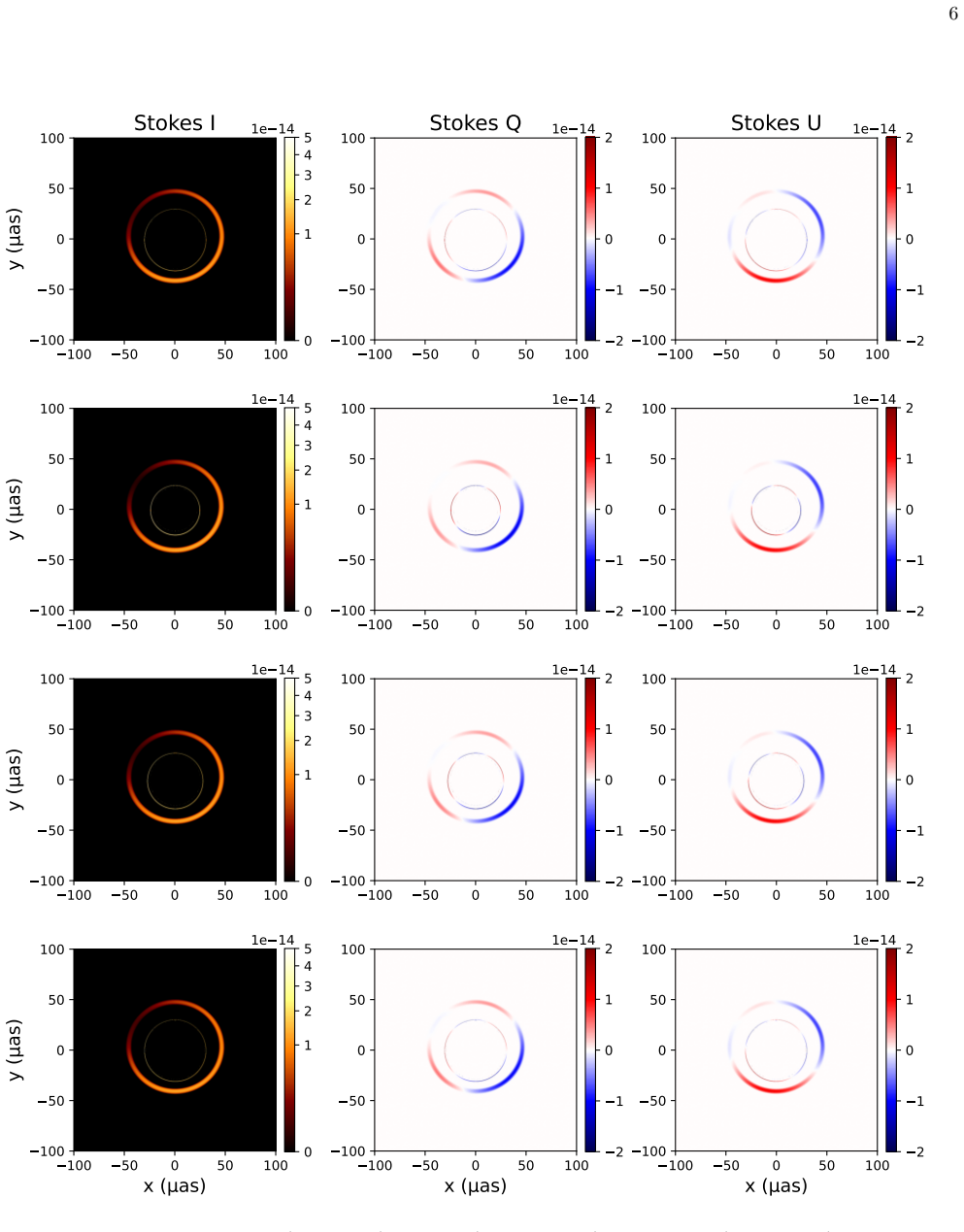
The authors select four spherically symmetric parametrized black hole metrics, two from the Johanssen-Psaltis family with epsilon = -5 and 11.4, and two from the Konoplya-Zhidenko family with eta = -32/27 and 2, the extremes allowed by Event Horizon Telescope 2-sigma shadow-size constraints. They simulate a synchrotron-emitting hot-spot on a circular Keplerian orbit at radius 8M with a vertical magnetic field, using the ray-tracing code GYOTO, and compute time-integrated Stokes I, Q, U images, temporal centroid and magnitude, QU-loops, and EVPA at 20 and 80 degree inclinations. The observational properties deviate only slightly from Schwarzschild: primary-image intensity and polarization are
Load-bearing premise
The simulations take the central object to be a spherically symmetric, non-rotating parametrized metric and place the hot-spot on a single fixed circular equatorial orbit at 8M with a vertical magnetic field; if Sgr A*'s actual spin or the flare's orbital and magnetic geometry shifts the higher-order images, the near-Schwarzschild degeneracy derived here may not hold.
Editorial extensions
If this is right
- Even the most extreme JP and KZ metrics allowed by current 2-sigma shadow bounds produce hot-spot images whose primary component is indistinguishable from Schwarzschild; all departures come from higher-order lensed images.
- Astrometric observables scale with the radial size of the secondary-image track: models with smaller secondary tracks show narrower centroid loops and dimmer temporal fluxes, models with larger tracks show the opposite.
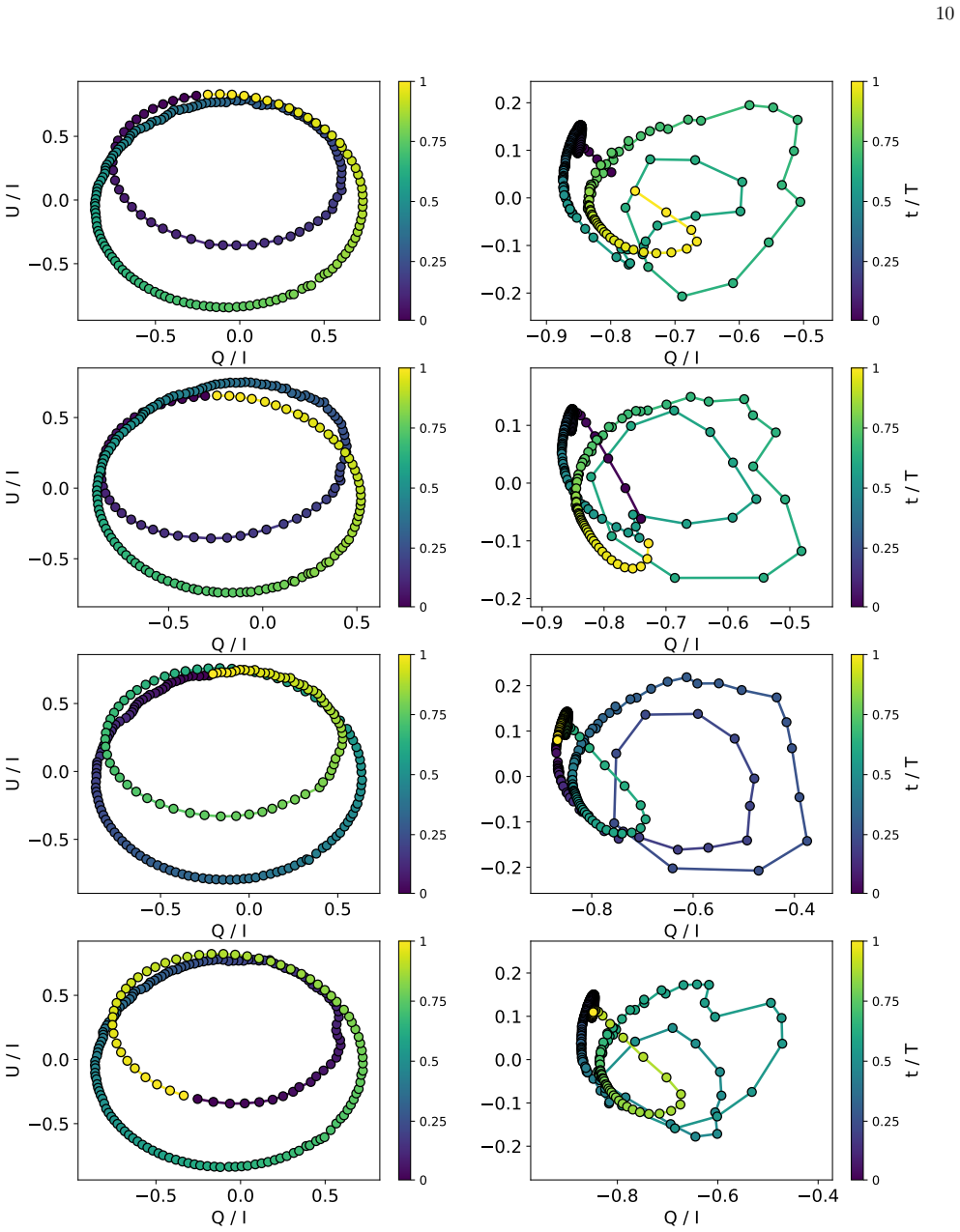
- At high inclination the QU-loop of the positive-JP model shows a left-side crossing absent in the negative-JP and Schwarzschild models, but this distinction occupies only a short portion of the orbit.
- The JP parametrization produces larger deviations than KZ, the positive-JP model deviating the most; the KZ models remain very close to Schwarzschild in both astrometry and polarimetry.
- Because the deviations are tiny or fleeting, constraining parametrized metrics with hot-spot flares requires next-generation sensitivity or a combination of time-averaged shadow and hot-spot measurements.
Reading between the lines
- An implicit consequence is that hot-spot observables are sensitive mainly to the photon-sphere critical-curve radius, not to the full metric; metrics sharing the same critical curve would be nearly indistinguishable in these observables regardless of other differences.
- The spherically symmetric, non-rotating assumption likely understates the separability of rotating configurations; including spin could shift the secondary image and break the degeneracy in ways this setup does not capture.
- A natural extension is to scan orbital radius and magnetic-field geometry: closer orbits, such as 6M, would amplify higher-order image contributions and may make the JP and KZ deviations detectable, while toroidal fields would change the two-loop structure of the QU-track.
- The finding that EVPA is practically unusable at high inclination is a practical warning for flare-monitoring campaigns: QU-loop morphology, not EVPA, is the more promising target observable for metric discrimination.
Signed reviews
Editorial analysis
A structured set of objections, weighed in public.
Referee Report
Summary. The paper uses the GYOTO ray-tracing code to simulate synchrotron-emitting spherical hot-spots on circular equatorial Keplerian orbits at r=8M around four static, spherically symmetric parametrized black hole metrics: two extreme Johanssen-Psaltis models (epsilon=-5 and epsilon=11.4) and two extreme Konoplya-Zhidenko models (eta=-32/27 and eta=2), whose shadow sizes lie within the EHT 2-sigma constraints. It computes time-integrated Stokes I,Q,U maps, temporal fluxes and magnitudes, centroid tracks, QU-loops and EVPA for inclinations of 20 degrees and 80 degrees, comparing each observable with the Schwarzschild case. The paper finds that the astrometric observables are qualitatively similar to Schwarzschild with small quantitative differences, that JP models deviate more than KZ models, and that some polarimetric differences at high inclination are noticeable but short-lived. The authors conclude that current observations cannot meaningfully constrain these parametrized models and that more precise observations, such as GRAVITY+ and ngEHT, would be needed.
Significance. If the result holds, the paper provides a useful caution for attempts to use hot-spot astrometry and polarimetry to constrain deviations from the Kerr/Schwarzschild geometry: within the static, spherically symmetric JP and KZ families compatible with the EHT shadow-size bound, the observable imprints are strongly degenerate with Schwarzschild. The paper makes productive use of a public ray-tracing code, compares multiple Stokes observables, and isolates the secondary/higher-order image channel as the source of model differences. These are concrete strengths. However, the absence of quantitative deviation metrics, resolution/convergence checks, and rotating spacetimes means the significance is currently more limited than the abstract and conclusion suggest; it is a proof-of-principle for the specific static metrics tested rather than a general statement about constraining parametrized black holes from hot-spot observations.
major comments (4)
- [Secs. IV.C and V] The central claim that the parametrized models 'deviate only slightly' from Schwarzschild is supported only by visual inspection of Figs. 4 and 5. No quantitative deviation metric (e.g., mean or peak difference in centroid position, QU-loop displacement, or EVPA curve), no comparison with GRAVITY/EHT astrometric or polarimetric uncertainties, and no statistical significance is reported. For example, the statement that 'the deviations in the EVPA are barely noticeable' (Sec. IV.D) is not backed by a number. Because the conclusion that 'more precise observations are needed' is the main message, this omission is load-bearing.
- [Secs. II, III.D, and V] All spacetimes used are static and spherically symmetric (Eqs. (2.1) and (2.5)), yet the analysis is framed as an alternative model for Sgr A* and the conclusion is stated broadly for 'parametrized BH models'. The authors themselves trace every deviation to differences in the size and position of secondary and higher-order images (Sec. IV.B). Spin changes precisely this sector through frame dragging, an asymmetric photon ring, and a spin-dependent critical curve. Therefore the extrapolation from these spherical metrics to rotating Sgr A* is not justified. The conclusions should either be restricted to the static JP/KZ models tested, or the analysis should be extended to at least one rotating parametrized metric.
- [Secs. III.D and IV.B] The simulations use a single resolution of 1000x1000 pixels, and the light-ring contribution is described as 'barely visible in the images due to pixelation' (Sec. IV.B). Since the quantitative model differences are attributed to the size and position of secondary and higher-order images, a convergence check (e.g., with 2000x2000 or higher resolution) or subpixel centroiding is needed to establish that the small differences in Fig. 4 are physical rather than numerical artifacts. No error bars or resolution study is provided.
- [Sec. III.D] Only a single orbital radius, r_o = 8M, is simulated. The flux, size, and position of secondary images depend on the emission radius, so the near-degeneracy with Schwarzschild may be specific to this radius. Testing at least one additional radius (e.g., r_o = 6M or 10M), or providing an argument for why the conclusions are radius-independent, would materially strengthen the generality of the central claim.
minor comments (8)
- [Eq. (3.10)] The two-argument inverse tangent is written as 'atan' but should be 'atan2' to match Eq. (3.3).
- [Abstract and Sec. III.B] The acronym EVPA is defined inconsistently as 'Electric Field Position Angle' in the abstract and as 'Electric Vector Position Angle' in Sec. III.B; please use one definition throughout.
- [Eq. (3.7)] The normalization scale F_min is not precisely defined. State explicitly whether it is the global minimum of the flux over all models, all times, and all pixels; otherwise the magnitude normalization is ambiguous.
- [Sec. II.A] The statement that the coefficient epsilon_2 is 'experimentally strongly constrained' is not quantified. Either give the relevant bound or cite the specific constraint used.
- [Introduction] Typos: 'Rezzola-Zidenko' should be 'Rezzolla-Zhidenko', and 'fidutial' in Sec. III.D should be 'fiducial'.
- [Sec. III.D] Please specify the orbital period T used to normalize the time axis, and state whether the Keplerian angular velocity is obtained from the g_tt component of each metric.
- [Sec. IV.C] The text quotes time intervals such as 't/T in [0.05, 0.40]' for the deviations; marking these intervals directly in the relevant panels of Figs. 4 and 5 would make the claims easier to verify.
- [Fig. 6] The color/point coding of the time parameter t/T is not explained in the caption; please clarify how the shading maps to time.
Circularity Check
No significant circularity: hot-spot observables are forward-modeled outputs; the only self-cited input is the EHT-based parameter range, which is not a fitted prediction.
full rationale
The paper's central claim is that hot-spot astrometric and polarimetric observables for the selected JP and KZ parametrized black hole models deviate only slightly from Schwarzschild. This claim is obtained by forward ray-tracing simulations: the metrics are taken from the literature, the parameter values (epsilon and eta) are fixed at the extremes of the shadow-size bounds from the authors' prior paper [60], and GYOTO is used to produce Stokes-parameter images and derived observables. The observables are never used to fit or redefine epsilon or eta, so there is no fitted-input-called-prediction structure. The only self-citation is the parameter range in Eqs. (2.4) and (2.9), which is an external observational constraint (EHT shadow size) rather than a result derived in this paper; it does not by itself force the hot-spot similarity conclusion. No equation is shown to reduce to another by construction, no uniqueness theorem is imported from the authors' own work, and no ansatz is smuggled in via self-citation. The comparison against Schwarzschild is an independent forward-modeling output, so the paper is self-contained against external benchmarks and the minor self-citation is not load-bearing for the central result.
Assumptions & free parameters
free parameters (3)
- JP deformation parameter epsilon =
-5 and +11.4
- KZ deformation parameter eta =
-32/27 and +2
- Hot-spot orbital radius r_o =
8 M
assumptions (5)
- domain assumption The JP and KZ parametrized metrics are valid effective descriptions of possible BH spacetimes.
- domain assumption The EHT 2 sigma shadow-size constraints on epsilon and eta from [60] are correct.
- ad hoc to paper A spherical synchrotron hot-spot on a circular equatorial Keplerian orbit in a vertical magnetic field reproduces Sgr A* flares.
- standard math Ray tracing of null geodesics with parallel-transported polarization in these metrics is correct.
- domain assumption The non-rotating limit is adequate for comparing to the rotating Sgr A*.
Cite this review
Pith. "Pith review of Astrometric and polarimetric imprints of hot-spots orbiting parametrized black holes." pith.science (2026). https://pith.science/paper/D2I2JLYD
@misc{pith2026250819874,
  author       = {Pith},
  title        = {Pith review of: Astrometric and polarimetric imprints of hot-spots orbiting parametrized black holes},
  year         = {2026},
  howpublished = {\url{https://pith.science/paper/D2I2JLYD}},
  note         = {Machine review of arXiv:2508.19874}
}
abstract
We analyze the observational features of hot-spots orbiting parametrized black hole (BH) spacetimes. We select a total of four BH spacetimes, two from the Johanssen-Psaltis (JP) parametrization, and two from the Konoplya-Zhidenko (KZ) parametrization, corresponding to the most extreme configurations whose shadow sizes are within the $2\sigma$-constraints of the Event Horizon Telescope (EHT). We use the ray-tracing software GYOTO to simulate the orbit of a spherically symmetric hot-spot emitting synchrotron radiation close to a central parametrized BH object, in a vertical magnetic field configuration, and we extract the corresponding astrometric and polarimetric observables for the Stokes parameters I, Q and U, namely the time integrated fluxes, temporal fluxes and magnitudes, temporal centroid, temporal QU-loops, and temporal Electric Field Position Angle (EVPA). Our results indicate that at low inclination the astrometric observables extracted from the parametrized BH spacetimes considered are qualitatively similar to those extracted from the Schwarzschild one, with minor quantitative deviations caused by differences in the size and position of the secondary images. On the other hand, the polarimetric observables at high inclination present qualitative differences, but these are only visible for a short portion of the whole hot-spot orbit. Furthermore, the observables extracted from the JP parametrized BH models deviate more prominently from those of the Schwarzschild model than the ones extracted from the KZ parametrized BH models, with the JP model with a positive free parameter deviating the most among all models tested. Given the strong similarity among the observables extracted from all models tested, we point out that more precise observations are needed to successfully impose constraints on parametrized BH models via this method.
Figures


Figures from the paper (3 more)


Forward citations
Cited by 1 Pith paper
-
Polarization Signatures of Inspiraling Hotspots around Kerr Black Holes
Inspiraling hotspots near Kerr black holes produce precessing, unwinding Stokes Q-U polarization loops, unlike the closed loops of stable circular orbits.
Reference graph
Works this paper leans on
-
[60]
K. J. He, C. Y. Yang and X. X. Zeng, [arXiv:2501.06778 [astro-ph.HE]]
-
[1]
B. P. Abbott et al. [LIGO Scientific and Virgo], Phys. Rev. Lett. 116, no.6, 061102 (2016)
2016
-
[2]
Abbott et al
R. Abbott et al. [KAGRA, VIRGO and LIGO Scientific], Phys. Rev. X 13, no.4, 041039 (2023)
2023
-
[3]
Akiyama et al
K. Akiyama et al. [Event Horizon Telescope], Astrophys. J. Lett. 875, L1 (2019)
2019
-
[4]
Akiyama et al
K. Akiyama et al. [Event Horizon Telescope], Astrophys. J. Lett. 930, no.2, L12 (2022)
2022
-
[5]
Baub¨ ocket al
M. Baub¨ ocket al. [GRA VITY], Astron. Astrophys.635, A143 (2020)
2020
-
[6]
Abuter et al
R. Abuter et al. [GRA VITY], Astron. Astrophys. 677 (2023) L10
2023
-
[7]
C. M. Will, Living Rev. Rel. 17, 4 (2014)
2014
Show all 91 references
-
[8]
Yagi and L
K. Yagi and L. C. Stein, Class. Quant. Grav. 33, no.5, 054001 (2016)
2016
-
[9]
R. P. Kerr, Phys. Rev. Lett. 11, 237-238 (1963)
1963
-
[10]
Penrose, Phys
R. Penrose, Phys. Rev. Lett. 14, 57-59 (1965)
1965
-
[11]
C. A. R. Herdeiro and E. Radu, Int. J. Mod. Phys. D 24, no.09, 1542014 (2015)
2015
-
[12]
Lorentzian wormholes: From Einstein to Hawking,
M. Visser “Lorentzian wormholes: From Einstein to Hawking,” (American Institute of Physics, 1996)
1996
-
[13]
S. L. Liebling and C. Palenzuela, Living Rev. Rel. 26, no.1, 1 (2023)
2023
-
[14]
Cardoso and P
V. Cardoso and P. Pani, Living Rev. Rel. 22, no.1, 4 (2019)
2019
-
[15]
Eichhorn and A
A. Eichhorn and A. Held, JCAP 05, 073 (2021)
2021
-
[16]
R. A. Konoplya, Phys. Lett. B 795, 1-6 (2019)
2019
-
[17]
Eichhorn, A
A. Eichhorn, A. Held and P. V. Johannsen, JCAP 01, 043 (2023)
2023
-
[18]
J. L. Rosa and D. Rubiera-Garcia, Phys. Rev. D 106, no.8, 084004 (2022)
2022
-
[19]
J. L. Rosa, J. Pelle and D. P´ erez, Phys. Rev. D 110, no.8, 084068 (2024)
2024
-
[20]
J. L. Rosa, Phys. Rev. D 107, no.8, 084048 (2023)
2023
-
[21]
L. C. N. Santos, Eur. Phys. J. C 84, no.12, 1318 (2024)
2024
-
[22]
Huang, D
Y. Huang, D. J. Liu and H. Zhang, [arXiv:2507.04761 [gr-qc]]
-
[23]
Faraji and J
S. Faraji and J. L. Rosa, Astron. Astrophys. 699 (2025), 12 A266
2025
-
[24]
J. L. Rosa, C. F. B. Macedo and D. Rubiera-Garcia, Phys. Rev. D 108, no.4, 044021 (2023)
2023
-
[25]
J. L. Rosa, P. Garcia, F. H. Vincent and V. Cardoso, Phys. Rev. D 106, no.4, 044031 (2022)
2022
-
[26]
J. L. Rosa, D. S. J. Cordeiro, C. F. B. Macedo and F. S. N. Lobo, Phys. Rev. D 109, no.8, 084002 (2024)
2024
-
[27]
C. F. B. Macedo, J. L. Rosa and D. Rubiera-Garcia, JCAP 07, 046 (2024)
2024
- [28]
-
[29]
J. L. Rosa, N. Aimar and H. L. Tamm, Phys. Rev. D 111, no.12, 124036 (2025)
2025
-
[30]
H. L. Tamm and J. L. Rosa, Phys. Rev. D 109, no.4, 044062 (2024)
2024
-
[31]
De Felice and S
A. De Felice and S. Tsujikawa, Living Rev. Rel. 13, 3 (2010)
2010
-
[32]
G. J. Olmo, Int. J. Mod. Phys. D 20, 413-462 (2011)
2011
-
[33]
Clifton, P
T. Clifton, P. G. Ferreira, A. Padilla and C. Skordis, Phys. Rept. 513, 1-189 (2012)
2012
-
[34]
Nojiri, S
S. Nojiri, S. D. Odintsov and V. K. Oikonomou, Phys. Rept. 692, 1-104 (2017)
2017
-
[35]
Shankaranarayanan and J
S. Shankaranarayanan and J. P. Johnson, Gen. Rel. Grav. 54, no.5, 44 (2022)
2022
-
[36]
T. P. Sotiriou and V. Faraoni, Rev. Mod. Phys. 82, 451- 497 (2010)
2010
-
[37]
Uniyal, R
A. Uniyal, R. C. Pantig and A. ¨Ovg¨ un, Phys. Dark Univ. 40, 101178 (2023)
2023
-
[38]
S. Hu, C. Deng, D. Li, X. Wu and E. Liang, Eur. Phys. J. C 82, no.10, 885 (2022)
2022
-
[39]
R. C. Pantig, L. Mastrototaro, G. Lambiase and A. ¨Ovg¨ un, Eur. Phys. J. C82, no.12, 1155 (2022)
2022
-
[40]
Okyay and A
M. Okyay and A. ¨Ovg¨ un, JCAP01, no.01, 009 (2022)
2022
-
[41]
J. Yang, C. Zhang and Y. Ma, Eur. Phys. J. C 83, no.7, 619 (2023)
2023
-
[42]
Heydari-Fard, M
M. Heydari-Fard, M. Heydari-Fard and N. Riazi, Int. J. Mod. Phys. D 32, no.13, 2350088 (2023)
2023
-
[43]
Murk and I
S. Murk and I. Soranidis, Phys. Rev. D 110, no.4, 044064 (2024)
2024
-
[44]
¨Ovg¨ un, R
A. ¨Ovg¨ un, R. C. Pantig and ´A. Rinc´ on, Annals Phys. 463, 169625 (2024)
2024
-
[45]
Asuk¨ ula, M
H. Asuk¨ ula, M. Hohmann, V. Karanasou, S. Bahamonde, C. Pfeifer and J. L. Rosa, Phys. Rev. D109, no.6, 064027 (2024)
2024
-
[46]
Johannsen and D
T. Johannsen and D. Psaltis, Phys. Rev. D 83, 124015 (2011)
2011
-
[47]
Konoplya and A
R. Konoplya and A. Zhidenko, Phys. Lett. B 756, 350- 353 (2016)
2016
-
[48]
Konoplya, L
R. Konoplya, L. Rezzolla and A. Zhidenko, Phys. Rev. D 93 (2016) no.6, 064015
2016
-
[49]
ERDF A way of making Europe
parametrizations. Scattering and grey-body factors [50–52], no-hair theorem [53], quasi-normal modes [54– 56], shadows [57–60], interferometry of higher-order im- ages [61] and strong-field gravity tests [62] of several such parametrized solutions have been studied in the lite...
-
[50]
Rezzolla and A
L. Rezzolla and A. Zhidenko, Phys. Rev. D 90, no.8, 084009 (2014)
2014
-
[51]
R. B. Magalh˜ aes, L. C. S. Leite and L. C. B. Crispino, Eur. Phys. J. C 82, no.8, 698 (2022)
2022
-
[52]
Dubinsky and A
A. Dubinsky and A. F. Zinhailo, EPL 149 no.6, 69004 (2025)
2025
-
[53]
R. A. Konoplya and A. Zhidenko, Phys. Lett. B 861 139288 (2025)
2025
-
[54]
Khodadi, G
M. Khodadi, G. Lambiase and D. F. Mota, JCAP 09 028 (2021)
2021
-
[55]
Cardoso, M
V. Cardoso, M. Kimura, A. Maselli, E. Berti, C. F. B. Macedo and R. McManus, Phys. Rev. D 99, no.10, 104077 (2019)
2019
-
[56]
R. A. Konoplya and A. Zhidenko, JHEAp 44 419-426 (2024)
2024
-
[57]
Hirano, M
S. Hirano, M. Kimura, M. Yamaguchi and J. Zhang, Phys. Rev. D 110, no.2, 024015 (2024)
2024
-
[58]
Bambhaniya, D
P. Bambhaniya, D. Dey, A. B. Joshi, P. S. Joshi, D. N. Solanki and A. Mehta, Phys. Rev. D 103 no.8, 084005 (2021)
2021
-
[59]
Younsi, D
Z. Younsi, D. Psaltis and F. ¨Ozel, Astrophys. J. 942 no.1, 47 (2023)
2023
-
[61]
G. J. Olmo, J. L. Rosa, D. Rubiera-Garcia, A. Rueda and D. S´ aez-Chill´ on G´ omez, [arXiv:2507.16580 [gr-qc]]
-
[62]
Feleppa, F
F. Feleppa, F. Aratore and V. Bozza, Phys. Rev. D 112 (2025) no.4, 044007
2025
-
[63]
Cardenas-Avendano, S
A. Cardenas-Avendano, S. Nampalliwar and N. Yunes, Class. Quant. Grav. 37 no.13, 135008 (2020)
2020
-
[64]
F. H. Vincent, T. Paumard, E. Gourgoulhon and G. Per- rin, Class. Quant. Grav. 28, 225011 (2011)
2011
-
[65]
Aimar, T
N. Aimar, T. Paumard, F. H. Vincent, E. Gourgoul- hon and G. Perrin, Class. Quant. Grav. 41, no.9, 095010 (2024)
2024
-
[66]
F. H. Vincent, M. Wielgus, M. A. Abramowicz, E. Gour- goulhon, J. P. Lasota, T. Paumard and G. Perrin, Astron. Astrophys. 646, A37 (2021)
2021
-
[67]
F. Lamy, E. Gourgoulhon, T. Paumard and F. H. Vin- cent, Class. Quant. Grav. 35, no.11, 115009 (2018)
2018
-
[68]
F. H. Vincent, E. Gourgoulhon, C. Herdeiro and E. Radu, Phys. Rev. D 94, no.8, 084045 (2016)
2016
-
[69]
Akiyama et al
K. Akiyama et al. [Event Horizon Telescope], Astrophys. J. Lett. 910, no.1, L12 (2021)
2021
-
[70]
Akiyama et al
K. Akiyama et al. [Event Horizon Telescope], Astrophys. J. Lett. 964, no.2, L25 (2024)
2024
-
[71]
Akiyama et al
K. Akiyama et al. [Event Horizon Telescope], Astrophys. J. Lett. 964, no.2, L26 (2024)
2024
-
[72]
Abuter et al
R. Abuter et al. [GRA VITY], Astron. Astrophys. 677, L10 (2023)
2023
-
[73]
Wielgus, et.al., Astron
M. Wielgus, et.al., Astron. Astrophys. 665, L6 (2022)
2022
-
[74]
F. H. Vincent, M. Wielgus, N. Aimar, T. Paumard and G. Perrin, Astron. Astrophys. 684, A194 (2024)
2024
-
[75]
Himwich, M
E. Himwich, M. D. Johnson, A. Lupsasca and A. Stro- minger, Phys. Rev. D 101, no.8, 084020 (2020)
2020
-
[76]
D. C. M. Palumbo, G. N. Wong, A. A. Chael and M. D. Johnson, Astrophys. J. Lett. 952, no.2, L31 (2023)
2023
-
[77]
J. G. Williams, S. G. Turyshev and D. H. Boggs, Phys. Rev. Lett. 93, 261101 (2004)
2004
-
[78]
Bertotti, L
B. Bertotti, L. Iess and P. Tortora, Nature 425, 374-376 (2003)
2003
-
[79]
Akiyama et al
K. Akiyama et al. [Event Horizon Telescope], Astrophys. J. Lett. 930 L17 (2022)
2022
-
[80]
Witzel, et al
G. Witzel, et al. Astrophys. J. 863 no.1, 15 (2018)
2018
-
[81]
Witzel, et al
G. Witzel, et al. Astrophys. J. 917 no.2, 73 (2021)
2021
-
[82]
A. E. Broderick and A. Loeb, Mon. Not. Roy. Astron. Soc. 367 905-916 (2006)
2006
-
[83]
Hamaus, T
N. Hamaus, T. Paumard, T. Muller, S. Gillessen, F. Eisenhauer, S. Trippe and R. Genzel, Astrophys. J. 692 902-916 (2009)
2009
-
[84]
A. I. Yfantis, M. Wielgus and M. A. Mo´ scibrodzka, As- tron. Astrophys. 691 A327 (2024)
2024
-
[85]
Wielgus, et
M. Wielgus, et. al. , Astron. Astrophys. 665 (2022) L6
2022
-
[86]
Abuter, et al
R. Abuter, et al. Astron. Astrophys. 618 (2018) L10
2018
-
[87]
Radiative processes in astrophysics
G. B. Rybicki, A. P. Lightman, “Radiative processes in astrophysics” (Wiley-Interscience Publication, New 13 York: Wiley, 1979)
1979
-
[88]
J. Vos, M. Moscibrodzka and M. Wielgus, Astron. Astro- phys. 668, A185 (2022)
2022
-
[89]
Shahzadi, M
M. Shahzadi, M. Koloˇ s, Z. Stuchl ´ ık and Y. Habib, Eur. Phys. J. C 82 no.5, 407 (2022)
2022
-
[90]
Radiative Pro- cesses in Astrophysics
George B. Rybicki, Alan P. Lightman, “Radiative Pro- cesses in Astrophysics”, ISBN 0-471-82759-2. Wiley-VCH (1986)
1986
-
[91]
Kocherlakota, L
P. Kocherlakota, L. Rezzolla, R. Roy and M. Wielgus, Mon. Not. Roy. Astron. Soc. 531, no.3, 3606 (2024)
2024
Reviewed August 5, 2026 · model on record in the stance chip above.
Discussion (0). Continue with ORCID to comment.