REVIEW 3 major objections 6 minor 30 references
Reducing Street Parking Search Time via Smart Assignment Strategies
T0 review · 3 major / 6 minor · reviewed 2026-08-15 · deepseek-v4-flash
Pith's one-line read A parking assignment strategy that weights travel time by historical spot availability cuts average search time from 19.98 to 6.69 minutes in Madrid simulations.
desk verdict Headline 72% reduction is conditional and shrinks to ~56% under the paper's own failure cap; still a genuinely new strategy worth refereeing. read the letter →
The pith
A machine-rendered reading of the paper's core claim, the machinery that carries it, and where it could break.
The reading
What carries the argument
The load-bearing object is the effective distance $\tilde{\tau}(d,s)=\tau(d,s)/\hat{p}_{k(s),t}$: a physical travel time divided by a predicted availability probability. Dividing by $\hat{p}$ inflates the cost of spots that historically vanish quickly, so the Hungarian assignment routes participants toward spots that are both near and likely to remain free. $\hat{p}$ is produced by an online-trained Ridge regression on features such as time of day, weekday, Geohash location, and recent occupancy trend. For the oracle upper bound, the paper builds a cost matrix with a probabilistic preemption penalty: for competitors outside the visibility radius $R$, it counts the fraction of their reachable grid positions within $t_c$ random steps that land exactly on the radius-$R$ circle around a spot, giving a smooth probability of being beaten to the spot. Cord-Approx replaces that explicit competitor calculation with the learned availability signal, which is what makes it deployable.
What would settle it
Re-run the simulator with the actual Madrid parking-duration distribution, measured from parking-meter transactions or curb-sensor logs, substituted for the undocumented calibration, and check whether Cord-Approx still yields 6.69 minutes mean and 67-76% hub-level reductions; if those numbers move materially, the headline claim rests on the unverified dwell-time input.
Extended reading notes
Core claim
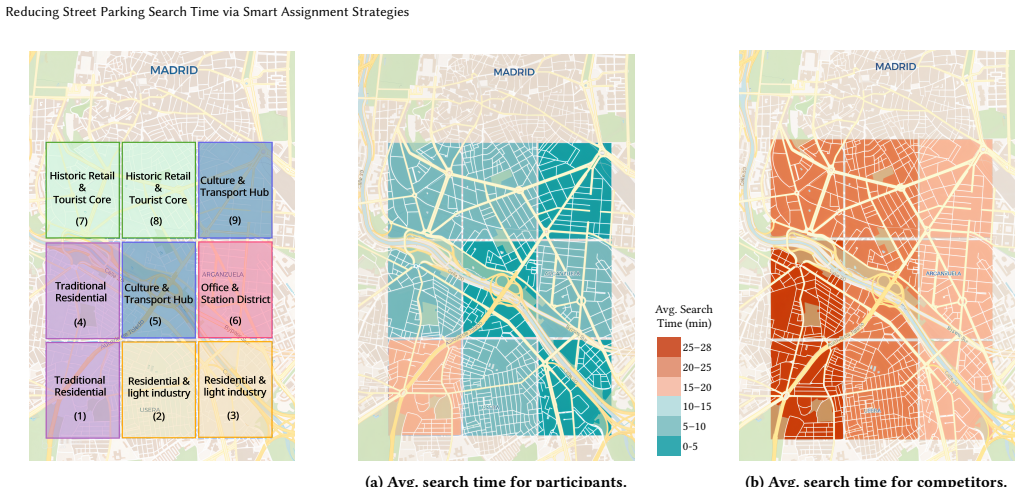
The central claim is that competitor awareness can be approximated statistically rather than measured in real time. Cord-Approx computes an effective distance $\tilde{\tau}(d,s)=\tau(d,s)/\hat{p}_{k(s),t}$ for every participant-spot pair, where $\hat{p}$ is the predicted probability that the spot's Geohash cell still has a free bay at that time, then passes the resulting cost matrix to a Hungarian assignment. In the weekday Madrid simulation this yields an average participant search time of 6.69 minutes against 19.98 for competitors, peak-hour success ratios of 77.54% for participants versus 28.71% for competitors, and zone-level search-time reductions of 67-76% in central hubs. The same experiments show uncoordinated real-time information alone leaves participants at 34.25% success, below the competitors' 38.63%, so coordination is the ingredient that converts information into improvement. Cord-Approx is presented as a practical middle point between Cord-Agn, which ignores competitors, and the Cord-Oracle upper bound, which knows every competitor's position.
Load-bearing premise
The simulation's parking dwell times are described as empirically calibrated, but the paper never names their source or distribution; if those durations do not match Madrid's real parking behavior, the historical availability signal that drives Cord-Approx is synthetic and all reported search-time gains are artifacts.
Editorial extensions
If this is right
- A street-parking app can approach oracle-level coordination without knowing where non-users are, so deployment needs only historical occupancy data plus a matching routine, not real-time tracking of all drivers.
- Real-time spot availability alone can make app users worse off than non-users; any practical smart-parking service should assign spots to drivers rather than just broadcast availability.
- The largest gains appear at intermediate availability (20-25% free spots); deployments targeting congested-but-not-saturated neighborhoods will see more benefit than ones in nearly empty or nearly full areas.
- App users' gains come partly at the expense of non-users, whose average search time rises; the same coordination that helps participants redistributes scarce curbside capacity away from uninformed drivers.
- On low-pressure weekends the simple coordinated strategy already matches the oracle, so the added complexity of Cord-Approx is only justified in high-competition weekday conditions.
Reading between the lines
- Testable extension: the same $\tau/\hat{p}$ cost structure could transfer to other scarce-resource assignment problems with hidden rivals, such as electric-vehicle charging bays or ride-hail pickup zones, wherever historical occupancy predicts contention.
- Because adoption is fixed at 1.5% of vehicles, scaling is an untested edge: past some adoption threshold participants begin competing with each other and the 72% reduction should erode; measuring that threshold is a concrete next experiment.
- The zone-level numbers suggest a deployment ordering the paper does not state: prioritize Cultural & Transport Hubs and Residential & Light Industry, where reductions run 68-78%, before historic cores with irregular layouts that mute the benefit.
- A field pilot could estimate $\hat{p}$ from parking-payment transactions or smartphone GPS traces instead of curb sensors, which would test whether the strategy survives without a dense sensing layer.
Signed reviews
Editorial analysis
A structured set of objections, weighed in public.
Referee Report
Summary. The paper proposes and evaluates four street-parking allocation strategies in a simulated Madrid setting: uncoordinated with information (Unc-Agn), coordinated without awareness of non-users (Cord-Agn), a perfect-knowledge oracle (Cord-Oracle), and a new practical method (Cord-Approx) that uses historical occupancy probabilities to weight travel times before solving a Hungarian assignment. The main claim is that Cord-Approx reduces participant search time to 6.69 minutes versus 19.98 minutes for non-users, a 72% reduction in central hubs, while remaining close to the oracle. The evaluation uses traffic intensity data from Madrid (April 2024) mapped to a 22x22 Geohash grid with 12,365 simulated parking spots, and the authors report success ratios and search times over a weekday and a weekend. The paper concludes that coordination, not just information, drives gains, and that the practical approximation captures much of the oracle's benefit without real-time tracking of non-users.
Significance. If the results are correct, the paper offers a practically attractive coordination scheme: it avoids live tracking of non-users and relies only on historical occupancy, which could make smart parking deployment easier. The comparison of four strategies in a common simulation framework is a useful contribution, and the use of real traffic intensity data is a strength. However, the central quantitative claim is compromised by two load-bearing issues: the search-time metric is conditioned on successful attempts while success rates differ sharply across groups, and the historical signal used for training is produced by the same simulator in which the strategy is evaluated, without validation against real occupancy data. These issues must be addressed before the headline reduction can be taken at face value.
major comments (3)
- [§4.1.2, Table 2, Abstract] The headline search-time reduction is computed only over successful parking attempts, while success ratios differ dramatically: Cord-Approx participants succeed in 77.54% of attempts whereas competitors succeed in only 28.71%. Because the simulator defines a failure at t_max = 30 minutes (§3.1), a well-defined inclusive metric is E[T] = SR * T_success + (1 - SR) * t_max. Using the values in Table 2 gives E[T] = 11.9 minutes for Cord-Approx participants and 27.1 minutes for competitors, a 56% reduction rather than the advertised 72%. Under the same metric, Cord-Oracle also yields about 11.9 minutes, so Cord-Approx's apparent advantage over the oracle disappears. Although the paper acknowledges this conditioning in §4.1.2 and the Conclusion, the Abstract and the zone-level claims in §4.2 still present the comparison as an unconditional search-time reduction. The authors should report the inclusive metric throughout or clearly qualify every headline claim.
- [§3.3, Algorithm 4] The claim that 'agents park and depart based on real-world dwell times' is never supported by any data source, distribution, or calibration procedure. The Contributions list 'empirically calibrated parking duration/turnover' as an input, but no details appear anywhere in the manuscript. This is particularly problematic because Algorithm 4 updates the historical corpus H with new occupancy data generated by the simulation itself, and Cord-Approx is trained on 15-17 April and tested on 18 April (§4). The historical occupancy signal p_hat is therefore a product of the same simulator in which Cord-Approx is evaluated, creating a closed loop. Without real Madrid occupancy data used in training or for validation, the reported 72%/66.5% reductions may be synthetic artifacts. The authors must either supply the missing dwell-time calibration or clearly state that the evaluation is fully synthetic and add a sensitivity analysis over plausible dwell-time distributions.
- [§3.3, Tables 2-3] The paper states that each strategy was run three times to reduce stochastic variation, but no variance measures, confidence intervals, or seed-level results are reported anywhere in the text or tables. All claims of reduction percentages and even the ranking of strategies are presented as point estimates. Given that the entire study is a simulation, the absence of error bars is a notable omission. The authors should report the range over seeds or standard errors for the key metrics (success ratio and search time) in Tables 2 and 3, and in the zone-level analysis.
minor comments (6)
- [§3.2.3, Eq. (9)] The Cord-Oracle cost calculation assumes that competitors move uniformly at random with equal probability among the four cardinal directions. This ad-hoc assumption directly drives the penalty term in Eq. (6) and thus the oracle upper bound, but it is neither justified nor tested. A sensitivity check over alternative movement models would strengthen the oracle comparison.
- [§4.2.2, Table 3] In the weekend Office & Station District, participants are reported as being worse off than competitors (7.43 min vs. 4.39 min). This runs counter to the paper's overall narrative and deserves a more explicit discussion, especially since the conclusion states that 'on low-pressure weekends, Cord-Agn nearly matches the oracle.'
- [§3.3] The paper calls the simulation 'high-fidelity,' but the model is a mesoscopic 22x22 Geohash grid with Manhattan-distance travel times and no lane-level dynamics. This term is overstated; 'mesoscopic' as used in the text is more accurate.
- [Table 2] The competitor search times under Cord-Agn, Cord-Approx, and Cord-Oracle are all nearly identical (19.79-19.98 min). The paper does not comment on why the participants' strategy has almost no effect on competitor search times; a brief explanation would help the reader.
- [§3.1, Eq. (1)] The definition of A_comp^t includes the condition that a spot is captured by a competitor if the competitor is closer than all participants. However, the subsequent tie-breaking rule says ties are broken uniformly at random; this should be reflected in the formal set definition or stated explicitly after Eq. (1).
- [Throughout] The terms 'success ratio' and 'success rate' are used interchangeably, and the paper uses 'participants' for app users and 'competitors' for non-users. Standardizing terminology would improve readability.
Circularity Check
No circularity found: the headline reduction is an emergent simulation outcome, not a fitted parameter or a self-citation load-bearing result.
full rationale
The paper's central claims are not circular. Cord-Approx uses a Ridge-regression estimate of spot availability p_hat to define an effective distance (Eq. 10: tau_tilde = tau / p_hat), which feeds a Hungarian assignment; the reported 6.69 vs 19.98 minute search times and 77.54% vs 28.71% success ratios are emergent outcomes of the simulator's agent dynamics, not read off from the fitted p_hat. The model is trained on an earlier simulated period (15-17 April) and tested on a held-out day (18 April), which is a standard train/test split rather than an identity between fitted input and predicted output. No load-bearing self-citations appear: the references to Ridge regression [4], the Hungarian algorithm [7], and Madrid traffic data [8] are all external. The main validity concerns are (i) the 'empirically calibrated parking duration/turnover' and 'real-world dwell times' are asserted but not sourced, so the historical occupancy corpus H appears to be generated by the same simulator used for evaluation, and (ii) the headline search-time metric is conditioned on successful attempts only, as the paper itself acknowledges in Section 4.1.2 and the Conclusion. These are statistical and external-validity issues, not circular reductions: the paper's equations do not make the output equal to an input by construction, and no fitted parameter is renamed as the headline prediction. Therefore the circularity score is 0.
Assumptions & free parameters
free parameters (4)
- Adoption split (participants vs competitors) =
1.5% participants, 8% competitors
- Competitor observability radius R =
1 grid cell (~150 m)
- Search-time budget t_max =
30 minutes
- Ridge predictor p_hat hyperparameters/features =
lambda by cross-validation; features: time-of-day, weekday, Geohash, recent occupancy trend
assumptions (8)
- domain assumption About 10% of vehicles are cruising for parking, split into 1.5% app participants and 8% competitors.
- domain assumption Competitors observe spots only within Manhattan distance R=1 grid cell.
- domain assumption Manually audited maximum legal street length is a valid proxy for parking supply.
- domain assumption Parking dwell times used in the simulator match real Madrid behavior.
- domain assumption Traffic counts can be uniformly disaggregated from 15-minute to 1-minute bins.
- standard math Manhattan distance on the Geohash grid equals travel time for all agents.
- domain assumption The historical occupancy corpus H from the simulator generalizes to the test day.
- ad hoc to paper Competitors move uniformly at random for the Cord-Oracle probability calculation.
Cite this review
Pith. "Pith review of Reducing Street Parking Search Time via Smart Assignment Strategies." pith.science (2026). https://pith.science/paper/S5BUU2ZC
@misc{pith2026250819979,
  author       = {Pith},
  title        = {Pith review of: Reducing Street Parking Search Time via Smart Assignment Strategies},
  year         = {2026},
  howpublished = {\url{https://pith.science/paper/S5BUU2ZC}},
  note         = {Machine review of arXiv:2508.19979}
}
read the original abstract
In dense metropolitan areas, searching for street parking adds to traffic congestion. Like many other problems, real-time assistants based on mobile phones have been proposed, but their effectiveness is understudied. This work quantifies how varying levels of user coordination and information availability through such apps impact search time and the probability of finding street parking. Through a data-driven simulation of Madrid's street parking ecosystem, we analyze four distinct strategies: uncoordinated search (Unc-Agn), coordinated parking without awareness of non-users (Cord-Agn), an idealized oracle system that knows the positions of all non-users (Cord-Oracle), and our novel/practical Cord-Approx strategy that estimates non-users' behavior probabilistically. The Cord-Approx strategy, instead of requiring knowledge of how close non-users are to a certain spot in order to decide whether to navigate toward it, uses past occupancy distributions to elongate physical distances between system users and alternative parking spots, and then solves a Hungarian matching problem to dispatch accordingly. In high-fidelity simulations of Madrid's parking network with real traffic data, users of Cord-Approx averaged 6.69 minutes to find parking, compared to 19.98 minutes for non-users without an app. A zone-level snapshot shows that Cord-Approx reduces search time for system users by 72% (range = 67-76%) in central hubs, and up to 73% in residential areas, relative to non-users.
Figures


Figures from the paper (3 more)


Reference graph
Works this paper leans on
-
[1]
Oded Cats, Chen Zhang, and Albania Nissan. 2016. Survey Methodology for Measuring Parking Occupancy: Impacts of an On-Street Parking Pricing Scheme in an Urban Center. Transport Policy 47 (2016), 55–63. doi:10.1016/j.tranpol.2015. 12.008
-
[2]
Giacomo Dalla Chiara, Klaas Fiete Krutein, Andisheh Ranjbari, and Anne Good- child. 2022. Providing Curb Availability Information to Delivery Drivers Reduces Cruising for Parking. Scientific Reports 12, 1 (2022), 19355. doi:10.1038/s41598- 022-23987-z
doi:10.1038/s41598- 2022
-
[3]
Geohash.es. n.d.. Geohash.es – Geohash Encoding and Decoding. https://geohash. es/. https://geohash.es/ Accessed: 2025-05-18
work page 2025
-
[4]
Arthur E. Hoerl and Robert W. Kennard. 1970. Ridge Regression: Biased Estimation for Nonorthogonal Problems. Technometrics 12, 1 (1970), 55–67. doi:10.1080/00401706.1970.10488634
arXiv 1970
-
[5]
Saba Inam, Azhar Mahmood, Shaheen Khatoon, Majed Alshamari, and Nazia Nawaz. 2022. Multisource data integration and comparative analysis of machine learning models for on-street parking prediction. Sustainability 14, 12 (2022),
work page 2022
-
[6]
Kotb, Yao-Chun Shen, Xu Zhu, and Yi Huang
Amir O. Kotb, Yao-Chun Shen, Xu Zhu, and Yi Huang. 2016. iParker—A New Smart Car-Parking System Based on Dynamic Resource Allocation and Pricing. IEEE Transactions on Intelligent Transportation Systems 17, 9 (2016), 2637–2647. doi:10.1109/TITS.2016.2531636
arXiv 2016
-
[7]
Harold W. Kuhn. 1955. The Hungarian Method for the Assignment Prob- lem. Naval Research Logistics Quarterly 2, 1–2 (1955), 83–97. doi:10.1002/nav. 3800020109
doi:10.1002/nav 1955
-
[8]
Madrid City Council. 2024. Historical Traffic Data. https://bit.ly/43xk6sn. https: //bit.ly/43xk6sn Accessed: 2024-04-18
work page 2024
Show all 30 references
-
[9]
Suhas Mathur, Tong Jin, Nikhil Kasturirangan, Janani Chandrasekaran, Wenzhi Xue, Marco Gruteser, and Wade Trappe. 2010. Parknet: Drive-by Sensing of Road-Side Parking Statistics. In Proceedings of the 8th International Conference on Mobile Systems, Applications, and Services (...
2010 doi
-
[10]
Weinberger, and Robert C
Adam Millard-Ball, Rachel R. Weinberger, and Robert C. Hampshire. 2014. Is the Curb 80% Full or 20% Empty? Assessing the Impacts of San Francisco’s Parking Pricing Experiment. Transportation Research Part A: Policy and Practice 63 (2014), 76–92. doi:10.1016/j.tra.2014.02.016
2014 doi
-
[11]
Kevin P. Murphy. 2012. Machine Learning: A Probabilistic Perspective . MIT Press, Cambridge, MA, USA
2012
-
[12]
Sarfraz Nawaz, Christos Efstratiou, and Cecilia Mascolo. 2013. ParkSense: A Smartphone-Based Sensing System for On-Street Parking. In Proceedings of the 19th Annual International Conference on Mobile Computing and Networking (MobiCom ’13) (MobiCom ’13) . Association for Comput...
2013
-
[13]
Huanmei Qin, Fei Zheng, Binhai Yu, and Zhongfeng Wang. 2022. Analysis of the effect of demand-driven dynamic parking pricing on on-street parking demand. IEEE Access 10 (2022), 70092–70103. doi:10.1109/ACCESS.2022.3187534
2022
-
[14]
Andrés Rodríguez, Borja Alonso, Jose Luis Moura, and Luigi dell’Olio. 2024. Analysis of user behavior in urban parking under different level of information scenarios provided by smart devices or connected cars. Travel Behaviour and Society 37 (2024), 100847. doi:10.1016/j.tbs....
2024
-
[15]
Cristian Roman, Ruizhi Liao, Peter Ball, Shumao Ou, and Martin de Heaver. 2018. Detecting On-Street Parking Spaces in Smart Cities: Performance Evaluation of Fixed and Mobile Sensing Systems.IEEE Transactions on Intelligent Transportation Systems 19, 7 (2018), 2234–2245. doi:1...
2018
-
[16]
Hamid R Sayarshad, Shahram Sattar, and H Oliver Gao. 2020. A scalable non- myopic atomic game for a smart parking mechanism. Transportation Research Part E: Logistics and Transportation Review 140 (2020), 101974. doi:10.1016/j.tre. 2020.101974
2020
-
[17]
Donald Shoup. 2007. Cruising for Parking. Access Magazine 1, 30 (2007), 16–23
2007
-
[18]
Chao Sun, Haodong Jing, and Haowei Yin. 2024. A Pricing Model Study of Shared Parking Area Charge Based on Game Theory. Systems 12, 8 (2024), 269. doi:10.3390/systems12080269
2024 doi
-
[19]
Supaplex030 and Riiga. 2022. Proposal: Street Parking Revision. OpenStreetMap Wiki. https://wiki.openstreetmap.org/wiki/Proposal:Street_parking_revision Accessed: 2025-05-13
2022
-
[20]
Bing Qing Tan, Su Xiu Xu, Matthias Thürer, Kai Kang, Zhiheng Zhao, and Ming Li. 2024. Booking versus search-based parking strategy: A game-theoretic methodology. Research in Transportation Economics 104 (2024), 101416. doi:10. 1016/j.retrec.2024.101416
2024
-
[21]
University of Pittsburgh. 2023. Novel Drive-By Sensing for On-Street Park- ing Detection. https://inventions.pitt.edu/technologies/novel-drive-by--06719. Accessed: 2025-05-25
2023
-
[22]
Rachel Weinberger, Adam Millard-Ball, Tayo Fabusuyi, Ellis Calvin, Jazymyn Blackburn, and Michelle Neuner. 2023. Parking Cruising Analysis Methodol- ogy: Final Project Report . FHWA-HOP-23-004. Federal Highway Administration, Washington, DC, USA. https://ops.fhwa.dot.gov/publi...
2023
-
[23]
Fan Wu and Wei Ma. 2022. Clustering analysis of the spatio-temporal on-street parking occupancy data: A case study in Hong Kong. Sustainability 14, 13 (2022),
2022
-
[24]
Sebastian Zambanini, Ana-Maria Loghin, Norbert Pfeifer, Elena Màrmol Soley, and Robert Sablatnig. 2020. Detection of parking cars in stereo satellite images. Remote Sensing 12, 13 (2020), 2170. doi:10.3390/rs12132170
2020 doi
-
[25]
Dong Zhao, Zijian Cao, Chen Ju, Desheng Zhang, and Huadong Ma. 2020. D2Park: Diversified Demand-Aware On-Street Parking Guidance. In Proceedings of the ACM on Interactive, Mobile, Wearable and Ubiquitous Technologies (IMWUT, Vol
2020
-
[26]
Xuejian Zhao, Kui Zhao, and Feng Hai. 2014. An algorithm of parking planning for smart parking system. In Proceeding of the 11th World Congress on Intelligent Control and Automation. IEEE, 4965–4969
2014
-
[27]
Carol Zimmerman, Rachel Klein, Jeremy Schroeder, Katie Turnbull, Kevin Balke, Mark Burris, Emily Saunoi-Sandgren, Elliot Martin, Susan Shaheen, Caroline Rodier, et al. 2014. San Francisco urban partnership agreement: national evaluation report. Technical Report. United States....
2014
-
[28]
(IMWUT ’20, Vol. 4) . Association for Computing Machinery, New York, NY, USA, 1–25. doi:10.1145/3432214
-
[7317]
doi:10.3390/su14127317
-
[7957]
doi:10.3390/su14137957
Reviewed August 15, 2026 · model on record in the stance chip above.
Discussion (0). Continue with ORCID to comment.