REVIEW 3 major objections 4 minor 4 cited by
Optimal Quoting under Adverse Selection and Price Reading
T0 review · 3 major / 4 minor · reviewed 2026-08-05 · deepseek-v4-flash
Pith's one-line read A first-order formula gives market makers explicit quote corrections for informed flow and skew sniffers, split into global and tier-specific parts.
desk verdict Useful, honest extension of optimal market making to adverse selection and price reading, but the ε=1 simulations stretch the first-order perturbation further than the paper can guarantee. read the letter →
The pith
A machine-rendered reading of the paper's core claim, the machinery that carries it, and where it could break.
The reading
What carries the argument
The engine of the paper is a first-order Taylor expansion of the HJB equation and its maximizers around the baseline market making model with no informational risk (ε=0). The load-bearing objects are the value-function correction f (solving the linear system (7)) and the tier-specific corrections g, which combine into equations (12)–(13) for the optimal quote offsets; the finite-difference operators D± and the concavity parameter c(δ) from the intensity functions govern the size of the adjustment. The quadratic Hamiltonian approximation of Section 4 turns the HJB into a Riccati equation whose solution yields f in closed form.
What would settle it
Solve the full HJB equation (6) numerically for the exponential functional forms of Section 5 using a convergent method, then compare the true optimal quotes and PnL with the first-order approximations (12)-(13) at ε=1 across the stated inventory range; a material divergence, or a PnL gap that reverses the ranking against the 'No Skew' strategy, would refute the paper's practical claim.
Extended reading notes
Core claim
The central claim is that, in an infinite-horizon optimal market making model, the first-order impact of adverse selection and price reading on optimal quotes can be computed explicitly and separates cleanly. The optimal bid and ask offsets in feedback form are the no-informational-risk quotes plus a correction equal to (1/c) times a bracket containing: (i) the finite difference of a value-function correction f (which aggregates the impact of all tiers' informational risk on expected PnL), and (ii) a tier-specific term g that depends on the slope of the price-impact function ζ, the intensity function Λ, and the skew-reading sensitivity J'. Under a quadratic approximation of the Hamiltonians,
Load-bearing premise
The paper's first-order expansions are derived under a small perturbation parameter ε, but the numerical experiments set ε=1 and are forced to impose a floor at zero on the adjusted quotes because in extreme regimes the approximation is questionable; if the omitted o(ε) terms are not small over the relevant inventory and quote ranges, equations (12)–(13) do not describe the true optimal quotes and the simulated gains vanish.
Editorial extensions
If this is right
- Market makers can compute quote adjustments for each client tier with only baseline quotes and the solution of a linear system, no full nonlinear HJB solve needed.
- Price reading leads to a two-sided response: spread widening at zero inventory plus reduced skew to tiers with skew sniffers, with the de-skewing strongest for infrequent, sensitive readers.
- Adverse selection can be exploited: a tier trading on slow signals can be used as a 'signal subscription' where attractive top-of-book prices buy information, improving franchise risk management.
- The formulas give a directional answer to whether to lean against or go with the skew: the net effect depends on relative slopes of intensity and price-impact functions, summarized by sign differences β−κ in exponential examples.
- The infinite-horizon, first-order approach avoids the curse of dimensionality and extends naturally to multi-asset settings via the same quadratic approximation.
Reading between the lines
- If the first-order approximations hold, the same decomposition—global value-function effect plus tier-specific control effect—may apply to other informational frictions (e.g., signals from order flow toxicity, latency advantages), giving a template for quote corrections beyond these two risks.
- The 'signal subscription' interpretation suggests a testable strategy: deliberately quote tight to an informed tier at small sizes to extract directional information, and measure whether the value of that information exceeds the adverse selection cost—this could be validated with client-level flow data.
- The authors' simulation sets ε=1 despite formal small-ε assumptions; a natural stress test is to compare equations (12)-(13) against a fully numerical HJB solution for realistic parameters, which would show the regime of validity and whether the floor at zero quotes is often binding.
- The tier-specific de-skewing result predicts that in markets with a large share of skew sniffers, top-of-book skew should be lower than the no-information-leakage baseline; this is observable in dealer-to-client quote data, e.g., comparing quote ladders across platforms with different information transparency.
Editorial analysis
A structured set of objections, weighed in public.
Referee Report
Summary. The paper proposes an infinite-horizon market-making model, in the spirit of Cartea–Jaimungal/Guéant, in which the reference price is affected by (i) adverse selection through tier- and size-dependent price-impact functions ζ and (ii) price reading through a feedback term J applied to the weighted skew of the market maker's own bid/ask ladder. The authors introduce a perturbation parameter ε and derive a first-order expansion of the value function around the no-informational-risk baseline, with the correction f characterized by the linear system (7). They then obtain first-order expansions of the optimal bid/ask offsets, Eqs. (12)–(13), showing a decomposition into a global value-function component common to all tiers and a tier-specific component. In a quadratic-Hamiltonian approximation with symmetric bid/ask functions and ρ→0, the adjustments become closed-form. Numerical examples with exponential intensities and two client tiers illustrate the effects and report simulated PnL, risk, and risk-adjusted performance for 'No Action', 'No Skew', and 'Optimal' strategies.
Significance. If the first-order expansions are reliable, the paper delivers a practical and implementable extension of existing market-making models: the explicit formulas (12)–(13) are straightforward to evaluate from baseline quotes and the auxiliary function f, and the global/tier-specific decomposition provides actionable intuition for flow toxicity and skew-sniffing. A notable strength is that no parameter is fitted to data, so the adjustment formulas do not reduce to fitted quantities; the exponential case is worked out in closed form and the simulation study uses 10^5 paths. The main limitation is that the numerical section runs the perturbation at ε=1, where no error control is provided and the corrections are comparable to the baseline quotes. Thus the practical 'optimality' claim is under-supported, although the analytical machinery is plausible and coherent.
major comments (3)
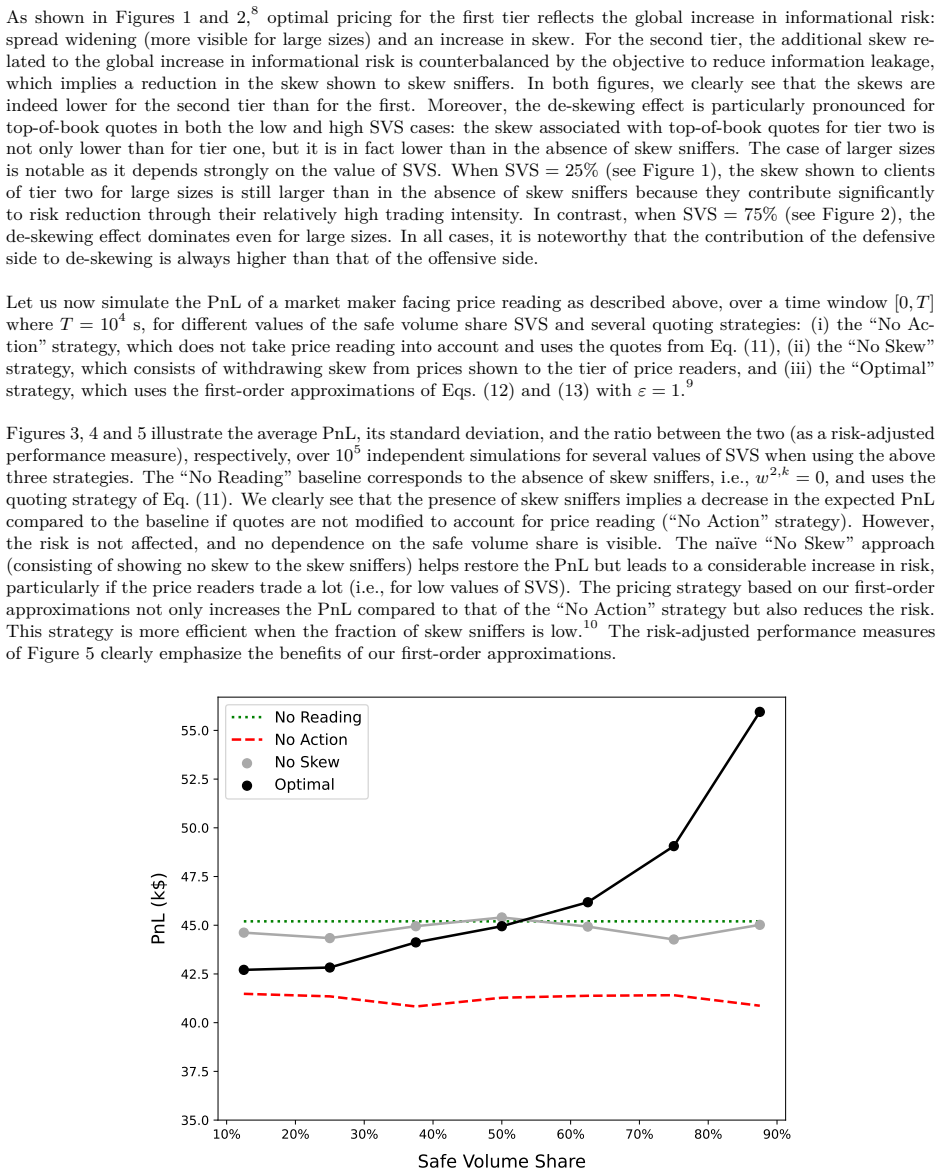
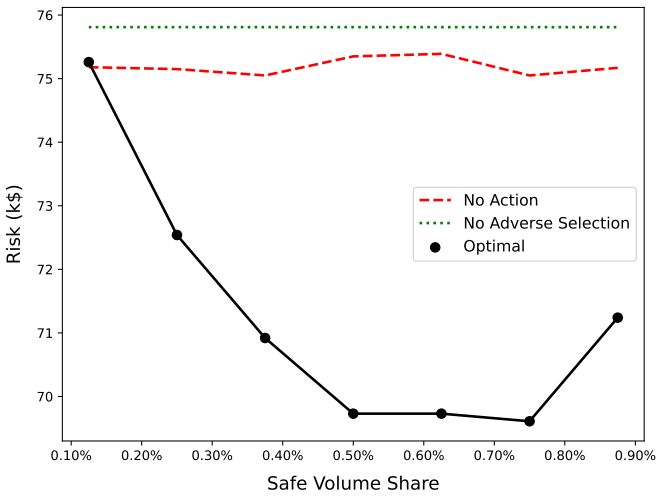
- [§5.2–5.3, footnote 9, Eqs. (12)–(13)] Eqs. (12)–(13) are first-order expansions in ε, but the simulations set ε=1, and footnote 9 admits a 0-floor is needed because 'the applicability of the first-order approximations is questionable' in extreme situations. With κ=3 bp^-1, the baseline half-spread is approximately 1/κ≈0.33 bp, while Figs. 1–2 show quote adjustments of order ±1 bp, so the corrections are not small relative to the unperturbed quotes. No uniform bound on the o(ε) remainder is supplied. The simulated PnL improvements of 'Optimal' over No Action/No Skew therefore do not establish that (12)–(13) approximate the true optimal controls; they only show that one heuristic beats two other heuristics inside the same model. The authors should provide a remainder estimate or a small-ε/numerical-HJB convergence check, or explicitly weaken the optimality claim.
- [§3.3.2–§3.3.3, Eq. (7), Eq. (6)] The perturbation ansatz ϑ=θ+εf+o(ε) and the first-order expansion of the maximizers in §3.3.3 require differentiability of the value function and of the argmax with respect to ε at ε=0; these properties are assumed without proof. Equation (7) for f is obtained by formally differentiating the HJB equation (6), so a verification argument or explicit regularity assumptions are needed to ensure that the formal expansion actually corresponds to the true value function and optimal quotes. At minimum, the regularity conditions should be stated, and one benchmark case should be checked against a high-accuracy numerical solution of (6).
- [§5.2–§5.3, Figs. 3–9] The PnL simulations are entirely in-sample and reuse the same model and the same first-order approximations. 'Optimal' is compared only with the 'No Action' and 'No Skew' heuristics, not with a policy obtained from a high-accuracy solution of the original HJB equation (6) or with a small-ε reference solution. Consequently, the simulations cannot distinguish 'closer to optimal' from 'different but lucky'. The reported improvements are internal-consistency checks of the first-order heuristic, not validation of the expansion's optimality.
minor comments (4)
- [§5.3, Figs. 7–9] The horizontal axes in Figs. 7–9 are labeled '0.10% ... 0.90%', while the text and Figs. 3–5 use '10% ... 90%'. Clarify whether SVS is expressed as a percentage or a decimal fraction.
- [Eq. (7) and §3.3.2] The Feynman-Kac representation for f requires integrability and growth conditions on f and on the intensities Λ; these conditions are not stated. Adding them would make the derivation complete.
- [§4.2, Eqs. (9)–(10)] The notation O(ε^2) in equations for Aε and Bε can be read as an exact residual of the quadratic Hamiltonian approximation. It would be clearer to state explicitly that Aε and Bε are themselves expanded to first order in ε, so that (9)–(10) are only first-order equations.
- [§5.1] The time units deserve clarification: Λ0 is given in day^-1 while the simulation horizon is T=10^4 s. The conversion between these units should be stated explicitly for reproducibility.
Circularity Check
No significant circularity: the quote adjustments are derived as first-order expansions from the model primitives, not relabeled fits or self-citation imports.
full rationale
The paper's central equations (12)–(13) are obtained by a genuine perturbation argument: they expand the HJB value function as ϑ = θ + εf + o(ε) and expand the Hamiltonian maximizers in ε around the no-information baseline. The correction f solves the linear equation (7) by collecting O(ε) terms, and the quote corrections follow from the first-order condition of the Hamiltonian. No parameter is fitted to data, and no empirical quantity is renamed as a prediction. The only overlapping-author citation, [6], is used in Section 4 as a stated quadratic-Hamiltonian approximation method, not as an imported uniqueness or existence theorem, and Section 3's first-order derivation is independent of it. The numerical section simulates the same model to compare strategies, which is a self-consistency check rather than an independent empirical validation, but it is not a circular derivation. Concerns about setting ε=1 and about the lack of remainder bounds (footnote 9) are legitimate approximation-error and correctness issues, not instances of circularity.
Assumptions & free parameters
free parameters (5)
- Lambda_0^{n,k} baseline trade intensity levels
- kappa^{n,k} exponential intensity and impact decay
- alpha^{n,k}, beta^{n,k} adverse selection amplitude and slope
- w^{n,k} price-reading weights
- gamma, sigma, rho risk aversion, volatility, discount rate
assumptions (6)
- domain assumption Trade arrivals are marked point processes with intensities Lambda^{n,k,b/a}(delta) depending only on the market maker's own quote offset relative to its reference price S_t.
- domain assumption The reference price S_t reacts to informed trades via zeta^{n,k}(delta) and to quote asymmetry via J_n(weighted skew), and these reactions enter PnL through q dS.
- domain assumption The optimization criterion is the infinite-horizon discounted risk-adjusted PnL (Eq. 5), and the associated HJB equation has a smooth solution with well-defined finite differences.
- ad hoc to paper The perturbation expansion theta = theta_0 + epsilon f + o(epsilon) is valid, and the maximizers of the perturbed Hamiltonian are differentiable in epsilon at epsilon=0.
- ad hoc to paper The Hamiltonian can be replaced by its second-order Taylor expansion around (p=0, epsilon=0), yielding a quadratic value function.
- ad hoc to paper For the closed-form insights, bid-ask symmetry and the limit rho to 0 are assumed.
invented entities (1)
-
Price-reading feedback channel J_n(weighted average quote skew) in the reference price dynamics
Cite this review
Pith. "Pith review of Optimal Quoting under Adverse Selection and Price Reading." pith.science (2026). https://pith.science/paper/KD5WQQNE
@misc{pith2026250820225,
  author       = {Pith},
  title        = {Pith review of: Optimal Quoting under Adverse Selection and Price Reading},
  year         = {2026},
  howpublished = {\url{https://pith.science/paper/KD5WQQNE}},
  note         = {Machine review of arXiv:2508.20225}
}
read the original abstract
Over the past decade, many dealers have implemented algorithmic models to automatically respond to RFQs and manage flows originating from electronic platforms. In parallel, building on the foundational work of Ho and Stoll, and later Avellaneda and Stoikov, the academic literature on market making has expanded to address trade size distributions, client tiering, complex price dynamics, alpha signals and the internalisation versus externalisation dilemma in markets with dealer-to-client and interdealer-broker segments. In this paper, we tackle two critical dimensions: adverse selection, arising from the presence of informed traders, and price reading, whereby the market maker's own quotes reveal the direction of their inventory. These risks are well known to practitioners, who routinely face informed flows and algorithms capable of extracting signals from quoting behaviour. Yet they have received limited attention in the quantitative finance literature, beyond stylised toy models with limited actionability. Extending the existing literature, we propose a tractable framework that enables market makers to adjust their quotes with greater awareness of informational risk.
Figures


Figures from the paper (6 more)



Forward citations
Cited by 4 Pith papers
-
Strategic OTC market making with reputation feedback
Performance-based flow gates make a single dealer's optimal quoting policy alternate between reputation-building and monetization, and can produce two stable reputation regimes.
-
Avellaneda-Stoikov and Cartea-Jaimungal as One Framework: A Forced Uniqueness Theorem for Inventory Market Making
Under cash-additivity, normalization, concavity, strong dynamic consistency and law-invariance, the Avellaneda-Stoikov framework is the unique entropic model and Cartea-Jaimungal is its Taylor expansion with phi force...
-
Explicit Signal-Adaptive Sequential Optimal Execution Quotes
Provides explicit value functions and optimal quotes for four execution criteria in a model incorporating signal-dependent drift, price impact, and point-process fills.
-
Market Making and Transient Impact in Spot FX
For an FX dealer, optimal hedging and quoting under exponentially decaying market impact are governed by a simple closed-form factor β/(β+ω) that interpolates between permanent and instantly-resilient impact.
Reviewed August 5, 2026 · model on record in the stance chip above.
Discussion (0). Continue with ORCID to comment.