REVIEW 4 major objections 5 minor 39 references
ATMS-KD: Adaptive Temperature and Mixed Sample Knowledge Distillation for a Lightweight Residual CNN in Agricultural Embedded Systems
T0 review · 4 major / 5 minor · reviewed 2026-08-05 · deepseek-v4-flash
Pith's one-line read ATMS-KD claims adaptive temperature plus Mixup/CutMix lets a 1.3M-param student hit 97.11% accuracy, beating 11 baselines.
desk verdict The reported 1.60 pp gain over KD baselines is not supported as written: the central adaptive-temperature mechanism is never specified, and the baseline comparisons look under-tuned. read the letter →
The pith
A machine-rendered reading of the paper's core claim, the machinery that carries it, and where it could break.
The reading
What carries the argument
The central object is the ATMS-KD loss L = α·τ²·KL(Softmax(z_student/τ) || Softmax(z_teacher/τ)) + β·CE(z_student, y), where τ is set by a capacity-aware scheduler: higher initial τ for smaller students, higher τ when the teacher-student performance gap is large, and monotonic annealing toward hard labels as training advances. Mixed-sample augmentation (Mixup and CutMix, each applied with probability 0.5) is applied to the input batches before both teacher and student forward passes, so the student learns from softened teacher predictions on mixed images. The scheduler carries the adaptive claim; the augmentation carries the robustness claim.
What would settle it
Retrain the same student with each of the eleven baseline KD methods on the same training/validation split, giving each method a per-method hyperparameter search over temperature, loss weights, and epochs. If tuned AT or ST reaches at least the 95% direct-training level, or if tuned RKD equals or exceeds 97.11%, the claimed margin collapses.
Extended reading notes
Core claim
The paper claims that knowledge distillation from MobileNetV3 Large to a lightweight residual CNN works substantially better when the distillation temperature is not fixed but scheduled: smaller students start with higher temperatures (T=6.0 for the 1.3M-parameter model) to absorb richer soft labels, and the temperature anneals to around 3.0 as training progresses, shifting weight toward true hard labels. Combining this with Mixup and CutMix augmentation applied to the inputs gives the Compact student 97.11% validation accuracy, a 1.60 percentage point improvement over the best of eleven established KD baselines (RKD at 95.51%), while also yielding the lowest inference latency (72.19 ms). Th
Load-bearing premise
The eleven baseline distillation methods were assumed to be tuned to comparable strength; if several were run with default or poorly chosen hyperparameters, the reported margin over the second-best method could be an artifact of under-tuned competition rather than a property of ATMS-KD.
Editorial extensions
If this is right
- A 1.3M-parameter student can reach 97.11% accuracy on rose maturity classification, within 0.48 points of a 5.7M-parameter teacher, while processing images at 13.9 samples per second on a CPU.
- Knowledge retention above 99% across all width multipliers suggests that adaptive-temperature distillation does not penalize smaller students for their reduced capacity.
- The 52.8–69.7% training-loss reduction over direct training implies faster convergence and lower compute cost per model trained.
- CutMix helping larger students and Mixup helping the compact configuration indicates the two augmentations are complementary rather than interchangeable in knowledge distillation.
- The reported combination of highest accuracy and lowest latency among twelve methods positions ATMS-KD for real-time embedded agricultural monitoring.
Reading between the lines
- The large gap between some baselines (AT at 85.07%, ST at 85.23%) and direct training at 95% strongly suggests those baselines ran with suboptimal hyperparameters; a fair comparison with tuned baselines would likely shrink the reported 1.60-point margin.
- Because the task is binary and the teacher already reaches 97.59%, the accuracy scale is compressed; the framework's benefits may show more clearly on multi-class or higher-variance datasets.
- The temperature schedule (high T early, low T late) is essentially a soft-to-hard curriculum; ablating against a simple linear or cosine decay would isolate whether capacity-aware initialization is what helps, or whether any annealing schedule suffices.
- If the result generalizes, a single teacher could spawn multiple student sizes at deployment time without retraining, letting an embedded system select a width multiplier based on its latency budget.
Editorial analysis
A structured set of objections, weighed in public.
Referee Report
Summary. The paper proposes ATMS-KD, a knowledge distillation framework that combines mixed-sample augmentation (Mixup/CutMix) with an 'adaptive temperature' scheduler, and evaluates it on a two-class Rosa damascena maturity dataset. A MobileNetV3 Large teacher (5.7M parameters) is distilled into three lightweight residual CNN students (0.75x, 1.0x, 1.25x width multipliers). The authors report that the Compact student reaches 97.11% test accuracy, a 1.60 percentage point improvement over the best of eleven KD baselines, with the lowest inference latency (72.19 ms). The paper also reports knowledge retention above 99% for all student configurations.
Significance. If the results were reliable, the combination of mixed-sample augmentation and capacity-aware temperature adjustment would be a useful contribution to deploying lightweight models in embedded agricultural systems. The paper contains a real-world dataset, a systematic comparison against eleven KD methods, and hardware latency measurements, which are valuable. However, the empirical support is currently undermined by several internal inconsistencies: the reported data split contradicts the confusion-matrix sample counts, the central 'adaptive temperature' mechanism is not actually specified in any algorithm, and several KD baselines perform far worse than direct training, indicating possible under-tuning. These issues must be resolved before the claimed 1.60 pp advantage can be trusted.
major comments (4)
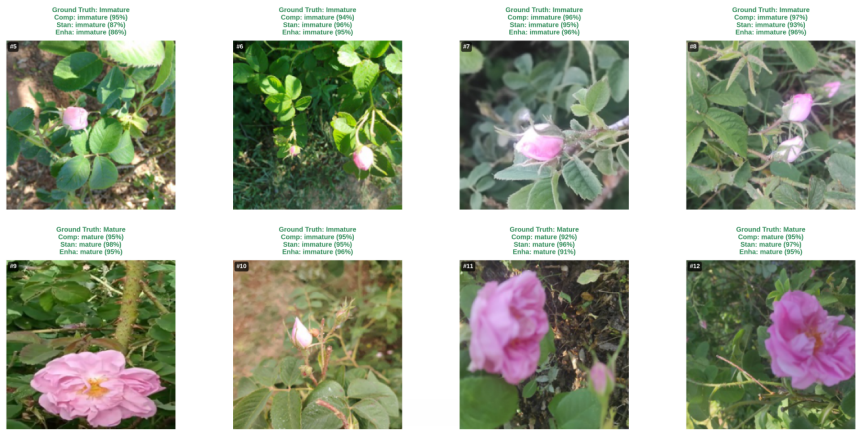
- [§3.4 vs §4.4/Figure 11] The confusion matrices in Figure 11 sum to 623 test samples (e.g., Compact: 268+7+11+337 = 623). With 3114 total images, this corresponds to an 80/20 split (3114 × 0.2 ≈ 623), not the 70/30 split stated in §3.4, which would give roughly 934 test samples. Since all reported accuracies, knowledge retention values, and inference-time measurements are computed on this test set, this inconsistency directly affects the numerical basis of the paper's central claim and must be corrected or explained.
- [§2.3.4, Algorithm 1 and Algorithm 2] The paper's stated novelty is 'adaptive temperature scheduling', but Algorithm 1 is a static grid search: it selects a single optimal τ on the validation set via arg max[H(τ)·Acc(τ)]. Algorithm 2 then fixes τ as a constant ('temperature τ > 0') and never updates it inside the training loop. The text and Figure 10 describe gradual annealing (e.g., Compact from 6.0 to 3.27), but no per-epoch formula or update rule is provided anywhere. As specified, the method is not reproducible, and the reported gains cannot be causally attributed to adaptive temperature.
- [Table 1 vs §4.2.1] Several KD baselines score far below the Compact student's direct-training validation accuracy of 95%: AT 85.07%, ST 85.23%, and PKT 89.73%. A correctly configured distillation method should not degrade a student below its own supervised baseline. This strongly suggests the baselines were run with default or poorly tuned hyperparameters, so the claimed 1.60 pp improvement over the second-best method (RKD, 95.51%) may be an artifact of unequal tuning effort rather than a property of ATMS-KD. The authors need to report per-baseline hyperparameter tuning or re-run the comparison with equally tuned baselines and multiple seeds.
- [§4.1, Figure 6] The teacher model is reported to have training accuracy 90.93% and test accuracy 97.59%, with test loss (0.25) below training loss (0.33). While this can occasionally happen with dropout or batch-norm effects during training, it is sufficiently unusual that the paper should explain how training accuracy was computed (e.g., with dropout enabled) and confirm the reported numbers. Since teacher accuracy is the denominator in the knowledge retention metric (Eq. 7), a misreported teacher test accuracy would propagate to all KR values and weaken the distillation claims.
minor comments (5)
- [Table 1] The baseline row 'A T [34]' should be 'AT [34]'.
- [§4.4] The text says 'Figure 7' when referring to the confusion matrices; it should be 'Figure 11'.
- [§2.1 / §3.4] The paper alternately calls the held-out set 'testing set' and 'validation set'. It should use a single consistent term and clarify whether validation data was used only for checkpoint selection, with a separate test set for final reporting.
- [Figure 12] Figure 12 is referenced in §4.5 but no image is visible in the manuscript. Either include the plot or remove the reference.
- [References] Reference [14] is missing the publication year, volume, and page numbers. Also, reference [13] is cited twice in the introduction with identical wording; one duplicate sentence should be removed.
Circularity Check
No significant circularity: reported accuracies are measured outcomes, not derived from fitted constants or self-cited theorems.
full rationale
The paper's claims are empirical evaluations. The headline numbers (97.11% accuracy, 72.19 ms latency, knowledge retention 99.51%) are direct measurements reported from training runs and confusion matrices, not quantities recovered from equations that were fitted to those same numbers. The loss in Algorithm 2 (L_total = alpha*L_KD + beta*L_CE with alpha+beta=1 and tau^2 scaling) is the standard Hinton/KL distillation loss plus cross-entropy; it does not by construction force a particular accuracy value. The hyperparameters (initial temperature, alpha, beta, mixup probability) are selected on validation data, which is selection bias rather than circularity; no reported accuracy is algebraically or definitionally equal to an input parameter. I checked the seven circularity patterns. (1) Self-definitional: no quantity is defined in terms of the target result; the adaptive temperature scheduler is described but Algorithm 1 optimizes tau against validation accuracy and Algorithm 2 keeps tau fixed, which is an under-specification/correctness problem, not a circular derivation. (2) Fitted input called prediction: no parameter is fit to a subset and then reported as a prediction of a closely related held-out quantity; accuracies are measured on the test set and the model checkpoints are selected by validation accuracy, which is standard practice. (3) Self-citation load-bearing: there are no self-citations; all references are prior external work (Hinton, Zhang, Yun, etc.). (4) Uniqueness imported from authors: no uniqueness theorem is invoked. (5) Ansatz smuggled via citation: the choice of Mixup/CutMix and KL distillation is explicitly attributed to the original external papers, and the 'adaptive temperature' mechanism is not imported from prior work by the same authors. (6) Renaming known result: ATMS-KD is presented as a combination of existing components (Mixup + CutMix + temperature-scaled KL loss); even if that combination is not very novel, presenting a combination is not circular renaming. The manuscript itself acknowledges limitations in Section 5: evaluation on a binary single-crop task, capacity-based initialization rules 'may need adjustment for different teacher-student architecture combinations', and augmentation strategies 'were optimized for the specific characteristics of the Rosa damascena dataset'. These are honest scope limitations, not circularity. The noteworthy inconsistencies (baselines such as AT, ST, and PKT scoring below the student's d
Assumptions & free parameters
free parameters (8)
- Initial temperature for Compact student (width 0.75x) =
6.0
- Initial temperature for Standard student (width 1.0x) =
4.5
- Initial temperature for Enhanced student (width 1.25x) =
4.3
- Final annealing temperatures =
3.27 / 3.30 / 2.98
- KD loss weight alpha =
0.7
- Hard-label loss weight beta =
0.3
- Mixup/CutMix activation probability =
0.5
- Mixup Beta distribution parameter =
not reported
assumptions (4)
- domain assumption Pretrained ImageNet weights transfer to Rosa damascena imagery.
- domain assumption The collected 3114-image dataset is representative and sufficient.
- domain assumption Baseline KD methods were implemented faithfully and comparably tuned.
- domain assumption Knowledge distillation theory (soft targets improve small models) holds for this task.
Cite this review
Pith. "Pith review of ATMS-KD: Adaptive Temperature and Mixed Sample Knowledge Distillation for a Lightweight Residual CNN in Agricultural Embedded Systems." pith.science (2026). https://pith.science/paper/RHAB2P2Z
@misc{pith2026250820232,
  author       = {Pith},
  title        = {Pith review of: ATMS-KD: Adaptive Temperature and Mixed Sample Knowledge Distillation for a Lightweight Residual CNN in Agricultural Embedded Systems},
  year         = {2026},
  howpublished = {\url{https://pith.science/paper/RHAB2P2Z}},
  note         = {Machine review of arXiv:2508.20232}
}
read the original abstract
This study proposes ATMS-KD (Adaptive Temperature and Mixed-Sample Knowledge Distillation), a novel framework for developing lightweight CNN models suitable for resource-constrained agricultural environments. The framework combines adaptive temperature scheduling with mixed-sample augmentation to transfer knowledge from a MobileNetV3 Large teacher model (5.7\,M parameters) to lightweight residual CNN students. Three student configurations were evaluated: Compact (1.3\,M parameters), Standard (2.4\,M parameters), and Enhanced (3.8\,M parameters). The dataset used in this study consists of images of \textit{Rosa damascena} (Damask rose) collected from agricultural fields in the Dades Oasis, southeastern Morocco, providing a realistic benchmark for agricultural computer vision applications under diverse environmental conditions. Experimental evaluation on the Damascena rose maturity classification dataset demonstrated significant improvements over direct training methods. All student models achieved validation accuracies exceeding 96.7\% with ATMS-KD compared to 95--96\% with direct training. The framework outperformed eleven established knowledge distillation methods, achieving 97.11\% accuracy with the compact model -- a 1.60 percentage point improvement over the second-best approach while maintaining the lowest inference latency of 72.19\,ms. Knowledge retention rates exceeded 99\% for all configurations, demonstrating effective knowledge transfer regardless of student model capacity.
Figures


Figures from the paper (10 more)


Reference graph
Works this paper leans on
-
[1]
Variational Information Distillation for Knowledge Transfer
Ahn, S., Hu, S.X., Damianou, A., Lawrence, N.D., Dai, Z., 2019. Variational Information Distillation for Knowledge Transfer. URL: http://arxiv.org/ abs/1904.05835, doi:10.48550/arXiv.1904.05835. arXiv:1904.05835 [cs]
-
[2]
Plant disease identification from individ- ual lesions and spots using deep learning
Arnal Barbedo, J.G., 2019. Plant disease identification from individ- ual lesions and spots using deep learning. Biosystems Engineering 180, 96–107. URL: https://www.sciencedirect.com/science/article/pii/ S1537511018307797, doi:10.1016/j.biosystemseng.2019.02.002
-
[3]
Chen, G., Choi, W., Yu, X., Han, T., Chandraker, M., 2017. Learning Efficient Object Detection Models with Knowledge Distillation, in: Advances in Neural Information Processing Systems, Curran Asso- ciates, Inc. URL:https://papers.nips.cc/paper_files/paper/2017/hash/ e1e32e235eee1f970470a3a6658dfdd5-Abstract.html
work page 2017
-
[4]
Improved Regularization of Convolutional Neural Networks with Cutout
DeVries, T., Taylor, G.W., 2017. Improved Regularization of Convolutional Neural Networks with Cutout. URL: http://arxiv.org/abs/1708.04552, doi:10.48550/arXiv.1708.04552. arXiv:1708.04552 [cs]
-
[5]
Fatehi, F., Bagherpour, H., Amiri Parian, J., 2025. Enhancing the Performance of YOLOv9t Through a Knowledge Distillation Approach for Real-Time Detec- tion of Bloomed Damask Roses in the Field. Smart Agricultural Technology 10, 100794. URL: https://www.sciencedirect.com/science/article/pii/ S2772375525000280, doi:10.1016/j.atech.2025.100794
-
[6]
A Robust Deep-Learning- Based Detector for Real-Time Tomato Plant Diseases and Pests Recogni- tion
Fuentes, A., Yoon, S., Kim, S.C., Park, D.S., 2017. A Robust Deep-Learning- Based Detector for Real-Time Tomato Plant Diseases and Pests Recogni- tion. Sensors 17, 2022. URL:https://www.mdpi.com/1424-8220/17/9/2022, doi:10.3390/s17092022. publisher: Multidisciplinary Digital Publishing Insti- tute. 31
-
[7]
Identification of plant leaf diseases using a nine- layer deep convolutional neural network
G., G., J., A.P., 2019. Identification of plant leaf diseases using a nine- layer deep convolutional neural network. Computers & Electrical Engineering 76, 323–338. URL:https://www.sciencedirect.com/science/article/pii/ S0045790619300023, doi:10.1016/j.compeleceng.2019.04.011
-
[8]
Knowledge Distilla- tion: A Survey
Gou, J., Yu, B., Maybank, S.J., Tao, D., 2021. Knowledge Distilla- tion: A Survey. International Journal of Computer Vision 129, 1789–1819. URL: https://link.springer.com/article/10.1007/s11263-021-01453-z, doi:10.1007/s11263-021-01453-z. publisher: Springer
Show all 39 references
- [9]
- [10]
-
[11]
MobileNets: Efficient Convolutional Neural Networks for Mobile Vision Applications
Howard, A.G., Zhu, M., Chen, B., Kalenichenko, D., Wang, W., Weyand, T., Andreetto, M., Adam, H., 2017. MobileNets: Efficient Convolutional Neural Networks for Mobile Vision Applications. URL:http://arxiv.org/abs/1704. 04861, doi:10.48550/arXiv.1704.04861. arXiv:1704.04861 [cs]
- [12]
-
[13]
A gradual approach to knowledge distillation in deep supervised hashing for large-scale image retrieval
Hussain, A., li, H.C., Hussain, M., Ali, M., Abbas, S., Ali, D., Rehman, A., 2024. A gradual approach to knowledge distillation in deep supervised hashing for large-scale image retrieval. Computers and Electrical Engineering 120, 109799. URL:https://www.sciencedirect.com/scien...
2024
-
[14]
A review of the use of convolutional neural networks in agriculture | The Journal of Agri- cultural Science
Kamilaris, A., Prenafeta-Boldú, F.X., . A review of the use of convolutional neural networks in agriculture | The Journal of Agri- cultural Science. Cambridge Core URL: https://www.cambridge. org/core/journals/journal-of-agricultural-science/article/ review-of-the-use-of-convo...
-
[15]
Deep learning in agri- culture: A survey
Kamilaris, A., Prenafeta-Boldú, F.X., 2018. Deep learning in agri- culture: A survey. Computers and Electronics in Agriculture 147, 70–90. URL: https://www.sciencedirect.com/science/article/pii/ S0168169917308803, doi:10.1016/j.compag.2018.02.016
2018 doi
-
[16]
Ma- chine Learning in Agriculture: A Review
Liakos, K.G., Busato, P., Moshou, D., Pearson, S., Bochtis, D., 2018. Ma- chine Learning in Agriculture: A Review. Sensors 18, 2674. URL: https: //www.mdpi.com/1424-8220/18/8/2674, doi: 10.3390/s18082674. publisher: Multidisciplinary Digital Publishing Institute
2018 doi
-
[17]
Frontiers | Using Deep Learning for Image-Based Plant Disease Detection URL: https://www.frontiersin
Mohanty, S.P., Hughes, D.P., Salathé, M., . Frontiers | Using Deep Learning for Image-Based Plant Disease Detection URL: https://www.frontiersin. org/journals/plant-science/articles/10.3389/fpls.2016.01419/full, doi:10.3389/fpls.2016.01419
2016
-
[18]
Relational Knowledge Distillation, in: 2019 IEEE/CVF Conference on Computer Vision and Pattern Recognition (CVPR), pp
Park, W., Kim, D., Lu, Y., Cho, M., 2019. Relational Knowledge Distillation, in: 2019 IEEE/CVF Conference on Computer Vision and Pattern Recognition (CVPR), pp. 3962–3971. URL: https://ieeexplore.ieee.org/document/ 8954416, doi:10.1109/CVPR.2019.00409. iSSN: 2575-7075
2019
- [19]
-
[20]
Computer vision and artificial intel- ligence in precision agriculture for grain crops: A systematic review
Patrício, D.I., Rieder, R., 2018. Computer vision and artificial intel- ligence in precision agriculture for grain crops: A systematic review. Computers and Electronics in Agriculture 153, 69–81. URL: https: //www.sciencedirect.com/science/article/pii/S0168169918305829, doi:10...
2018 doi
- [21]
- [22]
-
[23]
Plant Disease Detection and Classification by Deep Learning
Saleem, M.H., Potgieter, J., Arif, K.M., 2019. Plant Disease Detection and Classification by Deep Learning. Plants 8, 468. URL: https://www.mdpi. 33 com/2223-7747/8/11/468, doi:10.3390/plants8110468. publisher: Multidis- ciplinary Digital Publishing Institute
2019 doi
-
[24]
Mo- bileNetV2: Inverted Residuals and Linear Bottlenecks, in: 2018 IEEE/CVF Conference on Computer Vision and Pattern Recognition, pp
Sandler, M., Howard, A., Zhu, M., Zhmoginov, A., Chen, L.C., 2018. Mo- bileNetV2: Inverted Residuals and Linear Bottlenecks, in: 2018 IEEE/CVF Conference on Computer Vision and Pattern Recognition, pp. 4510–
2018
-
[25]
Machine Learning Applications for Precision Agriculture: A Comprehensive Review
Sharma, A., Jain, A., Gupta, P., Chowdary, V., 2021. Machine Learning Applications for Precision Agriculture: A Comprehensive Review. IEEE Ac- cess 9, 4843–4873. URL:https://ieeexplore.ieee.org/document/9311735, doi:10.1109/ACCESS.2020.3048415
2021
- [26]
- [27]
- [28]
-
[29]
Knowledge Distillation and Student-Teacher Learn- ing for Visual Intelligence: A Review and New Outlooks
Wang, L., Yoon, K.J., 2022. Knowledge Distillation and Student-Teacher Learn- ing for Visual Intelligence: A Review and New Outlooks. IEEE Transactions on Pattern Analysis and Machine Intelligence 44, 3048–3068. URL:http://arxiv. org/abs/2004.05937, doi: 10.1109/TPAMI.2021.305...
2022 arXiv
- [30]
-
[31]
Knowledge Distillation Meets Self-supervision
Xu, G., Liu, Z., Li, X., Loy, C.C., 2020. Knowledge Distillation Meets Self-supervision. URL: https://link.springer.com/chapter/10. 1007/978-3-030-58545-7_34, doi:10.1007/978-3-030-58545-7_34. 34
2020 doi
-
[32]
Knowledge Distilla- tion in Generations: More Tolerant Teachers Educate Better Students
Yang, C., Xie, L., Qiao, S., Yuille, A., 2018. Knowledge Distilla- tion in Generations: More Tolerant Teachers Educate Better Students. URL: http://arxiv.org/abs/1805.05551, doi:10.48550/arXiv.1805.05551. arXiv:1805.05551 [cs]
-
[33]
CutMix: Regularization Strategy to Train Strong Classifiers With Localizable Features, in: 2019 IEEE/CVF International Conference on Computer Vision (ICCV), pp
Yun, S., Han, D., Chun, S., Oh, S.J., Yoo, Y., Choe, J., 2019. CutMix: Regularization Strategy to Train Strong Classifiers With Localizable Features, in: 2019 IEEE/CVF International Conference on Computer Vision (ICCV), pp. 6022–6031. URL: https://ieeexplore.ieee.org/document/...
2019
-
[34]
Paying More Attention to Attention: Im- proving the Performance of Convolutional Neural Networks via Attention Trans- fer
Zagoruyko, S., Komodakis, N., 2017. Paying More Attention to Attention: Im- proving the Performance of Convolutional Neural Networks via Attention Trans- fer. URL: http://arxiv.org/abs/1612.03928, doi:10.48550/arXiv.1612. 03928. arXiv:1612.03928 [cs]
- [35]
- [36]
-
[37]
CropDeep: The Crop Vision Dataset for Deep-Learning-Based Classification and Detection in Precision Agriculture
Zheng, Y.Y., Kong, J.L., Jin, X.B., Wang, X.Y., Su, T.L., Zuo, M., 2019. CropDeep: The Crop Vision Dataset for Deep-Learning-Based Classification and Detection in Precision Agriculture. Sensors 19, 1058. URL:https://www. mdpi.com/1424-8220/19/5/1058, doi:10.3390/s19051058. pub...
2019 doi
-
[38]
Random Erasing Data Augmentation
Zhong, Z., Zheng, L., Kang, G., Li, S., Yang, Y., 2020. Random Erasing Data Augmentation. ProceedingsoftheAAAIConferenceonArtificialIntelligence34, 13001–13008. URL: https://ojs.aaai.org/index.php/AAAI/article/view/ 7000, doi:10.1609/aaai.v34i07.7000. 35
2020 doi
-
[4520]
1109/CVPR.2018.00474
URL: https://ieeexplore.ieee.org/document/8578572, doi: 10. 1109/CVPR.2018.00474. iSSN: 2575-7075
2018
Reviewed August 5, 2026 · model on record in the stance chip above.
Discussion (0). Sign in to comment.