REVIEW 3 major objections 5 minor 26 references
Semi-inclusive pion electroproduction at the highest transverse momenta
T0 review · 3 major / 5 minor · reviewed 2026-08-05 · deepseek-v4-flash
Pith's one-line read This paper argues that at the highest transverse momenta in semi-inclusive pion electroproduction, a perturbatively calculable 'isolated pion' process dominates and its factorized cross section separates the target's high-x quark distributi
desk verdict A clean direct-pion SIDIS calculation with a plausible dominance claim that rests on unquantified background estimates. read the letter →
The pith
A machine-rendered reading of the paper's core claim, the machinery that carries it, and where it could break.
The reading
What carries the argument
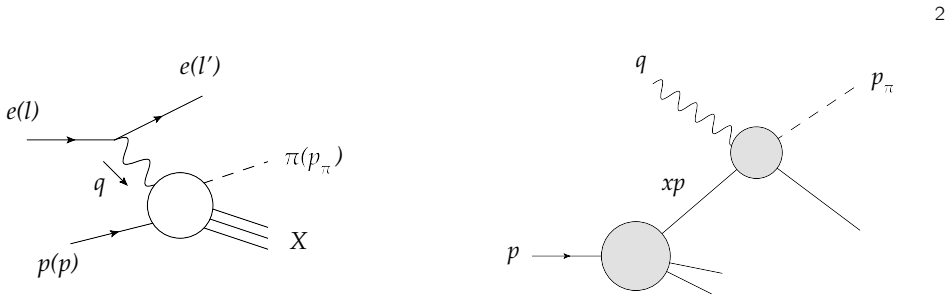
The engine of the calculation is the two-to-three quark-level subprocess gamma* q -> pi q', evaluated from four lowest-order diagrams in which a hard gluon creates a quark-antiquark pair; the pion is formed by the struck quark and the antiquark through the pion distribution amplitude phi_pi(y), with y1 and y2=(1-y1) the light-cone momentum fractions. All dependence on the pion's internal structure enters through the integral J1(q^2/t) = integral dy1 phi_pi(y)/(y1 + y2 q^2/t), together with the auxiliary J2 = 1 - (q^2/t) J1. The hadronic cross section is then q_a(x) times a squared amplitude built from rational coefficients A, B, C of J1 and the Mandelstam variables; the isolation requirement
What would settle it
Measure the semi-inclusive charged-pion cross section at a 22 GeV electron accelerator at photon energy E_gamma=22 GeV, pion angle 5 degrees, Q^2=3 GeV^2, scanning pion transverse momentum between 1.0 and 1.7 GeV. If the isolated-pion dominance is real, the p_perp-shape at fixed x should track the known valence quark distribution, the cos(2phi_h) modulation should be a sizable fraction of the unpolarized transverse cross section, and a veto on hadrons with transverse momentum above about 1 GeV in the pion hemisphere should not deplete the yield. If fragmentation or VMD backgrounds are actually
Extended reading notes
Core claim
The central claim is that a measurable window exists in which semi-inclusive pion electroproduction is dominated by the perturbatively calculable isolated-pion mechanism. Specifically, for E_gamma = 22 GeV, theta_pi = 5 degrees, and Q^2 = 3 GeV^2, the direct process exceeds VMD and fragmentation for pion transverse momentum p_perp above about 1.4 GeV when the asymptotic distribution amplitude is used; with a broader input DA the isolated pions are several times more abundant and dominance begins earlier. In this regime the cross section takes the factorized form q_a(x) times J1(q^2/t) times known kinematic factors, where q_a(x) is the target quark distribution and J1 is an integral over the
Load-bearing premise
The dominance claim rests on the estimated sizes of the two background processes—fragmentation, treated at low order with simple functions, and vector-meson dominance, carried by phenomenological fits to meson-proton scattering; if those estimates are too small, the momentum window where isolated pions rule would shrink or disappear.
Editorial extensions
If this is right
- At present and future electron accelerators, this channel gives a new way to measure target quark distributions at high momentum fraction (x ~0.25–0.5), where existing data are sparse, with a cross-section shape that is nearly independent of the pion distribution amplitude.
- Varying Q^2 at fixed x and t changes the argument of the integral J1 and produces ratios, particularly in the longitudinal cross section, that can discriminate between proposed pion distribution amplitudes; with enough data, J1 can be inverted to recover the distribution amplitude itself.
- The same perturbative kernel appears in exclusive pion electroproduction in generalized-parton-distribution analyses, so isolated-pion semi-inclusive data can independently constrain the short-range part of those exclusive amplitudes.
- The dominance of the isolated-pion mechanism grows relative to vector-meson dominance and fragmentation as Q^2 increases, so higher photon virtuality enlarges the usable extraction window.
- The transverse-transverse structure function, which drives the cos(2phi_h) azimuthal modulation, is predicted to be a sizable fraction of the unpolarized transverse cross section, offering an experimentally accessible signature of the mechanism.
Reading between the lines
- The factorization suggests a hadron-level analogue of the classic parton-program: the isolated pion acts as a tagged recoil of the struck quark, and tagging charged versus neutral pions could give flavor-separated high-x parton information from a single measurement.
- A practical way to sharpen the dominance window is to impose an experimental isolation cut—vetoing hadrons above a small transverse-momentum threshold in the pion hemisphere—which should suppress fragmentation pions faster than isolated pions, pushing effective dominance to lower p_perp.
- The fragmentation background is estimated here only at low order; next-to-leading corrections or parton-shower effects could raise it, and a dedicated study of the recoil-jet structure in existing simulation data would test whether the claimed background suppression holds.
- The connection to exclusive electroproduction implies the same J1 integral controls the hard part of that process; a combined fit of isolated-pion semi-inclusive data and exclusive meson data could constrain the pion distribution amplitude more tightly than either channel alone.
Editorial analysis
A structured set of objections, weighed in public.
Referee Report
Summary. The paper studies semi-inclusive pion electroproduction, focusing on a 'direct' or 'isolated' pion mechanism in which the pion is formed at short distances from a quark-antiquark pair produced by a hard gluon, rather than from jet fragmentation. The authors present an analytic tree-level calculation of the γ*p → π+X cross section in terms of the target quark PDF, the pion distribution amplitude, and Mandelstam variables (Sec. III). They compare this direct contribution with vector-meson-dominance (VMD) and fragmentation backgrounds (Sec. IV) and show, for representative kinematics (Eγ = 22 GeV, θπ = 5°, Q² = 3 GeV²), that the direct process dominates for pion transverse momenta above about 1.4 GeV (Fig. 6). They further propose kinematic strategies to separately extract the high-x quark PDF and the pion DA (Sec. VI). The photoproduction limit of the direct cross section is checked against a prior result (Eq. (10) of Ref. [16]).
Significance. If the dominance claim is quantitatively reliable, the paper identifies a perturbatively calculable window for accessing high-x PDFs and the pion distribution amplitude, with a direct connection to GPD-based exclusive meson electroproduction. The analytic derivation is transparent, the photoproduction limit agrees with an earlier external calculation, and the proposed extraction strategy is concrete. The main weakness is that the numerical demonstration of dominance relies on background estimates that are explicitly crude and carry no uncertainty bands; the crossover momentum is therefore not yet established at the level the paper's central claim requires.
major comments (3)
- [Sec. IV, Fig. 6] The central claim of a 'significant region' of direct-pion dominance is based on the comparison in Fig. 6, but neither background curve is assigned an uncertainty. The VMD contribution is taken from Ref. [5] with no error estimate, and the fragmentation contribution is explicitly 'a simple low order treatment' using the ad hoc fragmentation functions of Eq. (45) and the 1996 GRSV PDF set. Because the crossover at pπ⊥ ≈ 1.4 GeV is set by the separation between falling curves, a moderate upward shift in either background (e.g., 50%) moves the crossover above 1.6 GeV, where the W > 2 GeV condition (Fig. 10) is no longer satisfied and the claimed window disappears. The paper should provide uncertainty bands or at least a sensitivity scan showing how the crossover depends on the normalization of VMD and on the fragmentation/PDF choices.
- [Sec. III.B and Fig. 6] The direct-pion curve itself is shown without a scale or higher-twist uncertainty. The result depends on α_s² and I^2_π (Eqs. (14), (17)), yet no renormalization/factorization scale choice is specified and no estimate of power corrections at Q² = 3 GeV² is given. Since the dominance statement is quantitative, the absence of any uncertainty band on the direct curve is as load-bearing as the missing background uncertainties.
- [Sec. IV.B, Eqs. (41)-(48)] The fragmentation background is treated only at leading order with 'simple estimates' for the fragmentation functions and with a 1996 parton distribution set. For a claim that the direct process exceeds fragmentation in a specific pT range, this level of input is not quantitative. The authors should use at least one modern PDF set and a modern NLO fragmentation function, and show the sensitivity to the choice of scale and to the z-integration. This is not a request for a full NLO calculation, but the current treatment cannot support a precise dominance threshold.
minor comments (5)
- [Sec. IV.A] There are several typos: 'porootn induced porcesses' should be 'proton induced processes'; 'contibutions' should be 'contributions'.
- [Sec. III.C] Duplicate word: 'and and the point' should be 'and the point'.
- [Sec. VI] 'potted' should be 'plotted' in the description of Fig. 11.
- [Sec. IV.B, Eq. (44)] The expression for z_min is missing parentheses: it should be (−t + u − m_p² − q²)/(s − m_p²).
- [Sec. V, Fig. 6 caption] The caption says 'directπ,FUU,T (asy)' but the label in the plot area uses 'directπ' for both energies; consider defining the notation in the caption for clarity.
Circularity Check
No circularity: direct-pion cross section is an independent pQCD calculation; competing backgrounds come from external fits, not from fitting the target process.
full rationale
The paper's central derivation is self-contained in the sense required by the circularity pass. The direct-pion cross section, Eqs. (5)-(29), is obtained from standard QCD Feynman diagrams. The only non-perturbative inputs are the quark distribution q_a(x), the pion distribution amplitude φ_π(y) (asymptotic, square-root, or Chernyak-Zhitnitsky forms), and standard coupling constants. No parameter is fitted to the isolated-pion cross section itself; Eq. (22) is a factorization formula, not a definition of the cross section in terms of the final observable. The q^2→0 limit in Eq. (30) is checked against a previous photoproduction result, Ref. [16], which is a consistency test rather than a load-bearing input. The competing VMD background is taken from Ref. [5], a prior paper by two of the same authors, but that paper explicitly uses other authors' phenomenological fits to meson-proton scattering data, so the evidence is external and falsifiable, not an unverified self-citation chain. The fragmentation background is labeled 'a simple low order treatment' and uses 1993-era fragmentation functions; this is an admitted approximation, but it is an input model, not a quantity derived from the direct-pion result. The paper's strongest claim, that direct pions dominate above a transverse-momentum threshold, depends on the normalization of these background estimates, and the lack of uncertainty bands on VMD and fragmentation is a legitimate robustness concern. However, underestimating a background is a correctness/quantitative-risk issue, not circular reasoning. No step in the derivation reduces by construction to its own output, and no fitted parameter is renamed as a prediction. The self-citations are present but are not load-bearing in a circular sense; they point to earlier calculations and to externally anchored phenomenological fits. Score 1 reflects minor self-citation and admitted background-model limitations without any circular reduction.
Assumptions & free parameters
assumptions (6)
- domain assumption The pion is formed from a nearly collinear quark-antiquark pair with momentum fractions y1 and 1-y1, connected by a gamma5 factor and weighted by the pion distribution amplitude phi_pi(y).
- domain assumption Perturbative QCD with a single hard gluon exchange dominates the direct pion process at high transverse momentum and moderate Q^2.
- domain assumption Quarks and the pion are treated as massless.
- domain assumption The GRSV parton distributions (1996) provide an adequate model for the quark PDFs at high x.
- domain assumption The VMD and fragmentation estimates for the competing processes are reliable enough to establish the dominance region.
- domain assumption The momentum fraction of the struck quark is given by x = -t/(s+u-2m_p^2-q^2).
Cite this review
Pith. "Pith review of Semi-inclusive pion electroproduction at the highest transverse momenta." pith.science (2026). https://pith.science/paper/HBD3GU5C
@misc{pith2026250820242,
  author       = {Pith},
  title        = {Pith review of: Semi-inclusive pion electroproduction at the highest transverse momenta},
  year         = {2026},
  howpublished = {\url{https://pith.science/paper/HBD3GU5C}},
  note         = {Machine review of arXiv:2508.20242}
}
read the original abstract
At the energies of present and future electron accelerators designed to study the structure of hadrons, there is a regime where hard pion electroproduction proceeds by a perturbatively calculable process in QCD. The process is not the leading twist fragmentation one but rather a higher twist process that produces kinematically isolated pions. Semi-inclusive data may teach us more about parton distribution functions of the target and the pion distribution amplitude. In addition, there is a connection to generalized parton distribution calculations of exclusive electroproduction of mesons in that the perturbative kernel is the same.
Figures


Figures from the paper (5 more)


Reference graph
Works this paper leans on
-
[16]
A. Bacchetta, P. J. Mulders, and F. Pijlman, New ob- servables in longitudinal single-spin asymmetries in semi- inclusive dis, Physics Letters B 595, 309 (2004)
work page 2004
-
[5]
Semi-Exclusive Pion Production in Deep-Inelastic Scattering
A. Brandenburg, V. V. Khoze, and D. Mueller, Semiex- clusive pion production in deep inelastic scattering, Phys. Lett. B 347, 413 (1995), arXiv:hep-ph/9410327
work page Pith review arXiv 1995
-
[1]
C/q u(p1). (15) where A = e1 ˆs −t(ˆs− q2) + J1 ˆu(t− q2) + e2 ˆu t( ˆu− q2)− J1ˆs(t− q2) , B = 2t e1 ˆs J1 + e2 ˆu J2 , C = J1 e1 ˆu ˆs + e2ˆs ˆu + e2t ˆu (J1− 1) . (16) The argument of J1,2 is q2/t. Also, γ = 213 27 π3I2 παα2 S (17) and it is useful to know ϵ1· p′ 1 = √ ˆst ˆu ˆs− q2 . (18) 4 The subprocess cross section is d ˆσIJ d t = 1 16π(ˆs− q2)2 X...
-
[2]
V. N. Baier and A. G. Grozin, Determination of the me- son wave function using the cross-section of its isolated inclusive production, Phys. Lett. B 96, 181 (1980)
work page 1980
-
[3]
C. E. Carlson and J. Milana, The Approach to color trans- parency as a means of determining hadronic distribution amplitudes, Phys. Rev. D 44, 1377 (1991)
work page 1991
-
[4]
C. E. Carlson and A. B. Wakely, Semiinclusive pion pho- toproduction at large transverse momenta, Phys. Rev. D 48, 2000 (1993)
work page 2000
-
[6]
Soft Contributions to Hard Pion Photoproduction
A. Afanasev, C. E. Carlson, and C. Wahlquist, Soft con- tributions to hard pion photoproduction, Phys. Rev. D 61, 034014 (2000), arXiv:hep-ph/9903493
work page Pith review arXiv 2000
-
[7]
A. Afanasev and C. E. Carlson, Hard pion electroproduc- tion at medium energies, Nucl. Phys. A 721, 763 (2003)
work page 2003
Show all 26 references
-
[8]
Liu and J.-W
T. Liu and J.-W. Qiu, Power corrections in semi-inclusive deep inelastic scatterings at fixed target energies, Phys. Rev. D 101, 014008 (2020), arXiv:1907.06136 [hep-ph] and further work to come
2020 arXiv
-
[9]
Egerer et al
C. Egerer et al. (HadStruc), Transversity parton dis- tribution function of the nucleon using the pseudodis- tribution approach, Phys. Rev. D 105, 034507 (2022), arXiv:2111.01808 [hep-lat]
2022 arXiv
-
[10]
P. C. Barry et al. (Jefferson Lab Angular Momentum (JAM), HadStruc), Complementarity of experimental and lattice QCD data on pion parton distributions, Phys. Rev. D 105, 114051 (2022), arXiv:2204.00543 [hep-ph]
2022 arXiv
-
[11]
R. G. Edwards et al.(HadStruc), Non-singlet quark helicity PDFs of the nucleon from pseudo-distributions, JHEP 03, 086, arXiv:2211.04434 [hep-lat]
-
[12]
Bacchetta, M
A. Bacchetta, M. Diehl, K. Goeke, A. Metz, P. J. Mulders, and M. Schlegel, Semi-inclusive deep inelastic scattering at small transverse momentum, JHEP 02, 093, arXiv:hep- ph/0611265. One may also change the differential mea- sures using d 3ℓ′/E′ = mpν d x d y d ψand d 3pπ/ωπ =...
-
[13]
L. N. Hand, Experimental investigation of pion electropro- duction, Phys. Rev. 129, 1834 (1963)
1963
-
[14]
Amaldi, S
E. Amaldi, S. Fubini, and G. Furlan, PION ELECTRO- PRODUCTION. ELECTROPRODUCTION AT LOW- ENERGY AND HADRON FORM-FACTORS , Vol. 83 (1979)
1979
-
[15]
Arens, O
T. Arens, O. Nachtmann, M. Diehl, and P. V. Land- shoff, Some tests for the helicity structure of the pomeron in e p collisions, Z. Phys. C 74, 651 (1997), arXiv:hep- ph/9605376
1997
-
[17]
Afanasev, C
A. Afanasev, C. E. Carlson, and C. Wahlquist, Measuring polarized gluon and quark distributions with meson photo- production, Phys. Rev. D 58, 054007 (1998), arXiv:hep- ph/9706522
1998
-
[18]
Hua et al
J. Hua et al. (Lattice Parton), Pion and Kaon Distribu- tion Amplitudes from Lattice QCD, Phys. Rev. Lett. 129, 132001 (2022), arXiv:2201.09173 [hep-lat]
2022 arXiv
-
[19]
Pautz and G
A. Pautz and G. Shaw, Nuclear shadowing and rho pho- toproduction, Phys. Rev. C 57, 2648 (1998), arXiv:hep- ph/9710235
1998
-
[20]
Szczurek, V
A. Szczurek, V. Uleshchenko, and J. Speth, anti-d - anti-u asymmetry and semiinclusive production of pions in DIS, Phys. Rev. D 63, 114005 (2001), arXiv:hep-ph/0009318
2001 arXiv
-
[21]
Gluck, E
M. Gluck, E. Reya, M. Stratmann, and W. Vogelsang, Next-to-leading order radiative parton model analysis of polarized deep inelastic lepton - nucleon scattering, Phys. Rev. D 53, 4775 (1996), arXiv:hep-ph/9508347
1996 arXiv
-
[22]
Accardi et al., Strong interaction physics at the lumi- nosity frontier with 22 GeV electrons at Jefferson Lab, Eur
A. Accardi et al., Strong interaction physics at the lumi- nosity frontier with 22 GeV electrons at Jefferson Lab, Eur. Phys. J. A 60, 173 (2024), arXiv:2306.09360 [nucl-ex]
2024 arXiv
-
[23]
Diehl, Generalized parton distributions, Physics Reports 388, 41 (2003)
M. Diehl, Generalized parton distributions, Physics Reports 388, 41 (2003)
2003
-
[24]
Ahmad, G
S. Ahmad, G. R. Goldstein, and S. Liuti, Nucleon tensor charge from exclusive π 0 electroproduction, Physical Re- view D—Particles, Fields, Gravitation, and Cosmology 79, 054014 (2009)
2009
-
[25]
S. V. Goloskokov and P. Kroll, An attempt to understand exclusive π+ electroproduction, The European Physical Journal C 65, 137 (2010)
2010
-
[26]
Goloskokov and P
S. Goloskokov and P. Kroll, Transversity in hard exclusive electroproduction of pseudoscalar mesons, The European Physical Journal A 47, 112 (2011)
2011
Reviewed August 5, 2026 · model on record in the stance chip above.
Discussion (0). Sign in to comment.