REVIEW 4 major objections 4 minor 62 references
Latent Variable Modeling for Robust Causal Effect Estimation
T0 review · 4 major / 4 minor · reviewed 2026-08-15 · deepseek-v4-flash
Pith's one-line read A second-stage latent adjustment — subtracting the fitted expected latent contribution from the outcome residual — makes the causal-effect estimate consistent even when an unobserved confounder drives both treatment and outcome.
desk verdict A useful second-stage latent-variable extension to DML with a real theoretical gap: the Neyman orthogonality proof ignores that the adjustment term depends on the estimated residuals. read the letter →
The pith
A machine-rendered reading of the paper's core claim, the machinery that carries it, and where it could break.
The reading
What carries the argument
The load-bearing object is the adjusted score equation and its Neyman-orthogonal moment function. The paper defines $\varphi(W, \gamma, \nu) = (Y - h(X) - \theta(D - m(X)) - q_\gamma(W))\,(D - m(X) - r_\gamma(W))$ with $q_\gamma(W) = E[f_u(Z)\mid W, \gamma]$ and $r_\gamma(W) = 0$; once residuals are plugged in, this is exactly the estimating equation $\sum_i (R^z_i - \hat{\theta} V_i) V_i = 0$. The trailing factor $D - m(X)$ is the treatment residual, which acts as the noisy window onto $Z$; the leading factor is the latent-adjusted outcome residual. Neyman orthogonality — the derivative of the moment with respect to perturbations of the nuisance functions $h$ and $m$ vanishes — is what lets the second-stage latent fit ignore first-stage estimation error, and Lemma A.5 derives it from two conditional mean-zero restrictions, Equations (19)-(20). The posterior expectation $E[f_u(Z)\mid R, V, \hat{\gamma}]$ is the mechanism that removes the bias: it projects the latent part of the outcome noise onto what the treatment residual reveals about $Z$. EM computes that posterior — a truncated-normal mean in the outcome-only model, a success-probability-weighted average in the Bernoulli confounder model — and BIC selects between the two latent structures.
What would settle it
Simulate data from the confounder latent model with the Bernoulli probability $q$ near the boundary ($q \approx 0.01$) and with noise variances large relative to the loadings $a$ and $b$; fit latent DML across many EM restarts and check whether the fitted latent parameters recover their generating values and whether the empirical Fisher information at the EM solution stays well conditioned. If the latent parameters drift across restarts while $\hat{\theta}$ stays near the truth, the identification condition is failing and the paper's stated mechanism is not what is carrying the estimate; if $\hat{\theta}$ itself drifts, the consistency claim fails exactly in the regime the paper does not test.
Extended reading notes
Core claim
On the paper's own terms, the central claim is an unbiasedness identity. The outcome residual in DML decomposes as $R = \theta V + U$; writing the noise as $U = f_u(Z) + W_u$ and $V = f_v(Z) + W_v$ with mutually independent $Z, W_u, W_v$, subtracting $E[f_u(Z)\mid R, V, \gamma_0]$ from $R$ leaves an error that is mean-independent of $V$, so a well-specified latent model replaces the unconfoundedness condition $E[UV\mid X] = 0$ with a distributional assumption on the residual pair. The estimator solves the score equation $\sum_i (R^z_i - \hat{\theta} V_i) V_i = 0$ with adjusted residual $R^z_i = R_i - E[f_u(Z)\mid R_i, V_i, \hat{\gamma}]$, and the paper proves this score is Neyman-orthogonal to first-stage nuisance estimation error, yielding consistency and asymptotic normality under the usual $n^{1/4}$ rate condition on the nuisance fits. The claim is not that the latent variable itself is identified in an absolute sense, but that the finite-dimensional parameters are identified from the residual likelihood; Proposition B.2 ties this to non-singular Fisher information, and the paper asserts it holds 'straightforwardly' for the shifted exponential and shifted Bernoulli models without giving the verification (end of Appendix B.2.1). Two instantiations implement the framework — an outcome-only latent model and a confounder latent model — with EM supplying the posterior moments and BIC choosing between the two structures.
Load-bearing premise
The adjusting term $E[f_u(Z)\mid R, V, \hat{\gamma}]$ only removes the confounding if the latent parameters are identified from the residual likelihood alone: the paper assumes the moment condition vanishes only at the true $\gamma_0$ (Assumption A.4(a)) and asserts, with the verification left as 'straightforward', that its shifted exponential and shifted Bernoulli models satisfy this (Appendix B.2.1), so a near-singular Fisher information would let the EM fit settle on the wrong adjustment and the bias would return.
Editorial extensions
If this is right
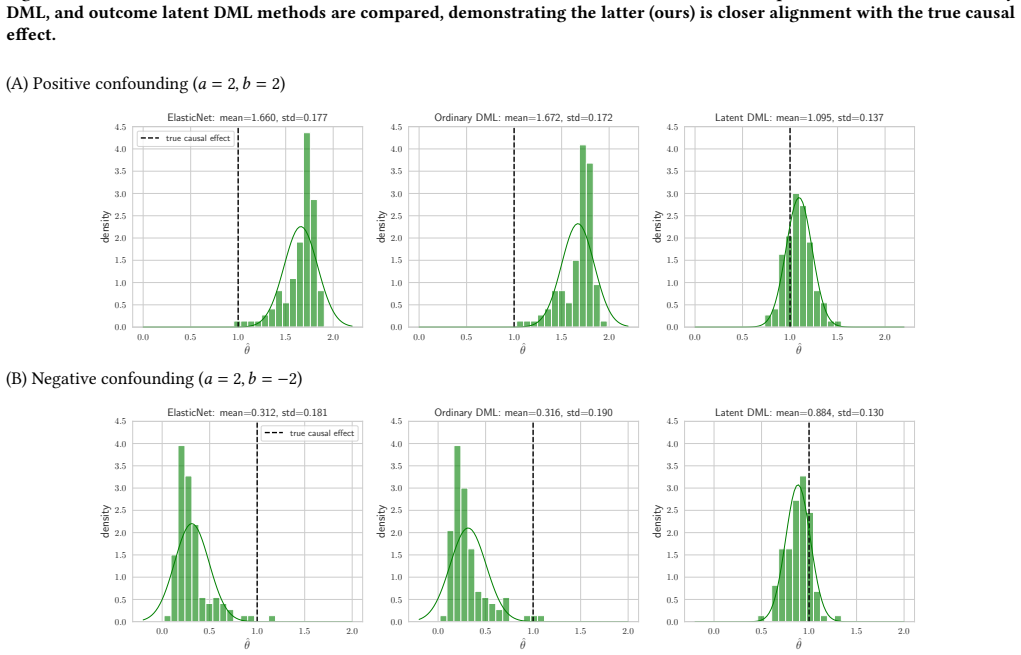
- With a well-specified latent model, the unconfoundedness condition $E[UV\mid X] = 0$ is no longer required: latent DML is consistent for $\theta$ even when a hidden factor drives both treatment and outcome, a regime where ordinary DML is inconsistent.
- Because the latent fit runs in the second stage only, the first-stage ML models are trained exactly once; latent DML inherits DML's computational decoupling and adds a single EM run on the residuals.
- The asymptotic variance formula of Theorem A.7 implies the latent adjustment narrows confidence intervals even when no confounding is present, since conditioning on the posterior of $Z$ reduces the variance of the estimating equation by the law of total variance.
- BIC selection between the outcome-latent and confounder-latent structures is claimed to stay reliable under misspecification, for instance with Laplace-distributed outcome noise, so the method can be applied without prior knowledge of the latent structure.
- In the real-data analyses, omitting covariates such as IRA participation (a treatment-outcome confounder) yields less bias than ordinary DML or coordinated DML, and the ad-timing effect on ROAS flips from an implausible positive value to the domain-expected negative value once the latent adjustment is applied.
Reading between the lines
- Editorial inference: the adjusted-residual construction is structurally a control-function estimator — the treatment residual acts as a noisy measurement of the hidden confounder — so latent DML should be directly comparable to econometric control-function and measurement-error estimators; the paper does not draw that connection or run that comparison.
- The variance-reduction argument points to a use the paper only mentions in passing: applying the latent second stage in settings with no confounding at all as a pure precision booster, for instance in randomized trials where unconfoundedness holds by design.
- A testable extension the paper does not run: generate the confounder as continuous but fit the shifted-Bernoulli model, and trace the bias of the causal estimate as the deviation grows; the paper's misspecification argument predicts gradual degradation, but its experiments cover only Laplace noise in the outcome-only setting, not misspecification of the confounder's support.
- Editorial flag: the main text reports the ROAS advertising effect at 'per 100 days' scales (positive 29.5%, negative 60.4%) while Table 2 labels its unit as 'per 10 days'; the scaling of the signed effects should be checked before the direction claim is used.
Signed reviews
Editorial analysis
A structured set of objections, weighed in public.
Referee Report
Summary. The paper proposes 'latent double machine learning' (latent DML), a modification of the double machine learning framework in which a latent variable model is fitted to the first-stage residuals and the outcome residual is adjusted by the conditional expectation of the latent contribution before the causal parameter is estimated via a score equation. Two instantiations are given: an outcome-only model with a shifted exponential latent variable, and a confounder model with a shifted Bernoulli latent variable affecting both treatment and outcome. The authors claim consistency and asymptotic normality of the resulting estimator under Neyman orthogonality, and support the method with synthetic experiments, a BIC-based model-selection procedure, and two real-data applications (401(k) participation and advertisement timing). The central theoretical claim is that, under correct specification, fitting the latent structure to the residuals removes the bias caused by unobserved confounding while retaining the computational decoupling of DML.
Significance. If the theoretical claims were established, the paper would offer a practically useful extension of DML to settings with latent structure: the second-stage-only modification is computationally attractive, the two parametric models are transparent and easy to interpret, and the synthetic results show clear bias reduction relative to ordinary DML in the confounded scenarios. The paper also deserves credit for spelling out the score equation, providing EM-based algorithms, including an explicit model-selection heuristic, and reporting replication-oriented experimental details. However, the theoretical guarantees are the main advertised contribution, and they are currently not connected to the algorithm that is actually implemented: the Neyman orthogonality proof does not account for the dependence of the adjustment term on the estimated residuals. In addition, two displayed formulas in Sections 3.2 and 3.3 appear to be incorrect as written, and the identifiability assumption that the theoretical results rely on is asserted rather than verified. These issues are load-bearing for the paper's central claims, although they are potentially fixable.
major comments (4)
- [§3.1, Eq. (12); Algorithm 2; §A.2 Lemma A.5] The Neyman orthogonality proof does not cover the estimator actually implemented. Lemma A.5 treats q_gamma(W)=E[f_u(Z)|W,gamma] as a function of the raw observation W, and the derivative with respect to s differentiates only the explicit h and m terms in Y-h and D-m. In Algorithm 2, however, the adjustment is computed as E[f_u(Z)|R_hat_i,V_hat_i,gamma_hat] with R_hat=Y-h_hat(X) and V_hat=D-m_hat(X), so q depends on the estimated nuisance functions through its arguments. Under a perturbation h->h+s xi_h, m->m+s xi_m, the derivative of E[phi] contains the additional terms -E[(partial q/partial R) V xi_h] and -E[(partial q/partial V) V xi_m]. In the confounder model of Section 3.3 these partial derivatives are generically nonzero, and conditions (19)-(20) do not make the extra terms vanish. Therefore Lemma A.5, and with it the consistency and asymptotic normality of Theorems A.6 and A.7, do not apply to Algorithm 2. The unbiasedness statement after Eq. (12) holds for oracle residuals R,V and the true gamma0, not for the plug-in residuals used in the algorithm.
- [§3.3, formula for pi_i] The displayed posterior probability pi_i = P(Z_i=1-q | R_hat_i,V_hat_i,theta,a,b,q,sigma_u,sigma_v) is not the posterior under the stated model. For q=1/2, the correct posterior log-odds for Z=1-q is [a(R-theta V)]/sigma_u^2 + [b V]/sigma_v^2, whereas the displayed exponential has the opposite sign. For q != 1/2, the term log(q/(1-q)) is also missing from the logistic argument. Since the adjusted residual R^z_i = R_hat_i - a(pi_i - q) uses pi_i, implementing this formula as written would not remove E[aZ|R,V] under the stated model. Please correct the formula or clarify the parametrization.
- [§3.2, Eq. (15) and following] The conditional expectation formula for the outcome latent model appears to be shifted. Under Eq. (15), Z has support [-beta, infinity), or equivalently T=Z+beta has support [0, infinity). The text states that E[Z_i | R_i,V_i,theta,beta,sigma] is the mean of a truncated normal N(m_i,sigma^2) truncated on [0, infinity), with m_i := R_i - theta V_i + beta - sigma^2/beta. This is at best a formula for a mean of T, not for the mean of Z; as written the adjustment in Eq. (12) is offset by beta and uses the wrong truncation point for Z. Please restate the formula with the correct support and offset.
- [Assumption A.4(a); Proposition B.2] Identification of the latent-variable parameters is load-bearing but is not actually verified. Proposition B.2 restates a standard local-identification result, but the application to the shifted exponential model and the shifted Bernoulli model is dismissed with the sentence that verification is 'straightforward' and no proof or computation is provided. Since the EM algorithm converges only to local maxima and Assumption A.4(a) requires the moment condition to vanish only at the true gamma0, the paper should show non-singularity of the relevant Fisher information (or otherwise establish local identification) for the specific models in Sections 3.2 and 3.3.
minor comments (4)
- [§3.1] The sentence 'the the nuisance components are estimated' contains a duplicated article; also the phrase 'unbiased estimate' is used where the argument establishes a conditional-moment property at the true parameter, not finite-sample unbiasedness for the implemented estimator.
- [§A.2] The text refers to 'late model parameters' where 'latent model parameters' is intended, and the second theorem in Section B.2.2 is labeled 'Theorem A.5 (Asymptotic Normality)' although it should be Theorem A.7.
- [§5.2.2 and Table 2] The table caption says the effect is 'percentage per 10 days' while the text reports 'per 100 days'; the units should be harmonized.
- [Algorithm 2 and Eq. (10)] The latent parameter gamma in Eq. (10) is said to include theta, yet Algorithm 2 first estimates gamma by minimizing L(gamma) and then solves Eq. (11) for theta separately; the relationship between the EM estimate of theta and the score-equation estimate should be clarified.
Circularity Check
No construction-level circularity found; latent DML's score equation is a genuine moment condition, and the caveats are proof gaps and self-consistency validation.
full rationale
The derivation chain is not circular at construction level. The causal effect theta is not an input fed into the latent model and then renamed as a prediction; rather theta is a parameter of the residual likelihood, and Eq. (11) is the first-order condition of that likelihood with respect to theta. At true gamma0, the unbiasedness identity E[Rz - theta V | V] = 0 follows from the tower property and the model (6), (9), (12), so the moment condition is a genuine identifying restriction rather than a restatement of the fitted adjustment. No load-bearing self-citation appears: the identification proposition invokes Rothenberg's classical theorem, and the DML framework cites external work; none of the key references are by the present authors. The main caveats are correctness and validation issues, not circularity. Lemma A.5 defines q_gamma(W) = E[fu(Z)|W,gamma] and differentiates only the explicit h and m terms, whereas Algorithm 2 evaluates E[fu|R_hat,V_hat,gamma_hat] with residuals depending on h_hat and m_hat, so the Neyman orthogonality proof as written does not cover the plug-in adjustment; this is a proof gap, not a reduction of the result to its inputs. Proposition B.2 says verification of local identifiability for the shifted-exponential and shifted-Bernoulli models is 'straightforward' but gives no proof, another omitted-support issue. The synthetic experiments are self-consistency checks because Section 5.1.1 generates noise from the same shifted-exponential and shifted-Bernoulli families used by the estimator, but this affects external validity rather than making the estimate equal to its input by construction. These omissions should be weighed as correctness risk, not as circularity.
Assumptions & free parameters
free parameters (7)
- beta =
estimated via EM with natural gradient
- sigma =
estimated via EM
- a =
estimated via EM
- b =
estimated via EM
- q =
estimated via EM with natural gradient
- sigma_u, sigma_v =
estimated via EM
- ElasticNet hyperparameters (alpha, l1_ratio) =
5-fold CV over {10^-2, 10^-1, 1, 10, 100} x {0, 0.25, 0.5, 0.75, 1}
assumptions (5)
- domain assumption Z, Wu, and Wv are mutually independent and independent of X (Eq. 9)
- domain assumption The true data-generating process is contained in the proposed parametric model family (Assumption A.1)
- domain assumption Local identification: Fisher information is non-singular and the moment condition E[psi(W,gamma,nu0)]=0 only at gamma0 (Assumption A.4(a), Proposition B.2)
- standard math Nuisance estimators are n^{1/4}-consistent and uniformly bounded (Assumption A.3)
- standard math Boundedness and differentiability of the moment function (Assumption A.4(b)-(d))
invented entities (1)
-
Latent variable Z (shifted exponential in outcome model, shifted Bernoulli in confounder model)
Cite this review
Pith. "Pith review of Latent Variable Modeling for Robust Causal Effect Estimation." pith.science (2026). https://pith.science/paper/WAW33K3B
@misc{pith2026250820259,
  author       = {Pith},
  title        = {Pith review of: Latent Variable Modeling for Robust Causal Effect Estimation},
  year         = {2026},
  howpublished = {\url{https://pith.science/paper/WAW33K3B}},
  note         = {Machine review of arXiv:2508.20259}
}
read the original abstract
Latent variable models provide a powerful framework for incorporating and inferring unobserved factors in observational data. In causal inference, they help account for hidden factors influencing treatment or outcome, thereby addressing challenges posed by missing or unmeasured covariates. This paper proposes a new framework that integrates latent variable modeling into the double machine learning (DML) paradigm to enable robust causal effect estimation in the presence of such hidden factors. We consider two scenarios: one where a latent variable affects only the outcome, and another where it may influence both treatment and outcome. To ensure tractability, we incorporate latent variables only in the second stage of DML, separating representation learning from latent inference. We demonstrate the robustness and effectiveness of our method through extensive experiments on both synthetic and real-world datasets.
Figures


Figures from the paper (1 more)

Reference graph
Works this paper leans on
-
[1]
Alberto Abadie. 2003. Semiparametric instrumental variable estimation of treat- ment response models. Journal of Econometrics 113, 2 (2003), 231–263
work page 2003
-
[2]
Alberto Abadie, Anish Agarwal, Raaz Dwivedi, and Abhin Shah. 2025. Doubly Robust Inference in Causal Latent Factor Models. arXiv preprint arXiv:2402.11652 (2025)
work page Pith review arXiv 2025
-
[3]
Muhammad Jehangir Amjad, Devavrat Shah, and Dennis Shen. 2018. Robust Synthetic Control. Journal of Machine Learning Research 19, 22 (2018), 1–51
work page 2018
-
[4]
Matthew Ashman, Chao Ma, Agrin Hilmkil, Joel Jennings, and Cheng Zhang
-
[5]
Susan Athey. 2017. Beyond prediction: Using big data for policy problems.Science 355, 6324 (2017), 483–485
work page 2017
-
[6]
Philipp Bach, Victor Chernozhukov, Sven Klaassen, Malte S. Kurz, and Martin Spindler. 2023. DoubleML: Data set on financial wealth and 401(k) plan partici- pation. https://docs.doubleml.org/stable/api/generated/doubleml.datasets.fetch_ 401K.html
work page 2023
-
[7]
Heather S Battey and Nancy Reid. 2024. On the role of parameterization in models with a misspecified nuisance component. Proceedings of the National Academy of Sciences 121, 36 (2024), e2402736121
work page 2024
-
[8]
Rudolf Beran. 1977. Minimum Hellinger distance estimates for parametric models. The Annals of Statistics 5, 3 (1977), 445–463
work page 1977
Show all 62 references
-
[9]
Christopher M. Bishop. 2006.Pattern Recognition and Machine Learning. Springer
2006
-
[10]
Brodersen, Fabian Gallusser, Jim Koehler, Nicolas Remy, and Steven L
Kay H. Brodersen, Fabian Gallusser, Jim Koehler, Nicolas Remy, and Steven L. Scott. 2015. Inferring causal impact using Bayesian structural time-series models. Annals of Applied Statistics 9 (2015), 247–274
2015
-
[11]
Andreas Buja, Richard Berk, Lawrence Brown, Edward George, Emil Pitkin, Mark Traskin, Linda Zhao, and Kai Zhang. 2019b. Models as approximations II: A model-free theory of parametric regression. Statist. Sci. 34, 4 (2019b), 545–565
2019
-
[12]
Andreas Buja, Lawrence Brown, Richard Berk, Edward George, Emil Pitkin, Mark Traskin, Kai Zhang, and Linda Zhao. 2019a. Models as approximations I: Consequences illustrated with linear regression. Statist. Sci. 34, 4 (2019a), 523–544
2019
-
[13]
Castro, Ian Walker, and Ben Glocker
Daniel C. Castro, Ian Walker, and Ben Glocker. 2020. Causality matters in medical imaging. Nature Communications 11, 3673 (2020)
2020
-
[14]
Neng-Chieh Chang. 2020. Double/debiased machine learning for difference- in-differences models. The Econometrics Journal 23 (2020), 177—-191. Issue 2
2020
-
[15]
Victor Chernozhukov, Denis Chetverikov, Mert Demirer, Esther Duflo andChris- tian Hansen, Whitney Newey, and James Robins. 2018. Double/debiased machine learning for treatment and structural parameters. The Econometrics Journal 21 (2018), C1–C68. Issue 1
2018
-
[16]
Victor Chernozhukov, Denis Chetverikov, Mert Demirer, Esther Duflo, Christian Hansen, Whitney Newey, and James Robins. 2018b. Double/debiased machine learning for treatment and structural parameters. The Econometrics Journal 21, 1 (2018b), C1–C68
2018
-
[17]
Victor Chernozhukov, Carlos Cinelli, Whitney Newey, Amit Sharma, and Vasilis Syrgkanis. 2021. Long Story Short: Omitted Variable Bias in Causal Machine Learning. arXiv preprint arXiv:2112.13398 (2021)
2021 arXiv
-
[18]
Victor Chernozhukov, Whitney Newey, Rahul Singh, and Vasilis Syrgkanis. 2020. Adversarial Estimation of Riesz Representers. arXiv preprint arXiv:2101.00009 (2020)
2020 arXiv
-
[19]
Chiang, Kengo Kato, Yukun Ma, and Yuya Sasaki
Harold D. Chiang, Kengo Kato, Yukun Ma, and Yuya Sasaki. 2021. Multiway Clus- ter Robust Double/Debiased Machine Learning. Journal of Business & Economic Statistics 40 (2021), 1046–1056. Issue 3
2021
-
[20]
Kyle Colangelo and Ying-Ying Lee. 2020. Double debiased machine learning non- parametric inference with continuous treatments.arXiv preprint arXiv:2004.03036 (2020)
2020 arXiv
-
[21]
Marleny Cuellar and Edward H. Kennedy. 2020. Propensity score estimation with boosted regression for evaluating causal effects in observational studies. Observational Studies 6 (2020), 80–98
2020
-
[22]
Davis and Sara B
Jonathan M.V. Davis and Sara B. Heller. 2017. Using Causal Forests to Predict Treatment Heterogeneity: An Application to Summer Jobs. American Economic Review 107, 5 (2017), 546–550
2017
-
[23]
Jau er Chen, Chien-Hsun Huang, and Jia-Jyun Tien. 2021. Debiased/Double Machine Learning for Instrumental Variable Quantile Regressions. Econometrics 9 (2021), 1–18. Issue 2
2021
-
[24]
Farrell, Tengyuan Liang, and Sanjog Misra
Max H. Farrell, Tengyuan Liang, and Sanjog Misra. 2021. Deep Neural Networks for Estimation and Inference. Econometrica 89 (2021), 181–213. Issue 1
2021
-
[25]
Nitai Fingerhut, Matteo Sesia, and Yaniv Romano. 2022. Coordinated Double Machine Learning. In International Conference on Machine Learning
2022
-
[26]
Dennis Frauen, Tobias Hatt, Valentyn Melnychuk, and Stefan Feuerriegel. 2023. Estimating Average Causal Effects from Patient Trajectories. In Proceedings of the AAAI Conference on Artificial Intelligence , Vol. 37. Issue 6
2023
-
[27]
Carlin, Hal S
Andrew Gelman, John B. Carlin, Hal S. Stern, David B. Dunson, Aki Vehtari, and Donald B. Rubin. 2013. Bayesian Data Analysis (3rd ed.). Chapman and Hall
2013
-
[28]
Duncan Sheppard Gilchrist and Emily Glassberg Sands. 2016. Something to Talk About: Social Spillovers in Movie Consumption. Journal of Political Economy 124, 5 (2016)
2016
-
[29]
Kazuharu Harada and Hironori Fujisawa. 2024. Outlier-Resistant Estimators for Average Treatment Effect in Causal Inference. Statistica Sinica 34 (2024), 133–155
2024
-
[30]
Trevor Hastie, Robert Tibshirani, and Jerome Friedman. 2009. The elements of statistical learning: Data mining, inference, and prediction . Springer
2009
-
[31]
Paul W. Holland. 1986. Statistics and Causal Inference. J. Amer. Statist. Assoc. 81 (1986), 945–960. Issue 396
1986
-
[32]
Peter J. Huber. 1967. The behavior of maximum likelihood estimates under non- standard conditions. Proceedings of the Fifth Berkeley Symposium on Mathematical Statistics and Probability 1 (1967), 221–233
1967
-
[33]
Imbens and Jeffrey M
Guido M. Imbens and Jeffrey M. Wooldridge. 2009. Recent Developments in the Econometrics of Program Evaluation. Journal of Economic Literature 47, 1 (2009), 5–86
2009
-
[34]
Nathan Kallus and Masatoshi Uehara. 2020. Double Reinforcement Learning for Efficient Off-Policy Evaluation in Markov Decision Processes. Journal of Machine Learning Research 21 (2020), 1–63. Issue 1
2020
-
[35]
Kennedy, Zeyu Ma, Matthew D
Edward H. Kennedy, Zeyu Ma, Matthew D. McHugh, and Dylan S. Small. 2019. Robust inference for generalized synthetic controls. J. Amer. Statist. Assoc. 114, 527 (2019), 1122–1131
2019
-
[36]
Yaroslav Kivva, , Saber Salehkaleybar, and Negar Kiyavash. 2023. A Cross- Moment Approach for Causal Effect Estimation. In Advances in Neural Informa- tion Processing Systems
2023
-
[37]
Durdane Kocacoban and James Cussens. 2019. Online Causal Structure Learning in the Presence of Latent Variables. In IEEE International Conference On Machine Learning And Applications
2019
-
[38]
Malte S. Kurz. 2021. Distributed Double Machine Learning with a Serverless Architecture. In International Conference on Performance Engineering
2021
-
[39]
Lanza and Brittany R
Stephanie T. Lanza and Brittany R. Cooper. 2016. Latent Class Analysis for Developmental Research. Child Development Perspectives 10 (2016), 59–64. Issue 1
2016
-
[40]
Greg Lewis and Vasilis Syrgkanis. 2021. Double/Debiased Machine Learning for Dynamic Treatment Effects. In Advances in Neural Information Processing Systems
2021
-
[41]
Christos Louizos, Uri Shalit, Joris Mooij, David Sontag, Richard Zemel, and Max Welling. 2017. Causal Effect Inference Deep Latent-Variable Models. In Advances in Neural Information Processing Systems
2017
-
[42]
Pawel Morzywolek, Johan Decruyenaere, and Stijn Vansteelandt. 2023. On a gen- eral class of orthogonal learners for the estimation of heterogeneous treatment effects. arXiv preprint arXiv:2303.12687 (2023)
2023 arXiv
-
[43]
Yusuke Narita, Shota Yasui, and Kohei Yata. 2021. Debiased Off-Policy Evaluation for Recommendation Systems. In ACM Conference on Recommender Systems
2021
-
[44]
van der Laan
Romain Neugebauer and Mark J. van der Laan. 2007. Inverse probability cross- validated targeted maximum-likelihood estimation. The International Journal of Biostatistics 3, 1 (2007)
2007
-
[45]
Judea Pearl. 2009. Causality. Cambridge University Press
2009
-
[46]
Victor Quintas-Martinez, Victor Chernozhukov, Vasilis Syrgkanis, and Whitney Newey. 2022. RieszNet and ForestRiesz: Automatic Debiased Machine Learning with Neural Nets and Random Forest. In International Conference on Machine Learning
2022
-
[47]
Rojas, and Ste- fan Bauer
Francesco Quinzan, Ashkan Soleymani, Patrick Jaillet, Cristian R. Rojas, and Ste- fan Bauer. 2023. DRCFS: Doubly Robust Causal Feature Selection. InInternational Conference on Machine Learning
2023
-
[48]
Alexander Rakhlin, Nathan Srebro, and Karthik Sridharan. 2017. Empirical entropy, minimax regret and minimax risk. Bernoulli 23, 2 (2017), 789–824
2017
-
[49]
Alessandro Rinaldo and Larry Wasserman. 2010. Generalized density clustering. Annals of Statistics 38, 5 (2010), 2678–2722
2010
-
[50]
Robinson
Peter M. Robinson. 1988. Root-N-Consistent Semiparametric Regression. Econo- metrica 56, 4 (1988), 931–954
1988
-
[51]
Thomas J Rothenberg. 1971. Identification in parametric models. Econometrica: Journal of the Econometric Society (1971), 577–591
1971
-
[52]
Vira Semenova and Victor Chernozhukov. 2021. Debiased Machine Learning of Conditional Average Treatment Effects and Other Causal Functions. The Latent Variable Modeling for Robust Causal Effect Estimation Econometrics Journal 24 (2021), 264–289. Issue 2
2021
-
[53]
Ladan Shams and Ulrik Beierholm. 2022. Bayesian causal inference: A unifying neuroscience theory. Neuroscience & Biobehavioral Reviews 137 (2022)
2022
-
[54]
Ashkan Soleymani, Anant Raj, Stefan Bauer, Bernhard Schölkopf, and Michel Besserve. 2023. Causal Feature Selection via Orthogonal Search. Transactions on Machine Learning Research (2023)
2023
-
[55]
Strobl and Thomas A
Eric V. Strobl and Thomas A. Lasko. 2023. Sample-Specific Root Causal Inference with Latent Variables. In Conference on Causal Learning and Reasoning
2023
-
[56]
van der Laan and Daniel Rubin
Mark J. van der Laan and Daniel Rubin. 2006. Targeted maximum likelihood estimation of a parameter of a marginal structural model. The International Journal of Biostatistics 2, 1 (2006)
2006
-
[57]
Weller, Natasha K
Bridget E. Weller, Natasha K. Bowen, and Sarah J. Faubert. 2020. Latent Class Analysis: A Guide to Best Practice. Journal of Black Psychology 46 (2020). Issue 4
2020
-
[58]
Halbert White. 1980. Using least squares to approximate unknown regression functions. International Economic Review (1980), 149–170
1980
-
[59]
Halbert White. 1982. Maximum likelihood estimation of misspecified models. Econometrica (1982), 1–25
1982
-
[60]
Liuyi Yao, Zhixuan Chu, Sheng Li, Yaliang Li, Jing Gao, and Aidong Zhang. 2021. A Survey on Causal Inference. ACM Transactions on Knowledge Discovery from Data 15, 74 (2021), 1–46. Issue 5
2021
-
[61]
Weijia Zhang, Jiuyong Li, and Lin Liu. 2021. A Unified Survey of Treatment Effect Heterogeneity Modelling and Uplift Modelling. Comput. Surveys 54, 162 (2021), 1–36. Issue 8. B Extended Appendix We provide additional information to complement the main paper, including experime...
2021
-
[2023]
In International Conference on Learning Representations
Causal Reasoning in the Presence of Latent Confounders via Neural ADMG Learning. In International Conference on Learning Representations
Reviewed August 15, 2026 · model on record in the stance chip above.
Discussion (0). Continue with ORCID to comment.