Using Symbolic Regression to Emulate the Radial Fourier Transform of the S\'ersic profile for Fast, Accurate and Differentiable Galaxy Profile Fitting
Pith reviewed 2026-05-18 20:46 UTC · model grok-4.3
The pith
Symbolic regression yields an equation that approximates the radial Fourier transform of the Sérsic profile.
A machine-rendered reading of the paper's core claim, the machinery that carries it, and where it could break.
Core claim
Symbolic regression applied to a dense numerical training set of radial Fourier transforms produces a closed-form equation that approximates the transform across the range of Sérsic indices and spatial frequencies encountered in real galaxy data. When this equation is substituted for direct numerical integration or expensive approximations inside a Fourier-space rendering pipeline, the full profile-fitting procedure runs substantially faster while returning essentially the same morphological parameters.
What carries the argument
The symbolic-regression-derived equation that emulates the radial Fourier transform of the Sérsic profile as a function of Sérsic index and spatial frequency k.
If this is right
- Morphological parameters of galaxies can be extracted 2.5 times faster than with previous rendering methods.
- The loss in accuracy remains small enough that scientific conclusions drawn from the fitted parameters are unchanged.
- Differentiability of the emulator allows gradient-based optimization to proceed without extra numerical overhead.
- The same rendering step scales directly to the data rates expected from future wide-field imaging surveys.
Where Pith is reading between the lines
- The same regression workflow could be repeated for other analytic light profiles that lack closed-form Fourier transforms.
- Replacing the current numerical training grid with an adaptive sampling strategy might further tighten the approximation error at high frequencies.
- Because the emulator is built only from elementary functions, it can be ported without change to any fitting code that already supports Fourier-space operations.
Load-bearing premise
The equation recovered by symbolic regression must remain accurate for every Sérsic index and every spatial frequency that actually occurs in observed galaxy images.
What would settle it
Compute the pointwise difference between the symbolic equation and a high-resolution numerical quadrature of the true radial Fourier integral for Sérsic indices spanning 0.5 to 8 and for k values up to the Nyquist frequency of typical survey pixels; if the maximum relative error exceeds the tolerance used in the fitting tests, the speed-up claim no longer holds.
Figures



read the original abstract
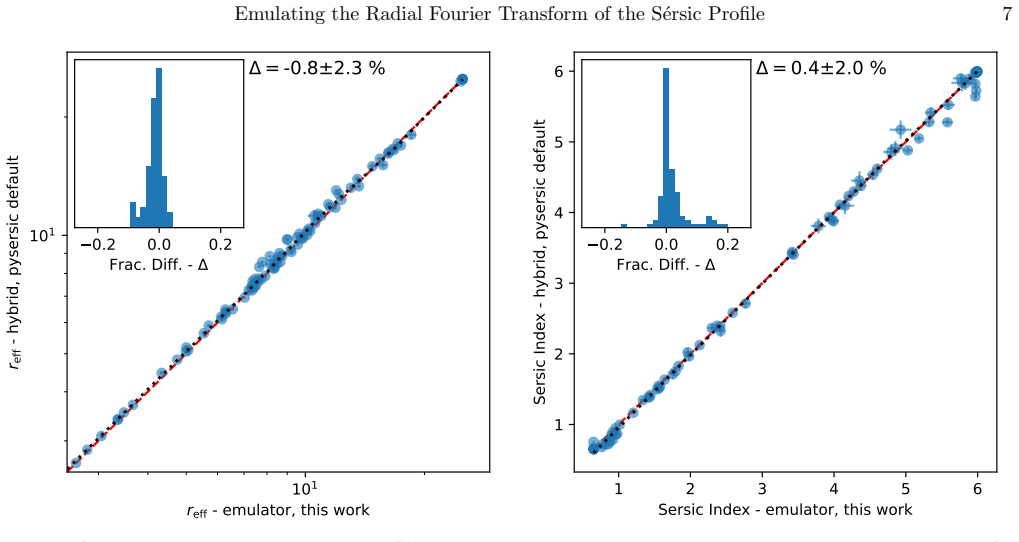
Galaxy profile fitting is a ubiquitous technique that provides the backbone for photometric and morphological measurements in modern extragalactic surveys. A recent innovation in profile fitting algorithms is to render, or create, the model profile in Fourier space, which aims to provide faster and more accurate results. However, the most common parameterization, the S\'ersic profile, has no closed form Fourier transform, requiring the use of computationally expensive approximations. In this paper our goal is to develop an emulator to mimic the radial Fourier transform of the S\'ersic profile, for use in profile fitting. We first numerically compute the radial Fourier transform and demonstrate that it varies smoothly as a function of the S\'ersic index and $k$, the spatial frequency coordinate. Using this set of numerically calculated transforms as a training set, we use symbolic regression to discover an equation which approximates its behavior. This ensures the emulator will be based on computationally efficient and differentiable building blocks. We implement this novel rendering method in the pysersic profile fitter, and ensure it is accurate by conducting both injection-recovery tests using model galaxy profiles and applying multiple rendering methods to a real sample of galaxies in HSC-SSP imaging. Crucially, the Fourier emulator rendering technique enables measurements of morphological parameters of galaxies 2.5 times faster than standard methods with minimal loss in accuracy. This increased performance while maintaining accuracy is a step that ensures these tools can continue to scale with the ever-increasing flow of incoming data.
Editorial analysis
A structured set of objections, weighed in public.
Referee Report
Summary. The manuscript develops an emulator for the radial Fourier transform of the Sérsic profile by first computing it numerically over a grid of Sérsic indices and spatial frequencies k, then applying symbolic regression to discover a closed-form approximating equation built from efficient, differentiable operations. This emulator is integrated into the pysersic profile-fitting code to enable Fourier-space rendering of galaxy models. The authors validate the approach via injection-recovery tests on simulated galaxies and by comparing fits to real HSC-SSP imaging using both the emulator and standard methods, reporting a 2.5× speed-up with minimal loss in accuracy.
Significance. If the emulator maintains sufficient accuracy across the parameter ranges encountered in real data, the work provides a practical route to scaling Fourier-space profile fitting to the data volumes expected from next-generation surveys. The use of symbolic regression to obtain an interpretable, differentiable approximation is a constructive contribution that could be adopted in other rendering contexts.
major comments (1)
- [Validation section] Validation section (injection-recovery and HSC-SSP tests): the reported performance metrics are averages; no maximum relative error, bias maps, or error distributions are shown specifically for n > 4 and intermediate k values (roughly 0.5–5) that dominate the likelihood surface for typical galaxy fits. Without these, it is not possible to confirm that downstream morphological parameters remain unbiased at the level implied by the “minimal loss in accuracy” claim.
minor comments (2)
- [Abstract] The abstract states that the transform “varies smoothly”; a brief quantitative statement of the smoothness (e.g., maximum second derivative or grid spacing used) would help readers assess the adequacy of the training-set density.
- [Methods] Notation for the spatial-frequency coordinate is introduced as k but later appears in figures without explicit definition of its normalization; a short clarifying sentence in the methods would remove ambiguity.
Simulated Author's Rebuttal
We thank the referee for their careful and constructive review of our manuscript. We have considered the major comment on the validation section and provide a point-by-point response below. We agree that additional detail will strengthen the paper and will incorporate the requested analyses in the revised manuscript.
read point-by-point responses
-
Referee: [Validation section] Validation section (injection-recovery and HSC-SSP tests): the reported performance metrics are averages; no maximum relative error, bias maps, or error distributions are shown specifically for n > 4 and intermediate k values (roughly 0.5–5) that dominate the likelihood surface for typical galaxy fits. Without these, it is not possible to confirm that downstream morphological parameters remain unbiased at the level implied by the “minimal loss in accuracy” claim.
Authors: We agree that reporting only average metrics leaves open the possibility of localized biases in the regimes most relevant to typical galaxy fits. In the revised manuscript we will add (i) maximum relative errors, (ii) two-dimensional bias maps in the (n, k) plane, and (iii) histograms of residuals, all restricted to n > 4 and 0.5 < k < 5. These quantities will be computed from the existing injection-recovery suite and from the HSC-SSP comparison sample, allowing direct assessment of whether morphological parameters remain unbiased at the level stated in the abstract. revision: yes
Circularity Check
No significant circularity; emulator derived from independent numerical training data with separate validation
full rationale
The paper first numerically computes the radial Fourier transform of the Sérsic profile as a function of index and frequency, assembles these values into a training set, and applies symbolic regression to discover an approximating functional form. This discovered equation is then implemented as an emulator inside the pysersic fitter and tested via injection-recovery experiments on model profiles plus direct comparison against other rendering methods on real HSC-SSP galaxies. None of the load-bearing steps reduce by construction to the target morphological parameters or to a self-citation chain; the numerical training data and downstream validation samples are generated independently of the final fitting results. The 2.5× speed-up claim therefore rests on external numerical and observational checks rather than tautological re-use of fitted quantities.
Axiom & Free-Parameter Ledger
free parameters (1)
- Sampling grid for Sérsic index and k in numerical training set
axioms (1)
- domain assumption The radial Fourier transform of the Sérsic profile varies smoothly as a function of Sérsic index and spatial frequency k
Lean theorems connected to this paper
-
IndisputableMonolith/Cost/FunctionalEquation.leanwashburn_uniqueness_aczel unclear?
unclearRelation between the paper passage and the cited Recognition theorem.
We use symbolic regression to discover an equation which approximates its behavior... ˜Fr(k, n) = 1 / (1 + e^G(k,n)) with G built from H and J containing exp, log, sqrt, n-powers (Eqs. 4-6)
-
IndisputableMonolith/Foundation/AlexanderDuality.leanalexander_duality_circle_linking unclear?
unclearRelation between the paper passage and the cited Recognition theorem.
Fr(k) = 2π ∫ I(R) J0(kR) R dR ... numerically computed via hankel package for training set
What do these tags mean?
- matches
- The paper's claim is directly supported by a theorem in the formal canon.
- supports
- The theorem supports part of the paper's argument, but the paper may add assumptions or extra steps.
- extends
- The paper goes beyond the formal theorem; the theorem is a base layer rather than the whole result.
- uses
- The paper appears to rely on the theorem as machinery.
- contradicts
- The paper's claim conflicts with a theorem or certificate in the canon.
- unclear
- Pith found a possible connection, but the passage is too broad, indirect, or ambiguous to say the theorem truly supports the claim.
Reference graph
Works this paper leans on
- [1]
-
[2]
Allen, N., Oesch, P. A., Toft, S., et al. 2024, arXiv e-prints, arXiv:2410.16354
-
[3]
Angelis, D., Sofos, F., & Karakasidis, T. E. 2023, Archives of Computational Methods in Engineering, 30, 3845
work page 2023
-
[4]
Baldwin, J. O., Nelson, E., Johnson, B. D., et al. 2024, forcepho: Generative modeling galaxy photometry for JWST, Astrophysics Source Code Library, record ascl:2410.006
work page 2024
-
[5]
Beers, T. C., Flynn, K., & Gebhardt, K. 1990, AJ, 100, 32
work page 1990
- [6]
-
[7]
Cappellari, M., McDermid, R. M., Alatalo, K., et al. 2013, MNRAS, 432, 1862
work page 2013
-
[8]
Chen, M., S. de Souza, R., Xu, Q., et al. 2024, Astronomy and Computing, 47, 100825
work page 2024
-
[9]
Interpretable Machine Learning for Science with PySR and SymbolicRegression.jl
Cranmer, M. 2023, arXiv e-prints, arXiv:2305.01582 De Cao, N., Aziz, W., & Titov, I. 2020, in Uncertainty in artificial intelligence, PMLR, 1263–1273 de Vaucouleurs, G. 1948, Annales d’Astrophysique, 11, 247
work page internal anchor Pith review Pith/arXiv arXiv 2023
- [10]
-
[11]
P., Bellstedt, S., Robotham, A
Driver, S. P., Bellstedt, S., Robotham, A. S. G., et al. 2022, MNRAS, 513, 439
work page 2022
-
[12]
2015, Astrophysical Journal, 799, 226
Erwin, P. 2015, Astrophysical Journal, 799, 226
work page 2015
-
[13]
NeuTra-lizing Bad Geometry in Hamiltonian Monte Carlo Using Neural Transport
Hoffman, M., Sountsov, P., Dillon, J. V., et al. 2019, arXiv e-prints, arXiv:1903.03704
work page internal anchor Pith review Pith/arXiv arXiv 2019
-
[14]
Hoffman, M. D., Blei, D. M., Wang, C., & Paisley, J. 2013, the Journal of machine Learning research, 14, 1303
work page 2013
-
[15]
Hoffman, M. D., Gelman, A., et al. 2014, J. Mach. Learn. Res., 15, 1593
work page 2014
- [16]
-
[17]
Kawinwanichakij, L., Silverman, J. D., Ding, X., et al. 2021, Astrophysical Journal, 921, 38
work page 2021
-
[18]
2020, arXiv e-prints, arXiv:2012.15797
Lang, D. 2020, arXiv e-prints, arXiv:2012.15797
-
[19]
Lang, D., Hogg, D. W., & Mykytyn, D. 2016, The Tractor: Probabilistic astronomical source detection and measurement, Astrophysics Source Code Library, record ascl:1604.008
work page 2016
-
[20]
Lange, R., Driver, S. P., Robotham, A. S. G., et al. 2015, Monthly Notices of the RAS, 447, 2603
work page 2015
- [21]
-
[22]
A., van Dokkum, P., Brammer, G
Mowla, L. A., van Dokkum, P., Brammer, G. B., et al. 2019, Astrophysical Journal, 880, 57
work page 2019
-
[23]
Murray, S. G., & Poulin, F. J. 2019, Journal of Open Source Software, 4, 1397
work page 2019
-
[24]
2005, Publications of the Research Institute for Mathematical Sciences, 41, 949
Ogata, H. 2005, Publications of the Research Institute for Mathematical Sciences, 41, 949
work page 2005
-
[25]
Pasha, I., & Miller, T. B. 2023, The Journal of Open Source Software, 8, 5703
work page 2023
- [26]
-
[27]
Composable Effects for Flexible and Accelerated Probabilistic Programming in NumPyro
Phan, D., Pradhan, N., & Jankowiak, M. 2019, arXiv preprint arXiv:1912.11554
work page internal anchor Pith review Pith/arXiv arXiv 2019
-
[28]
Driver, S. P. 2017, Monthly Notices of the RAS, 466, 1513
work page 2017
-
[29]
Rowe, B. T. P., Jarvis, M., Mandelbaum, R., et al. 2015, Astronomy and Computing, 10, 121 S´ ersic, J. L. 1963, Boletin de la Asociacion Argentina de Astronomia La Plata Argentina, 6, 41
work page 2015
-
[30]
Sersic, J. L. 1968, Atlas de Galaxias Australes
work page 1968
-
[31]
Shajib, A. J. 2019, Monthly Notices of the RAS, 488, 1387
work page 2019
-
[32]
Spergel, D. N. 2010, ApJS, 191, 58
work page 2010
-
[33]
J., Courteau, S., Cuillandre, J.-C., et al
Stone, C. J., Courteau, S., Cuillandre, J.-C., et al. 2023, MNRAS, 525, 6377
work page 2023
-
[34]
2024, A&A, 684, A23 10 Miller & Pasha
Tan, Q.-H., Daddi, E., de Souza Magalh˜ aes, V., et al. 2024, A&A, 684, A23 10 Miller & Pasha
work page 2024
-
[35]
Ward, E., de la Vega, A., Mobasher, B., et al. 2024, ApJ, 962, 176 Weaver, J. R., Kauffmann, O. B., Ilbert, O., et al. 2022, ApJS, 258, 11 This paper was built using the Open Journal of As- trophysics LATEX template. The OJA is a journal which provides fast and easy peer review for new papers in the astro-ph section of the arXiv, making the reviewing pro-...
work page 2024
discussion (0)
Sign in with ORCID, Apple, or X to comment. Anyone can read and Pith papers without signing in.