REVIEW 3 major objections 6 minor 45 references
Disentangling Latent Embeddings with Sparse Linear Concept Subspaces (SLiCS)
T0 review · 3 major / 6 minor · reviewed 2026-08-15 · deepseek-v4-flash
Pith's one-line read The paper claims that a dense image embedding can be approximated as a sum of concept-specific positive-cone components, and that retrieving with one such component is more precise than retrieving with the whole embedding.
desk verdict Useful retrieval technique, but the stated disentanglement claim is not supported by the headline experiments. read the letter →
The pith
A machine-rendered reading of the paper's core claim, the machinery that carries it, and where it could break.
The reading
What carries the argument
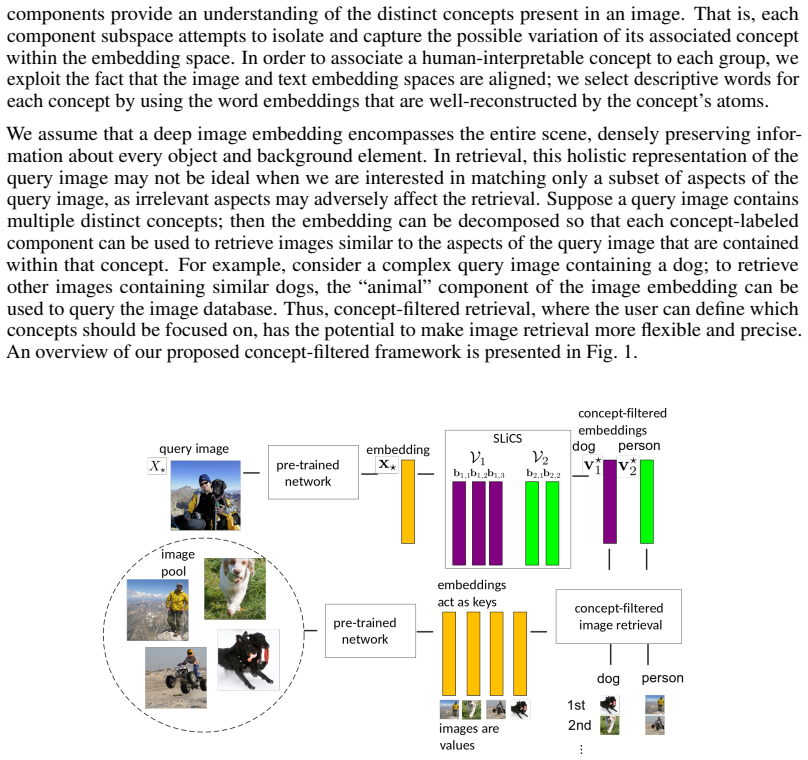
The machinery is a group-structured semi-non-negative dictionary: a global dictionary $B$ is partitioned into blocks $B_j$, each block spanning the positive cone $\{B_j a : a \ge 0\}$ for one concept, and coefficients are constrained to be non-negative and group-sparse according to the label vector. The optimization alternates a non-negative least-squares step for the coefficients with a K-SVD-style atom update in which each atom is refreshed from the rank-1 truncated SVD of the residual restricted to samples where that atom is active; a majority-sign rule for the atom's polarity is proved optimal, and thresholding restores the non-negativity of the coefficients. The component used for retrieval is the partial projection $\tilde{v}^\star_j = B_j \alpha_j$ obtained by solving the non-negative least-squares problem $\min_{a \ge 0} \|x^\star - B_j a\|^2$, which keeps the component close to the query while masking out other concepts.
What would settle it
Build paired queries that are the same scene with and without one added concept (for example, a person in an otherwise identical room), then compare the difference of the two SLiCS decompositions to the person concept's component; if adding the person substantially changes the other concepts' components or the difference is not close to the person cone, the additive model fails.
Extended reading notes
Core claim
The paper's central claim is the linear synthesis model $x^\star \approx \sum_{j=1}^S B_j \alpha_j$, in which an embedding is decomposed into $S$ concept components, with $B_j$ the dictionary of atoms for concept $j$ and $\alpha_j$ a non-negative coefficient vector that is zero when the concept is absent. The discovery is that this group-structured, non-negative decomposition can be learned and is useful: the proposed SLiCS algorithm initializes each concept's atoms by truncated SVD on embeddings that contain that concept, then alternates non-negative least-squares coefficient updates and K-SVD-style atom updates, using a provably optimal sign choice followed by thresholding to keep coefficients non-negative. Given the learned dictionaries, approximating a query embedding with only one concept's cone yields a component that isolates that concept, and retrieval ranked by cosine similarity to this component outperforms retrieval with the whole embedding for concept-specific queries.
Load-bearing premise
The load-bearing premise is that a dense image embedding is well approximated by a non-negative sum of concept-specific components; if concepts compose non-additively, interact during encoding, or leave negative semantic traces, the learned components are fitting artifacts rather than true concept separation.
Editorial extensions
If this is right
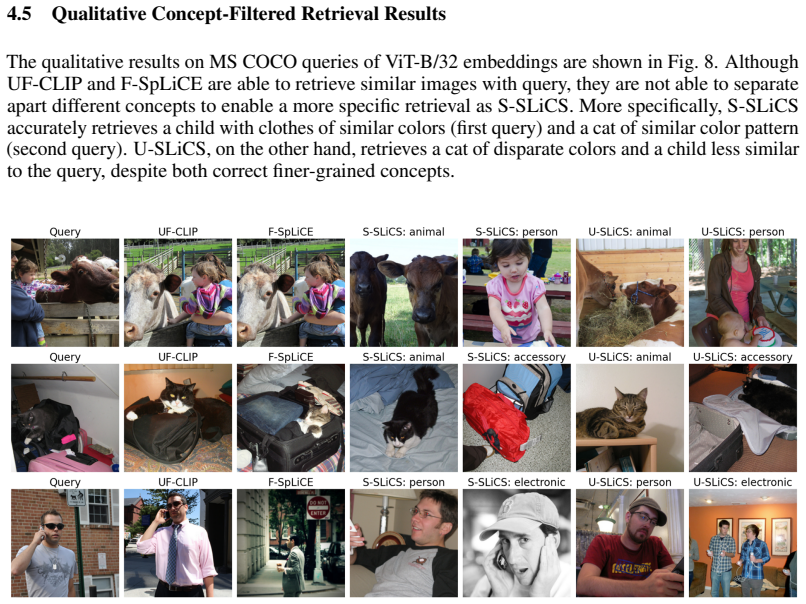
- Concept-filtered retrieval becomes a practical query mode: ranking candidates by cosine similarity to the query's concept component rather than to the whole embedding, with reported mAP@20 gains such as 0.895 versus 0.728 on MIRFlickr25K and 0.929 versus 0.791 on MS COCO for CLIP ViT-B/32.
- Training labels can be replaced by pseudo-labels: zero-shot classification of concept text embeddings against training images supplies the group-sparsity pattern, so the same dictionary learning runs without manual annotation beyond a list of concept names.
- The same decomposition applies across embedding families, including contrastive CLIP, self-supervised DINOv2, and highly compressed TiTok token embeddings, with DINOv2 yielding the highest filtered retrieval in the reported experiments.
- Each concept cone can be assigned human-readable words: the concept atoms that best reconstruct text embeddings of frequent words yield subspace captions consistent across supervised and unsupervised training.
- Disentangled concept components can drive conditional generation by converting a component into a prompt for a latent diffusion model after an orthogonal Procrustes alignment of the image and text spaces.
Reading between the lines
- Editorial inference: the additive cone model implies a compositional test: if concept components truly sum, removing one concept's component from an embedding should erase that concept from retrieval while leaving other concepts intact, a property that is implied but not directly measured in the paper.
- Editorial inference: because the non-negative cone can only add presence, concept-filtered retrieval for negated queries (images without a concept) would need an explicit complement subspace, which is a natural extension not addressed by SLiCS as described.
- Editorial inference: applying SLiCS to multiple encoders for the same concept could expose whether different vision models build aligned or incompatible concept geometry, turning the method into a comparative probe of embedding spaces.
- Editorial inference: the near-orthogonality of atoms within a concept group and the group-structured co-occurrence pattern suggest the learned cones behave like simplex codes; if that structure is consistent, concept arithmetic in the embedding space should support editing operations such as swapping one concept for another.
Signed reviews
Editorial analysis
A structured set of objections, weighed in public.
Referee Report
Summary. The paper proposes SLiCS (Sparse Linear Concept Subspaces), a supervised dictionary-learning method that decomposes a dense image embedding into a sum of concept-specific components, each a non-negative combination of atoms associated with one concept. The method is applied to CLIP, TiTok, and DINOv2 embeddings, and is evaluated primarily through concept-filtered image retrieval (mAP@20), qualitative word-caption interpretation of learned subspaces, and image-to-prompt generation. An unsupervised variant uses CLIP zero-shot classification to generate pseudo-labels. The central claims are that the learned decomposition is semantically meaningful, that concept-filtered retrieval improves over unfiltered CLIP and SpLiCE baselines, and that the proposed alternating optimization has guaranteed convergence.
Significance. If the linear additive model of Eq. (1) is valid, SLiCS would provide a practical tool for interpreting dense visual embeddings and for concept-focused retrieval without retraining the backbone. The paper's strengths are its breadth of empirical evaluation across three embedding families (CLIP, TiTok, DINOv2), consistent mAP@20 improvements over UF-CLIP, SpLiCE, and F-SpLiCE, the inclusion of a rank-1 sign-optimality proof in §3.3.1, and the practical extension to product-quantized candidate pools for TiTok. However, the current experiments mostly validate a weaker statement: per-concept positive-cone projections are useful retrieval filters. The full additive-decomposition claim, including support recovery and cross-concept isolation, is not directly tested, and the convergence guarantee in §3.3.2 does not apply to the algorithm variant that is actually run.
major comments (3)
- [§3.2 and §3.5, Table 2] The headline retrieval results are computed with the partial projection ṽ*_j from Eq. (3), not with the joint additive component v*_j = B_j α_j from Eq. (2). Because the concept cones can overlap, ṽ*_j is the point in one cone closest to the whole embedding and can carry information about concepts other than j; Fig. 7 confirms that this partial projection outperforms the joint component for retrieval. Consequently, the mAP gains reported in Tables 2–4 are consistent with the much weaker claim that supervised per-concept positive-cone projections are effective retrieval filters, and they do not establish Eq. (1) as a faithful decomposition, nor do they establish that α_j = 0 iff concept j is absent. Please report retrieval using v*_j from Eq. (2), report reconstruction error of Eq. (1) on held-out data, and evaluate support recovery (active/inactive concept classification) against ground-truth labels.
- [§3.3.2 and Abstract] The claimed convergence guarantee applies only to the cyclic-minimizer variant that includes the error-reduction check in Eq. (13), but the text immediately states: 'In practice, we let the algorithm proceed with an atom update without checking if it will increase the reconstruction error.' Therefore the algorithm actually run, and for which all experimental results are reported, has no proven convergence guarantee. The abstract's statement that the dictionary is 'optimized through a novel alternating optimization with guaranteed convergence' is thus an overstatement. Please either run the version with the check and report the effect on accuracy, or revise the convergence claim to describe the checked variant and provide empirical convergence evidence for the unchecked variant.
- [§3.1–§3.2 and §4.4] The load-bearing premise of the paper is the linear additive synthesis model x* ≈ Σ_j B_j α_j with non-negative group-sparse coefficients. This assumption is not validated directly anywhere in the manuscript. No quantitative reconstruction error for Eq. (1) is reported for any embedding, no comparison is made against unconstrained linear subspaces or a simple per-concept non-negative projection baseline of matched capacity, and no test is provided showing that the estimated α_j is zero exactly when the ground-truth label is absent. Without such evidence, the 'disentanglement' interpretation of the learned components remains an artifact hypothesis. Please add these direct measurements and ablations, or substantially soften the disentanglement claims.
minor comments (6)
- [Algorithm 1] In the atom-update step, the support set is defined as L_m ← {l ∈ {1,...,M} : A_ml ≠ 0}; this should be over training samples, i.e., l ∈ {1,...,N}, not over atoms.
- [§5] The dataset name is misspelled as 'MIRFlikr25K' in the conclusion; it should be 'MIRFlickr25K'.
- [Figure 4] The caption of Fig. 4 lists panels (a), (c), and (d) with d0 = 2, d0 = 5, and d0 = 20, but there is no panel (b) described, and the text refers to 'Fig. 4(b)' in §4.2. Please fix the panel labels and the corresponding in-text references.
- [§4.1] The sentence '6 concepts have have finer-grained labels' contains a duplicated word and should read '6 concepts have finer-grained labels.'
- [§3.4] The 'unsupervised' variant requires the set of concept words and the expected number of active concepts S̃ to be known in advance, and it uses CLIP text embeddings to generate pseudo-labels. This is more accurately described as zero-shot-supervised or pseudo-supervised; the current terminology may overstate the degree of unsupervised learning.
- [Table 1] Some unsupervised word captions are clearly not semantically consistent with their subspace (e.g., 'aircraft', 'plane', and 'airplanes' assigned to 'electronic' and 'appliance'). The text mentions this briefly but could analyze it more explicitly as evidence about pseudo-label noise and its effects on disentanglement quality.
Circularity Check
Partial self-definition in the unsupervised variant; the supervised retrieval evaluation is otherwise independent of the model inputs.
-
self definitional
[Section 3.4 (Unsupervised Dictionary Learning via Zero-shot Concept Classification), used with Eq. (4); Section 4.4 sets tilde-S from ground-truth label counts.]
"we also implement an essentially unsupervised version by exploiting the image-text alignment of CLIP if the set of concepts and the expected number of active concepts are known. ... The cosine similarity between an image embedding and each text embedding serves as a measurement of how close the word is to the image. ... since there are multiple concepts presented in each image we pick the highest tilde-S concepts as active. Thus, a pseudo-label is formed to enable the unsupervised SLiCS with the same algorithm as the supervised one."
In U-SLiCS, the multi-labels that supervise dictionary learning (Eq. 4) are generated by ranking CLIP cosine similarities between the same image embeddings and the CLIP text embeddings of the concept words, then taking the top tilde-S. The learned concept subspaces are therefore, by construction, directions in CLIP space that best reconstruct the very CLIP embeddings that CLIP's own text similarity already flagged for that concept; the 'unsupervised' discovery of concepts partly restates the pseudo-label construction. This is compounded by setting tilde-S from the dataset's ground-truth average number of concepts per image (2.467 for MIRFlickr25K and 2.303 for MS COCO), leaking label statistics into the 'unsupervised' pipeline.
full rationale
No significant circularity is found in the central derivation or in the supervised evaluation. The dictionary is fit on training images with either external labels or pseudo-labels, and concept-filtered retrieval is scored against held-out dataset ground-truth labels on a disjoint query/candidate split, so the reported mAP gains are not forced by the fitting procedure. The linear additive model (Eq. 1) is an explicit assumption that is tested indirectly through retrieval, not an input masquerading as a prediction. The paper's own admission that the convergence guarantee in Sec. 3.3.2 requires an error-reduction check that the authors skip in practice is a rigor/evidence gap, not a circular reduction. Similarly, the fact that the main retrieval uses the partial cone projection v-tilde*_j (Eq. 3) rather than the joint component v*_j (Eq. 2) is an overclaim/mismatch between the headline decomposition and the evaluated operation, but it does not make the result equivalent to the method's inputs. The only partial circularity is the unsupervised pseudo-label path described above, which does not determine the central supervised results.
Assumptions & free parameters
free parameters (3)
- d0 (atoms per concept) =
Optimal values from validation, e.g., between 5 and 20 (chosen per dataset/model; see Fig. 6)
- ~S (number of active concepts per image, unsupervised SLiCS) =
2 for both MIRFlickr25K and MS COCO
- Training iterations T =
10
assumptions (5)
- domain assumption The embedding x* is approximately a non-negative sum of concept-specific components, each lying in a positive cone (Eq. 1).
- domain assumption Non-negative coefficients correspond to semantic presence, and negative coefficients would imply semantic negation.
- domain assumption CLIP zero-shot classification with the top ~S concept words yields acceptable pseudo-labels for unsupervised training.
- domain assumption The orthogonal Procrustes alignment (Section 3.7) maps image-space components into Stable Diffusion's text prompt space accurately enough for generation.
- standard math Eckart-Young-Mirsky theorem and NNLS convexity.
Cite this review
Pith. "Pith review of Disentangling Latent Embeddings with Sparse Linear Concept Subspaces (SLiCS)." pith.science (2026). https://pith.science/paper/CPIZIJVO
@misc{pith2026250820322,
  author       = {Pith},
  title        = {Pith review of: Disentangling Latent Embeddings with Sparse Linear Concept Subspaces (SLiCS)},
  year         = {2026},
  howpublished = {\url{https://pith.science/paper/CPIZIJVO}},
  note         = {Machine review of arXiv:2508.20322}
}
read the original abstract
Vision-language co-embedding networks, such as CLIP, provide a latent embedding space with semantic information that is useful for downstream tasks. We hypothesize that the embedding space can be disentangled to separate the information on the content of complex scenes by decomposing the embedding into multiple concept-specific component vectors that lie in different subspaces. We propose a supervised dictionary learning approach to estimate a linear synthesis model consisting of sparse, non-negative combinations of groups of vectors in the dictionary (atoms), whose group-wise activity matches the multi-label information. Each concept-specific component is a non-negative combination of atoms associated to a label. The group-structured dictionary is optimized through a novel alternating optimization with guaranteed convergence. Exploiting the text co-embeddings, we detail how semantically meaningful descriptions can be found based on text embeddings of words best approximated by a concept's group of atoms, and unsupervised dictionary learning can exploit zero-shot classification of training set images using the text embeddings of concept labels to provide instance-wise multi-labels. We show that the disentangled embeddings provided by our sparse linear concept subspaces (SLiCS) enable concept-filtered image retrieval (and conditional generation using image-to-prompt) that is more precise. We also apply SLiCS to highly-compressed autoencoder embeddings from TiTok and the latent embedding from self-supervised DINOv2. Quantitative and qualitative results highlight the improved precision of the concept-filtered image retrieval for all embeddings.
Figures


Figures from the paper (8 more)




Reference graph
Works this paper leans on
- [1]
-
[2]
Effective conditioned and composed image retrieval combining CLIP -based features
Alberto Baldrati, Marco Bertini, Tiberio Uricchio, and Alberto Del Bimbo. Effective conditioned and composed image retrieval combining CLIP -based features. In 2022 IEEE/CVF Conference on Computer Vision and Pattern Recognition (CVPR), pages 21434--21442, 2022. doi:10.1109/CVPR52688.2022.02080
arXiv 2022
-
[3]
Calmon, and Himabindu Lakkaraju
Usha Bhalla, Alex Oesterling, Suraj Srinivas, Flavio P. Calmon, and Himabindu Lakkaraju. Interpreting CLIP with sparse linear concept embeddings ( SpLiCE ). In A. Globerson, L. Mackey, D. Belgrave, A. Fan, U. Paquet, J. Tomczak, and C. Zhang, editors, Advances in Neural Information Processing Systems, volume 37, pages 84298--84328. Curran Associates, Inc....
work page 2024
-
[4]
A fast non-negativity-constrained least squares algorithm
Rasmus Bro and Sijmen De Jong. A fast non-negativity-constrained least squares algorithm. Journal of Chemometrics, 11 0 (5): 0 393--401, 1997. doi:https://doi.org/10.1002/(SICI)1099-128X(199709/10)11:5<393::AID-CEM483>3.0.CO;2-L. URL https://analyticalsciencejournals.onlinelibrary.wiley.com/doi/abs/10.1002/
-
[5]
Multidimensional independent component analysis
J-F Cardoso. Multidimensional independent component analysis. In Proceedings of the 1998 IEEE International Conference on Acoustics, Speech and Signal Processing, ICASSP'98 (Cat. No. 98CH36181), volume 4, pages 1941--1944. IEEE, 1998
work page 1998
-
[6]
Unsupervised learning of visual features by contrasting cluster assignments
Mathilde Caron, Ishan Misra, Julien Mairal, Priya Goyal, Piotr Bojanowski, and Armand Joulin. Unsupervised learning of visual features by contrasting cluster assignments. Advances in neural information processing systems, 33: 0 9912--9924, 2020
2020
-
[7]
Image retrieval for complex queries using knowledge embedding
Chandramani Chaudhary, Poonam Goyal, Navneet Goyal, and Yi-Ping Phoebe Chen. Image retrieval for complex queries using knowledge embedding. ACM Trans. Multimedia Comput. Commun. Appl., 16 0 (1), mar 2020. ISSN 1551-6857. doi:10.1145/3375786. URL https://doi.org/10.1145/3375786
-
[8]
A simple framework for contrastive learning of visual representations
Ting Chen, Simon Kornblith, Mohammad Norouzi, and Geoffrey Hinton. A simple framework for contrastive learning of visual representations. In International Conference on Machine Learning, pages 1597--1607. PMLR, 2020 a
work page 2020
Show all 45 references
-
[9]
Improved baselines with momentum contrastive learning
Xinlei Chen, Haoqi Fan, Ross Girshick, and Kaiming He. Improved baselines with momentum contrastive learning. arXiv preprint arXiv:2003.04297, 2020 b
2003 arXiv
-
[10]
An empirical study of training self-supervised vision transformers
Xinlei Chen, Saining Xie, and Kaiming He. An empirical study of training self-supervised vision transformers. In Proceedings of the IEEE/CVF international conference on computer vision, pages 9640--9649, 2021
2021
-
[11]
Embedding arithmetic of multimodal queries for image retrieval
Guillaume Couairon, Matthijs Douze, Matthieu Cord, and Holger Schwenk. Embedding arithmetic of multimodal queries for image retrieval. In 2022 IEEE/CVF Conference on Computer Vision and Pattern Recognition Workshops (CVPRW), pages 4946--4954, 2022. doi:10.1109/CVPRW56347.2022.00542
2022
-
[12]
Convex and semi-nonnegative matrix factorizations
Chris HQ Ding, Tao Li, and Michael I Jordan. Convex and semi-nonnegative matrix factorizations. IEEE Transactions on Pattern Analysis and Machine Intelligence, 32 0 (1): 0 45--55, 2008
2008
-
[13]
The CLIP model is secretly an image-to-prompt converter
Yuxuan Ding, Chunna Tian, Haoxuan Ding, and Lingqiao Liu. The CLIP model is secretly an image-to-prompt converter. In Thirty-seventh Conference on Neural Information Processing Systems, 2023. URL https://openreview.net/forum?id=lHa7gFbmvS
2023
-
[14]
Taming transformers for high-resolution image synthesis
Patrick Esser, Robin Rombach, and Bjorn Ommer. Taming transformers for high-resolution image synthesis. In Proceedings of the IEEE/CVF Conference on Computer Vision and Pattern Recognition, pages 12873--12883, 2021
2021
-
[15]
Efros, and Jacob Steinhardt
Yossi Gandelsman, Alexei A. Efros, and Jacob Steinhardt. Interpreting CLIP 's image representation via text-based decomposition. In The Twelfth International Conference on Learning Representations, 2024. URL https://openreview.net/forum?id=5Ca9sSzuDp
2024
-
[16]
Exact and heuristic algorithms for semi-nonnegative matrix factorization
Nicolas Gillis and Abhishek Kumar. Exact and heuristic algorithms for semi-nonnegative matrix factorization. SIAM Journal on Matrix Analysis and Applications, 36 0 (4): 0 1404--1424, 2015
2015
-
[17]
Clip won't learn object-attribute binding from natural data and here is why
Bijay Gurung, David T Hoffmann, and Thomas Brox. Clip won't learn object-attribute binding from natural data and here is why. arXiv preprint arXiv:2507.07985, 2025
2025 arXiv
-
[18]
Noise-contrastive estimation: A new estimation principle for unnormalized statistical models
Michael Gutmann and Aapo Hyv \"a rinen. Noise-contrastive estimation: A new estimation principle for unnormalized statistical models. In Proceedings of the Thirteenth International Conference on Artificial Intelligence and Statistics, pages 297--304. JMLR Workshop and Conferen...
2010
-
[19]
Ridge regression: Biased estimation for nonorthogonal problems
Arthur E Hoerl and Robert W Kennard. Ridge regression: Biased estimation for nonorthogonal problems. Technometrics, 12 0 (1): 0 55--67, 1970
1970
-
[20]
Sparse autoencoders find highly interpretable features in language models
Robert Huben, Hoagy Cunningham, Logan Riggs Smith, Aidan Ewart, and Lee Sharkey. Sparse autoencoders find highly interpretable features in language models. In The Twelfth International Conference on Learning Representations, 2024. URL https://openreview.net/forum?id=F76bwRSLeK
2024
-
[21]
Huiskes and Michael S
Mark J. Huiskes and Michael S. Lew. The MIR Flickr retrieval evaluation. In MIR '08: Proceedings of the 2008 ACM International Conference on Multimedia Information Retrieval, New York, NY, USA, 2008. ACM
2008
-
[22]
Emergence of phase-and shift-invariant features by decomposition of natural images into independent feature subspaces
Aapo Hyv \"a rinen and Patrik Hoyer. Emergence of phase-and shift-invariant features by decomposition of natural images into independent feature subspaces. Neural Computation, 12 0 (7): 0 1705--1720, 2000
2000
-
[23]
Product quantization for nearest neighbor search
Herve Jegou, Matthijs Douze, and Cordelia Schmid. Product quantization for nearest neighbor search. IEEE Transactions on Pattern Analysis and Machine Intelligence, 33 0 (1): 0 117--128, 2010
2010
-
[24]
Vo, Patrick Labatut, and Piotr Bojanowski
Cijo Jose, Th \'e o Moutakanni, Dahyun Kang, Federico Baldassarre, Timoth \'e e Darcet, Hu Xu, Shang-Wen Li, Marc Szafraniec, Michael Ramamonjisoa, Maxime Oquab, Oriane Sim'eoni, Huy V. Vo, Patrick Labatut, and Piotr Bojanowski. DINOv2 meets text: A unified framework for image...
2025
-
[25]
InDiReCT : Language-guided zero-shot deep metric learning for images
Konstantin Kobs, Michael Steininger, and Andreas Hotho. InDiReCT : Language-guided zero-shot deep metric learning for images. In 2023 IEEE/CVF Winter Conference on Applications of Computer Vision (WACV), pages 1063--1072, 2023. doi:10.1109/WACV56688.2023.00112
2023
-
[26]
Mind the gap: Understanding the modality gap in multi-modal contrastive representation learning
Victor Weixin Liang, Yuhui Zhang, Yongchan Kwon, Serena Yeung, and James Y Zou. Mind the gap: Understanding the modality gap in multi-modal contrastive representation learning. In S. Koyejo, S. Mohamed, A. Agarwal, D. Belgrave, K. Cho, and A. Oh, editors, Advances in Neural In...
2022
-
[27]
Lawrence Zitnick
Tsung-Yi Lin, Michael Maire, Serge Belongie, James Hays, Pietro Perona, Deva Ramanan, Piotr Doll \'a r, and C. Lawrence Zitnick. Microsoft COCO : Common objects in context. In David Fleet, Tomas Pajdla, Bernt Schiele, and Tinne Tuytelaars, editors, Computer Vision -- ECCV 2014...
2014
-
[28]
Image retrieval on real-life images with pre-trained vision-and-language models
Zheyuan Liu, Cristian Rodriguez-Opazo, Damien Teney, and Stephen Gould. Image retrieval on real-life images with pre-trained vision-and-language models. In 2021 IEEE/CVF International Conference on Computer Vision (ICCV), pages 2105--2114, 2021. doi:10.1109/ICCV48922.2021.00213
2021
-
[29]
Mallat and Zhifeng Zhang
S.G. Mallat and Zhifeng Zhang. Matching pursuits with time-frequency dictionaries. IEEE Transactions on Signal Processing, 41 0 (12): 0 3397--3415, 1993. doi:10.1109/78.258082
1993 doi
-
[30]
Dinov2: Learning robust visual features without supervision
Maxime Oquab, Timoth \'e e Darcet, Th \'e o Moutakanni, Huy Vo, Marc Szafraniec, Vasil Khalidov, Pierre Fernandez, Daniel Haziza, Francisco Massa, Alaaeldin El-Nouby, et al. Dinov2: Learning robust visual features without supervision. arXiv preprint arXiv:2304.07193, 2023
2023 arXiv
-
[31]
Orthogonal matching pursuit: Recursive function approximation with applications to wavelet decomposition
Yagyensh Chandra Pati, Ramin Rezaiifar, and Perinkulam Sambamurthy Krishnaprasad. Orthogonal matching pursuit: Recursive function approximation with applications to wavelet decomposition. In Proceedings of 27th Asilomar Conference on Signals, Systems and Computers, pages 40--4...
1993
-
[32]
On variational bounds of mutual information
Ben Poole, Sherjil Ozair, Aaron Van Den Oord, Alex Alemi, and George Tucker. On variational bounds of mutual information. In International Conference on Machine Learning, pages 5171--5180. PMLR, 2019
2019
-
[33]
Learning transferable visual models from natural language supervision
Alec Radford, Jong Wook Kim, Chris Hallacy, Aditya Ramesh, Gabriel Goh, Sandhini Agarwal, Girish Sastry, Amanda Askell, Pamela Mishkin, Jack Clark, Gretchen Krueger, and Ilya Sutskever. Learning transferable visual models from natural language supervision. In Marina Meila and ...
2021
-
[34]
High-resolution image synthesis with latent diffusion models
Robin Rombach, Andreas Blattmann, Dominik Lorenz, Patrick Esser, and Bj\"orn Ommer. High-resolution image synthesis with latent diffusion models. In Proceedings of the IEEE/CVF Conference on Computer Vision and Pattern Recognition (CVPR), pages 10684--10695, June 2022
2022
-
[35]
Efficient implementation of the K-SVD algorithm using batch orthogonal matching pursuit
Ron Rubinstein, Michael Zibulevsky, and Michael Elad. Efficient implementation of the K-SVD algorithm using batch orthogonal matching pursuit. Technical Report CS-2008-08, Technion - Computer Science Department, 2008. URL https://csaws.cs.technion.ac.il/ ronrubin/Publications/...
2008
-
[36]
A generalized solution of the orthogonal procrustes problem
Peter H Sch \"o nemann. A generalized solution of the orthogonal procrustes problem. Psychometrika, 31 0 (1): 0 1--10, 1966
1966
-
[37]
Non-negative least squares for high-dimensional linear models: Consistency and sparse recovery without regularization
Martin Slawski and Matthias Hein. Non-negative least squares for high-dimensional linear models: Consistency and sparse recovery without regularization. Electronic Journal of Statistics, 7: 0 3004--3056, 2013
2013
-
[38]
Stoica and Y
P. Stoica and Y. Selen. Cyclic minimizers, majorization techniques, and the expectation-maximization algorithm: a refresher. IEEE Signal Processing Magazine, 21 0 (1): 0 112--114, 2004. doi:10.1109/MSP.2004.1267055
2004 arXiv
-
[39]
Grouped orthogonal matching pursuit for variable selection and prediction
Grzegorz Swirszcz, Naoki Abe, and Aurelie C Lozano. Grouped orthogonal matching pursuit for variable selection and prediction. Advances in Neural Information Processing Systems, 22, 2009
2009
-
[40]
Neural discrete representation learning
Aaron Van Den Oord, Oriol Vinyals, and koray kavukcuoglu. Neural discrete representation learning. Advances in Neural Information Processing Systems, 30, 2017
2017
-
[41]
Visualizing data using t-SNE
Laurens Van der Maaten and Geoffrey Hinton. Visualizing data using t-SNE . Journal of Machine Learning Research, 9 0 (11), 2008
2008
-
[42]
Take and took, gaggle and goose, book and read: Evaluating the utility of vector differences for lexical relation learning
Ekaterina Vylomova, Laura Rimell, Trevor Cohn, and Timothy Baldwin. Take and took, gaggle and goose, book and read: Evaluating the utility of vector differences for lexical relation learning. arXiv preprint arXiv:1509.01692, 2015
2015 arXiv
-
[43]
From image descriptions to visual denotations: New similarity metrics for semantic inference over event descriptions
Peter Young, Alice Lai, Micah Hodosh, and Julia Hockenmaier. From image descriptions to visual denotations: New similarity metrics for semantic inference over event descriptions. Transactions of the Association for Computational Linguistics, 2: 0 67--78, 2014. doi:10.1162/tacl...
2014 doi
-
[44]
An image is worth 32 tokens for reconstruction and generation
Qihang Yu, Mark Weber, Xueqing Deng, Xiaohui Shen, Daniel Cremers, and Liang-Chieh Chen. An image is worth 32 tokens for reconstruction and generation. Advances in Neural Information Processing Systems, 37: 0 128940--128966, 2024
2024
-
[45]
Post-hoc concept bottleneck models
Mert Yuksekgonul, Maggie Wang, and James Zou. Post-hoc concept bottleneck models. In The Eleventh International Conference on Learning Representations, 2023. URL https://openreview.net/forum?id=nA5AZ8CEyow
2023
Reviewed August 15, 2026 · model on record in the stance chip above.
Discussion (0). Continue with ORCID to comment.