REVIEW 5 major objections 6 minor 35 references
TCIA: A Task-Centric Instruction Augmentation Method for Instruction Finetuning
T0 review · 5 major / 6 minor · reviewed 2026-08-15 · deepseek-v4-flash
Pith's one-line read The paper claims that instruction augmentation succeeds when it is constrained to stay on-task, and shows that its TCIA framework raises open-source LLM performance by 8.7% on average across four real-world tasks without sacrificing…
desk verdict A plausible task-centric instruction augmentation pipeline, but the headline 8.7% gain is built on undisclosed proprietary data and inconsistent prose; worth peer review only if materials are released. read the letter →
The pith
A machine-rendered reading of the paper's core claim, the machinery that carries it, and where it could break.
The reading
What carries the argument
The load-bearing mechanism is the query-constraints state representation: an instruction is rewritten as a base query Q plus a categorized constraint set C (content, numerical, style/tone, format, language, input placeholder), with a task type T assigned. The framework's breadth-first search then treats constraint sets as states and applies three operations—Add (insert a constraint retrieved from a similar task), Remove (delete one), and Replace (swap in a semantically similar constraint)—guided by embedding-based retrieval over a task-organized instruction database built from Tulu-3. The natural-language reconstruction step with critique-and-refine, the validation step, and the five-dimension LLM-as-a-judge filtering are quality gates that keep the generated data usable for SFT; the core identity is that instruction diversity can be generated by composing and mutating constraints while keeping Q and T fixed.
What would settle it
Run TCIA on a held-out task with two decomposers that differ measurably in extraction accuracy (or with the same decomposer but with 10% of constraints deliberately dropped), then compare on-task ratios and downstream pass rates; if they do not fall when decomposition quality falls, the claim does not depend on decomposition fidelity, but if they track it, the framework's gains are bounded by the decomposer.
Extended reading notes
Core claim
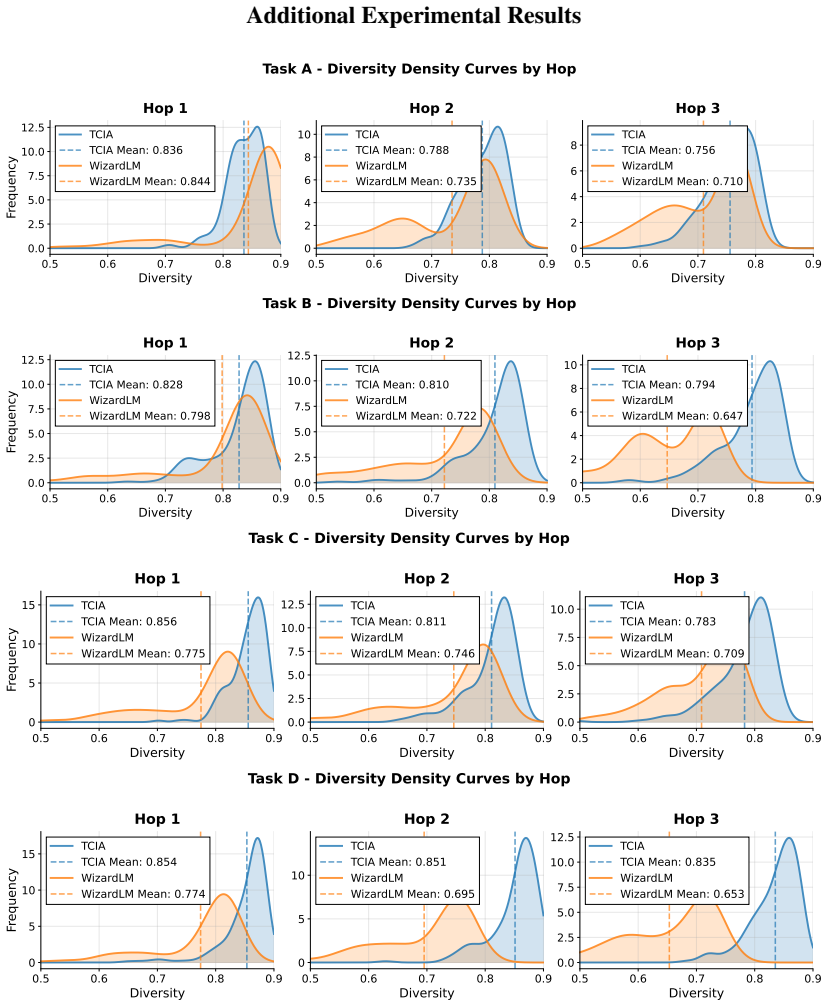
The central discovery, stated in the paper's own terms, is that task drift—not diversity—is the binding constraint on automatic instruction augmentation, and that a discrete query-constraints state space makes task relevance controllable. TCIA starts from one seed instruction per task, extracts the base query Q, task type T, and constraint set C, then runs a breadth-first search with Add, Remove, and Replace operations that pull candidate constraints from semantically similar tasks in an instruction database built from Tulu-3. Each mutated state is converted back to natural language with an LLM, verified for constraint coverage, validated for feasibility, paired with task-specific context, and filtered by an LLM-as-a-judge before supervised fine-tuning. The paper reports that this pipeline sustains near-100% on-task ratios across three augmentation hops while WizardLM's on-task ratio falls below 60%, and that the resulting TCIA-8B model achieves higher pass rates on unseen constraints and higher end-to-end scores than FI-8B, WizardLM-8B, and GPT-4o on all four proprietary tasks.
Load-bearing premise
The load-bearing premise is that the LLM's decomposition of each instruction into a base query plus a complete, correctly categorized set of constraints is faithful; if a constraint is missed, mislabeled, or invented, the BFS mutation and retrieval propagate that error into most generated instructions.
Editorial extensions
If this is right
- One seed instruction per task is enough to produce a high-quality SFT dataset of about 10k filtered instruction–input pairs per task.
- Models trained on TCIA data follow unseen user constraints (numbered lists, length limits, entity groupings) substantially better than fixed-instruction or WizardLM-augmented models.
- Task-specific fine-tuning with TCIA does not trade away general capability: averaged public-benchmark scores stay near the fixed-instruction baseline and close to Tulu-8B-SFT.
- Open-source 8B models fine-tuned on TCIA data can exceed a leading closed model such as GPT-4o on specialized, production-oriented tasks, suggesting the gap is data distribution rather than model scale.
- The framework is a pipeline that can be rerun for any new task by supplying a seed prompt and task context, so its benefits should transfer to other verticals as long as the instruction database has related constraints.
Reading between the lines
- An implication the paper leaves implicit is that the same constraint-mutation machinery could be turned into a controllable stress-test generator: by targeting specific constraint categories (format, length, tone), one could deliberately probe which instruction-following skills a model lacks.
- The near-100% on-task ratio suggests TCIA could also serve as a data-centric diagnostic, meaning that measuring an augmentation method's on-task ratio before training may predict downstream constraint robustness—a testable proxy the paper does not itself run.
- Because the constraint pool comes from Tulu-3, the framework's ceiling likely depends on the breadth and quality of the retrieval database; a natural extension would be to measure how downstream gains scale as the database grows or as retrieved constraints come from the target domain itself.
Signed reviews
Editorial analysis
A structured set of objections, weighed in public.
Referee Report
Summary. The paper proposes TCIA, a six-stage instruction augmentation pipeline: LLM-based decomposition of instructions into base queries and categorized constraints; construction of a task-organized instruction database from Tulu-3; breadth-first search over constraint sets using Add, Remove, and Replace operations; conversion of the augmented states back into natural-language instructions; LLM-based validation; and multi-LLM response generation with quality filtering. The resulting data are used for supervised fine-tuning of Llama-3.1-8B. The authors report that TCIA sustains instruction diversity and on-task ratio across three hops, achieves higher constraint pass rates than Fixed Instruction and WizardLM on unseen constraints (Table 3), improves average end-to-end scores by 8.7% over FI and 3% over WizardLM on four proprietary meeting-AI tasks while surpassing GPT-4o (Figure 3), and preserves general benchmark performance (Table 4).
Significance. The controlled three-way SFT comparison (FI, WizardLM, TCIA) under identical hyperparameters, generation pipelines, and filtering is methodologically sound, and the BFS state-space formulation is clearly specified. The prompt-level diversity and on-task analyses in Figure 1 and Figures 4-5 provide a concrete mechanism for TCIA's claimed benefits, and the paper is explicit about its experimental setup and several prompts. If the empirical claims hold, TCIA is a practically relevant contribution to task-specific instruction tuning. However, the headline results rest entirely on four undisclosed in-house tasks with no released data, code, judge prompts, or uncertainty quantification, and the general-benchmark 'no sacrifice' claim is only weakly supported by the reported numbers. The strengths do not yet outweigh the verification gap.
major comments (5)
- [Experiments; Figure 3; footnote 2] The central empirical claim---an average 8.7% improvement over FI and superiority over GPT-4o---is not independently verifiable. Footnote 2 states that the four in-house tasks A-D cannot be disclosed due to company policy, and no code, evaluation data, task prompts, LLM-as-judge prompts, per-run scores, or variance estimates are provided; Figure 3 reports only averages of three runs. The paper should either release sanitized or anonymized task specifications and the full evaluation protocol, or include a public replication study on open tasks; without one of these, the headline result cannot be checked by readers.
- [Experiments: SFT Setup and Baselines; Data Quality Filtering; Table 17] The quality filtering and reference-free evaluation share the same model family, creating a self-preference confound. SFT data are generated by claude-3.5-sonnet, gpt-4o, and gpt-4.1 and filtered by gpt-4.1 (Table 17), while the reference-free evaluations use unspecified 'variants of the LLM-as-a-Judge protocol' with no judge model named. If the evaluation judge is also gpt-4.1 or gpt-4o, the reported gains may partly reflect stylistic preference for data generated and filtered by those models rather than task-level capability. Please specify the judge models, report agreement with the human-annotated subset, and include at least one hold-out judge from a different model family.
- [Generalization on Public LLM Benchmarks; Table 4] The no-sacrifice claim is not supported by the reported numbers. TCIA's average of 51.33 is below Llama-8B (54.67) and Tulu-8B-SFT (51.99), and the sentence 'matches the average benchmark score of FI (50.17 vs. 51.33)' is internally inconsistent because TCIA actually exceeds FI by 1.16 points, while the two reference models score higher. Similarly, 'matches or exceeds Tulu-8B-SFT on almost all public benchmarks' is not accurate on IFEval, GPQA, BBH, and the overall average. Please correct these claims and add a more careful comparison, ideally with significance testing or at least variance reporting.
- [Instruction State Decomposition; BFS for Instruction Augmentation] The framework assumes that the LLM decomposition returns a complete and faithful query-constraint representation, but the paper reports no accuracy, recall, or human-agreement evaluation for this step. Since every Add and Replace operation mutates the extracted constraints, a missing or mislabeled constraint is inherited and amplified through the BFS; the on-task ratios in Figure 1d and the downstream gains in Figure 3 could therefore be specific to the decomposition model rather than to TCIA itself. Please include a human-annotated decomposition evaluation on a sample from Tulu-3 and from the seed tasks, reporting per-category constraint recall.
- [Table 17; Algorithm 1] The method has four free parameters (K, m, k, and the number of BFS hops), yet the paper reports no sensitivity analysis, no ablation of the individual BFS operations, and no comparison against a simple random constraint-sampling baseline. The reported gains could depend on these unexamined choices. Please add ablations that vary k and the number of hops and that replace BFS with a non-retrieval random-add baseline, to establish which components of TCIA are actually responsible for the improvements.
minor comments (6)
- [Abstract] There is a stray space in 'inputs .' in the first sentence that should be corrected.
- [Related Works] The phrase 'such as like WizardLM' contains a duplicated comparative marker and should read 'such as WizardLM'.
- [Figure 3] Figure 3 reports averages of three runs but shows no error bars, ranges, or per-run points; please add at least standard deviations or min-max ranges so the reader can judge stability.
- [Experiments: SFT Setup and Baselines] The LLM used for instruction decomposition in the main pipeline is not stated in the main text; it appears only in the appendix via Table 18 (GPT-4.1). Please state it explicitly in the setup.
- [Conclusion and Contributions] The claim of being 'the first task-centric instruction augmentation framework' is not substantiated with a comparison to prior task-specific or retrieval-augmented instruction generation methods; consider softening the claim.
- [Appendix: Data Scoring prompts] In the Data Scoring - Uncertainty and Data Scoring - Truthfulness prompts, the literal text '\None' appears where a numeric identifier is intended; this is likely a LaTeX artifact and should be fixed.
Circularity Check
No circularity found: TCIA's query-constraint BFS pipeline and downstream gains are not forced by construction; the undisclosed in-house evaluation and LLM-judge overlap are verification concerns, not formal circularity.
full rationale
TCIA is an empirical data-generation pipeline, not a mathematical derivation whose outputs are equivalent to its inputs. The core claim that TCIA improves task-specific instruction following (Table 3, Figure 3) is tested on constraints and tasks that are not identical to the generated training instructions, and the comparisons are made against external baselines (FI, WizardLM, GPT-4o) as well as public benchmarks (IFEval, Info-Bench, GPQA, BBH, MMLU-Pro). The query-constraint decomposition is produced by an LLM and could be noisy, and the reference-free evaluation uses an unspecified LLM-as-a-judge while the training data were generated and filtered by the same general class of models; however, this is a possible evaluation-bias and reproducibility limitation, not a formal reduction of a predicted quantity to a fitted input. The paper's self-citation to Info-Bench (Qin et al. 2024, which includes current authors) is present but not load-bearing, since the generality claim is also supported by four other external benchmarks. No equation or definition in the paper makes a claimed prediction equal to its input by construction.
Assumptions & free parameters
free parameters (4)
- K (BFS constraint-set limit) =
2700
- m (operations per BFS state) =
10
- k (sampled constraint sets) =
2000
- Number of BFS hops =
3
assumptions (6)
- domain assumption The decomposition prompt in Table 5 yields a complete and faithful (task, query, constraints) representation.
- domain assumption Semantic retrieval with all-mpnet-base-v2 finds constraints and task types that are genuinely similar and transferable.
- domain assumption Tulu-3 contains enough diverse constraints relevant to the four meeting tasks for BFS augmentation to be useful.
- domain assumption BFS Add, Remove, and Replace operations preserve task relevance over multiple hops.
- domain assumption LLM-as-a-judge scores and the human labels aggregated from 3-4 annotators provide unbiased quality measures.
- domain assumption The four proprietary meeting tasks are representative real-world settings for generalizing TCIA's gains.
Cite this review
Pith. "Pith review of TCIA: A Task-Centric Instruction Augmentation Method for Instruction Finetuning." pith.science (2026). https://pith.science/paper/CWX2272D
@misc{pith2026250820374,
  author       = {Pith},
  title        = {Pith review of: TCIA: A Task-Centric Instruction Augmentation Method for Instruction Finetuning},
  year         = {2026},
  howpublished = {\url{https://pith.science/paper/CWX2272D}},
  note         = {Machine review of arXiv:2508.20374}
}
read the original abstract
Diverse instruction data is vital for effective instruction tuning of large language models, as it enables the model to generalize across different types of inputs . Building such diversified instruction dataset is an essential step in this process. Existing approaches often leverage large language models to automatically explore and generate diverse instructions, ensuring both data diversity and quality. However, they tend to overlook an important factor in real-world applications: on-task relevance. In practice, only a few real-world applications require a truly general-purpose model; most benefit from task-specific knowledge tailored to their particular use case. Therefore, it is vital to develop instruction augmentation methods that not only maintain diversity but are also optimized for specific, real-world scenarios. We thus introduce Task Centric Instruction Augmentation (TCIA), a framework that systematically expands instructions while preserving both diversity and task alignment. By representing instructions in a discrete query-constraints space, TCIA creates a rich set of task-relevant instructions and enables models to generalize to these task-specific instructions without sacrificing overall performance. Experiments show that TCIA improves open-source LLMs' performance by an average of 8.7% across four real-world, task-specific applications, and in some cases outperforming leading closed-source models. These improvements do not compromise general instruction-following ability, making TCIA a scalable and efficient solution for adapting LLMs to real-world, task-focused applications.
Figures


Figures from the paper (4 more)


Reference graph
Works this paper leans on
- [1]
- [2]
-
[3]
arXiv preprint arXiv:2304.03277
Instruction tuning with gpt-4. arXiv preprint arXiv:2304.03277. Perez, E.; Huang, S.; Song, F.; Cai, T.; Ring, R.; Aslanides, J.; Glaese, A.; McAleese, N.; and Irving, G. 2022. Red team- ing language models with language models. arXiv preprint arXiv:2202.03286. Qin, Y .; Song, K.; Hu, Y .; Yao, W.; Cho, S.; Wang, X.; Wu, X.; Liu, F.; Liu, P.; and Yu, D. 2...
arXiv 2022
-
[4]
Nemo-aligner: Scalable toolkit for efficient model alignment. arXiv preprint arXiv:2405.01481. Sun, H.; Liu, L.; Li, J.; Wang, F.; Dong, B.; Lin, R.; and Huang, R. 2024. Conifer: Improving complex con- strained instruction-following ability of large language mod- els. arXiv preprint arXiv:2404.02823. Sun, Z.; Shen, Y .; Zhou, Q.; Zhang, H.; Chen, Z.; Cox,...
arXiv 2024
-
[5]
Rate the overall validity of the task prompt (1-5, where 5 means perfectly valid). Feel free to use specific examples from the prompt to illustrate your points. Here is the AI task prompt: <AI_task_prompt> {task_prompt} </AI_task_prompt> Please think step-by-step and output your final judgment in the following JSON format. {{"reason": "Your reason", "scor...
-
[7]
**Complex Queries ** (with constraints): a. Identify all task types implied in the query (e.g., "summarization", "creative writing", "math problem", etc.). b. For each task type found: - Extract the **Basic Query ** (state the central goal, without any constraints). - Extract all explicit constraints. For each constraint: * Assign a concise category from:...
-
[8]
Determine how relevant each part of the prompt is to the main goal or question
-
[9]
Identify any incorrect assumptions or factual inaccuracies
Show all 35 references
-
[10]
Evaluate how well the prompt reflects its intended outcome or request
-
[11]
Offer suggestions to improve relevance and clarity while maintaining the core intent
-
[13]
List any direct contradictions (where one requirement directly conflicts with another)
-
[14]
Identify any implicit contradictions (where requirements indirectly conflict)
-
[15]
Point out any ambiguous requirements that could lead to conflicts
-
[16]
Suggest ways to resolve these contradictions while maintaining the core intent
-
[17]
reason":
Rate the overall logical consistency of the prompt (1-5, where 5 is perfectly consistent) Feel free to use specific examples from the prompt to illustrate any contradictions you find. Here is the AI task prompt: <AI_task_prompt> {task_prompt} </AI_task_prompt> Please think ste...
-
[18]
Clarity and Relevance: Ensure the response relates to the task and seek clarifications if needed
-
[19]
Useful and Comprehensive Information: Provide relevant background, reasoning steps, or detailed description
-
[20]
</informativeness> <helpfulness> Helpfulness assessment emphasizes Overall Quality regarding correctness and informativeness
Not Lengthy, No Repetition: Avoid verbosity or recycling content. </informativeness> <helpfulness> Helpfulness assessment emphasizes Overall Quality regarding correctness and informativeness. Score 1 to 5 based on the extent of helpfulness, regarding both informativeness and c...
-
[21]
Severely Incorrect: Contains significant inaccuracies or fabricated content, even if comprehensive information is provided
-
[22]
Partially Incorrect: Contains errors that may cause confusion, even though comprehensive information is present
-
[23]
Correct: Accurate and provides useful information that meets the task’s requirements
-
[24]
Highly Informative: Accurate and extensive, providing valuable insights and detailed information
-
[25]
reason":
Outstandingly Helpful: Both accurate and in-depth, offering profound insights and comprehensive information. </helpfulness> Here are the system message (if any), user query and assistant output: {system_message} <user_query> {user_query} </user_query> <assistant_output> {assis...
-
[26]
I guess,
Weakeners: e.g., :"I guess," "probably."
-
[27]
I Don’t Know
Verbalized confidence scores: [0, 20] low; (20, 40] uncertain; (40, 60] moderate; (60, 80] leaning confident; (80, 100] high. - No uncertainty expression indicate confidence. - Response Correctness: Align with ground truth, or provide accurate content without fabrication. Plea...
-
[28]
Contradictory with the World (Factual Error): Entities, locations, concepts, events that conflict with established knowledge
-
[29]
Contradictory with Instruction and Input: Responses diverge, introducing new facts not aligned with instructions or inputs
-
[30]
Scoring: Rate outputs 1 to 5 based on extent of hallucination:
Self-Contradictory/Logical Error: Responses contain internal contradictions or logical errors within each independent text. Scoring: Rate outputs 1 to 5 based on extent of hallucination:
-
[31]
Completely Hallucinated: Entirely unreliable due to hallucinations
-
[32]
Severe Hallucination: Nearly half contains hallucinations, severe deviation from main points
-
[33]
Partial Hallucination / Misunderstanding: Overall truthful, partial misunderstanding due to hallucinations
-
[34]
Insignificant Hallucination: Mostly truthful, slight hallucination not affecting main points
-
[35]
reason":
No Hallucination: Free of hallucinations. </hallucination> Here are the system message (if any), user query and assistant output: {system_message} <user_query> {user_query} </user_query> <assistant_output> {assistant_output} </assistant_output> Please think step-by-step and ou...
-
[2023]
See https://vicuna
Vicuna: An open-source chatbot impressing gpt-4 with 90%* chatgpt quality. See https://vicuna. lmsys. org (accessed 14 April 2023) , 2(3): 6. Chung, H. W.; Hou, L.; Longpre, S.; Zoph, B.; Tay, Y .; Fe- dus, W.; Li, Y .; Wang, X.; Dehghani, M.; Brahma, S.; et al
2023
-
[2024]
Jour- nal of Machine Learning Research , 25(70): 1–53
Scaling instruction-finetuned language models. Jour- nal of Machine Learning Research , 25(70): 1–53. Ester, M.; Kriegel, H.-P.; Sander, J.; Xu, X.; et al. 1996. A density-based algorithm for discovering clusters in large spatial databases with noise. In kdd, volume 96, 226–23...
1996 arXiv
Reviewed August 15, 2026 · model on record in the stance chip above.
Discussion (0). Continue with ORCID to comment.