REVIEW 5 major objections 6 minor 51 references
Spinning Effective-to-Backwards One Body ($\texttt{SEBOB}$): combining Effective One-Body inspirals and Backwards One-Body merger-ringdowns for aligned spin black hole binaries
T0 review · 5 major / 6 minor · reviewed 2026-08-15 · deepseek-v4-flash
Pith's one-line read This paper claims that an analytically motivated merger-ringdown model, attached to an effective-one-body inspiral, can match numerical relativity waveforms for aligned-spin black hole binaries with accuracy comparable to heavily…
desk verdict A useful, honest hybrid waveform model whose headline mismatches mostly validate the SEOBNRv5 inspiral rather than the new BOB merger-ringdown—worth a careful referee round. read the letter →
The pith
A machine-rendered reading of the paper's core claim, the machinery that carries it, and where it could break.
The reading
What carries the argument
The central object is the Backwards-One-Body (BOB) merger-ringdown ansatz: each multipole of the Weyl scalar is written as $|\psi_{4,lm}| = A_{p,lm}\operatorname{sech}((t-t_{p,lm})/\tau_{lm})$, with a frequency evolution $\omega(t) = [\omega_0^4 + k(\tanh((t-t_p)/\tau) - \tanh((t_0-t_p)/\tau))]^{1/4}$ that approaches the remnant's quasinormal frequency. This is combined with the adiabatic strain relation $|h| \approx |\psi_4|/\omega^2$ and the peak-matching condition $t_p = t_0 - 2\tau\ln(\omega_0/\omega_{\mathrm{QNM}})$ to yield a fully analytic complex strain. The BOB formulas do double duty: they provide the merger-ringdown waveform after the peak, and in the BOB-informed variant they supply the amplitude and frequency derivatives that set the non-quasi-circular correction coefficients, tying both sides of the waveform to the same physics.
What would settle it
Compute the second derivative of the strain amplitude at the peak directly from the numerical relativity catalog and compare it with the BOB analytic prediction; the paper already reports order-one relative errors there. A sharper test is to replace the $\psi_4$-based BOB amplitude with a news-based formulation and check whether the median mismatch of the BOB-informed variant drops below ~$2\times10^{-4}$; if it does not, the adiabatic amplitude assumption is not the dominant error source.
Extended reading notes
Core claim
The paper claims that by attaching the BOB merger-ringdown to the EOB inspiral, the resulting hybrid SEBOB waveforms attain median noise-free mismatches around $2\times10^{-4}$ for the $(2,2)$ mode against a catalog of 607 numerical relativity waveforms. The more ambitious variant derives the non-quasi-circular correction targets analytically from BOB rather than from NR fits, reducing the NR-informed inputs to four quantities while guaranteeing $\mathcal{C}^2$ continuity at the attachment time. The authors interpret this as evidence that the late merger-ringdown is well described by a perturbation of the final black hole, not by phenomenological fits, and that the analytic description can be combined with a fast, generated-C implementation without sacrificing accuracy.
Load-bearing premise
The load-bearing premise is that the $\psi_4$ amplitude varies slowly enough near the peak that the strain amplitude obeys $|h| \approx |\psi_4|/\omega^2$, turning the strain into a simple sech pulse; the paper's own catalog tests show this assumption fails in the second derivative of the amplitude at peak, where the BOB prediction carries order-one relative error.
Editorial extensions
If this is right
- The merger-ringdown of an aligned-spin binary can be modeled analytically to the same accuracy as NR-calibrated fits, with no fitted merger-ringdown coefficients beyond remnant properties.
- The BOB-informed variant reduces the number of NR-derived pre-calibration inputs to four — peak strain, peak frequency, remnant mass, and remnant spin — while keeping median mismatches at the ~$2\times10^{-4}$ level.
- Because BOB supplies the NQC targets analytically, the attachment between inspiral and merger-ringdown is $\mathcal{C}^2$-continuous by construction, removing derivative discontinuities at the matching point.
- Waveform generation in the generated C implementation is about three times faster than the Python reference for equal and moderate mass ratios, which matters for the millions of waveform evaluations used in parameter estimation.
- Since BOB is defined mode by mode, the same construction can be carried to higher harmonics without introducing new merger-ringdown fits.
Reading between the lines
- The paper's own diagnostics show the amplitude second derivative at peak carries order-one relative error while the frequency derivative is accurate to about 4%; a news-based BOB formulation, which the authors cite as forthcoming, should sharpen exactly that derivative, and the mismatch gain from fixing it is a direct, testable prediction of the framework.
- Because BOB ties merger-ringdown parameters to remnant mass and spin, it offers a route to calibrating the EOB dynamics' own prediction of remnant properties from the inspiral, which would remove the remaining NR fits rather than just shrinking them.
- If the ~$2\times10^{-4}$ median mismatch holds in regions where the calibration catalog is sparse — extreme mass ratios or near-extremal spins — that would be evidence that the remaining error is dominated by the inspiral sector rather than the merger; this can be checked by partitioning the catalog by mass ratio and spin.
- The near-invariance of mismatch despite an order-one change in one NQC target suggests total mismatch is dominated by frequency evolution and the early inspiral; decomposing mismatch into amplitude-only and phase-only contributions would test this reading.
Signed reviews
Editorial analysis
A structured set of objections, weighed in public.
Referee Report
Summary. The paper introduces SEBOB, a hybrid aligned-spin binary-black-hole waveform model that combines the SEOBNRv5HM effective-one-body (EOB) inspiral with the analytic Backwards-One-Body (BOB) merger-ringdown formalism. Two variants are implemented in the NRPy framework: seobnrv5_nrnqc_bob, which keeps the standard NR-calibrated NQC corrections and only replaces the merger-ringdown attachment with BOB, and seobnrv5_bob, which also derives the NQC target derivatives from BOB, enabling C2 continuity at the attachment point. Against the SXS catalog the authors report median flat-PSD mismatches around 2e-4 for the (2,2) mode for both variants, comparable to SEOBNRv5HM and TEOBResumS, with roughly a 3x speedup over pySEOBNR. The paper candidly identifies a deficiency in the BOB-informed amplitude second derivative and discusses it as a known limitation.
Significance. If the main accuracy claim is substantiated for the merger-ringdown band, SEBOB would be a meaningful step toward reducing phenomenological NR calibration in the late inspiral and merger, with a transparent and extensible open-source implementation. Strengths of the work include the machine-checkable NRPy code generation, the explicit symbolic differentiation of the BOB formulas, the broad 607-waveform catalog comparison, and the honest reporting of the amplitude-curvature failure. However, the significance hinges on whether the headline mismatch numbers actually probe the novel merger-ringdown component; as reported, the flat-PSD full-band mismatch is dominated by the unchanged inspiral, so the evidence for the central accuracy claim is weaker than the abstract suggests.
major comments (5)
- [§V.B, Eqs. (40)–(41)] The reported median mismatches of about 2e-4 are computed with a flat PSD over the full bandwidth and are dominated by the long inspiral, which is identical across the seobnrv5 variants and the baseline SEOBNRv5HM model. As a result, the comparison against SXS does not by itself demonstrate that the BOB merger-ringdown or the BOB-informed NQC corrections are comparably accurate to the NR-calibrated SEOBNRv5HM attachment. Please provide a merger-focused or high-frequency-restricted mismatch (for example, restricting the inner product to f > 0.5 times the peak frequency, or time-windowing around the merger) to directly quantify the accuracy of the novel component.
- [§V.D, Fig. 7] The BOB-derived amplitude second derivative, which is used to set the NQC coefficients in seobnrv5_bob, has O(1) relative error as shown in Fig. 7, and Fig. 5 shows a visible amplitude loss before merger in a high-mismatch case. The paper's statement that 'even these sizeable parameter errors translate into only mild increases in mismatch' is not decisive because the headline mismatch is inspiral-dominated; the mild effect on the total mismatch is expected even if the merger-ringdown is substantially wrong. Please quantify the impact on the merger band individually, rather than relying on the full-band mismatch.
- [§IV.B.2 and §III] The claim that seobnrv5_bob ensures 'C2 continuity by construction' is not fully established. The five NQC coefficients are solved using the amplitude, its first two derivatives, the frequency, and the frequency first derivative, but the phase of the complex strain at the attachment time t0 is not mentioned. To obtain C2 continuity of the complex waveform, the phase offset phi0 in Eq. (28) must be chosen so that the BOB phase and its first derivative match the EOB NQC-corrected phase and its derivative at t0. Please specify the phase-matching condition, or revise the continuity claim accordingly.
- [§V.C–V.D and footnote 39] The deprecated SXS:BBH:1110 waveform is explicitly identified in footnote 39 as having been deprecated during final development of the paper, yet it is included in the catalog-wide statistics and in the outlier panels of Figs. 6–8. Including a known-unreliable NR waveform in the main accuracy comparisons can bias the reported results and the diagnostic scatter plots. Please exclude this waveform from all analyses, or clearly justify its retention and show that the conclusions are unchanged without it.
- [Abstract and §III] The phrase 'from first principles' overstates the parameter-free character of BOB as used here. The BOB time dependence is analytic, but its inputs include the NR-fitted peak strain amplitude |h0|, the peak frequency omega0, and the remnant mass and spin Mf and af (Table I), all of which are NR-calibrated. The paper should explicitly state in the abstract and in the description of the BOB attachment that the model is analytic in its functional form but is calibrated in these peak and remnant parameters; otherwise the novelty claim is misleading.
minor comments (6)
- [§V.B] There is a typo 'for the the case' in the sentence introducing Figs. 4 and 5; please correct it.
- [§V.B, Figs. 4–5] The captions refer to 'the case where BOB is least accurate' and 'the case where BOB is most accurate' against SXS; please specify that this is measured by mismatch with respect to SXS, since the panels show amplitude and frequency evolution rather than mismatch values.
- [§V.B, Eqs. (40)–(41)] The text calls the mismatch 'noise-free' and the equation uses a uniform weight; it would be clearer to explicitly state in the main text that a flat PSD is used, matching the description in Sec. VI.
- [Table I and Eq. (31)] The notation for the peak strain amplitude is written as |h0| in the table and |h_0| in Eq. (31); please unify the notation for consistency.
- [§V.E] The wall-time figure caption refers to 'Thorny Flat cluster' while the acknowledgments use 'Thorny Flat HPC cluster'; please align the names.
- [§V.B] The PyART package is referenced by URL only; please provide a proper citation or a version identifier so the analysis is reproducible.
Circularity Check
No significant circularity: the BOB merger-ringdown uses disclosed NR-fitted anchor inputs, and the paper's self-citation is independently tested against the SXS catalog.
full rationale
The paper's derivation chain is not circular. The BOB merger-ringdown waveform (Eqs. 24-31) is an analytic ansatz whose shape and phase evolution are fixed by the sech ansatz, the tanh frequency law, and the QNM frequency/damping time of the remnant; only the overall amplitude |h0|, frequency omega0 at the matching time, and remnant mass/spin are taken as inputs. These inputs are NR-fitted, and the paper explicitly discloses them in Table I and in Sec. III ('Primary NR inputs are thus limited to the remnant properties ... and the strain amplitude |h0| and frequency omega0 at the matching time t0'). No fitted quantity is renamed as a prediction; the paper does not claim to predict the peak amplitude or remnant properties from first principles. The seobnrv5_bob variant sources its NQC target derivatives from the same BOB model used for the merger-ringdown attachment, but the paper presents this as ensuring C^2 continuity 'by construction,' not as an independent test; self-consistency of an attachment is not circularity. The self-citation of the original BOB paper [17] is not load-bearing because Sec. V.C independently tests the BOB postulates against the SXS catalog (Eqs. 44-47, Fig. 6). The paper's own diagnostics, including the O(1) relative error in the BOB-informed amplitude second derivative (Sec. V.D) and the acknowledged 'lack of overlap between the EOB and BOB physics in the window where the corrections are necessary' (Sec. VI), are limitations on accuracy and physical overlap, not evidence of circular reasoning. The flat-PSD mismatch metric being dominated by the unchanged inspiral is a limitation of the evidence for the merger-ringdown accuracy claim, but it does not make any step of the derivation equivalent to its inputs. No equation reduces to its own inputs by construction, so the appropriate finding is no significant circularity.
Assumptions & free parameters
free parameters (5)
- |h0| (peak strain amplitude of (2,2) mode) =
NR fit (SEOBNRv5) or from SXS waveform peak
- omega0 (waveform frequency at peak strain) =
NR fit (SEOBNRv5) or from SXS waveform peak
- Mf (remnant mass) =
NR fit [26]
- af (remnant spin) =
NR fit [27]
- a6, dSO, Delta_tISCO (EOB calibration parameters) =
Calibrated to NR via Nested Bayesian Inference
assumptions (5)
- domain assumption BOB sech amplitude ansatz for each (l,m) mode of psi4
- domain assumption Adiabatic relation |psi4|^2 proportional to Omega^3 dOmega/dt, neglecting news amplitude derivative
- domain assumption Single underlying orbital frequency for all multipoles, omega_lm = m Omega
- domain assumption Phase evolves linearly near merger so psi4 = -omega^2 h
- domain assumption Remnant mass and spin from NR fitting formulae are accurate
Cite this review
Pith. "Pith review of Spinning Effective-to-Backwards One Body ($\texttt{SEBOB}$): combining Effective One-Body inspirals and Backwards One-Body merger-ringdowns for aligned spin black hole binaries." pith.science (2026). https://pith.science/paper/B2A533US
@misc{pith2026250820418,
  author       = {Pith},
  title        = {Pith review of: Spinning Effective-to-Backwards One Body ($\textttSEBOB$): combining Effective One-Body inspirals and Backwards One-Body merger-ringdowns for aligned spin black hole binaries},
  year         = {2026},
  howpublished = {\url{https://pith.science/paper/B2A533US}},
  note         = {Machine review of arXiv:2508.20418}
}
abstract
High-fidelity gravitational waveform models are essential for realizing the scientific potential of next-generation gravitational-wave observatories. While highly accurate, state-of-the-art models often rely on extensive phenomenological calibrations to numerical relativity (NR) simulations for the late-inspiral and merger phases, which can limit physical insight and extrapolation to regions where NR data is sparse. To address this, we introduce the Spinning Effective-to-Backwards One Body (SEBOB) formalism, a hybrid approach that combines the well-established Effective-One-Body (EOB) framework with the analytically-driven Backwards-One-Body (BOB) model, which describes the merger-ringdown from first principles as a perturbation of the final remnant black hole. We present two variants building on the state-of-the-art $\texttt{SEOBNRv5HM}$ model: $\texttt{seobnrv5_nrnqc_bob}$, which retains standard NR-calibrated non-quasi-circular (NQC) corrections and attaches a BOB-based merger-ringdown; and a more ambitious variant, $\texttt{seobnrv5_bob}$, which uses BOB to also inform the NQC corrections, thereby reducing reliance on NR fitting and enabling higher-order ($\mathcal{C}^2$) continuity by construction. Implemented in the open-source $\texttt{NRPy}$ framework for optimized C-code generation, the SEBOB model is transparent, extensible, and computationally efficient. By comparing our waveforms to a large catalog of NR simulations, we demonstrate that SEBOB yields accuracies comparable to the highly-calibrated $\texttt{SEOBNRv5HM}$ model, providing a viable pathway towards more physically motivated and robust waveform models
Figures


Figures from the paper (4 more)


Reference graph
Works this paper leans on
-
[1]
Initial Conditions EOB evolution begins by determining initial conditions for the canonical phase-space variables {r,ϕ,p r∗,pϕ}. First, for a user-specified initial orbital frequency Ω 0, the initial orbital separation r0 and azimuthal momen- tumpϕ,0 for quasi-circular orbits are obtained by solving the two-dimensional non-linear algebraic system: dpr dt ...
-
[2]
Orbital Evolution With initial conditions established, Hamilton’s equa- tions of motion are integrated forward in time using a GSL adaptive 8th-order Runge-Kutta Prince-Dormand method (or similar) with error control. Tortoise coordi- nates (r∗,pr∗) are used to enhance numerical stability, particularly near the EOB horizon analogue. Integration terminates ...
-
[3]
These modes are constructed symbolically within NRPy and gen- erated into optimized C code
Factorized Waveform Generation Factorized inspiral waveform modeshF lm are computed at each step of the finely sampled EOB trajectory. These modes are constructed symbolically within NRPy and gen- erated into optimized C code. This symbolic generation significantly facilitates faster computation of waveform modes, particularly by enabling pre-computation ...
-
[4]
The target values for the right-hand side of Eqs
seobnrv5 nrnqc bob: NR-informed NQCs and BOB Merger-Ringdown This variant mirrors the SEOBNRv5HM approach for NQC corrections. The target values for the right-hand side of Eqs. (14) and (16)—specifically, the amplitude |hNR 22|, its first and second time derivatives, the frequency ωNR 22 , and its first time derivative—are derived from fits to NR simulati...
-
[5]
The functional form of the NQC corrections (Eq
seobnrv5 bob: BOB-informed NQCs and Merger-Ringdown This model integrates BOB more deeply into the in- spiral by leveraging it to inform the NQC corrections. The functional form of the NQC corrections (Eq. (12)) is maintained, but the target values for the linear sys- tems are sourced analytically from the BOB model it- self (Eqs. (31), (26), and (32)), e...
-
[6]
pyseobnr pert, which applies random 10−15-level perturbations to the mass ratio and spins, and
-
[7]
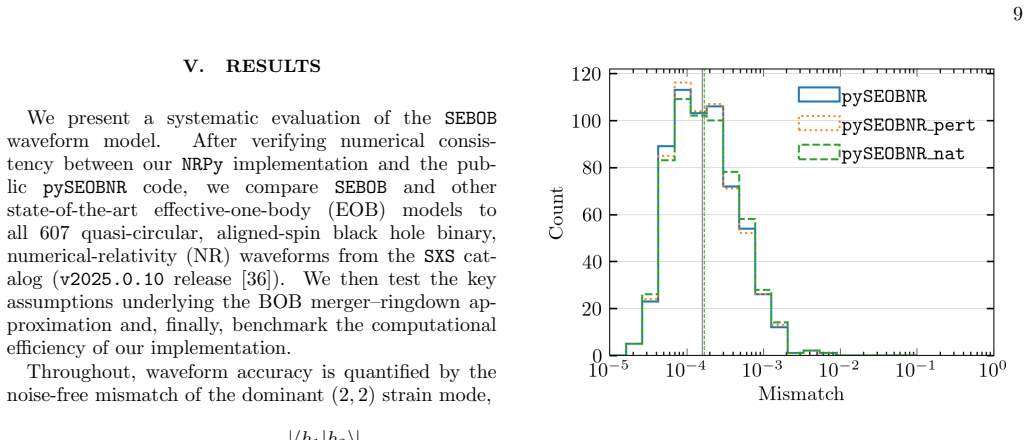
pyseobnr nat, which replaces all interpolations with natural splines [37]. Figure 1 shows that altering the interpolation bound- ary conditions induces slightly larger mismatches than round-off perturbations. By contrast, Figure 2 demon- strates round-off-level agreement between NRPy and pyseobnr nat, confirming that our code faithfully repro- duces the c...
- [8]
Show all 51 references
-
[9]
Abbott et al
R. Abbott et al. (KAGRA, VIRGO, LIGO Scien- tific), GWTC-3: Compact Binary Coalescences Observed by LIGO and Virgo during the Second Part of the Third Observing Run, Phys. Rev. X 13, 041039 (2023), arXiv:2111.03606 [gr-qc]
2023 arXiv
-
[10]
This work was performed in part at the Aspen Center for Physics, which is supported by National Science Foundation grant PHY-2210452
We acknowledge the computational resources pro- vided by the WVU Research Computing Spruce Knob HPC cluster, which is funded in part by NSF grant EPS- 1003907, and the Thorny Flat HPC cluster, which is funded in part by NSF grant OAC-1726534. This work was performed in part at...
-
[11]
Yunes and X
N. Yunes and X. Siemens, Gravitational-Wave Tests of General Relativity with Ground-Based Detectors and Pulsar Timing-Arrays, Living Rev. Rel. 16, 9 (2013), arXiv:1304.3473 [gr-qc]
2013 arXiv
-
[12]
Palmese, C
A. Palmese, C. R. Bom, S. Mucesh, and W. G. Hartley, A Standard Siren Measurement of the Hubble Constant Using Gravitational-wave Events from the First Three LIGO/Virgo Observing Runs and the DESI Legacy Sur- vey, Astrophys. J. 943, 56 (2023), arXiv:2111.06445 15 [astro-ph.CO]
2023 arXiv
-
[13]
Abbott et al
R. Abbott et al. (LIGO Scientific, Virgo), Population Properties of Compact Objects from the Second LIGO- Virgo Gravitational-Wave Transient Catalog, Astrophys. J. Lett. 913, L7 (2021), arXiv:2010.14533 [astro-ph.HE]
2021 arXiv
-
[14]
Amaro-Seoane, H
P. Amaro-Seoane, H. Audley, S. Babak, J. Baker, E. Ba- rausse, P. Bender, E. Berti, P. Binetruy, M. Born, D. Bor- toluzzi, et al., Laser interferometer space antenna, arXiv preprint arXiv:1702.00786 (2017)
2017 arXiv
-
[15]
Punturo et al
M. Punturo et al. , The Einstein Telescope: A third- generation gravitational wave observatory, Class. Quant. Grav. 27, 194002 (2010)
2010
-
[16]
Reitze et al
D. Reitze et al. , Cosmic Explorer: The U.S. Contribu- tion to Gravitational-Wave Astronomy beyond LIGO, Bull. Am. Astron. Soc. 51, 035 (2019), arXiv:1907.04833 [astro-ph.IM]
2019 arXiv
-
[17]
B. S. Sathyaprakash, B. F. Schutz, and C. Van Den Broeck, Cosmography with the Einstein Telescope, Class. Quant. Grav. 27, 215006 (2010), arXiv:0906.4151 [astro-ph.CO]
2010 arXiv
-
[18]
Boyle et al., The SXS Collaboration catalog of binary black hole simulations, Class
M. Boyle et al., The SXS Collaboration catalog of binary black hole simulations, Class. Quant. Grav. 36, 195006 (2019), arXiv:1904.04831 [gr-qc]
2019 arXiv
-
[19]
C. M. Will, Gravity: Newtonian, Post-Newtonian, and General Relativistic, in Gravity: Where Do We Stand?, edited by R. Peron, M. Colpi, V. Gorini, and U. Moschella (2016) pp. 9–72
2016
-
[20]
Garc´ ıa-Quir´ os, M
C. Garc´ ıa-Quir´ os, M. Colleoni, S. Husa, H. Estell´ es, G. Pratten, A. Ramos-Buades, M. Mateu-Lucena, and R. Jaume, Multimode frequency-domain model for the gravitational wave signal from nonprecessing black-hole binaries, Phys. Rev. D 102, 064002 (2020), arXiv:2001.10914 [gr-qc]
2020 arXiv
-
[21]
Varma, S
V. Varma, S. E. Field, M. A. Scheel, J. Blackman, L. E. Kidder, and H. P. Pfeiffer, Surrogate model of hybridized numerical relativity binary black hole waveforms, Phys. Rev. D 99, 064045 (2019), arXiv:1812.07865 [gr-qc]
2019 arXiv
-
[22]
Buonanno and T
A. Buonanno and T. Damour, Effective one-body ap- proach to general relativistic two-body dynamics, Phys. Rev. D 59, 084006 (1999), arXiv:gr-qc/9811091
1999 arXiv
-
[23]
Pompili et al., Laying the foundation of the effective- one-body waveform models SEOBNRv5: Improved ac- curacy and efficiency for spinning nonprecessing bi- nary black holes, Phys
L. Pompili et al., Laying the foundation of the effective- one-body waveform models SEOBNRv5: Improved ac- curacy and efficiency for spinning nonprecessing bi- nary black holes, Phys. Rev. D 108, 124035 (2023), arXiv:2303.18039 [gr-qc]
2023 arXiv
-
[24]
Nagar, G
A. Nagar, G. Riemenschneider, G. Pratten, P. Rettegno, and F. Messina, Multipolar effective one body waveform model for spin-aligned black hole binaries, Phys. Rev. D 102, 024077 (2020), arXiv:2001.09082 [gr-qc]
2020 arXiv
-
[25]
S. T. McWilliams, Analytical Black-Hole Binary Merger Waveforms, Phys. Rev. Lett. 122, 191102 (2019), arXiv:1810.00040 [gr-qc]
2019 arXiv
-
[26]
Newman and R
E. Newman and R. Penrose, An Approach to gravita- tional radiation by a method of spin coefficients, J. Math. Phys. 3, 566 (1962)
1962
-
[27]
Berti, V
E. Berti, V. Cardoso, and A. O. Starinets, Quasinormal modes of black holes and black branes, Class. Quant. Grav. 26, 163001 (2009), arXiv:0905.2975 [gr-qc]
2009 arXiv
-
[28]
C. V. Vishveshwara, Scattering of Gravitational Radi- ation by a Schwarzschild Black-hole, Nature 227, 936 (1970)
1970
-
[29]
W. H. Press, Long Wave Trains of Gravitational Waves from a Vibrating Black Hole, Astrophys. J. Lett. 170, L105 (1971)
1971
-
[30]
Ruchlin, Z
I. Ruchlin, Z. B. Etienne, and T. W. Baumgarte, SENR/NRPy+: Numerical Relativity in Singular Curvi- linear Coordinate Systems, Phys. Rev. D 97, 064036 (2018), arXiv:1712.07658 [gr-qc]
2018 arXiv
-
[31]
D. P. Mihaylov, S. Ossokine, A. Buonanno, H. Es- telles, L. Pompili, M. P¨ urrer, and A. Ramos-Buades, pySEOBNR: a software package for the next generation of effective-one-body multipolar waveform models, Soft- wareX 30, 102080 (2025), arXiv:2303.18203 [gr-qc]
2025 arXiv
-
[32]
LIGO Scientific Collaboration, Virgo Collaboration, and KAGRA Collaboration, LVK Algorithm Library - LAL- Suite, Free software (GPL) (2018)
2018
-
[33]
Nagar, P
A. Nagar, P. Rettegno, R. Gamba, S. Albanesi, A. Al- bertini, and S. Bernuzzi, Analytic systematics in next generation of effective-one-body gravitational waveform models for future observations, Phys. Rev. D108, 124018 (2023), arXiv:2304.09662 [gr-qc]
2023 arXiv
-
[34]
Jim´ enez-Forteza, D
X. Jim´ enez-Forteza, D. Keitel, S. Husa, M. Hannam, S. Khan, and M. P¨ urrer, Hierarchical data-driven ap- proach to fitting numerical relativity data for nonprecess- ing binary black holes with an application to final spin and radiated energy, Phys. Rev. D 95, 064024 (2017),...
2017 arXiv
-
[35]
Hofmann, E
F. Hofmann, E. Barausse, and L. Rezzolla, The final spin from binary black holes in quasi-circular orbits, Astro- phys. J. Lett. 825, L19 (2016), arXiv:1605.01938 [gr-qc]
2016 arXiv
-
[36]
L. C. Stein, qnm: A Python package for calculating Kerr quasinormal modes, separation constants, and spherical- spheroidal mixing coefficients, J. Open Source Softw. 4, 1683 (2019), arXiv:1908.10377 [gr-qc]
2019 arXiv
-
[37]
Khalil, A
M. Khalil, A. Buonanno, H. Estelles, D. P. Mihaylov, S. Ossokine, L. Pompili, and A. Ramos-Buades, Theo- retical groundwork supporting the precessing-spin two- body dynamics of the effective-one-body waveform mod- els SEOBNRv5, Phys. Rev. D 108, 124036 (2023), arXiv:2303.18143 [gr-qc]
2023 arXiv
-
[38]
J. G. Baker, W. D. Boggs, J. Centrella, B. J. Kelly, S. T. McWilliams, and J. R. van Meter, Mergers of non-spinning black-hole binaries: Gravitational radia- tion characteristics, Phys. Rev. D 78, 044046 (2008), arXiv:0805.1428 [gr-qc]
2008 arXiv
-
[39]
B. J. Kelly, J. G. Baker, W. D. Boggs, S. T. McWilliams, and J. Centrella, Mergers of black-hole binaries with aligned spins: Waveform characteristics, Phys. Rev. D 84, 084009 (2011), arXiv:1107.1181 [gr-qc]
2011 arXiv
-
[40]
Buonanno, Y
A. Buonanno, Y. Chen, and T. Damour, Transition from inspiral to plunge in precessing binaries of spinning black holes, Phys. Rev. D 74, 104005 (2006), arXiv:gr- qc/0508067
2006
-
[41]
Z. B. Etienne, Improved moving-puncture techniques for compact binary simulations, Phys. Rev. D 110, 064045 (2024), arXiv:2404.01137 [gr-qc]
2024 arXiv
-
[42]
Meurer et al., SymPy: symbolic computing in Python, PeerJ Comput
A. Meurer et al., SymPy: symbolic computing in Python, PeerJ Comput. Sci. 3, e103 (2017)
2017
-
[43]
M. C. Galassi, J. Davies, J. Theiler, B. Gough, G. Jung- man, P. Alken, M. Booth, F. Rossi, and R. Ulerich, GNU Scientific Library (Network Theory, Ltd., 2019)
2019
-
[44]
M. A. Scheel et al. , The SXS Collaboration’s third cat- alog of binary black hole simulations, arXiv (2025), 16 arXiv:2505.13378 [gr-qc]
2025
-
[45]
not-a-knot
Natural splines set the second derivative to zero at each endpoint, whereas the public code employs “not-a-knot” conditions
-
[46]
Kankani and S
A. Kankani and S. McWilliams, (in preparation) (2025)
2025
-
[47]
The highest error case in the amplitude and frequency fits corresponds to SXS:BBH:1110 (q = 7,χ 1 = 3×10⁻⁶,χ 2 = −2× 10⁻⁷), which was deprecated during final develop- ment of the paper
-
[48]
Devine, Z
C. Devine, Z. B. Etienne, and S. T. McWilliams, Opti- mizing spinning time-domain gravitational waveforms for Advanced LIGO data analysis, Class. Quant. Grav. 33, 125025 (2016), arXiv:1601.03393 [astro-ph.HE]
2016 arXiv
-
[49]
Buonanno, L
A. Buonanno, L. E. Kidder, and L. Lehner, Estimating the final spin of a binary black hole coalescence, Phys. Rev. D 77, 026004 (2008), arXiv:0709.3839 [astro-ph]
2008 arXiv
-
[50]
van der Walt, S
S. van der Walt, S. C. Colbert, and G. Varoquaux, The NumPy Array: A Structure for Efficient Numer- ical Computation, Comput. Sci. Eng. 13, 22 (2011), arXiv:1102.1523 [cs.MS]
2011 arXiv
-
[51]
Virtanen et al
P. Virtanen et al. , SciPy 1.0–Fundamental Algorithms for Scientific Computing in Python, Nature Meth. 17, 261 (2020), arXiv:1907.10121 [cs.MS]. 17 FIG. 9: Wall-times for the NRPy implementation of seobnrv5 bob compared with leading time-domain generators. Times are measured a...
2020 arXiv
Reviewed August 15, 2026 · model on record in the stance chip above.
Discussion (0). Continue with ORCID to comment.