REVIEW 5 major objections 5 minor 57 references
Enhancing Semantic Document Retrieval- Employing Group Steiner Tree Algorithm with Domain Knowledge Enrichment
T0 review · 5 major / 5 minor · reviewed 2026-08-15 · deepseek-v4-flash
Pith's one-line read The paper claims that routing document retrieval through a domain-specific concept graph and a Group Steiner Tree heuristic lifts precision to 90% and accuracy to 82% on 170 agriculture queries, well above Lucene, ElasticSearch, and…
desk verdict A real system with a plausible method, but the headline numbers are not credible due to a circular evaluation. read the letter →
The pith
A machine-rendered reading of the paper's core claim, the machinery that carries it, and where it could break.
The reading
What carries the argument
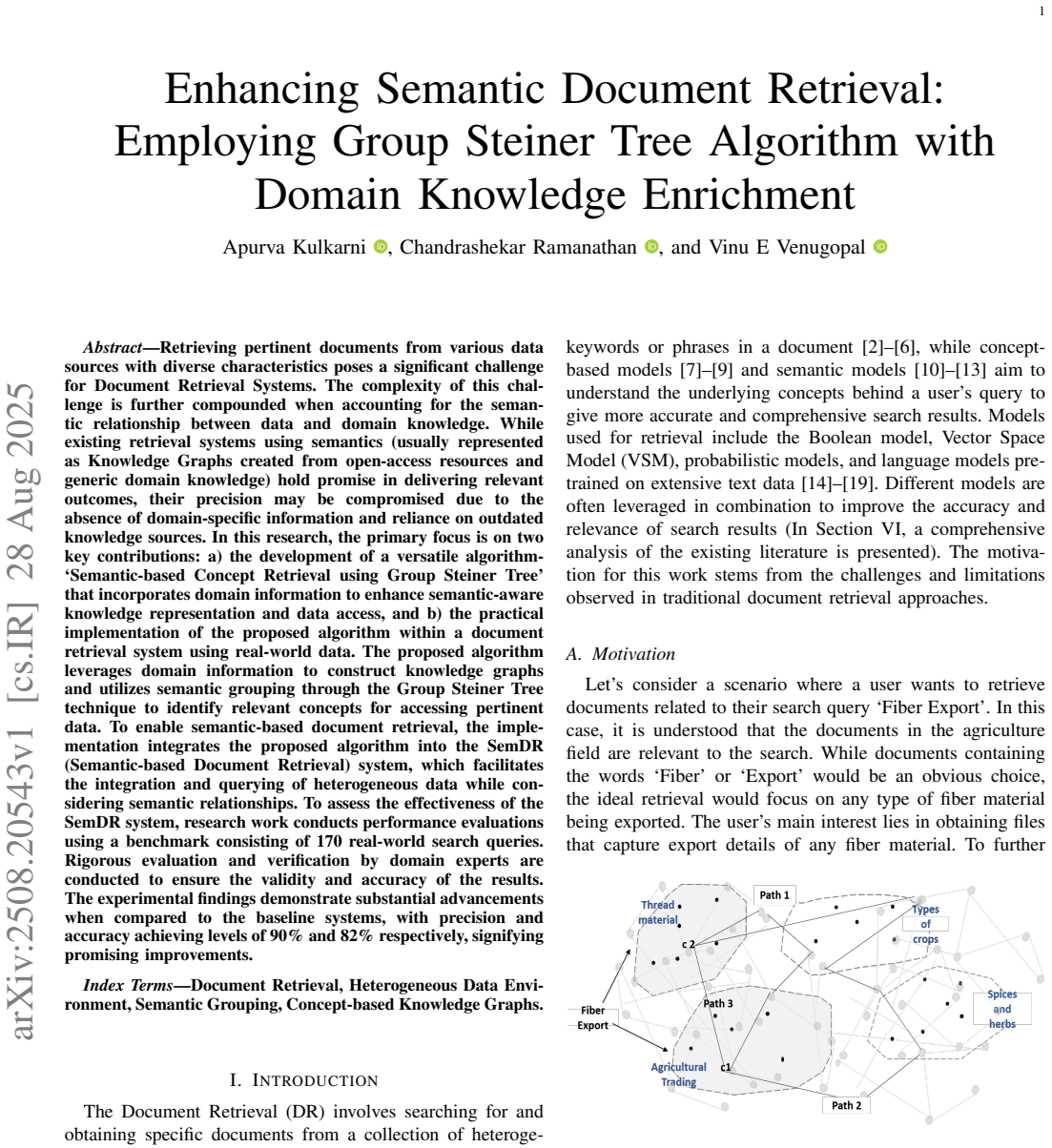
The Group Steiner Tree on a weighted Semantic Concept Graph G=(C,R,W) is the load-bearing mechanism. The node set C holds direct concepts from domain knowledge plus latent concepts, which are groups of concepts connected by high semantic proximity; edges R are contextual (hierarchical) or semantic relations; and edge weights W are set by an inverse document-overlap score (1 minus Jaccard similarity between the document sets of the two concepts). The algorithm first identifies anchor concepts by semantic proximity to the query, expands each anchor to its latent group, and then greedily computes and merges Steiner trees for the groups, returning the tree's nodes as relevant concepts. This turns the retrieval question—'which concepts tie the query's anchors together?'—into a tractable graph optimization and supplies the document-access path used by SemDR.
What would settle it
Have a separate group of domain experts, blind to the concept graph and threshold, independently label relevant documents for the same 170 queries, then recompute precision; if SemDR's score falls toward or below the baselines, the expert-alignment explanation stands.
Extended reading notes
Core claim
The central claim is that the relevant documents for a query can be found by solving a Group Steiner Tree problem on a domain-specific concept graph. Anchor concepts are graph nodes whose semantic proximity to the search words exceeds a threshold; each anchor is relaxed to a latent group of closely related concepts, and the algorithm repeatedly grows and merges low-cost Steiner trees until every group is touched. The nodes of the final tree are declared relevant concepts, and documents are retrieved through an index that maps documents to concepts. The paper reports that on its benchmark this pipeline reaches 90% precision, 88% recall, 82% accuracy, and 89% F1, with a mean type-2 error of 11.9%, and that its ranked results improve from 75% relevant at top-3 to 89% at top-10 while all baselines decline.
Load-bearing premise
The evaluation's ground truth and the system's domain knowledge were both produced by the same domain experts and the 0.9 semantic-proximity threshold was tuned with their input, so the reported 90% precision may reflect alignment with those experts' judgment rather than an independent measure of retrieval quality.
Editorial extensions
If this is right
- A query whose words never appear literally in any document can still retrieve relevant documents through latent concept groups, covering the indirect-query case.
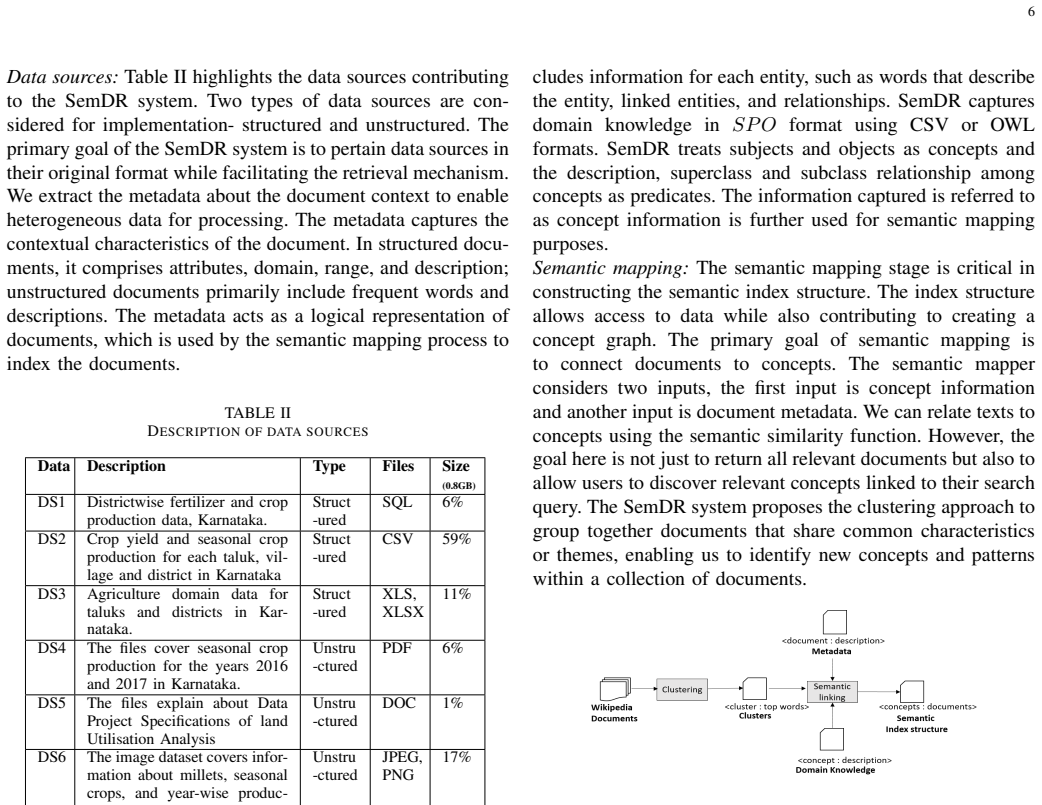
- Heterogeneous data sources can stay in their original structured and unstructured formats because retrieval happens through the semantic index rather than through reformatting the data.
- The GST formulation gives a principled reason to prefer concept paths with many shared documents, since the inverse-Jaccard edge weights keep the tree inside concepts with overlapping document sets.
- If the reported ranking results hold, users benefit from a semantic ranking that places more relevant documents in the top positions as the considered set grows from top-3 to top-10.
- The system's query module permits join-like queries across structured documents, extending the contribution from retrieval to light-weight analysis on the retrieved data.
Reading between the lines
- Because the expert-built concept graph and the expert-selected reference solution come from the same source, the reported 90% precision likely contains an alignment effect; an independent gold standard with multiple annotators would quantify how much.
- The approach's transfer cost is the domain knowledge itself: the GST algorithm is generic, so applying it to a new domain mainly means building a new concept graph and re-tuning the semantic-proximity threshold rather than changing the retrieval logic.
- The concept-selection step could act as a semantic router in front of a neural ranking model: retrieve documents attached to the GST-identified concepts, then rerank them with dense or cross-encoder models, potentially combining domain grounding with modern embeddings.
- A concrete stress test would use a sparse document collection where inverse-Jaccard weights might favor generic concepts; comparing against term-frequency-aware edge weights would show whether the weighting scheme, not the GST structure, drives the gains.
Signed reviews
Editorial analysis
A structured set of objections, weighed in public.
Referee Report
Summary. The paper proposes SemDR, a semantic document retrieval system that builds a domain-specific concept graph enriched with latent concepts, identifies anchor concepts for a query using a semantic proximity threshold, and retrieves documents by applying a Group Steiner Tree (GST) heuristic to connect those anchors. The system is implemented over heterogeneous Karnataka agriculture data and evaluated on 170 real-world search queries against Lucene, ElasticSearch, and Doc2Vec. The authors report that SemDR achieves precision 90%, recall 88%, accuracy 82%, and F1-score 89% (Section V-D), claiming substantial gains over the baselines. The paper also contributes a complexity analysis of the proposed heuristic and a discussion of domain and geographic ontology construction. The central claim is empirical: that SemDR's retrieval quality is superior to the baselines on this benchmark.
Significance. If the reported evaluation were independent, the paper would provide a useful application of the Group Steiner Tree formalism to document retrieval, and the effort to combine domain knowledge, latent concept grouping, and heterogeneous data indexing is a worthwhile engineering contribution. The paper also includes an explicit complexity analysis and a concrete real-world deployment scenario. However, the central empirical claim is not currently established: the reference solution, the domain knowledge graph, 104 of the 170 test queries (QS5), and the 0.9 semantic threshold all originate from the same expert community with no demonstrated separation, so the reported precision/recall numbers cannot be read as independent measures of retrieval quality. The numerical headline is also internally inconsistent across the abstract, Section V-D, and the conclusion. No code, data, or statistical detail is provided to allow independent verification. The contribution is therefore assessed as not yet suitable for publication as a validated retrieval result.
major comments (5)
- [Section V-A, Section IV-A, Section III footnote 2, Table III] The evaluation is circular. The reference solution is built "considering the application of the proposed research" and requires domain experts to select files for every search string (Section V-A). Those same experts, or the same expert community, are the source of the domain knowledge from which the semantic concept graph is constructed (Section IV-A), they provide 104 of the 170 queries (QS5 in Table III), and their insights were used in setting the 0.9 semantic proximity threshold (Section III, footnote 2). Under this protocol, SemDR's anchors, latent groups, and query set are all aligned with the experts' own file selections, while Lucene, ElasticSearch, and Doc2Vec are generic baselines with no such alignment. The reported 90% precision is therefore not an independent measure of retrieval quality; it could predominantly reflect expert-consistent concept engineering. A meaningful evaluation would require a held-out relevance judgment set, a separation of the knowledge-graph builders from the relevance judges, and a threshold selected on a development set rather than on the test queries.
- [Abstract, Section V-D, Section VII] The headline numbers are internally inconsistent. The abstract states "precision and accuracy achieving levels of 90% and 82% respectively"; Section V-D states "precision and recall at 90% and 88%, respectively, accuracy at 82%, and an F1-score of 89%"; and the conclusion states "attaining an accuracy rate of 90% and a precision score of 82%." These are three different statements of the central result. The authors must correct this and report per-query aggregates, not just the global values.
- [Section V-C] The evaluation metrics are not defined in an auditable way. The text defines True Positive (TP) as "the count of documents retrieved by the manual selection process and other baseline systems," which mixes the reference with the systems being evaluated, and it defines True Negative (TN) as documents retrieved by neither, which is undefined for an unpooled retrieval setting where most documents are never examined. Accuracy is then computed as (TP+TN)/(total), which is dominated by unjudged negatives and is not a meaningful retrieval measure. The formulas must be replaced with standard IR definitions based on pooled relevance judgments, and the pooling protocol must be described.
- [Section III and Algorithm 2] The algorithmic contribution is underspecified. Algorithm 2 repeatedly calls a subroutine "STEINER TREE (G, Li)" but the paper does not state what this subroutine computes (exact Steiner tree? a shortest-path heuristic?) and does not specify how trees are merged when common vertices are found. The complexity analysis in Section III-B assumes an exact Steiner tree step of O(2^k n^2), yet the text describes a greedy merging heuristic; the claimed overall complexity O(k * 2^k * n^2) is therefore not derived from the pseudocode. Without a precise description of the subroutine and the merging rule, the proposed "Semantic-based Concept Retrieval using Group Steiner Tree" cannot be implemented or verified from the manuscript.
- [Section V-D.4 and Table V] The ranked-retrieval comparison is presented without statistical support. Table V reports percentages for Top-3/5/7/10, but there are no error bars, no standard errors across the 170 queries, and no significance test showing that the differences between SemDR and Lucene/ElasticSearch are not due to query-level variance. Given the circularity concern, these comparisons do not yet support the claim that SemDR retrieves more relevant documents than the baselines.
minor comments (5)
- [Section V-D.2] The formula for the mean Type-2 error is written as a sum over search queries of (Reference solution - retrieved documents)/reference solution, but no averaging divisor is shown and the connection to the values in Table IV is not stated precisely. Please define the quantity formally.
- [Section V-D.4 and Table V] The first column of Table V is labeled "SDR" rather than "SemDR," and the equation above the table contains a malformed absolute-value expression. These should be corrected.
- [Section II and Section III] Wu-Palmer similarity is defined for WordNet synsets, but the paper uses it on a custom agriculture concept graph without stating how the concepts are mapped to an ontology or how similarity is computed for concepts not present in WordNet. This should be clarified because the anchor selection depends on it.
- [Section V-D.3] The text says "Figure 6 illustrates the True Positive value over different baseline systems," but Figure 6 is described as showing precision, recall, accuracy, and F1-score; the figure captions and in-text references need to be aligned.
- [General] The paper does not provide the code, the constructed concept graph, or the query/reference files. For a system whose central claim is empirical, sharing these artifacts or an online appendix would be important for reproducibility and for enabling a non-expert to audit the evaluation.
Circularity Check
Evaluation circularity: the 0.9 semantic threshold is tuned on the same benchmark used for the reported metrics, and the expert-built reference solution shares its construction inputs with SemDR's domain knowledge graph.
-
fitted input called prediction
[Section III, footnote 2 (algorithm anchor-concept threshold); Section V-D (reported results)]
"In this particular implementation set up, we established a threshold of 0.9 after experimenting with different values and taking into account the insights of domain experts."
The 0.9 semantic proximity threshold directly controls which concept nodes become anchor concepts (terminal nodes) for the Group Steiner Tree retrieval step. The paper reports that the same setup yields 90% precision, 88% recall, 82% accuracy, and 89% F1-score on the 170-query benchmark, but the threshold was chosen by experimentation on that benchmark, with no described train/validation split or cross-validation. The reported performance is therefore the outcome of a tuned parameter on the evaluation queries, not an independent prediction of retrieval quality.
-
other
[Section V-A (Experimental Setup, Reference Solution); Section V-D.2 (Error Calculation)]
"The reference solution is built considering the application of the proposed research. The domain experts have asked to select files from the search corpus for all the search strings."
The reference solution is the ground truth against which precision, recall, accuracy, and F1 are computed. Those expert file selections, however, come from the same expert community whose insights are used to construct the semantic concept graph (Section IV-A), to generate 104 of the 170 queries (Table III, QS5), and to inform the 0.9 threshold. Section V-D.2 itself concedes that the knowledge used in SemDR is based on subject matter experts and that the actual evaluation outcomes are interpreted manually. Thus the gold standard and SemDR's semantic apparatus share construction inputs, so a high agreement score can reflect expert-consistent concept engineering rather than an independent measure of retrieval effectiveness against the generic baselines.
full rationale
The paper's central claim is an empirical performance claim, not a formal derivation, so there is no chain of equations to reduce. However, the evaluation is not self-contained against an independent benchmark. First, the 0.9 semantic proximity threshold is a fitted parameter: Section III footnote 2 says it was established after experimenting with different values, and it directly controls which anchor concepts feed the Group Steiner Tree. The same 170 queries are then used for the reported precision, recall, accuracy, and F1 values, with no described train/test separation. Second, the reference solution is built by domain experts selecting files for all search strings, while the same expert community supplies the domain knowledge for the concept graph, contributes most of the queries (QS5), and informed the threshold. The paper itself admits the expert-dependence of its knowledge and the manual interpretation of evaluation outcomes. These two issues make the reported 90% precision / 82% accuracy / 89% F1 a partially circular result: the tuned threshold and shared-expert ground truth prevent interpreting the numbers as an independent measurement of retrieval quality against Lucene, ElasticSearch, and Doc2Vec. There is no load-bearing self-citation chain and no machine-checked or external benchmark to rescue independence. Separately, the reported numbers are internally inconsistent (Abstract: precision 90%, accuracy 82%; Section V-D: precision 90%, recall 88%, accuracy 82%, F1 89%; Conclusion: accuracy 90%, precision 82%), which is a correctness problem rather than a circularity finding. Overall score 6: one or more reported 'predictions' reduce to fitted/tuned inputs and to ground truth sharing construction inputs with the system.
Assumptions & free parameters
free parameters (2)
- semantic proximity threshold for anchor identification and latent grouping =
0.9
- number of k-means clusters for generic clusters (k)
assumptions (4)
- domain assumption Domain knowledge supplied by subject matter experts is accurate and sufficient for agriculture retrieval.
- domain assumption Wu-Palmer similarity on the manually built concept graph captures semantic relatedness useful for retrieval.
- ad hoc to paper The Group Steiner Tree heuristic (Algorithm 2) identifies concepts that semantically link the anchors, and these concepts correspond to relevant documents.
- domain assumption Manual expert document selection is an unbiased ground truth for retrieval evaluation.
invented entities (1)
-
Latent concepts (semantic groups)
Cite this review
Pith. "Pith review of Enhancing Semantic Document Retrieval- Employing Group Steiner Tree Algorithm with Domain Knowledge Enrichment." pith.science (2026). https://pith.science/paper/BH3OEX5W
@misc{pith2026250820543,
  author       = {Pith},
  title        = {Pith review of: Enhancing Semantic Document Retrieval- Employing Group Steiner Tree Algorithm with Domain Knowledge Enrichment},
  year         = {2026},
  howpublished = {\url{https://pith.science/paper/BH3OEX5W}},
  note         = {Machine review of arXiv:2508.20543}
}
read the original abstract
Retrieving pertinent documents from various data sources with diverse characteristics poses a significant challenge for Document Retrieval Systems. The complexity of this challenge is further compounded when accounting for the semantic relationship between data and domain knowledge. While existing retrieval systems using semantics (usually represented as Knowledge Graphs created from open-access resources and generic domain knowledge) hold promise in delivering relevant outcomes, their precision may be compromised due to the absence of domain-specific information and reliance on outdated knowledge sources. In this research, the primary focus is on two key contributions- a) the development of a versatile algorithm- 'Semantic-based Concept Retrieval using Group Steiner Tree' that incorporates domain information to enhance semantic-aware knowledge representation and data access, and b) the practical implementation of the proposed algorithm within a document retrieval system using real-world data. To assess the effectiveness of the SemDR system, research work conducts performance evaluations using a benchmark consisting of 170 real-world search queries. Rigorous evaluation and verification by domain experts are conducted to ensure the validity and accuracy of the results. The experimental findings demonstrate substantial advancements when compared to the baseline systems, with precision and accuracy achieving levels of 90% and 82% respectively, signifying promising improvements.
Figures


Figures from the paper (3 more)


Reference graph
Works this paper leans on
-
[50]
Keyword-driven service recommendation via deep reinforced steiner tree search,
H. Chen, H. Wu, J. Li, X. Wang, and L. Zhang, “Keyword-driven service recommendation via deep reinforced steiner tree search,” IEEE Transac- tions on Industrial Informatics , 2022, doi: 10.1109/TII.2022.3177411
arXiv 2022
-
[52]
Solving the steiner tree problem for knowledge graphs using link prediction,
M. W. Przewo ´zniczek, K. Walkowiak, A. Sen, M. Komarnicki, and P. Lechowicz, “Solving the steiner tree problem for knowledge graphs using link prediction,” vol. 479. Elsevier, 2019, pp. 1–19, doi: https://doi.org/10.1016/j.ins.2018.11.015
-
[54]
Finding minimum connected subgraphs with ontology exploration on large rdf data,
X. Ren, N. Sengupta, X. Ren, J. Wang, and O. Cur ´e, “Finding minimum connected subgraphs with ontology exploration on large rdf data,” IEEE Transactions on Knowledge and Data Engineering , 2022, doi:10.1109/ TKDE.2022.3225076
-
[1]
H. Chu, Information representation and retrieval in the digital age , 2003, information Today, Inc., url: https://books.google.co.in/books? id=Rzg6WagUrawC&printsec=frontcover&source=gbs ge summary r&cad=0#v=onepage&q&f=false
work page 2003
-
[2]
Information retrieval from documents: A survey,
M. Mitra and B. Chaudhuri, “Information retrieval from documents: A survey,” Information retrieval , vol. 2, pp. 141–163, 2000, doi: https: //doi.org/10.1023/A:1009950525500
-
[3]
Bert-based text keyword extrac- tion,
C. J. Yili Qian and Y . Liu, “Bert-based text keyword extrac- tion,” Journal of Physics: Conference Series , 2021, doi:10.1088/1742- 6596/1992/4/042077
doi:10.1088/1742- 2021
-
[4]
Joint learning of distance metric and query model for posteriorgram-based keyword search,
B. G ¨undo˘gdu, B. Yusuf, and M. Sarac ¸lar, “Joint learning of distance metric and query model for posteriorgram-based keyword search,” IEEE Journal of Selected Topics in Signal Processing, vol. 11, no. 8, pp. 1318– 1328, 2017, doi:10.1109/JSTSP.2017.2762080
arXiv 2017
-
[5]
Adaptive document retrieval with query term dependency modeling,
Z. Liu, W. He, Y . Wang, and H. Ji, “Adaptive document retrieval with query term dependency modeling,” arXiv, 2021, url: https://aclanthology. org/D18-1055.pdf
work page 2021
Show all 57 references
-
[6]
Tss: Efficient term set search in large peer-to-peer textual collections,
H. Chen, J. Yan, H. Jin, Y . Liu, and L. M. Ni, “Tss: Efficient term set search in large peer-to-peer textual collections,” IEEE Transactions on Computers, vol. 59, no. 7, pp. 969–980, 2010, doi:10.1109/TC.2010.81
2010 doi
-
[7]
Generating, integrating, and activating thesauri for concept-based document retrieval,
H. Chen, K. J. Lynch, K. Basu, and T. D. Ng, “Generating, integrating, and activating thesauri for concept-based document retrieval,” IEEE Expert, vol. 8, no. 2, pp. 25–34, 1993, doi:10.1109/64.207426
1993 doi
-
[8]
A semi- supervised framework for concept-based hierarchical document clus- tering,
S. M. Sadjadi, H. Mashayekhi, and H. Hassanpour, “A semi- supervised framework for concept-based hierarchical document clus- tering,” World Wide Web, pp. 1–30, 2023, doi: https://doi.org/10.1007/ s11280-023-01209-4
2023
-
[9]
A hybrid knowledge-based approach to information retrieval,
Y . Yoon, K. Choi, G. Kim, and D. Shin, “A hybrid knowledge-based approach to information retrieval,” Microprocessing and Microprogram- ming, vol. 35, no. 1-5, pp. 329–336, 1992, doi: https://doi.org/10.1016/ j.cie.2022.108940
1992
-
[10]
A semantic-based approach to compo- nent retrieval,
V . Sugumaran and V . C. Storey, “A semantic-based approach to compo- nent retrieval,” vol. 34, no. 3, 2003, doi:10.1145/937742.937745
2003
-
[11]
Ontology-based semantic retrieval of doc- uments using word2vec model,
A. Sharma and S. Kumar, “Ontology-based semantic retrieval of doc- uments using word2vec model,” Data & Knowledge Engineering , vol. 144, p. 102110, 2023, doi: https://doi.org/10.1016/j.datak.2022.102110
2023
-
[12]
Ontology-based semantic retrieval for engineering domain knowledge,
X. Zhang, X. Hou, X. Chen, and T. Zhuang, “Ontology-based semantic retrieval for engineering domain knowledge,” Neurocomputing, vol. 116, pp. 382–391, 2013, doi: https://doi.org/10.1016/j.neucom.2011.12.057
2013 doi
-
[13]
Efficient text-based query based on multi-level and deep-semantic multimedia indexing and retrieval,
M. Hamroun, S. Lajmi, M. Jallouli, and A. Souid, “Efficient text-based query based on multi-level and deep-semantic multimedia indexing and retrieval,” Multimedia Tools and Applications, pp. 1–40, 2023, doi: https: //doi.org/10.1007/s11042-023-17256-y
2023 doi
-
[14]
Extended boolean information retrieval,
G. Salton, E. A. Fox, and H. Wu, “Extended boolean information retrieval,” Communications of the ACM, vol. 26, no. 11, pp. 1022–1036, 1983, url: https://dl.acm.org/doi/pdf/10.1145/182.358466
1983 doi
-
[15]
Properties of extended boolean models in information retrieval,
J. H. Lee, “Properties of extended boolean models in information retrieval,” in SIGIR’94: Proceedings of the Seventeenth Annual In- ternational ACM-SIGIR Conference on Research and Development in Information Retrieval, organised by Dublin City University . Springer, 1994, pp. ...
1994 doi
-
[16]
Efficient non- parametric estimation of multiple embeddings per word in vector space,
A. Neelakantan, J. Shankar, A. Passos, and A. McCallum, “Efficient non- parametric estimation of multiple embeddings per word in vector space,” Conference on Empirical Methods in Natural Language Processing (EMNLP), 2015, doi: https://doi.org/10.3115/v1/D14-1113
2015 doi
-
[17]
Vector space models of lexical meaning,
S. Clark, “Vector space models of lexical meaning,” The Handbook of Contemporary semantic theory , pp. 493–522, 2015, doi: https://doi.org/ 10.1002/9781118882139.ch16
2015 doi
-
[18]
Evaluating machine learning for information extraction,
N. Ireson, F. Ciravegna, M. E. Califf, D. Freitag, N. Kushmerick, and A. Lavelli, “Evaluating machine learning for information extraction,” in Proceedings of the 22nd international conference on Machine learning , 2005, pp. 345–352, doi: https://doi.org/10.1145/1102351.1102395
2005
-
[19]
A study of smoothing methods for language models applied to ad hoc information retrieval,
C. Zhai and J. Lafferty, “A study of smoothing methods for language models applied to ad hoc information retrieval,” in ACM SIGIR Forum, vol. 51, no. 2. ACM New York, NY , USA, 2017, pp. 268–276, doi: https://doi.org/10.1145/3130348.3130377
2017
-
[20]
Cognitive retrieve: Empowering document retrieval with semantics and domain-specific knowledge graph,
A. Kulkarni, C. Ramanathan, and V . E. Venugopal, “Cognitive retrieve: Empowering document retrieval with semantics and domain-specific knowledge graph,” 2023
2023
-
[21]
A survey on knowledge graphs: Representation, acquisition, and applications,
S. Ji, S. Pan, E. Cambria, P. Marttinen, and S. Y . Philip, “A survey on knowledge graphs: Representation, acquisition, and applications,” IEEE transactions on neural networks and learning systems , vol. 33, no. 2, pp. 494–514, 2021, iEEE, url: https://arxiv.org/pdf/2002.00388.pdf
2021 arXiv
-
[22]
Verb semantics and lexical selection,
Z. Wu and M. Palmer, “Verb semantics and lexical selection,” arXiv, 1994, doi: https://doi.org/10.3115/981732.981751. 12
1994
-
[23]
Answering complex questions by joining multi-document evidence with quasi knowledge graphs,
A. Abujabal, X. Lu, S. Pramanik, R. S. Roy, G. Weikum, and Y . Wang, “Answering complex questions by joining multi-document evidence with quasi knowledge graphs,” in SIGIR 2019, 2019, url: https://arxiv.org/abs/ 1908.00469
2019 arXiv
-
[24]
An approximation algorithm for the group steiner problem,
G. Even and G. Kortsarz, “An approximation algorithm for the group steiner problem,” in Proceedings of the thirteenth annual ACM-SIAM symposium on Discrete algorithms , 2002, pp. 49–58
2002
-
[25]
C. H. Papadimitriou and K. Steiglitz, Combinatorial optimization: algorithms and complexity . Courier Corporation, 1998, url: https: //dl.acm.org/doi/book/10.5555/31027
1998 doi
-
[26]
V . V . Vazirani, Approximation algorithms , 2001, vol. Springer, 1, url: https://link.springer.com/book/10.1007/978-3-662-04565-7
2001 doi
-
[27]
Apache lucene 4,
A. Białecki, R. Muir, G. Ingersoll, and L. Imagination, “Apache lucene 4,” in SIGIR 2012 workshop on open source information retrieval, 2012, p. 17, url: https://www.researchgate.net/profile/ Andrzej-Bialecki/publication/260282732 Apache Lucene 4/links/ 5ede6a2545851516e65f1fa...
2012
-
[28]
Anserini: Enabling the use of lucene for information retrieval research,
P. Yang, H. Fang, and J. Lin, “Anserini: Enabling the use of lucene for information retrieval research,” in Proceedings of the 40th international ACM SIGIR conference on research and development in information retrieval, 2017, pp. 1253–1256, doi: https://doi.org/10.1145/307713...
2017 doi
-
[29]
Gormley and Z
C. Gormley and Z. Tong, Elasticsearch: the definitive guide: a dis- tributed real-time search and analytics engine . ” O’Reilly Media, Inc.”, 2015, url: https://books.google.co.in/books/about/Elasticsearch The Definitive Guide.html?id=d19aBgAAQBAJ&redir esc=y
2015
- [30]
-
[31]
Ontology augmented data lake system for policy support,
A. Kulkarni, P. Bassin, N. S. Parasa, V . E. Venugopal, S. Srinivasa, and C. Ramanathan, “Ontology augmented data lake system for policy support,” in Big Data Analytics in Astronomy, Science, and Engineering: 10th International Conference on Big Data Analytics, BDA 2022, Aizu,...
2022 doi
-
[32]
Using word embeddings for information retrieval: How collection and term normalization choices affect performance,
D. Roy, D. Ganguly, S. Bhatia, S. Bedathur, and M. Mitra, “Using word embeddings for information retrieval: How collection and term normalization choices affect performance,” 2018, doi:10.1145/3269206. 3269277
2018 doi
-
[33]
Concept based intelligent information retrieval within digital library,
T. M. M. Swe, “Concept based intelligent information retrieval within digital library,” 2021, doi: http://dx.doi.org/10.2139/ssrn.3787840
2021 doi
-
[34]
Ad hoc retrieval via entity linking and semantic similarity,
D. W. Ensan F., “Ad hoc retrieval via entity linking and semantic similarity,” in Springer, Knowl Inf Syst 58, 551–583 , 2019, pp. 1205– 1208, doi: https://doi.org/10.1007/s10115-018-1190-1
2019 doi
-
[35]
A concept-based text analysis approach using knowledge graph,
W. Hojas-Mazo, A. Sim ´on-Cuevas, M. de la Iglesia Campos, F. P. Romero, and J. A. Olivas, “A concept-based text analysis approach using knowledge graph,” in International Conference on Information Processing and Management of Uncertainty in Knowledge-Based Sys- tems. Springer...
2018
-
[36]
Classical databases and knowledge organization: A case for boolean retrieval and human decision-making during searches,
B. Hjørland, “Classical databases and knowledge organization: A case for boolean retrieval and human decision-making during searches,” Jour- nal of the Association for Information Science and Technology , vol. 66, no. 8, pp. 1559–1575, 2015, doi: https://doi.org/10.1002/asi.23250
2015 doi
-
[37]
Efficiency of boolean search strings for information retrieval,
M. B. Aliyu, “Efficiency of boolean search strings for information retrieval,” American Journal of Engineering Research, vol. 6, no. 11, pp. 216–222, 2017, url: https://www.ajer.org/papers/v6(11)/ZA0611216222. pdf
2017
-
[38]
From word to sense em- beddings: A survey on vector representations of meaning,
J. Camacho-Collados and M. T. Pilehvar, “From word to sense em- beddings: A survey on vector representations of meaning,” Journal of Artificial Intelligence Research , vol. 63, pp. 743–788, 2018, doi: https://doi.org/10.1613/jair.1.11259
2018 doi
-
[39]
Information retrieval as statistical transla- tion,
A. Berger and J. Lafferty, “Information retrieval as statistical transla- tion,” in ACM SIGIR Forum , vol. 51, no. 2. ACM New York, NY , USA, 2017, pp. 219–226, doi: https://doi.org/10.1145/312624.312681
2017
-
[41]
A comprehensive survey on word representation models: From classical to state-of-the-art word representation language models,
U. Naseem, I. Razzak, S. K. Khan, and M. Prasad, “A comprehensive survey on word representation models: From classical to state-of-the-art word representation language models,” Transactions on Asian and Low- Resource Language Information Processing , vol. 20, no. 5, pp. 1–35, ...
2021
-
[42]
Improving language models by retrieving from trillions of tokens,
S. Borgeaud, A. Mensch, J. Hoffmann, T. Cai, E. Rutherford, K. Milli- can, G. B. Van Den Driessche, J.-B. Lespiau, B. Damoc, A. Clark et al., “Improving language models by retrieving from trillions of tokens,” in International conference on machine learning. PMLR, 2022, pp. 22...
2022
-
[43]
An introduction to neural information retrieval,
B. Mitra, N. Craswell et al. , “An introduction to neural information retrieval,” Foundations and Trends® in Information Retrieval , vol. 13, no. 1, pp. 1–126, 2018, doi: http://dx.doi.org/10.1561/1500000061
2018 doi
- [44]
-
[45]
A deep look into neural ranking models for information retrieval,
J. Guo, Y . Fan, L. Pang, L. Yang, Q. Ai, H. Zamani, C. Wu, W. B. Croft, and X. Cheng, “A deep look into neural ranking models for information retrieval,” Information Processing & Management , vol. 57, no. 6, p. 102067, 2020, doi: https://doi.org/10.1016/j.ipm.2019.102067
2020
-
[46]
Discriminative models for information retrieval,
R. Nallapati, “Discriminative models for information retrieval,” in Pro- ceedings of the 27th annual international ACM SIGIR conference on Research and development in information retrieval , 2004, pp. 64–71, doi: https://doi.org/10.1145/1008992.1009006
2004
-
[47]
Knowledge graphs: An infor- mation retrieval perspective,
R. Reinanda, E. Meij, M. de Rijke et al., “Knowledge graphs: An infor- mation retrieval perspective,” Foundations and Trends® in Information Retrieval, vol. 14, no. 4, pp. 289–444, 2020, doi: http://dx.doi.org/10. 1561/1500000063
2020
-
[48]
Knowledge extraction for information retrieval,
F. Corcoglioniti, M. Dragoni, M. Rospocher, and A. P. Aprosio, “Knowledge extraction for information retrieval,” in The Semantic Web. Latest Advances and New Domains: 13th International Conference, ESWC 2016, Heraklion, Crete, Greece, May 29–June 2, 2016, Proceed- ings 13 . Sp...
2016
-
[49]
A survey on knowledge graph-based recommender systems,
Q. Guo, F. Zhuang, C. Qin, H. Zhu, X. Xie, H. Xiong, and Q. He, “A survey on knowledge graph-based recommender systems,” IEEE Transactions on Knowledge and Data Engineering , vol. 34, no. 8, pp. 3549–3568, 2020, url: 10.1109/TKDE.2020.3028705
2020
-
[51]
Survey and open problems in privacy preserving knowledge graph: Merging, query, representation, completion and applications,
C. Chen, J. Cui, G. Liu, J. Wu, and L. Wang, “Survey and open problems in privacy preserving knowledge graph: Merging, query, representation, completion and applications,” 2020, doi: https://doi.org/10.48550/arXiv. 2011.10180
-
[53]
Efficient computation of semantically cohesive subgraphs for keyword-based knowledge graph exploration
Y . Shi, G. Cheng, T.-K. Tran, E. Kharlamov, and Y . Shen, “Efficient computation of semantically cohesive subgraphs for keyword-based knowledge graph exploration.” New York, NY , USA: Association for Computing Machinery, 2021, doi: 10.1145/3442381.3449900
2021
-
[55]
A brief review on search engine optimization,
D. Sharma, R. Shukla, A. K. Giri, and S. Kumar, “A brief review on search engine optimization,” in 2019 9th international conference on cloud computing, data science & engineering (confluence). IEEE, 2019, pp. 687–692, doi:10.1109/CONFLUENCE.2019.8776976
2019
-
[56]
Nordlys: A toolkit for entity-oriented and semantic search,
F. Hasibi, K. Balog, D. Garigliotti, and S. Zhang, “Nordlys: A toolkit for entity-oriented and semantic search,” in Proceedings of the 40th International ACM SIGIR Conference on Research and Development in Information Retrieval , 2017, pp. 1289–1292, doi: https://doi.org/10. 1...
2017
-
[57]
Utility of the mayo end-stage liver disease (meld) score in assessing prognosis of patients with alcoholic hepatitis,
M. Sheth, M. Riggs, and T. Patel, “Utility of the mayo end-stage liver disease (meld) score in assessing prognosis of patients with alcoholic hepatitis,” BMC gastroenterology, vol. 2, no. 1, pp. 1–5, 2002, doi: https: //doi.org/10.1186/1471-230X-2-2
2002 doi
-
[58]
Schema. org: evolution of structured data on the web,
R. V . Guha, D. Brickley, and S. Macbeth, “Schema. org: evolution of structured data on the web,” Communications of the ACM, vol. 59, no. 2, pp. 44–51, 2016, doi:10.1145/2844544
2016 doi
Reviewed August 15, 2026 · model on record in the stance chip above.
Discussion (0). Continue with ORCID to comment.