REVIEW 3 major objections 4 minor 117 references
Exploring density dependent B as a suitable parameter in higher dimensional approach with a non-linear equation of state
T0 review · 3 major / 4 minor · reviewed 2026-08-15 · deepseek-v4-flash
Pith's one-line read The paper constructs singularity-free higher-dimensional interior solutions for anisotropic compact stars from the spheroidal Vaidya–Tikekar ansatz, derives a causality bound on the spheroidal parameter, and fits PSR J1614-2230 with a…
desk verdict Useful causality bound and an apparently coherent exact solution, but the mass-radius validation is computed from a different (isotropic) model and the bag parameter is a fitted recasting, so the pulsar-mimicry claims don't stand. read the letter →
The pith
A machine-rendered reading of the paper's core claim, the machinery that carries it, and where it could break.
The reading
What carries the argument
The load-bearing object is the Vaidya–Tikekar ansatz for the $g_{rr}$ metric potential, $e^{2\mu}=(1+\lambda r^2/R^2)/(1-r^2/R^2)$, which makes each $t=\text{constant}$ slice a $(D-1)$-dimensional spheroid; $\lambda$ is the spheroidal parameter and $R$ sets the curvature scale. With the chosen anisotropy $\Delta=\alpha\lambda^2(1-x^2)(n-1)/[8\pi G_D R^2(1+\lambda(1-x^2))^2]$, the field equations reduce under $x^2=1-r^2/R^2$ and $z=\sqrt{\lambda/(\lambda+1)}\,x$ to a Legendre-type equation $(1-z^2)\psi_{zz}+z\psi_z+(n-1)(1+\lambda(1-\alpha))\psi=0$, whose closed-form solution $\psi$ supplies $\rho$, $p_r$, and $p_t$. This reduction is what turns the problem into a solvable linear equation, and the same expressions yield the sound-speed ratio $v_r^2=dp_r/d\rho$ that produces the parameter bound.
What would settle it
Integrate the full $D$-dimensional anisotropic TOV equations using the paper's radial equation of state $p_r(\rho)$ together with the explicit anisotropy $\Delta(r)$ and check whether the fitted point $M=1.908\,M_\odot$, $R=11.93$ km for PSR J1614-2230 lies on the resulting mass-radius curve; the paper's own Table 3 peaks at $1.77\,M_\odot$ in $D=4$, so any mismatch shows the fitted object is not a solution of the model.
Extended reading notes
Core claim
On its own terms, the paper's central discovery is a closed-form family of exact interior solutions of the Einstein field equations for anisotropic matter in $D\ge4$, built from the Vaidya–Tikekar ansatz $e^{2\mu}=(1+\lambda r^2/R^2)/(1-r^2/R^2)$ and a chosen anisotropy profile $\Delta=p_t-p_r$. The metric potential $\psi=e^\nu$ is obtained as a closed trigonometric expression after transforming to $z=\sqrt{\lambda/(\lambda+1)}\,\sqrt{1-r^2/R^2}$, and the solution matches a higher-dimensional Schwarzschild exterior at the boundary where $p_r=0$. The causality condition $0<v_r^2<1$ forces $\lambda$ above a dimension- and anisotropy-dependent bound. The paper then fits the model to PSR J1614-2230, finds that a fifth-degree polynomial $p_r(\rho)$ is the best radial equation of state, converts this into a density-dependent bag parameter through the MIT-bag-style relation $p_r=(\rho-4B)/3$, and reports that the resulting mass-radius curves and energy-per-baryon stability windows reproduce a range of known pulsars and satisfy the generalized TOV, Herrera cracking, and adiabatic-index conditions.
Load-bearing premise
The load-bearing assumption is that the spheroidal Vaidya–Tikekar geometry with the chosen anisotropy function is an exact description of the stellar interior, and that the radial equation of state taken from that geometry is sufficient to compute the mass-radius relation.
Editorial extensions
If this is right
- If the central claim holds, the four-dimensional isotropic limit $\lambda>3/17$ is only the first member of a family: in $D=5,\dots,8$ causality requires increasingly large $\lambda$, and for $D>8$ a nonnegative bound demands substantial anisotropy $\alpha$.
- The observed mass and radius of PSR J1614-2230 can be reproduced by this model in $D=4,5,6,7$ only with a nonlinear fifth-degree radial equation of state; a constant-bag MIT linear equation of state is excluded, so density-dependent $B(\rho)$ becomes the natural quark-matter description.
- The model's mass-radius relation spans the measured bands of several compact objects and respects the $D$-dimensional Buchdahl bound at least up to $D=11$.
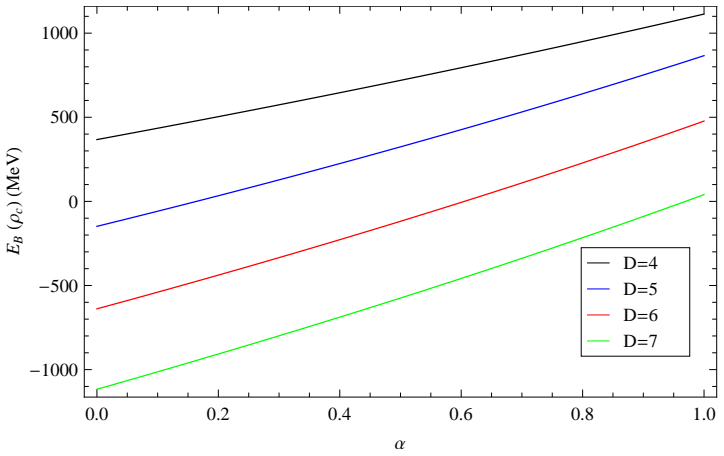
- Strange-quark matter in this model is absolutely stable in $D=4$, while in $D=5,6,7$ stability requires exceeding threshold anisotropy values $\alpha_{\rm crit}\approx0.16,0.61,0.97$, respectively.
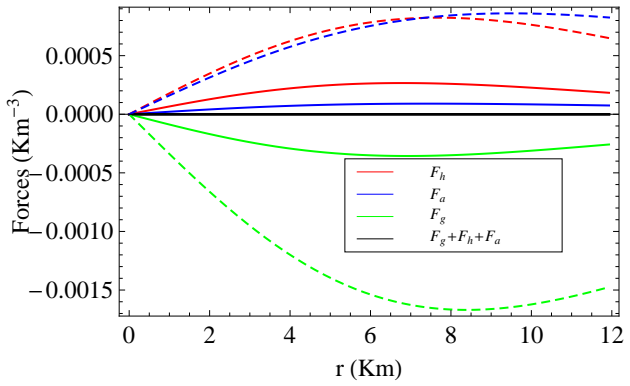
- The model passes the generalized TOV force-balance equation, the Herrera cracking condition, and the adiabatic-index criterion, so within the assumed geometry the configurations are dynamically stable.
Reading between the lines
- A direct way to stress-test the model would be to integrate the full anisotropic TOV equations with the explicit $\Delta(r)$, rather than using only the radial equation of state $p_r(\rho)$ for the mass-radius curves; the paper's Table 3 gives $M_{\max}=1.77\,M_\odot$ in $D=4$, while the fitted pulsar has $1.908\,M_\odot$, so the two could disagree.
- The construction effectively inverts observed mass-radius data into a density-dependent bag function $B(\rho)$; applied to other pulsars, the same pipeline would produce a family of bag functions whose mutual consistency could be checked against nuclear-physics constraints.
- The causality bound acts as a selection rule for higher-dimensional stars: if a compact object were ever observed whose inferred mass-radius point requires $D>4$, the model predicts it must be strongly anisotropic, a testable prediction for future gravitational-wave or X-ray measurements.
Signed reviews
Editorial analysis
A structured set of objections, weighed in public.
Referee Report
Summary. The manuscript constructs an exact static, spherically symmetric interior solution of the Einstein field equations in D>=4 spacetime dimensions with anisotropic pressures, using the Vaidya-Tikekar ansatz for the g_rr metric function and a specific form of pressure anisotropy. It derives a causality bound on the spheroidal parameter lambda, shows that the bound reduces to the known lambda>3/17 for D=4, alpha=0, fits the model to the observed mass and radius of PSR J1614-2230 with a fifth-order polynomial equation of state, converts that equation of state into a density-dependent MIT bag parameter B(rho), computes mass-radius curves by integrating TOV equations, and checks energy conditions and stability criteria such as the generalized TOV equation, Herrera cracking, and the adiabatic index. The paper claims that the model is singularity-free and that its mass-radius relation mimics a wide range of observed pulsars in four and higher dimensions.
Significance. If the exact solution and the stability checks were correct, the paper would provide a higher-dimensional anisotropic generalization of the Vaidya-Tikekar construction with a closed-form interior solution and a simple causality bound; the recovery of the known isotropic four-dimensional limit is a useful check. The solution algebra in Sec. 2 appears transparent, and the paper offers several standard physical checks (energy conditions, sound speeds, matching). However, the main phenomenological claims, namely the fit to PSR J1614-2230, the density-dependent bag model, and the mass-radius mimicry of pulsars, are not supported by the calculations as presented, and the paper's own numbers are internally inconsistent. The paper also does not ship reproducible code or machine-checked derivations, so the numerical claims rest entirely on the written text and figures.
major comments (3)
- [Sec. 7, Eq. (31), Table 3] The mass-radius curves and Table 3 are obtained by "solving the TOV equations" with the radial equation of state p_r(rho) from Eq. (31), but the TOV system used is not written down and no anisotropic term appears. The exact solution constructed in Sec. 2 is anisotropic, with Delta = p_t - p_r nonzero according to Eqs. (10), (15), and (16), and its hydrostatic equilibrium is governed by the generalized TOV equation (36), which contains the anisotropic force (n/r)(p_t - p_r). Integrating an isotropic TOV equation with p_r(rho) alone discards the anisotropy that was essential to the fitted exact solution. Consequently, Figs. 15-17 and Table 3 do not follow from the anisotropic solution presented in Sec. 2, and the abstract's claim that the mass-radius relation shows the model mimics a wide range of observed pulsars is unsupported.
- [Sec. 6 vs. Table 3] There is a direct numerical contradiction between the fitting section and the mass-radius table. Table 3 lists a D=4 maximum mass of 1.77 M_sun at b_max=10.09 km, while Sec. 6 fits the same model to PSR J1614-2230 with M=1.908^{+0.016}_{-0.016} M_sun and R=11.93^{+0.50}_{-0.50} km. Since 1.908 M_sun exceeds the declared maximum mass of the D=4 sequence, the fitted configuration cannot lie on the mass-radius curve shown in Fig. 15. The paper's validation against PSR J1614-2230 and its own mass-radius curves are therefore mutually inconsistent.
- [Sec. 6.2, Eq. (32), Figs. 12-14] The density-dependent bag parameter B(rho) is not independently determined. It is constructed by equating the linear MIT bag relation p_r=(rho-4B)/3 with the polynomial equation of state (31), whose coefficients in Table 2 are fits to the (rho,p_r) profile generated from Eqs. (13)-(14) for PSR J1614-2230. The stability window of strange quark matter in Fig. 12 and the critical anisotropy alpha_crit in Fig. 14 are therefore consequences of that fitting procedure rather than independent predictions of the model. The claim that the density-dependent MIT bag model is "useful" for the correct description of compact objects in this model needs to be reframed as a consistency check, not a validation.
minor comments (4)
- [Table 2 caption and Sec. 6] The table caption says the coefficients a_i are "obtained from Eq. (30)"; the coefficients actually come from fitting Eq. (31). The same typographical slip appears in the text near Table 2.
- [Fig. 20 caption] The caption of Fig. 20 states that the figure shows |v_t^2-v_r^2|, but the figure plots the adiabatic index Gamma and should also identify the anisotropic limit gamma of Eq. (40).
- [Introduction, after Eq. (1)] The sentence about the energy per baryon is garbled: "E_B of such system is 934 B_{145}^{1/4} MeV where,B_{145}^{1/4}=B_{145}^{1/4}" needs rewriting.
- [Sec. 5, Eq. (23)] The parentheses in the denominator of Eq. (23) are visually ambiguous; the expression should be typeset with explicit brackets so that the intended trigonometric ratio is unambiguous.
Circularity Check
Density-dependent bag parameter and 'wide pulsar mimicry' reduce to the same polynomial EoS fitted to PSR J1614-2230; exact solution and causality bound are self-contained.
-
fitted input called prediction
[Sec. 6.2, Eqs. (31)-(33), Fig. 12]
"B(ρ) = lX i=0 kiρi, where the coefficients ki s are related to ai s through the relations k0 =− 34a0, k1 = (1−3a1)4 , kj =− 34aj, where j runs from 2 to s. ... The energy per baryon of strange matter reads as [9] EB = 2√3(3π2B(ρ)/4)^{1/4}."
Eq. (32) for B(ρ) is obtained by eliminating p_r between the MIT bag relation p_r = (ρ−4B)/3 and the polynomial EoS Eq. (31), whose coefficients a_i were fitted in this same section to ρ and p_r values computed from the exact solution at the observed mass and radius of PSR J1614-2230. B(ρ) is therefore a re-expression of the fitted EoS, not an independent density-dependent bag parameter. The E_B(ρ) curves and the claimed stability window (absolute stability for D=4, metastability/instability in higher D) are consequences of that fit, not independent predictions.
-
fitted input called prediction
[Sec. 6.2 and Sec. 7, Eqs. (31), Fig. 15, Table 3]
"we use the observed mass, radius data of PSR J1614-2230 to find the values of ρ and pr at various interior points of the compact object using Eqs. (13) and (14). Then, we fit the obtained data with the predicted EoS given by Eq. (31). ... To solve the TOV equation, we have made use of the EoS given in Eq. (31)."
The mass-radius curves and maximum masses are outputs of a TOV integration whose input is the same polynomial EoS Eq. (31) that was fitted, earlier in the paper, to the interior ρ(r), p_r(r) profile of PSR J1614-2230 built from that object's observed mass and radius. Thus the J1614-based validation in Sec. 6 is in-sample by construction, and the abstract's claim that 'the mass radius relation shows that our model mimics a wide range of recently observed pulsars' is a statement about curves generated from that fitted EoS, not an independent prediction of the anisotropic exact solution.
full rationale
The core exact-solution derivation is self-contained: starting from the Vaidya-Tikekar metric ansatz (8) and the explicit anisotropy choice (10), the paper solves Eqs. (9)-(12), obtains density and pressures (13)-(16), imposes boundary conditions (20)-(24), and derives the causality bound (30), which reduces to the known Mukherjee et al. limit for D=4, α=0. No circularity attaches to that part. The self-citation to Goswami et al. [72] for the form of Δ is a modeling choice stated in the text, not a load-bearing external theorem. The circularity is confined to the phenomenological layer: Eq. (32) defines B(ρ) by substituting the fitted polynomial EoS (31) into the MIT bag relation, so the energy-per-baryon stability window is a relabeling of the fit; and the Sec. 7 mass-radius curves are generated by integrating that same fitted EoS. Consequently, the abstract's validation claims for PSR J1614-2230 and the 'wide range' of pulsars are not independent tests of the exact solution. Table 3's D=4 maximum mass (1.77 M_sun) also falls short of the fitted 1.908 M_sun point, an internal inconsistency that underscores that the M-R sequence does not directly reproduce the fitted configuration. Overall score 6: partial circularity in the phenomenological predictions, with the exact-solution core intact.
Assumptions & free parameters
free parameters (4)
- spheroidal parameter lambda =
40 in the application; varied in Table 1 and Figs. 13-14
- anisotropy parameter alpha =
0.3 for D=4,5 and 0.98 for D=6,7 in the application; varied elsewhere
- curvature parameter R =
not tabulated explicitly; fixed by matching to the observed mass and radius of PSR J1614-2230
- polynomial EoS coefficients a0...a5 =
listed in Table 2 for D=4,5,6,7
assumptions (7)
- domain assumption The interior spacetime is static, spherically symmetric in D dimensions, and filled with an anisotropic perfect fluid described by Eqs. (2) and (3).
- ad hoc to paper The g_rr metric function takes the Vaidya-Tikekar spheroidal form in Eq. (8).
- ad hoc to paper The pressure anisotropy Delta has the specific form in Eq. (10).
- domain assumption The exterior spacetime is the D-dimensional Schwarzschild/Tangherlini vacuum metric in Eq. (18), with mass related by Eq. (19).
- ad hoc to paper The equation of state is a finite polynomial in rho, Eq. (31), truncated at fifth order.
- domain assumption Causality requires 0 <= v_r^2 < 1, and this condition is used to derive the lambda bound in Eqs. (27)-(30).
- domain assumption The energy per baryon of strange quark matter is given by the MIT-bag formula Eq. (33).
Cite this review
Pith. "Pith review of Exploring density dependent B as a suitable parameter in higher dimensional approach with a non-linear equation of state." pith.science (2026). https://pith.science/paper/MLJY5IC3
@misc{pith2026250820634,
  author       = {Pith},
  title        = {Pith review of: Exploring density dependent B as a suitable parameter in higher dimensional approach with a non-linear equation of state},
  year         = {2026},
  howpublished = {\url{https://pith.science/paper/MLJY5IC3}},
  note         = {Machine review of arXiv:2508.20634}
}
abstract
In this investigation, we present a singularity free interior solution of the Einstein field equation for a class of anisotropic compact objects in dimensions $D\geq4$. In accordance with the concept of Vaidya and Tikekar, the geometry of the physical $(D-1)$-space of a star corresponding to $t=constant$ hypersurface is assumed to be of a $(D-1)$ spheroid. For the fulfilment of causality condition, a limit of the spheroidal parameter ($\lambda$) is noted depending on the values of amount of anisotropy ($\alpha$) and space-time dimensions ($D$). We note that by switching off the extra parameters ($\alpha$ and $D$), previously obtained limit of $\lambda$ can be generated. To validate our findings, we compare the results obtained from our model with observational data of PSR J1614-2230 (mass=$1.908^{+0.016}_{-0.016}M_{\odot}$, radius=$11.93^{+0.50}_{-0.50}km$). It is noted that the best fit equation of state corresponds to polynomial equation of state of the order of five. We use this finding to develop a density dependent MIT bag model which seems to be useful for the correct description of compact object in our model. The mass radius relation shows that our model mimics a wide range of recently observed pulsars in four and higher dimensions. Furthermore, we also found that our model exhibits stability according to Generalised TOV equation, Herrera cracking condition, and the adiabatic index.
Figures


Figures from the paper (17 more)






Reference graph
Works this paper leans on
-
[1]
GellMann, M., 1964. Phys. Lett. 8, 214. 19
1964
-
[2]
Zweig, G., 1964. Ed. Developments in the quark theory of hadrons, Lichtenberg, 1, 22
1964
-
[3]
Bodmer, A.R., 1971. Phys. Rev. D 4, 1601
1971
-
[4]
Witten, E., 1984. Phys. Rev. D 30, 272
1984
-
[5]
Physics and astrophysics of strange quark matter, in: Hadrons in Dense Matter and Hadrosyn- thesis, Lecture Notes in Physics, vol
Madsen, J., 1998. Physics and astrophysics of strange quark matter, in: Hadrons in Dense Matter and Hadrosyn- thesis, Lecture Notes in Physics, vol. 516. Cleymans J., Geyer H.B., Scholtz F.G. (Eds.), Heidelberg, Springer, p. 42
1998
-
[6]
Baym, G., Kolb, E.W., McLerran, L., Walker, T.P., Jaffe, R.L., 1985. Phys. Lett. B 160, 181
1985
-
[7]
Glendenning, N.K., 1990. Mod. Phys. Lett. A 5, 2197
1990
-
[8]
Astrophys
Alcock, C., Farhi, E., Olinto, A., 1986. Astrophys. J. 310, 261
1986
Show all 117 references
-
[9]
Weber, F., 2005. Prog. Part. Nucl. Phys. 54, 193
2005
-
[10]
Applegate, A., Hogan, C.J., 1985. Phys. Rev. D 31, 3037
1985
-
[11]
Farhi, E., Jaffe, R.L., 1984. Phys. Rev. D 30, 2379
1984
-
[12]
Chandra, D., Goyal, A., 2000. Phys. Rev. D 62, 063505
2000
-
[13]
et al., 1999
Bhattacharyya, A., Alam, J.E., Sarkar, S. et al., 1999. Nucl. Phys. A 661, 629
1999
-
[14]
et al., 2000
Bhattacharyya, A., Alam, J.E., Sarkar, S. et al., 2000. Phys. Rev. D 61, 083509
2000
-
[15]
Pramana - J
Bhattacharyya, A., Banerjee, S., Ghosh, S.K., Raha, S., Sinha, B., Toki, H., 2003. Pramana - J. Phys. 60, 909
2003
-
[16]
Chodos, A., Jaffe, R.L., Johnson, K., Thorn, C.B., Weisskopf, V.F., 1974. Phys. Rev. D 9, 3471
1974
-
[17]
Kettner, Ch., Weber, F., Weigel, M.K., Glendenning, N.K., 1995. Phys. Rev. D 51, 1440
1995
-
[18]
Finite-Temperature Field Theory, Cambridge University Press, Cambridge, p.163-165
Kapusta, J., 1994. Finite-Temperature Field Theory, Cambridge University Press, Cambridge, p.163-165
1994
-
[19]
Brilenkov, M., Eingorn, M., Jenkovszky, L., Zhuk, A., 2013. J. Cosmol. Astropart. Phys. 08, 002
2013
-
[20]
Paulucci, L., Horvath, J.E., 2014. Phys. Lett. B 733, 164
2014
-
[21]
Arba˜ nil, J.D.V., Malheiro, M., 2016. J. Cosmol. Astropart. Phys. 11, 012
2016
-
[22]
Lugones, G., Arba˜ nil, J.D.V., 2017. Phys. Rev. D 95, 064022
2017
-
[23]
Chowdhury, S.R., Deb, D., Rahaman, F., Ray, S., Guha, B.K., 2020. Int. J. Mod. Phys. D 29, 2050001
2020
-
[24]
Kalam, M., Usmani, A.A., Rahaman, F., Hossein, S.M., Karar, I., Sharma, R., 2013. Int. J. Theo. Phys. 52, 3319
2013
-
[25]
Aziz, A., Ray, S., Rahaman, F., Khlopov, M., Guha, B.K., 2019. Int. J. Mod. Phys. D 28, 1941006
2019
-
[26]
Reinhardt, H., Dang, B.V., 1986. Phys. Lett. B 173, 473
1986
-
[27]
Chakrabarty, S., Raha, S., Sinha, B., 1989. Phys. Lett. B 229, 112
1989
-
[28]
Chakrabarty, S., 1991. Phys. Rev. D 43, 627
1991
-
[29]
Chakrabarty, S., 1993. Phys. Rev. D 48, 1409
1993
-
[30]
Chakrabarty, S., 1996. Phys. Rev. D 54, 1306
1996
-
[31]
Peng, G.X., Chiang, H.C., Zou, B.S., Ning, P.J., Luo, S.J., 2000. Phys. Rev. C 62, 025801
2000
-
[32]
Prasad, N., Bhalerao, R., 2004. Phys. Rev. D 69, 1003001
2004
-
[33]
Zhu, M.F., Liu, G.Z., Yu, Z., Zu, Y., Song, W.T., 2009. Sci. China Ser. G 52, 1506
2009
-
[34]
Collins, J.C., Perry, M.J., 1975. Phys. Rev. Lett. 34, 1353
1975
-
[35]
Progress Theor
Itoh, N., 1970. Progress Theor. Phys. 44, 291
1970
-
[36]
Soviet Phys
Migdal, A.B., 1971. Soviet Phys. JETP 34, 1184. 20
1971
-
[37]
Sawyer, R.F., 1972. Phys. Rev. Lett. 29, 382
1972
-
[38]
Soviet Phys
Sokolov, A.I., 1980. Soviet Phys. JETP 52, 575
1980
-
[39]
Astrophys
Hartle, J.B., Sawyer, R., Scalapino, D., 1975. Astrophys. J. 199, 471
1975
-
[40]
Ruderman, M., 1972. Annu. Rev. Astron. Astrophys. 10, 427
1972
-
[41]
Cameron, A.G.V., Canuto, V., 1973. Proc. 16th Solvay Conf. on Astrophysics and Gravitation: Neutron Stars: General Review, `Editions de Universit` e de Bruxelles, Bruxelles
1973
-
[42]
Letelier, P., 1980. Phys. Rev. D 22, 807
1980
-
[43]
Herrera, L., 2020. Phys. Rev. D 101, 104024
2020
-
[44]
Cosenza, M., Herrera, L., Esculpi, M., Witten, L., 1981. J. Math. Phys. 22, 118
1981
-
[45]
Ruderman, R., 1972. Astron. Astrophys. 10, 427
1972
-
[46]
Canuto, V., 1974. Annu. Rev. Astron. Astrophys. 12, 167
1974
-
[47]
Steller Structure and Evolution, Springer, Berlin
Kippenhahn, R., Weigert, A., 1990. Steller Structure and Evolution, Springer, Berlin
1990
-
[48]
(Eds.), 2013
Broglia, R.A., Zelevinsky, V. (Eds.), 2013. Fifty Years of Nuclear BCS: Pairing in Finite Systems, World Scientific Publishing Co. Pte. Ltd., Singapore
2013
-
[49]
In: Bennemann, K.H., Ketterson, J.B
Page, D., Lattimer, J.M., Prakash, M., 2014. In: Bennemann, K.H., Ketterson, J.B. (Eds.), Novel Supefluids, vol
2014
-
[50]
Oxford University Press, Oxford, p. 505
-
[51]
Astrophys
Bowers, R.L., Liang, E.P.T., 1974. Astrophys. J. 188, 657
1974
-
[52]
Lake, K., 2009. Phys. Rev. D 80, 064039
2009
-
[53]
Baskey, L., Das, S., Rahaman, F., 2024. Eur. Phys. J. C 84, 92
2024
-
[54]
Pradhan, S., Bhar, P., Mandal, S., Sahoo, P.K., Bamba, K., 2025. Eur. Phys. J. C 85, 127
2025
-
[55]
Baskey, L., Ray, S., Das, S., Majumder, S., Das, A., 2023. Eur. Phys. J. C 83, 307
2023
-
[56]
Maurya, S.K., Gupta, Y.K., Ray, S., Dayanandan, B., 2015. Eur. Phys. J. C 75, 225
2015
-
[57]
Astrophys
Pandya, D.M., Thomas, V.O., Sharma, R., 2015. Astrophys. Space Sci. 356, 285
2015
-
[58]
Superstring Theory Vols
Green, M.B., Schwarz, J.H., Witten, E., 2012. Superstring Theory Vols. 1 and 2: 25th Anniversary Edition, Cam- bridge University Press, ISBN 978-1-139-53477-2, 978-1-107-02911-8 and ISBN 978-1-139-53478-9, 978-1-107-02913- 2
2012
-
[59]
String theory
Polchinski, J., 2007. String theory. Vol. 1: An introduction to the bosonic string, Cambridge University Press, ISBN 978-0-511-25227-3, 978-0-521-67227-6, 978-0-521-63303-1 and String theory. Vol. 2: Superstring theory and beyond, Cambridge University Press, ISBN 978-0-511-252...
2007
-
[60]
Kaluza, T., 1921. Sits. Press. Akad. Wiss. Math. Phys. K 1, 895
1921
-
[61]
Klein, O., 1921. Z. Phys. K 1, 895
1921
-
[62]
Chodos, A., Detweiler, S., 1980. Phys. Rev. D 21, 2167
1980
-
[63]
Chodos, A., Detweiler, S., 1982. Gen. Relativ. Gravit. 14, 879
1982
-
[64]
Myers, R.C., Perry, M.J., 1986. Ann. Phys. (N. Y.) 172, 304
1986
-
[65]
Mazur, P.O., 1987. J. Math. Phys. 28, 406
1987
-
[66]
Frolov, V.P., Zelnikov, A.I., Bleyer, U., 1987. Ann. Phys. (Leipzig) 44, 371
1987
-
[67]
Dianyan, Xu., 1988. Class. Quantum Gravity 5, 871
1988
-
[68]
Sokolowski, L., Carr, B., 1966. Phys. Lett. B 176, 334
1966
-
[69]
Myers, R.C., 1987. Phys. Rev. D 35, 455. 21
1987
-
[70]
Zahra, A., Mardan, S.A., Riaz, M.B., Manzoor, R., Noureen, I., 2024. Eur. Phys. J. Plus 139, 676
2024
-
[71]
Vaidya, P.C., Tikekar, R., 1982. J. Astrophys. Astron. 3, 325
1982
-
[72]
Astrophys
Paul, B.C., Chattopadhyay, P.K., Karmakar, S., 2015. Astrophys. Space Sci. 356, 327
2015
-
[73]
Astrophys
Goswami, K.B., Saha, A., Chattopadhyay, P.K., 2020. Astrophys. Space Sci. 365, 141
2020
-
[74]
Astrophys
Saha, A., Goswami, K.B., Chattopadhyay, P.K., 2021. Astrophys. Space Sci. 366, 98
2021
-
[75]
Goswami, K.B., Saha, A., Chattopadhyay, P.K., 2022. Class. Quantum Gravity 39, 175006
2022
-
[76]
Sharma, R., Das, S., Govender, M., Pandya, D.M., 2020. Ann. Phys. (N. Y.) 414, 168079
2020
-
[77]
Hansraj, S., Govender, M., Moodly, L., Singh, Ksh.N., 2022. Phys. Rev. D 105, 044030
2022
-
[78]
Sharif, M., Majid, A., 2021. Astron. Rep. 65, 1048
2021
-
[79]
JHEP 45, 231
Nag, A., Bhattacharjee, D., Goswami, K.B., Chattopadhyay, P.K., 2025. JHEP 45, 231
2025
-
[80]
Goswami, K.B., Bhattacharjee, D., Chattopadhyay, P.K., Saha, A., 2025. Phys. Dark Universe 47, 101752
2025
-
[81]
Mak, M.K., Harko, T., 2003. Proc. R. Soc. London A 459, 393
2003
-
[82]
Dev, K., Gleisser, M., 2004. Int. J. Mod. Phys. D 13, 1389
2004
-
[83]
Chaisi, M., Maharaj, S.D., 2005. Gen. Relativ. Gravit. 37, 1177
2005
-
[84]
Pramana-J
Tikekar, R., Thomas, V.O., 1999. Pramana-J. Phys. 52, 237
1999
-
[85]
Maharaj, S.D., Maartens, R., 1989. Gen. Relativ. Gravit. 21, 899
1989
-
[86]
Mukherjee, S., Paul, B.C., Dadhich, N.K., 1997. Class. Quantum Grav. 14, 3475
1997
-
[87]
Delgaty, M.S.R., Lake, K., 1998. Comput. Phys. Commun. 115, 395
1998
-
[88]
Relativistic Astrophysics
Zeldovich, Y.B., Novikov, I.D., 1971. Relativistic Astrophysics. vol. 1.: Stars and Relativity, University of Chicago Press, Chicago
1971
-
[89]
Shen, Y., Tan, Z., 1989. Phys. Lett. A 142, 341
1989
-
[90]
Bedaque, P., Steiner, A.W., 2015. Phys. Rev. Lett. 114, 031103
2015
-
[91]
Astrophys
Han, M.-Z., Jiang, J.-L., Tang, S.-P., Fan, Y.-Z., 2021. Astrophys. J. 919, 11
2021
- [92]
- [93]
- [94]
- [95]
- [96]
-
[97]
Sci Bull 68, 913
Han, M.-Z., Huang, Y.-J., Tang, S.-P., Fan, Y.-Z., 2023. Sci Bull 68, 913
2023
-
[98]
Glass, E.N., 1983. Phys. Rev. D 28, 2693
1983
-
[99]
Ruderman, M., 1968. Phys. Rev. 172, 1286
1968
-
[100]
Ellis, G.F.R., Maartens, R., MacCallum, M.A.H., 2007. Gen. Relativ. Gravit. 39, 1651
2007
-
[101]
Li, B.-A., Grundler, X., Xie, W.-J., Zhang, N.-B., 2024. Phys. Rev. D 110, 103040
2024
-
[102]
Brassel, B.P., Maharaj, S.D., Goswami, R., 2021. Prog. Theor. Exp. Phys. 2021, 103E01
2021
-
[103]
Maeda, H., Martinez, C., 2020. Prog. Theor. Exp. Phys. 2020, 043E02
2020
-
[104]
Astrophys Space Sci 361, 145
Chattopadhyay, P.K., Paul, B.C., 2016. Astrophys Space Sci 361, 145. 22
2016
-
[105]
Muller, B., Rafelski, J., 1981. Phys. Lett. B 101, 111
1981
-
[106]
Bakhti, B., 2021. Int. J. Mod. Phys. A 36, 2150217
2021
-
[107]
Gravitational Theory and Gravitational Collapse, University of Chicago Press, Chicago
Harrison, B.K., Thorne, K.S., Wakano, M., Wheeler, J.A., 1965. Gravitational Theory and Gravitational Collapse, University of Chicago Press, Chicago
1965
-
[108]
Ponce, de Leon J., Cruz, N., 2000. Gen. Relativ. Gravit. 32, 1207
2000
-
[109]
Tolman, R.C., 1939. Phys. Rev. 55, 364
1939
-
[110]
Oppenheimer, J.R., Volkoff, G.M., 1939. Phys. Rev. 55, 374
1939
-
[111]
Grøn, Ø., 1985. Phys. Rev. D 31, 2129
1985
-
[112]
Herrera, L., 1992. Phys. Lett. A 165, 206
1992
-
[113]
Abreu, H., Hern´ andez, H., N´ u˜ nez, L.A., 2007. Class. Quantum Gravity 24, 4631
2007
-
[114]
Astrophys
Chandrasekhar, S., 1964. Astrophys. J. 140, 417
1964
-
[115]
Heintzmann, H., Hillebrandt, W., 1975. Astron. Astrophys. 38, 51
1975
-
[116]
Chan, R., Herrera, L., Santos, N.O., 1993. Mon. Not. R. Astron. Soc. 265, 533
1993
-
[117]
Schwarz, J.H., 1999. Phys. Rep. 315, 107. 23
1999
Reviewed August 15, 2026 · model on record in the stance chip above.
Discussion (0). Continue with ORCID to comment.