REVIEW 3 major objections 8 minor 53 references
Task-Oriented Edge-Assisted Cross-System Design for Real-Time Human-Robot Interaction in Industrial Metaverse
T0 review · 3 major / 8 minor · reviewed 2026-08-05 · deepseek-v4-flash
Pith's one-line read The paper argues that predicting the operator's hand motion and decoupling the digital twin's display and control loops can neutralize end-to-end latency, cutting trajectory error from 0.0712 m to 0.0101 m.
desk verdict Real prototype and a plausible architecture, but the evaluation as written is not trustworthy: impossible percentage, inverted reward weights, a baseline beating the method in its own table, and an unverified load-bearing prediction claim. read the letter →
The pith
A machine-rendered reading of the paper's core claim, the machinery that carries it, and where it could break.
The reading
What carries the argument
The load-bearing mechanism is the prediction-horizon policy. At each time slot an agent receives the operator's normalized pose plus the measured end-to-end delays of the control loop (Tr) and the visual loop (Tv), and outputs two prediction lengths Hr and Hv. Those lengths tell the ARMA motion predictor how far ahead to look; the predicted poses are consumed by two parallel paths—preemptive joint control of the real robot and proactive rendering of the virtual twin—so that commands and frames arrive at their destination already referencing the future. The second essential piece is the two-stage HITL-MAML training: offline MAML pretraining on recorded circle/triangle/star/square trajectories
What would settle it
Collect held-out operator traces for the four drawing shapes, fit the same ARMA predictor, and measure prediction RMSE at 127 ms and 252 ms (the measured E2E delays in Table II). If at those horizons the prediction error exceeds the no-prediction motion-to-photon error for the same delays, then proactive rendering and preemptive control inject more error than they remove, and the reported 0.0101 m RMSE would not generalize.
Extended reading notes
Core claim
The central claim is that a task-oriented cross-system design—where the digital twin is decoupled into two virtual functions, one for visual display and one for robotic control, and where both are driven by predicted operator poses—can eliminate the effects of end-to-end delay in real-time human-robot interaction. Rather than trying to minimize latency in each subsystem, the system predicts the operator's pose with an ARMA model and chooses two prediction horizons, Hr and Hv, through a meta-reinforcement-learning policy that observes the operator's pose history and the measured E2E delays of both loops. The policy is first pretrained offline across four trajectory tasks using MAML, then adap
Load-bearing premise
The entire latency-compensation benefit rests on the empirical premise that a low-order ARMA model can predict a live operator's hand motion with RMSE below 1 cm over horizons up to 1000 ms, with error growing only slowly with horizon; the paper asserts this from Fig. 6 without releasing the traces, error distributions, or ARMA orders.
Editorial extensions
If this is right
- If correct, delay compensation becomes a task-level control problem: the system can tolerate communication delays as long as the motion predictor is accurate and the horizon policy picks compensating lengths.
- Decoupling the digital twin's rendering loop from its control loop lets the edge server run physics updates at 240 Hz while streaming display frames at 60 fps, which is how the prototype meets both spatial-precision and visual-fidelity requirements at once.
- Because the horizon policy is meta-learned, the same offline pretraining transfers across trajectory shapes and adapts online to an individual operator's style within roughly 80 episodes.
- In the inspection task, better control precision under a fixed time budget produces measurably better 3D reconstruction metrics, so communication latency degrades not only the teleoperation itself but the final task artifact.
Reading between the lines
- A testable extension is to swap the ARMA predictor for a learned sequence model and re-run the same two-loop framework; since the paper presents the framework as predictor-agnostic, this would reveal whether the remaining error comes from the predictor or from the horizon policy.
- The delay injections are Gaussian with 10 ms standard deviation; adversarial or bursty delay traces would stress the M/M/1/2* packet-discard discipline, where a stale packet could be worse than no prediction, and the horizon policy might need to learn to predict zero.
- The paper leaves implicit that the same architecture—predict the human's motion, run two parallel loops, meta-learn the horizon—should transfer to other human-in-the-loop cyber-physical systems such as surgical teleoperation, remote driving, or telepresence maintenance.
Editorial analysis
A structured set of objections, weighed in public.
Referee Report
Summary. The paper proposes a task-oriented, edge-assisted cross-system framework for real-time human-robot interaction in an industrial Metaverse. A digital twin is decoupled into a visual-feedback function and a robotic-control function, and an ARMA predictor is used to forecast operator motion. A DRL agent trained with a two-stage MAML procedure (HITL-MAML) dynamically selects the prediction horizons for proactive rendering and preemptive control. The system is validated on a prototype with a haptic device, Isaac Sim, and a UR3e arm. The reported results are a reduction in weighted RMSE from 0.0712 m to 0.0101 m in a drawing-control task and PSNR 22.11 / SSIM 0.8729 / LPIPS 0.1298 in a 3D scene-representation task. The central claim is that the proposed cross-system design with HITL-MAML improves spatial precision and visual fidelity under realistic latency conditions.
Significance. If properly supported, the paper would make a useful contribution by jointly addressing prediction, communication, control, and rendering in a human-in-the-loop industrial metaverse setting, and by providing a working testbed. The construction of the prototype and the measurement of end-to-end delays under emulated network conditions are genuine strengths, as is the comparison against three baselines. However, the evaluation currently has load-bearing gaps: the prediction-accuracy claim rests on an unreadable figure and no model details; the main RMSE results are obtained on the same four shapes used for offline pretraining; and the 3D reconstruction table contradicts the paper's own claim of consistency. The framework is plausible, but the evidence as presented does not yet establish the paper's strong quantitative claims.
major comments (3)
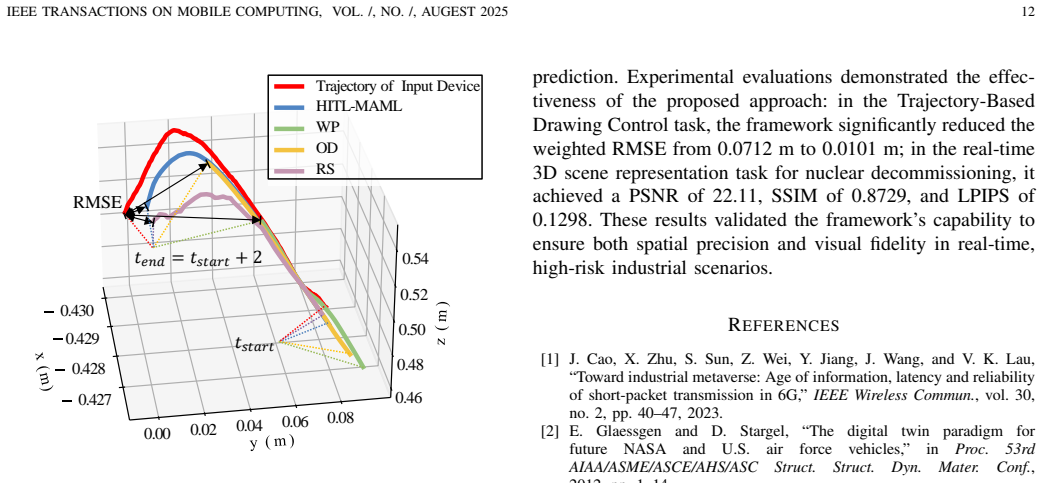
- [Section V-B, Fig. 6] The claim that the ARMA predictor achieves 'less than 0.01m RMSE when the prediction horizon is less than 1000 ms' is load-bearing and currently unsupported. Fig. 6 is unreadable in the submitted PDF (it appears as raw glyph paths rather than a plot), and the text gives no ARMA orders (p,q), no coefficient estimation procedure, no per-horizon error table, and no underlying trace data. Since the predicted poses enter the control and rendering loops (Eqs. 3, 6, and 10) and the DRL agent selects horizons based on this predictor, the headline reduction from 0.0712 m to 0.0101 m depends on prediction accuracy at the operating delays measured in Table II (roughly 127 to 252 ms). The authors should provide a readable figure, a table of RMSE versus horizon with error bars, and ideally release the operator-motion traces or a similarly detailed validation at the exact E2E delays reported.
- [Sections IV-B and V-C] The evaluation of the trajectory-tracking task is confounded with the training data. Section IV-B states that 150 repetitions of each of the four shapes (circle, triangle, pentagram, square) were collected for pretraining, and Section V-C then reports RMSE on exactly those four shapes. No held-out shape, no novel operator, and no different task distribution is used to test the generalizability claim of HITL-MAML. Furthermore, the DRL reward in Eq. (20) is the sum of ev and er, which are exactly the weighted RMSE metrics defined in Eqs. (16)-(17) and used for evaluation. This means the reported 'improvement' is, to a large extent, the agent minimizing its own training objective on the training-domain trajectories. The authors should evaluate on held-out shapes or operators, or otherwise demonstrate that the improvement generalizes beyond the in-sample objective.
- [Section V-D, Table IV] The text states that 'our method consistently achieved higher representation fidelity' compared with the baselines, but Table IV contradicts this under the Fixed Photographing Number condition: RS achieves higher PSNR (22.49 vs. 22.11) and lower LPIPS (0.1295 vs. 0.1298) than HITL-MAML. The claim of consistent superiority is therefore false as written. The authors should either correct the claim, provide statistical significance tests or confidence intervals, or explain why a fixed image budget changes the ranking. As presented, the 3D scene-representation advantage of the proposed method is not established.
minor comments (8)
- [Section V-C.1] 'The RMSE decrease by 249.39%, 132.79%, and 61.13%' is impossible: a decrease cannot exceed 100%. If the intended statistic is a relative reduction from the baseline, the values should be (baseline - proposed)/baseline × 100, which for the reported WP (0.0712) and proposed (0.0096) values would be about 86.5%, not 249.39%. Please restate with a clear formula and correct numbers.
- [Table I] The weighting coefficients ω1..ω4 are listed as -1. Since the reward in Eq. (20) is ev + er, negative weights make the reward a negative RMSE, which is a sensible reward for maximization. However, the text calls them 'weighting coefficients' without explaining the sign. Please clarify that the reward is negative weighted RMSE or change the notation so that the sign is explicit.
- [Figure 6] The figure is unreadable in the PDF; the axes and legend appear as garbled glyph paths. Replace it with a high-resolution vector graphic, and also provide a table of RMSE values at selected horizons (e.g., 50, 100, 127, 144, 236, 252 ms).
- [Section II-C.1, Eq. (4)] The ARMA model is central to the framework, but no orders or coefficient estimation method are given. Please report the values of p, q, and the fitting procedure used for the four trajectories, or state that they are chosen by a standard criterion (e.g., AIC).
- [Eq. (27)] The constraints (27b) and (27c) use Hv and Hr both as the variable and as the maximum horizon. Rename the maxima to, e.g., H_v^max and H_r^max, to avoid ambiguity.
- [Section II-C.2, Eq. (14)] The phrase 'where ˙t represents the differentiation of t' is unhelpful; define τ_i(t) as the joint position error and clarify the integration variable.
- [References] Reference [43] (Dell monitor) points to the 3D Systems haptics-devices URL, not the monitor datasheet. Please correct the URL.
- [General] The header on page 1 reads 'AUGEST 2025'; should be 'AUGUST 2025'. Also, the sentence in Section V-B ('It is intuitively that...') needs grammatical revision.
Circularity Check
Reported RMSE improvements are the in-sample training objective: the reward (Eq. 20) is exactly the evaluation metric (Eqs. 16-17), and the evaluation uses the same four shapes on which the model was trained.
-
self definitional
[Section III-A (Instantaneous Reward), Eq. (20); Section II-D, Eqs. (16)-(17); Section V-C, Fig. 8 and Table III]
"r(st, at) = ev(t) + er(t), where er(t) is the RMSE for the real-world robotic control and ev(t) is the RMSE for the visual feedback. ... ev = ω1 · RMSEp(˜pi, ˜pv) + ω2 · RMSEo(˜pi, ˜pv) ... er = ω3 · RMSEp(˜pi, ˜pr) + ω4 · RMSEo(˜pi, ˜pr) ... We collected real-time interaction data from four trajectory-following tasks ... shapes including circle, triangle, pentagram, and square."
The task-KPI RMSE (Eqs. 16-17) is used verbatim as the reward (Eq. 20), so the policy is optimized to minimize exactly the metric later reported as performance. Section V-C then reports the converged reward, 'an average RMSE of 0.0101 m,' and Table III gives per-shape RMSEs on the same four shapes used for MAML pretraining and HITL online adaptation. By construction, an agent trained to minimize a metric will score well when evaluated on that same metric and on the training distribution. The claimed 'generalizability' is therefore not tested by held-out shapes, operators, or horizons; the reported improvement is the in-sample training objective, not an independent prediction.
full rationale
The main circularity is the closed loop between the optimization objective and the evaluation metric: the reward function (Eq. 20) is defined as the weighted RMSE of Eqs. (16)-(17), and the paper's headline trajectory-tracking result is that same RMSE measured on the same four shapes used for training. This makes the reported 0.0712-to-0.0101 reduction partly a restatement of the optimization target at convergence, rather than an independent generalization result. The ARMA prediction-accuracy claim (Section V-B, Fig. 6) is load-bearing but not circular; it is an evidence gap because no ARMA orders, coefficient-estimation procedure, or per-horizon error data are given. Self-citations exist (e.g., [6], [32], [34]) but are not used as a uniqueness theorem or to import a central premise, so they do not add circularity. The 3D scene representation evaluation is not circular: PSNR/SSIM/LPIPS are external visual-quality metrics not used as the training reward, although the control policy that collects images is still trained with the RMSE reward. Overall, the central numerical claim partially reduces to its own training objective, warranting a moderate circularity score.
Assumptions & free parameters
free parameters (7)
- ARMA coefficients c, phi_a, theta_b and orders (p,q) (Eq. 4) =
not reported
- RMPFlow gains kp, kd and robust threshold theta_th (Eqs. 7-8) =
not reported
- PID gains Kp, Ki, Kd (Eq. 14) =
not reported
- Error weighting coefficients omega_1..omega_4 (Eqs. 16-17) =
-1 (Table I)
- Maximum prediction horizon H =
1000 ms
- Communication delay simulation parameters mu_c, sigma_c =
50 ms or 100 ms mean, 10 ms std (normal)
- MAML/PPO hyperparameters (alpha, beta, clip, gamma, lambda) =
alpha=1e-3, beta=1e-5, clip=0.2, etc.
assumptions (4)
- domain assumption Operator motion can be modeled as a low-order ARMA process, with prediction error below 1 cm for horizons up to 1000 ms.
- domain assumption The digital twin and Isaac Sim simulation faithfully mirror the real UR3e robot and environment so that predicted commands can be executed without additional correction.
- ad hoc to paper The M/M/1/2* queue model with packet discarding is an adequate abstraction of the system latency.
- domain assumption MAML pretraining on the four drawing tasks transfers to the same tasks during online HITL adaptation; no held-out task tests generalization.
Cite this review
Pith. "Pith review of Task-Oriented Edge-Assisted Cross-System Design for Real-Time Human-Robot Interaction in Industrial Metaverse." pith.science (2026). https://pith.science/paper/KPWHHMTM
@misc{pith2026250820664,
  author       = {Pith},
  title        = {Pith review of: Task-Oriented Edge-Assisted Cross-System Design for Real-Time Human-Robot Interaction in Industrial Metaverse},
  year         = {2026},
  howpublished = {\url{https://pith.science/paper/KPWHHMTM}},
  note         = {Machine review of arXiv:2508.20664}
}
read the original abstract
Real-time human-device interaction in industrial Metaverse faces challenges such as high computational load, limited bandwidth, and strict latency. This paper proposes a task-oriented edge-assisted cross-system framework using digital twins (DTs) to enable responsive interactions. By predicting operator motions, the system supports: 1) proactive Metaverse rendering for visual feedback, and 2) preemptive control of remote devices. The DTs are decoupled into two virtual functions-visual display and robotic control-optimizing both performance and adaptability. To enhance generalizability, we introduce the Human-In-The-Loop Model-Agnostic Meta-Learning (HITL-MAML) algorithm, which dynamically adjusts prediction horizons. Evaluation on two tasks demonstrates the framework's effectiveness: in a Trajectory-Based Drawing Control task, it reduces weighted RMSE from 0.0712 m to 0.0101 m; in a real-time 3D scene representation task for nuclear decommissioning, it achieves a PSNR of 22.11, SSIM of 0.8729, and LPIPS of 0.1298. These results show the framework's capability to ensure spatial precision and visual fidelity in real-time, high-risk industrial environments.
Figures


Figures from the paper (6 more)


Reference graph
Works this paper leans on
-
[2]
The digital twin paradigm for future NASA and U.S. air force vehicles,
E. Glaessgen and D. Stargel, “The digital twin paradigm for future NASA and U.S. air force vehicles,” in Proc. 53rd AIAA/ASME/ASCE/AHS/ASC Struct. Struct. Dyn. Mater. Conf. , 2012, pp. 1–14
work page 2012
-
[3]
S. Pacheco-Gutierrez, H. Niu, I. Caliskanelli, and R. Skilton, “A multiple level-of-detail 3d data transmission approach for low-latency remote visualisation in teleoperation tasks,” Robot., vol. 10, no. 3, p. 89, 2021
work page 2021
-
[4]
Lessons learned: Symbiotic autonomous robot ecosystem for nuclear environments,
D. Mitchell, P. D. E. Baniqued, A. Zahid, A. West, B. Nouri Rahmat Abadi, and et al, “Lessons learned: Symbiotic autonomous robot ecosystem for nuclear environments,” IET Cyber-Syst. Robot. , vol. 5, no. 4, p. e12103, 2023. [Online]. Available: https://ietresearch. onlinelibrary.wiley.com/doi/abs/10.1049/csy2.12103
-
[5]
A perspective on time toward wireless 6G,
P. Popovski, F. Chiariotti, K. Huang, A. E. Kalør, M. Kountouris, N. Pappas, and B. Soret, “A perspective on time toward wireless 6G,” Proc. IEEE, vol. 110, no. 8, pp. 1116–1146, 2022
work page 2022
-
[6]
Task-oriented metaverse design in the 6G era,
Z. Meng, C. She, G. Zhao, M. A. Imran, M. Dohler, Y . Li, and B. Vucetic, “Task-oriented metaverse design in the 6G era,” IEEE Wireless Commun., pp. 1–7, 2024
work page 2024
-
[7]
Study on scenarios and requirements for next generation access tech- nologies,
“Study on scenarios and requirements for next generation access tech- nologies,” document 3GPP , TSG RAN TR38.913 R14, Jun 2017
work page 2017
-
[8]
VR is on the edge: How to deliver 360 videos in mobile networks,
S. Mangiante, G. Klas, A. Navon, Z. GuanHua, J. Ran, and M. D. Silva, “VR is on the edge: How to deliver 360 videos in mobile networks,” in Proc. Workshop Virtual Reality Augmented Reality Netw. , 2017, pp. 30–35
work page 2017
-
[9]
The tactile internet: Vision, recent progress, and open challenges,
M. Maier, M. Chowdhury, B. P. Rimal, and D. P. Van, “The tactile internet: Vision, recent progress, and open challenges,” IEEE Commun. Mag., vol. 54, no. 5, pp. 138–145, 2016
work page 2016
Show all 53 references
-
[10]
A comprehensive survey of the tactile internet: State-of-the-art and research directions,
N. Promwongsa, A. Ebrahimzadeh, D. Naboulsi, S. Kianpisheh, F. Belqasmi, R. Glitho, N. Crespi, and O. Alfandi, “A comprehensive survey of the tactile internet: State-of-the-art and research directions,” IEEE Commun. Surv. Tut. , vol. 23, no. 1, pp. 472–523, 2021
2021
-
[11]
Toward industrial metaverse: Age of information, latency and reliability of short-packet transmission in 6G,
J. Cao, X. Zhu, S. Sun, Z. Wei, Y . Jiang, J. Wang, and V . K. Lau, “Toward industrial metaverse: Age of information, latency and reliability of short-packet transmission in 6G,” IEEE Wireless Commun. , vol. 30, no. 2, pp. 40–47, 2023
2023
-
[12]
Beyond transmitting bits: Context, seman- tics, and task-oriented communications,
D. G ¨und¨uz, Z. Qin, I. E. Aguerri, H. S. Dhillon, Z. Yang, A. Yener, K. K. Wong, and C.-B. Chae, “Beyond transmitting bits: Context, seman- tics, and task-oriented communications,” IEEE J. Sel. Areas Commun. , vol. 41, no. 1, pp. 5–41, 2022
2022
-
[13]
A full dive into realizing the edge- enabled metaverse: Visions, enabling technologies, and challenges,
M. Xu, W. C. Ng, W. Y . B. Lim, J. Kang, Z. Xiong, D. Niyato, Q. Yang, X. Shen, and C. Miao, “A full dive into realizing the edge- enabled metaverse: Visions, enabling technologies, and challenges,” IEEE Commun. Surv. Tut. , vol. 25, no. 1, pp. 656–700, 2022
2022
-
[14]
Resource allocation for augmented reality empow- ered vehicular edge metaverse,
J. Feng and J. Zhao, “Resource allocation for augmented reality empow- ered vehicular edge metaverse,” IEEE Tran. Commun. , vol. 73, no. 3, pp. 1987–2001, 2025
1987
-
[15]
Negative latency in the tactile internet as enabler for global metaverse immersion,
J. Schulz, C. Dubslaff, P. Seeling, S.-C. Li, S. Speidel, and F. H. P. Fitzek, “Negative latency in the tactile internet as enabler for global metaverse immersion,” IEEE Netw., pp. 1–1, 2024
2024
-
[16]
Samad, Human-in-the-Loop Control and Cyber–Physical–Human Systems: Applications and Categorization
T. Samad, Human-in-the-Loop Control and Cyber–Physical–Human Systems: Applications and Categorization . John Wiley & Sons, Ltd, 2023, ch. 1, pp. 1–23. [Online]. Available: https://onlinelibrary.wiley. com/doi/abs/10.1002/9781119857433.ch1
2023 doi
-
[17]
Simplifying telerobotics: Wearability and teleimpedance improves human-robot interactions in teleoperation,
S. Fani, S. Ciotti, M. G. Catalano, G. Grioli, A. Tognetti, G. Valenza, and etc., “Simplifying telerobotics: Wearability and teleimpedance improves human-robot interactions in teleoperation,” IEEE Robot. Autom. Mag. , vol. 25, no. 1, pp. 77–88, 2018. IEEE TRANSACTIONS ON MOBIL...
2018
-
[18]
Dependent task scheduling and offloading for minimizing deadline violation ratio in mobile edge computing networks,
S. Liu, Y . Yu, X. Lian, Y . Feng, C. She, P. L. Yeoh, L. Guo, B. Vucetic, and Y . Li, “Dependent task scheduling and offloading for minimizing deadline violation ratio in mobile edge computing networks,” IEEE J. Sel. Areas Commun. , vol. 41, no. 2, pp. 538–554, 2023
2023
-
[19]
L. Fang, J. Wan, H. Cai, S. Wang, Z. Pang, M. Safran, and S. A. AlQahtani, “A scalable cloud–edge collaborative approach for intelligent low-code fault diagnosis: Successful applications of agile migration deployment in heterogeneous fault diagnosis scenarios,” IEEE Ind. Elect...
2024
-
[20]
Cloud- fog automation: Vision, enabling technologies, and future research directions,
J. Jin, K. Yu, J. Kua, N. Zhang, Z. Pang, and Q.-L. Han, “Cloud- fog automation: Vision, enabling technologies, and future research directions,” IEEE Trans. Ind. Informat. , vol. 20, no. 2, pp. 1039–1054, 2024
2024
-
[21]
Cloud- edge-end collaborative intelligent service computation offloading: A digital twin driven edge coalition approach for industrial IoT,
X. Li, B. Chen, J. Fan, J. Kang, J. Ye, X. Wang, and D. Niyato, “Cloud- edge-end collaborative intelligent service computation offloading: A digital twin driven edge coalition approach for industrial IoT,” IEEE Trans. Netw. Serv. Manag., pp. 1–1, 2024
2024
-
[22]
Task offloading with multi-tier computing resources in next generation wireless networks,
K. Wang, J. Jin, Y . Yang, T. Zhang, A. Nallanathan, C. Tellambura, and B. Jabbari, “Task offloading with multi-tier computing resources in next generation wireless networks,” IEEE J. Sel. Areas Commun. , vol. 41, no. 2, pp. 306–319, 2023
2023
-
[23]
When large language model agents meet 6G networks: Perception, grounding, and alignment,
M. Xu, D. Niyato, J. Kang, Z. Xiong, S. Mao, Z. Han, D. I. Kim, and K. B. Letaief, “When large language model agents meet 6G networks: Perception, grounding, and alignment,” IEEE Wireless Commun. , pp. 1–9, 2024
2024
-
[24]
Generative AI agents with large language model for satellite networks via a mixture of experts transmission,
R. Zhang, H. Du, Y . Liu, D. Niyato, J. Kang, Z. Xiong, A. Jamalipour, and D. I. Kim, “Generative AI agents with large language model for satellite networks via a mixture of experts transmission,” IEEE J. Sel. Areas Commun., pp. 1–1, 2024
2024
-
[25]
Towards a decentralized metaverse: Synchronized orchestration of digital twins and sub-metaverses,
O. Hashash, C. Chaccour, W. Saad, K. Sakaguchi, and T. Yu, “Towards a decentralized metaverse: Synchronized orchestration of digital twins and sub-metaverses,” in Proc. ICC 2023-IEEE Int. Conf. Commun. IEEE, 2023, pp. 1905–1910
2023
-
[26]
Integrated scheduling of sensing, communication, and control for mmwave/thz communications in cellular connected uav networks,
B. Chang, W. Tang, X. Yan, X. Tong, and Z. Chen, “Integrated scheduling of sensing, communication, and control for mmwave/thz communications in cellular connected uav networks,” IEEE J. Sel. Areas Commun., vol. 40, no. 7, pp. 2103–2113, 2022
2022
-
[27]
Aoi-aware control and communication co-design for industrial iot systems,
X. Wang, C. Chen, J. He, S. Zhu, and X. Guan, “Aoi-aware control and communication co-design for industrial iot systems,” IEEE Internet Things J., vol. 8, no. 10, pp. 8464–8473, 2021
2021
-
[28]
Prediction and commu- nication co-design for ultra-reliable and low-latency communications,
Z. Hou, C. She, Y . Li, L. Zhuo, and B. Vucetic, “Prediction and commu- nication co-design for ultra-reliable and low-latency communications,” IEEE Trans. Wireless Commun. , vol. 19, no. 2, pp. 1196–1209, 2020
2020
-
[29]
Prediction, communication, and com- puting duration optimization for VR video streaming,
X. Wei, C. Yang, and S. Han, “Prediction, communication, and com- puting duration optimization for VR video streaming,” IEEE Trans. Commun., vol. 69, no. 3, pp. 1947–1959, 2021
1947
-
[30]
Goal-oriented scheduling and control co-design in wireless networked control sys- tems,
J. Cao, E. Kurniawan, A. Boonkajay, and S. Sun, “Goal-oriented scheduling and control co-design in wireless networked control sys- tems,” in Proc. 2023 IEEE Global Commun. Conf. (GLOBECOM), 2023, pp. 1090–1095
2023
-
[31]
Goal-oriented UA V communi- cation design and optimization for target tracking: A machine learning approach,
W. Wu, Y . Wu, Y . Yang, and Y . Deng, “Goal-oriented UA V communi- cation design and optimization for target tracking: A machine learning approach,” IEEE Commun. Lett. , pp. 1–1, 2024
2024
-
[32]
Task-oriented cross-system design for timely and accurate modeling in the metaverse,
Z. Meng, K. Chen, Y . Diao, C. She, G. Zhao, M. A. Imran, and B. Vucetic, “Task-oriented cross-system design for timely and accurate modeling in the metaverse,” IEEE J. Sel. Areas Commun., vol. 42, no. 3, pp. 752–766, 2024
2024
-
[33]
Differentiating digital twin from digital shadow: Elucidating a paradigm shift to expedite a smart, sustainable built environment,
S. M. Sepasgozar, “Differentiating digital twin from digital shadow: Elucidating a paradigm shift to expedite a smart, sustainable built environment,” Buildings, vol. 11, no. 4, p. 151, 2021
2021
-
[34]
Real-time interac- tions between human controllers and remote devices in metaverse,
K. Chen, Z. Meng, X. Xu, C. She, and P. G. Zhao, “Real-time interac- tions between human controllers and remote devices in metaverse,” in Proc. 2024 IEEE Int. Conf. Metrology eXtended Reality Artificial Intell. Neural Eng. (MetroXRAINE) . IEEE, 2024, pp. 353–358
2024
-
[35]
On the age of information in status update systems with packet management,
M. Costa, M. Codreanu, and A. Ephremides, “On the age of information in status update systems with packet management,” IEEE Trans. Inf. Theory, vol. 62, no. 4, pp. 1897–1910, 2016
1910
-
[36]
J. B. Kuipers, Quaternions and Rotation Sequences: A Primer with Applications to Orbits, Aerospace, and Virtual Reality. Princeton Univ. Press, 1999
1999
-
[37]
Choi, ARMA Model Identification
B. Choi, ARMA Model Identification . Springer Science & Business Media, 2012
2012
-
[38]
Rieman- nian motion policies,
N. D. Ratliff, J. Issac, D. Kappler, S. Birchfield, and D. Fox, “Rieman- nian motion policies,” arXiv preprint arXiv:1801.02854 , 2018
2018 arXiv
-
[39]
Motion Generation,
“Motion Generation,” https://docs.omniverse.nvidia.com/isaacsim/latest/ concepts/motion generation/index.html, accessed Jun. 2024
2024
-
[40]
Model-agnostic meta-learning for fast adaptation of deep networks,
C. Finn, P. Abbeel, and S. Levine, “Model-agnostic meta-learning for fast adaptation of deep networks,” in Proc. Int. Conf. Mach. Learn. PMLR, 2017, pp. 1126–1135
2017
-
[41]
Proximal Policy Optimization,
“Proximal Policy Optimization,” https://spinningup.openai.com/en/ latest/algorithms/ppo.html, accessed Jan. 2020
2020
-
[42]
Touch Haptic Device,
“Touch Haptic Device,” https://www.3dsystems.com/haptics-devices/ touch, (accessed May. 2024)
2024
-
[43]
Dell 32 Inch 4K UHD Gaming Monitor,
“Dell 32 Inch 4K UHD Gaming Monitor,” https://www.3dsystems.com/ haptics-devices/touch, (accessed Sep. 2024)
2024
-
[44]
What is Isaac Sim?
“What is Isaac Sim?” https://docs.omniverse.nvidia.com/isaac-sim/latest/ index.html, accessed Feb. 2024
2024
-
[45]
Isaac Cortex Overview,
“Isaac Cortex Overview,” https://docs.omniverse.nvidia.com/isaacsim/ latest/cortex tutorials/tutorial cortex 1 overview.html, (accessed Jul. 2024)
2024
-
[46]
UR3e: Ultra-Lightweight, Compact Cobot,
“UR3e: Ultra-Lightweight, Compact Cobot,” https://www. universal-robots.com/products/ur3-robot/, accessed Feb. 2024
2024
-
[47]
JointPositionController,
“JointPositionController,” http://wiki.ros.org/robot mechanism controllers/JointPositionController, accessed Aug. 2024
2024
-
[48]
ROS/Introduction,
“ROS/Introduction,” https://wiki.ros.org/ROS/Introduction, accessed Aug. 2024
2024
-
[49]
ROS/Patterns/Communication,
“ROS/Patterns/Communication,” https://wiki.ros.org/ROS/Patterns/ Communication, accessed Aug. 2024
2024
-
[50]
Linux Advanced Routing & Traffic Control,
“Linux Advanced Routing & Traffic Control,” https://lartc.org/howto/, accessed Jun. 2024
2024
-
[51]
Cybersecurity of industrial cyber-physical systems: A review,
H. Kayan, M. Nunes, O. Rana, P. Burnap, and C. Perera, “Cybersecurity of industrial cyber-physical systems: A review,” ACM Comput. Surv. (CSUR), vol. 54, no. 11s, pp. 1–35, 2022
2022
-
[52]
The importance of synthetic viewing for teleoperation tasks in hazardous environments,
S. Pacheco-Gutierrez, I. Caliskanelli, and R. Skilton, “The importance of synthetic viewing for teleoperation tasks in hazardous environments,” Proc. Eur. Nucl. Young Gener. Forum (ENYGF’ 21) , 2021
2021
-
[53]
Instant neural graphics primitives with a multiresolution hash encoding,
T. M ¨uller, A. Evans, C. Schied, and A. Keller, “Instant neural graphics primitives with a multiresolution hash encoding,” ACM Trans. Graph. , vol. 41, no. 4, pp. 102:1–102:15, Jul. 2022. [Online]. Available: https://doi.org/10.1145/3528223.3530127
2022
-
[54]
Effects of onset latency and robot speed delays on mimicry-control teleoperation,
D. Rakita, B. Mutlu, and M. Gleicher, “Effects of onset latency and robot speed delays on mimicry-control teleoperation,” in HRI’20: Proc. 2020 ACM/IEEE Int. Conf. Human-Robot Interaction , 2020
2020
Reviewed August 5, 2026 · model on record in the stance chip above.
Discussion (0). Continue with ORCID to comment.