REVIEW 3 major objections 4 minor 48 references
Addressing Tokenization Inconsistency in Steganography and Watermarking Based on Large Language Models
T0 review · 3 major / 4 minor · reviewed 2026-08-05 · deepseek-v4-flash
Pith's one-line read The paper claims that inconsistent tokens are infrequent and temporary, and that removing candidate tokens that fail a one-step detokenize-retokenize check guarantees 100-percent steganographic extraction and more reliable watermark detecti
desk verdict Useful empirical study of tokenization inconsistency with two practical fixes, but the steganography guarantee has a proof gap in the fallback branch. read the letter →
The pith
A machine-rendered reading of the paper's core claim, the machinery that carries it, and where it could break.
The reading
What carries the argument
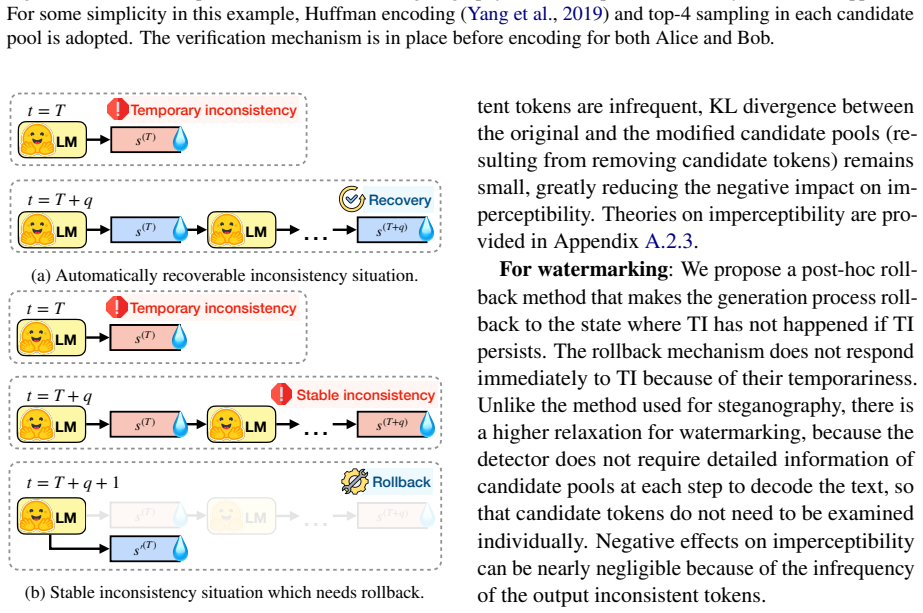
The load-bearing device is Algorithm 1, a one-step consistency oracle: detokenize the candidate-extended history to text, retokenize that text, and compare the two token lists; inequality marks the candidate as a candidate-level inconsistent token. The paper couples this with a necessary-condition relation (no candidate-level IT output means no TI in the final output) and, in watermarking, an observation window q that converts temporariness into a rollback trigger. The infrequency of inconsistent tokens is what makes both methods cheap: filtering deletes only a small fraction of the candidate pool, so KL divergence from the original model stays small, and rollbacks are rare.
What would settle it
Take any stegotext produced by the stepwise verification method and retokenize it with a tokenizer that differs in one setting, such as keeping special tokens instead of skipping them or using a different normalization flag. If the retokenized sequence contains a token Alice's per-step check had accepted, the sufficiency claim fails and extraction will not be 100 percent. Repeating this full-text retokenization across tokenizer versions or settings and counting mismatches would settle the claim.
Extended reading notes
Core claim
Working token by token, the paper defines a candidate-level inconsistent token as any vocabulary item that, appended to the generated history, fails the check tokenize(detokenize(list)) = list. It argues by contradiction that outputting such a token is necessary for any final tokenization inconsistency to occur, so a candidate pool from which they have all been removed cannot produce an inconsistency at the receiver. The method applies this filter before steganographic encoding at both sender and receiver, guaranteeing identical token sequences and therefore 100% extraction. For watermarking, where per-token filtering is unnecessary, the paper exploits temporariness: most candidate-level inc
Load-bearing premise
The guarantee rests on the assumption that the sender's quick single-step detokenize-retokenize check, run with default tokenizer settings and special tokens skipped, produces exactly the same token list the receiver will get from the full transmitted text.
Editorial extensions
If this is right
- Any LLM-based steganography pipeline that uses the same tokenizer as the receiver can be made TI-free by appending the stepwise filter; the 100%-extraction guarantee no longer depends on prefix-based disambiguation heuristics.
- Because filtering is O(k) per step rather than O(k^2), higher-capacity top-k pools become practical, and arithmetic or Huffman coding can be run on the cleaned pools without synchronization loss.
- Watermark detectors see higher watermark strength after rollback because inconsistent tokens distort token-level scores at positions where the watermark scheme's context or token assumption is violated.
- Quality gains follow partly because retokenized inconsistent tokens carry very low model probabilities, so suppressing them removes high-perplexity tokens from the transmitted text.
- The methods transfer across logit-based watermarks and sampling-based watermarks, so TI elimination is orthogonal to the specific watermarking scheme.
Reading between the lines
- The sufficiency guarantee is only as strong as the tokenizer configuration; pinning the tokenizer version and special-token handling between sender and receiver is an implicit deployment requirement the paper does not state.
- The same candidate-level check could be run on the tokenizer's vocabulary offline to identify and prune tokens that can never be emitted safely, potentially eliminating the per-step verification cost.
- The observation-window idea transfers to any autoregressive system that must be reconstructible, such as extractive QA or instruction-data generation, where a rollback on persistent detokenization mismatch would enforce consistency.
- Measuring the candidate-level inconsistency rate may serve as a cheap diagnostic of tokenizer-induced fragility, with whole-word-style tokenizers likely producing more candidate-level ITs.
Editorial analysis
A structured set of objections, weighed in public.
Referee Report
Summary. The paper studies tokenization inconsistency (TI) between sender Alice and receiver Bob in LLM-based steganography and watermarking. It first empirically characterizes inconsistent tokens as infrequent and temporary, based on token-level and candidate-level measurements across Llama-2-7b, Swallow-7b, and Qwen2.5-7b in English, Japanese, and Chinese. It then proposes two methods: a stepwise verification method for steganography that filters candidate-level inconsistent tokens at each generation step, claiming 100% correct extraction; and a post-hoc rollback method for watermarking that rolls back generation when a stable TI is detected after a q-token observation period. Experiments compare against disambiguation baselines in steganography and TI-unaware watermarking schemes, reporting improvements in fluency, imperceptibility, anti-steganalysis capacity, and watermark detectability/robustness.
Significance. If the central guarantee holds, the stepwise verification method is a useful contribution: it attacks TI directly instead of bypassing the tokenizer, has linear complexity, and the reported KL-divergence reductions indicate smaller distribution distortion than prior disambiguation methods. The empirical characterization of inconsistent tokens across three languages/models is also a useful reference. The paper releases code, which supports reproducibility. However, the headline 100%-extraction guarantee is not rigorously established for the algorithm as written because of an unverified fallback branch, and the watermarking improvements, while plausible, are numerically small and not supported by significance tests or error bars in several cells. These issues are fixable but they affect the two main claims of the paper.
major comments (3)
- [Section 3.1, Algorithm 2 (Appendix C.1)] The 100%-extraction guarantee rests on Proposition 2: if no candidate-level IT is ever output, no final TI can occur. Algorithm 2, however, explicitly has a fallback branch (Lines 5–6) that, when the filtered candidate pool is empty, adds the highest-probability token from V\hat c(t) and labels it 'not an SIT' without running the Algorithm 1 consistency check. Nothing ensures this token is not a candidate-level IT. If it is, the antecedent of Proposition 2 is violated and the proof no longer applies. Appendix C.1 dismisses this as an error scenario of 'very small probability', but no probability bound or empirical count is provided. The algorithm should either verify tokens outside the original pool until a candidate-level-IT-free token is found, or the guarantee should be explicitly restricted to generations that never hit the fallback branch, with evidence about how often that occurs.
- [Section 4.2, Tables 8, 14, 15] The claim that the post-hoc rollback method 'enhances detectability and robustness' is not statistically supported. No error bars, confidence intervals, or significance tests are reported, despite 500 samples per cell. Several cells show the proposed method performing worse than the TI-unaware original: e.g., Table 8 Unigram unattacked AUROC drops from 0.998 to 0.995; Table 14 LeftHash attacked (epsilon=0.2) watermark strength drops from 5.18 to 5.13. The aggregate improvement percentages in the steganography experiments similarly average over cells where the method loses. The reader cannot tell whether the reported improvements are systematic or noise. Report per-cell variability and significance tests, or soften the claims accordingly.
- [Section 3.2 and Algorithm 4 (Appendix C.2)] The prose description says that after a stable TI is detected, 'the candidate pool is resampled, excluding that candidate-level IT'. Algorithm 4 does not implement this exclusion: Line 14 simply deletes the latest (q+1) historical tokens and generation resumes with no bookkeeping of the offending token. As written, the same candidate-level IT can be sampled again immediately, potentially causing repeated rollbacks or an infinite loop. The algorithm needs an explicit exclusion mechanism or a state variable that prevents the inconsistent token from being regenerated at the rolled-back position.
minor comments (4)
- [Section 1] Typo: 'they comprise robustness' should be 'they compromise robustness'. Also 'Inconsistent tokens have not been systematically investigated in view of the detokenization-retokenization pipeline' is vague; consider clarifying that prior disambiguation methods bypass the tokenizer rather than addressing TI directly.
- [Appendix D.1] The guarantee depends on Bob using exactly the same tokenizer version, special-token handling, and normalization as Alice. This is reasonable within the paper's threat model, but it should be stated explicitly in the Limitations section, since the single-step check with skip_special_tokens=True may not reproduce Bob's retokenization in all deployment scenarios.
- [Appendix F, Table 19] The table contains typographical artifacts such as '1 .36%' and '60 .03%'. Also, the choice of q is empirical and per-model; a sentence clarifying that q is a tuned parameter rather than a derived constant would help readers assess sensitivity.
- [Section 4.1.2] The extraction error rates for the proposed method are not reported in the main tables; the paper states all methods achieve 100% extraction, but no empirical extraction-accuracy numbers are given for the stepwise verification method itself. Either report them or explicitly state that the 100% claim is a proof-based guarantee subject to the Algorithm 2 issue above.
Circularity Check
No significant circularity: the stepwise verification guarantee is constructive and defined by the same tokenizer check that defines TI; self-citations are baseline comparisons only.
full rationale
The derivation chain is self-contained. Section 3's guarantee ("the absence of candidate-level ITs is a sufficient condition for the final absence of inconsistent tokens") is a direct consequence of Proposition 2, which is proved from the operational definition of a candidate-level IT in Algorithm 1: a token that makes tokenize(detokenize(H_i)) differ from H_i. Filtering these tokens at every step is constructive, not a fit or a renamed target; Bob applies the same filter before decoding, so equality of the two token streams is enforced rather than assumed. The empirical investigation of infrequency and temporariness is used to motivate efficiency (why filtering is cheap) and to set the observation period q (Table 19), but q is a tuned hyperparameter, not a predicted quantity. Self-citations (Nozaki & Murawaki 2022; Yan et al. 2023, 2024a/b) appear only as baseline comparisons or as disambiguation methods not adopted; none is load-bearing for the paper's central correctness claim. The one genuine gap is the empty-pool fallback in Algorithm 2 (Appendix C.1, lines 5-6): the fallback adds an unverified token to the "inconsistency-free" pool, so the proof that no candidate-level IT is ever output does not cover the algorithm as written. This is a proof-completeness/correctness problem, not a circular reduction, so it does not raise the circularity score.
Assumptions & free parameters
free parameters (2)
- q (observation period for post-hoc rollback) =
2 (Llama-2-7b), 10 (Swallow-7b, Qwen2.5-7b)
- candidate pool truncation size for inconsistency measurement =
64
assumptions (4)
- domain assumption The detokenization-retokenization pipeline with default tokenizer parameters plus skip_special_tokens=True exactly models what Bob computes on the transmitted text.
- domain assumption Outputting a candidate-level IT is a necessary condition for any eventual TI.
- ad hoc to paper When the filtered candidate pool is empty, a non-SIT token outside the pool always exists and can be added without reintroducing TI.
- domain assumption The rollback operation in watermarking terminates and preserves watermark detectability.
Cite this review
Pith. "Pith review of Addressing Tokenization Inconsistency in Steganography and Watermarking Based on Large Language Models." pith.science (2026). https://pith.science/paper/LRII3UMY
@misc{pith2026250820718,
  author       = {Pith},
  title        = {Pith review of: Addressing Tokenization Inconsistency in Steganography and Watermarking Based on Large Language Models},
  year         = {2026},
  howpublished = {\url{https://pith.science/paper/LRII3UMY}},
  note         = {Machine review of arXiv:2508.20718}
}
read the original abstract
Large language models have significantly enhanced the capacities and efficiency of text generation. On the one hand, they have improved the quality of text-based steganography. On the other hand, they have also underscored the importance of watermarking as a safeguard against malicious misuse. In this study, we focus on tokenization inconsistency (TI) between Alice and Bob in steganography and watermarking, where TI can undermine robustness. Our investigation reveals that the problematic tokens responsible for TI exhibit two key characteristics: infrequency and temporariness. Based on these findings, we propose two tailored solutions for TI elimination: a stepwise verification method for steganography and a post-hoc rollback method for watermarking. Experiments show that (1) compared to traditional disambiguation methods in steganography, directly addressing TI leads to improvements in fluency, imperceptibility, and anti-steganalysis capacity; (2) for watermarking, addressing TI enhances detectability and robustness against attacks.
Figures


Figures from the paper (2 more)

Reference graph
Works this paper leans on
-
[1]
S. Aaronson and H. Kirchner. 2023. Watermarking of large language models. Watermarking gpt outputs https://www.youtube.com/watch?v=2Kx9jbSMZqA. Technical report, openai
work page 2023
-
[2]
Josh Achiam, Steven Adler, Sandhini Agarwal, Lama Ahmad, Ilge Akkaya, Florencia Leoni Aleman, Diogo Almeida, Janko Altenschmidt, Sam Altman, Shyamal Anadkat, et al. 2023. Gpt-4 technical report. arXiv preprint arXiv:2303.08774
arXiv 2023
-
[3]
Anthropic. 2024. The claude 3 model family: Opus, sonnet, haiku. https://www-cdn.anthropic.com/de8ba9b01c9ab7cbabf5c33b80b7bbc618857627/Model_Card_Claude_3.pdf
work page 2024
-
[4]
A. Stevie Bergman, Gavin Abercrombie, Shannon Spruit, Dirk Hovy, Emily Dinan, Y-Lan Boureau, and Verena Rieser. 2022. https://doi.org/10.18653/v1/2022.sigdial-1.4 Guiding the release of safer E 2 E conversational AI through value sensitive design . In Proceedings of the 23rd Annual Meeting of the Special Interest Group on Discourse and Dialogue, pages 39-...
-
[5]
Tom Brown, Benjamin Mann, Nick Ryder, Melanie Subbiah, Jared D Kaplan, Prafulla Dhariwal, Arvind Neelakantan, Pranav Shyam, Girish Sastry, Amanda Askell, Sandhini Agarwal, Ariel Herbert-Voss, Gretchen Krueger, Tom Henighan, Rewon Child, Aditya Ramesh, Daniel Ziegler, Jeffrey Wu, Clemens Winter, Chris Hesse, Mark Chen, Eric Sigler, Mateusz Litwin, Scott Gr...
2020
-
[6]
Miranda Christ, Sam Gunn, and Or Zamir. 2024. https://proceedings.mlr.press/v247/christ24a.html Undetectable watermarks for language models . In Proceedings of Thirty Seventh Conference on Learning Theory, volume 247 of Proceedings of Machine Learning Research, pages 1125--1139. PMLR
work page 2024
-
[7]
Falcon Dai and Zheng Cai. 2019. https://doi.org/10.18653/v1/P19-1422 Towards near-imperceptible steganographic text . In Proceedings of the 57th Annual Meeting of the Association for Computational Linguistics, pages 4303--4308, Florence, Italy. Association for Computational Linguistics
-
[8]
Jinyang Ding, Kejiang Chen, Yaofei Wang, Na Zhao, Weiming Zhang, and Nenghai Yu. 2023. https://doi.org/10.1109/SP46215.2023.10179287 Discop: Provably secure steganography in practice based on "distribution copies" . In 2023 IEEE Symposium on Security and Privacy (SP), pages 2238--2255
arXiv 2023
Show all 48 references
-
[9]
Fedotov, P
A.A. Fedotov, P. Harremoes, and F. Topsoe. 2003. https://doi.org/10.1109/TIT.2003.811927 Refinements of pinsker's inequality . IEEE Transactions on Information Theory, 49(6):1491--1498
2003
-
[10]
Pierre Fernandez, Antoine Chaffin, Karim Tit, Vivien Chappelier, and Teddy Furon. 2023. https://doi.org/10.1109/WIFS58808.2023.10374576 Three bricks to consolidate watermarks for large language models . In 2023 IEEE International Workshop on Information Forensics and Security ...
2023
-
[11]
Jiayi Fu, Xuandong Zhao, Ruihan Yang, Yuansen Zhang, Jiangjie Chen, and Yanghua Xiao. 2024. https://doi.org/10.18653/v1/2024.acl-long.315 G umbel S oft: Diversified language model watermarking via the G umbel M ax-trick . In Proceedings of the 62nd Annual Meeting of the Associ...
2024 doi
-
[12]
Kazuki Fujii, Taishi Nakamura, Mengsay Loem, Hiroki Iida, Masanari Ohi, Kakeru Hattori, Hirai Shota, Sakae Mizuki, Rio Yokota, and Naoaki Okazaki. 2024. Continual pre-training for cross-lingual llm adaptation: Enhancing japanese language capabilities. In Proceedings of the Fir...
2024
-
[13]
Jonas Geiping, Alex Stein, Manli Shu, Khalid Saifullah, Yuxin Wen, and Tom Goldstein. 2024. https://openreview.net/forum?id=Y5inHAjMu0 Coercing LLM s to do and reveal (almost) anything . In ICLR 2024 Workshop on Secure and Trustworthy Large Language Models
2024
-
[14]
Te Sun Han. 2005. https://doi.org/10.1109/TIT.2004.840860 Folklore in source coding: information-spectrum approach . IEEE Trans. Inf. Theor., 51(2):747–753
2005
-
[15]
Kingma and Jimmy Ba
Diederik P. Kingma and Jimmy Ba. 2017. https://arxiv.org/abs/1412.6980 Adam: A method for stochastic optimization . Preprint, arXiv:1412.6980
2017 arXiv
-
[16]
John Kirchenbauer, Jonas Geiping, Yuxin Wen, Jonathan Katz, Ian Miers, and Tom Goldstein. 2023. https://proceedings.mlr.press/v202/kirchenbauer23a.html A watermark for large language models . In Proceedings of the 40th International Conference on Machine Learning, volume 202 o...
2023
-
[17]
John Kirchenbauer, Jonas Geiping, Yuxin Wen, Manli Shu, Khalid Saifullah, Kezhi Kong, Kasun Fernando, Aniruddha Saha, Micah Goldblum, and Tom Goldstein. 2024. https://openreview.net/forum?id=DEJIDCmWOz On the reliability of watermarks for large language models . In The Twelfth...
2024
-
[18]
Rohith Kuditipudi, John Thickstun, Tatsunori Hashimoto, and Percy Liang. 2024. https://openreview.net/forum?id=FpaCL1MO2C Robust distortion-free watermarks for language models . Transactions on Machine Learning Research
2024
-
[19]
T Kudo. 2018. Sentencepiece: A simple and language independent subword tokenizer and detokenizer for neural text processing. arXiv preprint arXiv:1808.06226
2018 arXiv
-
[20]
Sander Land and Max Bartolo. 2024. https://doi.org/10.18653/v1/2024.emnlp-main.649 Fishing for magikarp: Automatically detecting under-trained tokens in large language models . In Proceedings of the 2024 Conference on Empirical Methods in Natural Language Processing, pages 116...
2024 doi
-
[21]
Yuxi Li, Yi Liu, Gelei Deng, Ying Zhang, Wenjia Song, Ling Shi, Kailong Wang, Yuekang Li, Yang Liu, and Haoyu Wang. 2024. https://doi.org/10.1145/3660799 Glitch tokens in large language models: Categorization taxonomy and effective detection . Proc. ACM Softw. Eng., 1(FSE)
2024 doi
-
[22]
Aiwei Liu, Leyi Pan, Yijian Lu, Jingjing Li, Xuming Hu, Xi Zhang, Lijie Wen, Irwin King, Hui Xiong, and Philip Yu. 2024. https://doi.org/10.1145/3691626 A survey of text watermarking in the era of large language models . ACM Comput. Surv., 57(2)
2024 doi
-
[23]
Yijian Lu, Aiwei Liu, Dianzhi Yu, Jingjing Li, and Irwin King. 2024. An entropy-based text watermarking detection method. arXiv preprint arXiv:2403.13485
2024 arXiv
-
[24]
Yisroel Mirsky, Ambra Demontis, Jaidip Kotak, Ram Shankar, Deng Gelei, Liu Yang, Xiangyu Zhang, Maura Pintor, Wenke Lee, Yuval Elovici, and Battista Biggio. 2023. https://doi.org/10.1016/j.cose.2022.103006 The threat of offensive ai to organizations . Computers & Security, 124:103006
2023
-
[25]
Jumon Nozaki and Yugo Murawaki. 2022. https://doi.org/10.18653/v1/2022.aacl-short.15 Addressing segmentation ambiguity in neural linguistic steganography . In Proceedings of the 2nd Conference of the Asia-Pacific Chapter of the Association for Computational Linguistics and the...
2022 doi
-
[26]
Naoaki Okazaki, Kakeru Hattori, Hirai Shota, Hiroki Iida, Masanari Ohi, Kazuki Fujii, Taishi Nakamura, Mengsay Loem, Rio Yokota, and Sakae Mizuki. 2024. Building a large japanese web corpus for large language models. In Proceedings of the First Conference on Language Modeling,...
2024
-
[27]
Yuang Qi, Kejiang Chen, Kai Zeng, Weiming Zhang, and Nenghai Yu. 2025. https://doi.org/10.1109/TDSC.2024.3519322 Provably secure disambiguating neural linguistic steganography . IEEE Transactions on Dependable and Secure Computing, 22(3):2430--2442
2025
-
[28]
Colin Raffel, Noam Shazeer, Adam Roberts, Katherine Lee, Sharan Narang, Michael Matena, Yanqi Zhou, Wei Li, and Peter J. Liu. 2020. http://jmlr.org/papers/v21/20-074.html Exploring the limits of transfer learning with a unified text-to-text transformer . Journal of Machine Lea...
2020
-
[29]
Rico Sennrich. 2015. Neural machine translation of rare words with subword units. arXiv preprint arXiv:1508.07909
2015 arXiv
-
[30]
Jiaming Shen, Heng Ji, and Jiawei Han. 2020. https://doi.org/10.18653/v1/2020.emnlp-main.22 Near-imperceptible neural linguistic steganography via self-adjusting arithmetic coding . In Proceedings of the 2020 Conference on Empirical Methods in Natural Language Processing (EMNL...
2020 doi
-
[31]
Kaiser Sun, Peng Qi, Yuhao Zhang, Lan Liu, William Wang, and Zhiheng Huang. 2023. https://doi.org/10.18653/v1/2023.findings-emnlp.887 Tokenization consistency matters for generative models on extractive NLP tasks . In Findings of the Association for Computational Linguistics: ...
2023 doi
-
[32]
Gemini Team, Rohan Anil, Sebastian Borgeaud, Jean-Baptiste Alayrac, Jiahui Yu, Radu Soricut, Johan Schalkwyk, Andrew M Dai, Anja Hauth, Katie Millican, et al. 2023. Gemini: a family of highly capable multimodal models. arXiv preprint arXiv:2312.11805
2023 arXiv
-
[33]
Gemini Team, Petko Georgiev, Ving Ian Lei, Ryan Burnell, Libin Bai, Anmol Gulati, Garrett Tanzer, Damien Vincent, Zhufeng Pan, Shibo Wang, et al. 2024. Gemini 1.5: Unlocking multimodal understanding across millions of tokens of context. arXiv preprint arXiv:2403.05530
2024 arXiv
-
[34]
Qwen Team. 2024. https://qwenlm.github.io/blog/qwen2.5/ Qwen2.5: A party of foundation models
2024
-
[35]
Hugo Touvron, Thibaut Lavril, Gautier Izacard, Xavier Martinet, Marie-Anne Lachaux, Timoth \'e e Lacroix, Baptiste Rozi \`e re, Naman Goyal, Eric Hambro, Faisal Azhar, et al. 2023. Llama: Open and efficient foundation language models. arXiv preprint arXiv:2302.13971
2023 arXiv
-
[36]
Dixuan Wang, Yanda Li, Junyuan Jiang, Zepeng Ding, Guochao Jiang, Jiaqing Liang, and Deqing Yang. 2024. https://arxiv.org/abs/2405.17067 Tokenization matters! degrading large language models through challenging their tokenization . Preprint, arXiv:2405.17067
2024 arXiv
-
[37]
Zihui Wu, Haichang Gao, Ping Wang, Shudong Zhang, Zhaoxiang Liu, and Shiguo Lian. 2024. https://arxiv.org/abs/2410.15052 Glitch M iner: Mining glitch tokens in large language models via gradient-based discrete optimization . Preprint, arXiv:2410.15052
2024
-
[38]
Lingyun Xiang, Shuanghui Yang, Yuhang Liu, Qian Li, and Chengzhang Zhu. 2020. https://doi.org/10.3390/math8091558 Novel linguistic steganography based on character-level text generation . Mathematics, 8(9)
2020 doi
-
[40]
Ruiyi Yan, Tian Song, and Yating Yang. 2024 b . https://doi.org/10.1109/SMC54092.2024.10831652 Token F ree: A tokenization-free generative linguistic steganographic approach with enhanced imperceptibility . In 2024 IEEE International Conference on Systems, Man, and Cybernetics...
2024
-
[41]
Ruiyi Yan, Yating Yang, and Tian Song. 2023. https://doi.org/10.1109/LSP.2023.3302749 A secure and disambiguating approach for generative linguistic steganography . IEEE Signal Processing Letters, 30:1047--1051
2023
-
[42]
An Yang, Baosong Yang, Binyuan Hui, Bo Zheng, Bowen Yu, Chang Zhou, Chengpeng Li, Chengyuan Li, Dayiheng Liu, Fei Huang, Guanting Dong, Haoran Wei, Huan Lin, Jialong Tang, Jialin Wang, Jian Yang, Jianhong Tu, Jianwei Zhang, Jianxin Ma, Jin Xu, Jingren Zhou, Jinze Bai, Jinzheng...
2024 arXiv
-
[43]
Zhong-Liang Yang, Xiao-Qing Guo, Zi-Ming Chen, Yong-Feng Huang, and Yu-Jin Zhang. 2019. https://doi.org/10.1109/TIFS.2018.2871746 RNN-S tega: Linguistic steganography based on recurrent neural networks . IEEE Transactions on Information Forensics and Security, 14(5):1280--1295
2019
-
[44]
KiYoon Yoo, Wonhyuk Ahn, and Nojun Kwak. 2024. https://doi.org/10.18653/v1/2024.naacl-long.224 Advancing beyond identification: Multi-bit watermark for large language models . In Proceedings of the 2024 Conference of the North American Chapter of the Association for Computatio...
2024 doi
-
[45]
Zhibo Zhang, Wuxia Bai, Yuxi Li, Mark Huasong Meng, Kailong Wang, Ling Shi, Li Li, Jun Wang, and Haoyu Wang. 2024. https://doi.org/10.1145/3691620.3695060 Glitch P rober: Advancing effective detection and mitigation of glitch tokens in large language models . In Proceedings of...
2024
-
[46]
Xuandong Zhao, Prabhanjan Vijendra Ananth, Lei Li, and Yu-Xiang Wang. 2024. https://openreview.net/forum?id=SsmT8aO45L Provable robust watermarking for AI -generated text . In The Twelfth International Conference on Learning Representations
2024
-
[47]
Zachary Ziegler, Yuntian Deng, and Alexander Rush. 2019. https://doi.org/10.18653/v1/D19-1115 Neural linguistic steganography . In Proceedings of the 2019 Conference on Empirical Methods in Natural Language Processing and the 9th International Joint Conference on Natural Langu...
2019 doi
-
[48]
online" 'onlinestring :=
ENTRY address archivePrefix author booktitle chapter edition editor eid eprint eprinttype howpublished institution journal key month note number organization pages publisher school series title type volume year doi pubmed url lastchecked label extra.label sort.label short.list...
-
[49]
write newline
" write newline "" before.all 'output.state := FUNCTION n.dashify 't := "" t empty not t #1 #1 substring "-" = t #1 #2 substring "--" = not "--" * t #2 global.max substring 't := t #1 #1 substring "-" = "-" * t #2 global.max substring 't := while if t #1 #1 substring * t #2 gl...
Reviewed August 5, 2026 · model on record in the stance chip above.
Discussion (0). Sign in to comment.