REVIEW 4 major objections 5 minor 130 references
Prediction of sulphate hazes in the lower Venus atmosphere
T0 review · 4 major / 5 minor · reviewed 2026-08-05 · deepseek-v4-flash
Pith's one-line read Trace metal salts from the hot Venus surface can condense into three solid haze layers below 20 km, matching the layers inferred from Pioneer Venus data.
desk verdict A genuinely new thermochemical prediction of Venus sulphate hazes that matches old Pioneer data, but the microphysical model and the gas-phase abundances it leans on are conditional enough that the paper needs a careful referee rather than acceptance on faith. read the letter →
The pith
A machine-rendered reading of the paper's core claim, the machinery that carries it, and where it could break.
The reading
What carries the argument
The central object is the improved DiffuDrift v2 model, a one-dimensional, moment-based aerosol microphysics code that evolves particle size moments while treating settling, diffusion, coagulation, and kinetic growth and sublimation. It uses a double-delta representation of the particle size distribution to handle arbitrary Knudsen numbers, covering both the free-molecular and viscous-flow regimes. The chemical driver is the set of surface reactions in which trace metal chlorides and fluorides—FeCl2, NaCl, KCl—react with sulphur gases and water to form FeS2, Na2SO4, and K2SO4; the growth rate of each material is set by the least-abundant reactant, which is exactly the trace metal molecule. A
What would settle it
Send a descent probe through 0 to 20 km that measures gas-phase FeCl2, NaCl, and KCl and collects particles for composition analysis: the claim fails if those molecules are absent or if no FeS2, Na2SO4, and K2SO4 layers appear at roughly 2, 10, and 15 km. A simpler laboratory check would heat NaCl and KCl with Venus-like sulphate minerals near 700 K and test whether the chlorides decompose before entering the gas phase.
Extended reading notes
Core claim
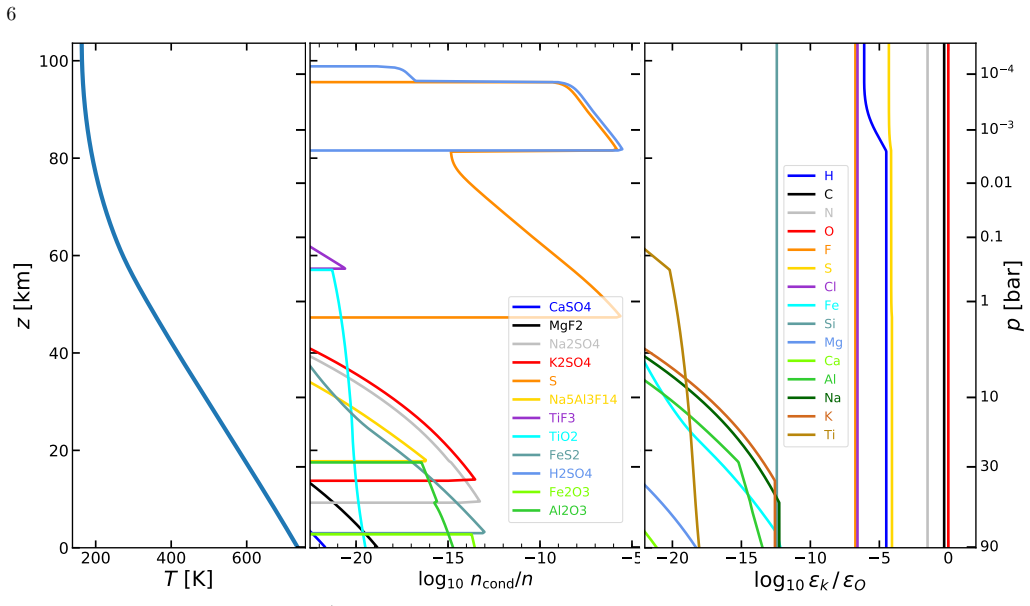
The authors argue that the lower Venus atmosphere, below the main sulphuric acid cloud deck, contains a sequence of salt hazes produced by surface chemistry rather than by transported dust alone. Phase-equilibrium modelling of the hot surface gives trace gas carriers FeCl2, NaCl, KCl, and SiF4 at concentrations below about 2e-12, reflecting chlorine and fluorine's grip on metals. Feeding those abundances into an improved version of the DiffuDrift model, the trace molecules deposit as solids once their supersaturation ratios cross unity: pyrite above about 2.4 km, sodium sulphate above about 9.5 km, and potassium sulphate above about 15.5 km. These heights match the three potential haze layer
Load-bearing premise
The load-bearing assumption is that the lowest layers of Venus's atmosphere are in thermochemical phase equilibrium with the hot surface, so trace amounts of FeCl2, NaCl, and KCl are really present in the gas; if surface chemistry destroys those molecules or a kinetic barrier keeps them from forming, the predicted sulphate and pyrite hazes have no source material.
Editorial extensions
If this is right
- Aerosol particles below 45 km should carry thin coatings of FeS2, Na2SO4, and K2SO4, giving the lower haze a measurable spectral signature distinct from pure sulphuric acid.
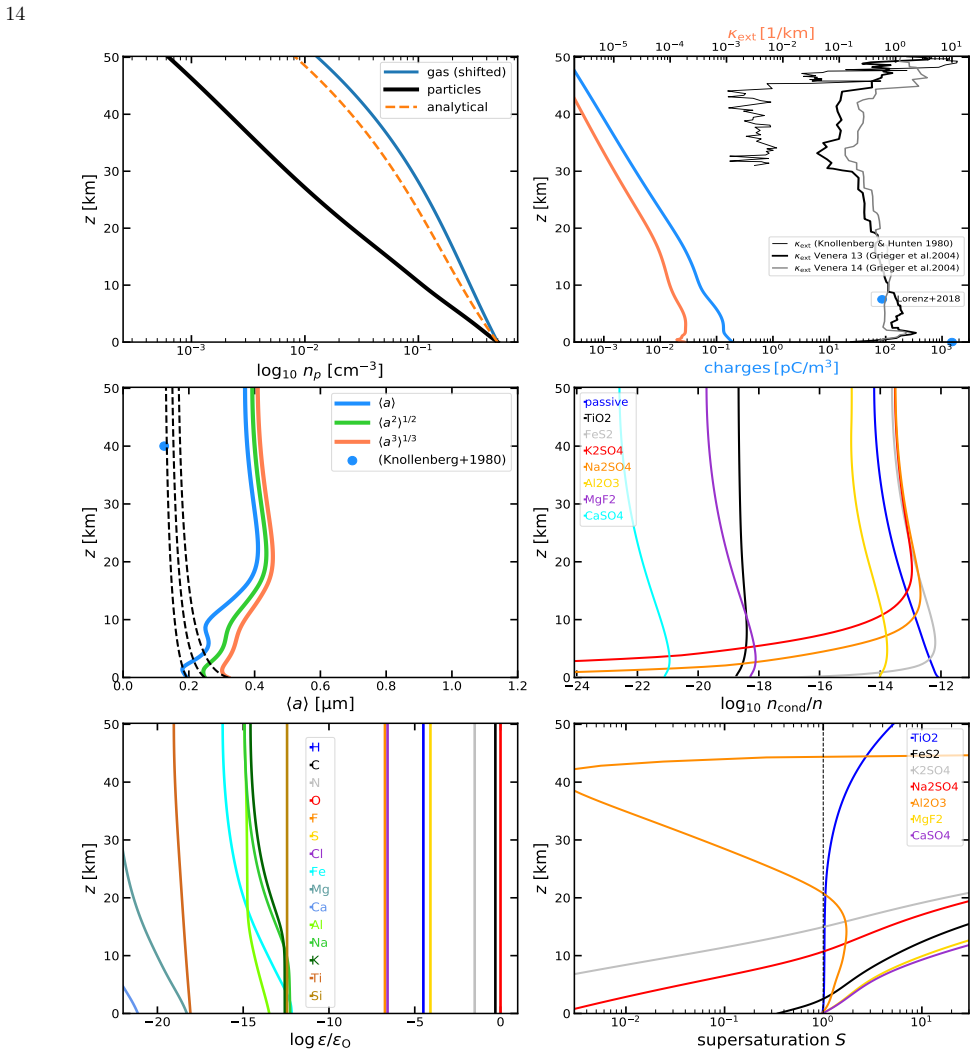
- Sub-0.3 micron particles can be mixed up from the surface to the cloud base, so the sulphuric acid cloud deck can be seeded from below; particles above about 1 micron cannot rise above about 10 km, meaning any mode-3 population must form or be injected higher up.
- The gas-phase abundances of Fe, Na, and K should drop sharply above their condensation heights, so the haze layers act as a chemical trap that removes those metals from the circulating atmosphere.
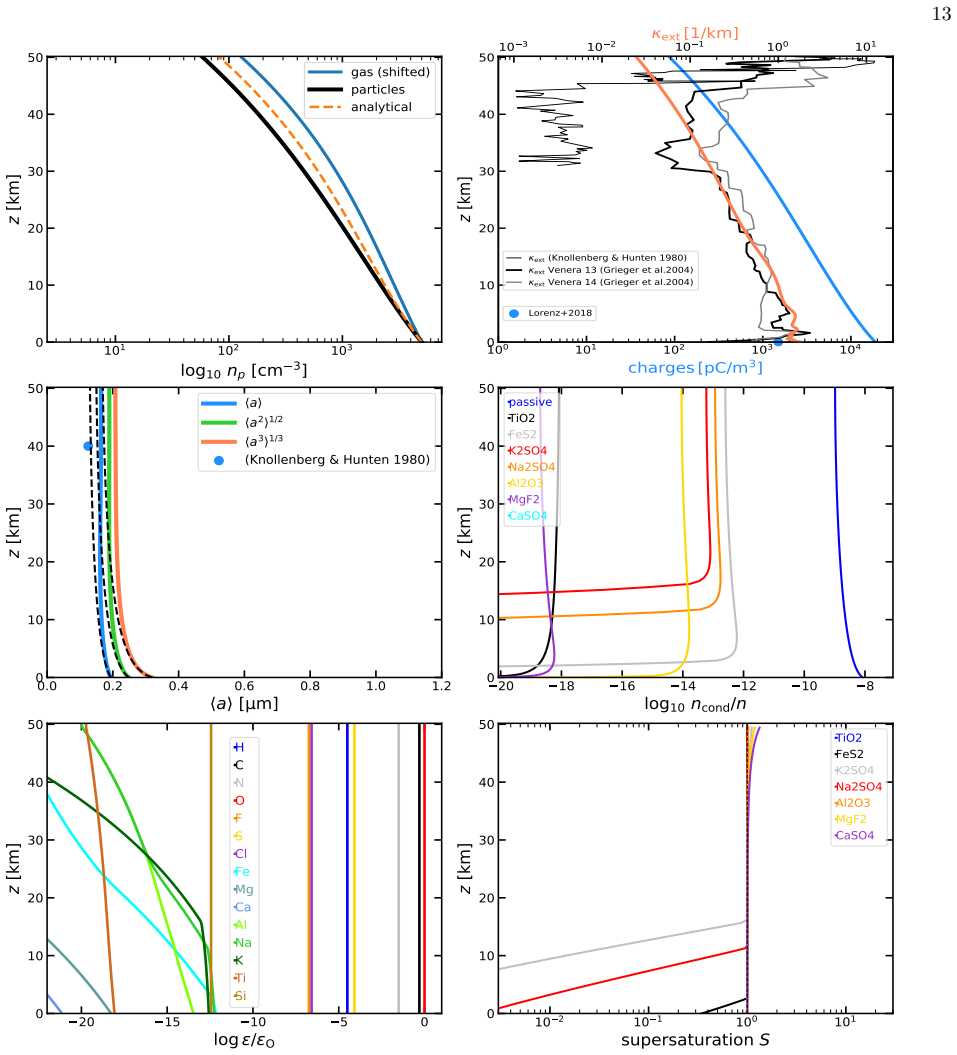
- Coagulation must be strongly suppressed by electrostatic repulsion: if particles were weakly charged, the resulting steep density gradients would conflict with Venera opacity and discharge-current measurements.
Reading between the lines
- If the surface-equilibrium premise survives direct testing, the same chloride-to-sulphate conversion mechanism could operate on other hot, rocky planets with HCl, HF, and sulphur gases, making low-altitude salt hazes a general phenomenon rather than a Venus oddity.
- The predicted strong negative charging means electrical charge density in the lower atmosphere carries information about aerosol surface area; combining that constraint with future lander measurements could provide a cheap test of particle number density.
- The model treats the surface as a fixed particle source at 5000 particles per cubic centimetre; a testable extension would couple wind-driven dust lifting to the condensation chemistry to see whether the surface source strength controls the altitude of the opacity maximum.
Signed reviews
Editorial analysis
A structured set of objections, weighed in public.
Referee Report
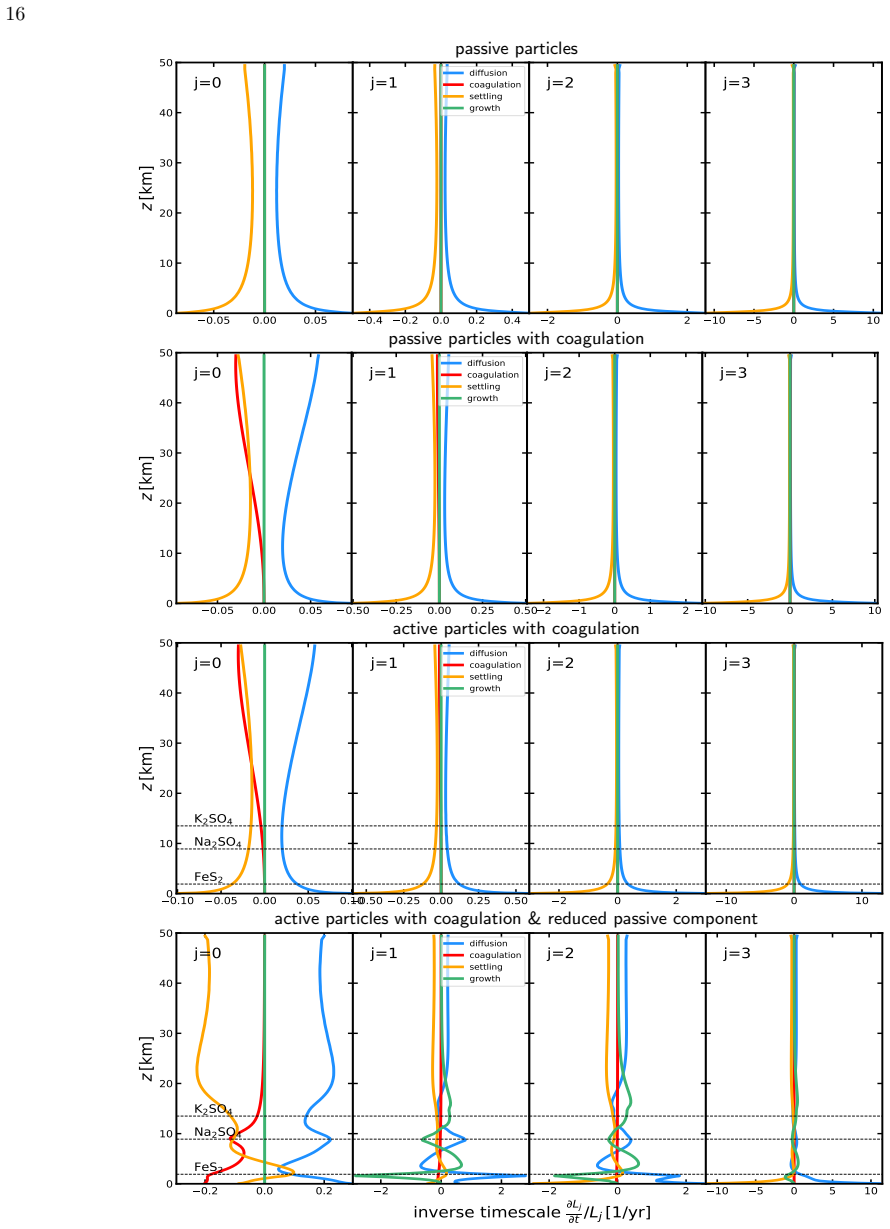
Summary. The paper predicts the presence of sulphate hazes in the lower Venus atmosphere (<50 km) using two modelling stages. First, the GGchem phase-equilibrium code is applied to the Venus surface and lower atmosphere, yielding trace gas-phase metal chlorides/fluorides (FeCl2, NaCl, KCl, SiF4, etc.) at mixing ratios of order 1e-12. From the same equilibrium model the authors derive condensation layers: pyrite FeS2 above ~3 km, Na2SO4 above ~9 km, and K2SO4 above ~14 km, which they associate with the three low-altitude haze layers reported by Mogul et al. (2023). Second, an improved DiffuDrift v2 model is used to follow the vertical transport, growth, coagulation, settling, and charging of aerosol particles, including a passive 'dust' component injected at the lower boundary. With a passive-particle density of 5000 cm^-3 at the surface, the model matches observed extinction slopes only if coagulation is strongly suppressed by charge; the resulting active coatings are only ~0.3 Å thick, which the authors themselves call physically not very meaningful. Reducing the passive-particle density to 0.5 cm^-3 produces ~0.2 µm coatings of FeS2, Na2SO4, K2SO4, but this model is not matched against opacity data. The paper also derives an analytic settling-diffusion solution for passive particles and provides a new moment method for arbitrary Knudsen numbers.
Significance. If the central prediction holds, the paper would provide a coherent thermochemical explanation for the three low-altitude haze layers inferred from Pioneer Venus data, and would identify a new class of sulphate hazes in a planetary atmosphere. The work also makes a methodological contribution: DiffuDrift v2 extends a published cloud model to arbitrary Knudsen numbers and adds charged coagulation, with an analytic test case for the passive-particle limit. The authors are commendably explicit about several internal weaknesses: the near-surface gas-phase equilibrium assumption is acknowledged as an approximation; the 5000 cm^-3 model produces sub-monolayer coatings described as 'physically not very meaningful'; and no single model simultaneously fits both the opacity and the charge-density data. These admissions are honest, but they also mean that the quantitative microphysical predictions are currently conditional on assumptions that are not fully validated. The equilibrium cloud-base heights, however, are derived from independent thermochemical data and do not by construction fit the Mogul et al. layers, so those heights are a genuine, falsifiable prediction.
major comments (4)
- [§2, Table 1; §3.1] The condensation bases at 2.4–15.5 km are load-bearing and depend entirely on the GGchem lower-boundary gas composition, in which FeCl2, NaCl, KCl, and SiF4 are present at ~1e-12. The only stated rebuttal to Zolotov's sulfatization mechanism is that pure Na2SO4(s) and K2SO4(s) are thermally unstable at surface temperatures. This does not rule out solid solutions or surface-mediated reactions that could consume the metal chlorides even if the pure phases are unstable. Because the authors themselves state (§2, §3.1) that chemical equilibrium is not expected to hold except near the surface, this is a correctness risk for the central claim. A quantitative sensitivity test — e.g., how much depletion of FeCl2, NaCl, or KCl is needed to erase the predicted layers — or an explicit equilibrium calculation including Na/K sulphate solid solutions would be needed.
- [§4.2, Figs. 6–7] No single model simultaneously supports both the sulphate-haze microphysics and the observed aerosol opacity. The np(0)=5000 cm^-3 model, which is matched to the opacity data, yields an average coating of ~0.3 Å, i.e., less than one monolayer, and the authors state this result is 'physically not very meaningful'. The reduced-passive model (np(0)=0.5 cm^-3) produces ~0.2 µm coatings but is not compared with opacity or charge data and its lower boundary concentration is set ad hoc. The paper should therefore clearly separate the equilibrium prediction of condensation heights (which is supported by GGchem) from the microphysical claim of a sulphate haze (which is not yet supported by a self-consistent model).
- [§4.1, Eq. (8), Figs. 4–5] The abstract and Section 6 state that particles 'must have at least 100 negative charges per micron of particle radius at ground level, and >50/µm at 45 km'. This conclusion is model-dependent: it follows only if the assumed np(0)=5000 cm^-3, the eddy diffusion coefficient of Eq. (10), and the charge scaling of Eq. (8) are all correct. Moreover, Section 4.1 explicitly concludes that 'it is currently not possible with our model to fit both the measured opacity and the charge density data': qa300=50 fits opacity but overproduces the Lorenz (2018) charge density, while qa300=4 fits the charge data but not the opacity. The 'at least 100 charges/µm' statement should be framed as a consistency requirement of one particular model scenario, not as a unique observational inference.
- [§4.3, §6] The numbers quoted for the condensation heights differ between sections. Table 1 and the GGchem discussion give bases at 2.9 km (FeS2), 9.3 km (Na2SO4), and 13.8 km (K2SO4); the abstract and summary quote 2.4, 9.5, and 15.5 km; Section 4.3 marks sublimation peaks at 1.9, 8.9, and 13.5 km. Some of these differences may reflect the difference between equilibrium cloud bases and kinetic sublimation fronts, but the paper never explains this. The reader cannot tell which number is being compared with Mogul et al. (2023). A clarifying table or an explicit statement of the definitions would remove the ambiguity.
minor comments (5)
- [§3.4] The optical-data substitutions (FeS for FeS2, Na2S for K2SO4/Na2SO4/CaSO4, MgO for MgF2) are acknowledged only briefly. Since the opacity comparison is central to Section 4, the figures should carry a visible caveat that these are proxy refractive indices, with a conservative uncertainty estimate where feasible.
- [§A.2, Eq. (A5)] The dynamic viscosity expression is presented for a 97% CO2/3% N2 mixture, but the text does not state over what pressure/temperature range this is valid. A short validity note would be helpful.
- [§C, Eq. (C27)] The derivation leading to q/a ≈ -5kT/e^2 is compressed. In particular, the factor 5 is not derived from the stated 'electrons cannot reach the grain' criterion; a one-sentence explanation of how this numerical factor arises would improve reproducibility.
- [Acknowledgements] Typo: 'anomynous' should be 'anonymous'.
- [§3.6] The lower boundary condition for the passive particles uses a log-normal distribution with np=5000 cm^-3, mu=ln(0.15), sigma=0.5, but it is not stated whether the 50 size bins are logarithmically spaced. Please specify the binning.
Circularity Check
Central sulphate/pyrite condensation heights are independent thermochemical predictions; two peripheral model quantities (grain charge parameter and near-surface particle boundary condition) are calibrated on the same observations later used as validation, giving partial circularity.
-
fitted input called prediction
[Sect. 3.2 / App. C (Eq. 8), Sect. 4.1, Abstract]
"However, since the charge of the aerosol particles in the lower Venus atmosphere is not known exactly, we treat q/a at T = 300 K as a free parameter, see Eq. (8). ... Our models suggest that the particles must have at least 100 negative charges per micron of particle radius at ground level, and > 50/µm at a height of 45 km."
The grain charge parameter qa300 in Eq. (8) is introduced as a free parameter and varied in Sect. 4.1 until the coagulation model reproduces the measured opacity and particle-size data (Figs. 4-5). The abstract then presents the fitted parameter regime as a model 'suggestion' ('particles must have at least 100 negative charges per micron'). This is a fitted input renamed as an inference: the claimed charge constraint is essentially the value of qa300 needed to make the model match the observations, not an independent prediction. However, this step concerns the dynamical/coagulation part of the model and does not determine the thermochemical condensation heights of K2SO4, Na2SO4, or FeS2.
-
fitted input called prediction
[Sect. 3.6, Fig. 4]
"From the Pioneer Venus sounder probe data, R. G. Knollenberg & D. M. Hunten (1980) estimated a mean particle diameter of 0.25 µm, i.e. ⟨a⟩ = 0.125 µm (mode-1 particles) at z = 40 km ... Based on these observations, we use a log-normal distribution ... for our lower BC with np = 5000 cm−3, µ = ln(0.15) and σ = 0.5"
The lower-boundary size distribution (µ = ln 0.15, σ = 0.5) and particle density (np = 5000 cm−3) are chosen using the same Pioneer Venus/Venera observations (Knollenberg & Hunten 1980; Lorenz 2018; Grieger et al. 2004) that are later plotted as validation points in Fig. 4. In particular, the 40 km mean particle radius used as a boundary-condition anchor is also shown as a model-data agreement point at 40 km, and the surface opacity/charge values are matched by construction. Because sub-0.3 µm particles are nearly perfectly mixed up to 40 km in the model, the 40 km size agreement is substantially inherited from the boundary condition rather than independently predicted. The vertical opacity slope above the boundary is still a genuine prediction, and this calibration does not affect the sul
full rationale
The headline prediction—that K2SO4, Na2SO4, and FeS2 condense at about 15.5, 9.5, and 2.4 km—is not circular. It is derived from the GGchem thermochemical equilibrium calculation of trace metal chloride/fluoride abundances at the surface and the temperature/pressure-dependent vapour pressures of the condensates, and then compared with the external Pioneer Venus Large Probe haze-layer altitudes of Mogul et al. (2023). The condensation heights are not fit to the Mogul data; the agreement is an independent, falsifiable comparison. The kinetic DiffuDrift v2 model uses the same GGchem supersaturation ratios to drive deposition, so the close agreement between the equilibrium model heights (13.8, 9.3, 2.9 km) and the kinetic model heights (13.5, 8.9, 1.9 km) is consistency rather than independent confirmation, but that is not circularity. The paper's self-citations (Rimmer et al. 2021 for the boundary composition, Woitke et al. 2020 for DiffuDrift, Balduin et al. 2023 for charging) are model-development references with external constraints and are not used to forbid alternatives or to import a uniqueness theorem. The identified circular elements are peripheral: the grain charge parameter qa300 is a free parameter fitted to the opacity and charge data and then restated as a 'suggestion', and the near-surface particle boundary condition is taken from the same observations used for validation of the vertical particle profile. These do not undermine the thermochemical condensation-height claim, hence the moderate score of 3 rather than a higher one. The Zolotov sulfatization objection is a scientific robustness concern, not a circularity argument.
Assumptions & free parameters
free parameters (4)
- grain charge parameter qa300 =
>50 (inferred; values 4-50 explored)
- passive particle density at lower boundary np(z=0) =
5000 cm^-3 (main), 0.5 cm^-3 (reduced)
- lower-boundary size distribution parameters =
np=5000 cm^-3, mu=ln(0.15 um), sigma=0.5
- eddy diffusion coefficient constant =
3e4 cm2/s at 1 bar, D ~ p^{-1/2}
assumptions (6)
- domain assumption Gas-phase chemical equilibrium holds at every grid point and time step
- domain assumption Near-surface gas is in phase equilibrium with the surface (from Rimmer et al. 2021)
- domain assumption Charge scaling q/a ~ -90/um at 300 K from Balduin et al. (2023) applies in Venus lower atmosphere
- domain assumption All collisions lead to sticking (alpha_ij=1)
- ad hoc to paper No homogeneous nucleation; particles enter only via lower boundary 'passive' seeds
- ad hoc to paper Passive material is chemically inert and is the only source of seed surface
invented entities (1)
-
Passive aerosol component
Cite this review
Pith. "Pith review of Prediction of sulphate hazes in the lower Venus atmosphere." pith.science (2026). https://pith.science/paper/5PL2CZHD
@misc{pith2026250820790,
  author       = {Pith},
  title        = {Pith review of: Prediction of sulphate hazes in the lower Venus atmosphere},
  year         = {2026},
  howpublished = {\url{https://pith.science/paper/5PL2CZHD}},
  note         = {Machine review of arXiv:2508.20790}
}
read the original abstract
We study the amount, size distribution and material composition of (sub-)mic aerosol particles in the lower Venus atmosphere < 50 km. Our GGchem phase-equilibrium model predicts metal-chloride and metal-fluoride molecules to be present in the gas over the Venus surface in trace concentrations < 2.E-12, in particular FeCl2, NaCl, KCl and SiF4. Using an improved version of the DiffuDrift model developed by Woitke et al.2020, we find that these molecules deposit to form solid potassium sulphate K2SO4, sodium sulphate Na2SO4, and pyrite FeS2 above about 15.5 km, 9.5 km and 2.4 km, respectively. These heights coincide well with the three potential haze layers found in the Pioneer Venus Large Probe neutral mass spectrometer data by Mogul et al.2023. The particles with radius < 0.3 mic can be dredged up from the ground to reach the sulphuric acid cloud base from below by diffusion. The particle density decreases from ~ 5000/cm3 at ground level to ~100/cm3 at a height of 45 km. Particles larger than about 1 mic are found to stay confined to the ground < 10 km, indicating that the larger, so-called mode 3 particles, if they exist, cannot originate from the surface. All particles are expected to be coated by a thin layer of FeS2, Na2SO4 and K2SO4. We have included the repelling effect of particle charges on the coagulation, without which the model would predict much too steep gradients close to the surface, which is inconsistent with measured opacity data. Our models suggest that the particles must have at least 100 negative charges per micron of particle radius at ground level, and > 50/mic at a height of 45 km.
Figures


Figures from the paper (6 more)



Reference graph
Works this paper leans on
-
[1]
, " * write output.state after.block = add.period write newline
ENTRY address archivePrefix author booktitle chapter doi edition editor eprint howpublished institution journal key month number organization pages publisher school series title misctitle type volume year version url label extra.label sort.label short.list INTEGERS output.state before.all mid.sentence after.sentence after.block FUNCTION init.state.consts ...
-
[2]
write newline
" write newline "" before.all 'output.state := FUNCTION format.url url empty "" new.block "" url * "" * if FUNCTION format.eprint eprint empty "" archivePrefix empty "" archivePrefix "arXiv" = new.block " " eprint * " " * new.block " " eprint * " " * if if if FUNCTION format.doi doi empty "" " " doi * " " * if FUNCTION format.pid doi empty eprint empty ur...
-
[3]
W VY ޱS : b# O m L?DGj us a>'rOR<E?y K܂q ;<k|b Wat IOpd RU4 y <P nVKZ 6wxd 2E6s!ֳ؎ n 3;W sJ @m'W ] : >f E /@Ktꖏn.e:;j te ^W|_m6ǝ X R ػc'; p /gZ秋WmO>͟ w߾w'ӥ
thebibliography [1] 20pt to REFERENCES 6pt =0pt \@twocolumntrue 12pt -12pt 10pt plus 3pt =0pt =0pt =1pt plus 1pt =0pt =0pt -12pt =13pt plus 1pt =20pt =13pt plus 1pt \@M =10000 =-1.0em =0pt =0pt 0pt =0pt =1.0em @enumiv\@empty 10000 10000 `\.\@m \@noitemerr \@latex@warning Empty `thebibliography' environment \@ifnextchar \@reference \@latexerr Missing key o...
2017
-
[4]
Allard , F., Hauschildt , P. H., Alexander , D. R., Tamanai , A., & Schweitzer , A. 2001, title The Limiting Effects of Dust in Brown Dwarf Model Atmospheres , , 556, 357, 10.1086/321547
doi:10.1086/321547 2001
-
[5]
Anderson , A. D. 1969, title Dust in the Lower Atmosphere of Venus , Science, 163, 275, 10.1126/science.163.3864.275
-
[6]
Electrical charging of ash in Icelandic volcanic plumes
Aplin , K. L., Houghton , I. M. P., & Nicoll , K. A. 2014, title Electrical charging of ash in Icelandic volcanic plumes , arXiv e-prints, arXiv:1404.6905, 10.48550/arXiv.1404.6905
work page Pith review arXiv doi:10.48550/arxiv.1404.6905 2014
-
[7]
Bains , W., Petkowski , J. J., Rimmer , P. B., & Seager , S. 2021 a , title Production of ammonia makes Venusian clouds habitable and explains observed cloud-level chemical anomalies , Proceedings of the National Academy of Science, 118, e2110889118, 10.1073/pnas.2110889118
- [8]
Show all 130 references
-
[9]
Bains , W., Shorttle , O., Ranjan , S., et al. 2022, title Only extraordinary volcanism can explain the presence of parts per billion phosphine on Venus , Proceedings of the National Academy of Science, 119, e2121702119, 10.1073/pnas.2121702119
2022 doi
-
[10]
J., Seager , S., et al
Bains , W., Petkowski , J. J., Seager , S., et al. 2021 b , title Phosphine on Venus Cannot Be Explained by Conventional Processes , Astrobiology, 21, 1277, 10.1089/ast.2020.2352
2021
-
[11]
G., Thi , W.-F., & Narita , Y
Balduin , T., Woitke , P., J rgensen , U. G., Thi , W.-F., & Narita , Y. 2023, title Size-dependent charging of dust particles in protoplanetary disks. Can turbulence cause charge separation and lightning? , , 678, A192, 10.1051/0004-6361/202346442
2023 doi
-
[12]
M., & Kockarts , G
Banks , P. M., & Kockarts , G. 1973, Aeronomy. (Elsevier), 10.1016/C2013-0-10329-7
1973 doi
-
[13]
L., Borunov , S
Barsukov , V. L., Borunov , S. P., Volkov , V. P., et al. 1986, in Lunar and Planetary Science Conference, Lunar and Planetary Science Conference, 28--29
1986
-
[14]
L., Khodakovskii , I
Barsukov , V. L., Khodakovskii , I. L., Volkov , V. P., et al. 1982, title Metal chloride and elemental sulfur condensates in the Venusian troposphere: are they possible? , Lunar and Planetary Science Conference Proceedings, 12, 1517
1982
-
[15]
I., & Ekonomov , A
Bertaux , J.-L., Widemann , T., Hauchecorne , A., Moroz , V. I., & Ekonomov , A. P. 1996, title VEGA 1 and VEGA 2 entry probes: An investigation of local UV absorption (220-400 nm) in the atmosphere of Venus (SO _ 2 , aerosols, cloud structure) , , 101, 12709, 10.1029/96JE00466
1996 doi
-
[16]
2007, title A warm layer in Venus' cryosphere and high-altitude measurements of HF, HCl, H _ 2 O and HDO , , 450, 646, 10.1038/nature05974
Bertaux , J.-L., Vandaele , A.-C., Korablev , O., et al. 2007, title A warm layer in Venus' cryosphere and high-altitude measurements of HF, HCl, H _ 2 O and HDO , , 450, 646, 10.1038/nature05974
2007 doi
-
[17]
J., & Zhang , X
Bierson , C. J., & Zhang , X. 2020, title Chemical Cycling in the Venusian Atmosphere: A Full Photochemical Model From the Surface to 110 km , Journal of Geophysical Research (Planets), 125, e06159, 10.1029/2019JE006159
2020 doi
-
[18]
2012, title A simple model for the evolution of the dust population in protoplanetary disks , , 539, A148, 10.1051/0004-6361/201118136
Birnstiel , T., Klahr , H., & Ercolano , B. 2012, title A simple model for the evolution of the dust population in protoplanetary disks , , 539, A148, 10.1051/0004-6361/201118136
2012 doi
-
[19]
W., Hunten , D
Bougher , S. W., Hunten , D. M., & Phillips , R. J., eds. 1997, Venus II , Vol. 165
1997
-
[20]
A., Fegley , B., & Arvidson , R
Brackett , R. A., Fegley , B., & Arvidson , R. E. 1995, title Volatile transport on Venus and implications for surface geochemistry and geology , , 100, 1553, 10.1029/94JE02708
1995 doi
-
[21]
Byrne , X., Shorttle , O., Jordan , S., & Rimmer , P. B. 2024, title Atmospheres as a window to rocky exoplanet surfaces , , 527, 10748, 10.1093/mnras/stad3914
2024 doi
-
[22]
W., Kamp , L
Carlson , R. W., Kamp , L. W., Baines , K. H., et al. 1993, title Variations in Venus cloud particle properties: a new view of Venus's cloud morphology as observed by the Galileo near-infrared mapping spectrometer , , 41, 477, 10.1016/0032-0633(93)90030-6
1993 doi
-
[23]
M., Gilmore , M
Carter , L. M., Gilmore , M. S., Ghail , R. C., et al. 2023, title Sedimentary Processes on Venus , , 219, 85, 10.1007/s11214-023-01033-2
2023 doi
-
[24]
1998, title NIST-JANAF Thermochemical Tables, Journal of Physical and Chemical Reference Data, Monograph 9
Chase, Jr., M. 1998, title NIST-JANAF Thermochemical Tables, Journal of Physical and Chemical Reference Data, Monograph 9
1998
-
[25]
2016, title Photocatalytic transformation of CO _ 2 to CH _ 4 and CO on acidic surface of TiO _ 2 anatase , Optical Materials, 56, 80, 10.1016/j.optmat.2015.11.015
Civi s , S., Ferus , M., Kn \' z ek , A., et al. 2016, title Photocatalytic transformation of CO _ 2 to CH _ 4 and CO on acidic surface of TiO _ 2 anatase , Optical Materials, 56, 80, 10.1016/j.optmat.2015.11.015
2016 doi
-
[26]
B., et al
Civiš, S., Knížek, A., Rimmer, P. B., et al. 2019, title Formation of Methane and (Per)Chlorates on Mars, ACS Earth and Space Chemistry, 3, 221, 10.1021/acsearthspacechem.8b00104
2019 doi
-
[27]
1980, title The Pioneer Venus Program , , 85, 7575, 10.1029/JA085iA13p07575
Colin , L. 1980, title The Pioneer Venus Program , , 85, 7575, 10.1029/JA085iA13p07575
1980 doi
-
[28]
V., Shao , W
Dai , L., Titov , D. V., Shao , W. D., et al. 2025, title Venus Cloud Research: Progress and Perspectives , , 221, 51, 10.1007/s11214-025-01176-4
2025 doi
-
[29]
I., Taylor , F
de Bergh , C., Moroz , V. I., Taylor , F. W., et al. 2006, title The composition of the atmosphere of Venus below 100 km altitude: An overview , , 54, 1389, 10.1016/j.pss.2006.04.020
2006 doi
-
[30]
W., Bertaux , J
Esposito , L. W., Bertaux , J. L., Krasnopolsky , V., Moroz , V. I., & Zasova , L. V. 1997, in Venus II: Geology, Geophysics, Atmosphere, and Solar Wind Environment, ed. S. W. Bougher , D. M. Hunten , & R. J. Phillips , 415
1997
-
[31]
W., Knollenberg , R
Esposito , L. W., Knollenberg , R. G., Marov , M. I., Toon , O. B., & Turco , R. P. 1983, in Venus, ed. D. M. Hunten , L. Colin , T. M. Donahue , & V. I. Moroz , 484--564
1983
-
[32]
Y., & Lodders , K
Fegley , B., Zolotov , M. Y., & Lodders , K. 1997, title The Oxidation State of the Lower Atmosphere and Surface of Venus , , 125, 416, 10.1006/icar.1996.5628
1997
-
[33]
2014, in Planets, Asteriods, Comets and The Solar System, ed
Fegley , Jr., B. 2014, in Planets, Asteriods, Comets and The Solar System, ed. A. M. Davis , Vol. 2, 127--148
2014
-
[34]
Fegley , Jr., B., & Treiman , A. H. 1992, title Chemistry of atmosphere-surface interactions on Venus and Mars. , Geophysical Monograph Series, 66, 7, 10.1029/GM066p0007
1992 doi
-
[35]
J., & Eshleman , V
Fjeldbo , G., Kliore , A. J., & Eshleman , V. R. 1971, title The Neutral Atmosphere of Venus as Studied with the Mariner V Radio Occultation Experiments , , 76, 123, 10.1086/111096
1971 doi
-
[36]
Florensky, C. P. 1977, The Surface of Venus as Revealed by Venera 9 and 10 Probes (Dordrecht: Springer Netherlands), 225--227, 10.1007/978-94-010-1248-5_22
1977 doi
-
[37]
N., Wennberg , P
Frandsen , B. N., Wennberg , P. O., & Kjaergaard , H. G. 2016, title Identification of OSSO as a near-UV absorber in the Venusian atmosphere, Geophysical Research Letters, 43, 11,146, https://doi.org/10.1002/2016GL070916
2016 doi
-
[38]
P., & Sedlmayr , E
Gail , H. P., & Sedlmayr , E. 1988, title Dust formation in stellar winds. IV. Heteromolecular carbon grain formation and growth. , , 206, 153
1988
-
[39]
G., & Yung , Y
Gao , P., Zhang , X., Crisp , D., Bardeen , C. G., & Yung , Y. L. 2014, title Bimodal distribution of sulfuric acid aerosols in the upper haze of Venus , , 231, 83, 10.1016/j.icarus.2013.10.013
2014 doi
-
[40]
S., Darby Dyar , M., Mueller , N., et al
Gilmore , M. S., Darby Dyar , M., Mueller , N., et al. 2023, title Mineralogy of the Venus Surface , , 219, 52, 10.1007/s11214-023-00988-6
2023 doi
-
[41]
S., Richards , A
Greaves , J. S., Richards , A. M. S., Bains , W., et al. 2021, title Phosphine gas in the cloud decks of Venus , Nature Astronomy, 5, 655, 10.1038/s41550-020-1174-4
2021 doi
-
[42]
Greeley , R., & Arvidson , R. E. 1990, title Aeolian Processes on Venus , Earth Moon and Planets, 50-51, 127, 10.1007/BF00142392
1990 doi
-
[43]
1984, title Windblown sand on Venus: Preliminary results of laboratory simulations , , 57, 112, 10.1016/0019-1035(84)90013-7
Greeley , R., Iversen , J., Leach , R., et al. 1984, title Windblown sand on Venus: Preliminary results of laboratory simulations , , 57, 112, 10.1016/0019-1035(84)90013-7
1984 doi
-
[44]
I., Hoekzema , N
Grieger , B., Ignatiev , N. I., Hoekzema , N. M., & Keller , H. U. 2004, in ESA Special Publication, Vol. 544, Planetary Probe Atmospheric Entry and Descent Trajectory Analysis and Science, ed. A. Wilson , 63--70
2004
-
[45]
Grinspoon, D. H. 1997, Venus revealed: a new look below the clouds of our mysterious twin planet
1997
-
[46]
H., Pollack , J
Grinspoon , D. H., Pollack , J. B., Sitton , B. R., et al. 1993, title Probing Venus's cloud structure with Galileo NIMS , , 41, 515, 10.1016/0032-0633(93)90034-Y
1993 doi
-
[47]
2006, title Dust in brown dwarfs
Helling , C., & Woitke , P. 2006, title Dust in brown dwarfs. V. Growth and evaporation of dirty dust grains , , 455, 325, 10.1051/0004-6361:20054598
2006 doi
-
[48]
2008, title Dust in brown dwarfs and extra-solar planets
Helling , C., Woitke , P., & Thi , W.-F. 2008, title Dust in brown dwarfs and extra-solar planets. I. Chemical composition and spectral appearance of quasi-static cloud layers , , 485, 547, 10.1051/0004-6361:20078220
2008 doi
-
[49]
Herbort , O., Woitke , P., Helling , C., & Zerkle , A. L. 2022, title The atmospheres of rocky exoplanets. II. Influence of surface composition on the diversity of cloud condensates , , 658, A180, 10.1051/0004-6361/202141636
2022 doi
-
[50]
M., Colin, L., Donahue, T
Hunten, D. M., Colin, L., Donahue, T. M., & Moroz, V. I., eds. 1983, Venus, University of Arizona Space Science Series (Tucson, AZ: University of Arizona Press), 1143
1983
-
[51]
Z., Rimmer , P
Jiang , C. Z., Rimmer , P. B., Lozano , G. G., et al. 2024, title Iron-sulfur chemistry can explain the ultraviolet absorber in the clouds of Venus , Science Advances, 10, eadg8826, 10.1126/sciadv.adg8826
2024 doi
-
[52]
F., Zahnle , K
Kasting , J. F., Zahnle , K. J., Pinto , J. P., & Young , A. T. 1989, title Sulfur, ultraviolet radiation, and the early evolution of life , Origins of Life and Evolution of the Biosphere, 19, 95, 10.1007/BF01808144
1989 doi
-
[53]
L., Hansen , J
Kawabata , K., Coffeen , D. L., Hansen , J. E., et al. 1980, title Cloud and haze properties from Pioneer Venus polarimetry , , 85, 8129, 10.1029/JA085iA13p08129
1980 doi
-
[54]
W., & Patzer , A
Kitzmann , D., Stock , J. W., & Patzer , A. B. C. 2024, title FASTCHEM COND: equilibrium chemistry with condensation and rainout for cool planetary and stellar environments , , 527, 7263, 10.1093/mnras/stad3515
2024 doi
-
[55]
S., Cain , D
Kliore , A., Levy , G. S., Cain , D. L., Fjeldbo , G., & Rasool , S. I. 1967, title Atmosphere and Ionosphere of Venus from the Mariner V S-Band Radio Occultation Measurement , Science, 158, 1683, 10.1126/science.158.3809.1683
1967
-
[56]
B., Wood , J
Klose , K. B., Wood , J. A., & Hashimoto , A. 1992, title Mineral Equilibria and the High Radar Reflectivity of Venus Mountaintops , , 97, 16353, 10.1029/92JE01865
1992 doi
-
[57]
Knollenberg , R. G. 1984, title A reexamination of the evidence for large, solid particles in the clouds of Venus , , 57, 161, 10.1016/0019-1035(84)90064-2
1984 doi
-
[58]
G., & Hunten , D
Knollenberg , R. G., & Hunten , D. M. 1980, title The microphysics of the clouds of Venus - Results of the Pioneer Venus particle size spectrometer experiment , , 85, 8039, 10.1029/JA085iA13p08039
1980 doi
-
[59]
2015, in 46th Annual Lunar and Planetary Science Conference, Lunar and Planetary Science Conference, 2563
Kohler , E., Port , S., Chevrier , V., Johnson , N., & Lacy , C. 2015, in 46th Annual Lunar and Planetary Science Conference, Lunar and Planetary Science Conference, 2563
2015
-
[60]
Krasnopolsky , V. A. 1985, title Chemical composition of venus clouds , , 33, 109, 10.1016/0032-0633(85)90147-3
1985 doi
-
[61]
Krasnopolsky , V. A. 2007, title Chemical kinetic model for the lower atmosphere of Venus , , 191, 25, 10.1016/j.icarus.2007.04.028
2007 doi
-
[62]
Krasnopolsky , V. A. 2013, title S _ 3 and S _ 4 abundances and improved chemical kinetic model for the lower atmosphere of Venus , , 225, 570, 10.1016/j.icarus.2013.04.026
2013 doi
-
[63]
Krasnopolsky , V. A. 2017, title On the iron chloride aerosol in the clouds of Venus , , 286, 134, 10.1016/j.icarus.2016.10.003
2017 doi
-
[64]
A., & Pollack , J
Krasnopolsky , V. A., & Pollack , J. B. 1994, title H _ 2 O-H _ 2 SO _ 4 System in Venus' Clouds and OCS, CO, and H _ 2 SO _ 4 Profiles in Venus' Troposphere , , 109, 58, 10.1006/icar.1994.1077
1994
-
[65]
V., Irwin , P
Kulkarni , S. V., Irwin , P. G. J., Wilson , C. F., & Ignatiev , N. I. 2025, title A Search for the Near-Surface Particulate Layer Using Venera 13 In Situ Spectroscopic Observations , Journal of Geophysical Research (Planets), 130, e2024JE008728, 10.1029/2024JE008728
2025 doi
-
[66]
S., Mogul , R., Smith , D
Limaye , S. S., Mogul , R., Smith , D. J., et al. 2018, title Venus' Spectral Signatures and the Potential for Life in the Clouds , Astrobiology, 18, 1181, 10.1089/ast.2017.1783
2018
-
[67]
Lorenz , R. D. 2018, title Discharge current measurements on Venera 13 & 14 - Evidence for charged aerosols in the Venus lower atmosphere? , , 307, 146, 10.1016/j.icarus.2018.02.014
2018 doi
-
[68]
P., Parkinson , C
Marcq , E., Mills , F. P., Parkinson , C. D., & Vandaele , A. C. 2018, title Composition and Chemistry of the Neutral Atmosphere of Venus , , 214, 10, 10.1007/s11214-017-0438-5
2018 doi
-
[69]
M \'e ndez Harper , J., Cimarelli , C., Cigala , V., Kueppers , U., & Dufek , J. 2021, title Charge injection into the atmosphere by explosive volcanic eruptions through triboelectrification and fragmentation charging , Earth and Planetary Science Letters, 574, 117162, 10.1016...
2021
-
[70]
P., Gunnlaugsson , H
Merrison , J. P., Gunnlaugsson , H. P., Hogg , M. R., et al. 2012, title Factors affecting the electrification of wind-driven dust studied with laboratory simulations , , 60, 328, 10.1016/j.pss.2011.10.008
2012 doi
-
[71]
S., & Way , M
Mogul , R., Limaye , S. S., & Way , M. J. 2023, title The CO _ 2 profile and analytical model for the Pioneer Venus Large Probe neutral mass spectrometer , , 392, 115374, 10.1016/j.icarus.2022.115374
2023
-
[72]
V., Fortney , J
Morley , C. V., Fortney , J. J., Marley , M. S., et al. 2012, title Neglected Clouds in T and Y Dwarf Atmospheres , , 756, 172, 10.1088/0004-637X/756/2/172
2012 doi
-
[73]
Moroz , V. I. 1983, in Venus, ed. D. M. Hunten , L. Colin , T. M. Donahue , & V. I. Moroz , 45--68
1983
-
[74]
Moroz , V. I. 2002, title Studies of the atmosphere of Venus by means of spacecraft: Solved and unsolved problems , Advances in Space Research, 29, 215, 10.1016/S0273-1177(01)00571-3
2002 doi
-
[75]
E., Moroz , V
Moshkin , B. E., Moroz , V. I., Gnedykh , V. I., et al. 1986, title VEGA-1 and VEGA-2 Optical Spectrometry of Venus Atmospheric Aerosols at the 60-30-KM Levels - Preliminary Results , Soviet Astronomy Letters, 12, 36
1986
-
[76]
2024, title A Novel Abiotic Pathway for Phosphine Synthesis over Acidic Dust in Venus' Atmosphere , Astrobiology, 24, 407, 10.1089/ast.2023.0046
Mr \'a zikov \'a , K., Kn \' z ek , A., Saeidfirozeh , H., et al. 2024, title A Novel Abiotic Pathway for Phosphine Synthesis over Acidic Dust in Venus' Atmosphere , Astrobiology, 24, 407, 10.1089/ast.2023.0046
2024
-
[77]
S., Rheingold , E
Méndez Harper , J., McDonald , C. S., Rheingold , E. J., et al. 2024, title Moisture-controlled triboelectrification during coffee grinding, Matter, 7, 266, https://doi.org/10.1016/j.matt.2023.11.005
2024 doi
-
[78]
2016, title AKATSUKI returns to Venus , Earth, Planets and Space, 68, 75, 10.1186/s40623-016-0457-6
Nakamura , M., Imamura , T., Ishii , N., et al. 2016, title AKATSUKI returns to Venus , Earth, Planets and Space, 68, 75, 10.1186/s40623-016-0457-6
2016 doi
-
[79]
A., Harrison, R
Nicoll, K. A., Harrison, R. G., & Ulanowski, Z. 2010, title Observations of Saharan dust layer electrification, Environmental Research Letters, 6, 014001, 10.1088/1748-9326/6/1/014001
2010 doi
-
[80]
W., & Cuzzi , J
Ormel , C. W., & Cuzzi , J. N. 2007, title Closed-form expressions for particle relative velocities induced by turbulence , , 466, 413, 10.1051/0004-6361:20066899
2007 doi
-
[81]
I., Carle , G
Oyama , V. I., Carle , G. C., Woeller , F., et al. 1980, title Pioneer Venus gas chromatography of the lower atmosphere of Venus , , 85, 7891, 10.1029/JA085iA13p07891
1980 doi
-
[82]
2014, Understanding Our Universe (W
Palen, S., Kay, L., Smith, B., & Blumenthal, G. 2014, Understanding Our Universe (W. W. Norton, Incorporated). https://books.google.at/books?id=1WMDvgAACAAJ
2014
-
[83]
J., Seager , S., Grinspoon , D
Petkowski , J. J., Seager , S., Grinspoon , D. H., et al. 2024, title Astrobiological Potential of Venus Atmosphere Chemical Anomalies and Other Unexplained Cloud Properties , Astrobiology, 24, 343, 10.1089/ast.2022.0060
2024
-
[84]
H., Ford , P
Pettengill , G. H., Ford , P. G., & Nozette , S. 1982, title Venus: Global Surface Radar Reflectivity , Science, 217, 640, 10.1126/science.217.4560.640
1982 doi
-
[85]
H., Ford , P
Pettengill , G. H., Ford , P. G., & Simpson , R. A. 1996, title Electrical Properties of the Venus Surface from Bistatic Radar Observations , Science, 272, 1628, 10.1126/science.272.5268.1628
1996
-
[86]
H., Ford , P
Pettengill , G. H., Ford , P. G., & Wilt , R. J. 1992, title Venus surface radiothermal emission as observed by Magellan , , 97, 13091, 10.1029/92JE01356
1992 doi
-
[87]
M., Head , J
Pieters , C. M., Head , J. W., Patterson , W., et al. 1986, title The Color of the Surface of Venus , Science, 234, 1379, 10.1126/science.234.4782.1379
1986
-
[88]
B., Jordan , S., Constantinou , T., et al
Rimmer , P. B., Jordan , S., Constantinou , T., et al. 2021, title Hydroxide Salts in the Clouds of Venus: Their Effect on the Sulfur Cycle and Cloud Droplet pH , , 2, 133, 10.3847/PSJ/ac0156
2021 doi
-
[89]
1975, title Windblown dust on Venus
Sagan , C. 1975, title Windblown dust on Venus. , Journal of the Atmospheric Sciences, 32, 1079, 10.1175/1520-0469(1975)032<1079:WDOV>2.0.CO;2
1975 doi
-
[90]
Z., & Moroz , V
Sagdeev , R. Z., & Moroz , V. I. 1986, title Project VEGA First Stage - Missions to Venus , Soviet Astronomy Letters, 12, 1
1986
-
[91]
Z., Linkin , V
Sagdeev , R. Z., Linkin , V. M., Kerzhanovich , V. V., et al. 1986, title Overview of VEGA Venus Balloon in Situ Meteorological Measurements , Science, 231, 1411, 10.1126/science.231.4744.1411
1986
-
[92]
S., Spear , A
Saunders , R. S., Spear , A. J., Allin , P. C., et al. 1992, title Magellan mission summary , , 97, 13067, 10.1029/92JE01397
1992 doi
-
[93]
Schaaf , S. A. 1963, title Mechanics of Rarefied Gases , Handbuch der Physik, 3, 591, 10.1007/978-3-662-10109-4_5
1963 doi
-
[94]
2004 a , title Heavy metal frost on Venus , , 168, 215, 10.1016/j.icarus.2003.11.023
Schaefer , L., & Fegley , B. 2004 a , title Heavy metal frost on Venus , , 168, 215, 10.1016/j.icarus.2003.11.023
2004 doi
-
[95]
2004 b , title A thermodynamic model of high temperature lava vaporization on Io , , 169, 216, 10.1016/j.icarus.2003.08.023
Schaefer , L., & Fegley , B. 2004 b , title A thermodynamic model of high temperature lava vaporization on Io , , 169, 216, 10.1016/j.icarus.2003.08.023
2004 doi
-
[96]
2012, title Vaporization of the Earth: Application to Exoplanet Atmospheres , , 755, 41, 10.1088/0004-637X/755/1/41
Schaefer , L., Lodders , K., & Fegley , B. 2012, title Vaporization of the Earth: Application to Exoplanet Atmospheres , , 755, 41, 10.1088/0004-637X/755/1/41
2012 doi
-
[97]
H., Abbas , O., Irwin , L
Schulze-Makuch , D., Grinspoon , D. H., Abbas , O., Irwin , L. N., & Bullock , M. A. 2004, title A Sulfur-Based Survival Strategy for Putative Phototrophic Life in the Venusian Atmosphere , Astrobiology, 4, 11, 10.1089/153110704773600203
2004 doi
-
[98]
J., Gao , P., et al
Seager , S., Petkowski , J. J., Gao , P., et al. 2021, title The Venusian Lower Atmosphere Haze as a Depot for Desiccated Microbial Life: A Proposed Life Cycle for Persistence of the Venusian Aerial Biosphere , Astrobiology, 21, 1206, 10.1089/ast.2020.2244
2021
-
[99]
1995, title Pioneer Venus 12.5 KM Anomaly Workshop Report, volume 1 , , Workshop held in Moffet Field, CA, 28-29 Sep
Seiff , A., Sromovsky , L., Borucki , W., et al. 1995, title Pioneer Venus 12.5 KM Anomaly Workshop Report, volume 1 , , Workshop held in Moffet Field, CA, 28-29 Sep. 1993
1995
-
[100]
S., Avatkova , N
Selivanov , A. S., Avatkova , N. A., Bokshtejn , I. M., et al. 1983, title First coloured panoramas of the Venus surface transmitted by Venera 13, 14. , Kosmicheskie Issledovaniia, 21, 183
1983
-
[101]
Smoluchowski , M. V. 1916, title Drei Vortrage uber Diffusion, Brownsche Bewegung und Koagulation von Kolloidteilchen , Zeitschrift fur Physik, 17, 557
1916
-
[102]
2014, title Carbon dioxide absorption at high densities in the 1.18 m nightside transparency window of Venus , , 133, 464, 10.1016/j.jqsrt.2013.09.009
Snels , M., Stefani , S., Piccioni , G., & B \`e zard , B. 2014, title Carbon dioxide absorption at high densities in the 1.18 m nightside transparency window of Venus , , 133, 464, 10.1016/j.jqsrt.2013.09.009
2014 doi
-
[103]
Sonett , C. P. 1963, title A Summary Review of the Scientific Findings of the Mariner Venus Mission , , 2, 751, 10.1007/BF00208814
1963 doi
-
[104]
A., Moskalyova , L
Surkov , Y. A., Moskalyova , L. P., Kharyukova , V. P., et al. 1986, title Venus rock composition at the Vega 2 landing site , , 91, E215, 10.1029/JB091iB13p0E215
1986 doi
-
[105]
V., McCoy , D., et al
Svedhem , H., Titov , D. V., McCoy , D., et al. 2007, title Venus Express The first European mission to Venus , , 55, 1636, 10.1016/j.pss.2007.01.013
2007 doi
-
[106]
V., Ignatiev , N
Titov , D. V., Ignatiev , N. I., McGouldrick , K., Wilquet , V., & Wilson , C. F. 2018, title Clouds and Hazes of Venus , , 214, 126, 10.1007/s11214-018-0552-z
2018 doi
-
[107]
V., Svedhem , H., Taylor , F
Titov , D. V., Svedhem , H., Taylor , F. W., et al. 2009, title Venus express: Highlights of the nominal mission , Solar System Research, 43, 185, 10.1134/S0038094609030010
2009 doi
-
[108]
B., Ragent , B., Colburn , D., Blamont , J., & Cot , C
Toon , O. B., Ragent , B., Colburn , D., Blamont , J., & Cot , C. 1984, title Large, solid particles in the clouds of Venus: Do they exist? , , 57, 143, 10.1016/0019-1035(84)90063-0
1984 doi
-
[109]
2021, title Volcanically extruded phosphides as an abiotic source of Venusian phosphine, Proceedings of the National Academy of Sciences, 118, e2021689118
Truong, N., & Lunine, J. 2021, title Volcanically extruded phosphides as an abiotic source of Venusian phosphine, Proceedings of the National Academy of Sciences, 118, e2021689118
2021
-
[110]
A., & Muhleman , D
Tryka , K. A., & Muhleman , D. O. 1992, title Reflection and emission properties on Venus: Alpha Regio , , 97, 13379, 10.1029/92JE01163
1992 doi
-
[111]
1983, title Venus: Mesospheric hazes of ice, dust, and acid aerosols, Icarus, 53, 18, https://doi.org/10.1016/0019-1035(83)90017-9
Turco, R., Toon, O., Whitten, R., & Keesee, R. 1983, title Venus: Mesospheric hazes of ice, dust, and acid aerosols, Icarus, 53, 18, https://doi.org/10.1016/0019-1035(83)90017-9
1983 doi
-
[112]
C., Korablev , O., Belyaev , D., et al
Vandaele , A. C., Korablev , O., Belyaev , D., et al. 2017 a , title Sulfur dioxide in the Venus atmosphere: I. Vertical distribution and variability , , 295, 16, 10.1016/j.icarus.2017.05.003
2017 doi
-
[113]
C., Korablev , O., Belyaev , D., et al
Vandaele , A. C., Korablev , O., Belyaev , D., et al. 2017 b , title Sulfur dioxide in the Venus Atmosphere: II. Spatial and temporal variability , , 295, 1, 10.1016/j.icarus.2017.05.001
2017 doi
-
[114]
M., Kamp , I., & Thi , W
Woitke , P., Arabhavi , A. M., Kamp , I., & Thi , W. F. 2022, title Mixing and diffusion in protoplanetary disc chemistry , , 668, A164, 10.1051/0004-6361/202244554
2022 doi
-
[115]
2024, title CAI formation in the early Solar System , , 687, A65, 10.1051/0004-6361/202450289
Woitke , P., Dra \.z kowska , J., Lammer , H., Kadam , K., & Marigo , P. 2024, title CAI formation in the early Solar System , , 687, A65, 10.1051/0004-6361/202450289
2024 doi
-
[116]
2003, title Dust in brown dwarfs
Woitke , P., & Helling , C. 2003, title Dust in brown dwarfs. II. The coupled problem of dust formation and sedimentation , , 399, 297, 10.1051/0004-6361:20021734
2003 doi
-
[117]
2004, title Dust in brown dwarfs
Woitke , P., & Helling , C. 2004, title Dust in brown dwarfs. III. Formation and structure of quasi-static cloud layers , , 414, 335, 10.1051/0004-6361:20031605
2004 doi
-
[118]
2020, title Dust in brown dwarfs and extra-solar planets
Woitke , P., Helling , C., & Gunn , O. 2020, title Dust in brown dwarfs and extra-solar planets. VII. Cloud formation in diffusive atmospheres , , 634, A23, 10.1051/0004-6361/201936281
2020 doi
-
[119]
H., et al
Woitke , P., Helling , C., Hunter , G. H., et al. 2018, title Equilibrium chemistry down to 100 K. Impact of silicates and phyllosilicates on the carbon to oxygen ratio , , 614, A1, 10.1051/0004-6361/201732193
2018 doi
-
[120]
1984, title The Numerical Stimulation of Two-Dimensional Fluid Flow with Strong Shocks , Journal of Computational Physics, 54, 115, 10.1016/0021-9991(84)90142-6
Woodward , P., & Colella , P. 1984, title The Numerical Stimulation of Two-Dimensional Fluid Flow with Strong Shocks , Journal of Computational Physics, 54, 115, 10.1016/0021-9991(84)90142-6
1984 doi
-
[121]
S., Morley , C
Zahnle , K., Marley , M. S., Morley , C. V., & Moses , J. I. 2016, title Photolytic Hazes in the Atmosphere of 51 Eri b , , 824, 137, 10.3847/0004-637X/824/2/137
2016 doi
-
[122]
V., Krasnopolskii , V
Zasova , L. V., Krasnopolskii , V. A., & Moroz , V. I. 1981, title Vertical distribution of SO _ 2 in upper cloud layer of Venus and Origin of U.V.-absorption , Advances in Space Research, 1, 13, 10.1016/0273-1177(81)90213-1
1981 doi
-
[123]
V., Moroz , V
Zasova , L. V., Moroz , V. I., & Linkin , V. M. 1996, title Venera-15, 16 and VEGA mission results as sources for improvements of the Venus reference atmosphere , Advances in Space Research, 17, 171, 10.1016/0273-1177(95)00747-3
1996 doi
-
[124]
Zolotov , M. Y. 1991, in Lunar and Planetary Science Conference, Vol. 22, Lunar and Planetary Science Conference, 1569
1991
-
[125]
Zolotov , M. Y. 1996, title A model of thermochemical equilibrium in the near-surface atmosphere of Venus , Geochemistry International, 11, 80
1996
-
[126]
Zolotov , M. Y. 2018, title Gas-Solid Interactions on Venus and Other Solar System Bodies , Reviews in Mineralogy and Geochemistry, 84, 351, 10.2138/rmg.2018.84.10
2018 doi
-
[127]
Zolotov , M. Y. 2021, in 52nd Lunar and Planetary Science Conference, Lunar and Planetary Science Conference, 2615
2021
- [128]
-
[129]
Zolotov , M. Y., ed. 2025, Stability of NaCl, KCl, MgCl2, and CaCl2 regarding sulfatization and sublimation on Venus (LPSC 2025, talk \#2532)
2025
-
[130]
Y., & Volkov , V
Zolotov , M. Y., & Volkov , V. P. 1992, in Venus Geology, Geochemistry, and Geophysics - Research results from the USSR, ed. V. L. Barsukov , A. T. Basilevsky , V. P. Volkov , & V. N. Zharkov , 177--199
1992
Reviewed August 5, 2026 · model on record in the stance chip above.
Discussion (0). Continue with ORCID to comment.