High-Resolution Atomic Magnetometer-Based Imaging of Integrated Circuits and Batteries
Pith reviewed 2026-05-18 20:43 UTC · model grok-4.3
The pith
A double-pass free-induction-decay optically pumped magnetometer images circuits and batteries at 0.5 pT/sqrt(Hz) sensitivity and 2 mm resolution.
A machine-rendered reading of the paper's core claim, the machinery that carries it, and where it could break.
Core claim
The central discovery is that the free-induction-decay optically pumped magnetometer in a double-pass configuration with micromirror scanning enables practical high-resolution magnetic imaging. At a 2.7 mm standoff distance it reaches 0.5 pT/sqrt(Hz) sensitivity and images antiparallel copper tracks 2 mm apart with field maps in agreement with Biot-Savart predictions. The same system resolves polarity asymmetries in a bridge rectifier integrated circuit and tracks current changes in a ceramic battery during operation.
What carries the argument
Double-pass optical configuration with two-axis scanning micromirror for beam steering, which places the atomic vapor cell close to the source to sample stronger near-field magnetic fields.
Load-bearing premise
The 2.7 mm standoff distance and double-pass setup increase the strength of near-field signals inside the sensitive volume without adding distortions from the vapor cell or light path.
What would settle it
If the magnetic field maps obtained from the 2 mm spaced antiparallel copper tracks on the custom PCB did not closely match the predictions from the Biot-Savart law, the claimed imaging resolution would be undermined.
Figures




read the original abstract
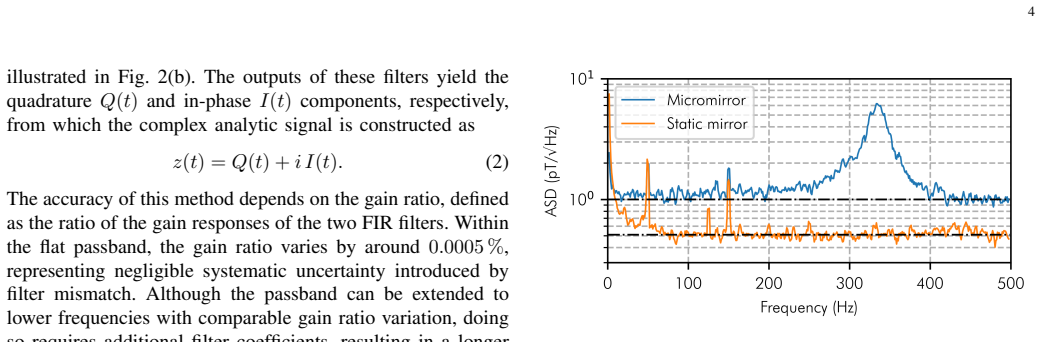
Optically pumped magnetometers (OPMs) have emerged as a powerful technique for high-resolution magnetic field imaging. However, achieving sub-millimeter spatial resolution at sub-picotesla sensitivities ($\mathrm{< 1\,pT/\sqrt{Hz}}$) remains challenging, particularly under finite-field conditions. We present a high-resolution magnetic imaging system based on a free-induction-decay (FID) OPM integrated with a two-axis scanning micromirror for automated beam steering. The double-pass optical configuration allows millimeter-scale devices under test (DUTs) to be positioned directly behind the vapor cell. This enables a standoff distance of 2.7 mm between the magnetic source and the atomic vapor, improving practical imaging resolution by increasing the amplitude of near-field magnetic signals sampled within the sensitive volume. Spatial resolution is experimentally demonstrated by imaging a custom printed circuit board (PCB) containing antiparallel copper tracks spaced 2 mm apart, with measured field maps in close agreement with Biot-Savart predictions. The OPM achieves an optimal field sensitivity of $\mathrm{0.5\,pT/\sqrt{Hz}}$, demonstrating the system's capability for high-precision magnetic field measurements. The imaging system is further validated by resolving polarity-dependent asymmetries in a bridge rectifier integrated circuit (IC) and tracking current dynamics in a ceramic battery in situ. These results highlight the potential of OPM-based systems for noninvasive diagnostics of electronic circuits and batteries.
Editorial analysis
A structured set of objections, weighed in public.
Referee Report
Summary. The manuscript describes a high-resolution magnetic imaging system based on a free-induction-decay optically pumped magnetometer (FID OPM) integrated with a two-axis scanning micromirror and a double-pass optical configuration. This setup achieves a 2.7 mm standoff distance between the device under test and the atomic vapor, enabling imaging of millimeter-scale structures. The OPM reports an optimal sensitivity of 0.5 pT/√Hz. Spatial resolution is demonstrated by mapping antiparallel copper tracks spaced 2 mm apart on a custom PCB, with measured field maps in close agreement with independent Biot-Savart predictions. The system is further applied to resolve polarity asymmetries in a bridge rectifier IC and to track in-situ current dynamics in a ceramic battery.
Significance. If the central claims hold, this work advances practical OPM-based magnetic imaging for noninvasive diagnostics of integrated circuits and batteries, combining sub-pT sensitivity with demonstrated millimeter-scale resolution. The validation via direct comparison to independent Biot-Savart calculations (rather than parameter fitting) strengthens the experimental results and supports transferability of the sensitivity figure to the imaging configuration.
major comments (1)
- [Imaging demonstration and standoff configuration] Description of the imaging demonstration and standoff configuration: The headline claim that the double-pass setup and 2.7 mm standoff improve practical imaging resolution by increasing near-field amplitude within the sensitive volume rests on the observed agreement between measured maps and Biot-Savart predictions for 2 mm tracks. This match does not independently test or rule out spatial averaging, path-length variations, or distortions arising from finite vapor-cell geometry, window refractions, or micromirror-induced beam-angle changes. Additional characterization (e.g., measured point-spread function or geometry-inclusive simulations) is required to substantiate the resolution improvement.
minor comments (2)
- [Abstract] Abstract: The sensitivity is stated as '0.5 pT/√Hz' and 'directly measured'; ensure the main text explicitly distinguishes this value from any effective sensitivity in the scanned imaging mode.
- [Figure captions and methods] Figure captions and methods: Clarify the precise measurement of the 2.7 mm standoff distance and any accounting for cell windows or mirror effects in the optical path.
Simulated Author's Rebuttal
We thank the referee for their careful review and constructive feedback on our manuscript. We address the major comment below and have revised the text to strengthen the discussion of resolution limits.
read point-by-point responses
-
Referee: [Imaging demonstration and standoff configuration] Description of the imaging demonstration and standoff configuration: The headline claim that the double-pass setup and 2.7 mm standoff improve practical imaging resolution by increasing near-field amplitude within the sensitive volume rests on the observed agreement between measured maps and Biot-Savart predictions for 2 mm tracks. This match does not independently test or rule out spatial averaging, path-length variations, or distortions arising from finite vapor-cell geometry, window refractions, or micromirror-induced beam-angle changes. Additional characterization (e.g., measured point-spread function or geometry-inclusive simulations) is required to substantiate the resolution improvement.
Authors: We agree that agreement with Biot-Savart calculations alone does not fully exclude all possible sensor-related distortions. The model we compare against assumes an ideal infinitesimal sensor located at the standoff distance; any significant spatial averaging over the vapor volume or angle-dependent effects would therefore be expected to reduce contrast and broaden features relative to the prediction. The observed close match, including clear separation of the 2 mm antiparallel tracks, indicates that such averaging and distortions remain below the level that would alter the reported resolution. Nevertheless, we acknowledge the value of more direct characterization. In the revised manuscript we have added a dedicated paragraph that (i) estimates the effective point-spread function from the known 2.7 mm standoff and vapor-cell dimensions and (ii) discusses why window refractions and micromirror beam-angle variations are negligible under the double-pass geometry. We have also included a brief geometry-inclusive ray-tracing estimate confirming that path-length variations do not measurably degrade the maps at the demonstrated scale. A full experimental PSF measurement would require a calibrated point-like magnetic source and a separate apparatus, which lies outside the scope of the present work but is noted as desirable future characterization. revision: partial
Circularity Check
No significant circularity; experimental results validated against independent Biot-Savart model.
full rationale
The paper reports experimental field maps from a custom PCB with 2 mm antiparallel tracks that are compared directly to Biot-Savart predictions rather than fitted to the data. Sensitivity of 0.5 pT/sqrt(Hz) is stated as a measured optimum, and the 2.7 mm standoff is a fixed physical parameter of the double-pass setup. No load-bearing equations, parameters, or uniqueness claims reduce to self-citations or to the presented measurements by construction. The derivation chain is therefore self-contained against external benchmarks.
Axiom & Free-Parameter Ledger
axioms (2)
- standard math Biot-Savart law accurately predicts the magnetic field produced by steady currents in the tested copper tracks and IC structures.
- domain assumption The atomic vapor cell and double-pass optics sample the near-field magnetic signals without significant geometric distortion at 2.7 mm standoff.
Lean theorems connected to this paper
-
IndisputableMonolith/Cost/FunctionalEquation.leanwashburn_uniqueness_aczel unclear?
unclearRelation between the paper passage and the cited Recognition theorem.
The OPM achieves an optimal field sensitivity of 0.5 pT/sqrt(Hz)... measured field maps in close agreement with Biot-Savart predictions.
-
IndisputableMonolith/Foundation/RealityFromDistinction.leanreality_from_one_distinction unclear?
unclearRelation between the paper passage and the cited Recognition theorem.
double-pass optical configuration... standoff distance of 2.7 mm... spatial resolution... limited by atomic spin diffusion and the optical beam waist
What do these tags mean?
- matches
- The paper's claim is directly supported by a theorem in the formal canon.
- supports
- The theorem supports part of the paper's argument, but the paper may add assumptions or extra steps.
- extends
- The paper goes beyond the formal theorem; the theorem is a base layer rather than the whole result.
- uses
- The paper appears to rely on the theorem as machinery.
- contradicts
- The paper's claim conflicts with a theorem or certificate in the canon.
- unclear
- Pith found a possible connection, but the passage is too broad, indirect, or ambiguous to say the theorem truly supports the claim.
Reference graph
Works this paper leans on
-
[1]
Optically pumped magnetometers recent advances and applications in biomagnetism: A review,
B. Zhao, L. Li, Y . Zhang, J. Tang, Y . Liu, and Y . Zhai, “Optically pumped magnetometers recent advances and applications in biomagnetism: A review,”IEEE Sensors Journal, vol. 23, no. 17, pp. 18 949–18 962, 2023
work page 2023
-
[2]
P. Kehayias, E. Levine, L. Basso, J. Henshaw, M. Saleh Ziabari, M. Titze, R. Haltli, J. Okoro, D. Tibbetts, D. Udoni et al. , “Measurement and simulation of the magnetic fields from a 555 timer integrated circuit using a quantum diamond microscope and finite-element analysis,” Physical Review Applied , vol. 17, no. 1, p. 014021, 2022
work page 2022
-
[3]
Atomic magnetometers and their application in industry,
X. Bai, K. Wen, D. Peng, S. Liu, and L. Luo, “Atomic magnetometers and their application in industry,” Frontiers in Physics , vol. 11, p. 1212368, 2023
work page 2023
-
[4]
Quantum technology for military applications,
M. Krelina, “Quantum technology for military applications,” EPJ Quan- tum Technology, vol. 8, no. 1, p. 24, 2021
work page 2021
-
[5]
S. Ingleby, P. Griffin, T. Dyer, M. Mrozowski, and E. Riis, “A digital alkali spin maser,” Scientific Reports, vol. 12, no. 1, p. 12888, 2022
work page 2022
-
[6]
Portable magnetometry for detection of biomagnetism in ambient environments,
M. Limes, E. Foley, T. Kornack, S. Caliga, S. McBride, A. Braun, W. Lee, V . Lucivero, and M. Romalis, “Portable magnetometry for detection of biomagnetism in ambient environments,” Physical Review Applied, vol. 14, no. 1, p. 011002, 2020
work page 2020
-
[7]
Three-dimensional imaging of integrated-circuit activity using quantum defects in diamond,
M. Garsi, R. St ¨ohr, A. Denisenko, F. Shagieva, N. Trautmann, U. V ogl, B. Sene, F. Kaiser, A. Zappe, R. Reuter et al. , “Three-dimensional imaging of integrated-circuit activity using quantum defects in diamond,” Physical Review Applied , vol. 21, no. 1, p. 014055, 2024
work page 2024
-
[8]
Nanoscale electrical conductivity imaging using a nitrogen-vacancy center in diamond,
A. Ariyaratne, D. Bluvstein, B. A. Myers, and A. C. B. Jayich, “Nanoscale electrical conductivity imaging using a nitrogen-vacancy center in diamond,” Nature communications, vol. 9, no. 1, p. 2406, 2018
work page 2018
-
[9]
Imaging of material de- fects with a radio-frequency atomic magnetometer,
P. Bevington, R. Gartman, and W. Chalupczak, “Imaging of material de- fects with a radio-frequency atomic magnetometer,” Review of Scientific Instruments, vol. 90, no. 1, 2019
work page 2019
-
[10]
Rapid electromagnetic induction imaging with an optically raster-scanned atomic magnetometer,
B. Maddox, C. Deans, H. Yao, Y . Cohen, and F. Renzoni, “Rapid electromagnetic induction imaging with an optically raster-scanned atomic magnetometer,”IEEE Transactions on Instrumentation and Mea- surement, vol. 72, pp. 1–5, 2023
work page 2023
-
[11]
Magnetic field imaging with microfabricated optically-pumped magnetometers,
O. Alem, R. Mhaskar, R. Jim ´enez-Mart´ınez, D. Sheng, J. LeBlanc, L. Trahms, T. Sander, J. Kitching, and S. Knappe, “Magnetic field imaging with microfabricated optically-pumped magnetometers,” Optics express, vol. 25, no. 7, pp. 7849–7858, 2017
work page 2017
-
[12]
Moving magnetoencephalography towards real-world applications with a wearable system,
E. Boto, N. Holmes, J. Leggett, G. Roberts, V . Shah, S. S. Meyer, L. D. Mu ˜noz, K. J. Mullinger, T. M. Tierney, S. Bestmann et al. , “Moving magnetoencephalography towards real-world applications with a wearable system,” Nature, vol. 555, no. 7698, pp. 657–661, 2018
work page 2018
-
[13]
Multi-channel atomic magnetometer for magnetoencephalog- raphy: A configuration study,
K. Kim, S. Begus, H. Xia, S.-K. Lee, V . Jazbinsek, Z. Trontelj, and M. V . Romalis, “Multi-channel atomic magnetometer for magnetoencephalog- raphy: A configuration study,” NeuroImage, vol. 89, pp. 143–151, 2014
work page 2014
-
[14]
X. Fang, K. Wei, T. Zhao, Y . Zhai, D. Ma, B. Xing, Y . Liu, and Z. Xiao, “High spatial resolution multi-channel optically pumped atomic magnetometer based on a spatial light modulator,” Optics Express , vol. 28, no. 18, pp. 26 447–26 460, 2020
work page 2020
-
[15]
C. Liu, H. Dong, and J. Sang, “Submillimeter-resolution magnetic field imaging with digital micromirror device and atomic vapor cell,” Applied Physics Letters, vol. 119, no. 11, 2021
work page 2021
-
[16]
Free-induction- decay magnetic field imaging with a microfabricated Cs vapor cell,
D. Hunter, C. Perrella, A. McWilliam, J. McGilligan, M. Mrozowski, S. Ingleby, P. Griffin, D. Burt, A. Luiten, and E. Riis, “Free-induction- decay magnetic field imaging with a microfabricated Cs vapor cell,” Opt. Express, vol. 31, no. 20, pp. 33 582–33 595, 2023
work page 2023
-
[17]
Optical pumping enhancement of a free-induction-decay magnetometer,
D. Hunter, M. Mrozowski, A. McWilliam, S. Ingleby, T. Dyer, P. Griffin, and E. Riis, “Optical pumping enhancement of a free-induction-decay magnetometer,” J. Opt. Soc. Am. B , vol. 40, no. 10, pp. 2664–2673, 2023
work page 2023
-
[18]
Wide- bandwidth atomic magnetometry via instantaneous-phase retrieval,
N. Wilson, C. Perrella, R. Anderson, A. Luiten, and P. Light, “Wide- bandwidth atomic magnetometry via instantaneous-phase retrieval,” Physical Review Research, vol. 2, no. 1, p. 013213, 2020
work page 2020
-
[19]
A sensitive and accurate atomic magnetometer based on free spin precession,
Z. D. Gruji ´c, P. A. Koss, G. Bison, and A. Weis, “A sensitive and accurate atomic magnetometer based on free spin precession,” Eur. Phys. J. D, vol. 69, pp. 1–10, 2015
work page 2015
-
[20]
Free-induction-decay magnetometer based on a microfabricated Cs vapor cell,
D. Hunter, S. Piccolomo, J. Pritchard, N. Brockie, T. Dyer, and E. Riis, “Free-induction-decay magnetometer based on a microfabricated Cs vapor cell,” Phys. Rev. Appl., vol. 10, no. 1, p. 014002, 2018
work page 2018
-
[21]
Waveform reconstruction with a Cs based free-induction- decay magnetometer,
D. Hunter, R. Jim ´enez-Mart´ınez, J. Herbsommer, S. Ramaswamy, W. Li, and E. Riis, “Waveform reconstruction with a Cs based free-induction- decay magnetometer,” Opt. Express, vol. 26, no. 23, pp. 30 523–30 531, 2018
work page 2018
-
[22]
Nitrogen buffer gas pressure tuning in a micro-machined vapor cell,
S. Dyer, A. McWilliam, D. Hunter, S. Ingleby, D. Burt, O. Sharp, F. Mirando, P. Griffin, E. Riis, and J. McGilligan, “Nitrogen buffer gas pressure tuning in a micro-machined vapor cell,” Appl. Phys. Lett. , vol. 123, no. 7, 2023
work page 2023
-
[23]
Optimizing longitudi- nal spin relaxation in miniaturized optically pumped magnetometers,
A. McWilliam, S. Dyer, D. Hunter, M. Mrozowski, S. Ingleby, O. Sharp, D. Burt, P. Griffin, J. McGilligan, and E. Riis, “Optimizing longitudi- nal spin relaxation in miniaturized optically pumped magnetometers,” Physical Review Applied , vol. 22, no. 6, p. 064024, 2024
work page 2024
-
[24]
H.-F. Dong, J.-L. Chen, J.-M. Li, C. Liu, A.-X. Li, N. Zhao, and F.-Z. Guo, “Spin image of an atomic vapor cell with a resolution smaller than the diffusion crosstalk free distance,” Journal of Applied Physics , vol. 125, no. 24, 2019
work page 2019
-
[25]
High resolution field imaging with atomic vapor cells,
A. Horsley, “High resolution field imaging with atomic vapor cells,” Ph.D. dissertation, University of Basel, 2015. 9
work page 2015
-
[26]
Spin-exchange relaxation-free magnetometry using elliptically polarized light,
V . Shah and M. Romalis, “Spin-exchange relaxation-free magnetometry using elliptically polarized light,” Phys. Rev. A, vol. 80, no. 1, p. 013416, 2009
work page 2009
-
[27]
Spin-exchange relaxation-free magnetometer with nearly parallel pump and probe beams,
T. Karaulanov, I. Savukov, and Y . Kim, “Spin-exchange relaxation-free magnetometer with nearly parallel pump and probe beams,” Meas. Sci. Technol., vol. 27, no. 5, p. 055002, 2016
work page 2016
-
[28]
Improving the sensitivity of optically pumped magnetometers by hyperfine repump- ing,
V . Schultze, T. Scholtes, R. IJsselsteijn, and H.-G. Meyer, “Improving the sensitivity of optically pumped magnetometers by hyperfine repump- ing,” J. Opt. Soc. Am. B , vol. 32, no. 5, pp. 730–736, 2015
work page 2015
-
[29]
Light-narrowed optically pumped M x magnetometer with a minia- turized Cs cell,
T. Scholtes, V . Schultze, R. IJsselsteijn, S. Woetzel, and H.-G. Meyer, “Light-narrowed optically pumped M x magnetometer with a minia- turized Cs cell,” Physical Review A—Atomic, Molecular, and Optical Physics, vol. 84, no. 4, p. 043416, 2011
work page 2011
-
[30]
Ultra- low noise, bi-polar, programmable current sources,
M. Mrozowski, I. Chalmers, S. Ingleby, P. Griffin, and E. Riis, “Ultra- low noise, bi-polar, programmable current sources,” Review of Scientific Instruments, vol. 94, no. 1, 2023
work page 2023
-
[31]
Intrinsic relaxation rates of polarized Cs vapor in miniaturized cells,
T. Scholtes, S. Woetzel, R. IJsselsteijn, V . Schultze, and H.-G. Meyer, “Intrinsic relaxation rates of polarized Cs vapor in miniaturized cells,” Appl. Phys. B , vol. 117, pp. 211–218, 2014
work page 2014
-
[32]
Frequency and damping estimation meth- ods—an overview,
T. Zieli ´nski and K. Duda, “Frequency and damping estimation meth- ods—an overview,” Metrol. Meas. Syst. , vol. 18, no. 4, pp. 505–528, 2011
work page 2011
-
[33]
Ultra- sensitive magnetometry based on free precession of nuclear spins,
C. Gemmel, W. Heil, S. Karpuk, K. Lenz, C. Ludwig, Y . Sobolev, K. Tullney, M. Burghoff, W. Kilian, S. Knappe-Gr¨uneberg et al., “Ultra- sensitive magnetometry based on free precession of nuclear spins,” The European Physical Journal D , vol. 57, no. 3, pp. 303–320, 2010
work page 2010
-
[34]
D. Hewatt, M. Ellmeier, C. Kiehl, T. Menon, J. Pollock, C. Regal, and S. Knappe, “Investigating the hyperfine systematic error and relative phase in low-spin-polarization alkali-metal free-induction-decay magne- tometers,” Physical Review A , vol. 111, no. 3, p. 033106, 2025
work page 2025
-
[35]
P. D. Welch, “The use of fast fourier transform for the estimation of power spectra: A method based on time averaging over short, modi- fied periodograms,” IEEE Transactions on audio and electroacoustics , vol. 15, no. 2, pp. 70–73, 1967
work page 1967
-
[36]
Magpylib: A python toolbox for magnetic field computation,
N. Tiercelin, G. Weis, P. Kollmannsberger, M. Hughes, J. Reichel, W. Ketterle, and A. Huck, “Magpylib: A python toolbox for magnetic field computation,” SoftwareX, vol. 20, p. 101202, 2022
work page 2022
-
[37]
Non-invasive current density imaging of lithium-ion bat- teries,
M. G. Bason, T. Coussens, M. Withers, C. Abel, G. Kendall, and P. Kr ¨uger, “Non-invasive current density imaging of lithium-ion bat- teries,” Journal of Power Sources , vol. 533, p. 231312, 2022
work page 2022
-
[38]
Microscopic magnetic field imaging with hot atoms via single- pixel imaging,
C. Torre, J. Brass, S. Bisdee, M. T. Rasheed, G. Ferranti, and C. A. Weidner, “Microscopic magnetic field imaging with hot atoms via single- pixel imaging,” arXiv preprint arXiv:2508.13869 , 2025
discussion (0)
Sign in with ORCID, Apple, or X to comment. Anyone can read and Pith papers without signing in.