REVIEW 3 major objections 4 minor 1 cited by
Modelling magnetic star-planet interaction in the iconic M dwarfs Proxima Centauri, YZ Ceti and GJ 1151
T0 review · 3 major / 4 minor · reviewed 2026-08-05 · deepseek-v4-flash
Pith's one-line read Under a hybrid PFSS wind geometry, Proxima b, YZ Cet b, and the putative GJ 1151 b are sub-Alfvénic and should emit radio via star-planet interaction, with the stretch-and-break mechanism matching tentative detections.
desk verdict A useful public-code paper with honest conditional claims; the fluxes are order-of-magnitude only because beta is unconstrained and the R_SS choice is adopted, but the tool deserves peer review and a light revision. read the letter →
The pith
A machine-rendered reading of the paper's core claim, the machinery that carries it, and where it could break.
The reading
What carries the argument
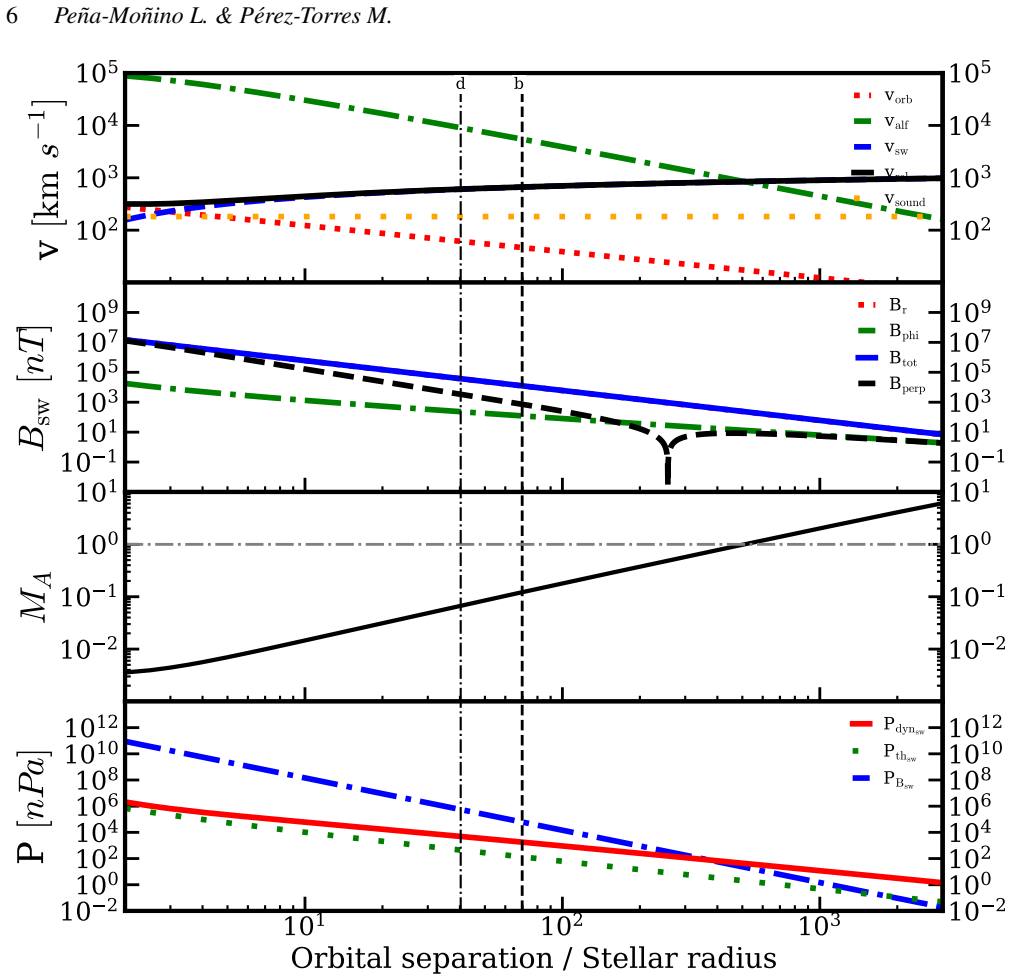
SIRIO, a public Python code, couples a 1D isothermal Parker stellar wind (solved with the Lambert W function) to three magnetic field geometries: closed dipole, open Parker spiral, and hybrid PFSS, where field lines are closed dipolar out to R_SS = 4.5 R* and open radial beyond. It computes Poynting flux with three star-planet interaction models—Alfvén wing, magnetic reconnection, and stretch-and-break—whose relative sizes are set by the ratios S_rec/S_Alf = 2.5/M_A and S_rec/S_sb = 2.5 ξ^2/f_ap, with ξ = B_sw/B_pl and f_ap the connected-area fraction. The planet's magnetopause radius comes from pressure balance, and free-free absorption is integrated along the line of sight to the observer.
What would settle it
Measure each star's surface magnetic field topology and wind mass-loss rate (e.g., with spectropolarimetry and Lyman-alpha absorption) and locate the Alfvén surface. If Proxima b orbits beyond that surface for the measured ~600 G field, the sub-Alfvénic claim collapses. On the flux side, a sensitive low-frequency radio observation at the predicted cyclotron frequency and orbital phase that reaches an upper limit below the stretch-and-break prediction—roughly 0.1 mJy for Proxima—and sees nothing would falsify the model's match.
Extended reading notes
Core claim
The paper's central claim is that all three iconic M-dwarf systems are most likely sub-Alfvénic, meaning their close-in planets move through the stellar wind slower than the local Alfvén speed, so magnetic energy can flow back to the star and power electron-cyclotron radio emission. This holds only under a hybrid PFSS wind geometry with a source surface at 4.5 stellar radii; a pure dipole geometry puts all the planets in the super-Alfvénic regime and kills the interaction. Among the three emission mechanisms tested, the Alfvén wing model yields negligible flux, while reconnection and stretch-and-break predict detectable emission. The stretch-and-break model is the only one matching Proxima's
Load-bearing premise
The load-bearing premise is that the magnetic field of each of the three stars opens up at 4.5 stellar radii (the hybrid PFSS geometry); if any field stays closer to a closed dipole, its planet becomes super-Alfvénic, no Poynting flux reaches the star, and the paper's radio predictions vanish.
Editorial extensions
If this is right
- Under the hybrid PFSS geometry, all three systems are sub-Alfvénic, so SPI radio emission is physically expected and can be searched at the cyclotron frequency.
- The stretch-and-break model sets the most promising flux scale: it alone matches Proxima's tentative detection and sits within a factor of two of GJ 1151's, so future observations should target its predicted frequency and orbital phase.
- Free-free absorption can erase the signal at high wind mass-loss rates; for YZ Ceti model A about 75% is absorbed, so non-detections in high-wind stars do not rule out SPI.
- GJ 1151 b, if real, must be low-mass (about 0.73 Earth masses) with an orbital period under two days for the PFSS geometry; the five-day high-mass scenario is ruled out.
- SIRIO's fast 1D approach lets observers compute detectability curves as functions of orbital separation, mass-loss rate, and planetary magnetic field, guiding target selection and constraining stellar winds or planetary fields.
Reading between the lines
- Measuring each star's actual magnetic source-surface radius would convert the model into a sharp test: radio detections or non-detections would then pin down the stellar wind mass-loss rate at the planet's orbit.
- The planetary magnetic fields are estimated from a tidal-lock scaling law that gives lower limits, so stronger planetary fields would boost reconnection and stretch-and-break fluxes further, widening the detectability window.
- If confirmed, SPI radio emission would provide a detection channel for close-in Earth-mass planets around M dwarfs that is independent of transits and radial velocities.
- The same machinery could be applied to other M-dwarf systems with tentative detections to decide whether free-free absorption or magnetic geometry explains null results.
Editorial analysis
A structured set of objections, weighed in public.
Referee Report
Summary. The paper introduces SIRIO, a public Python code that models sub-Alfvénic magnetic star-planet interaction (SPI) radio emission using a 1D isothermal Parker wind with three magnetic geometries (pure dipole, Parker spiral, hybrid PFSS), three Poynting-flux prescriptions (Alfvén wing, reconnection, stretch-and-break), and free-free absorption. The authors benchmark SIRIO against the M-dwarf systems Proxima Centauri, YZ Ceti, and GJ 1151, comparing with previous modeling by Turnpenney et al. (2018), Kavanagh et al. (2021), Réville et al. (2024), and Pineda & Villadsen (2023). They find that, assuming a hybrid PFSS geometry with R_SS = 4.5 R*, Proxima b, YZ Cet b, and a short-period GJ 1151 b lie in the sub-Alfvénic regime, that the Alvén wing model predicts negligible fluxes, and that reconnection/stretch-and-break models predict detectable fluxes, with the stretch-and-break model matching the Proxima tentative detection and the GJ 1151 Stokes I flux to within a factor of two. Free-free absorption suppresses YZ Cet model A emission by ~75%.
Significance. If the central conclusions hold, the paper provides a computationally efficient, publicly available tool for target selection and for constraining stellar mass-loss rates and planetary magnetic fields from SPI radio searches. The paper's benchmarks reproduce several previously published results, and the inclusion of free-free absorption is a genuine addition that can affect detectability, as shown for YZ Cet. These are strengths that make the code and parameter exploration useful to the community. However, the headline conclusions are quantitatively contingent on at least two externally calibrated parameters (β and R_SS), and the qualitative sub-Alfvénic/super-Alfvénic boundary is not robust to the adopted R_SS, so the paper's central claim is currently conditional rather than established.
major comments (3)
- [Sect. 3.1, 4.1, 4.3] The choice R_SS = 4.5 R* is adopted to match Pineda & Villadsen (2023), not derived for each star. The paper's own sensitivity note states that lower/higher R_SS would significantly change the emission, and the text quantifies the fragility: for Proxima with B* = 200 G, Proxima b is always super-Alfvénic if R_SS = 5.5 R* (Sect. 4.1); for GJ 1151 the PFSS sub-Alfvénic window closes for orbital periods above ~2 days (Sect. 4.3); and a pure dipole (R_SS → ∞) gives super-Alfvénic conditions for all three systems. Since the central claim that SPI is at work in all three systems rests entirely on this single adopted value, the paper should either derive R_SS from system-specific pressure balance (e.g., the Réville et al. 2015 estimate cited in Sect. 3.1) or present the sub/super-Alfvénic regimes and predicted fluxes as a function of R_SS over its plausible range (≈2.5–5.5 R*). At present the q
- [Sect. 3.2, Eq. (9)] The conversion efficiency β is fixed at 10^-3, with the acknowledged range 10^-4 to 10^-2. Because F_R is linear in β, all quantitative comparisons to observations are conditional on this nominal value. Specifically, the 'factor of two' agreement with Vedantham et al. (2020) for GJ 1151 (Sect. 4.3) and the statement that the stretch-and-break model is 'the only one predicting values in agreement' with the Proxima detection (Sect. 4.1) would not hold at β = 10^-4 (fluxes an order of magnitude or more below the detections), and at β = 10^-2 the Alfvén-wing model would also become detectable. The paper should propagate this factor-100 uncertainty through the flux predictions and adjust the model-comparison claims accordingly, or state them explicitly as nominal-β results.
- [Sect. 4.1] The text notes that for Proxima in the PFSS geometry 'M_A is so close to unity that star-planet interaction could be very inefficient,' yet the flux predictions in Fig. 4 are computed with the full Poynting-flux formulas without any reduction for this marginal sub-Alfvénicity. This internal tension directly affects the Proxima detection claim: the predicted detectability assumes an efficiency that the same section casts into doubt. Please either quantify how the near-unity M_A modifies the Poynting flux/radio conversion, or explicitly caveat that the Proxima flux should be treated as an upper limit.
minor comments (4)
- [Summary, Sect. 5] The summary mislabels the YZ Cet models: the high mass-loss, open-field model is called 'model B' and the low mass-loss PFSS model is also called 'model B'; from Sect. 4.2 the former should be model A and the latter model B.
- [Sect. 4.3] Typo: 'GJ 1551 b' and 'GJ 1551 c' should read 'GJ 1151 b' and 'GJ 1151 c'.
- [Throughout] Several minor typos: 'Fig, 5' (Sect. 4.1), 'with with' (Sect. 4.1), 'fells short' (Sect. 4.1), 'or and' (Sect. 4.1), and 'Potentially' capitalization in the abstract. These do not affect the science but should be cleaned up.
- [Sect. 3.1] The sentence 'We note that lower (higher) values of R_SS would result in significantly higher (lower) values of the radio emission' is not always true for all three models; for the reconnection and stretch-and-break models the dependence is more complex because R_mp and the magnetosphere condition also enter. Please qualify this statement or refer the reader to the relevant parameter study.
Circularity Check
No significant circularity: the predicted fluxes and sub-Alfvenic classifications are computed from literature-calibrated Poynting-flux models and explicit geometric assumptions; no parameter is fitted to the target radio detections.
full rationale
The paper's derivation chain is self-contained in the relevant sense: radio fluxes are obtained from published Poynting-flux formulae (Saur et al. 2013; Lanza 2009; Strugarek et al. 2022) with efficiency factors beta = 10^-3, epsilon = 0.2, and alpha = 1 taken from external measurements of the Io-Jupiter interaction and Earth's magnetosphere, not tuned to match the Proxima, YZ Cet, or GJ 1151 detections. The sub-Alfvenic classification is computed from a 1D isothermal Parker wind plus an assumed magnetic geometry; the hybrid PFSS case explicitly adopts R_SS = 4.5 R* from Pineda & Villadsen (2023) to ease comparison. This is an openly stated modeling assumption, not a prediction taken as input: the paper itself flags the dependence ('lower (higher) values of R_SS would result in significantly higher (lower) values of the radio emission') and shows that a pure dipole geometry would place the planets in the super-Alfvenic regime. That is a sensitivity/robustness caveat, not a circular reduction. The apparent agreements with the Proxima and GJ 1151 detections are presented as comparisons over a plausible range of the free planetary field B_pl and mass-loss rate, and no parameter is adjusted to force the match. Self-citations (Perez-Torres et al. 2021 for the Proxima detection; Pena-Monino et al. 2025 for GJ 486) are used as observational benchmarks or side remarks, but the central sub-Alfvenic and flux conclusions do not reduce to those citations. The external benchmarks (Turnpenney et al. 2018; Pineda & Villadsen 2023; Vedantham et al. 2020) are independently published, and the code is released for reproducibility. Therefore no circular step can be exhibited from the paper's own equations or citations.
Assumptions & free parameters
free parameters (5)
- beta (Poynting-to-radio conversion efficiency) =
10^-3 nominal; range 10^-4 to 10^-2
- R_SS (source surface radius) =
4.5 R*
- Omega (ECM beaming solid angle) =
0.16 to 0.48 sr
- Planetary surface magnetic field B_pl (scaling-law normalization) =
0.05 G (Proxima b); 0.20 G (YZ Cet b); 0.35 G / 0.11 G (GJ 1151 b low/high)
- epsilon (dissipated-power efficiency) =
0.2 +/- 0.1
assumptions (7)
- domain assumption Isothermal Parker wind model describes the stellar wind velocity and density profiles
- domain assumption Hybrid PFSS magnetic geometry with closed dipole inside R_SS and open Parker spiral outside
- standard math Poynting flux expressions for Alfvén wing, reconnection, and stretch-and-break models (Eqs. 3-5)
- domain assumption Sano (1993) scaling law for planetary magnetic moment and Curtis & Ness (1986) core-radius scaling
- domain assumption ECM radio emission with bandwidth Delta_nu = nu_g = 2.8 B* MHz and beaming solid angle calibrated on Jupiter-Io
- domain assumption Planets are tidally locked, so rotation period equals orbital period
- domain assumption Efficiency factors beta = 10^-3 and epsilon = 0.2
Cite this review
Pith. "Pith review of Modelling magnetic star-planet interaction in the iconic M dwarfs Proxima Centauri, YZ Ceti and GJ 1151." pith.science (2026). https://pith.science/paper/7M44UYBY
@misc{pith2026250820891,
  author       = {Pith},
  title        = {Pith review of: Modelling magnetic star-planet interaction in the iconic M dwarfs Proxima Centauri, YZ Ceti and GJ 1151},
  year         = {2026},
  howpublished = {\url{https://pith.science/paper/7M44UYBY}},
  note         = {Machine review of arXiv:2508.20891}
}
read the original abstract
The unambiguous detection of magnetic star-planet interaction (SPI) via radio observations would provide a novel method for detecting exoplanets and probing their magnetic fields. Although direct radio detection of sub-Jovian planets is hindered by the low frequencies involved, models of sub-Alfv\'enic SPI predict that Earth-like planets in close-in orbits around M dwarfs may induce detectable emission. Here, we revisit the modelling of the expected radio emission from magnetic star-planet interaction in the iconic M-dwarf systems Proxima Centauri, YZ Ceti, and GJ 1151, where claims of SPI-related radio detections have been made. For this, we use SIRIO (Star-planet Interaction and Radio Induced Observations), a public Python code that models radio emission from sub-Alfv\'enic SPI. We benchmark SIRIO results against those paradigmatic systems, whose SPI modeling has been previously discussed in the literature. Our results support previous findings that Proxima b, YZ Cet b, and the putative planet GJ 1151 b are most likely in the sub-Alfv\'enic regime (assuming a hybrid PFSS geometry), so SPI should be at work in all of them. We find that the Alfv\'en wing model generally predicts a very low level of radio emission, while if magnetic reconnection takes place, prospects for detection are significantly better. We also find that free-free absorption may play a relevant role, in particular in YZ Ceti. Our SIRIO code can also be used to evaluate the feasibility of radio proposals aimed at detecting SPI, and to constrain the stellar wind mass-loss rate or planetary magnetic field.
Figures


Figures from the paper (8 more)


Forward citations
Cited by 1 Pith paper
-
Magnetic field strengths of hot giant exoplanets consistent with Solar System values
Wind speed measurements in seven ultra-hot Jupiters decrease with temperature, consistent with magnetic drag and implying magnetic field strengths of a few gauss.
Reference graph
Works this paper leans on
-
[1]
C., 2011, @doi [The Astrophysical Journal] 10.1088/0004-637X/730/1/27 , 730, 27
Adams F. C., 2011, @doi [The Astrophysical Journal] 10.1088/0004-637X/730/1/27 , 730, 27
-
[2]
Altschuler M. D., Newkirk Jr. G., 1969, @doi [ ] 10.1007/BF00145734 , https://ui.adsabs.harvard.edu/abs/1969SoPh....9..131A 9, 131
-
[3]
Anglada-Escud \'e G., et al., 2016, @doi [ ] 10.1038/nature19106 , https://ui.adsabs.harvard.edu/abs/2016Natur.536..437A 536, 437
-
[4]
Blanco-Pozo J., et al., 2023, @doi [A&A] 10.1051/0004-6361/202245053 , 671, A50
-
[5]
Clarke J. T., et al., 1996, @doi [Science] 10.1126/science.274.5286.404 , https://ui.adsabs.harvard.edu/abs/1996Sci...274..404C 274, 404
-
[6]
N., 2000, Allen's astrophysical quantities
Cox A. N., 2000, Allen's astrophysical quantities . Springer New York, NY
work page 2000
-
[7]
Cranmer S. R., 2004, @doi [American Journal of Physics] 10.1119/1.1775242 , https://ui.adsabs.harvard.edu/abs/2004AmJPh..72.1397C 72, 1397
-
[8]
Curtis S. A., Ness N. F., 1986, @doi [ ] 10.1029/JA091iA10p11003 , https://ui.adsabs.harvard.edu/abs/1986JGR....9111003C 91, 11003
Show all 51 references
-
[9]
M., Desch M
Farrell W. M., Desch M. D., Zarka P., 1999, @doi [Journal of Geophysical Research: Planets] https://doi.org/10.1029/1998JE900050 , 104, 14025
1999 doi
-
[10]
Fischer C., Saur J., 2019, @doi [The Astrophysical Journal] 10.3847/1538-4357/aafaf2 , 872, 113
2019 doi
-
[11]
L., Zarka P., Kurth W
Kaiser M. L., Zarka P., Kurth W. S., Hospodarsky G. B., Gurnett D. A., 2000, @doi [ ] 10.1029/1999JA000414 , https://ui.adsabs.harvard.edu/abs/2000JGR...10516053K 105, 16053
2000 doi
-
[12]
D., Vidotto A
Kavanagh R. D., Vidotto A. A., Klein B., Jardine M. M., Donati J.-F., \'O Fionnag \'a in D., 2021, @doi [ ] 10.1093/mnras/stab929 , https://ui.adsabs.harvard.edu/abs/2021MNRAS.504.1511K 504, 1511
2021 doi
-
[13]
M., Zaire B., Folsom C
Klein B., Donati J.-F., H \'e brard \'E . M., Zaire B., Folsom C. P., Morin J., Delfosse X., Bonfils X., 2021, @doi [ ] 10.1093/mnras/staa3396 , https://ui.adsabs.harvard.edu/abs/2021MNRAS.500.1844K 500, 1844
2021 doi
-
[14]
Lamers H. J. G. L. M., Cassinelli J. P., 1999, Introduction to Stellar Winds. Cambridge University Press
1999
-
[15]
F., 2009, @doi [ ] 10.1051/0004-6361/200912367 , https://ui.adsabs.harvard.edu/abs/2009A&A...505..339L 505, 339
Lanza A. F., 2009, @doi [ ] 10.1051/0004-6361/200912367 , https://ui.adsabs.harvard.edu/abs/2009A&A...505..339L 505, 339
2009 doi
-
[16]
F., 2013, @doi [ ] 10.1051/0004-6361/201321790 , https://ui.adsabs.harvard.edu/abs/2013A&A...557A..31L 557, A31
Lanza A. F., 2013, @doi [ ] 10.1051/0004-6361/201321790 , https://ui.adsabs.harvard.edu/abs/2013A&A...557A..31L 557, A31
2013 doi
-
[17]
Mahadevan S., et al., 2021, @doi [The Astrophysical Journal Letters] 10.3847/2041-8213/abe2b2 , 919, L9
2021 doi
-
[18]
B., Dulk G
Melrose D. B., Dulk G. A., 1982, @doi [ ] 10.1086/160219 , https://ui.adsabs.harvard.edu/abs/1982ApJ...259..844M 259, 844
1982 doi
-
[19]
Neubauer F., 1980, @doi [Journal of Geophysical Research: Space Physics] https://doi.org/10.1029/JA085iA03p01171 , 85, 1171
1980 doi
-
[20]
D., Milan S
Nichols J. D., Milan S. E., 2016, @doi [ ] 10.1093/mnras/stw1430 , https://ui.adsabs.harvard.edu/abs/2016MNRAS.461.2353N 461, 2353
2016 doi
-
[21]
N., 1958, @doi [ ] 10.1086/146579 , https://ui.adsabs.harvard.edu/abs/1958ApJ...128..664P 128, 664
Parker E. N., 1958, @doi [ ] 10.1086/146579 , https://ui.adsabs.harvard.edu/abs/1958ApJ...128..664P 128, 664
1958 doi
-
[22]
P \'e rez-Torres M., et al., 2021, @doi [ ] 10.1051/0004-6361/202039052 , https://ui.adsabs.harvard.edu/abs/2021A&A...645A..77P 645, A77
2021 doi
-
[23]
Perger M., et al., 2021, @doi [ ] 10.1051/0004-6361/202140786 , https://ui.adsabs.harvard.edu/abs/2021A&A...649L..12P 649, L12
2021 doi
-
[24]
Peña-Moñino L., et al., 2025, @doi [A&A] 10.1051/0004-6361/202451835 , 693, A223
2025 doi
-
[25]
S., Villadsen J., 2023, @doi [Nat Astron] 10.1038/s41550-023-01914-0 , https://ui.adsabs.harvard.edu/abs/2023NatAs...7..569P 7, 569
Pineda J. S., Villadsen J., 2023, @doi [Nat Astron] 10.1038/s41550-023-01914-0 , https://ui.adsabs.harvard.edu/abs/2023NatAs...7..569P 7, 569
2023 doi
-
[26]
Queinnec J., Zarka P., 2001, @doi [ ] 10.1016/S0032-0633(00)00157-4 , https://ui.adsabs.harvard.edu/abs/2001P&SS...49..365Q 49, 365
2001 doi
-
[27]
Reiners A., Basri G., 2008, @doi [ ] 10.1051/0004-6361:200810491 , https://ui.adsabs.harvard.edu/abs/2008A&A...489L..45R 489, L45
2008 doi
-
[28]
S., Strugarek A., Matt S
Réville V., Brun A. S., Strugarek A., Matt S. P., Bouvier J., Folsom C. P., Petit P., 2015, @doi [The Astrophysical Journal] 10.1088/0004-637X/814/2/99 , 814, 99
2015 doi
-
[29]
Réville V., et al., 2024, @doi [The Astrophysical Journal] 10.3847/1538-4357/ad8132 , 976, 65
2024 doi
-
[30]
Sano Y., 1993, @doi [J. Geomag. Geoelectr.] 10.5636/jgg.45.65 , https://ui.adsabs.harvard.edu/abs/1993JGG....45...65S 45, 65
1993 doi
-
[31]
Springer International Publishing, Cham, pp 1877--1893, @doi 10.1007/978-3-319-55333-7_27 , https://doi.org/10.1007/978-3-319-55333-7_27
Saur J., 2018, Electromagnetic Coupling in Star-Planet Systems. Springer International Publishing, Cham, pp 1877--1893, @doi 10.1007/978-3-319-55333-7_27 , https://doi.org/10.1007/978-3-319-55333-7_27
2018 doi
-
[32]
M., Connerney J
Saur J., Neubauer F. M., Connerney J. E. P., Zarka P., Kivelson M. G., 2004, in Bagenal F., Dowling T. E., McKinnon W. B., eds, , Vol. 1, Jupiter. The Planet, Satellites and Magnetosphere. 'Cambridge University Press', pp 537--560
2004
-
[33]
M., Simon S., 2013, @doi [ ] 10.1051/0004-6361/201118179 , https://ui.adsabs.harvard.edu/abs/2013A&A...552A.119S 552, A119
Saur J., Grambusch T., Duling S., Neubauer F. M., Simon S., 2013, @doi [ ] 10.1051/0004-6361/201118179 , https://ui.adsabs.harvard.edu/abs/2013A&A...552A.119S 552, A119
2013 doi
-
[34]
Saur J., et al., 2018, @doi [Journal of Geophysical Research (Space Physics)] 10.1029/2018JA025948 , https://ui.adsabs.harvard.edu/abs/2018JGRA..123.9560S 123, 9560
2018 doi
-
[35]
Springer International Publishing, Cham, pp 1833--1855, @doi 10.1007/978-3-319-55333-7_25 , https://doi.org/10.1007/978-3-319-55333-7_25
Strugarek A., 2018, Models of Star-Planet Magnetic Interaction. Springer International Publishing, Cham, pp 1833--1855, @doi 10.1007/978-3-319-55333-7_25 , https://doi.org/10.1007/978-3-319-55333-7_25
2018 doi
-
[36]
S., Donati J
Strugarek A., Brun A. S., Donati J. F., Moutou C., R \'e ville V., 2019, @doi [ ] 10.3847/1538-4357/ab2ed5 , https://ui.adsabs.harvard.edu/abs/2019ApJ...881..136S 881, 136
2019 doi
-
[37]
Strugarek A., et al., 2022, @doi [Monthly Notices of the Royal Astronomical Society] 10.1093/mnras/stac778 , 512, 4556
2022 doi
-
[38]
K., Imada S., Kataoka R., Kato Y., Matsumoto T., Miyahara H., Tsuneta S., 2013, @doi [ ] 10.1093/pasj/65.5.98 , https://ui.adsabs.harvard.edu/abs/2013PASJ...65...98S 65, 98
Suzuki T. K., Imada S., Kataoka R., Kato Y., Matsumoto T., Miyahara H., Tsuneta S., 2013, @doi [ ] 10.1093/pasj/65.5.98 , https://ui.adsabs.harvard.edu/abs/2013PASJ...65...98S 65, 98
2013 doi
-
[39]
et al., 2020, @doi [A&A] 10.1051/0004-6361/202037745 , 639, A77
Suárez Mascareño, A. et al., 2020, @doi [A&A] 10.1051/0004-6361/202037745 , 639, A77
2020 doi
- [40]
-
[41]
D., Wynn G
Turnpenney S., Nichols J. D., Wynn G. A., Burleigh M. R., 2018, @doi [ ] 10.3847/1538-4357/aaa59c , https://ui.adsabs.harvard.edu/abs/2018ApJ...854...72T 854, 72
2018 doi
-
[42]
K., et al., 2020, @doi [Nat Astron] 10.1038/s41550-020-1011-9 , https://ui.adsabs.harvard.edu/abs/2020NatAs...4..577V 4, 577
Vedantham H. K., et al., 2020, @doi [Nat Astron] 10.1038/s41550-020-1011-9 , https://ui.adsabs.harvard.edu/abs/2020NatAs...4..577V 4, 577
2020 doi
-
[43]
A., Jardine M., Morin J., Donati J
Vidotto A. A., Jardine M., Morin J., Donati J. F., Opher M., Gombosi T. I., 2013, @doi [Monthly Notices of the Royal Astronomical Society] 10.1093/mnras/stt2265 , 438, 1162
2013 doi
-
[44]
E., et al., 2021, @doi [The Astrophysical Journal] 10.3847/1538-4357/abfda5 , 915, 37
Wood B. E., et al., 2021, @doi [The Astrophysical Journal] 10.3847/1538-4357/abfda5 , 915, 37
2021 doi
-
[45]
Zarka P., 1998, J. Geophys. Res., 103, 20159
1998
-
[46]
321, Extrasolar Planets: Today and Tomorrow
Zarka P., 2004, in Beaulieu J., Lecavelier Des Etangs A., Terquem C., eds, Astronomical Society of the Pacific Conference Series Vol. 321, Extrasolar Planets: Today and Tomorrow. p. 160
2004
-
[47]
Zarka P., 2007, @doi [ ] 10.1016/j.pss.2006.05.045 , https://ui.adsabs.harvard.edu/abs/2007P&SS...55..598Z 55, 598
2007 doi
-
[48]
arXiv:2409.16038
Zarka P., 2024, arXiv e-prints, https://ui.adsabs.harvard.edu/abs/2024arXiv240916038Z p. arXiv:2409.16038
2024 arXiv
-
[49]
O., Bauer S
Zarka P., et al., 1997, in Rucker H. O., Bauer S. J., Lecacheux A., eds, Planetary Radio Emission IV. pp 101--127
1997
-
[50]
S., 2004, @doi [JGR (Sp
Zarka P., Cecconi B., Kurth W. S., 2004, @doi [JGR (Sp. Physics)] 10.1029/2003JA010260 , https://ui.adsabs.harvard.edu/abs/2004JGRA..109.9S15Z 109, A09S15
2004 doi
-
[51]
write newline
" write newline "" before.all 'output.state := FUNCTION fin.entry write newline FUNCTION new.block output.state before.all = 'skip after.block 'output.state := if FUNCTION new.sentence output.state after.block = 'skip output.state before.all = 'skip after.sentence 'output.stat...
Reviewed August 5, 2026 · model on record in the stance chip above.
Discussion (0). Sign in to comment.