REVIEW 3 major objections 5 minor 47 references
Multi-View 3D Point Tracking
T0 review · 3 major / 5 minor · reviewed 2026-08-05 · deepseek-v4-flash
Pith's one-line read The paper claims that a feed-forward network can track arbitrary points in 3D across four calibrated camera views by matching features inside a fused point cloud, reaching median trajectory errors of 3.1 cm and 2.0 cm on two real-world benc
desk verdict MVTracker is a genuinely useful first feed-forward multi-view 3D point tracker, but the flagship Panoptic numbers run on oracle depth, so the robustness claims need qualifying. read the letter →
The pith
A machine-rendered reading of the paper's core claim, the machinery that carries it, and where it could break.
The reading
What carries the argument
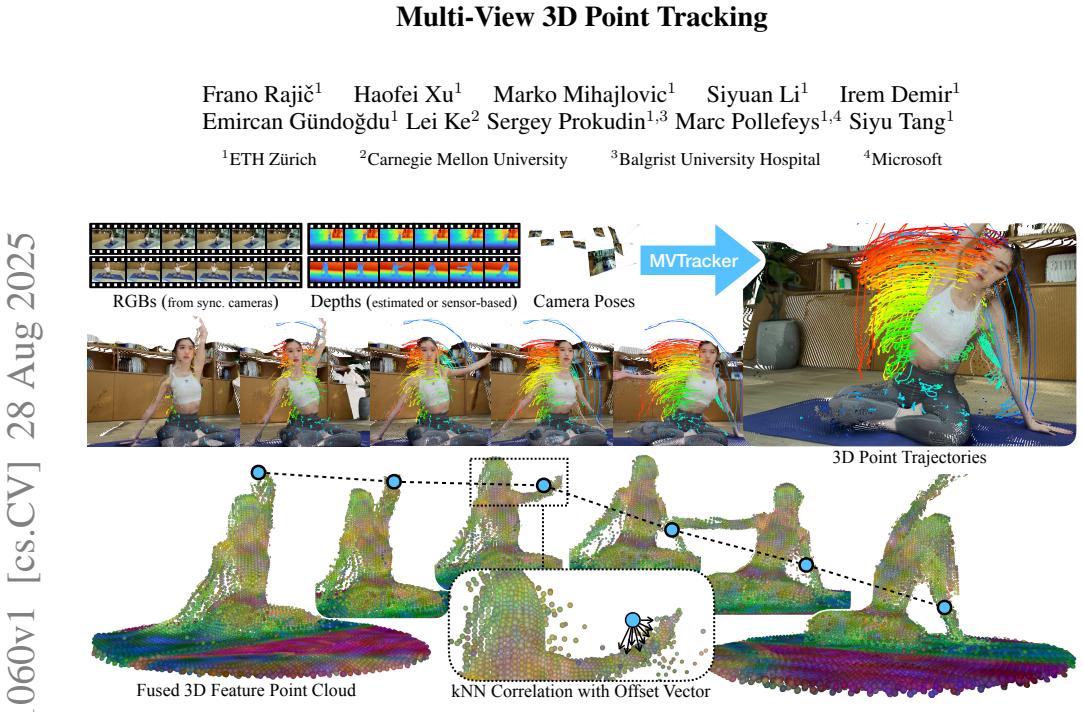
The central object is the fused 3D feature point cloud: every valid pixel from every view is unprojected with its depth and tagged with a learned feature vector, so all cameras contribute to one geometric representation. Correspondence is carried out by directed k-nearest-neighbor correlation: for each tracked point, K neighbors are found at four scales, and each neighbor contributes the dot product of features plus the explicit 3D offset vector from the current position estimate. A spatiotemporal transformer with sliding windows consumes these tokens, iteratively updates the point's 3D position and appearance, and predicts visibility; the offset vector is what gives the matching its directi
What would settle it
The paper's own Table A.1 is a near test case: on Panoptic Studio, switching depth from optimization-based to VGGT-estimated drops Average Jaccard from 86.0 to 47.7, while on DexYCB the drop with DUSt3R depth is smaller. A reader could settle the depth-dependence claim by retraining the tracker with the same estimated-depth augmentation and checking whether the gap closes.
Extended reading notes
Core claim
On its own terms, the paper's discovery is that 3D point tracking can be done as correspondence search inside a dynamically fused multi-view 3D point cloud rather than on 2D grids, triplanes, or per-sequence optimization. Given RGB-D frames from a practical number of calibrated cameras, the model unprojects each depth map into 3D, attaches learned appearance features to the lifted points, and fuses all views into one cloud. For each query point it retrieves the k nearest neighbors at four scales, concatenates feature similarity with the explicit 3D offset to the query's current estimate, and feeds these tokens to a spatiotemporal transformer that iteratively refines position, appearance, and
Load-bearing premise
MVTracker's accuracy stands on per-frame depth maps of reasonable quality being available for every view; when sparse-view depth estimation is misaligned or fails, the paper states that tracking becomes infeasible.
Editorial extensions
If this is right
- Multi-view 3D point tracking no longer requires a 20-plus-camera rig; four views suffice for near-real-time online tracking at 7.2 FPS when sensor depth is available.
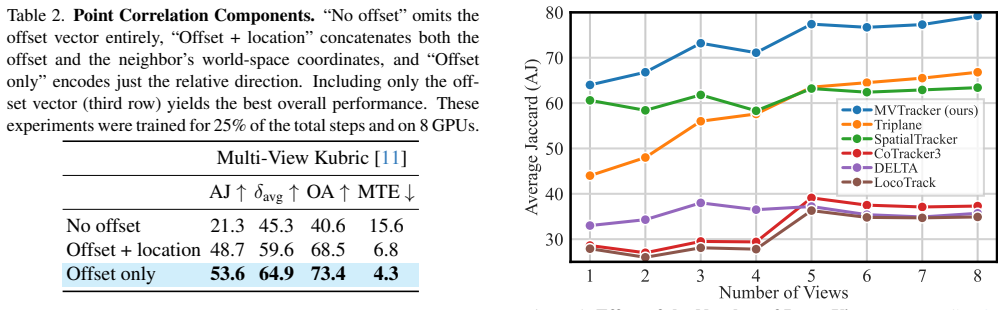
- Performance keeps improving as views are added from one to eight, suggesting the model learns to exploit geometric redundancy instead of relying on a fixed rig.
- The same synthetic-trained model transfers to real hand-object and social scenes, both with estimated depth and with sensor depth.
- The tracker can serve as a feed-forward tracking head for downstream 4D reconstruction and as a data-driven prior for optimization-based reconstruction methods.
- Depth quality is a direct lever: switching from noisy estimated depth to sensor depth improves the method more than it improves prior trackers.
Reading between the lines
- If the fused-cloud plus kNN correlation is as central as the ablations suggest, the same machinery could be dropped into other multi-view tasks such as dense scene flow or joint reconstruction-and-tracking pipelines.
- The sensitivity to depth source points to a testable extension: jointly estimate and refine depth inside the tracker, since the model already propagates appearance features that could serve as photometric constraints.
- The paper's weak results on the TAPVid-2D benchmark hint that scene-scale normalization, not just depth quality, is the main barrier to unbounded outdoor scenes; an editor could test this by training with randomized scene scales and re-evaluating on the same benchmark.
Editorial analysis
A structured set of objections, weighed in public.
Referee Report
Summary. The paper introduces MVTracker, a feed-forward multi-view 3D point tracker. Given synchronized RGB frames from V cameras, known camera poses, and depth maps (sensor-based or estimated), the method unprojects per-view features into a fused 3D feature point cloud, computes multi-scale kNN correlations with explicit 3D offsets, and iteratively refines point trajectories and visibilities with a spatiotemporal transformer over sliding windows. The model is trained on 5K synthetic multi-view Kubric sequences and evaluated on Panoptic Studio, DexYCB, and MV-Kubric, reporting state-of-the-art results: AJ 86.0 / MTE 3.1 cm on Panoptic (with optimization-based ground-truth depth), AJ 71.6 / MTE 2.0 cm on DexYCB (with DUSt3R depth), and AJ 81.4 / MTE 0.7 cm on MV-Kubric. The paper also ablates the correlation module, number of input views, camera setups, depth sources, and training augmentations, and releases code and data.
Significance. If the results hold, MVTracker is a useful practical contribution: it is the first multi-view 3D point tracker that is feed-forward and data-driven, avoiding per-sequence optimization and using a practical number of cameras (e.g., four). The kNN-based correlation in a fused 3D point cloud is a sensible architectural alternative to triplane splatting, and the ablation evidence supports its importance. The paper is commendably transparent about limitations: Section 5 explicitly acknowledges the dependence on sparse-view depth quality, and Appendix F.1 discloses that Panoptic ground-truth labels are noisy and derived from Dynamic 3DGS predictions. However, the flagship Panoptic result uses oracle depth, and with estimated depth the performance drops substantially (Table A.1). The evaluation is therefore not yet sufficient to support the unqualified robustness claims in the abstract and introduction. With clearer framing and additional validation, this could be a strong paper.
major comments (3)
- [§4.1, Table 1 vs Table A.1] The headline Panoptic Studio result (AJ 86.0) is obtained with ground-truth optimization-based depth [23]. With VGGT-estimated depth, AJ drops to 47.7; with DUSt3R depth estimation fails and no result is reported. Section 5 admits the reliance on sparse-view depth quality, yet the abstract and introduction promise 'robust and accurate online tracking' with 'either sensor-based or estimated multi-view depth.' This is a load-bearing qualification of the central claim. Please report the estimated-depth Panoptic numbers in the main table, label the 86.0 result as an oracle-depth upper bound, and temper the abstract accordingly.
- [Appendix F.1 / Table 1] The Panoptic ground-truth trajectories were 'filtered from Dynamic 3DGS 27-view predictions,' and Dynamic 3DGS is itself a comparison baseline in Table 1. This makes the Panoptic comparison partly circular: the method is scored against labels derived from one of the competing methods. The disclosure appears only in the appendix. Please quantify the filtering (retention rate, fraction of labels altered), confirm that the 6 evaluation scenes and 512 query points are independent of the baseline's outputs, and move the caveat to the main evaluation section. If independent validation is not feasible, the Panoptic claims should be downgraded accordingly.
- [§5 / Appendix E] The method depends on a manually or heuristically determined similarity transform for scene normalization at test time, but the sensitivity to this transform is not evaluated. Appendix E shows TAPVid-2D results far below CoTracker3 (best AJ 35.0 with MegaSAM depth vs. 64.1 for CoTracker3), attributed in part to normalization and depth failures. This weakens the stated generalization to 'diverse camera setups' and arbitrary scenes. Please either quantify the dependence on normalization parameters or restrict the generalization claim to the bounded, normalized settings used in the main experiments.
minor comments (5)
- [Eq. (8)] The ground-truth position in the position loss is written as p_t^{n,m,j}, but ground truth should not depend on the refinement iteration m or window j. Please use p_t^n.
- [Abstract / Eq. (F.1)-(F.2)] The paper reports 'median trajectory errors' but the metric is the mean across tracks of per-track median errors. Clarify this wording to avoid ambiguity.
- [Table A.1] The ✗ entry for DUSt3R on Panoptic Studio should be explained operationally: does depth estimation fail entirely, produce unusable geometry, or cause tracking to crash? This is important because it is a central failure mode of the method.
- [§4, Dataset paragraph] The sentence 'All results, unless otherwise stated, are reported assuming... ground-truth optimization-based depth [23] for Panoptic Studio' is easy to miss since it appears only in the experiments section. State this prominently in the abstract or at the first mention of the Panoptic result.
- [Figure 2] The pipeline diagram is dense; the arrows labeled with tensor shapes are difficult to read at normal scale. Consider enlarging the type and simplifying the data-flow annotations.
Circularity Check
No significant circularity; the derivation chain is self-contained.
full rationale
MVTracker's derivation chain is input-to-prediction, not prediction-to-input. The method takes RGB frames, known camera poses, and depth maps; unprojects depth into a fused 3D point cloud (Eq. 1-2); computes kNN correlations in that cloud (Eq. 4); iteratively updates position and appearance features via a transformer (Eq. 5-6); and trains with an L1 position loss plus balanced B-CE visibility loss (Eq. 7-9) on synthetic Kubric. Nothing in these equations defines the predicted trajectory as the input depth or as a fitted parameter renamed as a prediction. Depth is an explicit input assumption, and Section 5 honestly states that tracking is infeasible when sparse-view depth estimation fails; this qualifies the robustness claim but is not circular. The Panoptic Studio ground truth was generated by merging TAPVid-3D labels filtered from Dynamic 3DGS 27-view predictions (Appendix F.1), and Dynamic 3DGS is also a comparison baseline. This is a disclosed benchmark-label-quality issue rather than circularity: MVTracker is trained only on synthetic data, and its outputs are not equal to Dynamic 3DGS predictions by construction. The paper itself warns the Panoptic labels are 'often noisy and erroneous,' which is a noted evaluative caveat, not an equation-level reduction. No load-bearing self-citation chain or imported uniqueness theorem appears; the triplane/SpaTracker comparisons are argued from design properties, not from same-author citations. Therefore no circular step is identified.
Assumptions & free parameters
free parameters (6)
- Similarity transform for scene normalization =
per-scene, heuristically chosen
- Loss weight lambda_vis =
not reported
- Iteration weighting gamma =
not reported
- kNN neighbors K =
not reported
- Scale count S =
4
- Window size T =
12 (training)
assumptions (5)
- domain assumption Known camera intrinsics and extrinsics for all views and frames
- domain assumption Depth maps are available for all views and frames, from sensors or estimators
- domain assumption Synthetic Kubric training transfers to real-world scenes with bounded overlap and similar scale
- domain assumption DUSt3R or VGGT depth estimates are accurate enough to define the fused point cloud
- standard math Standard pinhole camera projection and unprojection model
Cite this review
Pith. "Pith review of Multi-View 3D Point Tracking." pith.science (2026). https://pith.science/paper/HM3DARDC
@misc{pith2026250821060,
  author       = {Pith},
  title        = {Pith review of: Multi-View 3D Point Tracking},
  year         = {2026},
  howpublished = {\url{https://pith.science/paper/HM3DARDC}},
  note         = {Machine review of arXiv:2508.21060}
}
read the original abstract
We introduce the first data-driven multi-view 3D point tracker, designed to track arbitrary points in dynamic scenes using multiple camera views. Unlike existing monocular trackers, which struggle with depth ambiguities and occlusion, or prior multi-camera methods that require over 20 cameras and tedious per-sequence optimization, our feed-forward model directly predicts 3D correspondences using a practical number of cameras (e.g., four), enabling robust and accurate online tracking. Given known camera poses and either sensor-based or estimated multi-view depth, our tracker fuses multi-view features into a unified point cloud and applies k-nearest-neighbors correlation alongside a transformer-based update to reliably estimate long-range 3D correspondences, even under occlusion. We train on 5K synthetic multi-view Kubric sequences and evaluate on two real-world benchmarks: Panoptic Studio and DexYCB, achieving median trajectory errors of 3.1 cm and 2.0 cm, respectively. Our method generalizes well to diverse camera setups of 1-8 views with varying vantage points and video lengths of 24-150 frames. By releasing our tracker alongside training and evaluation datasets, we aim to set a new standard for multi-view 3D tracking research and provide a practical tool for real-world applications. Project page available at https://ethz-vlg.github.io/mvtracker.
Figures

Reference graph
Works this paper leans on
-
[23]
Dynamic 3D Gaussians: Tracking by per- sistent dynamic view synthesis
Jonathon Luiten, Georgios Kopanas, Bastian Leibe, and Deva Ramanan. Dynamic 3D Gaussians: Tracking by per- sistent dynamic view synthesis. In 3DV, 2024. 2, 3, 5, 6, 8, 1, 4
work page 2024
-
[1]
ZoeDepth: Zero-shot trans- fer by combining relative and metric depth
Shariq Farooq Bhat, Reiner Birkl, Diana Wofk, Peter Wonka, and Matthias M ¨uller. ZoeDepth: Zero-shot trans- fer by combining relative and metric depth. arXiv preprint arXiv:2302.12288, 2023. 5
arXiv 2023
-
[2]
Effi- cient geometry-aware 3d generative adversarial networks
Eric R Chan, Connor Z Lin, Matthew A Chan, Koki Nagano, Boxiao Pan, Shalini De Mello, Orazio Gallo, Leonidas J Guibas, Jonathan Tremblay, Sameh Khamis, et al. Effi- cient geometry-aware 3d generative adversarial networks. In CVPR, 2022. 2
work page 2022
-
[3]
Narang, Karl Van Wyk, Umar Iqbal, Stan Birchfield, Jan Kautz, and Dieter Fox
Yu-Wei Chao, Wei Yang, Yu Xiang, Pavlo Molchanov, Ankur Handa, Jonathan Tremblay, Yashraj S. Narang, Karl Van Wyk, Umar Iqbal, Stan Birchfield, Jan Kautz, and Dieter Fox. DexYCB: A benchmark for capturing hand grasping of objects. In CVPR, 2021. 2, 5, 6, 7, 8, 3
work page 2021
-
[4]
Easi3R: Estimating disentangled motion from dust3r without training
Xingyu Chen, Yue Chen, Yuliang Xiu, Andreas Geiger, and Anpei Chen. Easi3R: Estimating disentangled motion from dust3r without training. In ICCV, 2025. 1
work page 2025
-
[5]
Local all-pair correspon- dence for point tracking
Seokju Cho, Jiahui Huang, Jisu Nam, Honggyu An, Seun- gryong Kim, and Joon-Young Lee. Local all-pair correspon- dence for point tracking. In ECCV, 2024. 2, 3, 4, 5, 6, 8
work page 2024
-
[6]
Dream- Scene4D: Dynamic multi-object scene generation from monocular videos
Wen-Hsuan Chu, Lei Ke, and Katerina Fragkiadaki. Dream- Scene4D: Dynamic multi-object scene generation from monocular videos. In NeurIPS, 2024. 3
work page 2024
-
[7]
TAP-Vid: A benchmark for track- ing any point in a video
Carl Doersch, Ankush Gupta, Larisa Markeeva, Adria Re- casens, Lucas Smaira, Yusuf Aytar, Joao Carreira, Andrew Zisserman, and Yi Yang. TAP-Vid: A benchmark for track- ing any point in a video. In NeurIPS, 2022. 2, 3, 4, 5
work page 2022
Show all 47 references
-
[8]
Tapir: Tracking any point with per-frame initialization and temporal refinement
Carl Doersch, Yi Yang, Mel Vecerik, Dilara Gokay, Ankush Gupta, Yusuf Aytar, Joao Carreira, and Andrew Zisserman. Tapir: Tracking any point with per-frame initialization and temporal refinement. ICCV, 2023. 3, 4
2023
-
[9]
BootsTAP: Bootstrapped training for tracking-any-point
Carl Doersch, Pauline Luc, Yi Yang, Dilara Gokay, Skanda Koppula, Ankush Gupta, Joseph Heyward, Ignacio Rocco, Ross Goroshin, Jo˜ao Carreira, et al. BootsTAP: Bootstrapped training for tracking-any-point. In ACCV, 2024. 2, 8
2024
-
[10]
RH20T: A robotic dataset for learning diverse skills in one-shot
Hao-Shu Fang, Hongjie Fang, Zhenyu Tang, Jirong Liu, Junbo Wang, Haoyi Zhu, and Cewu Lu. RH20T: A robotic dataset for learning diverse skills in one-shot. In RSS 2023 Workshop on Learning for Task and Motion Planning, 2023. 1
2023
-
[11]
Kubric: A scalable dataset generator
Klaus Greff, Francois Belletti, Lucas Beyer, Carl Doersch, Yilun Du, Daniel Duckworth, David J Fleet, Dan Gnanapra- gasam, Florian Golemo, Charles Herrmann, et al. Kubric: A scalable dataset generator. In CVPR, 2022. 2, 5, 6, 7, 3
2022
-
[12]
Particle video revisited: Tracking through occlusions using point trajectories
Adam W Harley, Zhaoyuan Fang, and Katerina Fragkiadaki. Particle video revisited: Tracking through occlusions using point trajectories. In ECCV, 2022. 2, 3, 4
2022
-
[13]
Adam W. Harley, Yang You, Xinglong Sun, Yang Zheng, Nikhil Raghuraman, Yunqi Gu, Sheldon Liang, Wen-Hsuan Chu, Achal Dave, Pavel Tokmakov, Suya You, Rares Am- brus, Katerina Fragkiadaki, and Leonidas J. Guibas. All- Tracker: Efficient dense point tracking at high resolution. I...
2025
-
[14]
Stereo4D: Learning how things move in 3d from internet stereo videos
Linyi Jin, Richard Tucker, Zhengqi Li, David Fouhey, Noah Snavely, and Aleksander Holynski. Stereo4D: Learning how things move in 3d from internet stereo videos. In CVPR,
-
[15]
Panoptic studio: A massively multiview system for social motion capture
Hanbyul Joo, Hao Liu, Lei Tan, Lin Gui, Bart Nabbe, Iain Matthews, Takeo Kanade, Shohei Nobuhara, and Yaser Sheikh. Panoptic studio: A massively multiview system for social motion capture. In ICCV, 2015. 2
2015
-
[16]
Co- Tracker: It is better to track together
Nikita Karaev, Ignacio Rocco, Benjamin Graham, Natalia Neverova, Andrea Vedaldi, and Christian Rupprecht. Co- Tracker: It is better to track together. In ECCV, 2023. 2, 3, 4, 5, 6, 8, 1
2023
-
[17]
Co- Tracker3: Simpler and better point tracking by pseudo- labelling real videos
Nikita Karaev, Iurii Makarov, Jianyuan Wang, Natalia Neverova, Andrea Vedaldi, and Christian Rupprecht. Co- Tracker3: Simpler and better point tracking by pseudo- labelling real videos. In ICCV, 2025. 2, 3, 4, 5, 6, 8, 1
2025
-
[18]
TAPVid-3D: A benchmark for tracking any point in 3d
Skanda Koppula, Ignacio Rocco, Yi Yang, Joe Heyward, Jo˜ao Carreira, Andrew Zisserman, Gabriel Brostow, and Carl Doersch. TAPVid-3D: A benchmark for tracking any point in 3d. In NeurIPS, 2024. 2, 5, 6, 8, 1, 3, 4
2024
-
[19]
MoSca: Dynamic gaussian fusion from casual videos via 4d motion scaffolds
Jiahui Lei, Yijia Weng, Adam Harley, Leonidas Guibas, and Kostas Daniilidis. MoSca: Dynamic gaussian fusion from casual videos via 4d motion scaffolds. In CVPR, 2024. 8
2024
-
[20]
MegaSaM: Accurate, fast and robust structure and motion from casual dynamic videos
Zhengqi Li, Richard Tucker, Forrester Cole, Qianqian Wang, Linyi Jin, Vickie Ye, Angjoo Kanazawa, Aleksander Holyn- ski, and Noah Snavely. MegaSaM: Accurate, fast and robust structure and motion from casual dynamic videos. In CVPR,
-
[21]
CamLiFlow: bidirectional camera-lidar fusion for joint optical flow and scene flow estimation
Haisong Liu, Tao Lu, Yihui Xu, Jia Liu, Wenjie Li, and Li- jun Chen. CamLiFlow: bidirectional camera-lidar fusion for joint optical flow and scene flow estimation. InCVPR, 2022. 2
2022
-
[22]
Decoupled weight decay regularization
Ilya Loshchilov and Frank Hutter. Decoupled weight decay regularization. In ICLR, 2019. 5
2019
-
[24]
DELTA: Dense efficient long-range 3d tracking for any video
Tuan Duc Ngo, Peiye Zhuang, Chuang Gan, Evange- los Kalogerakis, Sergey Tulyakov, Hsin-Ying Lee, and Chaoyang Wang. DELTA: Dense efficient long-range 3d tracking for any video. In ICLR, 2024. 2, 3, 4, 5, 6, 8, 1
2024
-
[25]
Aria digital twin: A new benchmark dataset for egocentric 3d machine perception
Xiaqing Pan, Nicholas Charron, Yongqian Yang, Scott Pe- ters, Thomas Whelan, Chen Kong, Omkar Parkhi, Richard Newcombe, and Yuheng Carl Ren. Aria digital twin: A new benchmark dataset for egocentric 3d machine perception. In ICCV, 2023. 2
2023
-
[26]
Dense wide-baseline scene flow from two handheld video cameras
Christian Richardt, Hyeongwoo Kim, Levi Valgaerts, and Christian Theobalt. Dense wide-baseline scene flow from two handheld video cameras. In 3DV, 2016. 2
2016
-
[27]
DynOMo: Online point tracking by dynamic online monocular gaussian recon- struction
Jenny Seidenschwarz, Qunjie Zhou, Bardienus Duisterhof, Deva Ramanan, and Laura Leal-Taix ´e. DynOMo: Online point tracking by dynamic online monocular gaussian recon- struction. In 3DV, 2025. 3
2025
-
[28]
RAFT-3D: Scene flow using rigid-motion embeddings
Zachary Teed and Jia Deng. RAFT-3D: Scene flow using rigid-motion embeddings. In CVPR, 2021. 2
2021
-
[29]
RoboTAP: Tracking arbitrary points for few-shot visual imitation
Mel Vecerik, Carl Doersch, Yi Yang, Todor Davchev, Yusuf Aytar, Guangyao Zhou, Raia Hadsell, Lourdes Agapito, and 9 Jon Scholz. RoboTAP: Tracking arbitrary points for few-shot visual imitation. In ICRA, 2024. 8
2024
-
[30]
Three-dimensional scene flow
Sundar Vedula, Simon Baker, Peter Rander, Robert Collins, and Takeo Kanade. Three-dimensional scene flow. In ICCV,
-
[31]
3d scene flow estimation with a rigid motion prior
Christoph V ogel, Konrad Schindler, and Stefan Roth. 3d scene flow estimation with a rigid motion prior. In ICCV,
-
[32]
SceneTracker: Long-term scene flow estimation network
Bo Wang, Jian Li, Yang Yu, Li Liu, Zhenping Sun, and Dewen Hu. SceneTracker: Long-term scene flow estimation network. IEEE TPAMI, 2025. 6, 1
2025
-
[33]
VGGT: Visual geometry grounded transformer
Jianyuan Wang, Minghao Chen, Nikita Karaev, Andrea Vedaldi, Christian Rupprecht, and David Novotny. VGGT: Visual geometry grounded transformer. In CVPR, 2025. 2, 3
2025
-
[34]
Tracking everything everywhere all at once
Qianqian Wang, Yen-Yu Chang, Ruojin Cai, Zhengqi Li, Bharath Hariharan, Aleksander Holynski, and Noah Snavely. Tracking everything everywhere all at once. In ICCV, 2023. 2
2023
-
[35]
Shape of Mo- tion: 4d reconstruction from a single video
Qianqian Wang, Vickie Ye, Hang Gao, Weijia Zeng, Jake Austin, Zhengqi Li, and Angjoo Kanazawa. Shape of Mo- tion: 4d reconstruction from a single video. In ICCV, 2025. 2, 3, 5, 6, 8, 1, 4
2025
-
[36]
MoGe: Unlocking accurate monocular geometry estimation for open-domain images with optimal training supervision
Ruicheng Wang, Sicheng Xu, Cassie Dai, Jianfeng Xiang, Yu Deng, Xin Tong, and Jiaolong Yang. MoGe: Unlocking accurate monocular geometry estimation for open-domain images with optimal training supervision. In CVPR, 2025. 5
2025
-
[37]
DUSt3R: Geometric 3d vision made easy
Shuzhe Wang, Vincent Leroy, Yohann Cabon, Boris Chidlovskii, and Jerome Revaud. DUSt3R: Geometric 3d vision made easy. In CVPR, 2024. 1, 2, 3, 4, 5, 6
2024
-
[38]
SpatialTracker: Tracking any 2d pixels in 3d space
Yuxi Xiao, Qianqian Wang, Shangzhan Zhang, Nan Xue, Sida Peng, Yujun Shen, and Xiaowei Zhou. SpatialTracker: Tracking any 2d pixels in 3d space. In CVPR, 2024. 2, 3, 4, 5, 6, 8, 1
2024
-
[39]
SpatialTrackerV2: 3d point tracking made easy
Yuxi Xiao, Jianyuan Wang, Nan Xue, Nikita Karaev, Yuri Makarov, Bingyi Kang, Xing Zhu, Hujun Bao, Yujun Shen, and Xiaowei Zhou. SpatialTrackerV2: 3d point tracking made easy. In ICCV, 2025. 2, 5, 6
2025
-
[40]
Representing long volu- metric video with temporal gaussian hierarchy
Zhen Xu, Yinghao Xu, Zhiyuan Yu, Sida Peng, Jiaming Sun, Hujun Bao, and Xiaowei Zhou. Representing long volu- metric video with temporal gaussian hierarchy. ACM TOG,
-
[41]
Upgrading optical flow to 3d scene flow through optical expansion
Gengshan Yang and Deva Ramanan. Upgrading optical flow to 3d scene flow through optical expansion. In CVPR, 2020. 2
2020
-
[42]
VideoDoodles: Hand-drawn animations on videos with scene-aware canvases
Emilie Yu, Kevin Blackburn-Matzen, Cuong Nguyen, Oliver Wang, Rubaiat Habib Kazi, and Adrien Bousseau. VideoDoodles: Hand-drawn animations on videos with scene-aware canvases. ACM TOG, 2023. 2, 3
2023
-
[43]
TAPIP3D: Tracking any point in persistent 3d geom- etry
Bowei Zhang, Lei Ke, Adam W Harley, and Katerina Fragki- adaki. TAPIP3D: Tracking any point in persistent 3d geom- etry. In ICCV, 2025. 2, 5, 6
2025
-
[44]
GSTAR: Gaussian surface tracking and reconstruction
Chengwei Zheng, Lixin Xue, Juan Zarate, and Jie Song. GSTAR: Gaussian surface tracking and reconstruction. In CVPR, 2025. 2
2025
-
[45]
Harley, Bokui Shen, Gordon Wet- zstein, and Leonidas J
Yang Zheng, Adam W. Harley, Bokui Shen, Gordon Wet- zstein, and Leonidas J. Guibas. Pointodyssey: A large-scale synthetic dataset for long-term point tracking. In ICCV,
-
[47]
The results reveal that combining both variable view and depth augmentations leads to the best performance, especially as measured on DexYCB
and (D) varying the source of depth maps (ground-truth versus off-the-shelf depth estimation). The results reveal that combining both variable view and depth augmentations leads to the best performance, especially as measured on DexYCB. We apply a range of augmentations to imp...
-
[2023]
Depth Estimation Analysis Robustness to depth quality
2 10 Multi-View 3D Point Tracking Supplementary Material A. Depth Estimation Analysis Robustness to depth quality. Our method is designed to be tolerant of moderate noise in estimated depth. As shown in Fig. A.1, tracking performance remains stable under ad- ditive Gaussian no...
Reviewed August 5, 2026 · model on record in the stance chip above.
Discussion (0). Continue with ORCID to comment.