REVIEW 3 major objections 4 minor 2 cited by
Anyon polarons as a window into the competing phases of the Kitaev-Gamma-Gamma' model
T0 review · 3 major / 4 minor · reviewed 2026-08-05 · deepseek-v4-flash
Pith's one-line read The antiferromagnetic Kitaev-Gamma model at Γ < 0 may host a magnetically ordered quantum spin liquid: bosonic vison pairs condense while single visons stay gapped, leaving the Kitaev anyon content intact.
desk verdict A credible anyon gap-closing study that reproduces several known phases and predicts a magnetically ordered Kitaev QSL, but the coexistence claim sits in an uncontrolled perturbative regime with a hand-set prefactor. read the letter →
The pith
A machine-rendered reading of the paper's core claim, the machinery that carries it, and where it could break.
The reading
What carries the argument
The central object is the bosonic vison pair—two neighboring flux excitations bound into a local boson that a single Pauli operator can create or annihilate, making it a generalized magnon. Since it has trivial mutual statistics with every other quasiparticle, its condensation breaks symmetry without confining anyons; the single vison, by contrast, is a non-local boson whose condensation confines them. The argument turns on the ordering of these gaps: the paper computes the Γ- and Γ'-induced hoppings of each quasiparticle type and shows that in the AFM Kitaev model the Γ-induced single-vison hopping vanishes to first and second order, so the bosonic pair gap closes before the vison gap. The
What would settle it
Compute the AFM K-Γ ground state at Γ ≈ −0.4|K|, Γ' = 0 with DMRG on cylinders or variational Monte Carlo, and measure the topological entanglement entropy or torus ground-state degeneracy: the coexistence claim holds only if the stripy/IC magnetic order appears together with topological degeneracy (or topological entanglement entropy near ln 2); if order sets in with no topological signature—or no order appears at all—the claim is falsified.
Extended reading notes
Core claim
The paper claims that the phase diagram of the K-Γ-Γ' model can be read from gap-closing instabilities of the Kitaev spin liquid's anyons, and that one regime yields a state that is simultaneously ordered and fractionalized. In the antiferromagnetic Kitaev model (K > 0) with Γ < 0, a magnon-like local boson—a bound pair of visons creatable by local spin operators—condenses around Γ ≈ −0.4|K|, driving stripy or incommensurate spiral magnetic order. The single vison, whose condensation would confine other anyons, stays gapped: Γ-induced vison hopping vanishes at first and second order in the AFM model, and the third-order vison chemical potential favors visons only for Γ > 0. The resulting sta
Load-bearing premise
The phase diagram is computed to leading order in Γ and Γ' even though the predicted boson condensation occurs at |Γ| ≈ 0.3–0.5|K|, where the expansion is not small; if higher-order processes change which quasiparticle gap closes first, the coexistence phase disappears.
Editorial extensions
If this is right
- The AFM K-Γ model with Γ ≲ −0.4|K| is conjectured to be a quantum spin liquid retaining the KSL's anyon content while exhibiting stripy or incommensurate spiral order.
- The fragility of the FM Kitaev KSL under Γ is explained microscopically: strong Γ-induced vison hopping closes the single-vison gap near Γ ≈ 0.035, signalling confinement and the onset of conventional order.
- Bosonic vison-pair condensation at the M point yields the zigzag order observed in Kitaev materials, with an induced moment tilted roughly 45° from the honeycomb plane.
- A softened NNN vison-pair mode at the Γ point carrying orbital angular momentum l = ±1 accounts for the nematic paramagnetic phase reported for the FM model at Γ > 0.
- The dynamical spin structure factor computed from bosonic vison pairs shows magnon-like low-energy dispersions coexisting with broad high-energy continua, a signature to be sought in scattering experiments near the transitions.
Reading between the lines
- If the predicted phase exists, its incommensurate spiral magnetic moment should be strictly gapless while the Majorana spinons remain gapless Dirac fermions, so the low-temperature specific heat could combine a T-linear spinon contribution with a spiral-magnon contribution—a distinctive thermodynamic fingerprint worth computing.
- The same gap-ordering logic suggests that any perturbation of the AFM Kitaev model which preserves the exact vanishing of single-vison mobility while lowering the bosonic pair gap should generate the same ordered-but-fractionalized phase; bond anisotropies or strain are natural candidates.
- The conjecture sharpens the target for numerics: the Γ > 0 FMU6 corner should be a trivial confined magnet (no topological entanglement), whereas the Γ < 0 stripy/IC corner is where topological order, if it survives, should be looked for.
Editorial analysis
A structured set of objections, weighed in public.
Referee Report
Summary. The paper studies the Kitaev-Gamma-Gamma' (K-Γ-Γ') honeycomb model starting from the exactly solvable Kitaev spin liquid. Treating Γ and Γ' to leading order in perturbation theory, the authors compute dispersions of single visons, fermionic vison pairs, and bosonic vison pairs, and use their gap closings to map out phase boundaries into zigzag, stripy, 120°, FMU6, AFMU6, and incommensurate spiral phases. The central new claim is that in the antiferromagnetic Kitaev model with Γ<0, bosonic vison pairs condense at |Γ|≈0.3–0.5|K| while single visons remain gapped, so that the resulting magnetically ordered state retains the anyon content of the Kitaev spin liquid. The paper argues the order is likely stripy or incommensurate spiral depending on the sign of Γ'. This claim is presented as a conjecture in Sec. V but also as the main result of the paper.
Significance. If correct, the predicted phase—a magnetically ordered quantum spin liquid with coexisting spontaneous symmetry breaking and fractionalization—would be a striking and important addition to the physics of Kitaev materials. The framework itself is valuable: the authors systematically compute single-vison, fermionic-vison-pair, and bosonic-vison-pair dispersions with finite-size scaling, reproduce several known magnetic orders and approximate critical couplings, correctly capture the projective translational symmetry of visons in the AFM Kitaev model, and compute dynamical structure factors from bosonic vison pairs. These are genuine strengths. However, the central coexistence claim rests on low-order perturbation theory applied at couplings where the expansion parameter is not small, and the paper itself identifies missing higher-order processes that could alter the relevant gap orderings. The result is therefore a plausible conjecture rather than an established finding in its current form.
major comments (3)
- [Sec. IV A and SM S-I.B; Fig. 7(b)] The claim that single visons remain gapped at Γ≈−0.4 requires that no Γ-induced single-vison hopping appears through third or higher order and that the third-order chemical potential has the correct sign and magnitude. The paper computes vanishing first- and second-order hopping (Sec. II A, SM S-I.B), but it does not compute third-order hopping. Using ΔE≈0.23|K| from SM S-I.B, Γ^3/ΔE^2≈1.2|K| at Γ=−0.4, so a third-order hopping amplitude of only ~0.1|K| could close the single-vison gap Δv≈0.15|K|. The only third-order term actually computed is the chemical potential in Eq. (S11), and its prefactor is manually set to −0.3 for the gray dashed line in Fig. 7(b), with the authors acknowledging it is likely overestimated. This is load-bearing: the coexistence phase disappears if third-order hopping closes the single-vison gap first. A bound or explicit computation of the missing term is neede
- [Secs. III A and IV A; Fig. 6(e)–(h)] The soft-boson momentum and mode ordering in the coexistence window (IC vs M, and whether another mode softens first) is obtained from linear-order boson Hamiltonians restricted to single Bogoliubov excitations of NN and NNN vison pairs. The authors themselves state in Sec. III A that including two-c-fermion excitations for NNN vison pairs, or higher-order hopping, may be needed to capture the correct energetics (e.g., to obtain AFMU6 order), and in Sec. III B that such refinements are needed to make the M mode the softest for zigzag in the FM Kitaev model. At Γ≈−0.4 the coupling is not small, so there is no demonstrated control over which mode softens first. Since the predicted magnetic order and the existence of the magnetically ordered QSL depend on this ordering, the central claim needs a systematic second-order or subspace-convergence check.
- [Sec. II and Fig. 7; Eq. (1)] The phase diagram is drawn from leading-order perturbation theory in Γ and Γ′, but the central coexistence region is at |Γ|≈0.3–0.5|K|, where the expansion parameter is not small; for example Γ^3/ΔE^2≈1.2 at Γ=−0.4. No estimate of omitted higher-order corrections is given for the quantities that determine the phase boundaries—single-vison hopping, fermion gap, and boson mode energies. The agreement with numerics on other phase boundaries is encouraging, but the new phase is not supported by direct numerical evidence; the cited ladder DMRG (Ref. [46]) sees a first-order stripy–IC transition in the analogous regime. The authors should either extend the calculation to the relevant order for the gap orderings or explicitly frame the coexistence claim as a conjecture whose validity depends on uncontrolled approximations.
minor comments (4)
- [Abstract] Typo: “an ferromagnetic Γ interaction” should be “a ferromagnetic Γ interaction.”
- [Throughout] Several typos: “Crutially” (Sec. II A), “morevoer” (Sec. IV A), “Kitev” (Sec. IV A), “tranform” (Sec. VI B), “numeber” (Eq. (10) vicinity). A careful proofreading pass is needed.
- [References] Ref. [31] appears to be a duplicate of Ref. [13] (same arXiv:2501.05608, same title/authors). Please remove or replace.
- [Fig. 7(b) caption and Sec. IV A] The gray dashed line in Fig. 7(b) is based on a third-order chemical potential with a prefactor of −0.3 chosen by hand, as acknowledged in SM S-I.B. This should be stated clearly in the main text near the figure, not only in the Supplemental Material, since the line is used to support the coexistence claim.
Circularity Check
No significant circularity — gap-closing boundaries are computed from Γ/Γ′ matrix elements, not fitted; the acknowledged hand-tuned prefactor in SM S-I.B is auxiliary and does not control the central Γ<0 deconfinement claim.
full rationale
The paper's derivation chain is not circular in any load-bearing sense. It starts from the exactly solvable Kitaev limit and computes from the Γ/Γ′ interaction matrix elements the effective Hamiltonians for single visons, fermions, and bosonic vison pairs; the gap-closing boundaries in Fig. 7 are outputs of these calculations, not inputs. In particular, the central AFM Γ<0 claim that single visons remain gapped while bosonic vison pairs condense rests on the separately computed vanishing of Γ-induced single-vison hopping at first and second order, and on the sign of the third-order chemical potential term (which disfavors visons for Γ<0). The prefactor −0.3 in Supplemental S-I.B is explicitly stated to be an overestimate/uncertain and is used only for the schematic gray dashed Γ>0 confinement line; its magnitude does not affect the sign-based Γ<0 conclusion. The self-citations ([37,38,41,52]) provide the numerical technique for extracting vison hopping, but the hopping amplitudes and gap orderings are recomputed here and cross-checked against external numerics ([14,21,46,49,61]); no central premise is justified solely by a self-citation chain. The acknowledged omissions (two-c-fermion excitations for NNN vison pairs, higher-order hopping processes) are stated limitations of the leading-order expansion, and the paper's own admission that no direct numerical evidence exists for the proposed QSL is a caveat on confidence, not a reduction of the prediction to its inputs. The derivation is self-contained in the sense required for a circularity assessment.
Assumptions & free parameters
free parameters (1)
- third-order vison chemical-potential prefactor =
-0.3
assumptions (5)
- domain assumption The KSL has three quasiparticle types with known gaps: single vison Δv ≈ 0.15|K|, fermionic vison pair Δχ ≈ 0.26|K|, NNN bosonic pair Δo ≈ 0.24|K|.
- ad hoc to paper Leading-order perturbation theory in Γ and Γ' suffices to determine which anyon gap closes first and at which momentum.
- domain assumption Condensation of a local boson with trivial statistics leaves the anyon content unchanged as long as single visons stay gapped.
- ad hoc to paper The bosonic vison-pair subspace (single d and o pairs with one Bogoliubov excitation) captures the softest magnetic modes.
- domain assumption The κ→0 extrapolation with vison separation greater than ξ_c yields the true thermodynamic-limit hopping amplitudes.
Cite this review
Pith. "Pith review of Anyon polarons as a window into the competing phases of the Kitaev-Gamma-Gamma' model." pith.science (2026). https://pith.science/paper/QXZWBZPU
@misc{pith2026250821129,
  author       = {Pith},
  title        = {Pith review of: Anyon polarons as a window into the competing phases of the Kitaev-Gamma-Gamma' model},
  year         = {2026},
  howpublished = {\url{https://pith.science/paper/QXZWBZPU}},
  note         = {Machine review of arXiv:2508.21129}
}
abstract
We investigate the dispersions of anyon quasi-particles in the Kitaev honeycomb spin-liquid perturbed by $\Gamma$ and $\Gamma'$ couplings in order to understand phase transitions into competing states through anyon gap-closing instabilities. We demonstrate how anyon gap closings allow to understand phase transitions into a plethora of previously identified competing phases -- including zigzag, stripy, $120^\circ$, and incommensurate spiral phases -- and are in agreement with numerical studies not only on the nature of the phases, but also on the specific critical values of $\Gamma$ and $\Gamma'$ couplings. Remarkably, when the anti-ferromagnetic Kitaev model is perturbed by an ferromagnetic $\Gamma$ interaction, we find that the single-vison and fermion gaps remain open while the gap of a magnon-like local boson vanishes, implying that the resulting state has coexistence of a spontaneous broken symmetry and the fractionalization pattern of the Kitaev spin liquid. The magnetic long-range order could be either a stripy antiferromagnet or an incommensurate spiral, depending on the sign of $\Gamma'$.
Figures


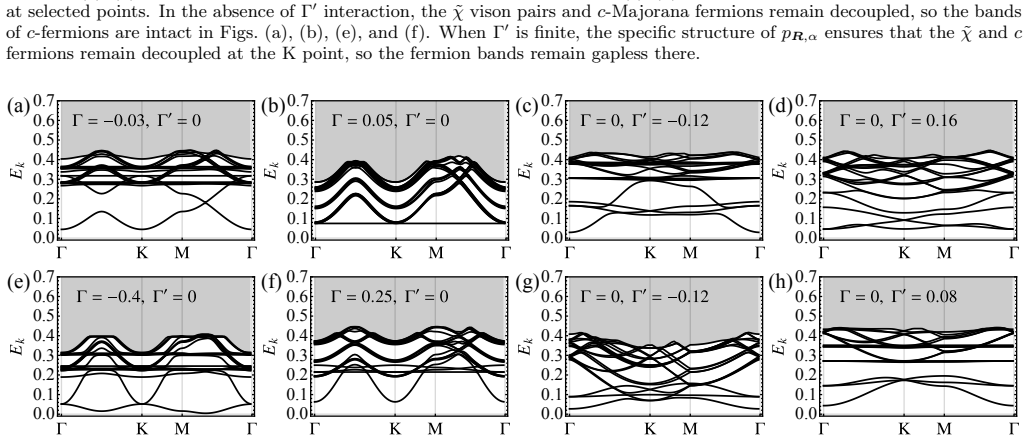
Figures from the paper (6 more)



Forward citations
Cited by 2 Pith papers
-
Evidence for Deconfined Magnetic Order in the Kitaev-$J_3$ Model
The Kitaev-J3 model hosts deconfined magnetic phases in which zigzag or antiferromagnetic order coexists with remnant Z2 topological structure inherited from the Kitaev spin liquid through vison-pair condensation.
-
Dynamical Response of the Kitaev Spin Liquid under Third-Nearest-Neighbor Heisenberg Interaction
J3 induces soft paramagnon modes coexisting with a Majorana continuum; they condense at a common critical |J3| for FM and AFM Kitaev models related by T4 duality, while Raman response separates matter-fermion and viso...
Reference graph
Works this paper leans on
-
[46]
E. S. Sørensen, A. Catuneanu, J. S. Gordon, and H.-Y. Kee, Heart of entanglement: Chiral, nematic, and incom- mensurate phases in the kitaev-gamma ladder in a field, Phys. Rev. X11, 011013 (2021)
work page 2021
-
[1]
X.-G. Wen,Quantum field theory of many-body systems: From the origin of sound to an origin of light and elec- trons (Oxford university press, 2004)
work page 2004
-
[2]
Fradkin,Field Theories of Condensed Matter Physics, 2nd ed
E. Fradkin,Field Theories of Condensed Matter Physics, 2nd ed. (Cambridge University Press, 2013)
2013
-
[3]
Balents, Spin liquids in frustrated magnets, Nature 464, 199 (2010)
L. Balents, Spin liquids in frustrated magnets, Nature 464, 199 (2010)
2010
-
[4]
C. Broholm, R. J. Cava, S. A. Kivelson, D. G. Nocera, M. R. Norman, and T. Senthil, Quantum spin liquids, Science 367, 10.1126/science.aay0668 (2020)
-
[5]
D. S. Rokhsar and S. A. Kivelson, Superconductivity and the quantum hard-core dimer gas, Phys. Rev. Lett.61, 2376 (1988)
1988
-
[6]
Moessner and S
R. Moessner and S. L. Sondhi, Resonating valence bond phase in the triangular lattice quantum dimer model, Phys. Rev. Lett.86, 1881 (2001)
2001
-
[7]
A. Y. Kitaev, Fault-tolerant quantum computation by anyons, Ann. Phys. (N. Y.)303, 2 (2003)
work page 2003
Show all 67 references
-
[8]
M. A. Levin and X.-G. Wen, String-net condensation: A physical mechanism for topological phases, Phys. Rev. B 71, 045110 (2005)
2005
-
[9]
Kitaev, Anyons in an exactly solved model and be- yond, Ann
A. Kitaev, Anyons in an exactly solved model and be- yond, Ann. Phys. (N. Y.)321, 2 (2006)
2006
-
[10]
Jackeli and G
G. Jackeli and G. Khaliullin, Mott insulators in the strong spin-orbit coupling limit: from heisenberg to a quantum compass and kitaev models, Phys. Rev. Lett. 102, 017205 (2009)
2009
-
[11]
Trebst and C
S. Trebst and C. Hickey, Kitaev materials, Phys. Rep. 950, 1 (2022)
2022
-
[12]
Takagi, T
H. Takagi, T. Takayama, G. Jackeli, G. Khaliullin, and S. E. Nagler, Concept and realization of kitaev quantum spin liquids, Nature Reviews Physics1, 264 (2019)
2019
-
[14]
J. G. Rau, E. K.-H. Lee, and H.-Y. Kee, Generic spin model for the honeycomb iridates beyond the kitaev limit, Phys. Rev. Lett.112, 077204 (2014)
2014
-
[15]
J. G. Rau and H.-Y. Kee, Trigonal distortion in the honeycomb iridates: Proximity of zigzag and spiral phases in Na2IrO3, arXiv [cond-mat.str-el] (2014), arXiv:1408.4811
2014 arXiv
-
[16]
J. G. Rau, E. K.-H. Lee, and H.-Y. Kee, Spin-orbit physics giving rise to novel phases in correlated systems: Iridatesandrelatedmaterials,Annu.Rev.Condens.Mat- ter Phys. 7, 195 (2016)
2016
-
[17]
Z. Zhu, I. Kimchi, D. N. Sheng, and L. Fu, Robust non- abelian spin liquid and a possible intermediate phase in the antiferromagnetic kitaev model with magnetic field, Phys. Rev. B.97, 241110 (2018)
2018
-
[18]
Gohlke, R
M. Gohlke, R. Moessner, and F. Pollmann, Dynamical and topological properties of the kitaev model in a [111] magnetic field, Phys. Rev. B Condens. Matter98, 014418 (2018)
2018
-
[19]
Hickey and S
C. Hickey and S. Trebst, Emergence of a field-driven U(1) spin liquid in the kitaev honeycomb model, Nat. Com- mun. 10, 530 (2019)
2019
-
[20]
J. S. Gordon, A. Catuneanu, E. S. Sørensen, and H.-Y. Kee, Theory of the field-revealed kitaev spin liquid, Nat. Commun. 10, 2470 (2019)
2019
-
[21]
Kawashima, and Y
H.-Y.Lee, R.Kaneko, L.E.Chern, T.Okubo, Y.Yamaji, N. Kawashima, and Y. B. Kim, Magnetic field induced quantum phases in a tensor network study of kitaev mag- nets, Nat. Commun.11, 1639 (2020)
2020
-
[22]
Li, H.-K
H. Li, H.-K. Zhang, J. Wang, H.-Q. Wu, Y. Gao, D.-W. Qu, Z.-X. Liu, S.-S. Gong, and W. Li, Identification of magnetic interactions and high-field quantum spin liquid in α-RuCl3, Nat. Commun.12, 4007 (2021)
2021
-
[23]
P. A. Maksimov and A. L. Chernyshev, Rethinkingα- RuCl3, Phys. Rev. Research2, 033011 (2020)
2020
-
[24]
Jiefu and K
C. Jiefu and K. Hae-Young, Intermediate phases in α-RuCl3 under in-plane magnetic field via inter- layer spin interactions, arXiv [cond-mat.str-el] (2025), arXiv:2504.11458
2025 arXiv
-
[25]
Möller, P
M. Möller, P. A. Maksimov, S. Jiang, S. R. White, R. Valenti, and A. L. Chernyshev, The saga ofα-RuCl3: Parameters, models, and phase diagrams, arXiv [cond- mat.str-el] (2025), arXiv:2502.08698
2025 arXiv
-
[26]
Kasahara, T
Y. Kasahara, T. Ohnishi, Y. Mizukami, O. Tanaka, S. Ma, K. Sugii, N. Kurita, H. Tanaka, J. Nasu, Y. Mo- tome, T. Shibauchi, and Y. Matsuda, Majorana quanti- zation and half-integer thermal quantum hall effect in a kitaev spin liquid, Nature559, 227 (2018), 1805.05022
2018 arXiv
-
[27]
Kurita, H
T.Yokoi, S.Ma, Y.Kasahara, S.Kasahara, T.Shibauchi, N. Kurita, H. Tanaka, J. Nasu, Y. Motome, C. Hickey, S. Trebst, and Y. Matsuda, Half-integer quantized anomalous thermal hall effect in the kitaev material can- didate α-RuCl3, Science 373, 568 (2021)
2021
-
[28]
Czajka, T
P. Czajka, T. Gao, M. Hirschberger, P. Lampen-Kelley, A. Banerjee, J. Yan, D. G. Mandrus, S. E. Nagler, and N. P. Ong, Oscillations of the thermal conductivity in the spin-liquid state ofα-RuCl3, Nat. Phys.17, 915 (2021)
2021
-
[29]
Czajka, T
P. Czajka, T. Gao, M. Hirschberger, P. Lampen-Kelley, A. Banerjee, N. Quirk, D. G. Mandrus, S. E. Nagler, and N. P. Ong, Planar thermal hall effect of topological bosons in the kitaev magnet α-RuCl3, Nat. Mater. 22, 36 (2023)
2023
-
[30]
J. A. N. Bruin, R. R. Claus, Y. Matsumoto, N. Kurita, H. Tanaka, and H. Takagi, Robustness of the thermal hall effect close to half-quantization inα-RuCl3, Nat. Phys. 18, 401 (2022)
2022
-
[31]
M. Yuji, S. Takasada, and K. Hae-Young, Kitaev quantum spin liquids, arXiv [cond-mat.str-el] (2025), arXiv:2501.05608
2025
-
[32]
Rousochatzakis, N
I. Rousochatzakis, N. B. Perkins, Q. Luo, and H.-Y. Kee, Beyond kitaev physics in strong spin-orbit coupled mag- nets, Rep. Prog. Phys.87, 026502 (2024)
2024
-
[33]
Hermele, T
M. Hermele, T. Senthil, and M. P. A. Fisher, Algebraic spin liquid as the mother of many competing orders, Phys. Rev. B72, 104404 (2005)
2005
-
[34]
P. A. Lee, N. Nagaosa, and X. G. Wen, Doping a mott in- sulator: Physics of high-temperature superconductivity, Rev. Mod. Phys.78, 17 (2006), cond-mat/0410445
2006 arXiv
-
[35]
F. J. Burnell, Anyon condensation and its applications, Annu. Rev. Condens. Matter Phys.9, 307 (2018)
2018
-
[36]
O. Pozo, P. Rao, C. Chen, and I. Sodemann, Anatomy of Z2 fluxes in anyon fermi liquids and bose condensates, Phys. Rev. B103, 035145 (2021)
2021
-
[37]
C. Chen, P. Rao, and I. Sodemann, Berry phases of vi- son transport in Z2 topologically ordered states from ex- act fermion-flux lattice dualities, Phys. Rev. Research4, 15 043003 (2022)
2022
-
[38]
Chen and I
C. Chen and I. S. Villadiego, Nature of visons in the per- turbed ferromagnetic and antiferromagnetic kitaev hon- eycomb models, Phys. Rev. B107, 045114 (2023)
2023
-
[39]
We are thankful to Chao-Ming Jian for helping us clarify this point
-
[40]
Zhang, G
S.-S. Zhang, G. B. Halász, W. Zhu, and C. D. Batista, Variationalstudyofthekitaev-heisenberg-gammamodel, Phys. Rev. B104, 014411 (2021)
2021
-
[42]
Kitaev and J
A. Kitaev and J. Preskill, Topological entanglement en- tropy, Phys. Rev. Lett.96, 110404 (2006)
2006
-
[43]
Levin and X.-G
M. Levin and X.-G. Wen, Detecting topological order in a ground state wave function, Phys. Rev. Lett.96, 110405 (2006)
2006
-
[44]
Zhang, G
S.-S. Zhang, G. B. Halász, and C. D. Batista, Theory of the kitaev model in a [111] magnetic field, Nat. Commun. 13, 399 (2022)
2022
-
[45]
L. E. Chern, R. Kaneko, H.-Y. Lee, and Y. B. Kim, Mag- netic field induced competing phases in spin-orbital en- tangled kitaev magnets, Phys. Rev. Research2, 013014 (2020)
2020
-
[47]
Gohlke, L
M. Gohlke, L. E. Chern, H.-Y. Kee, and Y. B. Kim, Emergence of nematic paramagnet via quantum order- by-disorder and pseudo-goldstone modes in kitaev mag- nets, Phys. Rev. Res.2, 043023 (2020)
2020
-
[48]
J. Wang, B. Normand, and Z.-X. Liu, One proximate kitaev spin liquid in theK-J-Γ model on the honeycomb lattice, Phys. Rev. Lett.123, 197201 (2019)
2019
-
[49]
J. Wang, B. Normand, and Z.-X. Liu, Multinode quan- tum spin liquids in extended kitaev honeycomb models, Npj Quantum Mater.9, 1 (2024)
2024
-
[50]
Chaloupka and G
J. Chaloupka and G. Khaliullin, Hidden symmetries of the extended kitaev-heisenberg model: Implications for the honeycomb-lattice iridates A 2IrO3, Phys. Rev. B Condens. Matter 92, 024413 (2015)
2015
-
[51]
I. Rousochatzakis, The spin-1/2 K-Γ honeycomb model: Semiclassical, strong coupling and exact diagonalization results,PresentedatKITPProgram: CorrelatedSystems with Multicomponent Local Hilbert Spaces (2020)
2020
-
[53]
Since physical states only contain pairs of visons, one imagines a distant auxiliary second vison which is not affected by the perturbation
-
[54]
Knolle, D
J. Knolle, D. L. Kovrizhin, J. T. Chalker, and R. Moess- ner, Dynamics of a two-dimensional quantum spin liquid: Signatures of emergent majorana fermions and fluxes, Phys. Rev. Lett.112, 207203 (2014)
2014
-
[55]
Knolle, D
J. Knolle, D. L. Kovrizhin, J. T. Chalker, and R. Moess- ner, Dynamics of fractionalization in quantum spin liq- uids, Phys. Rev. B Condens. Matter92, 115127 (2015)
2015
-
[56]
Here we are consid- ering a periodic system (torus)
The projection operator P = Q r(1 + Dr)/2 and the normalization factor N = 2 (Ns−1)/2 have been omitted, same for the bosonic vison pairs.Dr = bx rby rbz rcr and Ns is the number of sites in the system. Here we are consid- ering a periodic system (torus)
-
[57]
Zschocke and M
F. Zschocke and M. Vojta, Physical states and finite- size effects in kitaev’s honeycomb model: Bond disorder, spin excitations, and NMR line shape, Phys. Rev. B92, 014403 (2015)
2015
-
[58]
Zou and Y.-C
L. Zou and Y.-C. He, Field-induced QCD3-chern-simons quantum criticalities in kitaev materials, Phys. Rev. Res. 2, 013072 (2020)
2020
-
[59]
Y.-A. Chen, A. Kapustin, and Ð. Radičević, Exact bosonization in two spatial dimensions and a new class of lattice gauge theories, Ann. Phys. 393, 234 (2018), 1711.00515
2018 arXiv
-
[60]
J. A. Sears, L. E. Chern, S. Kim, P. J. Bereciartua, S. Francoual, Y. B. Kim, and Y.-J. Kim, Ferromag- netic kitaev interaction and the origin of large magnetic anisotropy in α-RuCl3, Nat. Phys.16, 837 (2020)
2020
-
[61]
P. Rao, R. Moessner, and J. Knolle, Dynamical response theory of interacting majorana fermions and its appli- cation to generic kitaev quantum spin liquids in a field, arXiv [cond-mat.str-el] (2025), arXiv:2503.10330
2025 arXiv
-
[62]
A. P. Joy and A. Rosch, Gauge field dynamics in mul- tilayer kitaev spin liquids, Npj Quantum Mater. 9, 1 (2024)
2024
-
[63]
A. P. Joy and A. Rosch, Raman spectroscopy of anyons in generic kitaev spin liquids, arXiv [cond-mat.str-el] (2025), arXiv:2505.01042. — Supplemental Material — Anyon polarons as a window into the competing phases of the Kitaev-Gamma-Gamma’ model Chuan Chen1, 2,∗ and Inti Sode...
2025
-
[64]
(σz 1σx 10 +σx 1σz 10)]. (S9) Evaluating the matrix element of this term between the initial state|Ψ(4)⟩ and the final state|Ψ(2)⟩ reveals that it vanishes in the AFM Kitaev model but remains finite in the FM Kitaev model. Now we discuss the vison chemical potential term gener...
-
[65]
Zschocke and M
F. Zschocke and M. Vojta, Physical states and finite-size effects in kitaev’s honeycomb model: Bond disorder, spin excita- tions, and NMR line shape, Phys. Rev. B92, 014403 (2015)
2015
-
[66]
Zhang, G
S.-S. Zhang, G. B. Halász, W. Zhu, and C. D. Batista, Variational study of the kitaev-heisenberg-gamma model, Phys. Rev. B 104, 014411 (2021)
2021
-
[67]
Zhang, G
S.-S. Zhang, G. B. Halász, and C. D. Batista, Theory of the kitaev model in a [111] magnetic field, Nat. Commun.13, 399 (2022)
2022
-
[68]
A. P. Joy and A. Rosch, Dynamics of visons and thermal hall effect in perturbed kitaev models, Phys. Rev. X12, 041004 (2022)
2022
-
[69]
Chen and I
C. Chen and I. S. Villadiego, Nature of visons in the perturbed ferromagnetic and antiferromagnetic kitaev honeycomb models, Phys. Rev. B107, 045114 (2023)
2023
-
[70]
Chen and I
C. Chen and I. S. Villadiego, Anyon polarons as a window into competing phases of the kitaev honeycomb model under a zeeman field, Phys. Rev. B111, 245140 (2025)
2025
Reviewed August 5, 2026 · model on record in the stance chip above.
Discussion (0). Sign in to comment.