REVIEW 3 major objections 5 minor 43 references
GCAV: A Global Concept Activation Vector Framework for Cross-Layer Consistency in Interpretability
T0 review · 3 major / 5 minor · reviewed 2026-08-05 · deepseek-v4-flash
Pith's one-line read The paper claims that fusing concept vectors across layers into a single global vector stabilizes concept-attribution scores, suppresses spurious activations, and makes explanations more resistant to targeted attacks.
desk verdict Plausible fix for cross-layer TCAV inconsistency, but variance reduction is the training objective and semantic preservation is never independently tested. read the letter →
The pith
A machine-rendered reading of the paper's core claim, the machinery that carries it, and where it could break.
The reading
What carries the argument
GCAV is the central object: a single vector in a fixed-dimensional embedding space that represents one human-defined concept by aggregating that concept's CAVs from all selected layers. The pipeline has three stages: per-layer autoencoders normalize dimensionalities, an MLP projection head plus InfoNCE (with negatives from random probe datasets) aligns same-concept embeddings across layers, and a transformer-style self-attention block reweights and average-pools them into z_GCAV. Layer-specific decoders then project z_GCAV back to each layer's original activation space, where the standard TCAV directional-derivative test is computed. A sigmoid relaxation with a straight-through estimator mak
What would settle it
Compute a concept-discrimination probe on held-out images: decode the GCAV back into each layer and rank held-out concept-positive versus random-negative activations by cosine similarity with the decoded vector. If the decoded vector's discrimination (e.g., AUC) falls toward chance while the TCAV variance drops, the variance reduction is shrinkage, not stabilization; alternatively, an annotator study localizing concepts from layer-decoded vectors would reveal semantic erasure.
Extended reading notes
Core claim
On its own terms, the paper discovers that a globally fused concept vector—built by compressing each layer's CAV with an autoencoder, aligning the same concept across layers with contrastive learning (InfoNCE plus a consistency loss), and merging the aligned vectors with transformer-style self-attention—can be decoded back into every layer and used in place of that layer's original CAV. Because the GCAV is shared, the resulting TGCAV scores inherit a common semantic direction; a variance loss plus a consistency loss drives the layer-wise scores toward agreement. The authors report that standard deviation, coefficient of variation, and range ratio drop across GoogleNet, ResNet50V2, and Mobile
Load-bearing premise
The claim that the fused global vector preserves each layer's concept meaning rests entirely on cosine-reconstruction losses; if the decoders instead smooth away the concept-specific direction, the reduced spread in scores is shrinkage rather than semantic stabilization.
Editorial extensions
If this is right
- If GCAV works as claimed, users of TCAV no longer need to choose a layer: any decoded layer produces roughly the same concept-importance score.
- Spurious activations—such as "dotted" receiving a high score for the class "zebra"—lose their inflated scores, so concept explanations better match semantic expectations.
- A single global vector per concept can be stored and reused across layers, simplifying interpretability tools that currently maintain one CAV per layer.
- Because perturbations in one layer are diluted by fusion, concept-attribution explanations become harder to manipulate through targeted adversarial attacks.
- The method transfers to other datasets and architectures, requiring only per-layer autoencoders plus a shared alignment and fusion module.
Reading between the lines
- The variance reduction may be partly a shrinkage effect: the fusion objective can penalize directional disagreement even where layers legitimately differ, so users should verify on held-out concept images that TGCAV still separates concepts as well as the original per-layer CAVs.
- A direct test of the central premise would be a concept-discrimination benchmark—decode the GCAV into each layer and measure retrieval or localization accuracy against held-out concept data; cosine reconstruction loss alone does not guarantee semantic fidelity.
- The contrastive step's choice of negative datasets is likely load-bearing: if negatives are too easy, alignment could collapse to a trivial common direction rather than a meaningful shared concept axis.
- A natural extension is to apply the same fusion idea across architectures or to treat the GCAV itself as an interpretable direction without decoding back to layers, which would test whether the global vector alone carries the semantic content.
Editorial analysis
A structured set of objections, weighed in public.
Referee Report
Summary. The paper proposes GCAV, a framework that combines per-layer CAVs into a single global concept vector by (a) compressing each layer's CAVs with autoencoders, (b) aligning the embeddings across layers with contrastive learning (InfoNCE plus a consistency loss), and (c) fusing the aligned embeddings with a Transformer-style attention module. The fused vector is decoded back into each layer and scored with a new procedure, TGCAV (Eq. 15). The authors claim that TGCAV reduces cross-layer variance in concept attributions, suppresses spurious concept activations, improves concept localization in Visual-TCAV maps, and is more robust to Brown-style adversarial attacks on TCAV. Experiments are reported on GoogleNet, ResNet50V2, and MobileNetV2 for a small set of Broden concepts, plus additional high-level concepts in the appendix.
Significance. If the central claims held, this would address a genuine limitation of TCAV, namely that concept importance scores can vary sharply across layers, and the paper's overall direction (building a global concept representation by aligning and fusing per-layer CAVs) is plausible and potentially useful. The authors also provide a public code link, stage-wise training rationale, and some ablation/hyperparameter analysis, including an honest report that removing the consistency loss causes scores to collapse toward 0.5. However, the current evidence does not establish the two load-bearing claims: (i) that the variance reduction is more than a consequence of optimizing Lvar, and (ii) that the fused/decoded directions retain the original concept's semantic content. The manuscript is therefore best viewed as a promising first version that needs additional validation before the claims can be accepted.
major comments (3)
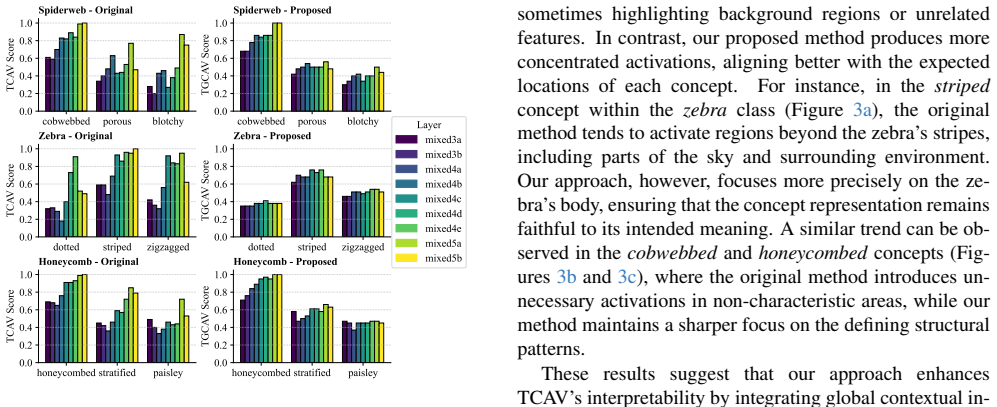
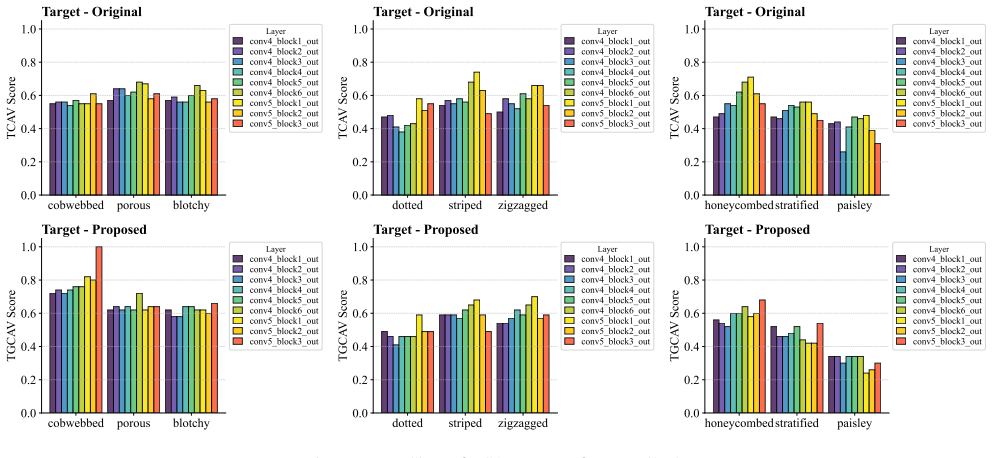
- [§3.4, Eq. (12) and Table 1] The headline empirical result is partly an artifact of the objective. Lvar in Eq. (12) directly minimizes the variance of the TGCAV scores across layers, and Eq. (14) trains the fusion to minimize it. Reporting lower Std/CV/RR for TGCAV in Table 1 therefore largely reports successful optimization of the training loss rather than an independent property of the framework. The 'preserving concept relevance' part of the claim is not tested independently: several TGCAV means drift toward 0.5 (e.g., zigzagged on GoogleNet 0.647→0.503, dotted 0.463→0.373, paisley on ResNet50V2 0.374→0.311), which is the signature of a direction that has lost concept signal, since near-random directions produce TCAV scores close to 0.5. The consistency loss in Eq. (13) is a cosine similarity between decoded vectors; it does not verify that the decoded GCAV still separates concept inputs from random inputs. Pleas
- [§4.4, Table 2] The robustness claim rests on a single concept (dotted), a single layer (mixed5a), a single model (GoogleNet), and a single attack configuration, with no reported variance across random seeds or attacks. The comparison is only against original TCAV, not against other fusion baselines or a simple average CAV. The lower relative increase under TGCAV (28.49% vs. 84.61% at mixed5a, and 42.63% vs. 61.77% in mean) could be partly explained by the lower baseline TGCAV score (0.38 vs. 0.52); without confidence intervals or multiple runs it is not possible to assess whether the difference is significant. Please expand this evaluation or soften the robustness claim accordingly.
- [§4.3, Figure 3] The claim that GCAV improves concept localization is supported only by three selected examples and a qualitative description. Because TGCAV scores are smoother by construction, the apparently more concentrated Visual-TCAV maps could be an artifact of averaging or of the reconstruction, rather than evidence of more precise semantics. Please provide a quantitative metric (e.g., IoU against concept masks, pointing-game accuracy, or a human study). Without such a metric, this contribution is not established.
minor comments (5)
- [§3.4, Eq. (10)] The text describes the fusion as attention-based, but Eq. (10) is a plain average over the aligned layer embeddings. The appendix adds an OutputLayer, but the main paper should state explicitly where the attention weights appear and how Eq. (10) is reconciled with the Transformer description.
- [§3.4, Eqs. (11)–(13)] Notation is inconsistent: Eq. (11) implicitly places \tilde v_c^l in the original layer space R^{d_l}, but Eq. (13) states \tilde v_c^l∈R^{d_embed}. Please clarify the dimensionality and the role of the decoder in both equations.
- [§4.1 and Table 1] The paper says '10 random experiments' were run, but Table 1 reports only point estimates with no standard errors or confidence intervals. At minimum, report the spread over the 10 runs for the headline metrics (Std, CV, RR).
- [Appendix A.3.2, Eq. (20)] The STE/sigmoid relaxation is used to make Lvar differentiable, but the main paper's tables presumably report the hard (non-relaxed) TCAV scores. Please state this explicitly and discuss whether the STE approximation affects the reported TGCAV values or only the training of the fusion module.
- [Throughout] There are several typos and formatting issues: 'Figeure 1', 'zagzagged', inconsistent spacing in 'CA Vs' and 'TCA V', and the corrupted text in the appendix figures' labels should be cleaned up before submission.
Circularity Check
The main evidence for variance reduction is the training objective itself: Lvar (Eq. 12) minimizes cross-layer TCAV-score variance, and Table 1's Std/CV/RR reductions are computed from those same scores.
-
fitted input called prediction
[Section 3.4, Eq. (12); Section 4.2, Table 1]
"We define the Variance Loss Lvar to minimize the variance of TCAV scores across layers over a batch of N samples: Lvar = 1/N Σ Var(s(i)1, s(i)2, . . . , s(i)L). (12) ... From Table 1, we observe that our method significantly enhances the stability and reliability of TGCAV scores across layers. Across all models, the standard deviation, coefficient of variation (CV), interquartile range (IQR), and range ratio (RR) are consistently lower..."
The paper's central empirical claim is the reduction of cross-layer TCAV-score dispersion, reported as Std/CV/RR in Table 1. But the fusion model is explicitly trained to minimize exactly that quantity: Lvar is the variance of the per-layer TCAV scores s(i)l (Eq. 12). After fitting, lower Std/CV/RR is a report of the training objective, not an independent test of 'more stable and reliable concept attributions.' No held-out semantic evaluation, human agreement study, or transfer benchmark is provided to show that the reduced spread reflects preserved concept meaning rather than shrinkage toward 0.5. The observed mean drifts—e.g., dotted on GoogleNet 0.463→0.373, zigzagged 0.647→0.503—are consistent with variance minimization through semantic erosion, and the paper supplies no evidence rulin
full rationale
The derivation chain is self-contained in the sense that the architecture, losses, and evaluation are all explicitly defined in the paper, with no load-bearing self-citation or imported uniqueness theorem. However, the headline result 'significantly reduces the variance in TCAV scores' is circular: the variance of TCAV scores across layers is the training loss Lvar (Eq. 12), and Table 1's Std/CV/RR are direct functions of the same scores. The generalization claims in Table 5 use the same metrics, so they inherit the same issue. The separate claims of better concept localization (qualitative Visual-TCAV maps) and reduced adversarial attack sensitivity are not literally the training objective, though the robustness discussion also invokes the variance loss. The appendix's collapse-to-0.5 ablation with no consistency loss shows the failure mode exists, but the inclusion of Lcons (Eq. 13) does not constitute an independent semantic check; the cosine reconstruction losses are themselves part of the training objective. Overall, the variance-reduction evidence reduces by construction to the fitted loss, while the 'preserving concept relevance' part remains an untested premise, yielding a partial-circularity score of 6.
Assumptions & free parameters
free parameters (6)
- lambda_NCE : lambda_cons balance =
1:3 (stage 2)
- lambda_var : lambda_cons balance =
3:1 (stage 3)
- Embedding dimension d_embed =
4096 (2048 for ResNet50V2)
- InfoNCE temperature tau =
not specified
- STE temperature schedule =
not specified, 'gradually increases'
- Set of layers L included in fusion =
not specified per model
assumptions (5)
- domain assumption CAVs from a linear probe are meaningful concept directions
- domain assumption Same-concept CAVs from different layers can be aligned in a shared embedding space by contrastive learning
- ad hoc to paper Cosine-similarity reconstruction (Eqs. 3, 13) preserves the concept information needed for TCAV scoring
- ad hoc to paper Minimizing cross-layer variance of TCAV scores equals improving reliability
- ad hoc to paper Sigmoid-STE relaxation (Eq. 20) converges to true TCAV scores
invented entities (2)
-
GCAV (Global Concept Activation Vector)
-
TGCAV scoring procedure
Cite this review
Pith. "Pith review of GCAV: A Global Concept Activation Vector Framework for Cross-Layer Consistency in Interpretability." pith.science (2026). https://pith.science/paper/UY6MIUR5
@misc{pith2026250821197,
  author       = {Pith},
  title        = {Pith review of: GCAV: A Global Concept Activation Vector Framework for Cross-Layer Consistency in Interpretability},
  year         = {2026},
  howpublished = {\url{https://pith.science/paper/UY6MIUR5}},
  note         = {Machine review of arXiv:2508.21197}
}
read the original abstract
Concept Activation Vectors (CAVs) provide a powerful approach for interpreting deep neural networks by quantifying their sensitivity to human-defined concepts. However, when computed independently at different layers, CAVs often exhibit inconsistencies, making cross-layer comparisons unreliable. To address this issue, we propose the Global Concept Activation Vector (GCAV), a novel framework that unifies CAVs into a single, semantically consistent representation. Our method leverages contrastive learning to align concept representations across layers and employs an attention-based fusion mechanism to construct a globally integrated CAV. By doing so, our method significantly reduces the variance in TCAV scores while preserving concept relevance, ensuring more stable and reliable concept attributions. To evaluate the effectiveness of GCAV, we introduce Testing with Global Concept Activation Vectors (TGCAV) as a method to apply TCAV to GCAV-based representations. We conduct extensive experiments on multiple deep neural networks, demonstrating that our method effectively mitigates concept inconsistency across layers, enhances concept localization, and improves robustness against adversarial perturbations. By integrating cross-layer information into a coherent framework, our method offers a more comprehensive and interpretable understanding of how deep learning models encode human-defined concepts. Code and models are available at https://github.com/Zhenghao-He/GCAV.
Figures


Figures from the paper (7 more)




Reference graph
Works this paper leans on
-
[19]
Angus Nicolson, Lisa Schut, J Alison Noble, and Yarin Gal. Explaining explainability: Understanding concept activation vectors.arXiv preprint arXiv:2404.03713, 2024. 2
arXiv 2024
-
[1]
Christopher J Anders, Leander Weber, David Neumann, Wojciech Samek, Klaus-Robert Müller, and Sebastian La- puschkin. Finding and removing clever hans: Using expla- nation methods to debug and improve deep models.Infor- mation Fusion, 77:261–295, 2022. 2
work page 2022
-
[2]
Network dissection: Quantifying inter- pretability of deep visual representations
David Bau, Bolei Zhou, Aditya Khosla, Aude Oliva, and Antonio Torralba. Network dissection: Quantifying inter- pretability of deep visual representations. InComputer Vi- sion and Pattern Recognition, 2017. 5
work page 2017
-
[3]
Yoshua Bengio, Aaron Courville, and Pascal Vincent. Rep- resentation learning: A review and new perspectives.IEEE transactions on pattern analysis and machine intelligence, 35(8):1798–1828, 2013. 1
work page 2013
-
[4]
Yoshua Bengio, Nicholas Léonard, and Aaron Courville. Estimating or propagating gradients through stochastic neurons for conditional computation.arXiv preprint arXiv:1308.3432, 2013. 13
arXiv 2013
-
[5]
Davis Brown and Henry Kvinge. Making corgis impor- tant for honeycomb classification: Adversarial attacks on concept-based explainability tools.2023 IEEE/CVF Con- ference on Computer Vision and Pattern Recognition Work- shops (CVPRW), pages 620–627, 2021. 2, 7
work page 2023
-
[6]
Zhi Chen, Yijie Bei, and Cynthia Rudin. Concept whitening for interpretable image recognition.Nature Machine Intelli- gence, 2(12):772–782, 2020. 2
work page 2020
-
[7]
Antonio De Santis, Riccardo Campi, Matteo Bianchi, and Marco Brambilla. Visual-tcav: Concept-based attribution and saliency maps for post-hoc explainability in image clas- sification.arXiv preprint arXiv:2411.05698, 2024. 7
arXiv 2024
Show all 43 references
-
[8]
Imagenet: A large-scale hierarchical image database
Jia Deng, Wei Dong, Richard Socher, Li-Jia Li, Kai Li, and Li Fei-Fei. Imagenet: A large-scale hierarchical image database. In2009 IEEE Conference on Computer Vision and Pattern Recognition, pages 248–255, 2009. 5
2009
-
[9]
What neural networks memorize and why: Discovering the long tail via influence estimation.Advances in Neural Information Processing Sys- tems, 33:2881–2891, 2020
Vitaly Feldman and Chiyuan Zhang. What neural networks memorize and why: Discovering the long tail via influence estimation.Advances in Neural Information Processing Sys- tems, 33:2881–2891, 2020. 2
2020
-
[10]
Towards automatic concept-based explanations
Amirata Ghorbani, James Wexler, James Zou, and Been Kim. Towards automatic concept-based explanations. NeurIPS, 2019. 2
2019
-
[11]
Ex- plaining classifiers with causal concept effect (cace).arXiv preprint arXiv:1907.07165, 2019
Yash Goyal, Amir Feder, Uri Shalit, and Been Kim. Ex- plaining classifiers with causal concept effect (cace).arXiv preprint arXiv:1907.07165, 2019. 2
1907 arXiv
-
[12]
Concept dis- tillation: leveraging human-centered explanations for model improvement.Advances in Neural Information Processing Systems, 36:63724–63737, 2023
Avani Gupta, Saurabh Saini, and PJ Narayanan. Concept dis- tillation: leveraging human-centered explanations for model improvement.Advances in Neural Information Processing Systems, 36:63724–63737, 2023. 2
2023
-
[13]
Identity mappings in deep residual networks
Kaiming He, Xiangyu Zhang, Shaoqing Ren, and Jian Sun. Identity mappings in deep residual networks. InComputer Vision–ECCV 2016: 14th European Conference, Amster- dam, The Netherlands, October 11–14, 2016, Proceedings, Part IV 14, pages 630–645. Springer, 2016. 1, 5
2016
-
[14]
Interpretability be- yond feature attribution: Quantitative testing with concept activation vectors (tcav)
Been Kim, Martin Wattenberg, Justin Gilmer, Carrie Cai, James Wexler, Fernanda Viegas, et al. Interpretability be- yond feature attribution: Quantitative testing with concept activation vectors (tcav). InInternational conference on ma- chine learning, pages 2668–2677. PMLR, 20...
2018
-
[15]
Understanding black-box predictions via influence functions
Pang Wei Koh and Percy Liang. Understanding black-box predictions via influence functions. InICML. PMLR, 2017. 2
2017
-
[16]
Concept bottleneck models
Pang Wei Koh, Thao Nguyen, Yew Siang Tang, Stephen Mussmann, Emma Pierson, Been Kim, and Percy Liang. Concept bottleneck models. InICML, pages 5338–5348. PMLR, 2020. 2
2020
-
[17]
Learning multiple layers of features from tiny images
Alex Krizhevsky, Geoffrey Hinton, et al. Learning multiple layers of features from tiny images. 2009. 1
2009
-
[18]
A unified approach to interpreting model predictions.NeurIPS, 30, 2017
Scott M Lundberg and Su-In Lee. A unified approach to interpreting model predictions.NeurIPS, 30, 2017. 2
2017
-
[20]
Repre- sentation learning with contrastive predictive coding.arXiv preprint arXiv:1807.03748, 2018
Aaron van den Oord, Yazhe Li, and Oriol Vinyals. Repre- sentation learning with contrastive predictive coding.arXiv preprint arXiv:1807.03748, 2018. 1, 4
2018 arXiv
-
[21]
Estimating training data influence by tracing gradient descent.Advances in Neural Information Process- ing Systems, 33:19920–19930, 2020
Garima Pruthi, Frederick Liu, Satyen Kale, and Mukund Sundararajan. Estimating training data influence by tracing gradient descent.Advances in Neural Information Process- ing Systems, 33:19920–19930, 2020. 2
2020
-
[22]
Why should i trust you?: Explaining the predictions of any classifier
Marco Tulio Ribeiro, Sameer Singh, and Carlos Guestrin. Why should i trust you?: Explaining the predictions of any classifier. InProceedings of the 22nd ACM SIGKDD interna- tional conference on knowledge discovery and data mining,
-
[23]
Mobilenetv2: Inverted residuals and linear bottlenecks
Mark Sandler, Andrew Howard, Menglong Zhu, Andrey Zh- moginov, and Liang-Chieh Chen. Mobilenetv2: Inverted residuals and linear bottlenecks. InProceedings of the IEEE conference on computer vision and pattern recogni- tion, pages 4510–4520, 2018. 1, 5
2018
-
[24]
Grad-cam: Visual explanations from deep networks via gradient-based localization
Ramprasaath R Selvaraju, Michael Cogswell, Abhishek Das, Ramakrishna Vedantam, Devi Parikh, and Dhruv Batra. Grad-cam: Visual explanations from deep networks via gradient-based localization. InProceedings of the IEEE in- ternational conference on computer vision, pages 618–626,
-
[25]
Axiomatic attribution for deep networks
Mukund Sundararajan, Ankur Taly, and Qiqi Yan. Axiomatic attribution for deep networks. InICML, pages 3319–3328. PMLR, 2017. 2
2017
-
[26]
Going deeper with convolutions
Christian Szegedy, Wei Liu, Yangqing Jia, Pierre Sermanet, Scott Reed, Dragomir Anguelov, Dumitru Erhan, Vincent Vanhoucke, and Andrew Rabinovich. Going deeper with convolutions. InProceedings of the IEEE conference on computer vision and pattern recognition, pages 1–9, 2015. 5
2015
-
[27]
Attention is all you need
Ashish Vaswani, Noam Shazeer, Niki Parmar, Jakob Uszko- reit, Llion Jones, Aidan N Gomez, Lukasz Kaiser, and Illia Polosukhin. Attention is all you need. InNeurIPS, 2017. 2
2017
-
[28]
Performance-optimized hierarchical models predict neural responses in higher visual cortex.Proceedings of the na- tional academy of sciences, 111(23):8619–8624, 2014
Daniel LK Yamins, Ha Hong, Charles F Cadieu, Ethan A Solomon, Darren Seibert, and James J DiCarlo. Performance-optimized hierarchical models predict neural responses in higher visual cortex.Proceedings of the na- tional academy of sciences, 111(23):8619–8624, 2014. 1
2014
-
[29]
Representer point selection for explaining deep neural networks.Advances in neural information processing systems, 31, 2018
Chih-Kuan Yeh, Joon Kim, Ian En-Hsu Yen, and Pradeep K Ravikumar. Representer point selection for explaining deep neural networks.Advances in neural information processing systems, 31, 2018. 2
2018
-
[30]
MLP(z)" denotes a multi-layer perceptron with LayerNorm and GELU activations, ensuring smooth and stable training. “Linear(z)
Matthew D Zeiler and Rob Fergus. Visualizing and un- derstanding convolutional networks. InComputer Vision– ECCV 2014: 13th European Conference, Zurich, Switzer- land, September 6-12, 2014, Proceedings, Part I 13, pages 818–833. Springer, 2014. 1 A. Implementation Details All ...
2014
-
[31]
Add positional encoding to each layer’s embedding
-
[32]
Compute self-attention via a multi-head attention layer
-
[33]
Apply residual connection and layer normalization
-
[34]
Process the result with a feed-forward network and dropout
-
[35]
Apply a second residual connection and normalization
-
[36]
Aggregate across layers (e.g., average pooling)
-
[37]
Output: Global CAV [batch_size, embedding_dim] A.3.2
Transform the pooled result via a linear output layer. Output: Global CAV [batch_size, embedding_dim] A.3.2. Loss Design The overall loss function consists of two components: • Lvar: Thelayer variance loss, which enforces layer-wise consistency by minimizing the variance of TC...
-
[38]
Update the dynamic temperature parameter
-
[39]
Reconstruct the CAV using the corresponding decoder
For each layer: a. Reconstruct the CAV using the corresponding decoder. b. Compute cosine similarity between the reconstructed and original CAV. c. Compute the TCAV score using a gradient-based method
-
[40]
Compute consistency loss as the average cosine loss over layers
-
[41]
Compute variance loss as the variance of TCAV scores across layers
-
[42]
Compute total loss: total_loss = var_weight * variance_loss + consistency_weight * consistency_loss
-
[43]
Zebra” class on GoogleNet. “w/o Align
Return total_loss. These components ensure that the fusion module aggregates multi-layer information into a unified GCA V while preserving consistency and maintaining clear semantic separation between concepts. During training, the computation of TCA V scores sl at layer l fol...
Reviewed August 5, 2026 · model on record in the stance chip above.
Discussion (0). Sign in to comment.