Signatures of two ferromagnetic states and goniopolarity in LaCrGe3 in the Hall effect
Pith reviewed 2026-05-18 20:45 UTC · model grok-4.3
The pith
Continuous Hall resistivity measurements at fixed fields reveal two ferromagnetic phases in LaCrGe3 independent of field direction.
A machine-rendered reading of the paper's core claim, the machinery that carries it, and where it could break.
Core claim
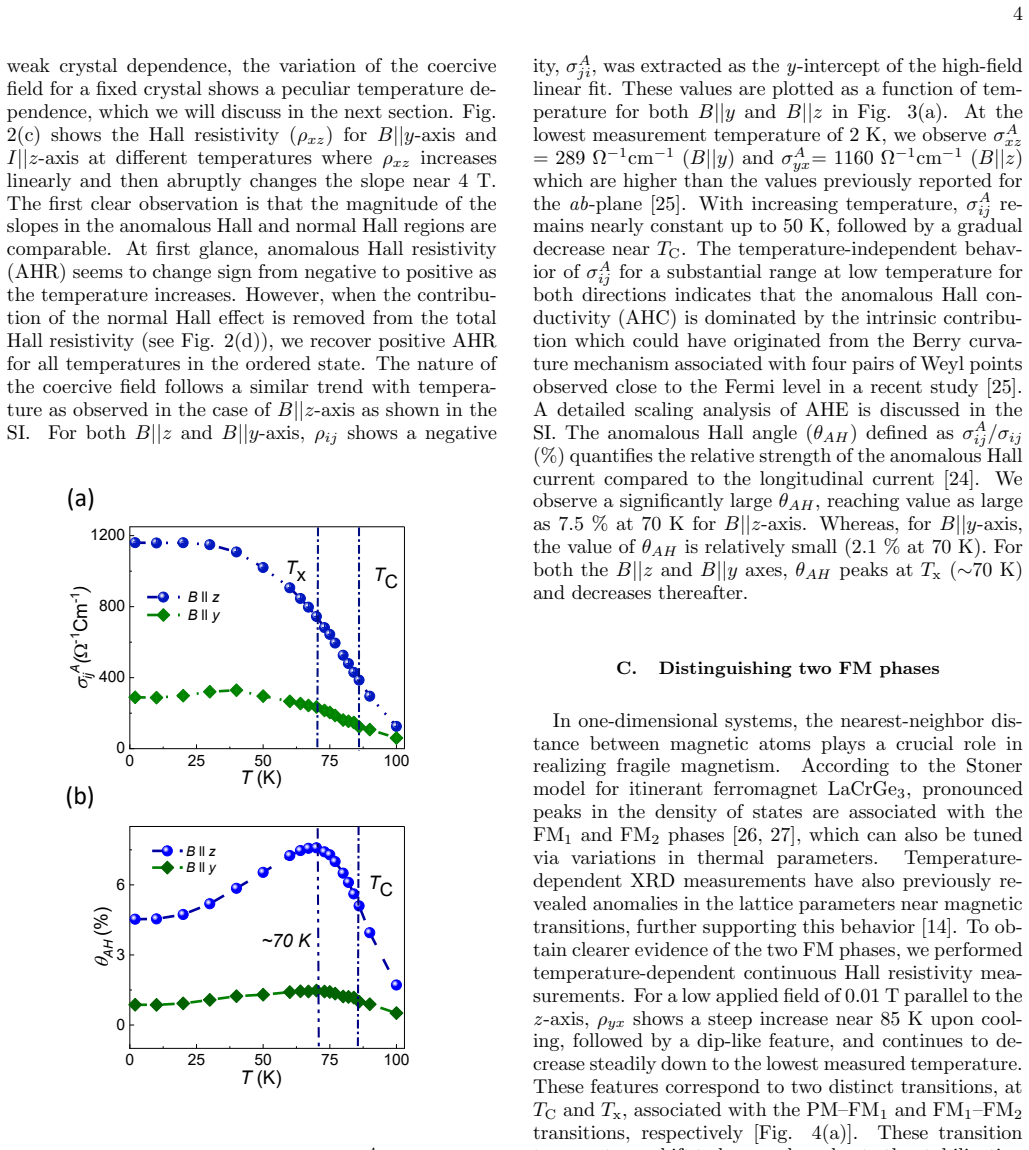
LaCrGe3 contains two ferromagnetic phases that are identified by continuous temperature-dependent Hall resistivity measurements performed at fixed magnetic fields. These measurements demonstrate the phases regardless of the direction of the applied field. The remanent Hall resistivity exhibits a maximum and the Hall coefficient a minimum at the boundary between the phases. An anomalous Hall conductivity of 1160 ohm^{-1}cm^{-1} is recorded at 2 K when the field lies along the magnetic easy axis, with intrinsic effects dominating in the low-temperature ferromagnetic phase. In the paramagnetic phase hexagonal LaCrGe3 shows goniopolarity, meaning opposite charge-carrier polarities along distinct
What carries the argument
Temperature-dependent Hall resistivity and Hall coefficient recorded at fixed magnetic field, which produce extrema at the ferromagnetic phase boundary and quantify both the anomalous Hall conductivity and the goniopolar carrier reversal.
If this is right
- The two ferromagnetic phases remain distinguishable in Hall data for any applied field direction.
- Intrinsic mechanisms dominate the anomalous Hall conductivity in the low-temperature ferromagnetic phase.
- Goniopolarity with opposite carrier polarities appears in the paramagnetic phase due to anisotropic Fermi surface geometry.
- The coexistence of multiple magnetic phases and goniopolar transport positions LaCrGe3 as a candidate for future electronic devices.
Where Pith is reading between the lines
- Hall signatures of this kind could be used to track the suppression of ferromagnetic order under pressure or doping near quantum critical points.
- Device concepts might combine the directional carrier reversal with magnetic phase switching to produce field- or temperature-tunable transport responses.
- Similar Hall-based identification of multiple magnetic states could be tested in other ferromagnetic compounds that show quantum criticality.
Load-bearing premise
The observed maximum in remanent Hall resistivity and minimum in Hall coefficient arise solely from the boundary between the two ferromagnetic phases without significant contributions from sample inhomogeneity, magnetic domains, or additional scattering mechanisms.
What would settle it
A continuous temperature sweep of the Hall resistivity at fixed field that shows neither a maximum in the remanent Hall resistivity nor a minimum in the Hall coefficient at the temperature previously associated with the phase boundary would falsify the direct identification of these Hall features with the ferromagnetic phase boundary.
Figures




read the original abstract
LaCrGe3 has become a playground to understand quantum critical phenomena in ferromagnetic (FM) materials. It has also garnered attention due to its peculiar two FM phases. Here, we demonstrate the presence of these phases using the Hall effect. Continuous temperature-dependent Hall resistivity measurements at fixed magnetic fields clearly demonstrate the presence of these phases, regardless of the direction of the applied magnetic field. The remanent Hall resistivity and Hall coefficient undergo a maximum and a minimum, respectively, at the boundary between the two phases. We observe significantly large anomalous Hall conductivity of 1160 ohm-1cm-1 at 2 K when the magnetic field is applied along the magnetic easy axis, which is dominated by intrinsic effects, at least in the low-temperature FM phase. In the paramagnetic (PM) phase, hexagonal LaCrGe3 exhibits opposite charge carrier polarities along different crystallographic directions, attributed to the anisotropic Fermi surface geometry, a phenomenon known as "goniopolarity". The coexistence of goniopolar transport and unconventional magnetic phases may lead this material as a promising candidate for future electronic devices.
Editorial analysis
A structured set of objections, weighed in public.
Referee Report
Summary. The manuscript uses temperature-dependent Hall resistivity measurements at fixed magnetic fields to demonstrate the presence of two distinct ferromagnetic phases in LaCrGe3, independent of field direction. It reports that the remanent Hall resistivity reaches a maximum and the Hall coefficient a minimum at the boundary between these phases. A large anomalous Hall conductivity of 1160 Ω^{-1} cm^{-1} is measured at 2 K along the easy axis and attributed to intrinsic mechanisms in the low-temperature FM phase. In the paramagnetic phase, opposite carrier polarities along different crystallographic axes are observed and ascribed to goniopolarity arising from anisotropic Fermi surface geometry.
Significance. If the central mapping from Hall extrema to the FM phase boundary is robust against alternative explanations, the work supplies a transport-based signature for the two ferromagnetic states that complements magnetization studies in this quantum-critical itinerant ferromagnet. The reported magnitude of the anomalous Hall conductivity and the goniopolar behavior add to the material's interest for potential spintronic or multi-functional devices. The study is grounded in direct experimental data rather than fitted parameters or derived tautologies.
major comments (2)
- [Results section on temperature-dependent Hall resistivity] The central claim that continuous T-dependent Hall resistivity at fixed H 'clearly demonstrates' the two FM phases and that the remanent Hall resistivity maximum and Hall coefficient minimum occur 'at the boundary' rests on the assumption that these extrema arise exclusively from the change in magnetic order. The manuscript does not present controls or analysis to exclude contributions from domain reconfiguration, sample inhomogeneity, or scattering variations, which routinely produce analogous non-monotonic Hall features in ferromagnets. Additional data (e.g., comparison with magnetization or field-cooling protocols) are needed to secure this attribution.
- [Discussion of anomalous Hall conductivity] The statement that the anomalous Hall conductivity of 1160 Ω^{-1} cm^{-1} at 2 K 'is dominated by intrinsic effects, at least in the low-temperature FM phase' lacks supporting evidence such as scaling analysis, temperature dependence of the conductivity, or comparison with extrinsic mechanisms. Without this, the intrinsic dominance remains an interpretation rather than a demonstrated result.
minor comments (2)
- [Abstract] The units 'ohm-1cm-1' should be rendered as Ω^{-1} cm^{-1} for standard notation.
- [Methods or experimental details] Sample characterization details (e.g., resistivity ratios, X-ray diffraction, or homogeneity checks) should be expanded to allow readers to assess possible inhomogeneity contributions to the Hall signals.
Simulated Author's Rebuttal
We thank the referee for the careful reading of our manuscript and the constructive comments. We address each major point below and have revised the manuscript to incorporate additional analysis and discussion where this strengthens the claims without altering the original data or interpretations.
read point-by-point responses
-
Referee: The central claim that continuous T-dependent Hall resistivity at fixed H 'clearly demonstrates' the two FM phases and that the remanent Hall resistivity maximum and Hall coefficient minimum occur 'at the boundary' rests on the assumption that these extrema arise exclusively from the change in magnetic order. The manuscript does not present controls or analysis to exclude contributions from domain reconfiguration, sample inhomogeneity, or scattering variations, which routinely produce analogous non-monotonic Hall features in ferromagnets. Additional data (e.g., comparison with magnetization or field-cooling protocols) are needed to secure this attribution.
Authors: We agree that explicit controls would further secure the attribution. The fixed-field temperature sweeps were chosen specifically to avoid field-induced domain reconfiguration that occurs in isothermal field sweeps. In the revised manuscript we have added a direct overlay of the Hall resistivity extrema with the ferromagnetic phase boundaries previously established by magnetization measurements on the same material. The correspondence is quantitative, and we have expanded the discussion to address why contributions from inhomogeneity or scattering variations are inconsistent with the observed sharpness of the features and their reproducibility across multiple crystals and field directions. revision: yes
-
Referee: The statement that the anomalous Hall conductivity of 1160 Ω^{-1} cm^{-1} at 2 K 'is dominated by intrinsic effects, at least in the low-temperature FM phase' lacks supporting evidence such as scaling analysis, temperature dependence of the conductivity, or comparison with extrinsic mechanisms. Without this, the intrinsic dominance remains an interpretation rather than a demonstrated result.
Authors: We accept that the original statement would benefit from explicit supporting analysis. We have added a scaling plot of anomalous Hall conductivity versus longitudinal conductivity for the low-temperature ferromagnetic phase. The data follow a linear relation with a slope consistent with the intrinsic Berry-phase contribution and show negligible deviation attributable to extrinsic mechanisms at the lowest temperatures, thereby converting the claim from interpretation to a data-supported conclusion. revision: yes
Circularity Check
No circularity: claims rest on direct Hall measurements
full rationale
The paper reports experimental observations from continuous temperature-dependent Hall resistivity measurements at fixed fields, attributing extrema in remanent Hall resistivity and Hall coefficient to the boundary between two FM phases, plus large anomalous Hall conductivity and goniopolarity. These are presented as empirical signatures without any derivation chain, fitted parameters renamed as predictions, or load-bearing self-citations that reduce the result to its own inputs by construction. The analysis is self-contained against external benchmarks, with interpretations open to alternative explanations such as domains but not tautological to the data.
Axiom & Free-Parameter Ledger
axioms (1)
- domain assumption Hall resistivity and its temperature dependence directly reflect changes in magnetic ordering and carrier polarity in ferromagnetic and paramagnetic phases of itinerant magnets.
Lean theorems connected to this paper
-
IndisputableMonolith/Cost/FunctionalEquation.leanwashburn_uniqueness_aczel unclear?
unclearRelation between the paper passage and the cited Recognition theorem.
Continuous temperature-dependent Hall resistivity measurements at fixed magnetic fields clearly demonstrate the presence of these phases... The remanent Hall resistivity and Hall coefficient undergo a maximum and a minimum, respectively, at the boundary between the two phases.
-
IndisputableMonolith/Foundation/RealityFromDistinction.leanreality_from_one_distinction unclear?
unclearRelation between the paper passage and the cited Recognition theorem.
We observe significantly large anomalous Hall conductivity of 1160 ohm-1cm-1 at 2 K... dominated by intrinsic effects
What do these tags mean?
- matches
- The paper's claim is directly supported by a theorem in the formal canon.
- supports
- The theorem supports part of the paper's argument, but the paper may add assumptions or extra steps.
- extends
- The paper goes beyond the formal theorem; the theorem is a base layer rather than the whole result.
- uses
- The paper appears to rely on the theorem as machinery.
- contradicts
- The paper's claim conflicts with a theorem or certificate in the canon.
- unclear
- Pith found a possible connection, but the passage is too broad, indirect, or ambiguous to say the theorem truly supports the claim.
Reference graph
Works this paper leans on
-
[1]
K. Buschow and F. De Boer, in Physics of Magnetism and Magnetic Materials (Springer, 2003) pp. 63–73
work page 2003
-
[2]
A. V. Chubukov, C. P´ epin, and J. Rech, Physical review letters 92, 147003 (2004)
work page 2004
- [3]
-
[4]
X. Lin, V. Taufour, S. L. Bud’ko, and P. C. Canfield, Physical Review B—Condensed Matter and Materials Physics 88, 094405 (2013)
work page 2013
-
[5]
V. Taufour, U. S. Kaluarachchi, S. L. Bud’ko, and P. C. Canfield, Physica B: Condensed Matter 536, 483 (2018)
work page 2018
-
[6]
E. Krenkel, M. A. Tanatar, M. Ko´ nczykowski, R. Gras- set, L.-L. Wang, S. L. Bud’ko, P. C. Canfield, and R. Pro- zorov, Physical Review B 110, 014429 (2024)
work page 2024
-
[7]
B. Bosch-Santos, G. Cabrera-Pasca, E. Correa, B. Cor- rea, T. Sales, K. Moon, C. Dennis, Q. Huang, J. Leao, J. Lynn, et al. , Physical Review Materials 5, 114406 (2021)
work page 2021
-
[8]
U. S. Kaluarachchi, S. L. Bud’ko, P. C. Canfield, and V. Taufour, Nature communications 8, 546 (2017)
work page 2017
- [9]
-
[10]
V. Taufour, U. S. Kaluarachchi, R. Khasanov, M. C. Nguyen, Z. Guguchia, P. K. Biswas, P. Bonf` a, R. De Renzi, X. Lin, S. K. Kim, et al. , Physical review letters 117, 037207 (2016)
work page 2016
-
[11]
J. Cadogan, P. Lemoine, B. R. Slater, A. Mar, and M. Avdeev, Solid State Phenomena 194, 71 (2013)
work page 2013
- [12]
-
[13]
K. Rana, H. Kotegawa, R. Ullah, E. Gati, S. Bud’ko, P. Canfield, H. Tou, V. Taufour, and Y. Furukawa, Phys- ical Review B 103, 174426 (2021)
work page 2021
-
[14]
E. Gati, J. M. Wilde, R. Khasanov, L. Xiang, S. Dis- sanayake, R. Gupta, M. Matsuda, F. Ye, B. Haberl, U. Kaluarachchi, et al. , Physical Review B 103, 075111 (2021)
work page 2021
-
[15]
M. Xu, S. Bud’ko, R. Prozorov, and P. Canfield, Physical Review B 107, 134437 (2023)
work page 2023
-
[16]
J. Sichelschmidt, T. Gruner, D. Das, and Z. Hossain, Journal of Physics: Condensed Matter 33, 495605 (2021)
work page 2021
-
[17]
D. Das, T. Gruner, H. Pfau, U. Paramanik, U. Burkhardt, C. Geibel, and Z. Hossain, Journal of Physics: Condensed Matter 26, 106001 (2014)
work page 2014
-
[18]
K. Rana, H. Kotegawa, R. Ullah, J. Harvey, S. L. Bud’ko, P. Canfield, H. Tou, V. Taufour, and Y. Furukawa, Phys- ical Review B 99, 214417 (2019)
work page 2019
-
[19]
H. Bie, O. Y. Zelinska, A. V. Tkachuk, and A. Mar, Chemistry of Materials 19, 4613 (2007)
work page 2007
- [20]
-
[21]
Z. Shen, X. Zhu, R. R. Ullah, P. Klavins, and V. Taufour, Journal of Physics: Condensed Matter 35, 045802 (2022)
work page 2022
- [22]
-
[23]
Takahashi, Journal of the Physical Society of Japan 55, 3553 (1986)
Y. Takahashi, Journal of the Physical Society of Japan 55, 3553 (1986)
work page 1986
-
[24]
N. Nagaosa, J. Sinova, S. Onoda, A. H. MacDonald, and N. P. Ong, Reviews of modern physics 82, 1539 (2010)
work page 2010
- [25]
-
[26]
M. C. Nguyen, V. Taufour, S. L. Bud’ko, P. C. Canfield, V. P. Antropov, C.-Z. Wang, and K.-M. Ho, Physical Review B 97, 184401 (2018)
work page 2018
-
[27]
Q. Niu, G. Knebel, D. Braithwaite, D. Aoki, G. Lapertot, M. Valiˇ ska, G. Seyfarth, W. Knafo, T. Helm, J.-P. Brison, et al. , Physical Review Research 2, 033179 (2020)
work page 2020
-
[28]
K. Sandeman, G. Lonzarich, and A. Schofield, Physical review letters 90, 167005 (2003)
work page 2003
-
[29]
N. Doiron-Leyraud, C. Proust, D. LeBoeuf, J. Levallois, J.-B. Bonnemaison, R. Liang, D. Bonn, W. Hardy, and L. Taillefer, Nature 447, 565 (2007)
work page 2007
-
[30]
B. He, Y. Wang, M. Q. Arguilla, N. D. Cultrara, M. R. Scudder, J. E. Goldberger, W. Windl, and J. P. Here- mans, Nature materials 18, 568 (2019)
work page 2019
-
[31]
Y. Wang, K. G. Koster, A. M. Ochs, M. R. Scudder, J. P. Heremans, W. Windl, and J. E. Goldberger, Journal of the American Chemical Society 142, 2812 (2020)
work page 2020
-
[32]
P. Yordanov, W. Sigle, P. Kaya, M. Gruner, R. Pentcheva, B. Keimer, and H.-U. Habermeier, Physi- cal Review Materials 3, 085403 (2019)
work page 2019
-
[33]
N. Nakamura, Y. Goto, and Y. Mizuguchi, Applied Physics Letters 118 (2021)
work page 2021
-
[34]
B. Rai, K. Patra, S. Bera, S. Kalimuddin, K. Deb, M. Mondal, P. Mahadevan, and N. Kumar, Advanced Science , 2502226 (2025)
work page 2025
- [35]
-
[36]
S. Luo, F. Du, D. Su, Y. Zhang, J. Zhang, J. Xu, Y. Chen, C. Cao, M. Smidman, F. Steglich, et al., Physical Review B 108, 195146 (2023)
work page 2023
-
[37]
K. G. Koster, Z. Deng, C. E. Moore, J. P. Heremans, W. Windl, and J. E. Goldberger, Chemistry of Materials 35, 4228 (2023)
work page 2023
-
[38]
R. A. Nelson, Z. Deng, A. M. Ochs, K. G. Koster, C. T. Irvine, J. P. Heremans, W. Windl, and J. E. Goldberger, Materials Horizons 10, 3740 (2023). 8
work page 2023
-
[39]
Y. Goto, H. Usui, M. Murata, J. E. Goldberger, J. P. Heremans, and C.-H. Lee, Chemistry of Materials 36, 2018 (2024)
work page 2018
-
[40]
A. M. Ochs, G. H. Fecher, B. He, W. Schnelle, C. Felser, J. P. Heremans, and J. E. Goldberger, Advanced Mate- rials 36, 2308151 (2024)
work page 2024
-
[41]
V. Rowe and P. Schroeder, Journal of Physics and Chem- istry of Solids 31, 1 (1970)
work page 1970
- [42]
- [43]
-
[44]
A. M. Ochs, P. Gorai, Y. Wang, M. R. Scudder, K. Koster, C. E. Moore, V. Stevanovic, J. P. Heremans, W. Windl, E. S. Toberer, et al. , Chemistry of Materials 33, 946 (2021)
work page 2021
- [45]
-
[46]
Behnia, Fundamentals of thermoelectricity (OUP Ox- ford, 2015)
K. Behnia, Fundamentals of thermoelectricity (OUP Ox- ford, 2015)
work page 2015
- [47]
-
[48]
M. R. Scudder, B. He, Y. Wang, A. Rai, D. G. Cahill, W. Windl, J. P. Heremans, and J. E. Goldberger, Energy & Environmental Science 14, 4009 (2021)
work page 2021
-
[49]
Y. Tang, B. Cui, C. Zhou, and M. Grayson, Journal of Electronic Materials 44, 2095 (2015)
work page 2095
discussion (0)
Sign in with ORCID, Apple, or X to comment. Anyone can read and Pith papers without signing in.