REVIEW 1 major objections 5 minor 1 cited by
Remote spin control in Haldane spin chains
T0 review · 1 major / 5 minor · reviewed 2026-08-15 · deepseek-v4-flash
Pith's one-line read The paper claims that a weak local magnetic field applied to one edge of an open Haldane spin chain can fully polarize and remotely switch the magnetization of the opposite edge, through the entangled singlet ground state.
desk verdict A clean, narrow theory result on remote edge-spin control in Haldane chains; the central formula is solid, but one unproved matrix-element identity shoulders the long-chain quantitative claims. read the letter →
The pith
A machine-rendered reading of the paper's core claim, the machinery that carries it, and where it could break.
The reading
What carries the argument
The machinery is an effective four-level Hamiltonian built in the singlet-triplet ground-state manifold of the open chain. The only non-vanishing matrix elements of the local spin operator are $S^z_i = \langle S|\hat{S}^z_i|T_0\rangle$ and $T^{(\pm)}_i = \langle T_\pm|\hat{S}^z_i|T_\pm\rangle$; the paper uses the identity $|T^{(\pm)}_1| = |S^z_1|$ to write a two-level model in the $(S,T_0)$ sector, $h(b) = -\tfrac{j}{2}\tau_z + \epsilon_0(b)\tau_x$. This two-level system, with splitting $E(b)=\tfrac{1}{2}\sqrt{j^2+4\epsilon_0(b)^2}$, controls the magnetization response and the Landau-Zener dynamics.
What would settle it
Measure the magnetization profile of a Haldane chain of N=12 spins as a function of a local field applied to one edge and compare the saturation value and the scaling with $4\epsilon_0^2+j^2$ against Eq. (11); a deviation in the edge magnetization beyond numerical error would falsify the effective model. Alternatively, an exact diagonalization that breaks the $|T^{(\pm)}_1|=|S^z_1|$ relation would show whether the predicted saturation persists.
Extended reading notes
Core claim
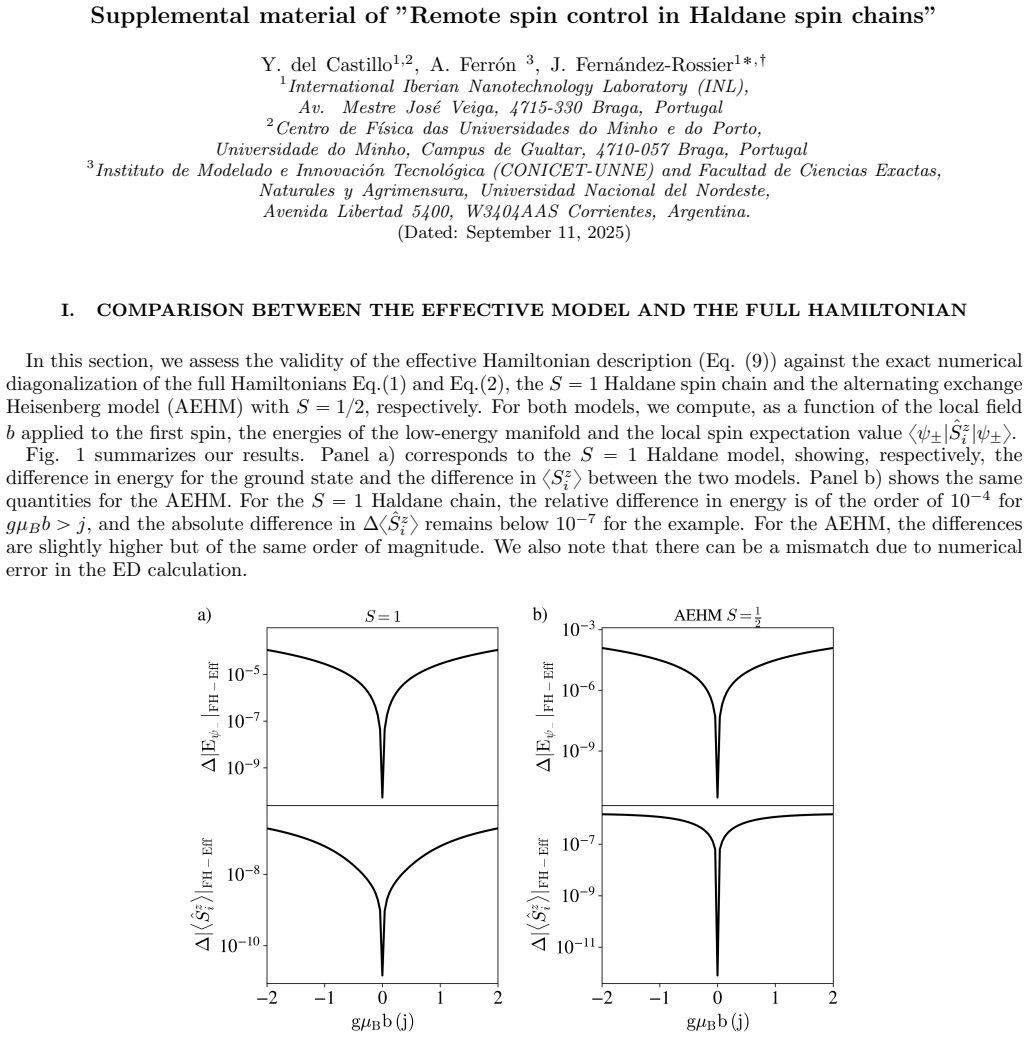
The central result is Eq. (11): for a field b applied only at site 1, the local magnetization at any site i is given by $\langle\psi_\pm|\hat{S}^z_i|\psi_\pm\rangle = \pm\,2\epsilon_0(b)\,S^z_i\,/\sqrt{4\epsilon_0(b)^2+j^2}$, where $\epsilon_0(b)=g\mu_B b\,S^z_1$ and $j$ is the exponentially small singlet-triplet splitting. In the limit $|\epsilon_0| \gg j$ this saturates to $\pm S^z_i$, so a local perturbation on one edge fully polarizes the opposite edge with opposite sign. The same formula holds for both the S=1 Haldane model and the S=1/2 alternating-exchange Heisenberg model, and exact numerics confirm the effective-model prediction to high accuracy.
Load-bearing premise
The entire quantitative prediction rests on the unproved identity that the diagonal matrix elements of the edge spin in the triplet states equal its singlet-triplet off-diagonal matrix element; if that relation is only approximate, the level structure and the Landau-Zener exponent change.
Editorial extensions
If this is right
- A local AC field can drive electron spin resonance transitions between the singlet and triplet at frequency $\hbar\omega = j$, providing a way to address individual Haldane chains with a scanning tip.
- A probe placed at one edge can sense a field applied at the opposite edge, enabling non-local magnetometry across the chain.
- Adiabatic sweeps of the local field reverse the far-edge magnetization on sub-nanosecond timescales for realistic nanographene parameters, enabling fast remote spin switching.
- The effective model remains valid for both S=1 Haldane chains and the alternating-exchange Heisenberg model, so the remote-control mechanism transfers across different physical platforms.
Reading between the lines
- The identity $|T^{(\pm)}_1| = |S^z_1|$ is asserted without proof; if it holds only approximately, the quantitative Landau-Zener exponent and the exact saturation value would shift, although the qualitative remote-control picture likely survives.
- The mechanism is essentially a two-level avoided crossing, so similar remote-control behavior should appear in other gapped spin chains with entangled edge states beyond the Haldane phase.
- The condition $k_B T \ll j$ restricts the protocol to very low temperatures; an interesting extension would be to use the $T_\pm$ states or multi-sweep Landau-Zener-Stückelberg-Majorana protocols to relax the temperature constraint.
Signed reviews
Editorial analysis
A structured set of objections, weighed in public.
Referee Report
Summary. The manuscript studies open Haldane spin chains, both the S=1 chain with biquadratic exchange (Eq. 1) and the S=1/2 alternating-exchange Heisenberg model (Eq. 2), in the regime where only the low-energy singlet-triplet quartet is populated. A local magnetic field is applied to the first spin, and degenerate perturbation theory is used to derive a four-state effective Hamiltonian, Eq. (7), whose Sz=0 block is a two-level system with splitting j and coupling ε0(b)=gμB b S^z_1. The central result, Eq. (11), gives the local magnetization at site i in the two Sz=0 eigenstates as ±2ε0(b) S^z_i / sqrt(4ε0(b)^2+j^2), so that for |ε0| >> j the edge magnetization saturates and the opposite edge responds with opposite sign. The authors validate the effective model against exact diagonalization for N=10 and N=12, compare a Landau-Zener sweep with the full time evolution for N=8, and use DMRG to estimate parameters for a nanographene realization with N=22.
Significance. If the result holds, the paper provides a simple, parameter-free prediction: a local field on one edge controls the magnetization of the opposite edge, with a closed-form expression involving only singlet-triplet matrix elements of S^z_i. The connection between the fractional edge spins of Haldane chains and a singlet-triplet qubit model is elegant and likely to be useful. The exact-diagonalization validation (energy deviations ~10^-4, magnetization deviations below 10^-7), the Landau-Zener comparison with full time evolution, and the explicit falsifiable formula in Eq. (11) are clear strengths. The main open question is the status of the identity |T±_1|=|S^z_1|, which is used for the quantitative long-chain claims but is not derived.
major comments (1)
- [After Eq. (6); Supplemental Material Sec. IV] The identity |T±_1| = |S^z_1|, stated after Eq. (6) as 'We find that' without proof, is load-bearing in two places. First, it fixes the diagonal energies of the T± states in Eq. (7), and it is what guarantees that ψ− remains the ground state for all b, so that the Landau-Zener protocol stays in the Sz=0 sector. Second, Supplemental Material Sec. IV uses this relation to extract the singlet-triplet matrix elements S_i from DMRG for long chains (N=20-70), including the N=22 case used for the feasibility estimates. The exact-diagonalization checks in the Supplemental Material are only for N=10 and N=12, so they do not establish the identity for the parameters of the proposed experiment. The authors should either derive the identity from the effective edge-spin structure or provide a direct DMRG computation of S_i for the relevant chain lengths, together with an estimate of the error incurred by replacing S_i with T±_i.
minor comments (5)
- [Eq. (4)] Eq. (4) writes Heff(b) = ⟨G|V|G′⟩, but the effective Hamiltonian in Eq. (7) also contains the unperturbed singlet-triplet energies; the notation should be corrected to include the unperturbed part, e.g., Heff = E_G δ_{GG′} + ⟨G|V|G′⟩.
- [Feasibility estimate after Eq. (14)] The quoted sweep time Δt_LZ = ℏ/(η j) ≃ 0.28 ns is inconsistent with the stated definitions: with gμB Δb = 4j and v_s = η v_{s,0}, one obtains Δt_LZ = 4ℏ/(η j) ≈ 0.22 ns for j = 94 μeV and η = 0.127, while the written expression gives about 0.055 ns. The factor of 4 should be corrected.
- [Eq. (14)] The hierarchy kBT << j < gμB b << ΔH is presented as a set of conditions for the model, but the Landau-Zener sweep necessarily passes through b = 0, where the middle inequality fails; this inequality should be described as a condition for full polarization rather than as a general validity condition.
- [Fig. 2(d) caption] The Fig. 2(d) caption states β = 0.3, while the main text near Fig. 2 and Fig. 4 uses β = 0.32; please harmonize the parameter values.
- [Supplemental Material Sec. II] The sentence 'the external field should be of the same order of magnitude as the thermal energy' is unclear; presumably the intended statement is that the external field should be small compared with the thermal energy, and the sentence should be rephrased.
Circularity Check
No significant circularity: Eq. (11) is an algebraic consequence of a degenerate-perturbation-theory Hamiltonian whose matrix elements are computed from the unperturbed chain, and the numerical comparisons are consistency checks, not fits.
full rationale
The central result, Eq. (11), is derived from the effective two-level Hamiltonian in Eq. (8), which is built from first-order degenerate perturbation theory in the local field. The matrix elements S^z_i and T^(±)_i are evaluated on the unperturbed singlet–triplet ground-state manifold and are explicitly stated to be independent of b, so no parameter is fitted to the magnetization response that the paper claims to predict. Eq. (11) then follows algebraically from diagonalizing Eq. (8). The Supplemental Material comparisons of the effective model with exact diagonalization of the full Hamiltonians (Eqs. (1)–(2)) and the Landau–Zener comparison in Fig. 4 validate the effective model against the same microscopic Hamiltonian; they do not inject the target result as an input. The relation |T^(±)_1| = |S^z_1| used to extract S^z_i by DMRG for longer chains is an unproved approximate identity and is legitimately flagged as a validation risk for the N=22 feasibility estimate, but it is not circular with respect to Eq. (11), whose derivation does not presuppose that identity, and the identity is checked by exact diagonalization for the sizes where that is feasible. Self-citations provide external nanographene parameters and experimental context but are not load-bearing for the formal derivation. Overall, the derivation chain is self-contained and no step reduces by construction to its own inputs.
Assumptions & free parameters
assumptions (4)
- domain assumption Open-boundary Haldane chains have a low-energy manifold of one singlet and one triplet, with splitting j that decays exponentially with chain length.
- domain assumption The local field is weak enough that first-order degenerate perturbation theory in the ground-state manifold is valid, i.e., gμB b << ΔH.
- domain assumption The matrix-element identity |T^(±)_1| = |S^z_1| holds.
- standard math The Landau-Zener formula describes the non-adiabatic transition probability for the two-level Hamiltonian h(b).
Cite this review
Pith. "Pith review of Remote spin control in Haldane spin chains." pith.science (2026). https://pith.science/paper/OFGLWSLU
@misc{pith2026250821544,
  author       = {Pith},
  title        = {Pith review of: Remote spin control in Haldane spin chains},
  year         = {2026},
  howpublished = {\url{https://pith.science/paper/OFGLWSLU}},
  note         = {Machine review of arXiv:2508.21544}
}
read the original abstract
We consider the remote manipulation of the quantum state of the edge fractional spins of Haldane spin chains using a weak local perturbation on the other edge. We derive an effective four-level model that correctly captures the response of the local magnetization to local perturbations and we use it to show that applying a small local field on one edge of the chain induces a strong variation of the magnetization on the opposite edge. Using a Landau-Zener protocol, we show how local control of the field on one edge of the chain, implemented for instance with a spin-polarized scanning tunnel microscope tip, can adiabatically switch the magnetization direction on the other side of the chain.
Figures


Figures from the paper (4 more)



Forward citations
Cited by 1 Pith paper
-
Identification and optimization of accurate spin models for Fermi-Hubbard ladders using matrix product states
Low-energy states of oligo(indenoindene) carbon ladders are accurately captured by an optimized delocalized-spin J1–J2 Heisenberg chain.
Reference graph
Works this paper leans on
-
[1]
Haldane, Physics Letters A 93, 464 (1983)
F. Haldane, Physics Letters A 93, 464 (1983)
work page 1983
-
[2]
F. D. M. Haldane, Phys. Rev. Lett. 50, 1153 (1983)
1983
- [3]
-
[4]
Hence, triangulene’s Haldane chain with N = 22 units would allow for remote control between edge spins at a distance of 13 nanometers in a fraction of nanosecond. Much faster sweeping times can be achieved with mul- tiple sweeps in the so-called Landau-Zener-Stuckelberg- Majorana[53, 54]. In conclusion, we have demonstrated that Haldane spin chains provid...
work page 2021
-
[5]
Kennedy, Journal of Physics: Condensed Matter 2, 5737 (1990)
T. Kennedy, Journal of Physics: Condensed Matter 2, 5737 (1990)
work page 1990
-
[6]
Bose, Phys
S. Bose, Phys. Rev. Lett. 91, 207901 (2003)
2003
-
[7]
Christandl, N
M. Christandl, N. Datta, A. Ekert, and A. J. Landahl, Phys. Rev. Lett. 92, 187902 (2004)
2004
-
[8]
D. Burgarth, V. Giovannetti, and S. Bose, Journal of Physics A: Mathematical and General 38, 6793 (2005)
work page 2005
Show all 55 references
-
[9]
Bose, Contemporary Physics 48, 13 (2007)
S. Bose, Contemporary Physics 48, 13 (2007)
2007
-
[10]
Campos Venuti, C
L. Campos Venuti, C. Degli Esposti Boschi, and M. Roncaglia, Physical Review Letters 99, 060401 (2007)
2007
-
[11]
Romero-Isart, K
O. Romero-Isart, K. Eckert, and A. Sanpera, Physical Review A—Atomic, Molecular, and Optical Physics 75, 050303 (2007)
2007
-
[12]
Zwick, G
A. Zwick, G. A. Alvarez, J. Stolze, and O. Osenda, Phys- ical Review A—Atomic, Molecular, and Optical Physics 84, 022311 (2011)
2011
-
[13]
G. M. Nikolopoulos, I. Jex, et al., Quantum state transfer and network engineering (Springer, 2014)
2014
-
[14]
Banchi, J
L. Banchi, J. Fern´ andez-Rossier, C. F. Hirjibehedin, and S. Bose, Physical review letters 118, 147203 (2017)
2017
-
[15]
D. I. Bazhanov, I. N. Sivkov, and V. S. Stepanyuk, Sci- entific Reports 8, 14118 (2018)
2018
-
[16]
J. S. Van Dyke, Y. P. Kandel, H. Qiao, J. M. Nichol, S. E. Economou, and E. Barnes, Physical Review B 103, 245303 (2021)
2021
-
[17]
D. S. Acosta Coden, O. Osenda, and A. Ferr´ on, Journal of Physics B: Atomic, Molecular and Optical Physics 58, 015504 (2024)
2024
-
[18]
C. F. Hirjibehedin, C. P. Lutz, and A. J. Heinrich, Science 312, 1021 (2006)
2006
-
[19]
A. A. Khajetoorians, J. Wiebe, B. Chilian, and R. Wiesendanger, Science 332, 1062 (2011)
2011
-
[20]
D.-J. Choi, N. Lorente, J. Wiebe, K. Von Bergmann, A. F. Otte, and A. J. Heinrich, Reviews of Modern Physics 91, 041001 (2019)
2019
-
[21]
Mishra, G
S. Mishra, G. Catarina, F. Wu, R. Ortiz, D. Jacob, K. Eimre, J. Ma, C. A. Pignedoli, X. Feng, P. Ruffieux, J. Fernandez-Rossier, and R. Fasel, Nature 598, 287 (2021)
2021
-
[22]
C. Zhao, G. Catarina, J.-J. Zhang, J. C. Henriques, L. Yang, J. Ma, X. Feng, O. Gr¨ oning, P. Ruffieux, J. Fern´ andez-Rossier,et al. , Nature Nanotechnology , 1 (2024)
2024
-
[23]
C. Zhao, L. Yang, J. C. Henriques, M. Ferri-Cort´ es, G. Catarina, C. A. Pignedoli, J. Ma, X. Feng, P. Ruffieux, J. Fern´ andez-Rossier,et al. , Nature Materials , 1 (2025)
2025
-
[24]
C. J. van Diepen, T.-K. Hsiao, U. Mukhopadhyay, C. Re- ichl, W. Wegscheider, and L. M. Vandersypen, Physical Review X 11, 041025 (2021)
2021
-
[25]
Donnelly, J
M. Donnelly, J. Rowlands, L. Kranz, Y. Hsueh, Y. Chung, A. Timofeev, H. Geng, P. Singh- Gregory, S. Gorman, J. Keizer, et al. , arXiv preprint arXiv:2405.03763 (2024)
2024 arXiv
-
[26]
Murmann, F
S. Murmann, F. Deuretzbacher, G. Z¨ urn, J. Bjerlin, S. M. Reimann, L. Santos, T. Lompe, and S. Jochim, Phys. Rev. Lett. 115, 215301 (2015)
2015
-
[27]
Senko, P
C. Senko, P. Richerme, J. Smith, A. Lee, I. Cohen, A. Retzker, and C. Monroe, Physical Review X 5, 021026 (2015)
2015
-
[28]
Barredo, H
D. Barredo, H. Labuhn, S. Ravets, T. Lahaye, A. Browaeys, and C. S. Adams, Physical review letters 114, 113002 (2015)
2015
-
[29]
P. K. Kandel, H. Qiao, S. Fallahi, G. C. Gardner, M. J. Manfra, and J. M. Nichol, Nature Communications 12, 2156 (2021)
2021
-
[30]
Y. Wang, Y. Chen, H. T. Bui, C. Wolf, M. Haze, C. Mier, J. Kim, D.-J. Choi, C. P. Lutz, Y. Bae, et al. , Science 382, 87 (2023)
2023
-
[31]
Hida, Physical Review B 45, 2207 (1992)
K. Hida, Physical Review B 45, 2207 (1992)
1992
-
[32]
H. Wang, P. Fan, J. Chen, L. Jiang, H.-J. Gao, J. L. Lado, and K. Yang, Nature Nanotechnology , 1 (2024)
2024
-
[33]
Sompet, S
P. Sompet, S. Hirthe, D. Bourgund, T. Chalopin, J. Bibo, J. Koepsell, P. Bojovi´ c, R. Verresen, F. Pollmann, G. Sa- 6 lomon, et al. , Nature 606, 484 (2022)
2022
-
[34]
M. M. Munia, S. Monir, E. N. Osika, M. Y. Simmons, and R. Rahman, Physical Review Applied 21, 014038 (2024)
2024
-
[35]
De L´ es´ eleuc, V
S. De L´ es´ eleuc, V. Lienhard, P. Scholl, D. Barredo, S. We- ber, N. Lang, H. P. B¨ uchler, T. Lahaye, and A. Browaeys, Science 365, 775 (2019)
2019
-
[36]
M¨ ogerle, K
J. M¨ ogerle, K. Brechtelsbauer, A. Gea-Caballero, J. Prior, G. Emperauger, G. Bornet, C. Chen, T. La- haye, A. Browaeys, and H. B¨ uchler, arXiv preprint arXiv:2410.21424 (2024)
2024 arXiv
-
[37]
Jaworowski, N
B. Jaworowski, N. Rogers, M. Grabowski, and P. Hawry- lak, Scientific Reports 7, 5529 (2017)
2017
-
[38]
V. V. Baran and J. Paaske, Physical Review B 110, 064503 (2024)
2024
-
[39]
Affleck, T
I. Affleck, T. Kennedy, E. H. Lieb, and H. Tasaki, Phys. Rev. Lett. 59, 799 (1987)
1987
-
[40]
Diederix, H
K. Diederix, H. Bl¨ ote, J. Groen, T. Klaassen, and N. Poulis, Physical Review B 19, 420 (1979)
1979
-
[41]
J. C. Bonner, S. A. Friedberg, H. Kobayashi, D. L. Meier, and H. W. Bl¨ ote, Physical Review B 27, 248 (1983)
1983
-
[42]
K. Yang, W. Paul, F. D. Natterer, J. L. Lado, Y. Bae, P. Willke, T. Choi, A. Ferr´ on, J. Fern´ andez-Rossier, A. J. Heinrich, et al. , Physical review letters 122, 227203 (2019)
2019
-
[43]
Phark, H
S.-h. Phark, H. T. Bui, A. Ferr´ on, J. Fern´ andez-Rossier, J. Reina-G´ alvez, C. Wolf, Y. Wang, K. Yang, A. J. Heinrich, and C. P. Lutz, Advanced Science 10, 2302033 (2023)
2023
-
[44]
J. R. Petta, A. C. Johnson, J. M. Taylor, E. A. Laird, A. Yacoby, M. D. Lukin, C. M. Marcus, M. P. Hanson, and A. C. Gossard, Science 309, 2180 (2005)
2005
-
[45]
Ortiz, N
R. Ortiz, N. A. Garc ´ ıa-Mart ´ ınez, J. Lado, and J. Fern´ andez-Rossier, Physical Review B 97, 195425 (2018)
2018
-
[46]
Fishman, S
M. Fishman, S. R. White, and E. M. Stoudenmire, Sci- Post Phys. Codebases , 4 (2022)
2022
-
[47]
Lado, DMRGpy library (2023)
J. Lado, DMRGpy library (2023)
2023
-
[48]
del Castillo and J
Y. del Castillo and J. Fern´ andez-Rossier, Physical Review B 110, 045145 (2024)
2024
-
[49]
The Supplemental Material also contains Ref
See Supplemental Material for a comparison between the complete Hamiltonian and the effective model, an esti- mation of the ground-state thermal occupation, and a discussion of possible experimental realizations of remote spin control. The Supplemental Material also contains Re...
-
[50]
Baumann, W
S. Baumann, W. Paul, T. Choi, C. P. Lutz, A. Ardavan, and A. J. Heinrich, Science 350, 417 (2015)
2015
-
[51]
Maiellaro, H
A. Maiellaro, H. Aubin, A. Mesaros, and P. Simon, Phys- ical Review B 110, L220410 (2024)
2024
-
[52]
Landau, Phys
L. Landau, Phys. Z. Sowjetunion 2, 118 (1932)
1932
-
[53]
Zener, Proceedings of the Royal Society of London
C. Zener, Proceedings of the Royal Society of London. Series A, Containing Papers of a Mathematical and Phys- ical Character 137, 696 (1932)
1932
-
[54]
Ivakhnenko, S
V. Ivakhnenko, S. N. Shevchenko, and F. Nori, Physics Reports 995, 1 (2023)
2023
-
[55]
S. A. Rodr ´ ıguez, S. S. G´ omez, J. Fern´ andez-Rossier, and A. Ferr´ on, Physical Review Letters134, 056703 (2025). Supplemental material of ”Remote spin control in Haldane spin chains” Y. del Castillo 1,2, A. Ferr´ on 3, J. Fern´ andez-Rossier1˚,: 1International Iberian Na...
2025
Reviewed August 15, 2026 · model on record in the stance chip above.
Discussion (0). Continue with ORCID to comment.