REVIEW 4 major objections 6 minor 2 cited by
Integrating Large Language Models with Network Optimization for Interactive and Explainable Supply Chain Planning: A Real-World Case Study
T0 review · 4 major / 6 minor · reviewed 2026-08-05 · deepseek-v4-flash
Pith's one-line read LLM wrapper turns supply-chain optimizer output into plain-English plans
desk verdict The LLM-orchestrated OR architecture is a plausible template, but the $394K savings claim is a self-referential artifact and the MIP has errors that undermine the paper's central quantitative result. read the letter →
The pith
A machine-rendered reading of the paper's core claim, the machinery that carries it, and where it could break.
The reading
What carries the argument
The load-bearing mechanism is the context engineering (CE) pipeline: LLM Model 1 takes a user request plus a static template of model constraints, variables, KPI definitions, and few-shot examples, and personalizes it for the user's role; LLM Model 2 reflects on and verifies that context before it queries the backend; the refined context is then used to turn SCIP's MIP output into tables, graphs, and natural-language summaries. The MIP itself is a multi-period transshipment model with inventory decomposition, safety-stock limits, minimum shipment quantities, no same-period reciprocal transfers, and frozen periods where transfers are disallowed.
What would settle it
Take the same demand, inventory, and cost data used in the paper, solve the MIP with SCIP while setting the shortage penalty to half and then double the reported value: if the recommended transfer quantities or the reported savings change materially, the headline result is an artifact of the chosen coefficients. Separately, present the same SCIP solution to planners with and without the LLM-generated narrative; if decisions and decision times are identical, the LLM layer adds no measurable planning value beyond the optimizer.
Extended reading notes
Core claim
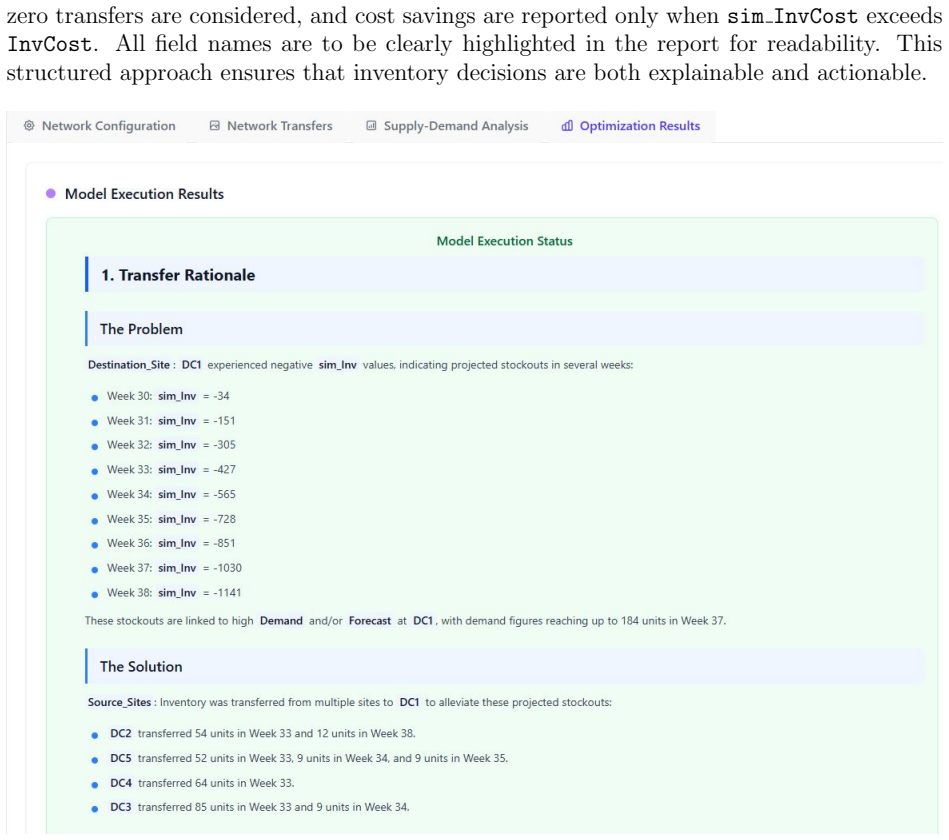
On its own terms, the paper's central claim is that an LLM-driven explanation layer can make a standard network-optimization model genuinely usable by people who are not operations-research specialists. The core model is a mixed-integer program that decides how much inventory to transfer between distribution centers, when, and from which source, while maximizing safety-stock benefit and penalizing shortages and shipment setup costs. The contribution is not a new optimization algorithm; it is the finding, via case study, that the same MIP solution, when translated by a two-LLM context-engineering pipeline into role-aware narratives and KPIs, prevents a projected stockout (DC1 reaches -1,141 s
Load-bearing premise
The case-study savings are computed by comparing two runs of the same mixed-integer model — one with and one without transfers — using author-chosen shortage and holding-cost coefficients, so if those coefficients do not match the retailer's real economics, the $394,734 figure and the transfer plan are not evidence of real-world improvement.
Editorial extensions
If this is right
- A single SCIP run can feed multiple audiences: analysts, managers, and executives each receive a different level of aggregation and explanation from the same solution.
- Planners can modify assumptions through JSON configuration files and re-run the optimization for what-if scenarios without changing code.
- The two-LLM reflection step acts as a quality check on the engineered context before it reaches the optimizer, improving accuracy and consistency of explanations.
- The framework positions the LLM as a facilitator rather than a replacement for human decisions, reducing the barrier to adopting OR tools in practice.
Reading between the lines
- The LLM layer changes communication, not the optimization solution; so measurable planning improvements must come through faster or more confident human decisions. A controlled experiment comparing planner decision time and error rate with and without the LLM layer would isolate the wrapper's contribution.
- The $394,734 savings is an arithmetic identity between two cost interpretations of the same inventory positions; change the shortage-penalty-to-holding-cost ratio and the number changes. The real-world claim therefore rests on the case study's cost parameters being the retailer's actual economics.
- The same CE pipeline could be pointed at shadow prices, slacks, or reduced costs to generate plain-English explanations of why a constraint binds, extending the framework beyond inventory rebalancing to scheduling and routing.
- A robustness check on the transfer plan across a plausible range of penalty coefficients would show whether the recommendation is stable or an artifact of the chosen weights.
Editorial analysis
A structured set of objections, weighed in public.
Referee Report
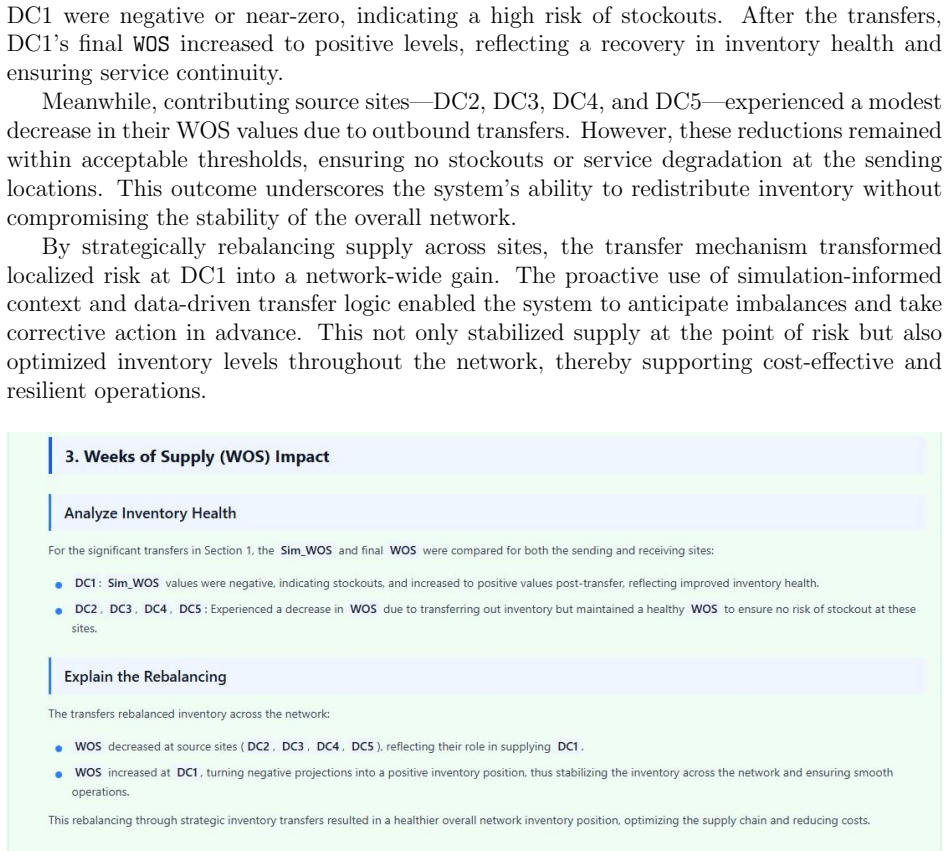
Summary. The paper presents an integrated decision-support system that couples a mixed-integer network optimization model for multi-period, multi-DC inventory transfers with LLM-based natural-language summaries, role-aware dashboards, and REST APIs. The optimization model maximizes safety-stock benefit minus shortage penalties and shipment costs. A case study with five DCs claims to prevent a projected stockout at DC1, save $394,734, and maintain healthy weeks of supply by transferring 294 units across DC2–DC5. The paper also details a 'context engineering' pipeline, system architecture, and future extensions.
Significance. If the quantitative claims were credible, the paper would demonstrate a practical integration of LLM explanation layers with OR-based supply chain planning. The architectural idea is plausible and the use of SCIP plus LLM templates is a natural systems contribution. However, the paper currently provides no reproducible code, no user study, no parameter values, and no external cost validation. The main numerical result rests on unstated cost coefficients and on a model formulation that is displayed with several errors, so the 'real-world case study' significance is not established in this version.
major comments (4)
- [§3.3, Eqs. (1b)–(1c)] The inventory balance constraints omit outbound transfers. For DC i, the balance should subtract ∑_{i'} X_{i i' t} when inventory is shipped out, but the constraints only add incoming shipments ∑_{i'} X_{i' i t} and subtract demand. As written, a DC can ship arbitrary quantities without reducing its own inventory. This directly undermines the source-site service-level claims in §5.5 and means the reported transfer plan may not be physically feasible under the stated model.
- [§3.3, Eq. (1e)] The 'No transshipment' constraint uses the undefined variable y_{i' t}; if it is intended to be Y_{i' t}, the constraint contradicts (1d), since (1d) requires Y_{i' t}=1 to allow inbound shipments while (1e) would then force X_{i' i t}≤0 when Y_{i' t}=1. The constraint therefore neither prevents reciprocal transshipments as written nor is mathematically well-defined. This needs correction and re-solving of the reported instance.
- [§5.5 and Eq. (1a)] The reported $394,734 cost saving is computed as sim InvCost minus InvCost, but neither cost function is defined, and the coefficients ĥ_it, k̂_it, r̂_it are never reported or tied to the retailer's actual economics. Moreover, the objective (1a) contains no holding-cost term for excess inventory I^E_it, so the optimizer is not trading off stockout penalties against overstocking costs. The claimed savings are therefore an artifact of the author-chosen penalty-to-holding cost ratio and are not falsifiable from the manuscript. Please provide the exact cost formulas and parameter values, or a sensitivity analysis over the ratio, before the cost-savings claim can be accepted.
- [§5.5, simulation baseline] The 'without optimization' baseline is generated from the same demand/forecast data and cost rules as the optimized run; it is not compared with the retailer's actual planning process or actual observed costs. Without a description of what sim InvCost represents and how its parameters are estimated, the statement that the system 'improves planning outcomes' is not supported by external evidence. The paper should either present real baseline/outcome data or substantially temper the real-world improvement claim.
minor comments (6)
- [§3.3, Eq. (1b)] The notation 't ∈ |T2|' is invalid; this should be 't > 1' or 't ∈ T \ {1}'.
- [§3.2] The variables I^S_it and I^E_it are used in the objective and constraints but are not defined in the notation subsection.
- [§3.3, Eqs. (1f), (1g), (1k)] These constraints quantify over i' but the expressions do not contain i'; the quantification should be removed for clarity.
- [§5.4] The claim that 'actual' and 'simulated' inventory alignment 'validates the forecasting model' is too strong based on a single site/time series; forecast validation would require error metrics and multiple sites.
- [§5.5] No data or code are provided to reproduce the transfer quantities, WOS values, or cost calculations, despite the paper being presented as a real-world case study.
- [§5.2] The LLM-generated summaries are illustrative; the paper does not evaluate summary accuracy, faithfulness to the optimization output, or user comprehension, so the 'explainable' claim is only demonstrated qualitatively.
Circularity Check
No significant circularity: the optimization model is stated explicitly, and the cost-savings demonstration is a model-internal simulation rather than a self-referential derivation.
full rationale
The paper's formulation (1a)-(1l) is presented explicitly, and no step of the claimed derivation defines a target quantity in terms of itself. The only self-citation affecting the narrative is ref [9] in the background sentence describing inventory balancing as a 'cornerstone' of supply chain planning; the MIP in Section 3 is stated in full and does not depend on that citation for its content, so the citation is not load-bearing. The cost-savings figure in §5.5 (sim InvCost minus InvCost) is a simulation counterfactual generated with the authors' cost coefficients and a template rule that reports savings only when sim InvCost exceeds InvCost. That is a serious external-validity and transparency limitation—the parameters are unreported and the baseline is not an independent real-world process—but it is not a circular derivation: the savings are not used as an input to the model, no parameter is fitted to a subset of data to force the result, and the optimizer's objective (1a) does not even contain the 'standard holding cost' term that the reported savings narrative invokes. The LLM summaries are post-hoc explanations of solver outputs rather than constraints on the optimization, so there is no self-definitional loop between the LLM layer and the MIP. Under the hard rule requiring a specific equation-to-equation reduction or a fitted parameter renamed as a prediction, no such reduction appears. The central derivation chain is therefore not circular, although the empirical claim would need external cost data and reported coefficients to be validated.
Assumptions & free parameters
free parameters (8)
- safety stock benefit h_hat_it =
not disclosed
- shortage penalty k_hat_it =
not disclosed
- fixed shipment cost r_hat_it =
not disclosed
- minimum shipment threshold Q =
not disclosed
- big-M constant M =
not disclosed
- safety stock levels s_hat_it =
not disclosed
- demand d_hat_it and initial inventory I_i0 =
not disclosed
- holding cost and simulated stockout cost (InvCost, sim InvCost) =
not disclosed
assumptions (5)
- domain assumption Demand forecasts used in the case study are accurate
- domain assumption The MIP formulation correctly encodes the business rules
- domain assumption LLM agents reliably produce correct, role-appropriate output
- domain assumption Cost coefficients reflect true supply chain economics
- standard math Standard linear programming and MIP theory
Cite this review
Pith. "Pith review of Integrating Large Language Models with Network Optimization for Interactive and Explainable Supply Chain Planning: A Real-World Case Study." pith.science (2026). https://pith.science/paper/JUWD55RE
@misc{pith2026250821622,
  author       = {Pith},
  title        = {Pith review of: Integrating Large Language Models with Network Optimization for Interactive and Explainable Supply Chain Planning: A Real-World Case Study},
  year         = {2026},
  howpublished = {\url{https://pith.science/paper/JUWD55RE}},
  note         = {Machine review of arXiv:2508.21622}
}
read the original abstract
This paper presents an integrated framework that combines traditional network optimization models with large language models (LLMs) to deliver interactive, explainable, and role-aware decision support for supply chain planning. The proposed system bridges the gap between complex operations research outputs and business stakeholder understanding by generating natural language summaries, contextual visualizations, and tailored key performance indicators (KPIs). The core optimization model addresses tactical inventory redistribution across a network of distribution centers for multi-period and multi-item, using a mixed-integer formulation. The technical architecture incorporates AI agents, RESTful APIs, and a dynamic user interface to support real-time interaction, configuration updates, and simulation-based insights. A case study demonstrates how the system improves planning outcomes by preventing stockouts, reducing costs, and maintaining service levels. Future extensions include integrating private LLMs, transfer learning, reinforcement learning, and Bayesian neural networks to enhance explainability, adaptability, and real-time decision-making.
Figures


Figures from the paper (6 more)



Forward citations
Cited by 2 Pith papers
-
Bayesian Uncertainty Propagation for Agentic RAG Pipelines: A Proof-of-Concept Study on Multi-Hop Question Answering
The study applies Bayesian uncertainty propagation to agentic RAG pipelines on StrategyQA and HotpotQA, reporting better discrimination on HotpotQA than on StrategyQA using standard calibration and selective-predictio...
-
Deep Learning for Sequential Decision Making under Uncertainty: Foundations, Frameworks, and Frontiers
A tutorial framing deep learning as a complement to optimization for sequential decision-making under uncertainty, with applications in supply chains, healthcare, and energy.
Reference graph
Works this paper leans on
-
[1]
M. H. Hugos, Essentials of supply chain management, John Wiley Sons (2018)
work page 2018
-
[2]
D. M. Lambert, M. C. Cooper, Issues in supply chain management, Industrial marketing management 29 (1) (2000) 65–83
work page 2000
-
[3]
OpenAI, Gpt-4 technical report (2023)
work page 2023
- [4]
-
[5]
P. Lee, S. Bubeck, J. Petro, Benefits, limits, and risks of gpt-4 as an ai chatbot for medicine, New England Journal of Medicine 388 (13) (2023) 1233–1239
work page 2023
-
[6]
M. Mostajabdaveh, T. T. L. Yu, S. C. B. Dash, R. Ramamonjison, J. S. Byusa, G. Carenini, Z. Zhou, Y. Zhang, Evaluating llm reasoning in the operations research domain with orqa, in: Proceedings of the AAAI Conference on Artificial Intelligence, Vol. 39, 2025, pp. 24902–24910
work page 2025
-
[7]
B. Li, K. Mellou, B. Zhang, J. Pathuri, I. Menache, Large language models for supply chain optimization, arXiv preprint arXiv:2307.03875 (2023)
arXiv 2023
-
[8]
P. P. Ray, A survey on model context protocol: Architecture, state-of-the-art, challenges and future directions, Authorea Preprints (2025)
work page 2025
Show all 33 references
-
[9]
Venkatachalam, K
S. Venkatachalam, K. Sundar, A. Narayanan, Inventory balancing in operations planning–an application to supply chain replenishment, Available at SSRN 5349428
-
[10]
Taghizadeh, S
E. Taghizadeh, S. Venkatachalam, R. B. Chinnam, Impact of deep-tier visibility on effective resilience assessment of supply networks, International Journal of Production Economics 241 (2021) 108254
2021
-
[11]
Venkatachalam, A
S. Venkatachalam, A. Narayanan, Efficient formulation and heuristics for multi-item single source ordering problem with transportation cost, International Journal of Production Research 54 (14) (2016) 4087–4103
2016
-
[12]
Taghizadeh, S
E. Taghizadeh, S. Venkatachalam, Two-stage risk-averse stochastic programming approach for multi-item single source ordering problem: Cvar minimisation with transportation cost, International Journal of Production Research 61 (7) (2023) 2129– 2146
2023
-
[13]
Venkatachalam, A
S. Venkatachalam, A. Narayanan, Two-stage absolute semi-deviation mean-risk stochas- tic programming: an application to the supply chain replenishment problem, Computers & Operations Research 106 (2019) 62–75
2019
-
[14]
D. J. Garcia, F. You, Supply chain design and optimization: Challenges and opportu- nities, Computers & Chemical Engineering 81 (2015) 153–170
2015
-
[15]
Pourhejazy, O
P. Pourhejazy, O. K. Kwon, The new generation of operations research methods in supply chain optimization: A review, Sustainability 8 (10) (2016) 1033
2016
-
[16]
Nickel, C
S. Nickel, C. Steinhardt, H. Schlenker, W. Burkart, Decision Optimization with IBM ILOG CPLEX Optimization Studio: A Hands-On Introduction to Modeling with the Optimization Programming Language (OPL), Springer Nature, 2022
2022
-
[17]
ˇCyras, D
K. ˇCyras, D. Letsios, R. Misener, F. Toni, Argumentation for explainable scheduling, in: Proceedings of the AAAI Conference on Artificial Intelligence, Vol. 33, 2019, pp. 2752–2759. 19
2019
-
[18]
GitHub, Github copilot: Your ai pair programmer (2023)
2023
-
[19]
L. Chen, M. Zaharia, J. Zou, Frugalgpt: How to use large language models while reducing cost and improving performance, arXiv preprint arXiv:2305.05176 (2023)
2023 arXiv
-
[20]
Devlin, M.-W
J. Devlin, M.-W. Chang, K. Lee, K. Toutanova, Bert: Pre-training of deep bidirectional transformers for language understanding, arXiv preprint arXiv:1810.04805 (2018)
2018 arXiv
-
[21]
Rosset, Turing-nlg: A 17-billion-parameter language model by microsoft, Microsoft Blog 1 (2) (2020)
C. Rosset, Turing-nlg: A 17-billion-parameter language model by microsoft, Microsoft Blog 1 (2) (2020)
2020
-
[22]
Smith, M
S. Smith, M. Patwary, B. Norick, P. LeGresley, S. Rajbhandari, J. Casper, Z. Liu, S. Prabhumoye, G. Zerveas, V. Korthikanti, et al., Using deepspeed and megatron to train megatron-turing nlg 530b, a large-scale generative language model, arXiv preprint arXiv:2201.11990 (2022)
2022 arXiv
-
[23]
Y. Liu, G. Deng, Y. Li, K. Wang, T. Zhang, Y. Liu, H. Wang, Y. Zheng, Y. Liu, Prompt injection attack against ilm-integrated applications, arXiv preprint arXiv:2306.05499 (2023)
2023 arXiv
-
[24]
Brown, B
T. Brown, B. Mann, N. Ryder, M. Subbiah, J. D. Kaplan, P. Dhariwal, A. Neelakantan, P. Shyam, G. Sastry, A. Askell, et al., Language models are few-shot learners, in: Advances in neural information processing systems, Vol. 33, 2020, pp. 1877–1901
2020
-
[25]
Danilevsky, K
M. Danilevsky, K. Qian, R. Aharonov, Y. Katsis, B. Kawas, P. Sen, A survey of the state of explainable ai for natural language processing, arXiv preprint arXiv:2010.00711 (2020)
2010 arXiv
-
[26]
Ahmed, G
I. Ahmed, G. Jeon, F. Piccialli, From artificial intelligence to explainable artificial intelligence in industry 4.0: a survey on what, how, and where, IEEE Transactions on Industrial Informatics 18 (8) (2022) 5031–5042
2022
-
[27]
Bommasani, D
R. Bommasani, D. A. Hudson, E. Adeli, R. Altman, S. Arora, S. von Arx, M. S. Bernstein, J. Bohg, A. Bosselut, E. Brunskill, et al., On the opportunities and risks of foundation models, arXiv preprint arXiv:2108.07258 (2021)
2021 arXiv
-
[28]
M. E. Peters, M. Neumann, M. Iyyer, M. Gardner, C. Clark, K. Lee, L. Zettlemoyer, Deep contextualized word representations (2018)
2018
-
[29]
Schwarz, An introduction to scip, University of Bayreuth (2010)
C. Schwarz, An introduction to scip, University of Bayreuth (2010)
2010
-
[30]
Touvron, T
H. Touvron, T. Lavril, G. Izacard, X. Martinet, M.-A. Lachaux, T. Lacroix, B. Rozi` ere, N. Goyal, E. Hambro, F. Azhar, et al., Llama: Open and efficient foundation language models, arXiv preprint arXiv:2302.13971 (2023)
2023 arXiv
-
[31]
Weiss, T
K. Weiss, T. M. Khoshgoftaar, D. Wang, A survey of transfer learning, Journal of Big data 3 (1) (2016) 1–40. 20
2016
-
[32]
Lester, R
B. Lester, R. Al-Rfou, N. Constant, The power of scale for parameter-efficient prompt tuning, arXiv preprint arXiv:2104.08691 (2021)
2021 arXiv
-
[33]
Dettmers, A
T. Dettmers, A. Pagnoni, A. Holtzman, L. Zettlemoyer, Qlora: Efficient finetuning of quantized llms, arXiv preprint arXiv:2305.14314 (2023). 21
2023 arXiv
Reviewed August 5, 2026 · model on record in the stance chip above.
Discussion (0). Sign in to comment.