Odd-Parity Magnetism in Fe-Based Superconductors
Pith reviewed 2026-05-18 20:26 UTC · model grok-4.3
The pith
Fe-based superconductors with coplanar magnetic order realize an odd-parity magnetic state with h-wave spin splitting along kz.
A machine-rendered reading of the paper's core claim, the machinery that carries it, and where it could break.
Core claim
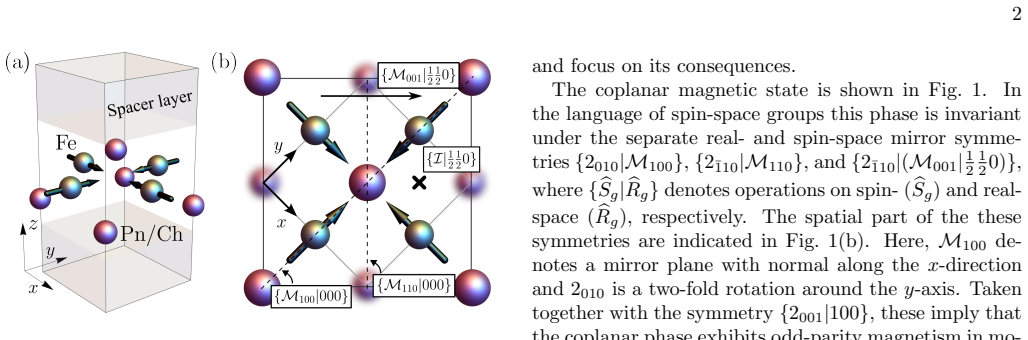
The Fe-based superconductors exhibiting coplanar magnetic order realize an odd-parity magnetic state by combining low-energy modeling with density-functional theory. In the absence of spin-orbit coupling, the electronic spins are polarized along the kz-direction and the splitting of the up and down states exhibits an h-wave form-factor. The magnitude of the splitting depends sensitively on specific parameters of the low-energy model, including specific out-of-plane hopping parameters and the Fermi energies of the hole- and electron-pockets. Despite breaking inversion symmetry and exhibiting a finite out-of-plane Berry curvature and non-linear anomalous Hall effect, the Edelstein effect is a.
What carries the argument
Low-energy electronic model of the coplanar magnetic order, whose out-of-plane hopping terms produce the h-wave spin-splitting form factor when the Fermi energies of hole and electron pockets are appropriately placed.
If this is right
- The state produces a finite out-of-plane Berry curvature and a non-linear anomalous Hall effect.
- The Edelstein effect is absent without spin-orbit coupling but acquires in-plane components once spin-orbit coupling is included.
- The odd-parity magnetic order can in principle coexist with the unconventional superconductivity already present in these compounds.
- The strength of the spin splitting is tunable through changes in out-of-plane hopping or pocket energies.
Where Pith is reading between the lines
- Pressure or doping that alters the out-of-plane hoppings could be used to switch the odd-parity splitting on and off.
- The combination of broken inversion symmetry with preserved time-reversal symmetry may stabilize pairing states that are otherwise forbidden.
- Similar coplanar orders in other layered compounds could be reexamined for hidden h-wave spin textures.
Load-bearing premise
The low-energy model parameters, specifically the out-of-plane hopping amplitudes and the Fermi energies of the hole and electron pockets, can be chosen such that a finite h-wave spin splitting occurs while remaining consistent with the known coplanar magnetic order and other experimental constraints.
What would settle it
Momentum-resolved spin-polarized spectroscopy or ARPES that either detects or rules out an h-wave spin splitting along kz in a material with established coplanar magnetic order.
Figures


read the original abstract
Odd-parity magnetism constitutes an intriguing phase of matter which breaks inversion symmetry while preserving time-reversal symmetry. Here we demonstrate that the Fe-based superconductors exhibiting coplanar magnetic order realize an odd-parity magnetic state by combining low-energy modeling with density-functional theory. In the absence of spin-orbit coupling, the electronic spins are polarized along the $k_z$-direction and the splitting of the up and down states exhibits an $h$-wave form-factor. The magnitude of the splitting depends sensitively on specific parameters of the low-energy model, including specific out-of-plane hopping parameters and the Fermi energies of the hole- and electron-pockets. Interestingly, despite this state breaking inversion symmetry and exhibiting a finite out-of-plane Berry curvature and non-linear anomalous Hall effect, the Edelstein effect vanishes. Incorporating spin-orbit coupling tilts the momentum-space electronic spins into the ($k_x,k_y$)-plane and imparts finite in-plane components to the Edelstein response. Our findings highlight the Fe-based superconductors as platforms for exploring odd-parity magnetism both on its own and coexisting with unconventional superconductivity.
Editorial analysis
A structured set of objections, weighed in public.
Referee Report
Summary. The manuscript claims that Fe-based superconductors exhibiting coplanar magnetic order realize an odd-parity magnetic state. Combining a low-energy effective model with density-functional theory, the authors show that, in the absence of spin-orbit coupling, kz-polarized spins exhibit an h-wave spin splitting whose magnitude depends sensitively on out-of-plane hopping amplitudes and the Fermi energies of the hole and electron pockets. With spin-orbit coupling the spins tilt into the (kx,ky) plane, the Edelstein response acquires in-plane components, and a finite out-of-plane Berry curvature and nonlinear anomalous Hall effect are present. The work positions these materials as platforms for odd-parity magnetism, possibly coexisting with unconventional superconductivity.
Significance. If the low-energy parameters are shown to be robustly fixed by DFT and experiment rather than tuned to produce the desired splitting, the result would identify a concrete, experimentally accessible realization of odd-parity magnetism in a family of materials already known for superconductivity and magnetism. This would enable direct tests of inversion-symmetry breaking, Berry-curvature effects, and the interplay with superconducting order.
major comments (2)
- [Abstract and low-energy model] Abstract and the low-energy modeling section: the central claim that coplanar order realizes odd-parity magnetism requires a finite h-wave spin splitting of kz-polarized states. The abstract states that this splitting 'depends sensitively' on out-of-plane hopping parameters and the Fermi energies of the hole- and electron-pockets. The manuscript must demonstrate that the specific values obtained from the DFT fit (or other independent constraints) produce a nonzero splitting while remaining consistent with the observed coplanar order; otherwise the realization is not established and the result reduces to a parameter-tuned possibility.
- [DFT + low-energy model comparison] The weakest assumption identified in the stress-test note is load-bearing: if the DFT-derived out-of-plane hoppings and pocket energies instead yield vanishing or negligible h-wave splitting, the odd-parity state is not realized. The paper should report the numerical value of the splitting obtained with the unconstrained DFT parameters and show that it remains finite under reasonable variations.
minor comments (2)
- [Results section] Clarify the precise definition of the h-wave form factor (e.g., the angular dependence in the Brillouin zone) and provide an explicit expression or plot in the main text rather than only in supplementary material.
- [Edelstein effect discussion] The statement that the Edelstein effect vanishes without SOC should be accompanied by a brief symmetry argument or explicit calculation showing why the in-plane components are forbidden.
Simulated Author's Rebuttal
We thank the referee for the thoughtful and constructive report. The comments correctly identify the need to explicitly demonstrate that the DFT-constrained parameters produce a finite h-wave splitting, rather than leaving the result dependent on unverified tuning. We address each major comment below and will revise the manuscript accordingly.
read point-by-point responses
-
Referee: [Abstract and low-energy model] Abstract and the low-energy modeling section: the central claim that coplanar order realizes odd-parity magnetism requires a finite h-wave spin splitting of kz-polarized states. The abstract states that this splitting 'depends sensitively' on out-of-plane hopping parameters and the Fermi energies of the hole- and electron-pockets. The manuscript must demonstrate that the specific values obtained from the DFT fit (or other independent constraints) produce a nonzero splitting while remaining consistent with the observed coplanar order; otherwise the realization is not established and the result reduces to a parameter-tuned possibility.
Authors: We agree that the central claim requires explicit verification with the DFT-derived parameters. The low-energy model parameters, including out-of-plane hoppings and pocket Fermi energies, were obtained by fitting to DFT calculations performed on Fe-based superconductors known to exhibit coplanar magnetic order. With these parameters the h-wave splitting is finite and the spin polarization remains along kz in the absence of spin-orbit coupling, consistent with the observed magnetic structure. In the revised manuscript we will add the explicit numerical value of the splitting (obtained directly from the unconstrained DFT fit) together with a brief discussion confirming consistency with the coplanar order. revision: yes
-
Referee: [DFT + low-energy model comparison] The weakest assumption identified in the stress-test note is load-bearing: if the DFT-derived out-of-plane hoppings and pocket energies instead yield vanishing or negligible h-wave splitting, the odd-parity state is not realized. The paper should report the numerical value of the splitting obtained with the unconstrained DFT parameters and show that it remains finite under reasonable variations.
Authors: We accept this criticism. The present manuscript highlights the sensitivity of the splitting but does not tabulate the concrete value obtained from the DFT fit. We will revise the text to report this numerical value and to show that the splitting remains finite (and of appreciable magnitude) under small variations of the out-of-plane hoppings and pocket energies that are still compatible with experimental Fermi-surface data and the stability of the coplanar magnetic phase. revision: yes
Circularity Check
Derivation self-contained via symmetry and DFT-constrained low-energy model
full rationale
The paper constructs a low-energy model informed by density-functional theory to examine the electronic structure under coplanar magnetic order. The odd-parity character and h-wave spin splitting follow directly from the symmetry-allowed terms in the model Hamiltonian once the magnetic order is imposed, with out-of-plane hoppings and pocket Fermi energies entering as standard tight-binding parameters constrained by DFT bands and known experimental order. No equation or result is shown to reduce by construction to a fitted input renamed as prediction, a self-citation chain, or an ansatz smuggled from prior work; the central demonstration remains independent of its inputs and externally falsifiable against DFT and experiment.
Axiom & Free-Parameter Ledger
free parameters (2)
- out-of-plane hopping parameters
- Fermi energies of the hole- and electron-pockets
axioms (1)
- domain assumption The low-energy model derived from DFT accurately captures the electronic states near the Fermi level in the presence of coplanar magnetic order.
Lean theorems connected to this paper
-
IndisputableMonolith/Cost/FunctionalEquation.leanwashburn_uniqueness_aczel unclear?
unclearRelation between the paper passage and the cited Recognition theorem.
the spin splitting can be expressed as ΔE ∼ |Δ|² 2a1 c g1 / (εΓ − ε1)² f(k) (kx² − ky²) kx ky sin kz
-
IndisputableMonolith/Foundation/AlphaCoordinateFixation.leanalpha_pin_under_high_calibration unclear?
unclearRelation between the paper passage and the cited Recognition theorem.
the magnitude of the splitting depends sensitively on specific out-of-plane hopping parameters and the Fermi energies of the hole- and electron-pockets
What do these tags mean?
- matches
- The paper's claim is directly supported by a theorem in the formal canon.
- supports
- The theorem supports part of the paper's argument, but the paper may add assumptions or extra steps.
- extends
- The paper goes beyond the formal theorem; the theorem is a base layer rather than the whole result.
- uses
- The paper appears to rely on the theorem as machinery.
- contradicts
- The paper's claim conflicts with a theorem or certificate in the canon.
- unclear
- Pith found a possible connection, but the passage is too broad, indirect, or ambiguous to say the theorem truly supports the claim.
Reference graph
Works this paper leans on
-
[1]
S. Ran, C. Eckberg, Q.-P. Ding, Y. Furukawa, T. Metz, S. R. Saha, I.-L. Liu, M. Zic, H. Kim, J. Paglione, and N. P. Butch, Nearly ferromagnetic spin-triplet supercon- ductivity, Science 365, 684 (2019)
work page 2019
- [2]
-
[3]
S.-B. Zhang, L.-H. Hu, and T. Neupert, Finite- momentum Cooper pairing in proximitized altermagnets, Nature Communications 15, 1801 (2024)
work page 2024
-
[4]
F. Pientka, L. I. Glazman, and F. von Oppen, Topological 6 superconducting phase in helical Shiba chains, Phys. Rev. B 88, 155420 (2013)
work page 2013
-
[5]
P. Fulde and R. A. Ferrell, Superconductivity in a strong spin-exchange field, Phys. Rev. 135, A550 (1964)
work page 1964
-
[6]
A. I. Larkin and Y. N. Ovchinnikov, Nonuniform state of superconductors, Zh. Eksp. Teor. Fiz. 47, 1136 (1964)
work page 1964
-
[7]
D. J. Scalapino, A common thread: The pairing inter- action for unconventional superconductors, Rev. Mod. Phys. 84, 1383 (2012)
work page 2012
-
[8]
R. M. Fernandes, A. I. Coldea, H. Ding, I. R. Fisher, P. J. Hirschfeld, and G. Kotliar, Iron pnictides and chalco- genides: a new paradigm for superconductivity, Nature 601, 35 (2022)
work page 2022
-
[9]
P. Monthoux, D. Pines, and G. G. Lonzarich, Supercon- ductivity without phonons, Nature 450, 1177 (2007)
work page 2007
-
[10]
A. T. Rømer, T. A. Maier, A. Kreisel, I. Eremin, P. J. Hirschfeld, and B. M. Andersen, Pairing in the two- dimensional Hubbard model from weak to strong cou- pling, Phys. Rev. Res. 2, 013108 (2020)
work page 2020
-
[11]
C. Wu, K. Sun, E. Fradkin, and S.-C. Zhang, Fermi liquid instabilities in the spin channel, Phys. Rev. B 75, 115103 (2007)
work page 2007
- [12]
-
[13]
I. I. Mazin, K. Koepernik, M. D. Johannes, R. Gonz´ alez- Hern´ andez, and L.ˇSmejkal, Prediction of unconventional magnetism in doped FeSb 2, Proceedings of the National Academy of Sciences 118, e2108924118 (2021)
work page 2021
-
[14]
L. ˇSmejkal, J. Sinova, and T. Jungwirth, Beyond Con- ventional Ferromagnetism and Antiferromagnetism: A Phase with Nonrelativistic Spin and Crystal Rotation Symmetry, Phys. Rev. X 12, 031042 (2022)
work page 2022
-
[15]
Mazin (The PRX Editors), Editorial: Altermagnetism—a new punch line of fundamental magnetism, Phys
I. Mazin (The PRX Editors), Editorial: Altermagnetism—a new punch line of fundamental magnetism, Phys. Rev. X 12, 040002 (2022)
work page 2022
-
[16]
S. Bhowal and N. A. Spaldin, Ferroically Ordered Mag- netic Octupoles in d-Wave Altermagnets, Phys. Rev. X 14, 011019 (2024)
work page 2024
-
[17]
A. Birk Hellenes, T. Jungwirth, R. Jaeschke-Ubiergo, A. Chakraborty, J. Sinova, and L. ˇSmejkal, P-wave mag- nets, arXiv e-prints , arXiv:2309.01607 (2023)
work page Pith review arXiv 2023
-
[18]
L. ˇSmejkal, J. Sinova, and T. Jungwirth, Emerging Re- search Landscape of Altermagnetism, Phys. Rev. X 12, 040501 (2022)
work page 2022
-
[19]
L. ˇSmejkal, A. B. Hellenes, R. Gonz´ alez-Hern´ andez, J. Sinova, and T. Jungwirth, Giant and Tunneling Mag- netoresistance in Unconventional Collinear Antiferro- magnets with Nonrelativistic Spin-Momentum Coupling, Phys. Rev. X 12, 011028 (2022)
work page 2022
-
[20]
Y. Guo, H. Liu, O. Janson, I. C. Fulga, J. van den Brink, and J. I. Facio, Spin-split collinear antiferromagnets: A large-scale ab-initio study, Materials Today Physics 32, 100991 (2023)
work page 2023
-
[21]
J. Sødequist and T. Olsen, Two-dimensional altermag- nets from high throughput computational screening: Symmetry requirements, chiral magnons, and spin-orbit effects, Applied Physics Letters 124, 182409 (2024)
work page 2024
-
[22]
Y. Yu, M. B. Lyngby, T. Shishidou, M. Roig, A. Kreisel, M. Weinert, B. M. Andersen, and D. F. Agterberg, Odd- parity magnetism driven by antiferromagnetic exchange, Phys. Rev. Lett. 135, 046701 (2025)
work page 2025
- [23]
-
[24]
J. Krempask´ y, L.ˇSmejkal, S. W. D’Souza, M. Hajlaoui, G. Springholz, K. Uhl´ ıˇ rov´ a, F. Alarab, P. C. Constanti- nou, V. Strocov, D. Usanov, W. R. Pudelko, R. Gonz´ alez- Hern´ andez, A. Birk Hellenes, Z. Jansa, H. Reichlov´ a, et al. , Altermagnetic lifting of Kramers spin degeneracy, Nature 626, 517 (2024)
work page 2024
-
[25]
S. Reimers, L. Odenbreit, L. ˇSmejkal, V. N. Strocov, P. Constantinou, A. B. Hellenes, R. Jaeschke Ubiergo, W. H. Campos, V. K. Bharadwaj, A. Chakraborty, T. Denneulin, W. Shi, R. E. Dunin-Borkowski, S. Das, M. Kl¨ aui,et al., Direct observation of altermagnetic band splitting in CrSb thin films, Nature Communications 15, 2116 (2024)
work page 2024
-
[26]
H. Reichlova, R. Lopes Seeger, R. Gonz´ alez-Hern´ andez, I. Kounta, R. Schlitz, D. Kriegner, P. Ritzinger, M. Lammel, M. Leivisk¨ a, A. Birk Hellenes, K. Olejn´ ık, V. Petˇ riˇ cek, P. Doleˇ zal, L. Horak, E. Schmoranzerova, et al. , Observation of a spontaneous anomalous Hall re- sponse in the Mn5Si3 d-wave altermagnet candidate, Na- ture Communications...
work page 2024
-
[27]
R. B. Regmi, H. Bhandari, B. Thapa, Y. Hao, N. Sharma, J. McKenzie, X. Chen, A. Nayak, M. El Gazzah, B. G. M´ arkus, L. Forr´ o, X. Liu, H. Cao, J. F. Mitchell, I. I. Mazin, and N. J. Ghimire, Altermagnetism in the layered intercalated transition metal dichalcogenide CoNb 4Se8, Nature Communications 16, 4399 (2025)
work page 2025
-
[28]
C. Candelora, M. Xu, S. Cheng, A. De Vita, D. Ro- manin, C. Bigi, M. Bang Petersen, A. LaFleur, M. Ca- landra, J. Miwa, Y. Hwang, Z. Wang, F. Mazzola, and I. Zeljkovic, Discovery of intertwined spin and charge density waves in a layered altermagnet, arXiv e-prints , arXiv:2503.03716 (2025)
- [29]
-
[30]
R. Yamada, M. T. Birch, P. R. Baral, S. Okumura, R. Nakano, S. Gao, Y. Ishihara, K. K. Kolincio, I. Be- lopolski, H. Sagayama, H. Nakao, K. Ohishi, T. Naka- jima, Y. Tokura, T.-h. Arima, Y. Motome, M. M. Hirschmann, and M. Hirschberger, Gapping the spin- nodal planes of an anisotropic p-wave magnet to in- duce a large anomalous Hall effect, arXiv e-prints...
-
[31]
Q. Song, S. Stavri´ c, P. Barone, A. Droghetti, D. S. An- tonenko, J. W. F. Venderbos, C. A. Occhialini, B. Ilyas, E. Erge¸ cen, N. Gedik, S.-W. Cheong, R. M. Fernandes, S. Picozzi, and R. Comin, Electrical switching of ap-wave magnet, Nature 642, 64 (2025)
work page 2025
-
[32]
D. H. Lu, M. Yi, S.-K. Mo, A. S. Erickson, J. Analytis, J.-H. Chu, D. J. Singh, Z. Hussain, T. H. Geballe, I. R. Fisher, and Z.-X. Shen, Electronic structure of the iron- based superconductor LaOFeP, Nature 455, 81 (2008)
work page 2008
-
[33]
H. Eschrig and K. Koepernik, Tight-binding models for the iron-based superconductors, Phys. Rev. B 80, 104503 (2009)
work page 2009
-
[34]
V. Cvetkovic and O. Vafek, Space group symmetry, spin- orbit coupling, and the low-energy effective Hamiltonian for iron-based superconductors, Phys. Rev. B 88, 134510 (2013)
work page 2013
-
[35]
R. M. Fernandes and A. V. Chubukov, Low-energy micro- scopic models for iron-based superconductors: a review, 7 Reports on Progress in Physics 80, 014503 (2016)
work page 2016
-
[36]
A. Kreisel, P. J. Hirschfeld, and B. M. Andersen, On the Remarkable Superconductivity of FeSe and Its Close Cousins, Symmetry 12, 10.3390/sym12091402 (2020)
-
[37]
G. R. Stewart, Superconductivity in iron compounds, Rev. Mod. Phys. 83, 1589 (2011)
work page 2011
-
[38]
R. Stadel, D. D. Khalyavin, P. Manuel, K. Yokoyama, S. Lapidus, M. H. Christensen, R. M. Fernandes, D. Phelan, D. Y. Chung, R. Osborn, S. Rosenkranz, and O. Chmaissem, Multiple magnetic orders in LaFeAs1−xPxO uncover universality of iron-pnictide su- perconductors, Communications Physics 5, 146 (2022)
work page 2022
-
[39]
J. M. Allred, K. M. Taddei, D. E. Bugaris, M. J. Krogstad, S. H. Lapidus, D. Y. Chung, H. Claus, M. G. Kanatzidis, D. E. Brown, J. Kang, R. M. Fernandes, I. Eremin, S. Rosenkranz, O. Chmaissem, and R. Os- born, Double-q spin-density wave in iron arsenide super- conductors, Nature Physics 12, 493 (2016)
work page 2016
-
[40]
J. Lorenzana, G. Seibold, C. Ortix, and M. Grilli, Com- peting Orders in FeAs Layers, Phys. Rev. Lett. 101, 186402 (2008)
work page 2008
-
[41]
J. Kang, X. Wang, A. V. Chubukov, and R. M. Fernan- des, Interplay between tetragonal magnetic order, stripe magnetism, and superconductivity in iron-based materi- als, Phys. Rev. B 91, 121104 (2015)
work page 2015
-
[42]
M. N. Gastiasoro and B. M. Andersen, Competing mag- netic double- Q phases and superconductivity-induced reentrance of C2 magnetic stripe order in iron pnictides, Phys. Rev. B 92, 140506 (2015)
work page 2015
-
[43]
M. H. Christensen, J. Kang, B. M. Andersen, I. Eremin, and R. M. Fernandes, Spin reorientation driven by the in- terplay between spin-orbit coupling and Hund’s rule cou- pling in iron pnictides, Phys. Rev. B 92, 214509 (2015)
work page 2015
-
[44]
M. H. Christensen, D. D. Scherer, P. Kotetes, and B. M. Andersen, Role of multiorbital effects in the magnetic phase diagram of iron pnictides, Phys. Rev. B 96, 014523 (2017)
work page 2017
-
[45]
M. D. Lumsden and A. D. Christianson, Magnetism in Fe-based superconductors, Journal of Physics: Con- densed Matter 22, 203203 (2010)
work page 2010
-
[46]
Dai, Antiferromagnetic order and spin dynamics in iron-based superconductors, Rev
P. Dai, Antiferromagnetic order and spin dynamics in iron-based superconductors, Rev. Mod. Phys. 87, 855 (2015)
work page 2015
-
[47]
S. Avci, O. Chmaissem, J. M. Allred, S. Rosenkranz, I. Eremin, A. V. Chubukov, D. E. Bugaris, D. Y. Chung, M. G. Kanatzidis, J.-P. Castellan, J. A. Schlueter, H. Claus, D. D. Khalyavin, P. Manuel, A. Daoud- Aladine, and R. Osborn, Magnetically driven suppression of nematic order in an iron-based superconductor, Nature Communications 5, 3845 (2014)
work page 2014
-
[48]
W. R. Meier, Q.-P. Ding, A. Kreyssig, S. L. Bud’ko, A. Sapkota, K. Kothapalli, V. Borisov, R. Valent´ ı, C. D. Batista, P. P. Orth, R. M. Fernandes, A. I. Gold- man, Y. Furukawa, A. E. B¨ ohmer, and P. C. Canfield, Hedgehog spin-vortex crystal stabilized in a hole-doped iron-based superconductor, npj Quantum Materials 3, 5 (2018)
work page 2018
-
[49]
S. Wu, W. A. Phelan, L. Liu, J. R. Morey, J. A. Tutma- her, J. C. Neuefeind, A. Huq, M. B. Stone, M. Feygenson, D. W. Tam, B. A. Frandsen, B. Trump, C. Wan, S. R. Dunsiger, T. M. McQueen, Y. J. Uemura, and C. L. Bro- holm, Incommensurate Magnetism Near Quantum Criti- cality in CeNiAsO, Phys. Rev. Lett. 122, 197203 (2019)
work page 2019
-
[50]
A. V. Chubukov, D. V. Efremov, and I. Eremin, Mag- netism, superconductivity, and pairing symmetry in iron- based superconductors, Phys. Rev. B 78, 134512 (2008)
work page 2008
- [51]
- [52]
-
[53]
W. Lv, F. Kr¨ uger, and P. Phillips, Orbital ordering and unfrustrated ( π, 0) magnetism from degenerate double exchange in the iron pnictides, Phys. Rev. B 82, 045125 (2010)
work page 2010
-
[54]
P. Dai, J. Hu, and E. Dagotto, Magnetism and its micro- scopic origin in iron-based high-temperature supercon- ductors, Nature Physics 8, 709 (2012)
work page 2012
-
[55]
Supplementary Material containing details of the pertur- bative calculation of the spin splitting and the calcula- tion of the Edelstein and anomalous Hall effects within the low energy model, as well as additional DFT results
-
[56]
I. Sodemann and L. Fu, Quantum Nonlinear Hall Effect Induced by Berry Curvature Dipole in Time-Reversal In- variant Materials, Phys. Rev. Lett. 115, 216806 (2015)
work page 2015
-
[57]
Z. Z. Du, H.-Z. Lu, and X. C. Xie, Nonlinear Hall effects, Nature Reviews Physics 3, 744 (2021)
work page 2021
-
[58]
A. I. Coldea and M. D. Watson, The key ingredients of the electronic structure of FeSe, Annual Review of Con- densed Matter Physics 9, 125 (2018)
work page 2018
-
[59]
S. V. Borisenko, D. V. Evtushinsky, Z.-H. Liu, I. Moro- zov, R. Kappenberger, S. Wurmehl, B. B¨ uchner, A. N. Yaresko, T. K. Kim, M. Hoesch, T. Wolf, and N. D. Zhi- gadlo, Direct observation of spin–orbit coupling in iron- based superconductors, Nature Physics 12, 311 (2016)
work page 2016
-
[60]
M. H. Christensen, J. Kang, and R. M. Fernandes, In- tertwined spin-orbital coupled orders in the iron-based superconductors, Phys. Rev. B 100, 014512 (2019)
work page 2019
-
[61]
K. Koepernik and H. Eschrig, Full-potential nonorthog- onal local-orbital minimum-basis band-structure scheme, Phys. Rev. B 59, 1743 (1999)
work page 1999
- [62]
-
[63]
K. Iida, Y. Nagai, S. Ishida, M. Ishikado, N. Murai, A. D. Christianson, H. Yoshida, Y. Inamura, H. Nakamura, A. Nakao, K. Munakata, D. Kagerbauer, M. Eisterer, K. Kawashima, Y. Yoshida, H. Eisaki, and A. Iyo, Co- existing spin resonance and long-range magnetic order of Eu in EuRbFe4As4, Phys. Rev. B 100, 014506 (2019)
work page 2019
-
[64]
J. M. Wilde, A. Kreyssig, D. Vaknin, N. S. Sangeetha, B. Li, W. Tian, P. P. Orth, D. C. Johnston, B. G. Ue- land, and R. J. McQueeney, Helical magnetic ordering in Sr(Co1−xNix)2As2, Phys. Rev. B 100, 161113 (2019)
work page 2019
-
[65]
A.-M. Nedi´ c, M. H. Christensen, Y. Lee, B. Li, B. G. Ueland, R. M. Fernandes, R. J. McQueeney, L. Ke, and P. P. Orth, Competing magnetic fluctuations and orders in a multiorbital model of doped SrCo 2As2, Phys. Rev. B 108, 245149 (2023)
work page 2023
-
[66]
B. Li, Y. Sizyuk, N. S. Sangeetha, J. M. Wilde, P. Das, W. Tian, D. C. Johnston, A. I. Goldman, A. Kreyssig, P. P. Orth, R. J. McQueeney, and B. G. Ueland, Antifer- romagnetic stacking of ferromagnetic layers and doping- controlled phase competition in Ca 1−xSrxCo2−yAs2, Phys. Rev. B 100, 024415 (2019). 8 εΓ ε1 ε3 1/(2mΓ) 1 /(2m1) 1 /(2m3) 132 −400 −647 −...
work page 2019
-
[67]
V. Cvetkovic and Z. Tesanovic, Multiband magnetism and superconductivity in Fe-based compounds, Euro- physics Letters 85, 37002 (2009). END MA TTER A. Low-energy model The parameters used in the low-energy model are given in Table I. The parameters controlling the in-plane dispersion are obtained from fitting the k · p-model of Ref. [34] to the tight-bind...
work page 2009
discussion (0)
Sign in with ORCID, Apple, or X to comment. Anyone can read and Pith papers without signing in.