Test of Time: Rethinking Temporal Signal of Benchmark Contamination
Pith reviewed 2026-05-18 21:07 UTC · model grok-4.3
The pith
The temporal decay signal for LLM benchmark contamination depends on question construction rather than source material alone.
A machine-rendered reading of the paper's core claim, the machinery that carries it, and where it could break.
Core claim
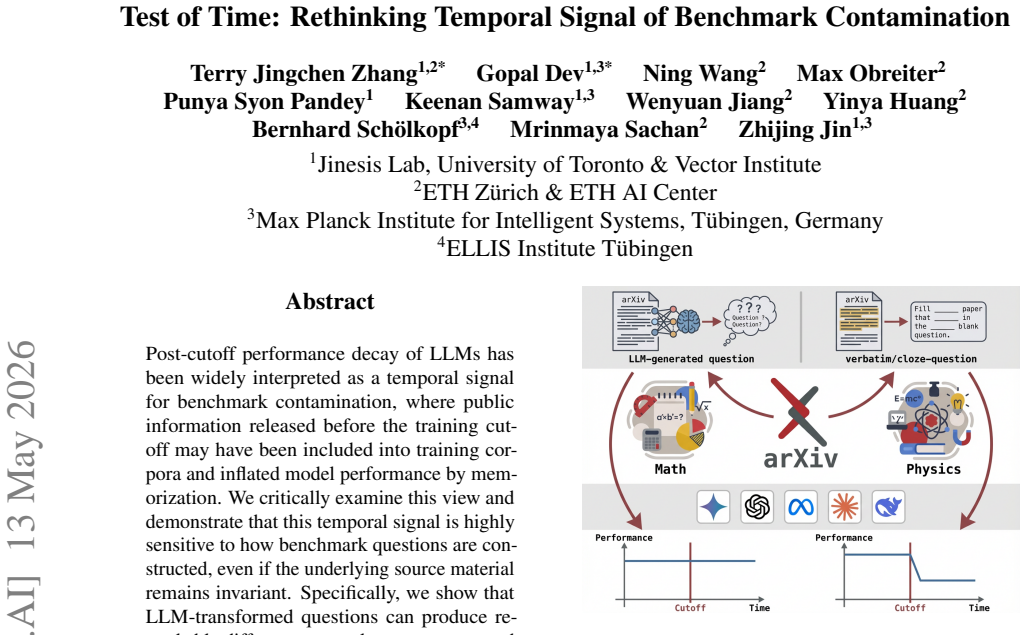
Post-cutoff performance decay has been interpreted as evidence of benchmark contamination via memorization of public data released before an LLM's training cutoff. The paper shows this decay is not invariant: cloze questions retrieved directly from source documents exhibit clear temporal decay on benchmarks such as LiveCodeBench, yet LLM-driven transformations of the identical problems remove the pattern. Influence function analysis supplies a mechanistic explanation for how question construction alters the observed temporal behavior.
What carries the argument
LLM-driven transformation of questions from fixed source documents, which alters temporal performance patterns while preserving the underlying material.
If this is right
- Temporal decay may fail to detect contamination reliably when benchmarks use transformed rather than cloze questions.
- Simple LLM transformations can eliminate apparent contamination signals in existing benchmarks without changing source content.
- Evaluation protocols require more robust contamination probes that do not hinge on a single question format.
- Influence function analysis can identify how specific construction choices drive differences in temporal model behavior.
Where Pith is reading between the lines
- The result raises the possibility that format-dependent artifacts affect other proposed signals of memorization beyond temporal decay.
- Benchmark designers could routinely apply transformations to generate evaluation sets less vulnerable to format-specific contamination readings.
- The finding invites direct tests on additional benchmarks to check whether the removal of decay generalizes across domains.
Load-bearing premise
The LLM-driven transformation preserves the underlying source material without introducing or removing factors that independently alter the temporal performance pattern.
What would settle it
If LLM-transformed versions of problems from LiveCodeBench or similar benchmarks retain the same post-cutoff decay as the original cloze questions, the claim that the signal is sensitive to construction would not hold.
Figures


read the original abstract
Post-cutoff performance decay of LLMs has been widely interpreted as a temporal signal for benchmark contamination, where public information released before the training cutoff may have been included into training corpora and inflated model performance by memorization. We critically examine this view and demonstrate that this temporal signal is highly sensitive to how benchmark questions are constructed, even if the underlying source material remains invariant. Specifically, we show that LLM-transformed questions can produce remarkably different temporal patterns compared to fill-in-the-blank (cloze) questions directly retrieved from the very same documents. We validate this effect on prior benchmarks that report clear post-cutoff decay (LiveCodeBench), and show that a simple LLM-driven transformation of the same problems can effectively remove the temporal pattern. We further provide a mechanistic understanding of this phenomenon using influence function analysis. Overall, our results suggest that post-cutoff performance decay is a sensitive contamination signal, motivating more robust contamination probes for reliable LLM evaluation.
Editorial analysis
A structured set of objections, weighed in public.
Referee Report
Summary. The paper claims that post-cutoff performance decay in LLMs on benchmarks is not a reliable signal of contamination because it is highly sensitive to question construction. Using LiveCodeBench, the authors show that original cloze questions retrieved from source documents exhibit clear post-cutoff decay, while LLM-transformed versions of the same problems produce markedly different temporal patterns that remove the decay signal. They validate the effect on prior benchmarks reporting decay and provide mechanistic support via influence function analysis, concluding that more robust contamination probes are needed.
Significance. If the central claim holds, the result would substantially weaken reliance on temporal decay as a contamination indicator and push the field toward format-robust evaluation methods. A strength is the combination of empirical validation on established benchmarks with influence-function analysis for mechanistic insight rather than purely correlational evidence.
major comments (1)
- [Section 3] Transformation experiment (Section 3 / Figure 2): The claim that LLM-driven transformations preserve the underlying source material invariant in content, difficulty, and required capabilities (while only varying surface format) is load-bearing for attributing temporal-pattern changes to question construction rather than shifts in tested skills. No explicit controls—such as semantic similarity metrics, human equivalence ratings, or difficulty calibration—are reported for the LiveCodeBench problems, leaving open the possibility that rephrasing or added context explains later-model gains via general capability advances.
minor comments (2)
- [Section 4] The influence-function analysis would be clearer if the paper explicitly states the approximation method (e.g., LiSSA or conjugate gradient) and the number of samples used for the Hessian-vector products.
- [Figures 1-3] Figure captions should include the exact number of problems per temporal bin and the precise definition of 'post-cutoff' date used for each benchmark.
Simulated Author's Rebuttal
We thank the referee for the constructive feedback. We address the single major comment on the transformation experiment below and agree that additional controls will strengthen the manuscript.
read point-by-point responses
-
Referee: [Section 3] Transformation experiment (Section 3 / Figure 2): The claim that LLM-driven transformations preserve the underlying source material invariant in content, difficulty, and required capabilities (while only varying surface format) is load-bearing for attributing temporal-pattern changes to question construction rather than shifts in tested skills. No explicit controls—such as semantic similarity metrics, human equivalence ratings, or difficulty calibration—are reported for the LiveCodeBench problems, leaving open the possibility that rephrasing or added context explains later-model gains via general capability advances.
Authors: We agree that explicit controls would make the invariance claim more robust. The transformations were generated with a prompt that instructs the model to convert the original cloze-style retrieval into a standard problem statement while preserving the core programming task, test cases, and required reasoning steps. To directly address the concern, the revised manuscript will report (i) average cosine similarity of sentence embeddings between each original and transformed question (expected >0.85), (ii) a human equivalence study on a random subset of 50 problems in which independent raters score content fidelity and difficulty on 5-point scales, and (iii) a brief comparison of solution lengths and required algorithmic primitives. These additions will help separate format effects from capability shifts. The influence-function results already indicate that the format change alters token-level influence patterns in a manner consistent with reduced memorization rather than a broad increase in capability. revision: yes
Circularity Check
Empirical comparison of cloze vs. transformed questions shows no circular derivation
full rationale
The paper's central result—that LLM-transformed questions from the same LiveCodeBench documents remove the post-cutoff temporal decay pattern observed in original cloze questions—is obtained through direct experimental comparison and influence function analysis on existing benchmarks. No load-bearing step reduces by construction to a fitted parameter, self-defined quantity, or self-citation chain; the invariance of source material is treated as an experimental premise rather than a derived output. The analysis remains self-contained against external benchmarks and does not invoke uniqueness theorems or ansatzes that loop back to the paper's own inputs.
Axiom & Free-Parameter Ledger
Lean theorems connected to this paper
-
IndisputableMonolith/Foundation/RealityFromDistinction.leanreality_from_one_distinction unclear?
unclearRelation between the paper passage and the cited Recognition theorem.
post-cutoff performance decay ... is highly sensitive to how benchmark questions are constructed, even if the underlying source material remains invariant
-
IndisputableMonolith/Cost/FunctionalEquation.leanwashburn_uniqueness_aczel unclear?
unclearRelation between the paper passage and the cited Recognition theorem.
influence function analysis ... models were able to identify source documents among the most influential training documents
What do these tags mean?
- matches
- The paper's claim is directly supported by a theorem in the formal canon.
- supports
- The theorem supports part of the paper's argument, but the paper may add assumptions or extra steps.
- extends
- The paper goes beyond the formal theorem; the theorem is a base layer rather than the whole result.
- uses
- The paper appears to rely on the theorem as machinery.
- contradicts
- The paper's claim conflicts with a theorem or certificate in the canon.
- unclear
- Pith found a possible connection, but the passage is too broad, indirect, or ambiguous to say the theorem truly supports the claim.
Reference graph
Works this paper leans on
-
[1]
Memorization or interpolation ? detecting llm memorization through input perturbation analysis. Preprint, arXiv:2505.03019. Yihong Dong, Xue Jiang, Huanyu Liu, Zhi Jin, Bin Gu, Mengfei Yang, and Ge Li. 2024. Generalization or Memorization: Data Contamination and Trust- worthy Evaluation for Large Language Models. In Findings of the Association for Computa...
-
[2]
Ziwei Ji, Delong Chen, Etsuko Ishii, Samuel Cahyaw- ijaya, Yejin Bang, Bryan Wilie, and Pascale Fung
OpenReview.net. Ziwei Ji, Delong Chen, Etsuko Ishii, Samuel Cahyaw- ijaya, Yejin Bang, Bryan Wilie, and Pascale Fung
-
[3]
LLM Internal States Reveal Hallucination Risk Faced With a Query. InProceedings of the 7th BlackboxNLP Workshop: Analyzing and Interpret- ing Neural Networks for NLP, pages 88–104, Miami, Florida, US. Association for Computational Linguis- tics. Aly M. Kassem, Omar Mahmoud, Niloofar Mireshghal- lah, Hyunwoo Kim, Yulia Tsvetkov, Yejin Choi, Sherif Saad, an...
work page 2025
-
[4]
InWorkshop on Socially Responsi- ble Language Modelling Research
LLM Hallucination Reasoning with Zero-shot Knowledge Test. InWorkshop on Socially Responsi- ble Language Modelling Research. Changmao Li and Jeffrey Flanigan. 2024. Task Con- tamination: Language Models May Not Be Few-Shot Anymore. InThirty-Eighth AAAI Conference on Ar- tificial Intelligence, AAAI 2024, Thirty-Sixth Confer- ence on Innovative Applications...
-
[5]
InForty-second Interna- tional Conference on Machine Learning
RE-IMAGINE: Symbolic benchmark synthe- sis for reasoning evaluation. InForty-second Interna- tional Conference on Machine Learning. Shuo Yang, Wei-Lin Chiang, Lianmin Zheng, Joseph Gonzalez, and Ion Stoica. 2023. Rethinking bench- mark and contamination for language models with rephrased samples. Hugh Zhang, Jeff Da, Dean Lee, Vaughn Robinson, Catherine W...
work page 2023
-
[6]
This variation reflects differing document im- pact: higher scores indicate that removing or mod- ifying the document would induce larger changes in model behavior, while lower scores correspond to comparatively smaller influence. C Details for Validation on LiveCodeBench For the perturbed LiveCodeBench (Jain et al., 2025) experiment, we use o4-mini to ge...
work page 2025
-
[7]
Keep the exact same algorithmic approach and complexity
-
[8]
Change variable names , function names , and context ( e . g . , if it uses'abc', use something like'XYZ ')
-
[9]
Modify specific values in test cases consistently with the context change
-
[10]
Maintain the same difficulty level and logic Original Problem : { problem_text } Original Test Examples : { test_examples } Provide the perturbed problem AND perturbed test cases in the following JSON format : { " p ro bl em _s tat em en t ": "..." , " test_cases ": [ {" input ": "..." , " output ": "..." , " testtype ": " stdin "} ] } Make sure to pertur...
work page 2023
discussion (0)
Sign in with ORCID, Apple, or X to comment. Anyone can read and Pith papers without signing in.