REVIEW 4 major objections 5 minor 43 references
Dual-Stage Global and Local Feature Framework for Image Dehazing
T0 review · 4 major / 5 minor · reviewed 2026-08-15 · deepseek-v4-flash
Pith's one-line read A two-stage global-then-local patch wrapper lifts high-resolution image dehazing from 14.9 dB to 25.4 dB PSNR in the paper's experiments.
desk verdict Plausible two-stage dehazing pipeline, but Algorithm 1 is mis-specified and the leaderboard tables contradict each other, so the claimed gains are not yet verifiable. read the letter →
The pith
A machine-rendered reading of the paper's core claim, the machinery that carries it, and where it could break.
The reading
What carries the argument
The load-bearing mechanism is the two-stage patch pipeline. The GFG pads the input to make height and width divisible by a patch size $G \times G$, divides the padded image into $n_h \times n_w$ grid patches intended to span the whole scene with minimal overlap, runs a dehazing model on each patch, and reconstructs a full-size output $\hat{I}_F$ by reversing the grid. The LFE then tiles that output into dense window patches, runs a second Uformer-based enhancer, and assembles the result with MOPS, which averages overlapping predictions under a second-order spline window to hide seams. Both models are trained with a customized loss that combines pixel-level fidelity with Laplacian-pyramid high-frequency alignment. The sequential ordering of these two blocks, global before local, is the design choice the ablations single out as decisive.
What would settle it
Execute Algorithm 1 as printed: because the lookup $P_k[i,j] = I'[i+n_w, j+n_h]$ does not involve the patch index $k$, every generated patch is identical, so the GFG stage cannot literally implement the claimed global coverage; a corrected sampling rule must be supplied and tested before the reported 25.43 dB can be attributed to the described mechanism.
Extended reading notes
Core claim
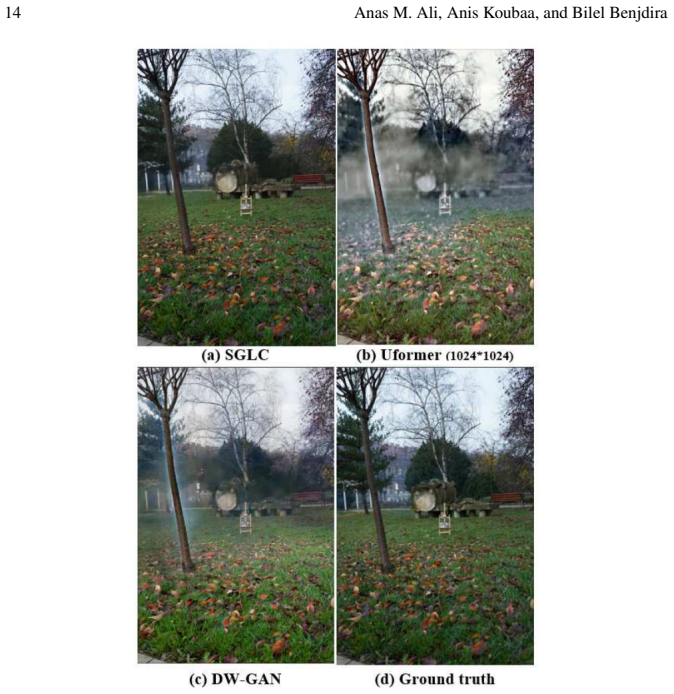
The central claim is that the global/local tension in high-resolution dehazing is best resolved sequentially rather than in parallel or by resizing. The GFG stage alone gives 24.49 dB PSNR on the local test set, already far above the 14.90 dB of Uformer applied to a resized image; adding the LFE raises this by about 0.89 dB to 25.43 dB, and the MOPS smoother adds only about 0.05 dB more while removing seams. Reversing the order (LFE before GFG) consistently underperforms, which the authors take as evidence that coarse holistic restoration should precede local refinement. The 2023 non-homogeneous dehazing challenge results are used to show the gain is not an artifact of the four-image local test: among no-extra-data solutions, SGLC tied for the best PSNR and SSIM.
Load-bearing premise
The framework's gains rest on the assumption that a coarse grid of minimally overlapping patches still supplies the dehazing model with enough global scene context, and that the printed patch-sampling rule actually covers the whole image rather than repeating one location.
Editorial extensions
If this is right
- Any existing dehazing network can be wrapped in SGLC to gain high-resolution capability, because the framework only adds patch generation, reconstruction, and blending around the model.
- The global-first, local-second order is essential: every reversed configuration tested underperforms the standard order.
- Dropping MOPS reduces per-image inference time from about 553 seconds to about 86 seconds while sacrificing only about 0.05 dB PSNR, giving an explicit accuracy-versus-speed trade-off for offline and near-real-time use.
- Because the top no-extra-data challenge results were achieved without external training data, the structure of SGLC itself, rather than data scale, appears to drive the improvement.
Reading between the lines
- If the grid-patching mechanism is corrected to sample distinct patch locations, the same sequential global-then-local wrapper could plausibly transfer to other high-resolution restoration tasks, such as deraining, deblurring, or super-resolution, that face the same global/local trade-off.
- The reported 25.43 dB comes from four self-selected training-set images; until the official withheld test split is used, the true margin over the 17.5 dB baselines remains an open question.
- A corrected implementation or code release would allow a direct check of whether the GFG stage is best understood as a global-context mechanism or simply as several independent dehazing passes whose outputs are stitched together.
Signed reviews
Editorial analysis
A structured set of objections, weighed in public.
Referee Report
Summary. The paper introduces SGLC, a two-stage framework for high-resolution image dehazing. The first stage (GFG) divides the padded input into grid patches, dehazes each patch with a base model (Uformer), and reconstructs a global output; the second stage (LFE) refines this output on window patches and uses a blending step (MOPS) to remove seams. The authors report large PSNR/SSIM gains over downsampled Uformer, DW-GAN, and 4K-Dehazer on a 4-image local subset of HD-NH-HAZE, and claim top no-extra-data ranks in the NTIRE 2023 Non-Homogeneous Dehazing Challenge.
Significance. If the results hold, SGLC offers a simple, model-agnostic way to adapt existing mid-resolution dehazing networks to high-resolution inputs, with an informative ablation showing the benefit of the global-then-local ordering and the computational cost of MOPS. The paper is honest about the large inference-time overhead and does not rely on external training data. However, the central empirical claim is currently not independently verifiable: the grid-patching algorithm is described incorrectly, the two NTIRE leaderboard tables contradict each other, and the local evaluation uses a self-selected 4-image split with no variance or confidence information.
major comments (4)
- [1.3.1.1, Algorithm 1] Algorithm 1's patch indexing, P_k[i,j] = I'[i+n_w, j+n_h], does not depend on the patch index k, so every generated patch is identical to the same shifted crop. As written, the grid-patching procedure cannot sample the full image and the central GFG mechanism of global coverage is not reproducible. The intended spatial offsets (e.g., based on k mod n_w and k div n_w) must be specified, or the algorithm description is incorrect.
- [1.4.2, Tables 1.2 and 1.3] The two leaderboard tables reported as the same final NTIRE 2023 challenge results are mutually inconsistent. Table 1.2 gives SGLC a PSNR of 22.27 dB with rank 1/12 among no-extra-data solutions and 3/17 overall in PSNR, while Table 1.3 lists SGLC at 22.49 dB with overall rank 5 and rank 2 among no-extra-data methods, with [Mask] at 22.90 dB. Both the PSNR values and the ranks cannot be correct simultaneously, so the paper does not currently establish SGLC's actual challenge standing.
- [1.4.1.1 and 1.4.2] The local evaluation that supports the headline gain is computed on a self-selected split of 4 images from the 40 training pairs, with no per-image scores, no standard deviation or confidence intervals, and no disclosure of how the 4 test images were chosen. Under these conditions, the reported 10 dB advantage over resized Uformer cannot be distinguished from split-selection effects. The authors should report full per-image metrics, justify the split selection, and provide seeds or repeated runs for reproducibility.
- [1.4.3] The text states that 'SGLC placed 5th among 13 submitted solutions' while Tables 1.2 and 1.3 refer to 17 solutions and rank 3/17 and 5/17 respectively; the counts and ranks should be reconciled with the official final leaderboard or the source should be cited consistently.
minor comments (5)
- [References] References [10] and [11] both point to the same NTIRE 2023 challenge report with different formatting; this should be unified.
- [1.4.1.2] The implementation details report only ranges for batch size and learning rate (e.g., batch size 2-8, learning rate 1e-4 to 2e-4); exact hyperparameters used for the final SGLC model should be stated for reproducibility.
- [1.3.1.5, Algorithm 2] The initialization line 'zeros(G·n_w, G·n_h, 3)' and the surrounding text use width and height in an ambiguous order; the axis conventions should be clarified to avoid confusion about which dimension is horizontal and which is vertical.
- [1.4.2] The sentence 'The visual comparison in Figure 1.6.' is a fragment and should be completed; additionally, Figure 1.6 is referenced without detailed discussion of what it shows beyond qualitative comparison.
- [Global] The method is called 'Streamlined Global and Local Features Combinator' in the abstract and 'Dual-Stage Global and Local Feature Framework' in the title; consistent naming should be used throughout.
Circularity Check
No significant circularity: the paper's claims are empirical comparisons against external baselines and a public leaderboard, with no fitted quantity renamed as a prediction and no load-bearing self-citation chain.
full rationale
The paper makes no derivation-style claim that X derives Y from an input by construction. Its headline result is an empirical comparison against external baselines (Uformer, DW-GAN, 4K-Dehazer) and the NTIRE 2023 Non-Homogeneous Dehazing Challenge leaderboard, which are independent of the present paper's fitted values. The customized loss function combines standard L2 and Laplacian-pyramid terms with a Charbonnier penalty; it is used as a training objective, not as a quantity that is later reported as a prediction. The self-supervised pretraining step is also a standard auxiliary task and does not encode the final PSNR or SSIM numbers. There are no load-bearing self-citations: the reference list contains no cited result by the present authors that is invoked to force a conclusion, and the paper does not import any uniqueness theorem from prior work by the same authors. The Grid Patching pseudocode inconsistency (Algorithm 1 sampling identically for every k) and the mutually inconsistent NTIRE leaderboard tables (Table 1.2 vs. Table 1.3) are real verifiability and correctness concerns, but they are not circular reasoning because neither equates an output to an input by definition or by statistical construction. Accordingly, no circular step is exhibited, and the appropriate score is 0.
Assumptions & free parameters
free parameters (3)
- Grid patch size G =
1024
- Charbonnier epsilon =
1e-3
- Batch size and learning rate =
2-8 and 1e-4 to 2e-4
assumptions (3)
- domain assumption Atmospheric scattering model I_h(x) = t(x)I_o(x) + (1-t(x))A(x)
- domain assumption A 36/4 split of the 40-image HD-NH-HAZE training set is sufficient for training and evaluation
- ad hoc to paper Grid patching preserves global context
Cite this review
Pith. "Pith review of Dual-Stage Global and Local Feature Framework for Image Dehazing." pith.science (2026). https://pith.science/paper/EGFA7265
@misc{pith2026250900108,
  author       = {Pith},
  title        = {Pith review of: Dual-Stage Global and Local Feature Framework for Image Dehazing},
  year         = {2026},
  howpublished = {\url{https://pith.science/paper/EGFA7265}},
  note         = {Machine review of arXiv:2509.00108}
}
read the original abstract
Addressing the challenge of removing atmospheric fog or haze from digital images, known as image dehazing, has recently gained significant traction in the computer vision community. Although contemporary dehazing models have demonstrated promising performance, few have thoroughly investigated high-resolution imagery. In such scenarios, practitioners often resort to downsampling the input image or processing it in smaller patches, which leads to a notable performance degradation. This drop is primarily linked to the difficulty of effectively combining global contextual information with localized, fine-grained details as the spatial resolution grows. In this chapter, we propose a novel framework, termed the Streamlined Global and Local Features Combinator (SGLC), to bridge this gap and enable robust dehazing for high-resolution inputs. Our approach is composed of two principal components: the Global Features Generator (GFG) and the Local Features Enhancer (LFE). The GFG produces an initial dehazed output by focusing on broad contextual understanding of the scene. Subsequently, the LFE refines this preliminary output by enhancing localized details and pixel-level features, thereby capturing the interplay between global appearance and local structure. To evaluate the effectiveness of SGLC, we integrated it with the Uformer architecture, a state-of-the-art dehazing model. Experimental results on high-resolution datasets reveal a considerable improvement in peak signal-to-noise ratio (PSNR) when employing SGLC, indicating its potency in addressing haze in large-scale imagery. Moreover, the SGLC design is model-agnostic, allowing any dehazing network to be augmented with the proposed global-and-local feature fusion mechanism. Through this strategy, practitioners can harness both scene-level cues and granular details, significantly improving visual fidelity in high-resolution environments.
Figures


Figures from the paper (3 more)


Reference graph
Works this paper leans on
-
[1]
IEEE Transactions on Image Processing 22(8), 3271–3282 (2013)
Ancuti, C.O., Ancuti, C.: Single image dehazing by multi-scale fusion. IEEE Transactions on Image Processing 22(8), 3271–3282 (2013)
work page 2013
-
[2]
Ashish Vaswani Noam Shazeer, N.P.J.U.L.J.A.N.G.K., Polosukhin, I.: Atten- tion is all you need (2017)
work page 2017
-
[3]
In: Proceedings of the IEEE Conference on Computer Vision and Pattern Recognition (CVPR), pp
Berman, D., Treibitz, T., Avidan, S.: Non-local image dehazing. In: Proceedings of the IEEE Conference on Computer Vision and Pattern Recognition (CVPR), pp. 1674–1682 (2016)
work page 2016
-
[4]
In: Proceedings of the IEEE/CVF Conference on Computer Vision and Pattern Recognition Workshops, pp
Bianco, S., Celona, L., Piccoli, F., Schettini, R.: High-resolution single image dehazing using encoder-decoder architecture. In: Proceedings of the IEEE/CVF Conference on Computer Vision and Pattern Recognition Workshops, pp. 0–0 (2019)
work page 2019
-
[5]
IEEE Transactions on Image Processing25(11), 5187–5198 (2016)
Bolun Cai Xiangmin Xu, K.J.C.Q., Tao, D.: Dehazenet: An end-to-end system for single image haze removal. IEEE Transactions on Image Processing25(11), 5187–5198 (2016)
work page 2016
-
[6]
Boyi Li Xiulian Peng, Z.W.J.X., Feng, D.: Aod-net: All-in-one dehazing net- work. In: ICCV (2017)
work page 2017
-
[7]
IEEE Transactions on Image Processing 25(11), 5187–5198 (2016)
Cai, B., Xu, X., Jia, K., Qing, C., Tao, D.: Dehazenet: An end-to-end system for single image haze removal. IEEE Transactions on Image Processing 25(11), 5187–5198 (2016)
work page 2016
-
[8]
IEEE geoscience and remote sensing letters 19, 1–5 (2021)
Chen, X., Li, Y., Dai, L., Kong, C.: Hybrid high-resolution learning for single remote sensing satellite image dehazing. IEEE geoscience and remote sensing letters 19, 1–5 (2021)
work page 2021
Show all 43 references
-
[9]
Ancuti Cosmin Ancuti, F.A.V., Timofte, R.: Ntire 2021 nonhomo- geneous dehazing challenge report
Codruta O. Ancuti Cosmin Ancuti, F.A.V., Timofte, R.: Ntire 2021 nonhomo- geneous dehazing challenge report. In: CVPR (2021)
2021
-
[11]
Ancuti Cosmin Ancuti, F.A.V., Timofte, R.: Nitre 2023 challenge on nonhomogeneous dehazing
Codruta O. Ancuti Cosmin Ancuti, F.A.V., Timofte, R.: Nitre 2023 challenge on nonhomogeneous dehazing. In: CVPR Workshops (2023)
2023
-
[12]
Pattern Recognition 108, 107563 (2020)
Dong, B., Chen, G., Zong, X., Feng, T.: Multi-scale boosted dehazing network with dense feature fusion. Pattern Recognition 108, 107563 (2020)
2020
-
[13]
ACM Transactions on Graphics (TOG) 27(3), 72:1–72:9 (2008)
Fattal, R.: Single image dehazing. ACM Transactions on Graphics (TOG) 27(3), 72:1–72:9 (2008)
2008
-
[14]
ACM Transactions on Graphics (TOG) (2014)
Fattal, R.: Dehazing using color-lines. ACM Transactions on Graphics (TOG) (2014)
2014
-
[15]
ACM Transactions on Graphics (TOG) 34(1), 13:1–13:14 (2014)
Fattal, R.: Dehazing using color-lines. ACM Transactions on Graphics (TOG) 34(1), 13:1–13:14 (2014)
2014
-
[16]
IEEE Transactions on Pattern Analysis and Machine Intelligence33(12), 2341–2353 (2011)
He, K., Sun, J., Tang, X.: Single image haze removal using dark channel prior. IEEE Transactions on Pattern Analysis and Machine Intelligence33(12), 2341–2353 (2011)
2011
-
[17]
ACM Computing Surveys (2022) 1 Dual-Stage Global and Local Feature Framework for Image Dehazing 21
Jie Gui Xiaofeng Cong, Y.C.W.R.J.Z.J.Z.J.C., Tao, D.: A comprehensive sur- vey and taxonomy on single image dehazing based on deep learning. ACM Computing Surveys (2022) 1 Dual-Stage Global and Local Feature Framework for Image Dehazing 21
2022
-
[18]
IEEE Transactions on Pattern Analysis and Machine Intelligence33(12), 2341–2353 (2011)
Kaiming He, J.S., Tang, X.: Single image haze removal using dark channel prior. IEEE Transactions on Pattern Analysis and Machine Intelligence33(12), 2341–2353 (2011)
2011
-
[19]
In: CVPR (2014)
Ketan Tang, J.Y., Wang, J.: Investigating haze-relevant features in a learning framework for image dehazing. In: CVPR (2014)
2014
-
[20]
In: Proceedings of the IEEE Conference on Computer Vision and Pattern Recognition Workshops, pp
Ki, S., Sim, H., Choi, J.S., Kim, S., Kim, M.: Fully end-to-end learning based conditional boundary equilibrium gan with receptive field sizes enlarged for single ultra-high resolution image dehazing. In: Proceedings of the IEEE Conference on Computer Vision and Pattern Recogn...
2018
-
[21]
Proceedings of the IEEE International Conference on Computer Vision (ICCV) pp
Li, B., Peng, X., Wang, Z., Xu, J., Feng, D.: Aod-net: All-in-one dehazing network. Proceedings of the IEEE International Conference on Computer Vision (ICCV) pp. 4770–4778 (2017)
2017
-
[22]
IEEE Transactions on Image Processing 29, 2766–2779 (2019)
Li, B., Peng, X., Wang, Z., Xu, J., Feng, D., Guo, Y.: Semi-supervised image dehazing. IEEE Transactions on Image Processing 29, 2766–2779 (2019)
2019
-
[23]
In: CVPR (2020)
Ming Hong Yuan Xie, C.L., Qu, Y.: Distilling image dehazing with heteroge- neous task imitation. In: CVPR (2020)
2020
-
[24]
In: CVPR (2021)
Minghan Fu Huan Liu, Y.Y.J.C., Wang, K.: Dw-gan: A discrete wavelet trans- form gan for nonhomogeneous dehazing. In: CVPR (2021)
2021
-
[25]
In: Proceedings of the AAAI Conference on Artificial Intelligence, vol
Qin, X., Wang, Z., Bai, Y., Xie, X., Jia, H.: FFA-Net: Feature fusion attention network for single image dehazing. In: Proceedings of the AAAI Conference on Artificial Intelligence, vol. 34, pp. 11908–11915 (2020)
2020
-
[26]
IEEE Transactions on Image Processing 24(11), 3522–3533 (2015)
Qingsong Zhu, J.M., Shao, L.: A fast single image haze removal algorithm using color attenuation prior. IEEE Transactions on Image Processing 24(11), 3522–3533 (2015)
2015
-
[27]
arXiv preprint arXiv:1908.11035 (2019)
Qu, Y., Cai, H., Xiao, C., Ren, D., Ma, W.: Enhanced pix2pix dehazing network. arXiv preprint arXiv:1908.11035 (2019)
2019 arXiv
-
[28]
In: European Conference on Computer Vision (ECCV), pp
Ren, W., Liu, S., Zhang, H., Pan, J., Cao, X., Yang, M.H.: Single image dehazing via multi-scale convolutional neural networks. In: European Conference on Computer Vision (ECCV), pp. 154–169. Springer (2016)
2016
-
[29]
In: CVPR (2018)
Runde Li Jinshan Pan, Z.L., Tang, J.: Single image dehazing via conditional generative adversarial network. In: CVPR (2018)
2018
-
[30]
In: Proceed- ings of the IEEE Conference on Computer Vision and Pattern Recognition Workshops, pp
Sim, H., Ki, S., Choi, J.S., Seo, S., Kim, S., Kim, M.: High-resolution image dehazing with respect to training losses and receptive field sizes. In: Proceed- ings of the IEEE Conference on Computer Vision and Pattern Recognition Workshops, pp. 912–919 (2018)
2018
-
[31]
arXiv preprint (2021)
Tian Ye Mingchao Jiang, Y.Z.L.C.E.C.P.C., Lu, Z.: Perceiving and modeling density is all you need for image dehazing. arXiv preprint (2021)
2021
-
[32]
In: Proceedings of the IEEE/CVF conference on computer vision and pattern recognition, pp
Wang, Z., Cun, X., Bao, J., Zhou, W., Liu, J., Li, H.: Uformer: A general u-shaped transformer for image restoration. In: Proceedings of the IEEE/CVF conference on computer vision and pattern recognition, pp. 17683–17693 (2022)
2022
-
[33]
In: CVPR (2018) 22 Anas M
Wenqi Ren Lin Ma, J.Z.J.P.X.C.W.L., Yang, M.H.: Gated fusion network for single image dehazing. In: CVPR (2018) 22 Anas M. Ali, Anis Koubaa, and Bilel Benjdira
2018
-
[34]
In: AAAI (2020)
Xu Qin Zhilin Wang, Y.B.X.X., Jia, H.: Ffa-net: Feature fusion attention net- work for single image dehazing. In: AAAI (2020)
2020
-
[35]
Nature (2015)
Yann LeCun, Y.B., Hinton, G.: Deep learning. Nature (2015)
2015
-
[36]
In: CVPR (2019)
Yanyun Qu Yizi Chen, J.H., Xie, Y.: Enhanced pix2pix dehazing network. In: CVPR (2019)
2019
-
[37]
arXiv preprint (2022)
Yuda Song Yang Zhou, H.Q., Du, X.: Rethinking performance gains in image dehazing networks. arXiv preprint (2022)
2022
-
[38]
In: CVPR (2018)
Zhang, H., Patel, V.M.: Densely connected pyramid dehazing network. In: CVPR (2018)
2018
-
[39]
In: Proceedings of the IEEE Conference on Computer Vision and Pattern Recognition (CVPR), pp
Zhang, H., Sindagi, V.A., Patel, V.M.: Densely connected pyramid dehazing network. In: Proceedings of the IEEE Conference on Computer Vision and Pattern Recognition (CVPR), pp. 3194–3203 (2018)
2018
-
[40]
In: CVPR (2022)
Zhaoje Chen Qi Li, H.F.Z.X., Chen, Y.: Nonuniformity dehaze network for visible remote sensing images. In: CVPR (2022)
2022
-
[41]
In: 2021 IEEE/CVF Conference on Computer Vision and Pattern Recognition (CVPR), pp
Zheng, Z., Ren, W., Cao, X., Hu, X., Wang, T., Song, F., Jia, X.: Ultra- high-definition image dehazing via multi-guided bilateral learning. In: 2021 IEEE/CVF Conference on Computer Vision and Pattern Recognition (CVPR), pp. 16180–16189. IEEE (2021)
2021
-
[42]
In: CVPR (2021)
Zheng Zhuoran Ren Wenqi, C.X.H.X.W.T.S.F., Xiuyi, J.: Ultra-high-definition image dehazing via multi-guided bilateral learning. In: CVPR (2021)
2021
-
[43]
In: ICCV (2019)
Zijun Deng Lei Zhu, X.H.C.W.F.X.X.Q.Z.J.Q., Heng, P.A.: Deep multi-model fusion for single-image dehazing. In: ICCV (2019)
2019
-
[44]
arXiv preprint (2023)
Zixuan Chen, Z.H., Lu, Z.M.: Dea-net: Single image dehazing based on detail- enhanced convolution and content-guided attention. arXiv preprint (2023)
2023
Reviewed August 15, 2026 · model on record in the stance chip above.
Discussion (0). Continue with ORCID to comment.